



Gardening & Landscaping Insurance UK 2026 | PL & Tools
Why is UK gardening and landscaping insurance a specialist placement, not a generic tradesman policy?
To the average commercial underwriter, gardening looks deceptively simple: someone with a mower, a strimmer, and a van. In practice, UK gardening and landscaping is one of the most regulatorily complex trades on the high street. A single working week for a typical operator can involve mixing professional pesticides under the Plant Protection Products (Sustainable Use) Regulations 2012, operating a petrol chainsaw at height under PUWER 1998 and the Work at Height Regulations 2005, handling soil and green waste regulated under environmental law, and operating power equipment within feet of customer property, vehicles, and members of the public. Generic tradesman policies — built for plumbers and electricians — were never designed for this risk profile.
The 2026 backdrop has sharpened the picture further. Tree work remains one of the deadliest UK trades: the HSE confirms 24 tree surgeon and arborist fatalities in the previous decade with nearly 1,400 reportable injuries, predominantly from chainsaws, falls, and falling timber. Japanese knotweed case law has continued to evolve — the Supreme Court decision in Davies v Bridgend County Borough Council in 2024 clarified the boundary between recoverable and non-recoverable diminution claims, but the wider Williams v Network Rail framework remains intact and contractors who fail to control invasive species face encroachment damages. Pesticide compliance has tightened: anyone applying professional-use herbicides such as glyphosate in the course of employment now needs valid PA1 and an appropriate applicator certificate (typically PA6 for handheld and knapsack use), with HSE/CRD compliance audits increasingly common on commercial grounds maintenance contracts. Plant theft remains endemic — gardening equipment is the most-stolen tradesman kit category in the UK, with ride-on mowers, commercial strimmers, and battery-powered backpack blowers all routinely targeted from vans and lock-ups.
This guide is the definitive 2026 UK gardening and landscaping business insurance article — built around the actual claim-driving exposures, the cover architecture that responds, and the operational documentation that defends a claim or a regulatory engagement. It sits alongside our broader tradesman cluster including our guides on tradesman liability insurance, groundworks contractors insurance, and our contractors combined and professional indemnity product pages.
Key facts at a glance
- Gardening is a regulated trade for pesticides — under the Plant Protection Products (Sustainable Use) Regulations 2012, anyone applying professional-use plant protection products in the course of business must hold a recognised certificate of competence (PA1 foundation plus an applicator unit such as PA6). Operating without this is a criminal offence and a material non-disclosure issue at insurance proposal stage.
- Japanese knotweed liability remains live in 2026 — the Williams v Network Rail Court of Appeal framework still allows neighbouring property owners to recover damages for nuisance, encroachment, and amenity loss. Contractors who advise on or treat knotweed without proper survey discipline and Property Care Association (PCA)-style management plans face direct PI exposure.
- Tree work is one of the deadliest UK trades — HSE data: 24 arborist fatalities over 10 years and nearly 1,400 reportable injuries, chiefly from chainsaws, falls from height, and being struck by falling timber. Employers' Liability claims in this discipline routinely settle at £80k–£500k+ for serious injuries.
- Tree Preservation Orders and conservation areas create criminal liability — felling or significantly pruning a TPO-protected tree without local planning authority consent is an offence under the Town and Country Planning Act 1990, with fines of up to £20,000 per tree on summary conviction and unlimited fines on indictment.
- Wildlife disturbance is a criminal offence — destroying an active wild bird nest during hedge cutting is an offence under the Wildlife and Countryside Act 1981. Most UK birds nest February–August, making hedge work in this window a high-exposure activity that demands documented pre-work survey.
- Plant and tool theft is the dominant property claim — gardening tools, ride-on mowers, and commercial backpack equipment are the most-stolen tradesman category. Many policies sub-limit "tools in vehicles overnight" to as little as £1,000 — far below typical replacement cost.
- UK gardening and landscaping insurance typically runs £350–£3,500 for sole traders and small firms, rising to £5,000–£18,000+ for mid-sized landscape construction operators with design/advisory scope, tree surgery exposure, and significant fleet. Pricing depends on work mix, certifications held, claims history, and tool security.
1. The 8 biggest gardening and landscaping risks: summary table
The risks below are ranked by combined frequency, severity, and regulatory consequence under the 2026 framework. Some — customer property damage, plant theft — are everyday operational realities for almost every operator. Others — TPO prosecution, knotweed PI — are infrequent but business-altering when they occur. The intelligent gardening operator manages all eight simultaneously rather than addressing them in priority order.
| Risk | Frequency | Severity | Primary Cover |
|---|---|---|---|
| Customer property damage (stone-throw, equipment strike) | Routine — multiple per year typical | Low-Medium (£300–£25k) | Public Liability |
| Plant, tool, and machinery theft | Common — UK-wide problem | Medium (£3k–£40k) | Tools & Plant cover (in vehicles overnight) |
| Chemical drift / pesticide damage to neighbour property | Occasional | Medium (£2k–£60k) | PL with treatment risk scope |
| Tree work — operative injury | Occasional but HSE-tracked | High (£50k–£500k+) | Employers' Liability |
| Tree work — third-party injury / property damage | Occasional | High (£20k–£250k+) | Public Liability with tree work scope |
| Japanese knotweed and invasive species PI | Rising — case law driven | Medium-High (£10k–£100k+) | Professional Indemnity |
| TPO / wildlife / conservation area prosecution | Rare per business | Medium-High (£3k–£20k+ per tree fines) | Legal Expenses |
| Insurance non-disclosure under Insurance Act 2015 | Common — often unnoticed | Catastrophic (uninsured claim) | None — preventable at proposal only |
2. Risk 1: Pesticide certification and chemical drift — the regulated trade
Pesticide Application — The Compliance Trap
This is the single most misunderstood compliance area in UK gardening. Many operators believe pesticide certification only applies to professional contractors or agricultural use. In fact, anyone applying professional plant protection products — including the most common glyphosate-based herbicides used to control paths, patios, gravel beds, driveways, and weeds in landscape maintenance — in the course of business must hold a valid PA1 foundation certificate plus an appropriate applicator certificate (typically PA6 for handheld knapsack equipment). The same requirement applies when applying even amateur-use products on land that isn't your own. Operating without certification is a criminal offence under the Plant Protection Products (Sustainable Use) Regulations 2012, enforced by HSE and the Chemicals Regulation Division.
The downstream insurance issue is twofold. First, operating without certification is a material non-disclosure under the Insurance Act 2015 — most proposal forms ask about chemical use and certifications held. Second, the practical claim driver is chemical drift onto neighbour property: glyphosate drifting onto an adjacent ornamental garden, a herbicide knapsack overspray killing a row of established box hedge plants, a residual herbicide tracking into a flower bed via run-off after a downpour. Damages can be modest (£500 to replace a few specimen shrubs) or substantial (£10,000+ where mature ornamental trees, lawn turf, or commercial plant displays are killed).
PA1 + PA6 certification per operative applying professional products (or amateur products outside own property); records of products used, dilution rates, weather conditions (wind speed, temperature), and approximate volumes applied per job; COSHH risk assessment specific to chemicals used with safety data sheets accessible; appropriate PPE (chemical-resistant gloves, eye protection, coveralls); no spraying in wind speeds above label thresholds; documented pre-work property condition survey for any job involving chemical application near neighbour boundaries; written client communication explaining what will be applied, expected re-entry timing for pets and children, and any visible discolouration to expect.
Public Liability with explicit treatment risk / chemical drift scope is the primary response for neighbour property damage. Generic tradesman PL may carry pollution and contamination exclusions that bite on chemical claims; specialist gardening placement should remove or significantly narrow these exclusions. Claim values £2k–£60k typical; mature specimen replacement and commercial landscape damage can push higher. Employers' Liability with occupational disease scope responds to staff chemical exposure injury. Certifications are reviewed at every renewal — uncertified operators applying professional products will be declined or non-disclosed.
3. Risk 2: Japanese knotweed and invasive species liability
Japanese Knotweed and INNS — The Case-Law Driven Exposure
Japanese knotweed is the highest-profile invasive non-native species (INNS) under UK law. Under Schedule 9 of the Wildlife and Countryside Act 1981 it is an offence to plant or cause Japanese knotweed to grow in the wild — and that includes causing it to spread through improperly disposed soil. Knotweed-contaminated soil is classified as controlled waste under the Environmental Protection Act 1990 and must go to a permitted facility.
For gardening and landscaping contractors, three claim patterns dominate in 2026. First, accidental spread: a landscaper digs a bed containing unrecognised knotweed rhizomes, moves the soil to another part of the same property or a different site, and creates a new infestation. The customer (or downstream property owner) brings a claim. Second, misidentification: an operator advises a customer that what they have is bindweed or bamboo when in fact it's knotweed; the customer relies on that advice, fails to declare on subsequent sale, and faces a misrepresentation claim — with the original landscaper named as a contributory party. Third, negligent treatment: a contractor treats knotweed with glyphosate as a one-off without a multi-year management plan and without an insurance-backed guarantee, knotweed regrows, and the customer claims for treatment failure and stigma damages following the Williams v Network Rail framework. The Supreme Court's 2024 decision in Davies v Bridgend narrowed the recoverable stigma category somewhat but left the wider nuisance framework intact.
Knotweed identification training for site staff; pre-work site survey for INNS on any soil-disturbance job, documented and photographed; written referral protocol — refer to a Property Care Association (PCA) registered knotweed contractor rather than attempt treatment; do not move suspect soil between sites; if soil must be removed, dispose via permitted waste facility with consignment notes retained; written advice to customer with clear scope limitations ("this opinion is not a knotweed survey"); contract terms making knotweed and INNS an explicit exclusion from your general landscape works scope unless specifically commissioned and quoted.
Professional Indemnity with INNS / knotweed scope is the primary response for advice and treatment failure claims. Public Liability with contamination spread scope responds to accidental relocation of contaminated soil. Most generic tradesman PI policies do not contemplate knotweed specifically and either exclude it or sub-limit heavily. Claim values £10k–£100k+ typical; major contaminated-development claims rare but can reach mid-six figures. Run-off PI cover is important because knotweed damage from negligent treatment can take 2–4 growing seasons to surface.
4. Risk 3: Tree work, chainsaws, and work at height fatalities
Tree Work — The Deadliest Discipline
Tree work — felling, dismantling, crown reduction, sectional take-downs, stump grinding — is one of the deadliest UK trades. HSE data shows 24 tree surgeon and arborist fatalities over the previous 10 years and nearly 1,400 reportable injuries, dominated by three causes: chainsaw injury (operator and ground crew), falls from height (climbing, MEWP work), and being struck by falling timber. Many gardening and landscaping operators undertake "light tree work" — pruning, hedge reduction, smaller tree removal — without recognising they're operating under the same regulatory framework as full arborists: the Work at Height Regulations 2005, PUWER 1998, LOLER 1998, and the British Standard BS 3998:2010 Tree Work — Recommendations as the industry methodology baseline.
The insurance impact is substantial. Tree work is the single largest height-driver in the gardening and landscaping family — and height is the single largest insurance rating factor across the trade. Many tradesman policies cap working height at 10 metres without specific notification; many cap chainsaw use to ground level only without specific notification. Operators who undertake tree climbing, MEWP-based pruning, or sectional dismantling without declaring it carry uninsured exposure that surfaces at the first serious claim.
NPTC / Lantra certification per operative for the specific chainsaw, climbing, and aerial rescue units used; pre-work site-specific risk assessment per tree job; method statement documenting dismantling sequence and exclusion zone; documented PPE issue (chainsaw trousers, helmet, eye protection, hearing protection, gloves, climbing harness); LOLER inspection records for all climbing equipment; aerial rescue plan with second competent climber on site; ground crew briefed on exclusion zone and stop-work signals; alignment with BS 3998:2010 methodology; documented adherence to Arboricultural Association Industry Code of Practice (ICoP) for relevant work types.
Employers' Liability £10m with no height restriction for tree work — generic tradesman EL with a 10m cap is inadequate for almost all tree work. Public Liability £5m–£10m with tree work and felling scope; falling timber third-party damage is a major sub-claim category. Personal Accident insurance — tree workers are among the most exposed UK occupations and personal accident protects against income loss following injury that prevents working. Specialist arborist insurers price tree work risk specifically and avoid the generic-policy non-disclosure traps. Claim values: serious operative injury £80k–£500k+; fatality claims reach £1m+ including dependants' awards; third-party property damage £20k–£250k for trees falling on cars, conservatories, or neighbour structures.
5. Risk 4: Customer property damage and stone-throw incidents
Customer Property Damage — The Routine Public Liability Claim
The bread and butter of any gardening operation's claim history. The pattern is endless variation on the same theme: a flymo throws up a stone that cracks a customer's conservatory glass; a strimmer flick damages the paintwork on a neighbouring parked car; a hedge cutter accidentally severs a low-voltage garden lighting cable; a wheelbarrow tips on a slope and gouges a freshly laid patio; a chainsaw kicks back and damages a fence; topsoil delivery damages a tarmac driveway. Most claims settle at £300–£3,000; some — particularly damage to vehicles, conservatories, or recently completed landscaping — can reach £10,000–£25,000.
The fact that claim values are typically modest hides the volume problem. Many gardening operators receive 3–8 small claims per year across a busy season. Each one impacts no-claims discount and renewal premium. Many policies carry £250–£500 excesses that wipe out the smallest claims entirely. The accumulated impact of routine small claims on renewal pricing is typically larger than a single serious claim every few years.
Pre-work site walk with photographic record of existing damage, fixtures, fittings, vehicles, and surfaces in the work area; protective sheeting and screens for stone-throw work near glazing and vehicles; safety-aware operator positioning — never strim or mow at a glass surface; written confirmation from customer that vehicles will be moved before pressure washing, strimming, or hedge cutting near driveway; documented post-work walk-around with customer to confirm no damage; clear written contract terms on what's accepted as pre-existing wear vs work-caused damage; small-claim absorption protocol (under £200 damage often economically better to settle directly than claim).
Public Liability standard response. Limit £1m–£5m typically adequate for routine domestic gardening; £5m+ for landscape construction and commercial work. Excess level affects renewal premium materially — £500 excess vs £100 excess can save 8–15% but only if you actually self-fund small claims rather than claim everything. Pre-work property condition photos are the primary claim defence — without them, claim defence on pre-existing damage becomes near impossible. The volume of small claims is the leading driver of bad renewal experiences in this trade.
6. Risk 5: Tree Preservation Orders and protected wildlife
Tree Preservation Orders and Wildlife — Criminal Exposure
Two parallel regulatory frameworks create criminal liability for tree and hedge work that most gardening operators underestimate. First, Tree Preservation Orders (TPOs) — under sections 198–214 of the Town and Country Planning Act 1990, felling, lopping, topping, uprooting, or wilfully damaging a TPO-protected tree without local planning authority consent is a criminal offence. The same protections apply to most trees over 7.5cm trunk diameter in conservation areas (with a separate 6-week notification regime). Fines on summary conviction are up to £20,000 per tree; on indictment, the fine is unlimited. Local planning authorities prosecute regularly and increasingly assertively — including against contractors who undertake the work, not just the property owners who instructed them.
Second, wildlife protection. Under section 1 of the Wildlife and Countryside Act 1981, it's an offence to intentionally kill, injure, or take any wild bird, or to take, damage, or destroy the nest of any wild bird while it's being built or used. Most UK wild birds nest February–August. Cutting a hedge or felling a tree containing an active nest in this window is therefore a criminal offence regardless of the contractor's intent or knowledge — the prosecution standard is whether they should reasonably have known a nest was present, which translates to "did you survey the hedge before cutting?" Bat roosts and badger setts attract separate, even stricter protection under the Conservation of Habitats and Species Regulations 2017 and the Protection of Badgers Act 1992.
TPO check via local planning authority before any tree work above light pruning — most LPAs offer free online tree-status maps; conservation area check by postcode; documented client warranty that they have authority to instruct the work; pre-work hedge and tree wildlife survey during nesting season (Feb–Aug), photographed and noted in writing; written client communication explaining that work may need to pause if active nests, bat roosts, or badger setts are found; relationship with local ecologist for advice where uncertainty arises; refusal to proceed without LPA consent or wildlife clearance is the documented operational standard.
Legal Expenses insurance with regulatory investigation scope is the primary response — defence costs for a contested TPO or wildlife prosecution routinely run £8,000–£25,000 and the fine itself is uninsurable under UK public policy. Some specialist tradesman PI policies extend to cover negligent advice claims where the contractor recommended work that turned out to be unauthorised. Public Liability is generally not engaged because the issue isn't third-party injury or damage but criminal breach. The strongest defence is documentation showing the contractor checked TPO/conservation status and obtained written client authority before commencing.
7. Gardening and landscaping insurance cover checker
Select your business profile below to see the cover matched to your specific risk profile. For broader tradesman context see our tradesman liability insurance specialist guide.
Gardening and Landscaping Insurance Cover Checker
Select your business profile to see the recommended insurance programme matched to the 8 main gardening and landscaping risks
Sole Trader Gardener (Maintenance Only)
- ESSENTIAL Public Liability £1m–£2m with chemical drift / treatment risk scope
- ESSENTIAL Tools and equipment cover — sum insured matching full replacement value of mowers, strimmers, blowers, hedge cutters
- ESSENTIAL Tools in vehicle overnight extension — check sub-limit carefully (£1,000 default is rarely enough)
- ESSENTIAL Commercial vehicle / van with carriage of own tools and materials declared
- ESSENTIAL Personal Accident — primary income protection for physical trade
- RECOMMENDED Legal Expenses with HSE and regulatory investigation scope
- RECOMMENDED Specific PA1/PA6 declaration if applying professional pesticides
- CONSIDER Employers' Liability immediately if any subcontract help engaged — legal requirement
- CONSIDER Hired-in plant cover for occasional mini-digger / chipper hire
Small Gardening Team (2-5 Staff)
- LEGAL Employers' Liability £10m with no height restriction declared
- ESSENTIAL Public Liability £2m–£5m with chemical drift, tree work, and stone-throw scope
- ESSENTIAL Tools and plant schedule at full replacement value
- ESSENTIAL Tools in vehicles overnight extension — multi-vehicle
- ESSENTIAL Fleet or multi-vehicle van cover
- ESSENTIAL Documented PA1/PA6 certification declared if professional pesticides applied
- ESSENTIAL Working height declaration — accurate maximum height worked
- RECOMMENDED Personal Accident for owner-operator and key staff
- RECOMMENDED Legal Expenses with regulatory scope
Landscape Construction Contractor
- CRITICAL Landscape construction blends groundworks, contracting, and gardening risk — needs specialist contractors combined placement, not generic tradesman
- LEGAL Employers' Liability £10m comprehensive scope
- ESSENTIAL Public Liability £5m typically required by larger residential and commercial clients
- ESSENTIAL Contract Works (CAR) cover — protects works in progress (patios, walls, decking, water features)
- ESSENTIAL Tools, plant, and hired-in plant schedule — diggers, dumpers, compactors
- ESSENTIAL Working depth declaration if any excavation undertaken
- ESSENTIAL Professional Indemnity £250k–£500k if any design or specification advice given
- ESSENTIAL Fleet insurance for multi-vehicle operation
- RECOMMENDED Cyber for client data and design files
- RECOMMENDED Legal Expenses comprehensive scope
Tree Surgery / Arborist Firm
- CRITICAL Tree work needs specialist arborist placement — generic tradesman cover routinely inadequate
- LEGAL Employers' Liability £10m with NO height restriction and chainsaw use declared
- ESSENTIAL Public Liability £5m–£10m with felling and falling-timber third-party damage scope
- ESSENTIAL NPTC / Lantra certification per operative declared at proposal
- ESSENTIAL LOLER inspection records for climbing kit
- ESSENTIAL Plant and equipment schedule — chainsaws, chippers, MEWPs, climbing kit
- ESSENTIAL Personal Accident — high-exposure trade, income protection essential
- ESSENTIAL Professional Indemnity if undertaking arboricultural reports, surveys, or expert advice
- ESSENTIAL Legal Expenses with HSE investigation scope
- ESSENTIAL Fleet insurance — typically multi-vehicle including specialist tipper / chipper combinations
Commercial Grounds Maintenance
- CRITICAL Commercial contracts (councils, schools, MOD, housing associations) typically specify minimum cover terms — review carefully
- LEGAL Employers' Liability £10m comprehensive scope
- ESSENTIAL Public Liability £5m–£10m (council and education contracts typically £10m)
- ESSENTIAL PA1/PA6 certification per operative for amenity herbicide use
- ESSENTIAL Documented health and safety management system — RAMS per site
- ESSENTIAL DBS clearance for staff if school grounds or care home grounds in scope
- ESSENTIAL Fleet insurance comprehensive
- ESSENTIAL Tools, plant, and ride-on / commercial mower schedule
- ESSENTIAL Professional Indemnity £500k–£1m for grounds maintenance recommendations
- ESSENTIAL Cyber insurance for client data and contract management
- ESSENTIAL Legal Expenses comprehensive
Landscape Design + Build
- CRITICAL Design advice creates PI exposure 2–5 years post-completion — run-off cover essential
- LEGAL Employers' Liability £10m comprehensive
- ESSENTIAL Public Liability £5m with treatment risk and contamination spread scope
- ESSENTIAL Professional Indemnity £500k–£1m with design, specification, drainage, and structural advice scope
- ESSENTIAL Run-off PI cover at policy end — design claims surface late
- ESSENTIAL Contract Works (CAR) cover for build phase
- ESSENTIAL Plant and equipment comprehensive
- ESSENTIAL Cyber insurance for design files and client data
- ESSENTIAL Confidentiality cover for high-net-worth client work
- ESSENTIAL Legal Expenses comprehensive
8. Gardening and landscaping compliance self-check
The compliance burden on UK gardening and landscaping in 2026 is more diverse than most trades — pesticides, work at height, wildlife, tree preservation, waste, and PPE all sit in scope. Tick each discipline your operation has in place. The unchecked items are your priority compliance and insurance gaps.
Gardening & Landscaping Compliance Self-Check
Click each compliance discipline you have in place. The more ticked, the lower your regulatory and insurance non-disclosure exposure.
-
PA1 + PA6 (or other applicator) certification held by every operative applying any professional plant protection product — herbicides, fungicides, insecticides
-
NPTC / Lantra chainsaw certification per operative for the specific units used (CS30 ground crosscut, CS31 fell small trees, CS38 climb and rescue, CS39 use chainsaw from rope and harness)
-
Working height accurately declared at insurance proposal — maximum height worked, MEWP use, and any climbing or roped tree work specifically disclosed
-
TPO and conservation area check before tree work — local planning authority online tree map referenced and written client authority obtained
-
Nesting season hedge and tree work survey February–August — pre-work wildlife check documented in writing with photographs
-
Pre-work site condition photographs — vehicles, glazing, fixtures, existing damage in work area recorded per job
-
LOLER 1998 inspection records for all climbing kit, MEWPs, and lifting equipment — six-monthly thorough examination evidenced
-
COSHH 2002 risk assessment for all chemicals used — safety data sheets accessible, PPE matched to substance, training documented
-
Waste carrier registration with Environment Agency / NRW / SEPA where green waste, soil, or arisings are transported off-site
-
Tool security at vehicles overnight — alarmed van, deadlocks, telematics, GPS tracking on high-value items, and overnight storage off-vehicle where practical
-
Japanese knotweed identification training for site staff — and written protocol referring suspect cases to PCA-accredited contractor
-
Written contract terms for every job — scope, exclusions, payment, warranty period, and clear liability limitations
9. Gardening and landscaping operation risk assessor
Two factors drive gardening and landscaping operational risk above all others: the complexity of work mix (especially tree work and chemical use) and the maturity of documentation and certifications. Use the tool below for your specific risk profile.
Gardening & Landscaping Operation Risk Assessor
Select your work mix and your documentation maturity to see your specific risk profile and indicative insurance package
10. Risk 6: Plant, tool, and machinery theft
Plant and Tool Theft — The Dominant Property Claim
Gardening and landscaping equipment is consistently among the most-stolen tradesman kit categories in the UK. A typical sole-trader gardener's van contains £4,000–£8,000 of mowers, strimmers, leaf blowers, hedge cutters, chainsaws, and hand tools. A small landscape construction firm's tool inventory frequently exceeds £25,000 once mini-diggers, dumpers, compactors, breakers, and specialist battery systems are included. Battery-powered backpack blowers and lithium-battery commercial systems are particularly targeted in 2026 because of resale value and ease of theft.
The dominant claim driver isn't workshop theft but vehicle theft overnight. Operators routinely park vans loaded with tools at their home address or roadside; sign-written gardening vans signal "valuable contents" to opportunistic thieves; and despite improving van security, organised tool theft remains widespread. Many tradesman policies sub-limit "tools in vehicle overnight" to £1,000 or impose a £500–£2,500 cap regardless of declared sum insured. A £6,000 theft becomes a £1,000 payout. Specialist gardening placement removes or substantially raises these sub-limits but requires accurate disclosure of where tools are kept overnight.
Alarm and deadlocks on vans; high-security padlocks on internal tool storage; GPS tracking on ride-on mowers and high-value items; serial number register of all equipment with photographs; engraving or UV-marking for identification; overnight storage off-vehicle where practical (garage, secure compound, lock-up); telematics on vans for recovery support; vehicle not parked in obvious roadside locations; remove tools from sign-written vehicles where high-risk areas; CCTV at depot or home parking where feasible; written security protocol followed and documented.
Tools and Plant cover with explicit "tools in vehicle overnight" extension at adequate sub-limit — review carefully, the default £1,000 sub-limit is the single biggest under-cover trap in this trade. Specialist placement raises the limit and may require declared security minimums (deadlocks, alarm, secure overnight parking). Plant theft claims £3,000–£40,000 typical depending on what was lost. Replacement-cost basis is standard; some policies revert to indemnity (depreciated) value for items over 3 years old — check the wording. Hired-in plant theft is a separate cover line.
11. Risk 7: Landscape design, drainage, and structural advice
Design and Advisory Liability — The PI Trap
Landscape design and build is a fast-growing UK sector. Many gardening operators move up the value chain by adding garden design, planting specification, drainage and surface water management, retaining wall design, decking and pergola specification, water feature design, and irrigation system layout. Each adds significant PI exposure. A retaining wall designed without considering hydraulic pressure can fail two seasons later, damaging both customer property and neighbouring land. A drainage specification that doesn't address surface water run-off can flood adjacent properties. Planting specification without considering invasive root systems (notably bamboo, willow, and silver birch near building foundations) can lead to subsidence claims decades after planting. Soakaway design that doesn't comply with Building Regulations Part H can create downstream pollution claims.
The insurance challenge is that most landscape contractors don't think of themselves as "professional advisors" the way an architect or chartered surveyor does. They give recommendations on what to plant, where to put a patio, how to grade a slope, what kind of fence will last. Under English law, that's professional advice — and if it's negligent, the contractor is on the hook regardless of professional qualification. Generic tradesman package policies often exclude design and advice; specialist landscape placement explicitly includes it.
Written design briefs and specifications — never verbal-only; clear scope limitations ("this design assumes pre-existing drainage adequate; not a drainage assessment"); appropriate professional input for structural elements (retaining walls over 600mm typically need structural engineer sign-off); Building Regulations awareness (Part H drainage, Part C site preparation, Part A structure); planting design considering proximity to buildings, drains, and boundaries; documented warranty terms with maintenance obligations on customer; reference to relevant British Standards including BS 4428 Code of Practice for General Landscape Operations and BS 7370 Grounds Maintenance; CDM 2015 awareness for larger projects above the construction threshold.
Professional Indemnity with landscape design and specification scope. Limit £250k for occasional design; £500k–£1m for substantial design-and-build operators; £2m+ where commercial design contracts are undertaken. Run-off cover essential — landscape design defects can take 2–5 years to manifest (mature plants causing damage, retaining walls failing under accumulated water pressure). Claim values £5k–£100k+ typical; major design failure with structural consequence can reach £250k+. See our broader professional indemnity insurance guide for cover principles.
12. Risk 8: Insurance non-disclosure under the Insurance Act 2015
Insurance Non-Disclosure — The Most Preventable Catastrophe
The single most common reason UK gardening and landscaping insurance claims are reduced or declined isn't underwriting fraud or bad luck — it's non-disclosure at the proposal or renewal stage. The specific patterns in this trade are predictable: working height understated (10m policy cap, 14m actual maximum); chainsaw use under-declared (cheap policy for ground-level work, actual practice includes climbing or MEWP use); pesticide application not declared at all (operator doesn't realise glyphosate counts as "professional chemicals"); tree work treated as occasional when it's a significant part of turnover; commercial grounds maintenance taken on without notifying insurer; subcontract help taken on without enabling Employers' Liability.
The Insurance Act 2015 requires businesses to make a "fair presentation of the risk" — proactively disclosing every material fact the insurer would want to know. Failure to do so allows the insurer to: avoid the policy (treating it as never having existed); reduce the claim proportionally; impose terms that would have applied with proper disclosure. The remedy is not subject to negotiation at claim stage; it follows the statutory framework.
Annual review of declared activities against actual operations; specific declaration at proposal of: maximum working height, chainsaw use (ground / climbing / MEWP), pesticide application (amateur / professional / PA1+PA6 held), tree work as % of turnover, hedge work as % of turnover, landscape construction as % of turnover, commercial vs domestic split, subcontractor use, depots and overnight tool storage; mid-term notifications to broker when new work types are taken on; written confirmation from broker that all current activities are within scope; retention of policy documents and broker correspondence as evidence.
There is no insurance response to insurance non-disclosure — that's the whole point. The cover that should have responded doesn't. The only mitigation is at the proposal stage: detailed declaration, broker discipline, and renewal review. Specialist gardening placement makes a material difference here — generic brokers often miss the specific declarations that this trade requires, while specialist brokers know exactly what each insurer expects to see at proposal.
13. What drives the cost of gardening and landscaping insurance in 2026?
Gardening and landscaping insurance pricing in 2026 reflects the wide range of risk profiles in the trade — from sole-trader maintenance operators with very low claim severity to multi-discipline landscape contractors with significant height and chemical exposure. For context on broader tradesman premium dynamics see our cheap tradesman insurance guide. Indicative annual premium ranges:
| Business Profile | Indicative Annual Premium 2026 |
|---|---|
| Sole trader gardener — maintenance only, £25k–£60k turnover | £350–£900 |
| Sole trader + occasional pesticide application — PA1/PA6 held, £40k–£80k turnover | £550–£1,400 |
| Small gardening team (2–5 staff) — maintenance and light landscaping, £120k–£300k turnover | £1,400–£3,800 |
| Landscape construction contractor — patios, walls, decking, design and build, £200k–£600k turnover | £3,000–£7,500 |
| Tree surgery / arborist firm — climbing and MEWP work, £150k–£500k turnover | £3,500–£12,000 |
| Commercial grounds maintenance — council, education, housing panels, £400k–£1m turnover | £5,500–£14,000 |
| Mid-sized regional landscape operator — 6–15 staff, multi-discipline, £500k–£1.5m turnover | £8,500–£18,000+ |
The factors below drive both insurance premium and overall risk management investment. The rating impact within each profile band is typically larger than the differential between profile bands — meaning a sole technician with no certifications and a roadside-parked van can pay more than a small firm with full certifications and secure overnight storage.
| Rating Factor | Impact on Premium | What You Can Do |
|---|---|---|
| Work mix and discipline complexity | Maintenance-only lowest; tree surgery and design-and-build highest | Declare every work type specifically — misdeclaration is the #1 claim dispute |
| Maximum working height | Primary EL/PL rating factor; over 10m attracts significant load | Declare accurately; many policies default to 10m cap |
| Chainsaw use category | Ground-only lowest; climbing/MEWP/aerial highest | Specific declaration with NPTC/Lantra unit certification evidenced |
| PA1/PA6 certification (or other applicator) | Certified operatives reduce chemical-claim PL premium 10–15% | Maintain at every operative level; evidence at every renewal |
| Annual turnover and staff numbers | Primary scaling factors for PL, EL, PI | Declare accurately including planned growth |
| Tool security at vehicles overnight | Material — alarm, deadlocks, secure parking reduce premium 10–20% | Implement, document, declare security minimums met |
| Tools schedule replacement value | Higher sum insured = higher premium but lower under-insurance risk | Match to actual replacement cost not depreciated value |
| Tools in vehicle overnight sub-limit | Significant — default £1,000 vs realistic £5,000+ adds modest premium | Don't accept default; specify realistic limit |
| Documentation maturity | Mature RAMS, contracts, certifications reduce premium 10–20% | Build over time; evidence at every renewal |
| Limits selected | £1m / £2m / £5m PL rate differently; £500k / £1m PI material | Match to contract requirements — commercial panels often £5m–£10m |
| Claims history | 5+ year impact; multiple small property damage claims compound | Self-fund truly small claims; document defence on others |
| Geographic operating area | Postcode-based loadings for theft and operational risk | Declare typical operating area accurately |
| Broker placement | Specialist gardening/tradesman brokers access better terms | Use a broker with specialist tradesman underwriting experience |
| Continuity with insurer | 3+ years with same insurer typically reduces renewal premium 5–10% | Strategic continuity decision; don't chase £50 savings |
14. Real claims and how to manage them
Claim — Stone-Throw PL, £18,400 Settlement
A four-operative gardening firm was undertaking routine lawn maintenance at a domestic property in a residential cul-de-sac. The operative was using a wheeled flymo on a sloping front lawn. The lawn was bordered on one side by an off-street parking bay shared with neighbours. A stone — later identified as a small piece of gravel from a freshly re-laid driveway edge — was picked up by the mower and thrown approximately four metres, striking the rear quarter panel of a neighbour's three-year-old executive saloon. The dent was visible; subsequent inspection identified bodywork damage requiring full panel respray and paint blend across the adjacent panels.
The neighbour did not pursue directly against the customer (the lawn owner) but against the contractor whose visible van was parked nearby. Pre-work site walk had been verbal only — no photographs of vehicle positions or surfaces. The contractor's defence position was weak: no evidence of pre-existing damage, no evidence of safety screens deployed, no documented warning to the customer that vehicles should be moved. The PL responded but the insurer required the claim handled in full given the documentation gap.
Settlement: £18,400 (bodywork repair, paint blending across three panels, courtesy car for 11 days, valuation impact reduction). Defence costs: £2,800. Total claim: £21,200.
Post-claim renewal: PL premium increased 22%. Insurer required: documented pre-work site walk per job with vehicle and glazing photographs; written customer briefing on vehicle positioning before mowing or strimming; mandatory safety screens for any work within 6m of vehicles or glazing. The firm implemented these; the following renewal saw premium return to a 9% loading over baseline.
The lesson: routine domestic gardening claims are dominated by stone-throw and equipment-strike incidents. The defence is documentation — pre-work photographs and written customer briefing. Without it, even modest claims settle in full. With it, claim volume drops, premium impact is contained, and many claims become defensible at the no-claims-discount level.
Claim — Tree Work EL Injury, £165,000 Settlement
A six-operative landscape and tree work firm was undertaking a sectional take-down of a substantial cypress tree adjoining a domestic property in spring 2024. The lead climber had NPTC CS38 (climb and rescue) but had not undertaken CS39 (use chainsaw from rope and harness) — having instead been "shown how" by the firm's owner over the previous 18 months. During the take-down, a section being lowered to ground swung unexpectedly, struck the climber's left forearm, and a chainsaw kickback subsequently occurred when the climber attempted to recover position. The chainsaw lacerated the climber's thigh, severing the femoral artery. Ground crew applied a tourniquet and emergency services attended within 14 minutes. The climber survived but spent four months in rehabilitation and lost 35% function in his left leg, ending his career as a working arborist.
HSE investigation under the Health and Safety at Work Act 1974 and PUWER 1998 found: no CS39 certification for chainsaw use from rope and harness; no documented site-specific RAMS for the dismantle; LOLER inspection records on climbing kit incomplete; no aerial rescue plan documented; second climber on site was a labourer not a competent climber. The firm pleaded guilty to breach of section 2(1) HSWA 1974. Sentencing fine: £85,000 plus £18,400 costs.
The injured climber's EL claim against the firm settled at £165,000 (medical costs, lost earnings during rehabilitation, future earnings impact from career change, general damages for ongoing disability). The firm's EL policy responded but coverage required argument because chainsaw use from rope and harness had not been specifically declared at proposal — the policy schedule said "ground-level chainsaw use only". Insurer ultimately responded on a "non-disclosure / proportionate reduction" basis at 70% of the gross settlement. The firm self-funded the remaining £49,500 plus all HSE fines. Defence costs: £42,000. Total firm cost: £130,900 plus the £85,000 HSE fine.
Post-claim, the firm restructured: NPTC certification matrix per operative with renewal dates; CS38 and CS39 mandatory for any aerial chainsaw use; documented RAMS template per tree job; LOLER inspection contract with arboricultural specialist; aerial rescue protocol with second competent climber on every site. Insurance was re-placed with a specialist arborist insurer with explicit CS39 scope and full chainsaw climbing declaration.
The lesson: tree work is the most insurance-sensitive discipline in the gardening and landscaping family. Non-disclosure of climbing chainsaw use is the most common single cover failure. Specialist arborist placement with explicit unit certification at proposal is the only safe route — and the documentation that defends an HSE prosecution is the same documentation that prevents the incident in the first place.
Claim — Japanese Knotweed PI, £58,000 Settlement
A mid-sized landscape and design firm was commissioned in 2022 to redesign a substantial domestic garden following a property purchase. The brief included clearing existing planting, regrading a slope, and installing a new patio and lawn. During clearance, the firm's site staff disturbed an area at the far corner of the property containing what the firm's project manager identified as "bindweed and bamboo" — and treated it accordingly with glyphosate as part of routine clearance, then graded and turfed over the area.
In late 2024, Japanese knotweed regrowth emerged through the new turf and across the adjacent newly laid patio. Surveyor inspection confirmed mature knotweed infestation; subsequent investigation identified that the corner area had contained an established knotweed stand for at least four years pre-purchase, which the original sellers had not disclosed. The customer faced two issues: the cost of professional treatment (multi-year management plan with PCA-registered contractor, approximately £7,500); and potential diminution following the Williams v Network Rail framework.
The customer brought a contractual and negligence claim against the landscape firm alleging: failure to identify Japanese knotweed despite undertaking soil disturbance work; negligent advice (the project manager's "bindweed and bamboo" identification); negligent application of glyphosate which is inappropriate for knotweed and effectively dormant the rhizome rather than killing it; loss of the firm's stated 10-year landscape warranty value because the work failed within 30 months.
The firm's PI responded after dispute — initial position was that knotweed identification was not within the original scope. Settlement: £58,000 (PCA knotweed management programme, contribution to patio replacement, diminution claim, customer legal costs). Defence costs: £14,500. Total claim: £72,500.
Post-claim renewal: PI premium increased 38%. Insurer required: site staff knotweed identification training annually; written referral protocol — never identify INNS, always refer to PCA-accredited specialist; written contract terms explicitly excluding INNS identification from general landscape works scope; site survey protocol on soil-disturbance work with photographs.
The lesson: Japanese knotweed PI exposure is rising under post-2018 case law. The single safest position for a landscape contractor is to never attempt INNS identification or treatment — refer all suspect cases to a PCA-registered knotweed contractor and document the referral. Contract terms should explicitly exclude INNS scope unless specifically commissioned and quoted as a separate engagement. PI cover with INNS scope is now a baseline for design-and-build operators.
Claims Management Steps
How to respond to a gardening and landscaping incident or regulatory engagement — the steps below are critical given the multi-policy and multi-regulator exposure typical of 2026 landscape work:
- Make the site safe and protect persons first. Standard response. If chainsaw, chemical, or heavy plant injury has occurred, emergency medical response takes priority over administrative steps. Apply first aid; call 999 for serious injury; secure equipment from further harm.
- Preserve the scene and gather evidence immediately. Before clean-up begins, photograph the scene, the equipment involved, the surrounding area, any vehicles or structures damaged, and the position of operatives and customers. Note witness names and contact details. Note weather and ground conditions if relevant. This evidence is the foundation of claim defence across all coverage layers.
- Notify your insurer immediately for any potential claim. Gardening incidents often engage multiple policies (PL, EL, Tools, Personal Accident, Legal Expenses). Single notification triggers coordinated response. Threshold is "may give rise to a claim" — much lower than "formal claim received".
- Do not admit liability or fault. Provide factual information about what happened, what work was being done, methodology followed. Do not accept fault, apologise in writing, or commit to remedial work that could be interpreted as admission. Sympathy is fine; admission of liability is not.
- Preserve all documentation rigorously. Pre-work site condition photographs; method statement / RAMS for the job; PA1/PA6 certification if chemicals involved; NPTC/Lantra certification if chainsaw involved; LOLER inspection records if climbing kit involved; product safety data sheets if chemicals involved; written contract terms; customer communications; warranty documentation.
- Manage HSE engagement carefully. If HSE attend or notify (mandatory for any serious injury under RIDDOR), engage your Legal Expenses insurer immediately. Cooperate factually with inspectors but do not provide written statements without legal representation. Regulatory investigation can become criminal prosecution.
- Engage with local planning authority on TPO / conservation matters carefully. If the issue relates to alleged unauthorised tree work, do not undertake further work on the site until the LPA position is clear. Engage Legal Expenses early. Provide factual records of what work was done, what authority was provided, and what checks were made before commencing.
- Conduct root cause analysis and update operational documentation. Where the claim identified a gap (no pre-work photos, no certification, no LOLER record, no contract terms), update the standard operating procedure to close the gap going forward. Insurers reviewing renewal will ask what's changed since claim; regulators will require evidence of remedial action. The same documentation pack is the foundation of next year's premium negotiation.

Glossary of gardening and landscaping insurance terms
- PA1 (Foundation Module)
- The Principles of Safe Handling and Application of Pesticides — Level 2 award delivered by Lantra or NPTC. Mandatory foundation unit before any applicator unit can be taken. Required for anyone applying professional plant protection products in the course of business.
- PA6 (Hand Held Applicator)
- The Safe Application of Pesticides using Pedestrian Hand Held Equipment — Level 2 award. Required for knapsack and handheld lance application, which covers the typical herbicide work undertaken in landscape maintenance.
- NPTC / Lantra
- The two UK awarding bodies for land-based skills certifications including chainsaw operation (CS30 ground crosscut, CS31 fell small trees, CS38 climb and rescue, CS39 use chainsaw from rope and harness), pesticide application, and brush cutter use.
- BS 3998:2010 Tree Work
- The British Standard for tree work recommendations. Industry baseline methodology for crown thinning, crown reduction, dismantling, and felling. Compliance is not legally mandatory but is treated as the working standard by HSE and insurers.
- LOLER (Lifting Operations and Lifting Equipment Regulations 1998)
- UK regulation governing lifting equipment used at work. For arborists, applies to climbing ropes, harnesses, friction devices, and other equipment used to lift personnel. Requires thorough examination every six months and after any significant event affecting integrity.
- PUWER (Provision and Use of Work Equipment Regulations 1998)
- UK regulation governing the safety, inspection, and maintenance of work equipment including chainsaws, mowers, strimmers, blowers, chippers, and mini-diggers. Imposes duties on employers and self-employed users.
- Work at Height Regulations 2005
- UK regulation governing all work where a person could fall and be injured. Material for hedge cutting from ladders, tree climbing, MEWP use, and any work above ground level. Imposes a hierarchy of control: avoid, prevent, mitigate.
- Tree Preservation Order (TPO)
- A formal order made by a local planning authority under sections 198–214 of the Town and Country Planning Act 1990 protecting specific trees from felling, lopping, topping, uprooting, or wilful damage. Unauthorised work is a criminal offence with fines up to £20,000 per tree on summary conviction.
- Conservation Area
- An area designated by a local planning authority under the Planning (Listed Buildings and Conservation Areas) Act 1990. Most trees over 7.5cm trunk diameter in a conservation area are protected; six weeks' written notice to the LPA is required before any work.
- Wildlife and Countryside Act 1981
- UK legislation protecting wild birds, animals, and plants. Section 1 makes it an offence to destroy active wild bird nests; Schedule 9 governs invasive non-native species including Japanese knotweed. Material for hedge cutting in nesting season (Feb–Aug).
- Japanese Knotweed (Reynoutria japonica)
- The most regulated invasive non-native species in the UK. Causing it to spread is an offence under WCA 1981. Property law liability under Williams v Network Rail framework allows neighbouring owners to claim damages for encroachment and amenity loss.
- PCA (Property Care Association)
- UK trade association for specialists in property care including Japanese knotweed treatment. PCA-registered contractors provide insurance-backed guarantees on knotweed treatment plans, which are typically required by mortgage lenders.
- COSHH (Control of Substances Hazardous to Health Regulations 2002)
- UK regulation governing exposure to hazardous substances including pesticides, herbicides, fungicides, and petrol fuels. Imposes duties for risk assessment, exposure control, and information/training.
- RIDDOR (Reporting of Injuries, Diseases and Dangerous Occurrences Regulations 2013)
- UK regulations requiring reporting of specified workplace injuries, diseases, and dangerous occurrences to HSE. For gardening and landscaping, serious chainsaw injuries, falls from height, and chemical exposures are reportable.
- BALI (British Association of Landscape Industries) / APL (Association of Professional Landscapers)
- UK trade associations for landscape professionals. Accreditation provides standards-led peer recognition and is often a tender requirement for commercial and council work. Some insurers recognise accreditation in premium rating.
- Run-off Cover
- Professional Indemnity cover that continues to respond to claims notified after the policy has ended (provided the work was performed during the original policy period). Essential for landscape design work where claims can surface 2–5 years after the original engagement.
- Tools in Vehicle Overnight Sub-Limit
- The sub-limit applied to tool theft claims where the equipment was inside a vehicle overnight. Default sub-limits of £1,000 are common and routinely inadequate for typical gardening/landscaping tool inventories. Specialist placement raises this limit.
Frequently asked questions
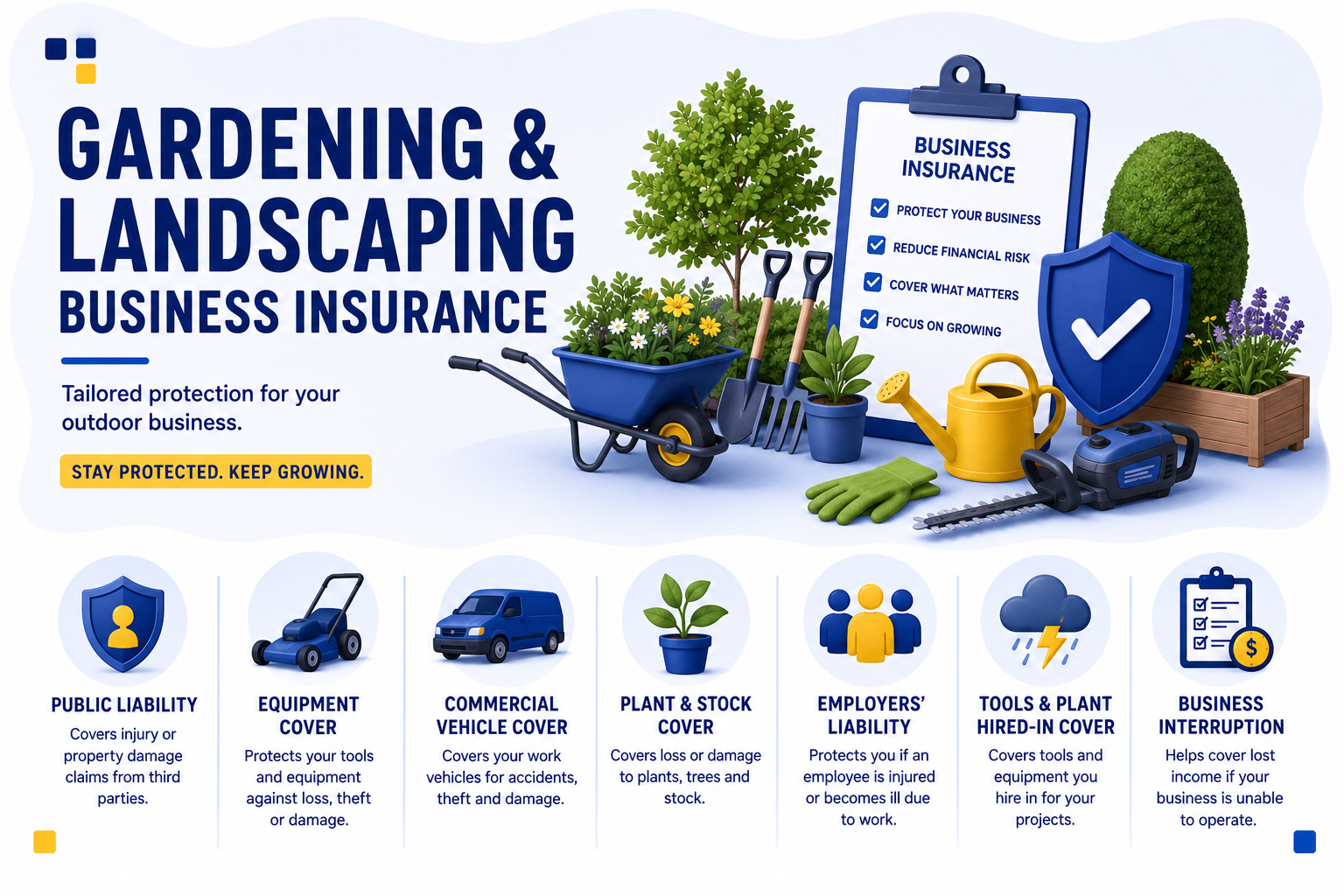
Gardening and landscaping business insurance is specialist commercial insurance for sole traders, partnerships, and limited companies operating in garden maintenance, landscape construction, grounds maintenance, tree surgery, and landscape design. The core 2026 covers are: Public Liability with chemical drift, stone-throw, and tree work scope; Employers' Liability where staff are engaged; Tools and Plant cover (with overnight in-vehicle extension); Commercial Vehicle / van; Personal Accident; Professional Indemnity where design or specification advice is given; Legal Expenses with regulatory and HSE investigation scope; Contract Works (CAR) for landscape construction. Cover differs from generic tradesman packages because gardening engages height, chemicals, wildlife regulation, and TPO criminal exposure that other trades typically don't.
Employers' Liability is legally required if you have staff under the Employers' Liability (Compulsory Insurance) Act 1969 — fines of £2,500 per day for non-compliance. Motor insurance is legally required for any company vehicle used on public roads. Public Liability is not legally required but is contractually required by virtually all commercial clients, councils, schools, and housing associations. PA1/PA6 pesticide certification is legally required for anyone applying professional plant protection products in the course of business. NPTC/Lantra chainsaw certification is required as a competence standard under PUWER 1998. Waste carrier registration with the Environment Agency / NRW / SEPA is required where green waste, soil, or arisings are transported off-site.
Indicative 2026 annual premiums: sole trader gardeners £350–£900; sole trader with pesticide application £550–£1,400; small gardening teams (2–5 staff) £1,400–£3,800; landscape construction contractors £3,000–£7,500; tree surgery / arborist firms £3,500–£12,000; commercial grounds maintenance £5,500–£14,000; mid-sized regional landscape operators £8,500–£18,000+. Pricing depends on work mix (especially tree work and chemical use), staff numbers, certifications held, working height, claims history, tool sum insured, security arrangements, and broker placement type. For broader context on premium dynamics see our cheap tradesman insurance and business insurance quote guides.
Only if specifically declared and only if you hold appropriate certification. Anyone applying professional plant protection products — including glyphosate-based herbicides used in landscape maintenance — in the course of business must hold PA1 plus an appropriate applicator certificate (typically PA6) under the Plant Protection Products (Sustainable Use) Regulations 2012. At insurance proposal, chemical use must be specifically declared and certification evidenced. Generic tradesman PL with default pollution and contamination exclusions does not respond to chemical drift claims. Specialist placement removes or narrows these exclusions and gives explicit treatment risk scope. Claim values for chemical drift damaging neighbour property typically range £2,000–£60,000.
Only if specifically declared, and only at the height and certification level disclosed. Many generic tradesman policies cap working height at 10m and chainsaw use to "ground level only" — and many gardening operators have policies with these restrictions without realising. If you undertake any climbing chainsaw work, MEWP-based pruning, or sectional dismantling, this must be specifically declared at proposal with relevant NPTC/Lantra unit certification (CS38 climb and rescue, CS39 use chainsaw from rope and harness). Tree work injury and falling-timber third-party property damage are the highest-severity claim categories in this trade — operative injury claims £80k–£500k+, fatality claims £1m+, third-party damage £20k–£250k. Specialist arborist placement is the standard for any meaningful tree work scope.
Potentially yes. Under the post-2018 Williams v Network Rail framework (refined by Davies v Bridgend in 2024), causing knotweed to spread is actionable in nuisance. For landscape contractors, the most common claim pattern is accidental spread through soil movement during clearance or excavation work, plus negligent advice claims where an operator misidentifies knotweed as bindweed, bamboo, or similar non-invasive species. The safest operational position is: never attempt to identify or treat suspected knotweed; refer all cases to a PCA-registered specialist; contract terms should explicitly exclude INNS identification and treatment from general landscape works scope. PI cover with INNS scope is essential for design-and-build operators. Knotweed-contaminated soil is controlled waste under EPA 1990 and must go to a permitted facility.
Yes — and contractors are prosecuted alongside or instead of property owners with increasing frequency. Felling, lopping, topping, uprooting, or wilfully damaging a TPO-protected tree without local planning authority consent is a criminal offence under sections 198–214 of the Town and Country Planning Act 1990. Fines on summary conviction are up to £20,000 per tree; unlimited on indictment. Conservation areas attract similar protection. Wildlife protection (active bird nests during Feb–Aug, bat roosts, badger setts) creates parallel criminal exposure. The contractor's defence depends on demonstrating they checked TPO/conservation area status before commencing and obtained written customer authority. Legal Expenses insurance with regulatory investigation scope covers defence costs (the fine itself is uninsurable).
If you provide any design, specification, planting advice, drainage recommendation, or structural advice — yes. PI was historically optional for many landscape contractors but the design-and-build evolution of the sector has made it functionally essential. Claim drivers: drainage specification leading to flooding; retaining wall design failure; planting specification leading to building damage (root systems, subsidence); paving and surface design leading to slip claims; water feature design failure. Limits typically £250k for occasional design; £500k–£1m for substantial design-and-build operators; £2m+ where commercial design contracts are undertaken. Run-off cover essential — landscape design claims can surface 2–5 years after completion. See our professional indemnity insurance guide for cover principles.
Insurance non-disclosure under the Insurance Act 2015 — usually around working height, chainsaw use category, or pesticide application. The pattern: operator buys a tradesman package declaring "garden maintenance", undertakes climbing tree work and professional herbicide application as substantial parts of the work, doesn't specifically declare either. At claim stage, the insurer points to the proposal showing the declared activity was generic garden maintenance, and any claim involving tree work injury, chainsaw incident, or chemical drift becomes uninsured or proportionately reduced. This isn't fraud; it's the normal operation of UK insurance law requiring fair presentation of the risk. The fix at proposal stage is small; the retrospective cost can be every uninsured claim across multiple policy years.
The biggest premium reduction levers are documented certifications (PA1/PA6 if chemicals used; NPTC/Lantra for chainsaw and brush cutter; CSCS where commercial); accurate work mix declaration (over-declaration increases premium, under-declaration creates non-disclosure); tool security (alarm, deadlocks, secure overnight parking can reduce tools premium 10–20%); pre-work property condition photo discipline (reduces small-claim defence costs); accurate tools sum insured at replacement value; specialist broker placement; 3+ years continuity with same insurer; annual payment vs monthly; sensible excess level (high excess saves premium only if you actually self-fund small claims). Stack the levers — don't choose between them. Avoid the trap of buying the cheapest tradesman package — the saving is dwarfed by uninsured exposure on a tree work or chemical drift claim.
Commercial clients (councils, schools, MOD, NHS, housing associations) typically specify minimum cover requirements. Typical specifications: Employers' Liability £10m comprehensive; Public Liability £5m–£10m with chemical drift and tree work scope; Professional Indemnity £500k–£1m for grounds maintenance recommendations; documented PA1/PA6 certification per operative; NPTC/Lantra chainsaw certification where any tree or hedge work in scope; DBS clearance for staff if school or care home grounds in scope; documented health and safety management system with RAMS per site; Environment Agency waste carrier registration. Beyond insurance specifically, contracts increasingly require: BALI or APL accreditation; ISO 9001 / 14001 / 45001; documented sustainability and pesticide reduction policy. Our contractors combined product page covers the broader cover architecture.
Look for brokers with specific experience in gardening, landscaping, tree surgery, and grounds maintenance evidenced by: specialist articles or guides on chainsaw, chemical drift, and tree work cover; willingness to discuss specific exposures (tree work, chemical drift, knotweed, TPO, plant theft) in detail; access to Lloyd's market and specialist arborist MGAs rather than just mainstream tradesman markets; FCA authorisation and documented track record; specific questions at proposal about working height, chainsaw use category, pesticide certification, and tool security. Avoid brokers offering generic "tradesman package" without discussing these specifics; brokers who can only quote one or two markets; brokers who don't ask about height and chemical use in detail. Miller & Partner specialise in this sector — see our tradesman insights hub and broader commercial insurance hub.







Instagram
LinkedIn