



Best Public Liability Insurance UK 2026: Compared by a Specialist Broker
Why does the choice of business liability insurance company matter so much in 2026?
UK SMEs spent the back half of 2025 and the opening months of 2026 living through the biggest renewed scrutiny of business insurance buying in over a decade. The Association of British Insurers' January 2026 Small Business, Big Risk: Tackling SME Underinsurance report — based on a survey of 1,002 SME decision-makers — found that 28% of sole traders held no insurance at all, 39% of firms employing one to nine people did not hold the legally compulsory employers' liability cover, and only 23% of SMEs with physical premises held business interruption cover. PwC's parallel research went further: 58% of UK SMEs are not insured against their top three risks. The conversation in the industry has shifted from "do SMEs have insurance" to "do SMEs have the right insurance with the right company on the right terms".
Against that backdrop, the question "which business liability insurance company should I use" stops being a price-comparison exercise. The UK has over 100 general liability business insurers and over 1,200 insurance products on the market. The names a small business owner most often encounters — Aviva, AXA, Zurich, Hiscox, Allianz, RSA, QBE, Chubb, Markel, Direct Line, Hiscox, Simply Business, Premierline, PolicyBee, Coalition — represent very different propositions, distribution models, appetite for risk, and claims experience. Buying from the wrong one isn't necessarily about paying too much. It's about discovering at claim stage that the policy doesn't respond, the limit is too low, or that an Insurance Act 2015 non-disclosure has rendered cover voidable.
This guide is the definitive 2026 buyer's framework for evaluating UK business liability insurance companies — built around how the major UK insurers actually differ on appetite, claims service, and policy wording; where specialist insurers and the Lloyd's market sit in the picture; how the broker, direct, and comparison-site distribution channels compare on real-world claims outcomes; and what the Insurance Act 2015 means for how you interact with whichever insurance company you pick. It complements our Commercial Insurance Hub and sits alongside the broader Miller & Partner liability-cover library including Business Liability Insurance UK, Business Liability Coverage, and Business General Liability Insurance.
Key facts at a glance
- 58% of UK SMEs are not insured against their top three risks according to PwC research published 2026 — meaning the majority of small businesses face a structural insurance gap that the insurance company you choose can either close or perpetuate.
- The UK general liability insurance market is fragmented across over 100 insurers ranging from FTSE-listed composites (Aviva, Direct Line) and global commercial specialists (AXA, Zurich, Allianz, Chubb, AIG), to monoline specialists (Hiscox, Markel, Beazley, Coalition), to Lloyd's-backed schemes and managing general agents (MGAs).
- Employers' Liability is legally required if you have staff under the Employers' Liability (Compulsory Insurance) Act 1969 — minimum £5m statutory cover, fines of £2,500 per day for non-compliance.
- Public Liability is not legally required but is contractually required by virtually all commercial clients — typical limits £1m, £2m, £5m, £10m. The right limit isn't what your insurance company quotes you cheapest; it's what your contracts and your worst-case exposure require.
- Only 50% of SMEs reviewed their insurance cover in the past year according to ABI 2026 data — meaning the policy bought from one liability insurance company at incorporation is often still in place years later, even where work mix, turnover, and risk profile have changed materially.
- SMEs buy through brokers, comparison sites, and direct in roughly equal numbers — but claims outcomes differ. Brokered policies typically settle faster and with stronger advocacy on disputed claims; direct policies are faster to buy but provide no advocacy at claim stage.
- The Insurance Act 2015 sits underneath every UK business liability policy — requiring "fair presentation of the risk" at proposal and renewal. The Berkshire Assets v AXA judgment confirmed that insurers can avoid policies entirely where non-disclosure is material, even where the undisclosed matter seems peripheral to the loss.
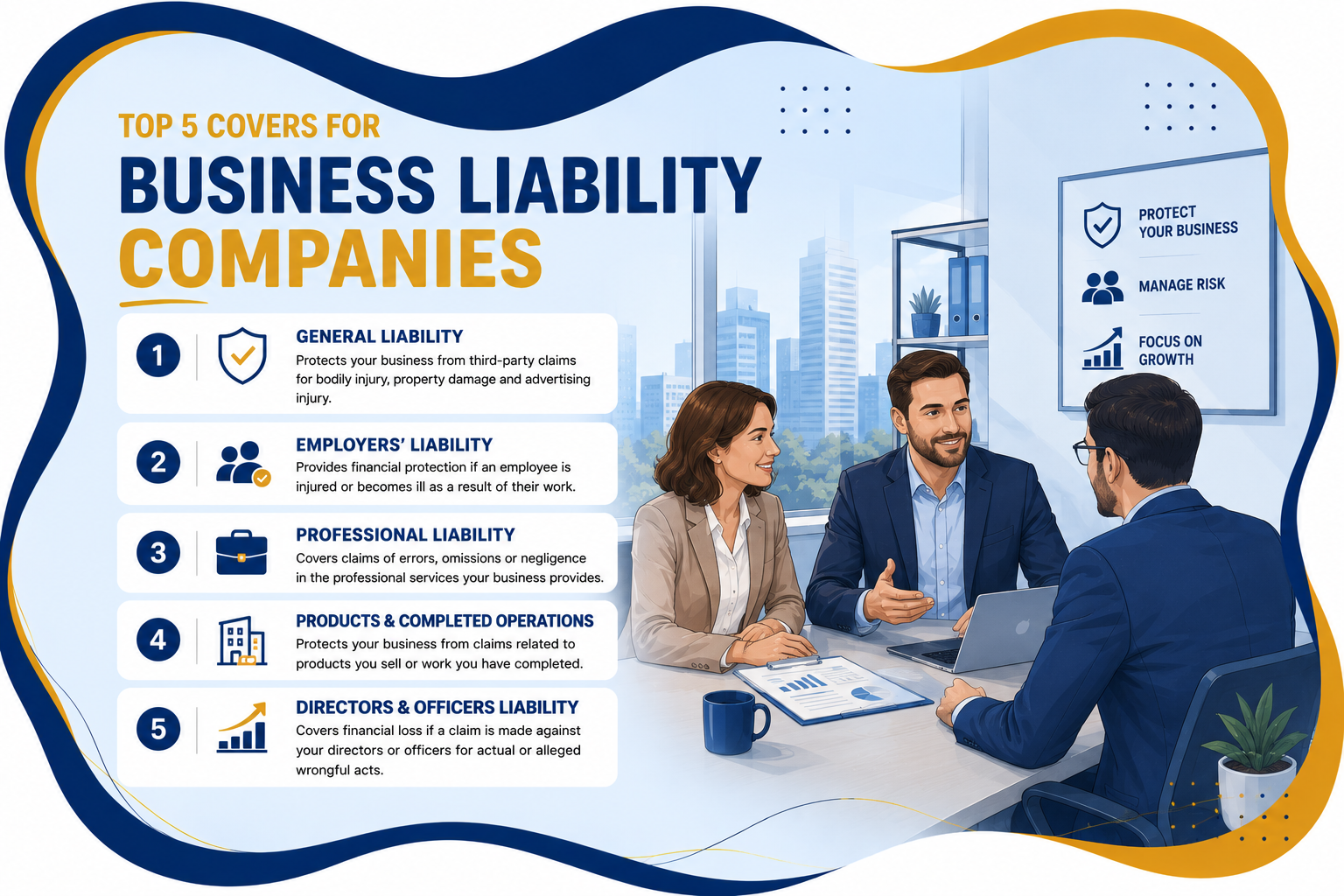
1. What are the main types of business liability insurance UK companies offer?
Before comparing insurance companies, it's worth being precise about what "business liability insurance" actually means in the UK market. The term is used loosely to describe a family of cover types, each addressing a different category of legal liability. The table below sets out what's in the family and which insurers typically lead each line.
| Liability Cover Type | What It Protects | Legal Status | Strong UK Insurers |
|---|---|---|---|
| Public Liability (PL) | Third-party injury / property damage caused by your business | Not compulsory; contractually essential | Aviva, AXA, Zurich, Allianz, Hiscox, RSA, QBE |
| Employers' Liability (EL) | Staff injury or occupational illness | Legally compulsory if you employ staff | Aviva, AXA, Chubb, AIG, Zurich, RSA, Allianz, QBE |
| Professional Indemnity (PI) | Financial loss to clients from your advice, design, or service | Compulsory for some regulated professions only | Hiscox, Markel, AIG, Beazley, Aviva, Travelers, QBE |
| Product Liability | Injury / damage caused by products you supply | Not compulsory; contractually essential for manufacturers | Allianz, Aviva, AXA, Chubb, QBE, RSA, Zurich |
| Management Liability / D&O | Director and officer personal liability | Not compulsory; essential for directors of limited companies | AIG, Chubb, Allianz, Travelers, Beazley, CFC |
| Cyber Liability | Data breach, ransomware, network business interruption | Not compulsory; increasingly required by clients and ICO | Coalition, Beazley, Hiscox, CFC, AIG, Travelers, Chubb |
| Environmental Impairment Liability (EIL) | Pollution and contamination liability | Not compulsory; required for waste, industrial, contractor sectors | AIG, Chubb, Allianz, Liberty, AXA XL, specialist MGAs |
| Employment Practices Liability (EPL) | Discrimination, harassment, unfair dismissal tribunal claims | Not compulsory; rising claim frequency | AIG, Chubb, Hiscox, Markel, Allianz, CFC |
A typical UK SME holds Public Liability and Employers' Liability as a minimum, often bundled into a "commercial combined" or "office combined" package. Beyond that, the cover stack depends on activity: professional services need PI; manufacturers need product liability; limited companies need D&O; anyone holding customer data needs cyber. The insurance company that's best for one of these covers is rarely best for all — which is why the "which liability insurance company is best" question has no single answer.
2. Who are the major UK business liability insurance companies in 2026?
The tier-1 composite insurers are the household names with the broadest commercial appetite, deepest balance sheets, and largest distribution networks. They write the bulk of UK SME public and employers' liability cover, often through a mix of broker-distributed commercial schemes and direct-to-consumer online platforms. For a broader entry-level overview of UK liability insurance see our Small Business Liability Insurance guide.
Aviva
The UK's largest general insurer by gross written premium, Aviva writes very large volumes of SME public and employers' liability across virtually every sector. Strong shop and retail offering with comprehensive policy features at competitive limits. Distributed through both direct channels (online quote) and the broker market. The direct platform has appetite limitations — accountants and surveyors seeking PI online may be declined where a broker placement would succeed.
High-street retail, office-based SMEs, hospitality, mainstream professional services. Builder and tradesman cover including working at heights up to 15m and depths to 3m. High Trustpilot ratings on customer satisfaction.
AXA
Global insurer with one of the broadest UK appetites — covering both professional indemnity for higher-risk professions like accountants and financial services, and public liability for builders and manual trades. Strong combined tradesman policies including tools and hired-in plant. The direct platform is among the most user-friendly, with quick customisation and customisation feedback on premium impact.
Trades and construction combined; professional services where bundled cover including PI is needed; SMEs that benefit from a fully-customisable online journey. AXA is also a leading employers' liability provider where staff numbers and turnover are growing.
Zurich
Predominantly broker-distributed in the UK SME market. Zurich's strength is flexibility — their commercial underwriters have authority to accommodate non-standard risks that online platforms reject. Commercial combined policies bundle premises, contents, business interruption, liability, and legal expenses into a single policy with high limits and broad cover. Typical fit for businesses outgrowing off-the-shelf policies.
SMEs with 10–250 employees; non-standard risks; high policy limit requirements; mixed property/liability/BI placements. Less appropriate for micro-businesses where the underwriting attention available exceeds the premium paid.
Allianz
Strong broker-distributed commercial insurer with particular appetite for manufacturing, product liability, and mid-market combined placements. Allianz's product liability wording is widely considered among the strongest in the UK market. Active in environmental impairment liability and management liability via specialty divisions.
Manufacturers; product liability heavy sectors; mid-market combined placements; management liability and D&O. The commercial combined wording is among the broadest in the market for SMEs of meaningful scale.
RSA (now part of Intact Financial)
Long-established UK commercial insurer, now part of Canadian Intact Financial. Strong tradesman, contractor, and property owner liability appetite. The contractors combined product (covering contract works, plant, liability) competes effectively with Aviva and AXA equivalents. Distribution is primarily broker-driven with selective direct schemes.
Contractors and trades combined placements; property owner liability; mid-market SME combined. Long history in UK trades insurance gives strong claims experience and stable wordings.
QBE
Australian-headquartered specialty commercial insurer with strong UK presence. QBE writes liability across a wide range of mid-market and specialty sectors, with particular strength in construction, manufacturing, and professional services. Distribution is essentially broker-only; no direct-to-SME online channel.
Construction; manufacturing; specialty professional services; mid-market combined liability. Particularly strong on engineering-related professional indemnity where Hiscox and Markel may decline.
Chubb & AIG
Both global specialty insurers with strong UK presence in the corporate and mid-market space. Chubb has historically led the UK employers' liability market by market share. Both are leaders in management liability (D&O), employment practices liability, environmental impairment liability, and specialty professional indemnity. Less active in the SME micro-segment; more active where corporate-grade liability programmes are needed.
Corporate-grade EL; D&O and management liability for limited companies; employment practices liability; environmental impairment liability; specialty professional indemnity (architects, engineers, IT, financial services). Pricing reflects the corporate-grade wording and claims service.
Direct Line for Business
Direct-to-SME online proposition with broad business type coverage and very competitive pricing on smaller PL/EL placements. Strong on admin/office-based professions; reasonable on manual trades including work-at-height and depth options. Notably price-competitive — some of the lowest published public liability premiums for admin professionals on the UK market.
Sole traders and micro-SMEs buying PL/EL only; admin and office-based professions; price-sensitive simple placements. Less appropriate where complexity, multi-line cover, or specialist appetite is required.
3. Which specialist liability insurance companies should SMEs know about?
Below the tier-1 composites sits a layer of specialist insurers and MGAs (managing general agents) that often write deeper, broader, or more flexible liability cover for specific sectors than the composites can offer. For SMEs in technical, professional services, or fast-evolving sectors, these specialist insurers are often the right primary placement choice. For more on how independent brokers access these markets see our Broker Commercial Insurance guide.
Hiscox
Hiscox is the UK's leading specialist insurer for professional indemnity and small business liability. The PI policy wording is widely considered the deepest in the SME market, with particularly strong appetite for consultants, IT professionals, marketing, design, media, and financial services. The PI claims handling is among the fastest and most policyholder-friendly in the UK market. Hiscox also writes substantial public liability volumes including for higher-value professional service businesses.
Professional services; consultants; IT and tech; media; marketing and design; financial advisers. PI claim service is materially better than mainstream alternatives. Less competitive on manual trades and high-risk physical liability.
Markel International
Markel writes specialist professional indemnity, employment practices liability, and management liability across UK SME and mid-market segments. Notable for willingness to underwrite non-standard PI risks that Hiscox declines (certain regulated activities, financial services, niche consultancies). Active in the UK ABI conversation on SME underinsurance — Markel UK managing director Lee Mooney spoke at the ABI 2026 conference on the SME advice gap.
Non-standard PI risks; employment practices liability; management liability for SMEs; niche professional sectors. Often the back-up market when Hiscox declines or quotes at high loading.
Beazley
Beazley is one of the leading specialist cyber and PI insurers globally. The cyber wording and breach response service is widely considered best-in-class for UK SME and mid-market cyber cover. Beazley also writes substantial professional indemnity, management liability, and specialty liability lines through both broker-distributed channels and direct schemes.
Cyber liability; PI for tech, financial services, and healthcare; specialty management liability. Breach response service typically responds within hours of notification.
Coalition
Cyber-only specialist with a distinctive proposition: active monitoring and vulnerability scanning included with the policy, warning policyholders of risks before incidents occur. Breach response includes 24/7 incident response, PR, legal counsel, and forensic investigation. Strong fit for any SME holding customer data, processing payments, or running cloud services. See our Cyber Insurance product page for cover principles.
SaaS, e-commerce, payment-processing, data-heavy businesses. The active monitoring component differentiates Coalition meaningfully from competitors and reduces incident frequency materially.
CFC Underwriting
UK-headquartered specialist MGA writing cyber, technology PI, intellectual property, and management liability via Lloyd's syndicates. Particularly active in technology, SaaS, and emerging digital sectors. Often the right placement choice for tech startups, AI businesses, and digital agencies where Aviva or Direct Line would decline.
Tech contractors, SaaS businesses, AI companies, digital agencies, IP-heavy businesses. The technology PI wording contemplates real tech risks (open-source liability, cloud failure, AI model errors) that mainstream wordings overlook.
Travelers
Strong UK presence in mid-market liability and specialty lines. Particularly active in professional indemnity for design and engineering professions, management liability, and bond/surety. Distribution is broker-led.
Architects, engineers, surveyors PI; management liability for mid-market SMEs; specialty placements requiring corporate-grade wording.
4. What role does the Lloyd's of London market play in UK liability cover?
For most UK SME liability placements, the policy is underwritten by a single composite or specialist insurance company. But where the risk is non-standard — emerging technology, hazardous activity, recent claims history, high-value bespoke commercial — placements often flow to the Lloyd's of London market, where over 50 syndicates compete with specialist appetite for risks that mainstream insurers decline.
Lloyd's matters to SME liability buyers in three specific scenarios:
- Non-standard or hazardous risks — adventure activities, specialist contractors, hazardous materials handling, unusual professional services. Lloyd's syndicates routinely write what mainstream insurers won't.
- Specialist niche sectors — emerging tech (AI, robotics, drones), niche healthcare, specialist hospitality, fine art, marine. Syndicate appetite is often the only viable placement.
- Higher limits and bespoke wording — where £10m+ liability limits are required, or where specific exclusions need carve-outs, Lloyd's wording flexibility exceeds mainstream commercial markets.
Critically, Lloyd's syndicates are not directly accessible to SMEs — placement requires a broker. The retail and wholesale broker model is how the Lloyd's market reaches UK SME buyers. Brokers like Miller & Partner with direct Lloyd's access can place non-standard or specialty risks that consumer-facing comparison sites cannot quote at all. See our Insurance Underwriter guide for more on how underwriting decisions work across mainstream and Lloyd's markets.
5. Should you buy business liability insurance direct, through a comparison site, or via a broker?
The ABI's 2026 research found UK SMEs buy business insurance through comparison sites, direct insurers, and brokers in roughly equal proportions. PwC's research found 46% prefer online channels but 27% still want phone-based engagement and 11% want face-to-face. The right channel depends on the complexity of what you're buying and how much advice you need. For a deeper look at the broker channel see our Commercial Insurance Agencies overview.
| Channel | Best For | Key Trade-offs |
|---|---|---|
| Direct (insurer's own site) | Sole traders, micro-SMEs buying simple PL/EL only; price-sensitive admin and office work; minimal complexity | Fastest to buy; cheapest on simple risks; no advocacy at claim stage; appetite limitations on non-standard work |
| Comparison sites (Simply Business, Compare the Market, Premierline) | Standard SME risks where price comparison is genuinely meaningful; trade categories with clear matching | Quick comparison across 20–40 insurers; limited cover detail comparison; no claims advocacy; can miss specialist insurers entirely |
| Broker (Miller & Partner-type) | Non-standard risks; complex multi-line placements; mid-market SMEs; specialty sectors; anyone holding inadequate cover historically | Access to specialist insurers and Lloyd's; claims advocacy; ongoing relationship and review; broker remuneration built into premium |
The data on outcomes is clear. The ABI's 2026 research found that between 3% and 10% of UK SME insurance claims are turned down at first decision — but between 25% and 32% of claims are only partially paid because costs exceeded policy limits, and up to 11% are partially paid due to policy exclusions. Brokered policies typically have higher limits chosen to match exposure, broader wording, and an advocate to negotiate disputed claims. Direct-sold policies often have whatever limit the buyer accepted at quote stage, sometimes with exclusions the buyer didn't fully understand.
6. Liability cover requirement checker
Select your business profile below to see the liability cover stack matched to your specific situation. For an entry-level introduction to UK business liability covers see Business Liability Insurance UK.
Liability Cover Requirement Checker
Select your business profile to see the liability insurance cover stack matched to your sector and operational profile
Sole Trader / Consultant
- ESSENTIAL Public Liability £1m–£2m — most contracts require minimum £1m, many now require £2m
- ESSENTIAL Professional Indemnity £250k–£1m if advice or service is part of what you sell
- RECOMMENDED Cyber liability if holding any client data, processing payments, or operating cloud-based
- RECOMMENDED Personal Accident — income protection given sole earner status
- RECOMMENDED Equipment / tools cover at replacement value
- CONSIDER Legal Expenses cover for contract disputes
- CONSIDER Employers' Liability immediately becomes legal requirement if any subcontract help engaged
- RECOMMENDED Direct or comparison site placement appropriate if simple PL/PI only — see Sole Proprietorship Insurance
Office-Based SME (2-10 Staff)
- LEGAL Employers' Liability £10m minimum (statutory minimum is £5m; £10m is market norm)
- ESSENTIAL Public Liability £2m–£5m
- ESSENTIAL Professional Indemnity £500k–£2m where advice or service-based
- ESSENTIAL Cyber liability with breach response service
- ESSENTIAL Office contents and business interruption
- RECOMMENDED Directors and Officers (D&O) for limited companies
- RECOMMENDED Employment Practices Liability — discrimination, harassment, unfair dismissal exposure
- RECOMMENDED Legal Expenses including HR and tax investigation scope
Trades / Contractor (2-10 Staff)
- LEGAL Employers' Liability £10m with manual trades scope
- ESSENTIAL Public Liability £2m–£5m (£5m increasingly required for main contractor work)
- ESSENTIAL Tools, plant, and equipment cover at replacement value including in-vehicle
- ESSENTIAL Commercial vehicle / fleet — see Commercial Vehicle Insurance Cost
- RECOMMENDED Contractors Combined where contract works in progress need cover — see Contractors Combined
- RECOMMENDED Professional Indemnity if any design or specification advice given
- RECOMMENDED Product Liability if installing components or supplied goods
- CRITICAL Heights and depth limits matter — declare accurately or cover fails at claim
Retail / Hospitality SME
- LEGAL Employers' Liability £10m
- ESSENTIAL Public Liability £2m–£5m — slip/trip and food safety exposure
- ESSENTIAL Product Liability for any goods sold including food and drink
- ESSENTIAL Shop / premises cover with contents, stock, and business interruption
- ESSENTIAL Cyber liability if processing card payments or holding customer data
- RECOMMENDED Money cover for cash handling
- RECOMMENDED Employment Practices Liability — high-volume turnover staff sector
- RECOMMENDED Legal Expenses
Manufacturer / Product Business
- LEGAL Employers' Liability £10m with manufacturing scope
- ESSENTIAL Public Liability £5m–£10m
- ESSENTIAL Product Liability — primary risk for manufacturers, often £5m–£10m
- ESSENTIAL Product Recall — distinct from product liability and often overlooked
- ESSENTIAL Premises and business interruption — see Commercial Property Insurance
- ESSENTIAL Cyber liability (manufacturing is now a major ransomware target)
- RECOMMENDED Environmental Impairment Liability for any chemical or industrial process
- RECOMMENDED Management Liability / D&O
- CRITICAL Specialist or broker placement strongly advised; mainstream direct routes often inadequate
Mid-Market SME (25+ Staff)
- LEGAL Employers' Liability £10m comprehensive — occupational disease scope
- ESSENTIAL Public Liability £5m–£10m
- ESSENTIAL Professional Indemnity £1m–£5m where service-based
- ESSENTIAL Directors and Officers (D&O) — material personal liability exposure
- ESSENTIAL Employment Practices Liability — tribunal claim frequency
- ESSENTIAL Cyber liability with breach response, business interruption, and ransomware scope
- ESSENTIAL Commercial combined or multi-line property/contents/BI placement
- ESSENTIAL Legal Expenses with regulatory, tax, and HR scope
- CRITICAL Broker placement essential at this scale — specialist insurer access and claims advocacy materially affect outcomes
7. Insurer and policy red flag checklist
The single biggest cause of unsatisfied UK business liability claims isn't bad luck or insurer bad faith — it's mismatch between what was bought and what was needed. The red flags below identify the most common patterns that turn a perfectly priced policy into an inadequate one. Click each red flag you recognise in your current cover.
Insurer and Policy Red Flag Self-Check
Click each red flag you recognise in your current business liability insurance. The more ticked, the more urgent a specialist broker review.
-
You can't name the insurer behind your policy — many SMEs know the broker, comparison site, or scheme name but cannot identify the actual underwriting insurer. The insurer matters more than the front-end brand.
-
Your declared activity doesn't match what you actually do — selected the closest dropdown match years ago, business has evolved since. Insurance Act 2015 non-disclosure risk.
-
Your turnover declared is significantly different from actual — typical underdeclaration of 30%+ creates proportional claim reduction under Insurance Act 2015. Update at every renewal.
-
Your PL limit hasn't been reviewed in 3+ years — contract requirements have risen across most sectors; £1m PL is increasingly inadequate where £2m or £5m is now standard.
-
You have no Professional Indemnity despite giving advice or specification — common in trades, designers, consultants, anyone whose recommendation could cause client loss.
-
You have no Cyber cover — only 29% of SMEs holding software/cloud services have cyber cover (ABI 2026). Material gap given current ransomware and breach claim frequency.
-
You couldn't identify exclusions in your policy if asked — between 25% and 32% of claims are only partially paid due to limits or exclusions. Read the schedule of conditions at every renewal.
-
Your policy was the cheapest quote you found — cheap pricing typically means lower limits, narrower wording, more exclusions, or appetite mismatch. Match cover to exposure, not to price.
-
You bought cover without speaking to a human — fine for sole-trader PL/EL only; risky where multiple cover types interact or sector-specific exclusions matter.
-
You auto-renewed without reviewing — only 50% of UK SMEs review insurance annually. Auto-renewal locks in yesterday's risk profile against today's business.
-
You have a claim outstanding and no claims advocate — direct or comparison-site policies provide no advocacy. Disputed claims settle materially better with broker representation.
-
You have employees but no employers' liability — 39% of micro-employers do not hold the legally compulsory cover (ABI 2026). £2,500 daily fine plus uninsured staff injury exposure.
If you ticked 3–5: Material gaps exist that should be addressed at the next renewal. Specialist broker review will identify which gaps matter most for your sector and exposure.
If you ticked 6 or more: Significant exposure. The probability that a serious claim would respond fully under your current cover is materially lower than it should be. Broker review should be a near-term priority, not a renewal-date one.
8. Business liability complexity assessor
Two factors drive business liability complexity above all others: the type of business you run, and the size and structure of your operations. Use the tool below to see your specific complexity profile and the right placement channel.
Business Liability Complexity Assessor
Select your business type and scale to see your complexity profile and the right insurance company / channel match
9. How should you evaluate a business liability insurance company before buying?
The instinct of most SME buyers is to start with price. The empirical evidence on UK claims outcomes suggests that's exactly the wrong starting point. The ABI's 2026 research found that while only 3–10% of UK SME insurance claims are turned down outright, between 25% and 32% of claims are only partially paid because costs exceeded policy limits, and up to 11% are partially paid because of policy exclusions. The pattern is unmistakable: the policy responds, but at less than the actual loss. The cheapest quote bought at incorporation becomes the partially-paid claim three years later. The right evaluation framework is structured around six factors, in this order.
| Evaluation Factor | Why It Matters | How To Assess |
|---|---|---|
| 1. Appetite match | The insurer's stated appetite for your specific activity drives both pricing and claim certainty | Ask: does this insurer routinely write this specific activity? Aviva, AXA, Hiscox publish appetite guides. Brokers know it from placement experience. |
| 2. Policy wording breadth | Standard wordings differ materially between insurers — exclusions, definitions, sub-limits | Read the policy summary AND the wording. If buying direct, the wording is on the insurer's website. Specialist wording (Hiscox PI, Allianz product) is typically broader than mainstream. |
| 3. Limit adequacy | Limit gaps drive the partial-payment problem; the limit must match worst-case exposure, not contract minimums | For PL: what's the worst-case third-party injury exposure? For PI: what's the largest contract value × multiplier? For EL: industry benchmark £10m minimum. |
| 4. Claims service | Claims handling speed, advocacy approach, and policyholder support varies materially | Hiscox, Markel, Beazley, Coalition have strong claims service reputations in their specialties. Mainstream composites are more variable; broker advocacy matters more. |
| 5. Financial strength rating | The insurer must still be paying claims in 10 years' time for occurrence-based covers, or in 30+ years for occupational disease EL claims | A.M. Best, Standard & Poor's, Moody's ratings. UK FCA-authorised insurers are all solvent today; ratings indicate financial strength for the long tail. |
| 6. Premium | The final filter, not the first. Premium should be evaluated against the cover purchased, not in isolation | Compare premium per £1m of cover, not absolute premium. Compare across like-for-like wordings, not "cheapest quote". |
The framework matters because the UK liability insurance market is structurally not a price-comparison market for non-trivial risks. The premium variance between Aviva, AXA, Zurich, and Allianz for a mid-market commercial combined placement may be modest; the wording and claims service variance is significant. The premium variance between Hiscox PI and a generic PI from a comparison site may also be modest; the wording, appetite, and claims service variance is significant. For the simplest sole-trader PL placements, price comparison is reasonable. For everything else, the framework above is the right starting point.
10. How does the Insurance Act 2015 reshape your relationship with liability insurance companies?
The Insurance Act 2015, in force since 12 August 2016, fundamentally changed how UK business insurance proposals work. It replaced the historic duty of "utmost good faith" and disclosure under the Marine Insurance Act 1906 with a new duty of "fair presentation of the risk". Every business buying liability insurance from any UK insurance company sits underneath this duty whether they realise it or not.
Section 3 of the Act requires the insured to make a "fair presentation of the risk" before the contract is entered into. The presentation must:
- Disclose every material circumstance the insured knows or ought to know;
- OR give the insurer sufficient information to put a prudent insurer on notice that further enquiries are needed;
- Be made in a manner reasonably clear and accessible to a prudent insurer;
- Contain material representations of fact that are substantially correct, and representations of expectation or belief made in good faith.
A "material circumstance" is anything that would influence the judgment of a prudent insurer in deciding whether to take the risk and on what terms. The insured must conduct a "reasonable search" of information available to them — including information held by directors, senior management, and anyone responsible for arranging the insurance. The duty applies at both initial proposal AND every renewal.
Remedies for breach — what the insurer can do
Where the insured fails to make a fair presentation and that failure is a "qualifying breach" (meaning the insurer would have acted differently with full disclosure), the Act provides proportional remedies depending on whether the breach was deliberate/reckless or merely inadvertent:
- Deliberate or reckless breach — the insurer can avoid the contract entirely, refuse all claims, and keep the premium paid. This is the worst case.
- Inadvertent breach where the insurer would not have written the risk — the insurer can avoid the contract and refund the premium.
- Inadvertent breach where the insurer would have written on different terms — the contract is treated as having been written on those terms (different premium, different exclusions, different limit).
- Inadvertent breach where the insurer would have charged more premium — claims are reduced proportionately by the ratio of premium actually charged to premium that would have been charged.
The Berkshire Assets case — what it means in practice
In Berkshire Assets (West London) Limited v AXA Insurance UK Plc [2021] EWHC 2689 (Comm), the High Court applied the Insurance Act 2015 to a Construction All Risks and Business Interruption claim. The insured had failed to disclose at policy renewal that one of its directors was the subject of criminal charges in Malaysia (charges later dropped). When the property subsequently flooded, AXA declined the claim on the basis of non-disclosure. The Court held that the charges were a material circumstance that should have been disclosed, that AXA would not have written the renewal had the disclosure been made, and that AXA was entitled to avoid the policy in full.
The Berkshire Assets case is the single most important reference point for any UK business buying liability insurance in 2026 — because it establishes definitively that non-disclosure remedies remain available to insurers under the 2015 Act, and that the materiality of the undisclosed circumstance is judged by the prudent underwriter standard, not the policyholder's view of relevance. The director's criminal charges had nothing to do with the eventual flood; they were still material at proposal.
This is one of the structural reasons broker placement materially improves claim certainty. The duty of fair presentation is a discipline most SMEs cannot easily perform alone — they don't know what's material, don't know what to disclose, don't track changes over time. A specialist broker performing the proposal and renewal disciplines materially reduces the probability of an Insurance Act 2015 dispute at claim stage. For more on related cover principles see our Insurance Underwriter overview.
11. What drives the cost of business liability insurance from different companies in 2026?
Premium pricing across UK business liability insurance companies in 2026 reflects a complex mix of underwriting factors. Direct-to-SME insurers tend to use algorithmic pricing based on declared business type, turnover, and limited risk factors; broker-distributed insurers use richer underwriting data; specialist insurers underwrite individual risks with more attention to specific exposures. For pricing principles on comparable specialist products see our Affordable Business Insurance guide.
Indicative 2026 annual premium ranges for typical UK business liability placements:
| Business Profile / Cover Type | Indicative Annual Premium 2026 |
|---|---|
| Sole trader admin / consultant PL £1m only | £75–£250 |
| Sole trader PL + PI £250k bundled | £200–£600 |
| Small office SME (4-staff) PL £2m + EL £10m | £450–£1,400 |
| Small office SME full liability stack (PL/EL/PI/cyber) | £1,200–£3,800 |
| Tradesman / contractor (3-staff) combined liability + tools | £950–£2,800 |
| Retail SME (5-staff) combined policy | £900–£2,600 |
| Manufacturer (10-staff) PL £5m / EL £10m / product £5m | £2,500–£8,500 |
| Mid-market SME (50-staff) commercial combined programme | £8,000–£25,000+ |
| SaaS / tech business cyber + tech PI | £1,800–£12,000+ |
The factors below drive premium variation within each profile band — and the rating impact within each profile band is often larger than the differential between bands. A well-managed micro-SME with mature documentation can pay materially less than a poorly managed small SME.
| Rating Factor | Impact on Premium | What You Can Do |
|---|---|---|
| Declared activity specificity | Generic declarations attract higher premium; accurate specific declarations get better rates | Declare exactly what you do; don't pick the closest dropdown match if it's not accurate |
| Annual turnover | Primary scaling factor for PL, EL, PI premium | Declare accurately including projected growth |
| Staff numbers (for EL) | Direct multiplier on EL premium | Declare accurately; include contractors and casual workers |
| Claims history (5+ years) | Significant impact on PI, PL, EL; some claim types matter more than others | Disclose all claims including those settled without payment; provide context |
| Health and safety documentation | Documented H&S management system can reduce EL premium 10–20% | Risk assessments, training records, accident book, near-miss reporting |
| Professional qualifications | Recognised certification can reduce PI premium 5–15% | RICS, ACCA, RIBA, IET, CMI etc. — evidence at every renewal |
| Limits selected | £1m vs £2m vs £5m PL rate differently but not linearly | Match to actual contract requirements and exposure |
| Excess / deductible chosen | Higher excess reduces premium materially | Match excess to ability to absorb; £500–£1,000 typical for SMEs |
| Cover scope and endorsements | Wider scope (treatment risk, contamination, additional insured) increases premium | Don't strip scope to save premium; the strip you save creates the claim you don't recover |
| Continuity with insurer | 3+ years continuity typically reduces renewal premium 5–10% | Strategic continuity choice; don't switch insurers for marginal savings |
| Distribution channel | Direct typically cheapest at proposal; broker may save at claim stage | Match channel to complexity; direct fine for simple PL/EL, broker for multi-line |
| Payment frequency | Monthly payments typically include 8–15% finance charge vs annual | Pay annually if cash flow allows; significant saving over 5 years |
12. Real claims and how to manage them
Claim — Insurance Act 2015 Non-Disclosure, £180,000 Avoided Cover
A consultancy SME with 8 staff held a Professional Indemnity policy with a mainstream specialist insurer at £1m limit. The policy had been in place for 4 years, renewed annually online without broker intervention. The original declared activity was "management consultancy" generating £450k turnover. Over 4 years the business had grown to £950k turnover (declared) but had also taken on substantial implementation work delivering technology systems to clients. At renewal each year the activity declaration remained "management consultancy". The implementation work was not specifically declared.
A client brought a £180,000 PI claim alleging negligent implementation of a CRM system caused 6 months of operational disruption. The insurer investigated the claim and identified that the activity giving rise to the claim — technology implementation work — was not within the declared activity scope. The insurer relied on the Insurance Act 2015 duty of fair presentation and avoided the policy on grounds of material non-disclosure. The £180,000 claim was uninsured; the £24,000 in defence costs were uninsured.
Post-claim consequence: the consultancy paid the settlement personally over 18 months, with material cash flow impact. The subsequent placement (with broker intervention) declared the actual activity profile correctly and was placed with a specialist tech PI insurer at higher premium but matched cover scope. Total avoidable cost of the original non-disclosure: £204,000 plus legal fees.
The lesson: Insurance Act 2015 non-disclosure is the single most preventable category of uninsured loss in UK business liability insurance. Annual review of declared activities against actual operations is the fix. The conversation costs nothing; the avoidance costs everything.
Claim — Sub-Limit Cover Gap, £85,000 Recovery on £140,000 Loss
A small manufacturing SME held a commercial combined policy with a tier-1 composite insurer including PL £5m, EL £10m, and product liability £1m. The policy had been renewed annually via comparison site for 3 years on lowest-price basis. A product liability claim was brought when a manufactured component failed in a customer's industrial system, causing consequential damage estimated at £140,000.
The insurer accepted liability and engaged. Settlement was £140,000 inclusive of consequential losses and defence costs. The product liability limit of £1m was adequate to settle in full — but the policy contained a £85,000 sub-limit for "consequential loss arising from product failure" within the product liability section. The insurer paid the £85,000 sub-limit. The balance of £55,000 was the policyholder's exposure.
Post-claim review: the sub-limit had been in the policy from year 1 but was never explicitly drawn to the policyholder's attention at any renewal. The comparison-site purchase journey had displayed only headline limits, not sub-limits. A broker review at any point during the 3-year period would have identified the sub-limit as inadequate for typical claim quanta in the manufacturer's sector and recommended an extension to full limit (modest premium uplift, dramatic claim impact).
The lesson: sub-limits and exclusions matter as much as headline limits. Between 25% and 32% of UK SME insurance claims are only partially paid because of policy limits or exclusions (ABI 2026 data). The fix is reading the wording, asking the question "what's sub-limited?", and adjusting at proposal — not at claim. For more on commercial property and combined cover see our Commercial Property Insurance UK guide.
Claim — Direct vs Broker Claims Advocacy, £45,000 Recovery Differential
Two near-identical SMEs (small trade contractors, 6 staff each, similar turnover, both with PL £2m and EL £10m) faced similar Employers' Liability claims when an operative suffered a back injury during heavy lifting. Both insurers (different mainstream composites) initially valued the claims at £35,000–£45,000 range based on injury severity and recovery timeline.
Business A held cover direct via the insurer's online platform and had no broker advocacy. The claim was managed by the insurer's in-house team. The settlement reached £42,000 over 14 months. The policyholder had no representation during settlement negotiations; the in-house team's settlement was accepted on the timeline offered.
Business B held cover via a specialist commercial broker. The broker engaged with the insurer's claims team throughout the process, challenged the initial liability assessment, secured independent medical evidence to dispute the injury attribution to a single incident vs cumulative manual handling exposure, and identified a potential third-party recovery against a sub-contractor whose negligent practice contributed to the lifting circumstances. The combined settlement and third-party recovery position came in at £87,000 total — a £45,000 differential vs Business A.
Both businesses had identical policies on paper; the outcomes differed materially because of claims advocacy. Direct policies provide no claim advocacy; broker policies provide active representation throughout the claim lifecycle. Across a typical SME's 10-year insurance lifetime the cumulative claims advocacy benefit is typically 1–3 claims worth £20k–£100k each.
The lesson: the value of broker placement is concentrated at claim stage, not at proposal stage. Premium price differences direct vs broker are typically small; outcome differences at claim stage are typically large.
Claims Management Steps
How to respond to a UK business liability claim or incident — the steps below apply across the full liability cover stack (PL, EL, PI, product, cyber, D&O). Acting correctly in the first 48 hours materially affects the claim outcome regardless of which insurance company holds the policy:
- Secure people first. Whatever the cover type, any injury, exposure, or imminent harm response takes priority. Medical attention for any person injured; secure the site to prevent further harm.
- Notify your insurer immediately for any potential claim. Most UK business liability policies require notification "as soon as reasonably possible" or "within X days of awareness". The threshold is "may give rise to a claim" — much lower than "formal claim received". Late notification can prejudice cover.
- Preserve documentation rigorously. Photographs, witness statements, contemporaneous notes, contract documents, correspondence with the claimant. The documentation pack is the foundation of claim defence across every cover type. Do not destroy any communication or document.
- Do not admit liability or fault. Provide factual information about what happened. Do not accept fault, apologise in writing, or commit to remedial work that could be interpreted as admission of liability. Policy conditions typically prohibit admissions without insurer consent.
- Engage your broker if you have one. The broker is your representative against the insurer's settlement position. Direct policies provide no broker advocacy; if you bought direct, the insurer's claims team is acting on the insurer's behalf, not yours.
- Provide full and accurate information to the insurer. Under the Insurance Act 2015, the duty of good faith continues throughout the claim. Selective disclosure or misleading information can prejudice cover even on a properly disclosed risk.
- Manage regulatory engagement carefully. Where HSE, ICO, FCA, or other regulators engage, notify your Legal Expenses insurer immediately. Cooperate factually with inspectors but do not provide written statements without legal representation. Regulatory investigation can escalate to criminal prosecution.
- Conduct root cause analysis and document remedial action. Identify why the incident occurred and implement remedial action. Insurers reviewing renewal will require evidence; regulators may require evidence; future claim defence depends on documented improvement. Update your operational documentation to address the gap identified.

Glossary of business liability insurance terms
- Public Liability (PL)
- Insurance protecting against legal liability for injury to third parties or damage to their property arising from your business activities. Not legally required but contractually essential for most UK businesses.
- Employers' Liability (EL)
- Insurance protecting against legal liability to your employees for injury or occupational illness arising from their work. Legally compulsory under the Employers' Liability (Compulsory Insurance) Act 1969 if you have staff; minimum £5m statutory cover.
- Professional Indemnity (PI)
- Insurance protecting against client claims for financial loss arising from your professional advice, design, or service. Compulsory for some regulated professions (solicitors, accountants, financial advisers); commercially essential for many others.
- Product Liability
- Insurance protecting against legal liability for injury or damage caused by products you have manufactured, supplied, or sold. Often bundled with PL but covers a distinct legal exposure.
- Management Liability / Directors and Officers (D&O)
- Insurance protecting directors and officers personally against claims arising from decisions or omissions in their corporate role. Includes shareholder actions, regulatory actions, employment-related claims against directors personally.
- Employment Practices Liability (EPL)
- Insurance protecting against employee tribunal claims including discrimination, harassment, unfair dismissal, and wrongful termination. Rising claim frequency in UK SME market.
- Cyber Liability
- Insurance covering first-party costs (breach response, business interruption, ransomware) and third-party liability arising from data breaches, network failures, and cyber incidents. Increasingly essential for any business holding customer data or operating cloud services.
- Environmental Impairment Liability (EIL)
- Insurance covering legal liability for pollution and contamination, including remediation costs and third-party claims. Essential for waste, chemical, industrial, and contractor sectors.
- Commercial Combined Policy
- A single policy bundling property, liability, contents, business interruption, and other covers for a single business. Typically broker-distributed for mid-market SMEs; offers wording consistency and limit alignment across covers.
- Limit of Indemnity
- The maximum amount the insurer will pay under a policy section. Can be "any one claim" or "aggregate" (annual total). PL limits typically £1m, £2m, £5m, £10m; EL minimum £5m, market norm £10m.
- Sub-Limit
- A limit within a policy section that is lower than the headline policy limit. Common sub-limits apply to specific perils (contamination, consequential loss, certain types of damage). Sub-limits are a major cause of partially-paid claims.
- Excess / Deductible
- The amount the policyholder pays on each claim before the insurer's cover applies. Higher excess reduces premium; should be matched to ability to absorb.
- Insurance Act 2015
- The principal UK statute governing non-consumer insurance contracts. Requires "fair presentation of the risk" at proposal and renewal; provides insurers with proportional remedies for breach of the duty.
- Fair Presentation of the Risk
- The Insurance Act 2015 duty on the insured to disclose every material circumstance known or that ought to be known, in a manner reasonably clear and accessible to a prudent insurer. The duty applies at every renewal and material mid-term change.
- Material Circumstance
- Anything that would influence the judgment of a prudent insurer in determining whether to take the risk and on what terms. Includes activity, turnover, staff numbers, claims history, ownership, regulatory matters, and director matters.
- Qualifying Breach
- A failure to make a fair presentation that induced the insurer to enter the contract or write it on the terms it did. Required for the insurer to have a remedy under the Insurance Act 2015.
- Avoidance
- The insurer's remedy of treating a policy as if it had never been entered into, with no claims payable. Available only where breach was deliberate/reckless or where the insurer would not have written the risk at all.
- Composite Insurer
- An insurer writing multiple lines of business (motor, property, liability, life). Includes Aviva, AXA, Zurich, Allianz, RSA. Distinct from monoline or specialty insurers.
- Specialty Insurer
- An insurer focused on specific lines or sectors. Includes Hiscox (PI/professional), Markel (specialty/PI), Beazley (cyber/PI), Coalition (cyber), CFC (tech/cyber).
- Managing General Agent (MGA)
- An underwriting agency authorised to write business on behalf of one or more insurers under delegated authority. Often the route to Lloyd's syndicate capacity for specialist risks.
- Lloyd's of London
- The insurance and reinsurance market in London where syndicates underwrite risks through brokers. Source of specialty appetite for non-standard UK SME liability risks; not directly accessible to SMEs without a broker.
Frequently asked questions
There is no single "best" — the right insurer depends on the business type and cover required. For mainstream SME PL/EL, Aviva, AXA, Zurich, RSA, and Allianz are the leading composite insurers. For Professional Indemnity, Hiscox and Markel lead the specialist market. For Cyber, Coalition, Beazley, and CFC are the leading specialists. For corporate-grade D&O and specialty lines, AIG, Chubb, and Travelers lead. The right evaluation framework matches insurer to specific cover need and business profile, not to general reputation. See our Business General Liability Insurance guide for more on the cover types.
Employers' Liability is legally required under the Employers' Liability (Compulsory Insurance) Act 1969 if you have staff — minimum £5m statutory cover, fines of £2,500 per day for non-compliance. Public Liability is not legally required but is contractually required by virtually all commercial clients, landlords, and panels. Professional Indemnity is compulsory for certain regulated professions only (solicitors, accountants, financial advisers under FCA rules, architects under RIBA rules). All other liability covers are commercially essential but not legally required.
Indicative 2026 ranges: sole trader admin PL £1m only £75–£250; sole trader bundled PL/PI £200–£600; small office SME (4-staff) PL+EL £450–£1,400; small office full liability stack £1,200–£3,800; tradesman combined liability £950–£2,800; retail combined £900–£2,600; manufacturer combined £2,500–£8,500; mid-market commercial combined £8,000–£25,000+. Pricing depends on declared activity, turnover, staff numbers, claims history, limits, excess, cover scope, and distribution channel. For pricing principles see our Affordable Business Insurance guide.
Direct (insurer's own platform) is fastest and cheapest for simple sole-trader and micro-SME PL/EL placements with no complexity. Comparison sites (Simply Business, Compare the Market, Premierline) work well for standard SME risks where price comparison across 20–40 insurers matters. Broker placement (Miller & Partner-type) is materially better for non-standard risks, multi-line placements, mid-market SMEs, and anyone whose current cover has gaps. The empirical claims outcome data favours broker placement for non-trivial risks: between 25% and 32% of UK SME claims are only partially paid because of limits or exclusions (ABI 2026), and brokered policies typically have better limit selection and claims advocacy.
Aviva is the UK's largest composite insurer with very broad SME appetite via both direct platform and broker channel — particularly strong on retail, hospitality, and office-based SMEs. AXA has one of the widest direct platforms with strong appetite for both manual trades and higher-risk professional services. Zurich is predominantly broker-distributed, with underwriter authority to accommodate non-standard risks and high limits — best fit for SMEs with 10–250 staff and non-standard requirements. Practically: Aviva and AXA are first-choice for typical SME direct or broker placements; Zurich is first-choice for mid-market broker placements requiring flexibility.
The Insurance Act 2015 is the principal UK statute governing business insurance contracts. It requires the insured to make a "fair presentation of the risk" at proposal and renewal — disclosing every material circumstance that would influence a prudent insurer's decision. Breach of this duty gives the insurer proportional remedies including avoiding the policy entirely (deliberate breach) or reducing claims proportionately (inadvertent breach). The Berkshire Assets v AXA judgment established that non-disclosure remedies remain robustly available to insurers. The duty applies whether you buy direct, via comparison site, or through a broker — but specialist broker placement materially improves compliance discipline at proposal stage.
Three tests: (1) Does declared activity match actual operations? Most common gap. (2) Does the limit match worst-case exposure, not contract minimum? £1m PL is often inadequate against modern injury claim quanta; £5m or £10m is increasingly standard. (3) Have you read the wording, including sub-limits and exclusions? Between 25% and 32% of UK SME claims are only partially paid because of limits or exclusions (ABI 2026). The red flag checklist earlier in this guide identifies the most common adequacy gaps. For sole-trader-specific cover principles see our Sole Proprietorship Insurance guide.
"Lloyd's-backed" typically means the policy is underwritten by one or more syndicates at Lloyd's of London — the specialty insurance and reinsurance market in London. Lloyd's syndicates underwrite over 50 distinct specialist appetites, often including risks that mainstream UK composite insurers decline. Lloyd's-backed cover reaches UK SMEs through broker placement or via specialist MGAs (managing general agents) with delegated authority. For non-standard, hazardous, or specialty risks, Lloyd's-backed placement is often the only viable cover. SMEs cannot access Lloyd's directly; broker placement is required.
Yes — and for many SMEs this is the optimal structure. A mid-market business might hold PL/EL with a composite insurer (Aviva/AXA/Zurich), PI with a specialist (Hiscox/Markel), Cyber with a cyber specialist (Coalition/Beazley), and D&O with a corporate specialty insurer (AIG/Chubb). The "multi-insurer programme" is broker-coordinated to ensure consistent wording, no gaps between policies, and aligned renewal dates. Single-policy commercial combined placements have simplicity advantages; multi-insurer programmes have specialist-quality advantages. The right structure depends on business complexity. See our Commercial General Liability Policies guide for more on combined vs separate placement.
Insurance Act 2015 non-disclosure. The pattern: business buys cover with declared activity matching the business 3 years ago, business evolves over time, declared activity is not updated at renewal, claim arises from the evolved activity, insurer relies on Section 3 fair presentation duty and applies proportional remedies (potentially full avoidance). The fix at proposal stage is structured disclosure discipline — annual review of declared activities, accurate turnover and staff, full claims history. The fix is virtually free; the cost of non-disclosure is potentially every uninsured claim across the policy period. This is why broker placement materially reduces claim dispute frequency — the broker is professionally obliged to ensure fair presentation.
The principal levers in priority order: (1) accurate declared activity — generic declarations attract higher premium than specific accurate ones; (2) documented health and safety management — 10–20% EL premium reduction available; (3) professional qualifications evidenced (RICS, ACCA, etc.) — 5–15% PI reduction; (4) annual payment vs monthly — saves 8–15% finance charge; (5) higher excess matched to ability to absorb; (6) 3+ years continuity with same insurer — 5–10% loyalty discount typically; (7) accurate turnover declaration — over-declaration costs unnecessary premium; (8) specialist broker placement — often saves premium net of broker remuneration vs comparison-site placement. Don't strip cover scope to save premium; that's where claim recovery gaps appear.
Look for brokers with: FCA authorisation (check the FCA register); demonstrable specialist sector experience evidenced through guides, articles, and published placement examples; access to Lloyd's market and specialist MGAs as well as mainstream composite insurers; willingness to discuss your specific exposures (Insurance Act 2015 fair presentation, sub-limits, claim advocacy) in detail at proposal; independent (not tied to a single insurer). Avoid brokers offering only one or two insurer quotes; brokers who push generic combined policies without sector-specific discussion; brokers without FCA authorisation. Miller & Partner specialise in commercial broking across sole trader, SME, mid-market, and specialist niche sectors — see our Commercial Insurance Hub.







Instagram
LinkedIn