



How Much Is Business Car Insurance? UK Costs 2026
What Commercial Car Insurance Actually Costs in 2026
If you use your car for any work purpose beyond commuting to a single fixed workplace, a standard private car insurance policy will not cover you. From the moment you drive to a second site, visit a client, attend a business meeting, or travel between offices, you need business use cover — and using your car for work without it can invalidate your policy entirely. That is a financial risk most business owners and self-employed professionals don't fully appreciate until they need to make a claim.
The good news is that adding business use to a car insurance policy is one of the least expensive insurance upgrades a UK business can make. For a typical Class 1 business use addition, the premium increase over standard private cover is often £20 to £50 per year. The bad news is that the boundary between social/commuting use and business use is narrower than most people think, and getting it wrong renders the entire policy void at claim stage — not just the business journey.
This guide stays on the money — what business car insurance actually costs in 2026, the rating factors that move your premium, IPT and the true annual total, fleet versus individual cost, and how to bring it down. If you're not sure which class of use you need, or whether you need business cover at all, that's covered on our business use car insurance guide. For the full product picture, including company vehicles, fleets and grey fleet, see car insurance for a business vehicle.
1. What Class 1, Class 2 and Class 3 Business Use Cost
UK motor insurers categorise business use into three classes that sit above the standard Social, Domestic and Pleasure (SDP) or Social, Domestic, Pleasure and Commuting (SDPC) levels of cover. The class you need depends on how you use your vehicle for work — not what your job title is. This section focuses on where each class sits on cost. For a fuller walkthrough of which class actually fits how you drive, see our business use car insurance guide.
| Class | What's Included | Typical Use Case | Cost Position |
|---|---|---|---|
| Class 1 | Business use by the policyholder (and usually spouse) — travel to multiple workplaces, client visits, meetings | Office workers visiting clients, teachers travelling between schools, healthcare staff visiting patients | Lowest business class; £20–£50 above SDPC |
| Class 2 | Everything in Class 1, plus a named driver who is not your spouse (typically a colleague or business partner) | Small business owners whose employee occasionally uses their car for work errands; partners sharing a vehicle | Slightly more than Class 1; £30–£80 above SDPC |
| Class 3 | Also known as "commercial travelling" — unlimited business mileage, multiple destinations, light samples carriage | Sales representatives, regional account managers, building inspectors driving site-to-site daily | Most expensive business class; £100–£400+ above SDPC depending on mileage |
| Commercial | Hire and reward — carrying paying passengers or goods commercially | Taxi drivers, private hire, courier services, driving instructors | Specialist market; not standard business car insurance |
The Mileage Question
Insurers also rate business cover heavily on business mileage. Some Class 1 wordings cap business mileage at around 1,250 miles per year (the Allianz limit), others at 6,000 miles for Class 2. Class 3 typically has no mileage cap but rates against total annual mileage. Declare business mileage accurately — under-declaration is one of the most common reasons claims are reduced or denied.
What None of the Business Classes Cover
Critically, all three business classes exclude:
- Carrying goods for delivery — even for your own business; this needs commercial vehicle or courier cover
- Hire and reward — carrying paying passengers (taxi, private hire, ride-share)
- Door-to-door selling of goods (Class 3 covers samples only, not commercial merchandise)
- Driving instruction — requires specialist driving instructor cover
- Construction and trade goods carriage — vans, pickups carrying tools, materials, and stock need commercial vehicle insurance
2. When Standard Cover Stops Working — and What It Costs You
The line between commuting and business use is one of the most consequential — and least understood — distinctions in UK motor insurance. A standard SDPC policy covers commuting, defined as travel between your home and a single regular place of work. Anything beyond that single workplace is business use. The list of activities that quietly cross this line includes:
- Driving to a client's office for a meeting
- Travelling between two or more company sites in the same working day
- Driving to a training course away from your normal workplace
- Visiting a supplier, contractor, or other business contact
- Dropping into the bank, post office, or anywhere else on behalf of your employer
- Travelling to a temporary work location (a site, a building, a different branch)
- Visiting customers at their homes (carers, mobile beauticians, surveyors, estate agents)
Each of these is business use. If your policy is SDPC only, you are not insured for the journey — and crucially, an accident during it may invalidate not just that journey but the entire policy.
The "Invalidated Policy" Consequence
If you make a claim arising from a business journey on a non-business policy, the insurer's investigation will typically:
- Establish that the journey was for business purposes
- Confirm the policy does not include business use
- Decline the claim on the basis that the policy did not cover the use at the time of the incident
- In serious cases, treat the policy as void from inception, meaning all premiums paid may need to be returned but no past or future claims will be honoured
The third-party victim of any accident will still be paid by the Motor Insurers' Bureau, but the MIB will then pursue you personally for the recovery. We have seen claims of this nature exceed £200,000 for a single serious injury — entirely uninsured because of a missing business use box on a renewal form. The cost of the right cover at inception is trivial by comparison.
Driving Other Cars (DOC) and Business Use
If you have a comprehensive policy that includes "driving other cars" cover (DOC), be aware that DOC typically only covers third-party liability and is almost always restricted to social use only. Driving a colleague's car on a business errand under your own DOC extension will not be insured even if your own policy has business use. DOC is also no longer included as standard on most comprehensive policies — confirm before relying on it.
3. Business Use Cover Checker
Select your situation below for a tailored cover recommendation showing exactly which class of business use (or commercial cover) you need, plus the adjacent policies worth considering.
Commercial Car Use Checker
Select the scenario that best matches how you use your car for work
Office Worker — Occasional Client Visits or Meetings
- ESSENTIAL Class 1 business use — covers travel beyond your normal commute including client visits, meetings, training, and travel between company sites
- ESSENTIAL Check business mileage allowance under your policy — some Class 1 wordings cap at 1,250 miles per year; if you drive more than that for business, declare it
- RECOMMENDED Comprehensive cover (not third-party only) — TPO is often more expensive due to higher-risk driver pool, despite being theoretically less cover
- RECOMMENDED Personal belongings cover — check the limit; typical default is £100–£250 which may not cover laptops or work equipment carried in the car
- CONSIDER Tools cover if your employer's equipment is regularly in your car; specialist tools in transit cover may be needed beyond the personal belongings sub-limit
- CONSIDER Legal expenses — adds modest premium for uninsured loss recovery and motoring legal protection
Multi-Site Worker — Travel Between Two or More Workplaces
- ESSENTIAL Class 1 business use — covers travel between multiple workplaces in the same working day; pure commuting cover is inadequate
- ESSENTIAL Honest mileage declaration — work out total business mileage across all sites for the year and declare accurately
- RECOMMENDED Check whether your contract obliges your employer to indemnify your insurance position — some employment contracts include this provision
- RECOMMENDED Comprehensive cover with European driving extension if any site visits cross borders (Republic of Ireland operations, for example)
- RECOMMENDED Courtesy car provision — operational continuity matters more than for purely social drivers
- CONSIDER Breakdown cover — particularly if your role depends on reaching multiple sites reliably
Sales Rep / Regional Manager — Daily Site-to-Site Driving
- ESSENTIAL Class 3 business use (commercial travelling) — unlimited mileage, unlimited destinations; Class 1 and 2 are likely inadequate for genuinely high-mileage sales roles
- ESSENTIAL Comprehensive cover with replacement vehicle provision — being off the road costs your business directly
- ESSENTIAL Samples cover within Class 3 — confirms cover for demonstration stock, not commercial merchandise; commercial goods need commercial vehicle insurance
- RECOMMENDED Higher third-party limit — £10m+ is increasingly standard given typical UK personal injury settlements
- RECOMMENDED Telematics or black-box discount — many insurers offer 10–25% discount on high-mileage commercial drivers with evidenced safe driving
- CONSIDER Personal accident cover — high road exposure justifies the relatively modest premium
Mobile Professional — Carers, Surveyors, Mobile Trades
- ESSENTIAL Class 1 or Class 3 depending on mileage — high-visit-frequency carers and surveyors often qualify for Class 3 with unlimited mileage
- ESSENTIAL Check whether you carry any goods, samples, or work equipment — if so, business car insurance may be inadequate and commercial vehicle cover required
- ESSENTIAL Professional indemnity if your role involves giving advice — check our professional indemnity guide for whether your activity attracts PI exposure
- RECOMMENDED Tools in transit cover separately if tools are part of the role — beauticians, mobile mechanics, mobile groomers, healthcare visitors
- RECOMMENDED Public liability — for any visit to a client's home or premises; standard motor cover excludes this
- CONSIDER Personal accident on top of any employer or NHS scheme; sole traders especially benefit
Sole Trader / Self-Employed With Tools or Stock in Car
- CRITICAL Business car insurance may not be enough — if you regularly carry trade tools, stock, samples, or goods for sale, commercial vehicle insurance is typically required
- ESSENTIAL Commercial vehicle insurance (van or car for commercial use) — wider scope, includes goods carriage, often modestly priced for low-risk trades
- ESSENTIAL Tools in transit cover — typical car insurance personal belongings limit is £250; trade tools often exceed £2,000–£5,000 in value
- ESSENTIAL Public liability for the underlying trade — see business liability insurance guide
- RECOMMENDED Goods in transit insurance if you carry stock for delivery — specifically protects goods rather than the vehicle
- CONSIDER Contractors all risks if your work is construction-related — see contractors all risks guide
4. Cost Driver Assessor
Premium differences for the same driver can run into the hundreds of pounds. Select your profile below to identify which factors are most likely driving your premium up or down — and where you have room to negotiate at renewal.
Commercial Car Premium Assessor
Select your profile to see which factors most affect your premium and where you can save
5. What Drives the Premium — The 12 Rating Factors
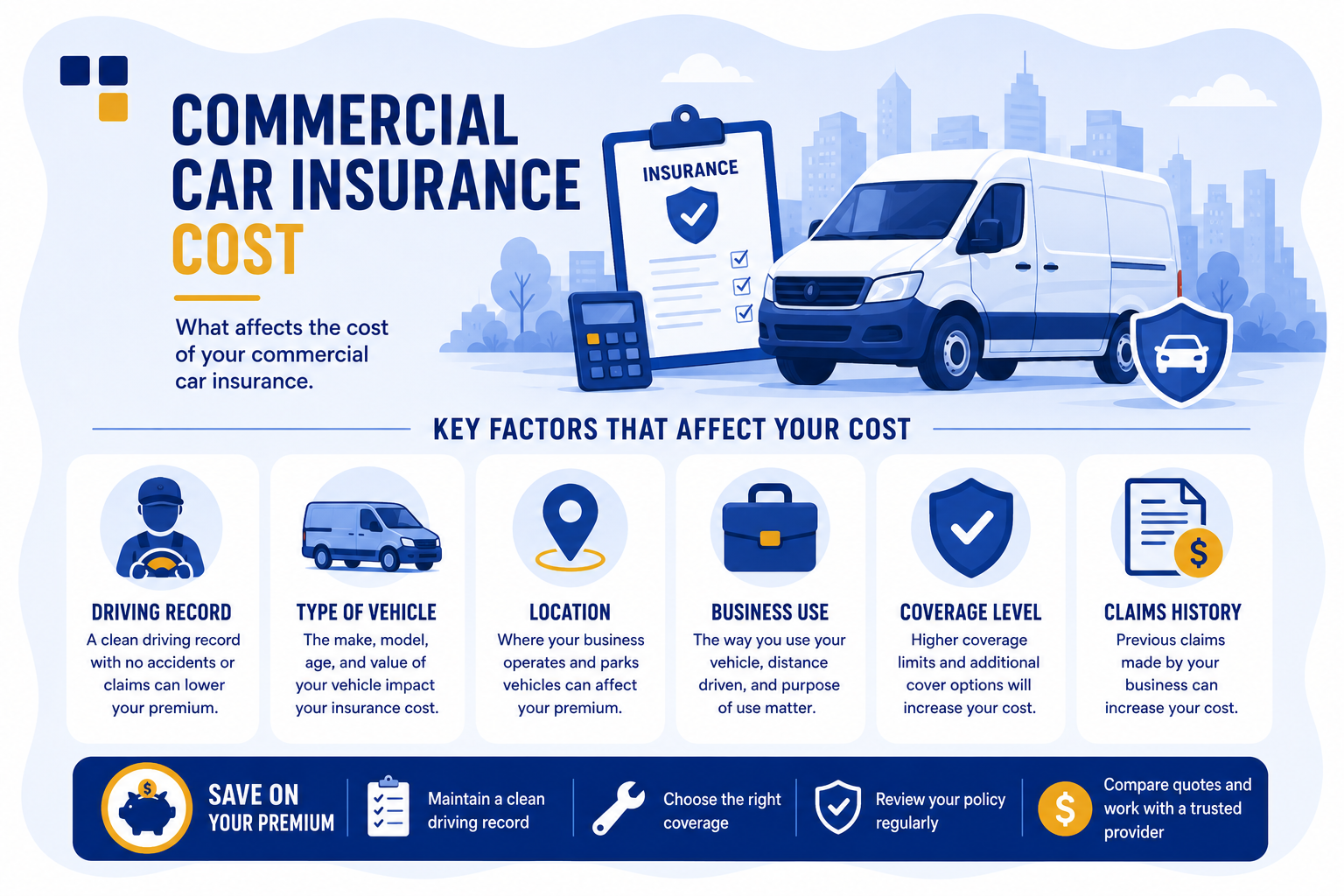
Commercial car insurance pricing is built up from a dozen rating factors that insurers weight differently. Understanding them helps you see why two drivers in apparently similar situations can receive quotes that differ by hundreds of pounds — and where you have practical scope to improve your position at renewal.
| Rating Factor | How It's Used | What You Can Influence |
|---|---|---|
| Class of use | Class 1, 2, or 3 — defines the scope of business journeys covered | Choose the lowest class that genuinely matches your use; don't over-buy |
| Annual mileage | Total mileage including commuting plus business mileage; under-declaration voids cover | Declare accurately; if mileage drops, update mid-year |
| Occupation | Job title rating — some occupations rate cheaper than others for identical roles | Choose the most accurate job title (insurer lists vary); never falsify |
| Postcode | Theft, vandalism, and accident rates by postcode; Inner London is highest, rural lowest | Location is fixed but overnight parking is rateable — secure off-road parking helps |
| Vehicle insurance group | Group 1 (cheapest) to 50 (most expensive); reflects repair cost, theft attractiveness, performance | Check insurance group before buying any car for business use |
| Driver age and experience | Single biggest factor; under-25 drivers pay multiples of the mainstream rate | Add experience over time; named young drivers should not be on annual policies long term |
| No-claims bonus | Up to 60–70% discount for 5+ years claim-free; protected NCB is well worth £20–£50 | Protect NCB once 4+ years built; consider not claiming for minor losses |
| Excess | Voluntary excess on top of compulsory excess; higher excess = lower premium | Set voluntary excess to a level you could afford in a claim, not arbitrarily high |
| Cover level | Comprehensive, third party fire & theft, or third party only | Compare all three — TPO is often more expensive due to higher-risk pool |
| Convictions and points | Speeding (SP), insurance (IN), drink/drugs (DR) all rate heavily and for years | Drive carefully; disclose convictions accurately — non-disclosure voids cover |
| Claims history | Both fault and non-fault claims affect rating; fault claims significantly so | Pursue uninsured loss recovery on non-fault claims; document everything |
| Add-ons and extras | Legal expenses, breakdown, courtesy car, key cover, personal accident — each adds incremental premium | Check duplication with bank accounts, breakdown clubs, and other policies |
Why Quotes Vary by Hundreds of Pounds
The same driver in the same car at the same postcode can receive quotes that differ by £400 or more between insurers. The reason is that each insurer weights the 12 factors above differently — one insurer may charge more for occupation but less for postcode; another the reverse. This is why annual comparison shopping is the single most effective cost-saving action a business car driver can take. Auto-renewing without comparing means you are relying on a single insurer's weighting model being optimal for your profile in the current year — which it almost never is.
6. When You Need Fleet Insurance Instead
If your business operates more than one vehicle — even just two — fleet insurance often becomes more cost-effective than individual policies. The threshold varies by insurer but most fleet insurers will quote from two vehicles up, and the structural advantages compound as the fleet grows.
Why Fleet Cover Works Better at Scale
- Single renewal date — one programme, one administrative cycle, one set of certificates rather than chasing multiple individual renewals
- "Any driver" or named driver flexibility — fleet wordings can cover any authorised driver above a minimum age and licence threshold, removing the need to add every driver individually
- Easier to add and remove vehicles mid-year — declaration basis rather than separate policies for each vehicle
- Aggregated claims data — your entire business claims experience drives the rating, often more favourable than individual driver profiles
- Mixed-vehicle programmes — many fleet wordings cover cars, vans, and even goods vehicles in a single programme
Mini-Fleet vs Full Fleet
Insurers segment fleet into:
- Mini-fleet — typically 2 to 5 vehicles; rated on individual driver and vehicle data; suits small businesses with multiple director or staff cars
- Standard fleet — 6 to 50 vehicles; rated more heavily on aggregated claims experience; common for trade businesses, regional service providers
- Large fleet — 50+ vehicles; rated almost entirely on own claims experience, often with experience rating clauses and aggregate stop-loss
For most small businesses that have outgrown individual business car policies, mini-fleet is the natural next step. Discuss the structure with your broker before assuming you need to maintain separate policies — the administrative and pricing benefits are often substantial. See our wider commercial insurance guide for how fleet sits within the overall business insurance programme.
7. IPT, Add-Ons, and the True Annual Cost
Insurance Premium Tax (IPT)
Every UK motor insurance premium includes Insurance Premium Tax at the standard rate of 12%. This is collected by the insurer and paid directly to HMRC. The current rate (12%) has been in place since 1 June 2017 and remains unchanged for 2025/26. Key facts about IPT on commercial car insurance:
- IPT is calculated on the gross premium — a £400 policy includes £48 of IPT (£400 ÷ 1.12 × 0.12)
- IPT cannot be reclaimed as input VAT by VAT-registered businesses; it is a genuine additional cost, not a recoverable tax
- Some specific motor-related products (e.g. supplier-arranged car cover bought directly through a dealership, or mechanical breakdown insurance sold by dealers) attract the higher 20% IPT rate — check the schedule
- Long-term insurance (life, permanent health) is IPT-exempt; standard motor insurance is not
The Cost of Add-Ons
The headline premium is rarely the total cost. Common add-ons that can add £100–£300+ to the annual cost include:
- Legal expenses cover — uninsured loss recovery, motor prosecution defence, contractual disputes (£20–£40)
- Breakdown cover — recovery and roadside assistance (£40–£120 depending on tier)
- Courtesy car — usually included on comprehensive policies; like-for-like upgrades cost extra
- Key cover — replacement keys, locksmith (£15–£30)
- Personal accident — fixed-sum cover for the driver or named occupants (£20–£50)
- European driving extension — full cover beyond UK and Republic of Ireland (£30–£80)
- Tools or business equipment cover — beyond the personal belongings sub-limit (£40–£100)
The Monthly Payment Trap
Paying monthly rather than annually effectively turns your premium into a loan. Insurers (or their finance partners) typically charge 10–15% APR for monthly payments. On a £600 premium, monthly payment can add £60–£90 to the total annual cost — more than the entire business use uplift. If cash flow allows annual payment, take it.
8. How to Reduce Commercial Car Insurance Cost
The biggest savings come from getting the basics right, not from clever tricks. The most effective actions in approximate order of impact:
- Compare quotes 21–28 days before renewal. Single biggest action. The same driver shopping at the optimal window typically beats the renewal quote by 15–30%.
- Pay annually, not monthly. Saves 10–15% of premium in financing cost.
- Choose the right class of use — and no more. Don't pay for Class 3 if Class 1 genuinely covers your usage. Conversely, don't under-buy and risk invalidation.
- Build and protect a no-claims bonus. Five years of NCB = 60%+ discount. Once you have 4+ years, NCB protection (£20–£50) is well worth it.
- Choose a low insurance group car for business use. A Group 5 car is structurally cheaper to insure than a Group 25 car regardless of any other factor.
- Set a sensible voluntary excess. An excess you can afford to pay if needed — typically £250 to £500 — meaningfully reduces premium.
- Park securely overnight. Off-road parking (driveway or garage) reduces theft risk and rates accordingly.
- Consider telematics or black-box cover. Particularly powerful for high-mileage business drivers who can evidence safe driving — discounts of 10–25% are realistic.
- Decline duplicate add-ons. Many drivers pay for legal expenses, breakdown, and key cover that are duplicated by bank accounts or breakdown club membership.
- Use a specialist broker for higher-risk or specialist cases. For commercial drivers, trade vehicle use, or non-standard occupations, broker access often beats aggregator pricing materially.
9. Real Claims and How to Manage Them
Claim — Class of Use Mismatch, Rear-End Collision
A self-employed marketing consultant was rear-ended on a dual carriageway while travelling between client meetings. The third party admitted fault and her insurer initially accepted the claim. During investigation, however, the insurer identified that her policy was SDPC only — she had not added business use despite regularly visiting multiple clients. The insurer continued to handle the third-party claim (because the third party was the victim) but refused to pay for her own vehicle damage and refused to pursue her uninsured loss recovery against the third-party insurer.
Total uninsured loss to the consultant: £3,200 for vehicle repairs, £450 for hire car costs, £600 for medical assessment fees that her policy's personal accident section would have covered. She paid these personally and her future premium increased by 28% because the incident remained on her claims record, even though no payment was made by her insurer. Adding Class 1 business use at inception would have cost £35 per year.
The lesson: business use is not an optional upgrade for "high-mileage" drivers — it applies the moment your journey isn't a normal commute. The cost-benefit of correctly classifying use is overwhelming. Review your policy schedule at every renewal and update for any change in working pattern.
Claim — Tools in Car, Personal Belongings Limit
A self-employed electrician with Class 1 business use cover had his car broken into overnight while parked at a customer's premises. The thieves took his electrical testing equipment, hand tools, and a small stock of consumables he had loaded for the next day's job. Total value of items stolen: £4,800.
His business car insurance personal belongings cover was capped at £200. The insurer paid £200 and confirmed the rest was not covered under his motor policy. The thieves had also damaged his car door and dashboard — those repairs were covered by his comprehensive cover (after the standard excess) but the tools were the bulk of the loss.
A subsequent review with our office identified that his risk profile required commercial vehicle insurance with a tools-in-transit extension — not a private car policy with business use. The cost of the correct cover would have been around £180 above his Class 1 premium; the uninsured loss was £4,600. He now operates with a commercial van policy specifically scoped for trade tools.
The lesson: business car insurance is for driving for business. Carrying significant trade tools or stock pushes you into the territory of commercial vehicle insurance with specific tools cover. The line between "business car" and "commercial vehicle" is one of the most common cover gaps for self-employed trades.
Claim — Under-Declared Mileage Discovered Post-Claim
A regional sales account manager declared 12,000 annual mileage on her Class 3 business car policy. Following a single-vehicle accident on a wet road, her insurer accepted the claim subject to investigation. The investigation included reviewing dashcam footage, telematics data from her phone, and her mileage allowance claims to her employer — all of which suggested her actual annual mileage was closer to 24,000.
The insurer settled the claim at 50% of the assessed loss, applying an "average" reduction proportional to the under-declaration. Net payout: £4,800 against an actual loss of £9,600. The driver's renewal premium increased significantly and a non-disclosure note was added to her claims record, affecting future placements.
The lesson: mileage under-declaration is the single most common cause of partial settlements in commercial motor claims. Insurers are increasingly cross-checking declared mileage against telematics, MOT records, and (with consent) HMRC mileage claims. Declare accurately. If your mileage rises mid-year, update the policy.
Claims Management Steps
- At the scene: ensure everyone is safe; call emergency services if injuries; take photos of all vehicles, damage, registration plates, and the scene from multiple angles; obtain witness contact details where possible.
- Don't admit liability: exchange details factually but avoid statements about fault — leave assessment to insurers. The MIB record is consulted on every claim and statements at the scene are weighed.
- Notify your insurer as soon as practical: most policies require notification within 24–48 hours regardless of whether you intend to claim. Failure to notify can prejudice future cover even if you settle privately.
- If the journey was for business: ensure you have business use on your policy. If you don't, take legal advice before notifying the insurer to understand the implications.
- For tools, equipment, or goods losses: review whether the loss falls under your motor policy, a separate tools-in-transit policy, or a business insurance package. Notify the right insurer; double-notification rarely hurts but missing one entirely can lose the claim.
- For uninsured loss recovery (non-fault claims): use your legal expenses cover if you have it. Recover your excess, hire car costs, lost earnings, and personal injury claims from the third-party insurer.
- Document everything in writing: phone calls and verbal undertakings are easily disputed. Email summaries of every conversation with your insurer, broker, third-party insurer, and any solicitors.

Frequently Asked Questions
The median annual cost of comprehensive business car insurance in late 2025 was £402 (Go.Compare data) — broadly comparable to standard private cover at £386. Adding Class 1 business use to an existing policy typically costs £20–£50 per year extra. Class 2 (with a named driver) costs slightly more. Class 3 (commercial travelling, unlimited mileage) can range from £475 to £1,857+ depending on mileage, occupation, and location. The total cost is heavily affected by postcode (Inner London is around 75% above the UK average), driver age, vehicle insurance group, and claims history. Comparison shopping 21–28 days before renewal typically delivers the lowest prices.
Not for a single regular workplace — commuting to one fixed place of work is covered under standard SDPC (social, domestic, pleasure and commuting) cover. You need business use the moment your journey involves anything beyond that: visiting a client, attending a meeting away from your normal workplace, travelling between two work sites, going to a training course at a different location, or making any work-related journey on your employer's behalf. The boundary is narrow and often crossed unintentionally. If in doubt, add Class 1 business use — the cost is typically £20–£50 per year and protects you from the risk of policy invalidation.
Class 1 covers the policyholder (usually plus spouse) for business journeys including travel between multiple workplaces and client visits. Class 2 adds a named driver who isn't your spouse — typically a colleague or business partner. Class 3, sometimes called "commercial travelling", is designed for high-mileage roles like sales reps with unlimited business mileage and destinations. None of them cover hire and reward (taxi, courier), driving instruction, or commercial goods carriage — those require separate commercial vehicle insurance. Mileage caps vary by insurer and class — confirm the specific limit at quote stage.
The insurer will investigate the purpose of the journey and, if it concludes the journey was for business, decline the claim. The third party (if any) will be paid by the Motor Insurers' Bureau, but the MIB will then pursue you personally for recovery. In serious cases, the policy can be voided from inception, meaning no past or future claims will be honoured. The financial consequence can run into hundreds of thousands of pounds for a serious injury claim. Adding business use at inception costs a fraction of this risk.
Yes, if you are self-employed or use your car for business as a sole trader, business car insurance (or the business proportion of a mixed-use policy) is a deductible expense on your self-assessment tax return. If you are an employee using your own car for business and claiming mileage at the HMRC approved rates (currently 45p per mile for the first 10,000 miles, 25p thereafter), you cannot separately deduct the insurance — the mileage rate is designed to include a proportion of insurance, fuel, depreciation, and other running costs. VAT-registered businesses cannot reclaim Insurance Premium Tax (IPT) on the premium — IPT is not VAT and is not reclaimable.
Most fleet insurers will quote from two vehicles up. The administrative and pricing advantages of fleet cover — single renewal, "any driver" flexibility, aggregated claims rating, easier to add and remove vehicles — typically make it worth considering from two vehicles onward. For three to five vehicles, mini-fleet cover is usually the structural fit. For larger fleets (6+), standard or large fleet placement applies, with rating based heavily on aggregated own-claims experience. Trade businesses with mixed vehicle types (cars + vans) particularly benefit from a single fleet programme.
Counter-intuitively, third party only (TPO) policies are often more expensive than comprehensive because TPO tends to be bought by higher-risk drivers — younger drivers, those with convictions or claims, or drivers of older or higher-risk vehicles. This drives up the claims frequency for the TPO insurance pool, pushing prices up. Comprehensive cover attracts a lower-risk pool of drivers and is rated accordingly. Always get quotes for all three cover levels and compare — the cheapest cover by name is often not the cheapest in practice.
No. Insurance Premium Tax (IPT) is a separate tax from VAT and is not reclaimable by VAT-registered businesses. The standard IPT rate on motor insurance is 12% (in place since June 2017); a higher 20% rate applies to certain dealer-arranged insurance and motor breakdown cover sold by dealers. IPT is collected by the insurer and paid to HMRC. It is added to the gross premium and shown separately on most quotes. Because it cannot be reclaimed as input VAT, IPT is a genuine cost to businesses purchasing motor insurance and should be budgeted accordingly.
Yes, particularly a fault claim. A first fault claim typically increases the next renewal premium by 20–40% and the effect can persist for 3–5 years until the no-claims bonus has rebuilt. Non-fault claims also affect rating, though less severely. The size of the claim matters less than the fact of it — a £1,500 claim has a similar impact to a £15,000 claim. This is one reason to consider not claiming for very minor losses where the excess plus the next year's premium increase would exceed the claim payout. Always weigh the maths before claiming for minor damage.
Related Guides from Miller & Partner
Related specialist cover
More on business motor cover
Most people checking business car costs also need to know which cover fits how the vehicle is owned and used.
- Business use car insuranceClass 1, 2 and 3 business use explained, and when a personal policy stops covering work driving.
- Car insurance for a business vehicleCompany-owned and director cars: the cover they need and how they are rated.
- Motor trade insuranceRoad risks, premises and customer vehicles for traders, mechanics and garages.







Instagram
LinkedIn