


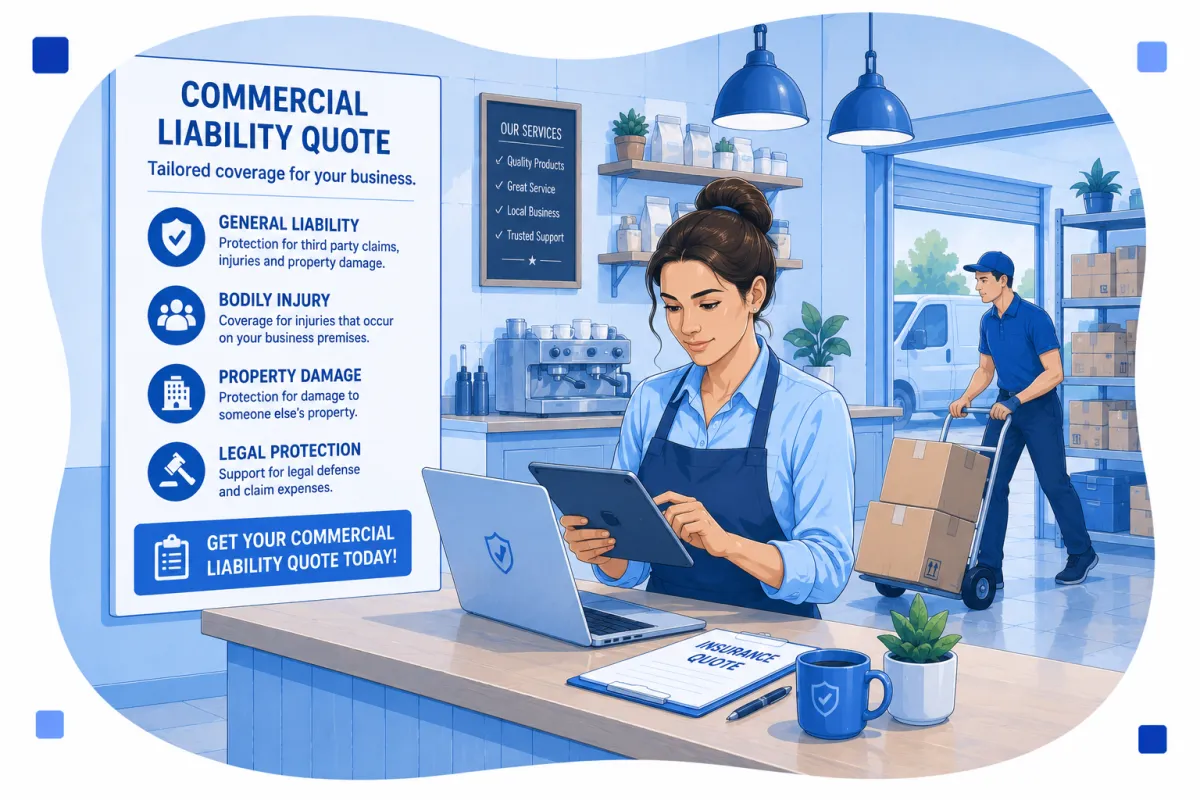
The Essential Commercial General Liability Quote Guide 2025
Why do two commercial general liability quotes for the same business differ by 200–300%?
Two brokers can quote the same business for the same cover on the same day and produce premiums that vary by 200% or more. This isn't market dysfunction. It's a direct reflection of how the UK commercial general liability quote process actually works — and how much the quote *you* receive depends on what *you* present, who presents it, and how it lands on the underwriter's desk.
Most UK business owners approach the CGL quote process as if they were buying motor insurance: enter a few details, compare prices, pick the cheapest, buy. That logic produces predictably bad outcomes in commercial insurance. The "cheapest" quote routinely turns out to be the most expensive when you read the wording. The "quick" online quote routinely turns out to be uninsured at claim stage because the activity description was generic. The "comparison" between two quotes is meaningless when they cover different things, exclude different things, and apply different sub-limits.
This article is built for the moment in your business where you've decided to look at commercial general liability cover — or to renew the cover you already have — and you want to do it properly. It complements our broader cover guides including business liability insurance UK, commercial general liability policies, and small business general liability insurance. Those answer the "what does it cover" question. This one answers the "how do I actually get a good quote" question — which is a different and arguably harder problem.
The structure below walks through what is inside a CGL quote, how the Insurance Act 2015 fair-presentation duty shapes every quote you receive (whether you realise it or not), what underwriters actually look at when pricing, the documentation that wins better terms, how to compare quotes side-by-side without being misled, and the hidden cover gaps that make a "cheap" quote uninsured. There are three interactive tools embedded in the article — a cover checker by business profile, a quote-readiness self-check, and a complexity assessor — to let you stress-test where your operation sits before you contact a broker. For Miller & Partner's main commercial insurance product page, see our commercial insurance hub.
Key facts about the CGL quote process at a glance
- Two CGL quotes for the same business commonly vary by 200–300% in 2026 — the variance reflects differences in declared activity scope, limits, sub-limits, exclusions, and underwriter appetite, not the underlying risk. Price comparison without coverage comparison is meaningless.
- The Insurance Act 2015 imposes a duty of "fair presentation of the risk" on every commercial buyer at quote and renewal stage — this means proactively disclosing every material circumstance an underwriter would want to know, not just answering the questions asked.
- Failure to make a fair presentation is the #1 reason UK commercial claims are reduced or declined — not fraud, not bad luck, just incomplete or vague information at quote stage. The remedy is structured disclosure, not better claims luck.
- UK average small business public liability insurance cost in 2026 is around £120 for £1 million of cover per NimbleFins 2026 market data — but the average masks a 200–300% range across identical business types depending on quote quality and broker placement.
- Increasing PL cover from £1m to £2m typically adds only £50–£100 annually, making higher limits dramatically cheaper per £ of cover than the headline number suggests — yet 84% of UK SME buyers default to £1m because that's the headline price they were quoted.
- The ABI's January 2026 SME underinsurance report found 57% of UK SMEs hold public liability cover — meaning 43% trade with no PL cover at all, and a substantial proportion of those who do are underinsured for the contracts they hold.
- The single most expensive mistake at CGL quote stage is the "general contractor" or "general cleaning" activity description — vague activity descriptions trigger wider underwriter assumptions, higher loadings, and broader exclusions. Precision in activity description is the largest single rating lever the buyer controls.
1. What is actually inside a commercial general liability quote?
A UK commercial general liability quote is not a single product. The phrase "CGL" is borrowed from US insurance and used loosely in the UK market to describe a bundle of third-party liability covers commonly placed together. Different brokers and insurers will package the bundle differently. When you receive two quotes labelled "commercial general liability", the labels can hide structural differences in what's covered, what's excluded, and where the sub-limits sit.
A properly-built UK CGL quote in 2026 typically includes the following components — though the exact mix depends on your sector and trading profile:
| Cover Component | What It Does | Typical Limit |
|---|---|---|
| Public Liability | Third-party injury, illness, or property damage caused by your business activities | £1m–£10m |
| Products Liability | Third-party injury or damage caused by products you sell, supply, or manufacture | Usually shares PL limit |
| Employers' Liability | Injury or illness to your employees arising from work — legally required if you have staff | £10m (standard; £5m legal minimum) |
| Financial Loss extension | Third-party pure financial loss not arising from injury or property damage | £50k–£250k sub-limit |
| Defective Workmanship cover | Damage to the part of the work you've completed (limited — not contract works) | £25k–£100k sub-limit |
| Custody & Control extension | Damage to property in your care, custody, or control while you work on it | £50k–£500k sub-limit |
| Contractual Liability extension | Liabilities assumed under contracts beyond common-law liability | Often £1m matching PL |
| Legal Defence Costs | Legal costs of defending covered claims — typically in addition to limit, sometimes inside | Varies — "in addition" is materially better |
| Court Attendance Compensation | Daily allowance if you or staff are required to attend court for a covered claim | £250–£500/day |
Two quotes that both say "Public Liability £2m" can deliver radically different cover when you factor in the sub-limits, the inner limits on legal costs, the way "products" sits inside or outside the PL aggregate, and the exclusions wording. The quote document is a contract proposal; you have to read it like one.
2. How does the Insurance Act 2015 shape every CGL quote you receive?
The Insurance Act 2015 reshaped the UK commercial insurance market when it came into force on 12 August 2016, and a decade on it still surprises buyers who don't realise it applies to them. Every commercial insurance quote — including every CGL quote — is governed by it.
The Act replaced the old "duty of disclosure" with a positive duty of fair presentation. Section 3(1) of the Act requires the insured to "make to the insurer a fair presentation of the risk" before the contract is entered into. In plain English, this means you have to proactively tell the insurer everything a "prudent underwriter" would want to know to price your risk — not just answer the questions on the proposal form. Knowing this changes how you approach the quote process from "fill in the form" to "build the submission".
What counts as a material circumstance?
A material circumstance is any piece of information that would influence the judgment of a prudent insurer in deciding whether to underwrite a risk and on what terms. For a commercial general liability quote, common material circumstances include:
- Past claims history across all liability lines (typically last 5 years, sometimes 10)
- Director or business owner criminal convictions (even if dropped, per Berkshire Assets v AXA [2021] EWHC 2689)
- Director or business owner previous insurance refusals, cancellations, or special terms
- All trading activities — including secondary activities that might be 10% of turnover
- Use of subcontractors and the proportion of work subcontracted
- Work at height, hot work, work on bonded premises, or work in regulated environments
- Export activity and overseas work — including jurisdictional reach of claims
- Previous insolvencies, CCJs, or financial restructuring of related entities
- Material changes in trading pattern (e.g. taking on a new contract type recently)
- Known disputes or potential claims circumstances even if not yet formal claims
- Health and safety improvement notices, prohibition notices, or HSE investigations
- Any prior product recalls or quality incidents
What happens when fair presentation isn't made?
The remedies under the Act for breach of the fair presentation duty depend on whether the breach was deliberate or reckless, or neither. Where the breach was deliberate or reckless, the insurer can avoid the policy (treat it as never having existed) and keep the premium. Where the breach was non-deliberate and non-reckless, the remedy is proportionate: the insurer can reduce a claim payment to reflect what it would have charged or what terms it would have imposed if the truth had been known.
The decision in Berkshire Assets (West London) Limited v AXA Insurance UK Plc [2021] EWHC 2689 (Comm) — the first English judgment specifically on the fair presentation duty — established that even circumstances later discontinued (Malaysian criminal charges against a director that were later dropped) can be material if they existed at the time of placement. The Berkshire case isn't about the underlying merits of those charges; it's about the principle that the insurer was entitled to know about them at the time, and the policy could be avoided in their entirety for the failure to disclose.
3. What 12 pieces of information change the price of your CGL quote?
An underwriter pricing your CGL risk in 2026 is working off a rating algorithm that translates declared facts about your business into a premium. The 12 most material rating factors below are not just things to declare; they are things to declare precisely, because each one moves the price meaningfully.
| # | Information | Why It Matters to the Underwriter |
|---|---|---|
| 1 | Precise activity description | "Domestic gas engineer" prices differently from "boiler installation, gas safety inspections, and Gas Safe-certified work in occupied homes". Precision tightens the rating; vagueness triggers worst-case assumptions. |
| 2 | Annual turnover (split by activity) | Turnover is the primary scaling factor. Splitting by activity (e.g. 60% domestic, 40% commercial) allows the underwriter to rate each part appropriately rather than rate everything at the higher rate. |
| 3 | Number of staff and role breakdown | EL premium scales directly with payroll. The role breakdown (manual vs admin) is the second-largest EL rating factor after payroll itself. |
| 4 | 5-year claims history (declared, not just recent) | Claims experience over 5 years (sometimes 10) drives loading or discount. Missing a claim from year 4 of the history is a fair-presentation breach. |
| 5 | Use and value of subcontractors | Subcontractor exposure changes the risk profile. Underwriters price differently for businesses with bona-fide labour-only subbies (covered as own staff) vs bona-fide subcontractors (uninsured under your policy unless extended). |
| 6 | Limits required and the contracts driving them | Why you need £5m or £10m matters — a contract requirement is rated differently from a general appetite. Higher limits are typically dramatically cheaper per £ than the first £1m. |
| 7 | Work at height, hot work, or specialist exposures | Work over 2m, work involving heat, work on listed buildings, work in food premises, work in healthcare settings — each triggers specific underwriter questions and rating factors. |
| 8 | Geographic operating area | Postcode-level loadings apply. Working London differs from working rural Powys. Working in multiple regions affects the rating average. |
| 9 | Overseas exposure (work, products, contracts) | EU work, US/Canada work, and rest-of-world work are rated separately and dramatically differently. US/Canada exposure typically loads PL premium 50–200%. |
| 10 | Health and safety documentation maturity | Documented risk assessments, method statements, COSHH assessments where applicable, accident book, RIDDOR reporting discipline — mature H&S systems attract discounts of 5–15% on EL/PL. |
| 11 | Trade association memberships and qualifications | Gas Safe, NICEIC, FENSA, TrustMark, CHAS, Constructionline, sector-specific bodies — recognised certifications attract 5–10% discounts and access to specialist schemes. |
| 12 | Continuity with insurer and broker | 3+ years' continuity with the same insurer typically delivers 5–10% lower renewal premiums. Chasing the cheapest annual quote often destroys this and costs more over 5 years. |
These 12 factors are the ones the buyer controls or can influence. There are others (insurer appetite, broader market conditions, sector loss trends, capacity in the reinsurance market) that the buyer can't control but the broker navigates. A specialist broker's value comes from steering placement toward insurers whose appetite matches your risk profile — see our broker commercial insurance guide for more on how that works.
4. What is the underwriter actually looking at when they price your quote?
Understanding the underwriter's perspective is the single most useful frame for getting a better quote. An underwriter has portfolio targets — they're trying to write a profitable book of business for their insurer. Each risk they accept either improves or worsens the portfolio's loss ratio. Your quote sits inside that calculation.
What the underwriter looks at, in order:
1. Does this risk fit our appetite?
Insurers have appetite statements — defined sectors, sizes, geographies, and activities they want to write. A consultant submission for a sector outside the insurer's appetite gets a polite decline or a very high price designed to discourage. A submission inside the appetite gets engaged underwriting. Specialist brokers know which insurers have appetite for which risks; this is half the value they add. Sending a niche risk to a generic market typically gets you a quote, but at the wrong price.
2. Is this presentation complete and credible?
A submission with thin information triggers the underwriter to add loadings for unknown unknowns. A submission with detail, evidence (claims summary, H&S documentation, certifications), and structure triggers engaged pricing. The difference between a one-page proposal form and a structured broker submission is routinely 15–25% of premium.
3. What is the loss potential?
The underwriter is thinking about the worst-credible-claim scenario. For PL, this is typically a serious personal injury claim — head injury, spinal injury, fatality — that can run to £1m–£5m+. The underwriter is asking: how likely is this business to generate such a claim? What is the worst-case scenario from the work described? Is the proposed limit sufficient?
4. What is the loss frequency?
Separately, the underwriter looks at frequency — how often do similar businesses produce small-to-medium claims? Sectors with high attritional loss frequency (e.g. property repair, hospitality) attract loadings even where severity is moderate.
5. What does the claims history tell us?
A clean 5-year history is taken at face value. A history with claims triggers questions: what changed since the claims, what's been done to prevent recurrence, what was the root cause analysis. A business that can articulate the lessons from past claims and the remedial action taken gets better terms than one that treats claims as bad luck.
6. Is this business well-run?
The underwriter forms a judgment about management quality from the submission. Tidy documentation, accurate financials, clear activity descriptions, evidence of H&S investment, certifications maintained — all of this signals a well-run business that is statistically less likely to produce claims. Disorganised submissions signal the opposite, and the price reflects it.
5. How do you compare two commercial general liability quotes side-by-side?
The price comparison is the easy part — and the wrong part. Two quotes can show the same headline price for completely different cover, or wildly different prices for substantially identical cover. The framework below is the one I use when comparing competing CGL quotes for a client.
| Comparison Point | What to Check | Why It Matters |
|---|---|---|
| Declared activities | Are all your trading activities listed? Including secondary ones? | Activities not declared can produce uninsured claims even if the quote looks comprehensive |
| Public Liability limit | The headline number, but also: is the limit per claim or aggregate? | "Aggregate" means the limit is the cap for ALL claims in the policy year combined |
| Products Liability | Shared with PL or separate? What's the aggregate? | If shared, one big product claim can erode your PL cover for the year |
| Employers' Liability limit | £5m minimum legal; £10m is the working standard in 2026 | £5m used to be sufficient; serious injury claims now routinely exceed it |
| Legal defence costs | Inside the limit or in addition? | £100k of defence costs eating into a £1m PL limit leaves £900k for settlement |
| Custody & Control sub-limit | What's the sub-limit and what's excluded? | Damage to property you're working on is a leading claim type for tradespeople |
| Defective Workmanship | What's covered, what's excluded, what's the sub-limit? | Standard PL excludes the cost of redoing your work; the sub-limit covers consequential damage |
| Financial Loss extension | Is it included? At what sub-limit? | Pure financial loss claims (no injury, no damage) need this extension or aren't covered |
| Excess (deductible) | What's the excess for each claim type? | A "cheap" quote with a £2,500 excess vs another with £250 excess produces meaningful TCO difference |
| Territorial limits | UK only? EU? Worldwide ex US/Canada? Worldwide including US/Canada? | Working overseas requires the right territorial scope; default quotes are UK-only |
| Jurisdiction | What courts can claims be brought in? | US/Canada jurisdiction is significantly higher-risk and dramatically more expensive |
| Specific exclusions | Any pollution, asbestos, professional services, cyber, or sector-specific exclusions? | The fastest way to identify cover gaps is to read the exclusions list, not the headline cover |
| Subcontractor cover | Are bona-fide subbies and labour-only subbies handled correctly? | Subcontractor mis-classification is a major cover gap source |
| Insurer financial strength | A-rated (S&P) or better is the working standard | A cheap quote from a weak-rated insurer is poor value if the insurer fails before your claim is paid |
| Payment terms | Annual vs monthly; what's the monthly finance APR? | Monthly payment APR is often 8–14% — material on multi-thousand-pound premiums |
6. Commercial general liability quote cover checker
Select your business profile below to see the CGL cover components matched to your specific operation. The checker covers what should be on the quote for each profile — use it as a comparison list when reviewing actual quotes. For Miller & Partner's broader commercial insurance product page see commercial insurance hub.
CGL Quote Cover Checker
Select your business profile to see the cover components that should appear on your CGL quote
Sole Trader / Freelancer CGL Quote
- ESSENTIAL Public Liability £1m–£5m (match to contract requirements)
- ESSENTIAL Products Liability if you sell or supply goods — usually shares PL limit
- ESSENTIAL Legal defence costs explicitly "in addition to limit" not "inside limit"
- RECOMMENDED Personal Accident — no statutory sick pay protection as sole trader
- RECOMMENDED Professional Indemnity if you provide advice or designs — separate cover
- RECOMMENDED Custody & Control extension if you work on or with client property
- CONSIDER Cyber insurance if you hold any client data
- CONSIDER Tools and equipment cover if you have £1,000+ of work tools
Micro Business CGL Quote (1–4 staff)
- LEGAL Employers' Liability £10m — legally required from your first employee
- ESSENTIAL Public Liability £2m–£5m
- ESSENTIAL Products Liability if applicable
- ESSENTIAL Legal defence costs in addition to limit
- ESSENTIAL Custody & Control where relevant
- RECOMMENDED Professional Indemnity for advice/design work
- RECOMMENDED Tools and equipment cover
- RECOMMENDED Business interruption if loss of premises would halt trading
- CONSIDER Cyber insurance — increasingly essential for any digital-using business
Small Business CGL Quote (5–25 staff)
- LEGAL Employers' Liability £10m comprehensive
- ESSENTIAL Public Liability £5m typically — many contracts now require this
- ESSENTIAL Products Liability £5m where applicable
- ESSENTIAL Legal defence costs in addition
- ESSENTIAL Custody & Control £100k+
- ESSENTIAL Contractual Liability extension where contracts impose additional liabilities
- ESSENTIAL Property and contents at premises
- ESSENTIAL Business Interruption matched to actual gross profit
- ESSENTIAL Cyber insurance for any data-handling business — see our cyber insurance page
- RECOMMENDED Professional Indemnity if any advisory/design element
- RECOMMENDED Directors and Officers (D&O) where company structure
Trade Contractor CGL Quote
- CRITICAL Activity description must be precise — "general contractor" is the costliest declaration mistake
- LEGAL Employers' Liability £10m
- ESSENTIAL Public Liability £5m (£10m for main contractors)
- ESSENTIAL Subcontractor cover correctly classified (labour-only vs bona-fide)
- ESSENTIAL Work-at-height scope where applicable
- ESSENTIAL Hot work scope where applicable
- ESSENTIAL Custody & Control £250k+ for property worked on
- ESSENTIAL Defective Workmanship extension
- ESSENTIAL Tools and equipment at full replacement value
- ESSENTIAL Plant and machinery if relevant
- ESSENTIAL Contractors Combined where contract values warrant — see our contractors combined page
- RECOMMENDED Contract Works (CAR) for ongoing project exposure
Shop / Retail / Hospitality CGL Quote
- LEGAL Employers' Liability £10m
- ESSENTIAL Public Liability £5m — customers on premises = high-frequency exposure
- ESSENTIAL Products Liability for goods sold — including food, alcohol where applicable
- ESSENTIAL Property and contents at full reinstatement value
- ESSENTIAL Business Interruption — typically 24-month indemnity
- ESSENTIAL Stock cover including seasonal uplift if relevant
- ESSENTIAL Money (cash on premises and in transit)
- ESSENTIAL Glass cover for shopfront
- ESSENTIAL Theft including damage caused by intrusion
- ESSENTIAL Food safety / Liquor Liability where applicable
- ESSENTIAL Cyber insurance for any business processing card payments
Mid-Sized Commercial CGL Quote (25+ staff)
- CRITICAL At this scale, specialist broker placement vs online portal makes 6-figure premium difference
- LEGAL Employers' Liability £10m–£25m comprehensive
- ESSENTIAL Public Liability £5m–£10m (contract requirements often £10m at this scale)
- ESSENTIAL Products Liability £5m–£10m separately or shared with PL
- ESSENTIAL Excess Liability layer above PL/EL primary where contract values warrant
- ESSENTIAL Directors and Officers (D&O) £1m–£5m
- ESSENTIAL Professional Indemnity matched to sector — see our PI page
- ESSENTIAL Cyber comprehensive — see our cyber insurance page
- ESSENTIAL Property and BI at full sums insured, BCIS-aligned
- ESSENTIAL Fleet insurance for commercial vehicles
- ESSENTIAL Legal Expenses with HSE/regulatory scope
- ESSENTIAL Crime / Employee Dishonesty
- ESSENTIAL Environmental Impairment Liability where applicable
7. Quote-readiness self-check
Before you contact a broker or run an online quote, work through the checklist below. Every item you have ready strengthens your fair-presentation position under the Insurance Act 2015 and helps the broker secure better terms. Items you don't have ready are not deal-breakers — but they are the conversations you'll need to have during the quote process.
CGL Quote-Readiness Self-Check
Click each item you have ready. The more ticked, the stronger your fair presentation and the better your quote outcome.
-
Precise activity description — written description of what you actually do, split by activity type if you do more than one
-
Annual turnover (last full year + projected current year) — split by activity type where relevant
-
Wage roll figure for all staff — used for EL rating; split by manual/non-manual roles
-
5-year claims history — every claim including ones declined, plus any circumstances notified to previous insurers
-
Subcontractor breakdown — value of subcontract spend, split between labour-only and bona-fide subcontractors
-
Limits required and the contracts driving them — copies of contractual insurance requirements if you have them
-
Health & safety documentation — written H&S policy, risk assessments, method statements where applicable
-
Trade certifications and memberships — Gas Safe, NICEIC, CHAS, Constructionline, sector body memberships
-
Director declarations — any convictions (including discontinued), bankruptcies, previous insurance refusals or special terms, prior insolvencies of related entities
-
Overseas exposure — any work, products, or contracts with non-UK exposure, especially US/Canada
-
Premises details — address(es), construction, security (alarms, locks to BS3621), tenure (owned/leased)
-
Current insurance schedule — existing policy documents, including the schedule and full wording, not just the renewal invitation
-
Known disputes or potential claims — any circumstance that might give rise to a claim, even if no formal claim made
8. CGL quote complexity assessor
Two factors drive how complex your CGL quote will be: the inherent risk profile of your business activities, and the size/complexity of your operation. Use the tool below to estimate the right placement approach for your specific position.
CGL Quote Complexity Assessor
Select your business activity profile and operational complexity to see your indicative placement approach

9. What hidden cover gaps make a cheaper quote actually uninsured?
The "cheap quote that turns out to be uninsured at claim stage" is a routine pattern in UK commercial general liability placement. The savings on the headline price are dwarfed by the claim exposure that materialises later. Below are the 8 most common hidden cover gaps to check for in any CGL quote you receive — these are the gaps that explain why apparently equivalent quotes can vary so dramatically in price.
Gap 1: Activities not specifically declared
The most common gap. The quote describes "cleaning services" but you also do mould remediation, or "general building work" but you also do work at height, or "consultancy" but you also handle client funds. At claim stage, the insurer reviews the policy schedule, identifies the work that gave rise to the claim wasn't declared, and reduces or declines under the Insurance Act 2015 remedies. The fix: declare every activity at proposal, even ones that are 5% of turnover.
Gap 2: Legal defence costs "inside" the limit
A £1m PL policy with defence costs inside the limit can leave you with £600k–£800k of indemnity if defence costs run to £200k–£400k (routine for any contested liability claim). The same headline limit with defence costs in addition leaves the full £1m for settlement. The premium difference between the two structures is typically modest; the cover difference at claim stage is dramatic.
Gap 3: Aggregate limits where you assumed per-occurrence
Some PL policies — especially products-heavy ones — apply the headline limit on an aggregate basis, meaning the limit is the cap for ALL claims in the policy year combined. If you have two £600k claims in the same year on a £1m aggregate policy, you have £400k uninsured. Most buyers assume "per occurrence" by default; underwriters increasingly write aggregate-basis cover to manage their exposure.
Gap 4: Custody & Control sub-limit lower than actual exposure
If you work on or with client property — laptops in for repair, plant on hire, vehicles being serviced, equipment in your custody — the standard sub-limit (often £10k–£25k) may be far below the value of the property you're routinely handling. The fix: tell the broker what's in custody, what its peak value is, and ensure the sub-limit matches.
Gap 5: Defective Workmanship excluded entirely
Standard PL excludes the cost of redoing your work. The Defective Workmanship extension covers consequential damage — damage to OTHER property caused by your defective workmanship. Many quotes don't include this extension at all; many that do apply punitively low sub-limits. For trade contractors this is one of the most material cover items.
Gap 6: Subcontractor cover mis-classified
"Labour-only" subcontractors work under your direction with your materials and are treated as your staff (covered under EL and PL). "Bona-fide" subcontractors run their own businesses and are not covered under your PL unless specifically extended. Many quotes get this mis-classified at proposal stage. At claim stage, an injured "subcontractor" who was actually working as labour-only triggers an EL claim against a policy that wasn't rated for them.
Gap 7: Pollution / Contamination exclusion
Most CGL policies carry pollution and contamination exclusions of varying severity. For most businesses this isn't a major issue. For businesses handling chemicals, biocides, biological agents, fuels, paints, or anything that can spread or contaminate — the exclusion can be a critical gap. Specific Environmental Impairment Liability (EIL) cover or removal of the standard exclusion is the fix.
Gap 8: Worldwide jurisdiction left at "UK only" when you have overseas work
The default territorial limit and jurisdiction is UK only. Any work, products, or contracts with EU, North American, or rest-of-world exposure can fall outside cover. Even a single trip to advise a client overseas can create exposure under a UK-only policy. The fix: tell the broker exactly where you work, where your products end up, and what jurisdiction your contracts specify.
10. What negotiation levers do brokers use that direct buyers never see?
Direct buyers approaching an online portal or insurer direct interact with a rating algorithm that produces a single quote with little flex. Specialist brokers operate in a different conversation with the underwriter — one where multiple levers can be pulled to improve terms. The most important levers below are routinely invisible to direct buyers but are part of every broker placement worth its fee.
| Lever | What It Does | Typical Impact |
|---|---|---|
| Appetite-led market selection | Sending the risk only to insurers whose appetite statement matches the business — not blanket marketing to every market | 10–30% premium reduction vs generic placement |
| Structured submission with claims narrative | Building the proposal with structured information including claims analysis, remedial action evidence, and management context | 15–25% premium reduction vs minimal proposal |
| Risk management engagement | Engaging the underwriter's risk engineering team to undertake a survey or risk consultation before quote | 5–15% discount and broader cover terms |
| Higher voluntary excess | Trading a higher excess against premium reduction where the buyer can absorb the increased frequency exposure | 10–25% premium reduction for material excess increases |
| Multi-year deals | Negotiating 2-year or 3-year fixed terms where insurer appetite supports continuity | 5–15% off baseline + protection against renewal volatility |
| Multi-policy placement | Placing PL, EL, property, BI, fleet with same insurer in exchange for terms | 10–20% across the programme typical |
| Renewal continuity | Demonstrating 3+ years' loyalty to existing insurer in exchange for renewal terms | 5–10% renewal discount |
| Coverage trading | Removing unnecessary cover (e.g. higher BI indemnity period than needed) in exchange for tighter terms elsewhere | Material cover improvements at neutral premium |
| Specialist scheme placement | Accessing MGA schemes that price niche sectors specifically (e.g. cleaning, healthcare, tech) | 20–40% premium reduction vs generic markets for niche sectors |
| Lloyd's market access | Accessing Lloyd's syndicates for risks outside mainstream appetite or where bespoke wordings are needed | Often the only way to get cover at certain risk profiles |
| Wordings negotiation | Specific wording amendments — removing exclusions, expanding sub-limits, clarifying definitions | Material cover improvements without significant premium impact |
| Pricing model challenge | Direct challenge to underwriter on the rating basis — specific factors being applied incorrectly | 10–20% reduction where the challenge is well-founded |
11. What are the 7 most expensive mistakes buyers make at quote stage?
The list below ranks the most expensive (and most preventable) mistakes I see at quote stage. Each one is preventable with 15 minutes of thought; each one routinely costs tens of thousands of pounds when it isn't.
Mistake 1: Treating "quote" as a price exercise
The quote isn't a price — it's a contract proposal. Comparing two quotes on price alone is like comparing two cars on weight alone. The cover variance between two same-priced quotes is routinely larger than the price variance. Read the wording. Compare structurally, not financially.
Mistake 2: Vague activity description to keep the premium down
The temptation to declare narrowly is understandable; the consequences are catastrophic. Activities not declared aren't covered. At claim stage the insurer applies the Insurance Act 2015 remedies. The fix is precise declaration — and trusting that the higher premium is better than the uninsured claim.
Mistake 3: Defaulting to £1m PL because that's the headline number
£1m used to be standard PL cover. In 2026 it's becoming inadequate. Serious personal injury claims regularly exceed £1m; many commercial contracts now require £5m or £10m minimum. And the marginal cost of higher limits is small — typically £50–£100 to double from £1m to £2m. The default should be £2m minimum for most businesses, £5m for any business with regular public interaction, £10m for any business with significant contract exposure.
Mistake 4: Ignoring sub-limits in the wording
The headline PL limit is meaningful; the sub-limits are often more meaningful at claim stage. Custody & control, defective workmanship, financial loss, contractual liability — these sub-limits decide whether routine claim types are properly covered. Buyers who look only at the headline are buying the marketing, not the cover.
Mistake 5: Switching insurer every year for £100 saving
Renewal continuity has commercial value. 3+ years' continuity typically delivers 5–10% renewal discounts and stronger relationship dynamics at claim stage. Saving £100 in year 1 by switching costs the £400+ continuity discount you'd have earned by year 3 — and increases the risk of fair-presentation issues at claim stage where the new insurer asks questions about your history with the previous insurer.
Mistake 6: Not disclosing minor claims or near-misses
Buyers routinely don't disclose small claims, claims that were settled by the previous insurer without admission, or "circumstances" notified but never crystallised into claims. All of these are material under the Insurance Act 2015. The temptation to omit them is the temptation to invalidate the policy.
Mistake 7: Using a generic broker for a specialist sector
Generic high-street brokers offer commodity placement competently. For specialist sectors — niche trades, complex contractors, regulated activities — generic placement leaves money on the table and creates cover gaps. The sector-specialist broker who places 50 risks per year in your sector knows exactly which insurer has appetite, what to declare, what to negotiate, and what the working market terms are. See our broker commercial insurance guide for more on how broker selection drives outcomes.
12. What drives the cost of a commercial general liability quote in 2026?
The premium ranges below are indicative for 2026 UK market conditions across the main CGL buyer profiles. Within each band, the rating factors that follow drive both the actual price and the spread between competing quotes.
| Business Profile | Indicative Annual Premium 2026 |
|---|---|
| Sole trader, office-based, < £100k turnover | £120–£350 |
| Sole trader, light service or trade, £100k–£200k turnover | £250–£800 |
| Micro business (1–4 staff), £100k–£350k turnover | £600–£2,500 |
| Small business (5–25 staff), £350k–£2m turnover | £2,000–£8,500 |
| Trade contractor, multi-trade, 5–15 staff | £3,500–£12,000 |
| Shop / retail / hospitality with premises | £2,500–£15,000 (depending on premises value and BI) |
| Medium business (26–100 staff), £2m–£10m turnover | £8,000–£30,000 |
| Mid-market (100+ staff or £10m+ turnover) | £25,000–£100,000+ |
Within each profile, the rating factors below drive both the premium and the spread between competing quotes. The within-profile variance is typically larger than the cross-profile variance — meaning a small business with poor quote preparation can pay more than a medium business with excellent preparation.
| Rating Factor | Impact on Premium | What You Can Do |
|---|---|---|
| Activity precision in declaration | Single largest rating lever the buyer controls | Precise written description, split by activity, with turnover split |
| Annual turnover | Primary scaling factor; rated linearly within band | Declare accurately including current-year projection |
| Staff numbers and payroll | Primary EL scaling factor; split by manual/admin role | Declare accurately including subcontractor labour where labour-only |
| 5-year claims history | Major loading or discount driver | Declare every claim including declined; document remedial action |
| Limits selected | Higher limits dramatically cheaper per £ of cover | Don't default to £1m PL; £2m–£5m typically far better value |
| Sub-limits and cover scope | Materially affects price within same headline limits | Match sub-limits to actual exposure; don't accept defaults blindly |
| Documentation and H&S maturity | 5–15% discount on EL/PL for mature systems | Documented H&S policy, RAs, accident book, training records |
| Trade certifications | 5–10% sector-specific discounts; access to schemes | Maintain Gas Safe, NICEIC, CHAS, Constructionline, sector bodies |
| Geographic operating area | Postcode-level loadings | Declare typical operating area accurately |
| Overseas exposure | EU/RoW work moderate loading; US/Canada 50–200% loading | Declare accurately; consider separate placement for US/Canada exposure |
| Excess level | Higher voluntary excess reduces premium 10–25% | Trade against premium where cashflow supports increased excess |
| Payment frequency | Monthly typically adds 8–14% APR | Pay annually where cashflow supports |
| Insurer continuity | 3+ years with same insurer typically 5–10% renewal discount | Strategic continuity over short-term price chasing |
| Broker placement type | Specialist broker placement vs generic 10–30% material on complex risks | Match broker specialisation to your sector |
For deeper coverage of how the broader commercial insurance market prices commercial vehicle exposures (which often sit alongside CGL programmes), see our commercial car insurance cost guide. For sector-specific cost dynamics across professional indemnity and other lines, see our professional indemnity page.
13. Real claim cases where the quote stage decided the outcome
Case 1 — Vague Activity Description, £67,000 Uninsured PL Claim
A small business operating as a "domestic cleaning service" had been buying PL cover through an online portal for three years. The declared activity was "domestic cleaning". In practice, the business had grown into a mixed operation — around 55% domestic, 35% commercial office cleaning, and 10% post-build construction cleanups including dust extraction and minor decorating touch-ups. None of the commercial or construction-related activity had been declared.
A claim arose from a post-build cleanup at a residential development: a cleaner spilled an aggressive cleaning chemical on a freshly-laid hardwood floor, causing damage that required full floor replacement across two rooms. The claim came in at £67,000 (floor replacement, alternative accommodation for the new owners while the work was redone, contractor costs).
The insurer reviewed the policy schedule, identified that "post-build construction cleanups" were not within the declared activities, and applied the Insurance Act 2015 remedy. The claim was reduced to a nominal proportionate amount reflecting what would have been covered if the activities had been properly declared. The business owner paid the balance from personal resources. Subsequent placement with a specialist broker — declaring all three activity streams properly — produced a premium that was around £180 higher per year than the original online quote. Over the three years of underdeclaration, the "saving" was around £540. The uninsured cost on the single claim was £52,000+.
The lesson: vague activity description is the single most expensive mistake at CGL quote stage. The marginal premium for accurate declaration is dwarfed by the claim exposure of inaccurate declaration. The Insurance Act 2015 remedy isn't punitive — it's just the normal operation of UK insurance law for breach of fair presentation.
Case 2 — Defence Costs Inside Limit, £180,000 Settlement Becomes £40,000 Net Cover
A mid-sized contractor held a £500,000 PL limit through a generic commercial broker. The policy structure had defence costs "inside the limit". A contested PL claim arose from a slip injury on a construction site: a delivery driver from a third-party supplier slipped on debris and suffered a serious back injury. The driver pursued a claim against the contractor; liability was disputed; the matter went to trial over 14 months.
Defence costs accumulated to £140,000 across solicitor fees, expert witness fees, counsel's fees, and court costs. The trial outcome was a settlement at £180,000 plus claimant's costs of £35,000. Total claim outflow: £355,000. The policy was a £500,000 PL with defence inside the limit — so the £140,000 defence costs eroded the indemnity, leaving £360,000 of cover for the £215,000 settlement-plus-costs. The cover held; the contractor avoided personal exposure on this particular claim.
The dynamics, however, prompted a review of the cover structure. At the renewal after the claim, the contractor moved to a £1m PL with defence costs in addition to the limit — placed by a specialist broker. The premium uplift for the higher limit and improved structure was approximately £450 per year. If a similar but slightly larger claim had occurred under the original structure (e.g. £300,000 settlement + £150,000 defence), the contractor would have faced £450,000 of claim outflow against £500,000 of cover with £150,000 already consumed by defence — leaving only £350,000 of net indemnity for a £300,000 settlement, before claimant's costs. The cover would have been technically exhausted at the moment the settlement was paid.
The lesson: defence costs "inside the limit" is one of the most material structural differences between quotes and one of the most underweighted. For any business with serious contract exposure or work that could generate large claims, defence-in-addition is structurally better cover for a typically modest premium difference.
Case 3 — Non-Disclosed Director Conviction, Policy Avoided, £225,000 Uninsured Claim
A small mid-market manufacturing company had Combined Liability cover with a £5m PL limit through a regional broker. At the renewal that turned out to be material, the broker had asked the proposal questions and the responses had not disclosed a fraud conviction held by one of the directors — a conviction from 8 years earlier that the director had concluded was "spent" under the Rehabilitation of Offenders Act and therefore not disclosable. Legal advice had not been sought; the broker had not been told.
The following policy year, a product liability claim arose: a piece of manufacturing equipment failed in use at a customer site, causing significant property damage. The claim came in at £225,000. During claim handling, the insurer's investigation uncovered the director's prior conviction. Despite the conviction being unrelated to the claim circumstances, the insurer determined that it was a material circumstance that should have been disclosed at the renewal (per the principle established in Berkshire Assets v AXA). The insurer avoided the policy. The entire £225,000 became uninsured. The company faced significant cash impact and the customer relationship was severely damaged.
The lesson: material circumstances under the Insurance Act 2015 include personal director circumstances even where they appear unrelated to the underlying business risk. The Rehabilitation of Offenders Act covers criminal law disclosure obligations to most parties — but insurance disclosure operates under a separate framework. When in doubt at quote and renewal stage, disclose. The insurer can decline to act on the disclosure if they consider it immaterial; they cannot give you back a claim once they've avoided the policy. Specialist broker advice at proposal stage — including legal advice where personal disclosure decisions are complex — is dramatically cheaper than the uninsured claim that follows non-disclosure.
How to manage a CGL quote process to win the best terms
The steps below are the structured process for managing a CGL quote from initial decision through to bound cover — designed to maximise the quality of cover and minimise the risk of fair-presentation problems at claim stage:
- Run the quote-readiness self-check above. Identify what you have ready and what you need to gather. The items not yet ready are not blockers; they're the conversations you need to have with the broker during placement.
- Define your cover requirements before going to market. Limits required (driven by contracts and risk appetite), structure required (e.g. defence in addition), territorial scope, specific extensions needed. Don't let the market define what you need.
- Choose between direct placement, generic broker, and specialist broker. The right choice depends on complexity — see the assessor tool above. Specialist broker placement typically delivers material ROI above standard complexity.
- Provide structured fair presentation to the broker. Activity description, turnover split, payroll, claims history, certifications, H&S documentation, director declarations. Volunteer information; don't wait to be asked.
- Review the quote against the comparison framework. Use the side-by-side table in section 5. Compare structurally, not just on price.
- Ask the broker the acid-test questions. "If [scenario] happened, would this respond?" Get answers in writing. Identify any cover gaps that need closing before bind.
- Negotiate the levers that apply to your placement. Excess, multi-year terms, multi-policy bundling, wording amendments, sub-limit improvements. These are routinely available even if not initially offered.
- Confirm the binding terms in writing before payment. Cover schedule, full wording, premium, payment terms. Don't pay against a "summary" — pay against the binding documentation.
- Calendar the renewal review 60 days before expiry. Don't wait for the renewal invitation — use the 60-day window to update activity descriptions, claims history, certifications, and contracts driving limits.
- Maintain ongoing fair-presentation discipline. Mid-term notifications to broker when activities change, new contracts taken on, claims arise. Mid-term changes are not automatic policy variations under the Act, but consistent disclosure protects against renewal-stage disputes.

Glossary of commercial general liability quote terms
- Commercial General Liability (CGL)
- An umbrella term borrowed from US insurance to describe a bundle of third-party liability covers commonly placed together in the UK — typically Public Liability, Products Liability, Employers' Liability, and various extensions including financial loss, custody & control, and defective workmanship.
- Public Liability (PL)
- Cover for third-party injury, illness, or property damage caused by your business activities. The core element of any CGL programme. Typical limits £1m–£10m.
- Products Liability
- Cover for third-party injury or damage caused by products you sell, supply, or manufacture. Usually shares the PL limit; sometimes written separately for product-heavy businesses.
- Employers' Liability (EL)
- Cover for injury or illness to your employees arising from their work. Legally required from your first employee under the Employers' Liability (Compulsory Insurance) Act 1969. Minimum £5m by law; £10m is the working standard.
- Fair Presentation of the Risk
- The duty imposed on commercial insureds by Section 3 of the Insurance Act 2015. Requires you to proactively disclose every material circumstance a prudent underwriter would want to know — not just answer the questions asked. The cornerstone of the post-2016 UK commercial insurance framework.
- Material Circumstance
- Any piece of information that would influence the judgment of a prudent insurer in deciding whether to underwrite a risk and on what terms. The test under the Insurance Act 2015 is objective — what a reasonable underwriter would consider relevant.
- Per Occurrence vs Aggregate Limit
- "Per occurrence" means the limit applies to each claim individually. "Aggregate" means the limit is the cap for ALL claims in the policy year combined. Aggregate cover with a £1m headline can be very different from per-occurrence cover with the same headline.
- Defence Costs Inside vs In Addition
- "Inside the limit" means legal defence costs are paid from the same pot as settlement amounts — they erode your indemnity. "In addition to the limit" means defence costs are paid on top, leaving the full indemnity available for settlement. The structural difference matters enormously for any contested claim.
- Sub-Limit
- An inner limit applying to a specific cover component within the overall policy. Custody & control sub-limit, defective workmanship sub-limit, financial loss sub-limit, etc. Sub-limits often constrain cover much more than the headline policy limit suggests.
- Custody & Control Extension
- Cover for damage to property in your care, custody, or control while you work on it. Critical for tradespeople, repairers, and any business handling client property. Often sub-limited at £10k–£250k.
- Defective Workmanship Extension
- Cover for consequential damage to OTHER property caused by your defective work — NOT the cost of redoing your own work (which is excluded under standard PL). Essential for trade contractors.
- Contractual Liability Extension
- Cover for liabilities you assume under contracts beyond what common law would impose. Critical where customer contracts impose additional indemnity obligations on you.
- Bona-Fide vs Labour-Only Subcontractor
- "Bona-fide" subcontractors run their own businesses, use their own materials, work under their own direction. "Labour-only" subcontractors work under your direction with your materials. Bona-fide subbies are treated as third parties (covered under your PL only if specifically extended); labour-only subbies are treated as your staff (covered under EL/PL).
- Excess (Deductible)
- The amount you contribute toward each claim before the insurance responds. Higher excess reduces premium; lower excess increases it. The right level depends on your cashflow tolerance and claim frequency.
- Territorial Limits
- The geographic scope where cover applies. Default is typically UK only. Working overseas, sending products abroad, or having clients overseas may require expanded territorial limits — particularly for US/Canada exposure which is dramatically higher-risk.
- Jurisdiction
- The courts in which claims against you can be brought under the policy. UK jurisdiction is standard; expanding to include EU, RoW, or US/Canada changes both the cover scope and the premium dramatically.
- Lloyd's Market
- The London-based insurance market comprising specialist syndicates. Often the source of cover for risks outside mainstream insurer appetite or where bespoke wordings are needed. Accessed via specialist brokers with Lloyd's market access.
- MGA (Managing General Agent)
- An organisation with delegated underwriting authority from insurers to write specific niche sectors. Specialist MGA schemes often price niche risks (e.g. cleaning, healthcare, tech) significantly better than generic mainstream markets.
Frequently asked questions
A commercial general liability quote is a price proposal for a bundle of third-party liability covers including Public Liability, Products Liability, Employers' Liability (where you have staff), and various extensions. The exact components vary by quote, which is why two CGL quotes with the same headline price can deliver materially different cover. Always compare the wording, not just the price. See our commercial general liability policies guide for cover principles.
The variance reflects differences in declared activity scope, limits, sub-limits, exclusions, insurer appetite, broker placement type, and the quality of the underlying submission. Vague activity descriptions trigger worst-case underwriter assumptions. Generic broker placement misses specialist insurer schemes that price niche sectors significantly better. Direct online portals don't access the wording-level negotiation specialist brokers do. The fix is structured fair-presentation, multi-insurer comparison via specialist broker, and side-by-side cover analysis — not headline price comparison.
Indicative 2026 UK premium ranges: sole trader (office-based) £120–£350; sole trader (light service/trade) £250–£800; micro business 1–4 staff £600–£2,500; small business 5–25 staff £2,000–£8,500; trade contractor £3,500–£12,000; shop/retail/hospitality with premises £2,500–£15,000; medium business £8,000–£30,000; mid-market £25,000–£100,000+. Within each band, quote quality and broker placement type drive 200–300% variance. See our small business liability insurance guide for sector-specific pricing dynamics.
The Insurance Act 2015 imposes a positive duty on commercial buyers to "make a fair presentation of the risk" before the policy is entered into. This means proactively disclosing every material circumstance an underwriter would want to know — not just answering the questions on the proposal form. Failure to make a fair presentation allows the insurer to avoid the policy or proportionately reduce a claim. It's the single most common reason UK commercial claims are reduced or declined. The fix at quote stage is structured disclosure — declaring all activities precisely, full claims history, director declarations, certifications, H&S documentation, and any material circumstances even where not specifically asked.
No — but for most businesses above the lowest complexity tier, a broker delivers material ROI. Direct placement through online portals works competently for sole traders and very small businesses with simple risk profiles. For anything above standard complexity (multi-trade contractors, businesses with overseas exposure, businesses with mixed activity, businesses with claims history), specialist broker placement typically delivers 10–30% premium reduction and materially stronger cover terms. Use the complexity assessor in this article to gauge where you sit. For broader broker guidance see our broker commercial insurance guide.
Use the quote-readiness self-check tool in this article — it covers the 12 items that strengthen your fair-presentation position. The minimum to gather: precise written activity description (split by activity type if you do more than one); annual turnover (last full year + projected current year); wage roll for all staff; 5-year claims history (including declined claims and circumstance notifications); subcontractor breakdown (labour-only vs bona-fide); limits required (with reasons); current insurance schedule and full wording; director declarations covering any convictions, bankruptcies, previous insurance refusals.
Use the comparison framework in section 5 of this article. Key comparison points: declared activities (are all yours listed?); PL limit and whether per occurrence or aggregate; defence costs inside the limit or in addition; sub-limits for custody & control, defective workmanship, financial loss; exclusions; subcontractor handling; territorial limits and jurisdiction; insurer financial strength; excess; payment terms. Two quotes with identical headline limits can deliver completely different cover. Always compare the wording, not just the schedule.
Public Liability is a single cover responding to third-party injury, illness, or property damage caused by your business. Commercial General Liability is an umbrella term for a bundle of third-party liability covers commonly placed together — including PL, Products Liability, Employers' Liability, and various extensions. Buying "CGL" in the UK is functionally buying a packaged combined liability programme. Buying "PL" is typically buying just the public liability element. See our business liability insurance guide for the broader cover landscape.
Employers' Liability is legally required if you have any staff under the Employers' Liability (Compulsory Insurance) Act 1969 — minimum £5m cover; fines of £2,500 per day for non-compliance. Public Liability, Products Liability, and other CGL components are not legally required but are contractually required by virtually all commercial contracts, landlords, professional bodies, and customer specifications. Practically essential for any trading business above sole trader level.
Vague activity description to keep the premium down. Buyers describe their activities narrowly — "general cleaning" rather than "commercial office cleaning plus post-build construction cleanups plus mould remediation" — to keep the rating lower. At claim stage, the insurer reviews the policy schedule, identifies that the activity giving rise to the claim wasn't declared, and applies the Insurance Act 2015 remedies. The premium "saving" from vague declaration is typically £100–£300; the uninsured claim exposure is typically £20k–£200k+. The fix is precise declaration of every activity at proposal.
Driven by contracts, risk appetite, and statutory minimums. EL minimum £5m legal, £10m working standard. PL: £1m used to be standard but is increasingly inadequate — serious personal injury claims routinely exceed it. Default to £2m minimum; £5m for any business with regular public interaction; £10m for any business with significant contract exposure or commercial contracts that require it. The marginal cost of higher limits is typically modest (£50–£100 to double from £1m to £2m) — meaning higher limits are usually the best value cover upgrade available. Match limits to actual contract requirements; don't default to the cheapest.
The single biggest lever is structured fair presentation — accurate activity description, complete claims history, certifications evidenced, H&S documentation provided, director declarations completed. This alone typically delivers 15–25% reduction vs minimal proposal. Other levers: specialist broker placement vs generic; higher voluntary excess if cashflow supports; insurer continuity (3+ years); multi-policy bundling; annual payment vs monthly (avoiding 8–14% APR); trade certifications maintained. Stack the levers; don't trade off cover for headline price.






Instagram
LinkedIn