


Battery Storage Facility Insurance UK: BESS Fire & BI Cover
Why has UK battery storage facility insurance changed completely in 2026?
UK Battery Energy Storage System (BESS) deployment has moved from emerging technology to critical national infrastructure inside five years. The government's clean power 2030 target relies on scaling installed BESS capacity from around 4.5 GW in 2024 to 23–27 GW by 2030 — a six-fold expansion in the asset class. By the end of 2025 the UK had roughly 12.9 GWh of grid-scale BESS online, and Ofgem expects to approve the first round of long-duration energy storage (LDES) cap-and-floor projects in Q2 2026. The pipeline is enormous.
The insurance market underwriting this expansion has fundamentally reset. Two events compressed the timeline: the February 2025 fire at Statera Energy's Thurrock BESS project in Essex, which broke out while the site was still under construction, and the January 2025 Moss Landing fire in California, which became a global reference point for worst-case BESS loss. Behind those headlines, structural shifts have been building for longer — multi-million-pound thermal runaway claims, contractor integration failures during commissioning, transformer losses now exceeding battery losses on some claim profiles, and underwriter retreat from the energy lines that traditionally absorbed renewable risk.
The result in 2026 is a BESS insurance market characterised by: hardening rates and tightened terms; mandatory alignment with the National Fire Chiefs Council's revised Grid Scale BESS Planning Guidance (approved December 2025, published February 2026) as the working underwriting baseline; granular underwriting on cell chemistry, container spacing, suppression methodology, and balance-of-plant design; and growing differentiation between operators with mature operational data and those still at construction or early-operation stage. Generic commercial combined policies cannot respond to this risk profile — specialist placement is now the only realistic route to comprehensive cover.
This guide is the definitive 2026 UK battery storage facility insurance article — covering the 8 dominant claim-driving risks, the cover architecture that responds to each, readiness against the revised NFCC guidance, and the underwriting differentiators that determine premium and capacity in the current hard market. It complements our broader commercial insurance hub and sits alongside our renewable-energy-adjacent cluster including solar power business insurance, EV charging installer insurance, air source heat pump insurance, and sustainability business insurance. Where a battery site shares its grid connection with generation, our solar farm insurance page covers the solar side.
Key facts at a glance
- UK BESS capacity is scaling from 4.5 GW (2024) to a government target of 23–27 GW by 2030 — meaning the insurance market is sizing for a six-fold expansion in assets at risk, against a backdrop of hardening renewable energy capacity.
- The NFCC published its revised Grid Scale BESS Planning Guidance in February 2026 — replacing the 2023 version, now significantly expanded with detailed sections including water flow requirements, vapour cloud mitigation, and incident impact assessments. This is the working underwriting baseline.
- Underwriter focus has shifted beyond thermal runaway to balance of plant — transformer losses, inverter failures, and EPC (Engineering, Procurement, Construction) contractor integration errors are now driving as many large claims as battery fires themselves.
- Two notable UK BESS fires were documented in the post-2020 period — Liverpool September 2020 and Thurrock (Essex) February 2025 during construction. The frequency of thermal runaway events has fallen materially since 2018; severity per event remains very high.
- NMC and LFP cell chemistry are now priced differently — LFP (lithium-iron-phosphate) attracts more favourable terms due to better thermal stability; NMC (nickel-manganese-cobalt) commands higher premiums and tighter conditions. Chemistry declaration is no longer optional.
- Standard commercial combined policies carry contamination, electrical breakdown, and faulty workmanship exclusions that combine to leave most BESS sites materially uninsured. Specialist energy market placement with bespoke endorsements is now essential.
- UK BESS facility insurance premiums in 2026 range from £8,000 for a sub-5 MW behind-the-meter installation to £150,000+ annually for grid-scale 100 MW+ facilities — driven primarily by capacity, chemistry, NFCC compliance evidence, and balance-of-plant design.
1. The 8 biggest BESS risks: summary table
The risks below are ranked by combined frequency and severity within the 2026 UK BESS underwriting framework. Some — thermal runaway, balance-of-plant failure — are headline catastrophic exposures. Others — performance degradation, cyber, insurance non-disclosure — are slower-developing or below-the-line risks that can be equally consequential. Specialist BESS placement addresses all eight; generic commercial combined cover addresses one or two at best.
| Risk | Frequency | Severity | Primary Cover |
|---|---|---|---|
| Thermal runaway / fire propagation | Rare per site, rising deployment | Catastrophic (£2m–£50m+) | Property / Operational All Risks |
| Balance of plant — transformer/inverter | Increasing | High (£500k–£8m typical) | Property with electrical breakdown |
| Environmental contamination | Occasional | High (£150k–£3m+ remediation) | Environmental Impairment Liability |
| Business interruption / revenue loss | Follows any major loss event | High (12–24 month BI typical) | Business Interruption / DSU |
| Cyber-attack on EMS/SCADA | Rising — energy sector targeted | High (£200k–£2m+) | Cyber + Operational Technology cover |
| Performance degradation / capacity loss | Routine over asset lifetime | Medium-High (revenue impact) | Technology / Performance warranty |
| Construction / commissioning phase | Concentrated risk window | Catastrophic (matches asset value) | CAR + DSU + Marine Cargo |
| Insurance non-disclosure | Common (often unnoticed) | Catastrophic (uninsured loss) | No cover responds — proposal stage discipline |
2. How does the NFCC's revised BESS guidance reshape insurer expectations?
The single biggest 2026 shift in BESS underwriting is the National Fire Chiefs Council's revised Grid Scale Battery Energy Storage System Planning — Guidance for Fire and Rescue Services, approved for publication in December 2025 and released in February 2026. It replaces the 2023 first edition and is significantly expanded, with far more detailed sections covering scope and principles, permitting and planning, battery chemistry, explosion control, water flow requirements, vapour cloud mitigation, life-cycle considerations, and incident event databases.
Crucially, the NFCC guidance is built around (and largely aligned with) the US National Fire Protection Association's NFPA 855 Standard for the Installation of Stationary Energy Storage Systems, with UK-specific caveats. NFPA 855 has become the global reference standard for BESS fire safety, and its UK adoption via NFCC guidance means insurers can now underwrite to a single coherent technical framework. The practical effect on insurance:
Insurer impact 1: UL 9540A testing has become an underwriting precondition
The UL 9540A test method — which evaluates thermal runaway and fire propagation behaviour under worst-case failure conditions — now sits at the heart of UK BESS underwriting. Container spacing requirements depend directly on it: NFPA 855 permits tight unit spacing (around 0.914m / 3 feet) where UL 9540A testing justifies it, while the NFCC guidance works to larger separations — historically around 6m between units and up to 30m to occupied buildings, reduced only where testing supports it. Either way, underwriters expect UL 9540A reports at proposal stage; without them, terms tighten significantly or capacity withdraws.
Insurer impact 2: Water supply, vapour, and explosion control are now scoring factors
The revised NFCC guidance sets explicit minimum water-flow standards: 1,900 litres/minute for at least 120 minutes (two hours) of manual firefighting capacity, with strategically located hydrants tested and serviced at regular intervals. Sites remote from pressure-fed water supply must incorporate an Emergency Water Supply (EWS) with above-ground tank facilities for fire-service discharge and refill. Sites that meet these standards attract competitive terms; those that don't face material loadings or exclusions.
Insurer impact 3: Emergency Response Plans and FRS engagement are mandatory documentation
Under Section 7(2)(d) of the Fire and Rescue Services Act 2004, fire and rescue services maintain operational response plans for identified BESS sites. The NFCC guidance now formalises early engagement between operators and the local FRS, with documented Emergency Response Plans that must be maintained, reviewed, and shared on material change. From an insurance perspective, the existence and currency of this plan is now standard proposal documentation; absence is a red flag.
Insurer impact 4: Chemistry-specific underwriting is the working norm
The NFCC guidance and underwriter practice both differentiate clearly between LFP (lithium-iron-phosphate) and NMC (lithium-nickel-manganese-cobalt-oxide) chemistries. LFP is more thermally stable, lower in catastrophic failure risk, and attracts more favourable terms. NMC offers higher energy density but greater thermal runaway risk; insurers price the difference, often material. Chemistry is now a primary underwriting input — declaration at proposal is essential under Insurance Act 2015 fair presentation duties.
3. Risk 1: Thermal runaway and fire propagation — the headline exposure
Thermal Runaway and Fire Propagation — The Catastrophic Loss Driver
Thermal runaway is the failure mode that defines BESS insurance. A single damaged or defective lithium-ion cell can self-heat past a critical threshold, decompose its electrolyte, and propagate failure cell-to-cell, module-to-module, and container-to-container if spacing and suppression are inadequate. The resulting fire is exceptionally difficult to extinguish — reignition can occur hours or days later as the battery core continues to generate flammable gas and carbon monoxide. Documented UK incidents include the September 2020 Liverpool BESS fire, which took several days to fully extinguish, and the February 2025 Thurrock fire, which started in a single containerised unit while the site was still under construction and was brought under control within 24 hours.
Severity is the dominant feature: a single catastrophic thermal runaway at a 50–100 MW facility can produce £10m–£50m+ in combined property, business interruption, and third-party loss. Frequency per site is rare and has fallen materially since 2018 according to industry failure-rate research — but the rapidly growing UK deployment base means absolute incident counts will rise even as per-site rates fall. If your project is debt-funded, our guide to BESS insurance requirements sets out what lenders expect.
UL 9540A testing on cell, module, and unit level; container spacing aligned to the revised NFCC guidance (tighter unit spacing only where 9540A justifies it, larger otherwise); LFP chemistry preferred where energy density allows; battery management system (BMS) with cell-level temperature, voltage, and impedance monitoring; aspirating smoke detection and carbon monoxide detection within containers; sprinkler protection sized to NFCC standards; thermal barriers between switchgear and batteries; documented Emergency Response Plan agreed with local FRS; access routes and turning circles for fire appliances; minimum 1,900 l/min water supply for 120 minutes per NFCC; vapour cloud mitigation and explosion venting.
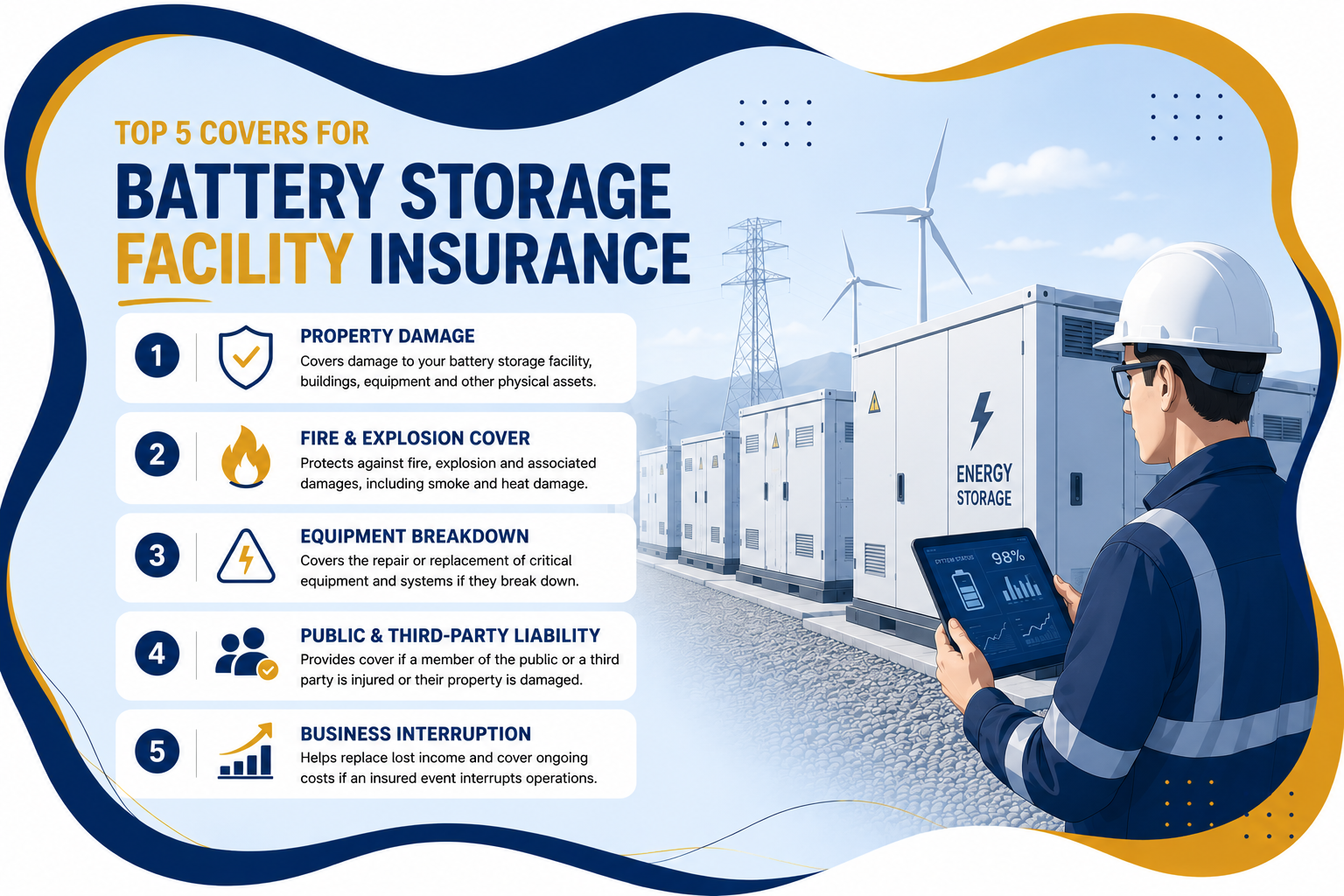
Property / Operational All Risks with explicit thermal runaway and fire propagation scope as primary response. Standard commercial property policies routinely sub-limit or exclude lithium-ion battery losses; specialist energy market placement is essential. Limits should match maximum probable loss assessment — typically the value of a full container array plus neighbouring asset damage. Business Interruption indemnity period needs to reflect realistic rebuild lead times for transformers and battery containers, which can be 12–24 months. Self-insured retentions on thermal runaway are typically £100k–£500k on grid-scale assets.
4. Risk 2: Balance of plant — transformers and contractor integration errors
Balance of Plant — The Underestimated Claim Frequency Driver
Industry underwriting commentary through 2025–2026 has steadily reframed BESS risk. While thermal runaway grabs headlines, balance-of-plant losses are increasingly driving claim frequency and aggregate severity. Specifically: high-voltage transformer failures (with 18–24 month replacement lead times in current supply chains); inverter and power conversion system (PCS) failures; switchgear faults; cabling and connection defects from rushed commissioning; and EPC contractor integration errors that produce latent defects manifesting months or years after handover. Tokio Marine GX underwriting commentary in March 2026 explicitly identified balance of plant as the area "keeping the insurance industry on its toes" — beyond battery fires themselves.
Independent Engineer review at construction, commissioning, and operational phases; documented EPC contractor experience and reference projects; warranty terms with clear back-to-back coverage from major OEMs (battery, inverter, transformer); commissioning testing aligned to IEC 62933 / IEC 62619 standards; periodic thermographic and partial discharge surveys on transformers and switchgear; condition monitoring on transformer oil, gas-in-oil analysis; remote SCADA monitoring with alarm escalation procedures; planned maintenance regime documented and audit-ready.
Property cover with explicit electrical breakdown scope (mechanical and electrical breakdown is routinely excluded from standard property cover and must be specifically added back). Transformer replacement sub-limits should reflect current lead times and replacement values (£500k–£3m per transformer common). Construction All Risks (CAR) cover during build phase with extended maintenance/defects period. Latent Defects Insurance (LDI) is increasingly relevant on larger projects. Professional Indemnity at the EPC contractor level supports recovery routes when integration errors are the proximate cause.
5. Risk 3: Environmental contamination from suppression water and off-gassing
Environmental Impairment Liability — The Suppression-Water Trap
BESS environmental exposure has two dominant claim profiles. First: contaminated firewater run-off following an incident — the 1,900 l/min water flow that the NFCC guidance mandates for firefighting, applied to a thermal runaway event, generates highly contaminated run-off containing dissolved lithium salts, transition metal compounds, electrolyte breakdown products, and combustion residues. Without containment (bunded ground, interceptor systems, run-off capture tanks), this contaminated water enters soil, surface water, and watercourses, triggering Environment Agency engagement under the Environmental Protection Act 1990. Remediation costs alone routinely run £150k–£2m+. Second: gradual contamination from off-gassing (carbon monoxide, hydrogen fluoride, hydrogen chloride, organic vapours) during cell failure that may not register as a discrete loss event but creates statutory nuisance and Section 80 enforcement exposure.
Bunded ground beneath BESS containers sized to contain maximum probable firewater volume; interceptor systems to surface water drainage; documented Emergency Response Plan including contaminated water management; spill response equipment on site; Environment Agency pre-engagement on environmental permit conditions; baseline environmental survey before construction (soil, groundwater) to evidence pre-existing condition; ongoing environmental monitoring during operation; written agreement with FRS on suppression methodology recognising environmental considerations.
Environmental Impairment Liability (EIL) as primary cover — standalone or as a comprehensive policy extension. Standard Public Liability typically excludes pollution and contamination through pollution exclusions; EIL fills this gap. Claims-made trigger basis is normal for EIL — meaning the policy must remain in force when the claim is made, not just when the event occurred. Limits typically £1m–£5m+ depending on facility size and proximity to sensitive receptors (watercourses, residential, agricultural land). Run-off cover important — EIL claims can surface years after the operational event.
6. Risk 4: Business interruption and revenue stream protection
Business Interruption — The Revenue Stream That Has to Survive a Loss
UK BESS revenue streams have diversified significantly through 2024–2026 — balancing services from the National Energy System Operator (NESO), wholesale arbitrage in day-ahead and intraday markets, capacity market payments, ancillary services contracts, and the new cap-and-floor LDES scheme that Ofgem expects to approve first projects under in Q2 2026. The combined revenue model is sensitive to operational availability — a 12-month outage on a 50 MW asset can lose £3m–£8m+ in revenue depending on market conditions and contracted commitments. Critically: rebuild lead times for grid-scale BESS containers and high-voltage transformers in current supply chains run 12–18 months at minimum, and 24+ months on transformers in tight supply windows.
Indemnity period sized to realistic combined rebuild + commissioning timeline (typically 18–24 months not 12); revenue calculation including all contracted revenue streams (capacity market, balancing services, ancillaries, energy arbitrage); modular design enabling partial operation during partial loss scenarios; spare critical components held (transformers, inverters) where economically viable; documented incident response plan with clearly defined operational recovery milestones; supplier agreements with replacement lead time commitments where available.
Business Interruption (BI) cover triggered by insured property damage, with indemnity period reflecting realistic recovery. Delay in Start-Up (DSU) cover during construction phase for revenue lost from delayed commissioning following insured construction-phase damage. Standalone Operational BI covers loss following operational-phase damage. Calculation of gross revenue must reflect the full multi-stream BESS revenue model — undervaluation at proposal is a common cause of underpayment at claim. Increased Cost of Working (ICW) cover for additional expenses incurred to minimise revenue loss. For more on BI principles see our delay in start-up insurance guide.
7. Risk 5: Cyber-attack on EMS and SCADA control systems
Cyber and Operational Technology — The Energy Sector's Targeted Risk
BESS facilities sit at the intersection of operational technology (OT) and information technology (IT) — the Battery Management System (BMS), Energy Management System (EMS), and Supervisory Control and Data Acquisition (SCADA) systems are network-connected for remote monitoring, dispatch optimisation, and grid services delivery. That connectivity creates attack surface. The UK energy sector has been a documented target for state-actor and criminal cyber attacks, and BESS operators above certain thresholds fall within the Network and Information Systems (NIS) Regulations 2018 as Operators of Essential Services with specific security and incident reporting duties. Attack vectors include ransomware targeting EMS workstations, manipulation of dispatch commands to force battery operation outside safe parameters (potentially triggering thermal events), and data exfiltration of trading strategy or capacity availability data.
Network segmentation between IT and OT environments; bastion/jump host architecture for remote access; multi-factor authentication on all EMS and SCADA access; documented vulnerability management programme on OT components; regular penetration testing including OT-specific assessment; SOC monitoring with OT visibility; incident response plan tested through tabletop exercises; supplier risk assessment of BMS/EMS vendors; NIS Regulations compliance documentation; cyber security ownership at executive level documented.
Cyber insurance with specific Operational Technology / Industrial Control System scope. Standard cyber policies focus on IT environments and data; BESS exposure requires OT-extended cover responding to physical damage and business interruption flowing from cyber events. Bricking cover (physical damage to OT components from cyber attack) is increasingly relevant. Limits £500k–£5m+ depending on facility scale. NIS Regulations defence costs are typically covered under Legal Expenses or D&O. For broader cyber principles see our cyber insurance product page and cyber insurance guide.
8. BESS insurance cover checker
Select your BESS operating profile below to see the cover matched to your specific risk profile. For broader commercial energy infrastructure principles see our commercial insurance hub.
BESS Insurance Cover Checker
Select your facility profile to see the recommended insurance programme matched to the 8 main BESS risks
Behind-the-Meter BESS (1-5 MW)
- LEGAL Employers' Liability £10m if site staff present
- ESSENTIAL Property / Operational All Risks at full reinstatement value with thermal runaway scope
- ESSENTIAL Public Liability £5m–£10m with pollution buyback
- ESSENTIAL Environmental Impairment Liability £1m–£2m
- ESSENTIAL Business Interruption — 12-18 month indemnity period
- ESSENTIAL Cyber insurance with OT extension £500k–£1m
- RECOMMENDED Electrical breakdown and equipment cover
- RECOMMENDED Terrorism cover (industry-standard add-on)
Small Grid-Scale BESS (5-20 MW)
- LEGAL Employers' Liability £10m
- ESSENTIAL Property / Operational All Risks with thermal runaway and electrical breakdown scope
- ESSENTIAL Public Liability £10m with pollution buyback
- ESSENTIAL Environmental Impairment Liability £2m–£5m
- ESSENTIAL Business Interruption — 18-24 month indemnity period reflecting transformer lead times
- ESSENTIAL Cyber with OT extension £1m–£2m
- ESSENTIAL Electrical breakdown / machinery breakdown
- ESSENTIAL Terrorism cover
- RECOMMENDED Performance / technology warranty cover
Mid-Scale BESS (20-100 MW)
- CRITICAL Specialist energy market placement only — generic commercial markets inadequate at this scale
- LEGAL Employers' Liability £10m comprehensive
- ESSENTIAL Property / Operational All Risks with comprehensive thermal runaway scope
- ESSENTIAL Public Liability £10m+ with full pollution buyback
- ESSENTIAL Environmental Impairment Liability £5m+
- ESSENTIAL Business Interruption — 24 month indemnity period
- ESSENTIAL Cyber with comprehensive OT scope £2m+
- ESSENTIAL Electrical breakdown with transformer sub-limits reflecting current values
- ESSENTIAL Terrorism cover
- ESSENTIAL D&O liability for governance and regulatory exposure
Large Grid-Scale BESS (100 MW+)
- CRITICAL Lloyd's market and specialist energy MGA placement essential — capacity sharing typical
- LEGAL Employers' Liability £10m comprehensive
- ESSENTIAL Property / Operational All Risks at full reinstatement, layered programme typical
- ESSENTIAL Public Liability £25m+ with full pollution buyback
- ESSENTIAL Environmental Impairment Liability £10m+
- ESSENTIAL Business Interruption — 24+ month indemnity reflecting transformer lead times
- ESSENTIAL Cyber with comprehensive OT scope, NIS Regs defence £5m+
- ESSENTIAL Electrical / machinery breakdown with bespoke transformer schedule
- ESSENTIAL Terrorism and political violence cover
- ESSENTIAL D&O liability comprehensive
- ESSENTIAL Independent Engineer monitoring and pre-loss surveys
BESS in Construction / Commissioning
- CRITICAL Construction phase carries concentrated risk — Thurrock February 2025 is the reference incident
- ESSENTIAL Construction All Risks (CAR) at full contract value plus 10% escalation
- ESSENTIAL Delay in Start-Up (DSU) cover with realistic delay scenarios
- ESSENTIAL Marine Cargo cover for battery container and transformer transit
- ESSENTIAL Public Liability with treatment/installation risk scope
- ESSENTIAL EPC contractor Professional Indemnity verified — back-to-back recovery route
- ESSENTIAL Extended Maintenance / Defects Liability period (typically 24 months post-handover)
- ESSENTIAL Latent Defects Insurance consideration on large projects
- ESSENTIAL Documented commissioning testing protocols per IEC 62933 / UL 9540A
Co-Located Solar + BESS
- CRITICAL Combined-risk placement — solar PV and BESS exposures intersect
- LEGAL Employers' Liability £10m comprehensive
- ESSENTIAL Property / OAR covering both solar PV and BESS components
- ESSENTIAL Cross-contamination consideration — solar PV damage from BESS fire and vice versa
- ESSENTIAL Public Liability £10m+ with pollution buyback
- ESSENTIAL Environmental Impairment Liability £5m+
- ESSENTIAL Business Interruption reflecting combined revenue streams
- ESSENTIAL Cyber with OT scope
- ESSENTIAL See solar power business insurance for PV-specific scope
9. NFCC readiness self-check
The NFCC's February 2026 guidance is the working underwriting baseline for UK BESS. Tick each compliance discipline your facility has in place. The unchecked items are your priority compliance and insurance gaps — and the items most likely to attract premium loadings or restricted terms at renewal.
NFCC BESS Readiness Self-Check
Click each compliance discipline you have in place. The more ticked, the lower your insurance exposure at proposal and renewal.
-
UL 9540A test reports held — cell, module, and unit level large-scale fire test documentation per the NFPA 855 / NFCC framework
-
Container spacing and separation aligned to the NFCC guidance — unit-to-unit and to occupied buildings, reduced only where UL 9540A testing justifies it, with explosion control between containers
-
Documented Emergency Response Plan developed in conjunction with the local Fire and Rescue Service, maintained and reviewed regularly
-
Water supply per NFCC standard — minimum 1,900 l/min for 120 minutes with strategically located hydrants tested and serviced regularly, or compliant Emergency Water Supply
-
Aspirating smoke detection and CO detection within containers — early warning detection with documented response procedures
-
Sprinkler / water mist suppression within containers designed to contain and extinguish fire, recognising thermal runaway reignition risk
-
Bunded ground / firewater containment sized to maximum probable firewater volume, with interceptor to surface water drainage
-
Vapour cloud and explosion control — explosion venting, ATEX-zone assessment where applicable per BS EN 60079
-
Battery Management System monitoring — cell-level temperature, voltage, impedance with alarm escalation and remote monitoring
-
Fire appliance access routes and turning circles documented and maintained, with safe operational distance from containers
-
Cell chemistry declared and risk-profiled — LFP vs NMC understood with associated thermal stability and propagation characteristics evidenced
-
Cyber / OT security framework with NIS Regulations alignment where applicable, network segmentation, MFA on EMS/SCADA access
-
Insurance specifically declared for BESS scope — written broker confirmation that thermal runaway, balance of plant, and environmental scope are within cover
10. BESS operation risk assessor
Two factors drive BESS operational risk and insurance pricing above all others: facility scale and the maturity of NFCC-aligned operational documentation. Use the tool below for your specific risk profile.
BESS Operation Risk Assessor
Select your facility scale and NFCC readiness to see your specific risk profile and indicative insurance package
11. Risk 6: Performance degradation and capacity loss
Performance Degradation — The Long-Tail Revenue Risk
Every lithium-ion BESS loses capacity over time — cycling stress, calendar ageing, and thermal exposure progressively reduce usable energy. OEM warranties typically guarantee 70–80% retained capacity at 10 years against specified cycle and operating conditions. Where capacity decline outpaces warranty expectations, two failure modes follow: (1) revenue underperformance against capacity market contracts, balancing services obligations, or cap-and-floor scheme commitments — triggering financial penalties or contract default; (2) OEM warranty disputes where the operator alleges defective product and the OEM alleges operator misuse (cycling outside guaranteed conditions, ambient temperature breaches, charging profile non-compliance). The disputes are routinely high-value and turn on operational data.
OEM warranty terms reviewed before procurement with legal input; warranty operating envelope documented and built into BMS limits; comprehensive operational data capture (cell voltage, temperature, cycle count, depth of discharge) retained for warranty period; periodic capacity testing per manufacturer protocol with documented results; SOC (state of charge) management aligned to warranty conditions; thermal management to keep cells within warranty temperature windows; capacity test independent verification where significant disputes anticipated.
Technology insurance / performance warranty cover sits outside traditional Property and Liability lines — a specialised market often integrated with project finance structures. Manufacturer's insolvency cover protects against OEM failure invalidating warranty. Performance gap cover responds where capacity decline exceeds OEM warranted curves. Business Interruption cover does not respond to gradual degradation — only to insured property damage events. For larger projects, integration with project finance insurance arrangements is typical.
12. Risk 7: Construction and commissioning phase exposure
Construction and Commissioning — The Concentrated Risk Window
The single highest claim-rate window in a BESS asset lifecycle is construction and commissioning. The February 2025 Thurrock fire broke out while the site was still under construction — the battery containers had been installed but the site was not yet energised, and the fire originated in a single containerised unit. Industry research consistently identifies the build and commissioning window as a disproportionately high-incident phase: containers being moved into position with no fire safety systems yet active; cabling and switchgear connections being made under live conditions; cell-level commissioning tests pushing units to operating extremes; multiple contractor disciplines on site simultaneously; emergency response plans not yet finalised. The construction phase value-at-risk equals or exceeds operational phase exposure, compressed into a 12–18 month timeline.
Beyond fire, construction risks include: marine cargo loss during battery container and transformer transit (typically from Asia for cells, Europe for transformers); installation damage; testing-phase electrical faults; weather and natural perils to partially constructed assets; theft of high-value components from open construction sites; and post-handover latent defects manifesting during the maintenance/defects liability period.
EPC contractor selection with documented BESS construction experience; phased commissioning with fire safety systems active before energisation; container-level commissioning protocols per UL 9540A and IEC 62933; CDM 2015 compliance with Principal Designer and Principal Contractor roles documented; site safety management plan covering simultaneous discipline operations; emergency response plan operational from commissioning start; weather protection during partial-build periods; site security with monitored CCTV and access control; structured handover testing with documented sign-off.
Construction All Risks (CAR) at full contract value plus 10% escalation, with named principal works and BESS-specific scope. Delay in Start-Up (DSU) cover responding to revenue loss from delayed commissioning following insured damage — see our delay in start-up insurance guide for principles. Marine Cargo for transit. Extended Maintenance / Defects Liability cover for the 12–24 month post-handover period. Latent Defects Insurance increasingly considered on grid-scale projects. EPC contractor Professional Indemnity verified before contract signature — back-to-back recovery route is essential. For broader construction principles see our contractors all risks insurance guide.
13. Risk 8: Insurance non-disclosure under the Insurance Act 2015
Insurance Non-Disclosure — The Most Preventable Catastrophe
The single most common reason UK insurance claims are reduced or declined isn't underwriting fraud — it's non-disclosure at the proposal or renewal stage. BESS operators sometimes buy generic commercial combined or property owner policies without specifically declaring grid-scale battery storage, lithium-ion chemistry, thermal runaway exposure, or NIS Regulations status. The Insurance Act 2015 requires businesses to make a "fair presentation of the risk" — proactively disclosing every material fact the insurer would want to know. Failure to do so allows the insurer to: avoid the policy (treating it as never having existed); reduce the claim proportionally to what would have been paid had proper disclosure been made; impose terms that would have applied with proper disclosure.
Annual review of declared activities against actual operations; written confirmation from broker that all current activities — including grid services, balancing market participation, capacity market obligations, ancillary services contracts, cap-and-floor scheme involvement — are within scope; specific declaration of cell chemistry (LFP / NMC / other); declaration of NIS Regulations status; mid-term notifications to broker when capacity is added or modified; documented response to broker enquiries at renewal; retention of policy documents and broker correspondence as evidence.
There is no insurance response to insurance non-disclosure — that's the whole point. The cover that should have responded doesn't. The only mitigation is at the proposal stage: detailed declaration, broker discipline, and renewal review. Specialist BESS broker placement makes a material difference here — generic commercial brokers may miss the specific declarations that BESS work requires, while specialist energy brokers know exactly what each insurer expects to see at proposal.
14. What drives the cost of BESS insurance in 2026?
BESS insurance pricing in 2026 reflects a hardened specialist energy market, materially higher reinsurance costs in the renewables space, and rapid evolution in underwriting expectations. Indicative annual premium ranges:
| Facility Profile | Indicative Annual Premium 2026 |
|---|---|
| Behind-the-meter BESS — 1-5 MW, LFP chemistry, NFCC-aligned | £8,000–£18,000 |
| Small grid-scale BESS — 5-20 MW, LFP/NMC, single site | £18,000–£42,000 |
| Mid-scale grid BESS — 20-100 MW, single site, NFCC-aligned | £40,000–£95,000 |
| Large grid-scale BESS — 100 MW+, mature operations | £85,000–£180,000+ |
| BESS in construction phase — CAR + DSU + Marine, 100 MW project | £120,000–£280,000+ (project total) |
| Portfolio operator — multiple sites, capacity sharing arrangement | Bespoke — typically blended rate 15–25% below single-site equivalent |
The factors below drive both insurance premium and overall risk management investment. The rating impact within each profile band is typically larger than the differential between profile bands — meaning a small grid-scale operator with strong NFCC documentation can pay less than a mid-scale operator with weak documentation.
| Rating Factor | Impact on Premium | What You Can Do |
|---|---|---|
| Cell chemistry (LFP vs NMC) | NMC typically 15–35% premium uplift vs LFP at equivalent scale | Where energy density allows, LFP preferred for insurance and safety; declare chemistry accurately |
| Installed capacity and configuration | Primary scaling factor — capacity drives sum insured and aggregate exposure | Declare accurately including planned expansion; modular configuration helps partial-loss scenarios |
| NFCC documentation maturity | Mature documentation reduces premium 15–25% across programme | UL 9540A reports, ERP with FRS engagement, water supply evidence, bunded containment |
| Container spacing and explosion control | Inadequate spacing attracts loadings or exclusions; NFCC-compliant attracts terms | Spacing justified by UL 9540A; documented explosion venting; thermal barriers |
| Suppression methodology | Sprinkler + water mist + adequate water supply scores best | Sized to NFCC 1,900 l/min for 120 min; EWS where remote |
| BMS / EMS sophistication | Cell-level monitoring with alarm escalation reduces premium 5–10% | Cell-level temperature, voltage, impedance; remote monitoring; documented alarm response |
| Proximity to sensitive receptors | Watercourses, residential, agricultural land add EIL premium 10–25% | Pre-construction siting decision; bunded containment; EA pre-engagement |
| EPC contractor track record | Documented BESS experience and reference projects reduce CAR premium | Verify references; documented contractor PI; back-to-back recovery |
| Cyber / OT security maturity | NIS Regs-aligned framework reduces cyber line 10–20% | Network segmentation, MFA, SOC, penetration testing, NIS compliance |
| Limits selected and structure | Layered programmes on grid-scale typical; sub-limits material | Match to contract requirements; transformer schedule specific |
| Indemnity period (BI) | 24 month vs 12 month reflects 60–90% BI premium uplift | Size to realistic combined rebuild + commissioning — transformer lead times |
| Claims history | 5+ year impact; thermal runaway claims particularly material | Root cause analysis and remedial documentation after any claim |
| Broker placement type | Specialist energy brokers access materially better terms | Use a broker with direct Lloyd's energy market and MGA relationships |
| Continuity with insurer | 3+ years with same insurer reduces renewal volatility | Strategic continuity decision; don't chase £5k savings on £100k programme |
15. Real claims and how to manage them
Claim — Thermal Runaway, £14.2 Million Settlement
A 50 MW grid-scale BESS facility on a coastal site, commissioned 2023, suffered a thermal runaway event in a single container during routine operation in late 2025. The proximate cause investigation identified a manufacturing defect in a single cell that progressed to thermal runaway over approximately 90 minutes despite BMS detection. Suppression activated, but propagation to adjacent cells within the same container could not be prevented. Fire and rescue services maintained a defensive perimeter for 36 hours allowing the container contents to burn out under controlled conditions. Two adjacent containers sustained heat damage but did not progress to thermal runaway, attributed to the NFCC-aligned spacing and thermal barriers installed.
Loss components: complete loss of one container (battery, BMS, container, internal cabling, suppression system) £1.8m; heat damage to two adjacent containers requiring full module replacement £2.4m; transformer damage from heat and contaminated suppression water £1.6m; site remediation including soil contamination from suppression water run-off (the bunded containment partially failed under volume) £2.1m; business interruption over 16-month rebuild period covering capacity market default penalties, lost balancing services revenue, and arbitrage revenue £5.8m; legal and engineering investigation costs £0.5m. Total: £14.2 million.
Insurance response: Property / Operational All Risks responded for property damage (£5.8m); Environmental Impairment Liability for contamination remediation (£2.1m, sub-limit reached); Business Interruption with 24-month indemnity period responded for full revenue loss (£5.8m); defence costs absorbed within Legal Expenses provision (£0.5m). Total recovered: £14.2m against combined policy aggregate.
Post-claim renewal: the facility's premium increased 65% at the next renewal; insurer required UL 9540A re-testing of remaining stock, enhanced bunded containment with secondary containment capacity, additional fire-service-discharge facilities on the EWS, and quarterly BMS data review by an independent engineer. Two markets withdrew from the programme; replacement capacity secured at specialist Lloyd's syndicate level. The lesson: NFCC-aligned design materially limited the loss — spacing and thermal barriers prevented multi-container progression that would have multiplied the property loss 3–5x. The same design discipline made the post-claim placement possible.
Claim — Transformer Failure and Extended BI, £6.8 Million Settlement
A 30 MW BESS facility — 2 years into operation, no battery-related issues — suffered a catastrophic failure of the site's primary 33/11 kV transformer during a routine cycling operation. Root cause: a manufacturing defect in transformer windings that had progressed under cyclical load to insulation failure and internal arcing. Adjacent infrastructure was not damaged but the site was rendered non-operational. Replacement transformer lead time from order placement: 19 months at prevailing supply chain conditions.
Loss components: transformer replacement cost £2.4m (including premium for expedited delivery); switchgear damage from arc fault £0.6m; site reconfiguration costs £0.3m; business interruption over the 19-month outage covering capacity market default, balancing services contract penalties, and lost arbitrage £3.2m; investigation and engineering oversight costs £0.3m. Total: £6.8 million.
Insurance response: Property cover with electrical breakdown scope responded for transformer and switchgear (£3.0m); Business Interruption with 24-month indemnity period responded for revenue loss (£3.2m); Legal and engineering costs (£0.3m); transformer replacement premium (£0.3m) covered as Increased Cost of Working. Total recovered: £6.8m. Defence costs absorbed: £180k.
Post-claim renewal: premium increased 30%; insurer required quarterly transformer thermographic and partial discharge surveys, gas-in-oil analysis quarterly rather than annually, spare transformer windings held by EPC contractor on retained-stock basis, and BMS cycle data analysis to confirm transformer was not being driven outside operating envelope. The OEM warranty position was disputed — the transformer manufacturer alleged misuse from heavy cycling; the operator demonstrated operation within warranty envelope. The dispute is ongoing in arbitration.
The lesson: balance of plant — particularly transformers — is now equal to thermal runaway as a severity driver. The 19-month replacement lead time made the BI loss far larger than the property loss. Adequate BI indemnity period is the single most important coverage decision after Property limits themselves. The OEM warranty dispute illustrates why operational data discipline matters — without it, defending the operator's position would have been very difficult.
Claim — Cyber Attack on EMS, £1.9 Million Settlement
A 20 MW BESS operator with three sites operating across the UK suffered a ransomware attack on the central Energy Management System (EMS) cloud workstation. The attack vector was a compromised credential from a third-party maintenance contractor with EMS access. Threat actor encrypted EMS configuration data and trading strategy data, with secondary impact on the SCADA bridge that pushed dispatch commands to site-level BMS systems. For 11 days, the operator could not safely dispatch the facilities; manual fallback procedures were used for limited operation but capacity market and balancing services obligations could not be met.
Loss components: forensic investigation and incident response £180k; ransomware payment was declined (against insurance terms); EMS rebuild and clean reinstatement £140k; capacity market default penalties across three sites £620k; balancing services contract default and reputational reset £380k; legal costs including NIS Regulations engagement with the competent authority and ICO notification £165k; business interruption (lost arbitrage and ancillary revenue) £415k. Total: £1.9 million.
Insurance response: Cyber insurance with OT extension responded for incident response, ransomware investigation, EMS rebuild, business interruption from cyber event, and legal/regulatory defence. Property / OAR did not respond (no physical damage occurred). The OT extension was critical — standard cyber cover often excludes operational technology impact and would have left the operational interruption losses uninsured. NIS Regulations defence cost responded under Legal Expenses extension. Total recovered: £1.85m (vs £1.9m loss with small uninsured retention).
Post-claim renewal: cyber premium increased 50%; insurer required third-party access management improvements, MFA on all EMS access (extended to contractors), quarterly penetration testing with OT-specific scope, SOC monitoring with OT visibility, and documented incident response plan rehearsed via tabletop exercise. The third-party contractor's PI policy was engaged for recovery — partial recovery of £180k. The lesson: BESS cyber exposure is not theoretical — energy infrastructure is targeted, third-party access is the dominant vector, and standard cyber cover without OT extension is materially inadequate.
Claims Management Steps
How to respond to a BESS incident or regulatory engagement — the steps below are critical given the multi-policy and multi-regulator exposure typical of 2026 BESS operations:
- Make the site safe and protect persons first. Standard response. Engage the local Fire and Rescue Service immediately per Emergency Response Plan. For thermal runaway events, expect defensive containment over 24–72 hours; do not attempt manual intervention. Evacuate to safe distance accounting for vapour cloud and explosion exposure.
- Notify your insurer immediately for any potential claim. BESS incidents typically engage multiple policies (Property, EIL, BI, Cyber, Legal Expenses, D&O). Single notification triggers coordinated response. Threshold is "may give rise to a claim" — much lower than "formal claim received". Major insurer specialist energy claim teams respond within hours.
- Preserve all documentation rigorously. Pre-incident BMS data; alarm logs; SCADA event records; suppression activation logs; CCTV; site security records; personnel logs; chemistry and configuration documentation; UL 9540A reports; NFCC-aligned ERP; maintenance records. The documentation pack is the defence across all coverage layers.
- Do not admit liability or fault. Provide factual information about what happened. Do not accept fault, apologise in writing, or commit to remedial work that could be interpreted as admission. Specialist energy claim teams will direct communication strategy.
- Manage HSE / Environment Agency / FRS / NIS regulator engagement carefully. Multiple regulators may attend or notify. HSE under HSAW 1974; Environment Agency under Environmental Protection Act 1990; FRS under Fire and Rescue Services Act 2004; competent authority under NIS Regulations 2018 for cyber events. Engage Legal Expenses insurer immediately. Cooperate factually but no written statements without legal representation.
- Engage independent engineering investigation early. Root cause investigation is essential for both insurance and regulatory defence. Independent engineers acceptable to insurers should attend within 48–72 hours of safe access. Investigation outcomes affect all subsequent coverage decisions and future renewal terms.
- Manage OEM warranty position alongside insurance. Cell, BMS, transformer, and inverter OEMs all have warranty interests in incident root cause findings. Their investigations may run parallel to insurer investigation. Subrogation rights typically flow through insurer to OEM where defective product is cause; documented operational data is essential.
- Update operational documentation to address gap. Where the claim identifies a documentation or technical gap (BMS data, ERP, water supply, bunded containment), update the standard operating procedure to close the gap. This is both insurance defence at the next renewal and regulatory defence under HSE/EA improvement notices.

Glossary of BESS insurance terms
- BESS (Battery Energy Storage System)
- A system that stores electricity in batteries — typically lithium-ion — for release back to the grid or to a local load. Grid-scale BESS in the UK are typically 1 MW or larger and may reach 100 MW+ installed capacity at a single site.
- Thermal Runaway
- The failure mode in which a damaged or defective lithium-ion cell self-heats past a critical threshold, decomposes its electrolyte, and propagates failure to adjacent cells. Generates extreme heat, flammable gases, and toxic vapours. The dominant catastrophic loss scenario in BESS insurance.
- NFCC Grid Scale BESS Guidance
- The National Fire Chiefs Council's "Grid Scale Battery Energy Storage System Planning — Guidance for Fire and Rescue Services". The 2026 revision (approved December 2025, published February 2026) is the working underwriting baseline for UK BESS, replacing the 2023 first edition.
- NFPA 855
- US National Fire Protection Association Standard for the Installation of Stationary Energy Storage Systems. The global reference standard for BESS fire safety, substantially aligned with the revised UK NFCC guidance.
- UL 9540A
- Test method developed by UL for evaluating thermal runaway and fire propagation behaviour in BESS under worst-case failure conditions. Results inform container spacing, suppression selection, and hazard zoning. Now an underwriting precondition for UK grid-scale BESS.
- LFP (Lithium Iron Phosphate)
- A lithium-ion battery chemistry favoured for thermal stability and safety; typically attracts more competitive insurance terms than NMC. Dominant in UK grid-scale BESS deployment.
- NMC (Lithium Nickel Manganese Cobalt Oxide)
- A lithium-ion battery chemistry with higher energy density than LFP but greater thermal runaway risk. Attracts higher insurance premiums and stricter conditions; cobalt supply chain concerns add economic risk.
- BMS (Battery Management System)
- The electronic system managing battery operation including cell-level voltage, temperature, and impedance monitoring, charge/discharge control, safety alarms, and fault response. Sophistication of BMS is a primary insurance rating factor.
- EMS (Energy Management System)
- The higher-level system optimising BESS dispatch across multiple revenue streams (capacity market, balancing services, arbitrage). Cyber attack target due to network connectivity.
- SCADA
- Supervisory Control and Data Acquisition — the industrial control system layer that pushes operational commands to BMS and balance-of-plant components. Critical for grid services and a primary cyber attack vector.
- Balance of Plant (BoP)
- All BESS components other than the battery cells themselves — transformers, inverters, switchgear, cabling, suppression systems, containment. Increasingly a dominant claim driver in UK BESS insurance.
- EPC (Engineering, Procurement, Construction)
- The contracting model for BESS facility delivery — a single contractor delivering engineering, procurement, and construction. EPC contractor experience and PI cover are key underwriting inputs.
- EIL (Environmental Impairment Liability)
- Specialist insurance covering pollution, contamination, and environmental damage. Material for BESS due to suppression water contamination, off-gassing, and electrolyte breakdown products. Standard PL excludes pollution.
- DSU (Delay in Start-Up)
- Insurance covering revenue lost from delayed commissioning following insured construction-phase damage. Material for BESS construction projects where commissioning is a concentrated risk window.
- Cap-and-Floor / LDES Scheme
- Ofgem's revenue support scheme for long-duration electricity storage providing a guaranteed minimum revenue (floor) and limit on revenues (cap). First projects expected during 2026. Affects BESS revenue modelling for BI cover purposes.
- NIS Regulations 2018
- The Network and Information Systems Regulations 2018 — UK implementation of the EU NIS Directive. BESS operators above certain thresholds are Operators of Essential Services with security and incident reporting duties. Cyber underwriting input.
- Operator of Essential Services (OES)
- Designation under NIS Regulations applied to certain energy sector operators including some BESS operators. Triggers specific security, governance, and incident reporting obligations.
- Vapour Cloud
- Flammable and toxic gas cloud released from cell failure or thermal runaway. Includes hydrogen, carbon monoxide, hydrocarbons, and decomposition products. Explosion control and ventilation are specific NFCC design areas.
- Emergency Water Supply (EWS)
- Water supply meeting NFCC 1,900 l/min for 120 minutes standard for sites remote from pressure-fed water — typically above-ground tanks with fire-service discharge facilities.
- Fair Presentation of Risk
- The duty under the Insurance Act 2015 requiring businesses to proactively disclose every material fact to insurers at proposal and renewal. Breach allows insurer to avoid the policy, reduce claims proportionally, or impose alternative terms.
Frequently asked questions
Battery storage facility insurance is specialist commercial insurance designed for Battery Energy Storage Systems (BESS). The core covers in 2026 are: Property / Operational All Risks with thermal runaway and fire propagation scope; Public Liability with pollution buyback; Environmental Impairment Liability for contamination from suppression water and off-gassing; Business Interruption with 18-24 month indemnity period reflecting transformer lead times; Cyber insurance with Operational Technology extension; electrical/machinery breakdown for transformers and inverters; Employers' Liability where staff present; D&O liability at scale. Cover differs fundamentally from generic commercial combined or property owner policies, which typically exclude or sub-limit lithium-ion battery exposure and contamination from thermal runaway events.
The National Fire Chiefs Council's revised Grid Scale BESS Planning Guidance (approved December 2025, published February 2026) is the working underwriting baseline for UK BESS in 2026. Practical insurance impact: UL 9540A testing is now an underwriting precondition; container spacing must be justified by 9540A; water supply must meet 1,900 l/min for 120 minutes; Emergency Response Plan developed with the local Fire and Rescue Service is mandatory documentation at proposal; LFP and NMC chemistries are priced differently. Sites that meet the revised NFCC standards attract competitive terms; sites that don't face material loadings, exclusions, or capacity withdrawal.
Indicative 2026 annual premiums: behind-the-meter BESS (1-5 MW) £8,000–£18,000; small grid-scale (5-20 MW) £18,000–£42,000; mid-scale (20-100 MW) £40,000–£95,000; large grid-scale (100 MW+) £85,000–£180,000+; construction phase (CAR + DSU + Marine, 100 MW project) £120,000–£280,000+. Pricing depends on cell chemistry (LFP vs NMC), NFCC documentation maturity, container spacing, suppression, BMS sophistication, proximity to sensitive receptors, EPC contractor track record, claims history, limits, and broker placement type. Specialist energy market placement is essential at all scales above behind-the-meter.
Employers' Liability is legally required if you have staff under the Employers' Liability (Compulsory Insurance) Act 1969 — fines of £2,500 per day for non-compliance. Public Liability is not legally required but is contractually required by virtually all grid services counterparties, Distribution Network Operators (DNOs), and capacity market contracts. Planning conditions and environmental permits commonly specify minimum insurance. NIS Regulations 2018 do not directly require insurance but operational risk management duties make cyber insurance commercially essential. Cap-and-floor LDES scheme conditions are expected to specify insurance requirements as the scheme matures through 2026.
Only if specifically scoped. Generic commercial property cover typically excludes lithium-ion battery losses through electrical breakdown exclusions, or sub-limits them to commercially inadequate amounts. Specialist BESS Property / Operational All Risks should explicitly cover thermal runaway, fire propagation between containers, suppression activation damage, and consequential damage to balance of plant. Get written broker confirmation that thermal runaway is within scope and that sub-limits are commercially adequate. This is the headline catastrophic exposure and the most common cover gap in non-specialist placements. The premium uplift for proper scope is material but the claim exposure without it is potentially the entire facility value.
LFP (lithium-iron-phosphate) has better thermal stability, lower probability of thermal runaway, and slower fire propagation when failure does occur. NMC (lithium-nickel-manganese-cobalt-oxide) has higher energy density (smaller footprint for same capacity) but greater thermal runaway risk and faster propagation. Insurance impact: LFP typically attracts more competitive terms and lower premium (15–35% differential at equivalent scale); NMC requires tighter container spacing, more conservative suppression sizing, and faces capacity restrictions in some markets. Both chemistries need full NFCC-aligned design; chemistry is not a substitute for engineering rigour. Chemistry must be specifically declared at proposal under Insurance Act 2015 fair presentation duties.
The principal works contractor (EPC contractor) requires Professional Indemnity to support back-to-back recovery if integration errors cause loss after handover. Facility owners and operators don't typically require PI cover for routine operations, but consultants providing advisory services to BESS projects (independent engineers, technical advisors, planning consultants, environmental consultants) absolutely need PI scoped for BESS work. Limits typically £1m–£5m depending on contract values. Run-off cover important — BESS technical disputes can surface years after the original advice. See our professional indemnity insurance guide for cover principles.
Three contenders. First, insurance non-disclosure under the Insurance Act 2015 — operators buying generic commercial combined cover without declaring BESS specifics. Second, Business Interruption indemnity period sized to 12 months when current transformer lead times require 18–24 months — underinsurance at claim. Third, contamination sub-limits within Public Liability rather than dedicated Environmental Impairment Liability — leaving the suppression-water contamination loss either uninsured or massively underinsured. All three are preventable at proposal stage; all three are catastrophic at claim stage if the gaps are present.
The single biggest lever is full NFCC documentation: UL 9540A reports, Emergency Response Plan with FRS engagement, water supply evidence, bunded firewater containment, container spacing justification, suppression methodology, BMS alarm escalation procedures. Mature documentation reduces premium 15–25% across the programme. Other levers: LFP chemistry preference where energy density allows; specialist energy market placement (vs generic commercial); accurate limits matched to contract requirements; 24-month BI indemnity period sized realistically; 3+ years continuity with same insurer; D&O programme demonstrating governance maturity; cyber/OT security framework with NIS Regulations alignment. Stack the levers; don't choose between them. The largest saving on the programme is avoiding the largest gaps — not chasing the cheapest premium.
Yes, where scoped correctly. Standard property cover routinely excludes electrical and mechanical breakdown, which must be specifically added back through machinery breakdown / electrical breakdown extensions. Transformer sub-limits should reflect current replacement values (£500k–£3m per transformer common) and current lead times (12–24 months). Switchgear, inverter, PCS, and balance-of-plant cabling all need explicit scope. Business Interruption indemnity period must reflect the longest realistic component replacement lead time. Balance of plant is now a dominant claim driver alongside thermal runaway — generic property cover that contemplates "fire and natural perils" without electrical breakdown is materially inadequate.
Construction is the concentrated risk window. Required cover: Construction All Risks (CAR) at full contract value plus 10% escalation; Delay in Start-Up (DSU) for revenue lost from delayed commissioning following insured damage; Marine Cargo for battery container and transformer transit; Public Liability with installation risk scope; Extended Maintenance / Defects Liability period (typically 24 months post-handover); EPC contractor Professional Indemnity verified with back-to-back recovery route. Latent Defects Insurance is increasingly considered on grid-scale projects. Specialist energy market placement is essential — the February 2025 Thurrock fire broke out during construction before the site was energised, and is now the reference point for construction and commissioning-phase BESS underwriting.
Look for brokers with specific experience in renewable energy and BESS evidenced by: specialist articles on BESS, NFCC guidance, and thermal runaway cover; direct access to Lloyd's energy syndicates and specialist energy MGAs (not just mainstream commercial markets); willingness to discuss specific exposures (thermal runaway, balance of plant, environmental impairment, cyber/OT, NFCC alignment) in detail; FCA authorisation and documented track record. Avoid brokers offering "commercial combined" without discussing BESS specifics; brokers quoting only generic property markets; brokers not asking about cell chemistry, NFCC documentation, or NIS Regulations status at proposal. Miller & Partner specialise in this sector — see our commercial insurance hub and energy-adjacent guides on solar power, EV charging, and sustainability business insurance.
Related guides from Miller & Partner
Related specialist cover
Cover across the renewables supply chain
Battery sites depend on installers and contractors who need specialist cover of their own.
- Renewable energy installer insuranceLiability, PI and contract works for solar, battery and heat pump installers.
- Air source heat pump installer insuranceCover for heat pump installers, including workmanship and design liability.
- EV charging installer insuranceLiability and workmanship cover for chargepoint installers.
- Solar panel installation insuranceCover for solar PV installers, from roof work to design liability.






Instagram
LinkedIn