


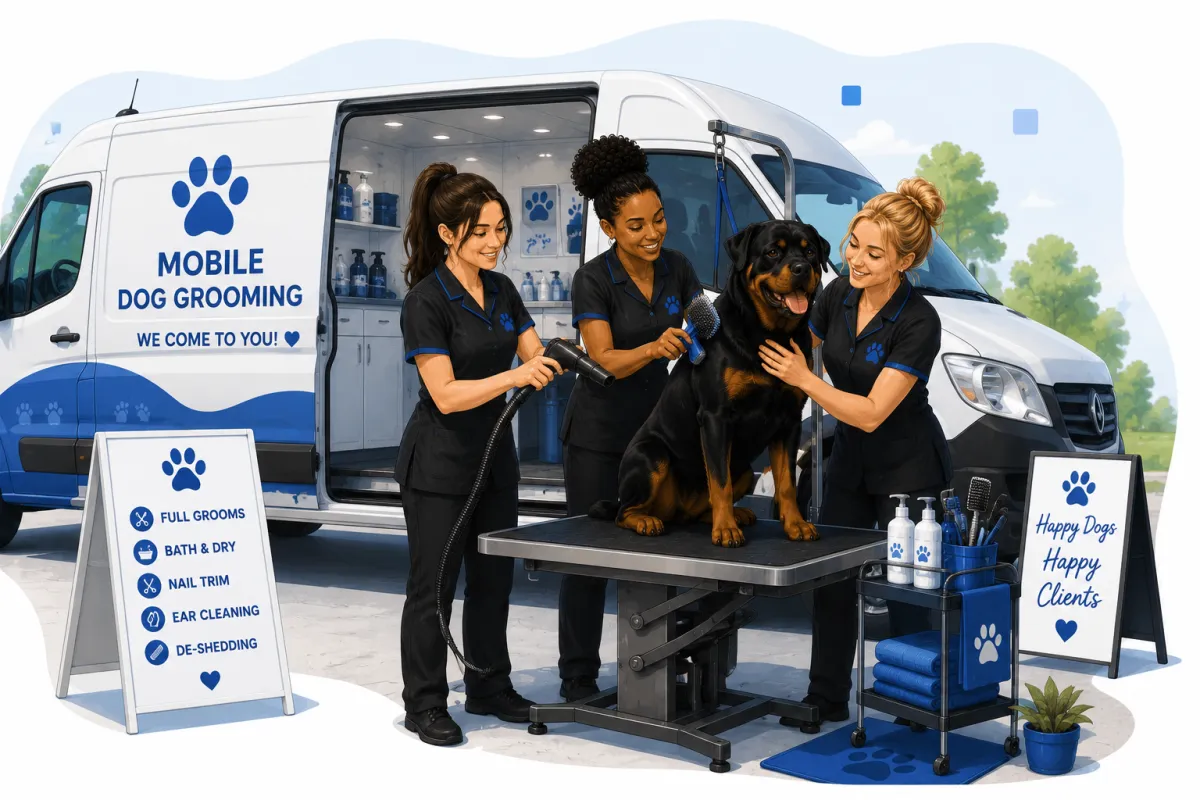
Mobile Dog Groomer Insurance Specialist - Our Guide 2026
Why does mobile dog grooming need specialist insurance treatment in 2026?
Mobile dog grooming is one of the fastest-growing pet service sectors in the UK. Pet ownership remains historically elevated post-pandemic, premium owners increasingly want at-home convenience, and the operational model — one groomer, one converted van, a regular route of repeat clients — is well-suited to a solo trader or small family business. From an insurance broker's perspective, however, the mobile dog groomer is one of the most under-insured small businesses in the UK. Most operators buy an off-the-shelf "pet business" policy through a comparison site and assume the box is ticked. It usually isn't.
The reason is straightforward. A mobile dog groomer isn't really running one business — they're running three at the same time. They are an animal care professional under the Animal Welfare Act 2006 with a Section 9 duty of care to every dog in their van. They are a commercial vehicle operator with a converted van containing a 190-250 litre water tank, a generator or lithium battery bank, RCD-protected mains supply, gas or electric water heating, and £8,000-£20,000 of grooming equipment. And they are a visiting tradesperson entering customer driveways, parking on kerbside outside private homes, and running cables across pavements. Each of those three identities has its own insurance exposure profile. A single generic pet-business policy almost never addresses all three properly.
This guide is the definitive 2026 mobile dog groomer insurance article — built around the genuine risk profile of a converted-van grooming business, the specific covers that respond, the Animal Welfare Act duty that sits behind every job, and the documentation that defends a claim. It sits alongside Miller & Partner's main dog grooming insurance product page, and complements our wider pet-services and small-business cluster including the exotic pet business insurance guide, sole proprietorship insurance guide, and the professional indemnity insurance guidance applicable where grooming advice is given.
Key facts at a glance
- Mobile dog groomers operate under three overlapping regulatory frameworks — the Animal Welfare Act 2006 (Section 9 duty of care), the Health and Safety at Work etc. Act 1974 (for any employed help), and commercial motor regulation for the converted vehicle. Each carries its own offence framework and insurance response.
- Care, Custody & Control (CCC) cover is the dog-grooming-specific extension you cannot operate without — standard Public Liability typically excludes injury to property "in your care, custody or control". A dog under UK law is the legal property of its owner. Without CCC, the dog in your van isn't covered.
- Animal Welfare Act 2006 offences carry unlimited fines, up to 5 years' imprisonment and lifetime pet-keeping bans — penalties were increased by the Animal Welfare (Sentencing) Act 2021. A failed-duty-of-care conviction also ends the business.
- The converted grooming van is the highest-value single asset and the highest-loss-severity exposure — a £25,000-£60,000 fully-equipped grooming van combines vehicle, equipment, water-system, electrical and stock risks in one mobile package. Generic van insurance will not cover the conversion contents.
- The most common cover gap is "tools in vehicle overnight" — most basic policies exclude equipment theft from an unattended vehicle overnight, exactly when most mobile groomers' equipment is stolen. Specialist placement removes this restriction or provides clear written terms for compliance.
- Mobile dog groomer insurance premiums typically run £180–£650 for a sole trader on basic cover and £700–£2,200 for a small mobile operation with employed help — pricing depends on van value, qualification (City & Guilds Level 3, iPET), claims history, and limits selected.
- Insurance non-disclosure under the Insurance Act 2015 is the most preventable catastrophe — operating mobile (rather than salon-based) grooming under a salon policy, or failing to declare hydrobath, generator, or employed help, creates uninsured loss exposure that can dwarf a decade of correctly priced premium.
1. What are the 8 biggest mobile dog grooming risks?
The risks below are ranked by a combination of claim frequency, claim severity, and how often a standard pet-business policy fails to respond to them properly. Some — minor clipper cuts, customer driveway damage — are routine and quickly resolved. Others — Animal Welfare Act prosecution, a van fire while the dog is inside — are rare but business-ending when they happen. The intelligent operator understands all eight and structures cover around the genuine pattern rather than the basic comparison-site checklist.
| Risk | Frequency | Severity | Primary Cover |
|---|---|---|---|
| Animal injury — clipper cuts, nail quick, ear nicks | Common — routine across a career | Low-Medium (£200–£3,500 typical vet) | Care, Custody & Control (CCC) |
| Dog escape, bite injury, third-party harm | Occasional | Medium-High (£3,000–£40,000) | Public Liability with CCC |
| Converted van fire, water leak, electrical fault | Rare per van but rising with battery banks | High (£15,000–£80,000+ van + contents) | Commercial Vehicle + Equipment / Conversion |
| Customer property damage (driveway, fence, kerbstone) | Routine — low value | Low (£100–£3,500 typical) | Public Liability |
| Equipment theft — tools in vehicle overnight | Common | Medium (£3,000–£15,000) | Tools / Equipment cover with overnight scope |
| Commercial vehicle / road traffic incident | Statistically routine | Medium-High (£5,000–£60,000+) | Commercial Vehicle Insurance |
| Allergic reaction, undiagnosed illness, vet liability | Occasional | Medium (£1,500–£12,000 typical) | CCC with vet-fee extension; Professional Indemnity for advice |
| Animal Welfare Act / HSE prosecution & non-disclosure | Rare per business | Catastrophic (unlimited fine + prison + ban) | Legal Expenses; cover voided by non-disclosure |
2. How does the Animal Welfare Act 2006 affect mobile dog groomers?
Mobile dog grooming sits squarely inside the framework of the Animal Welfare Act 2006. Parliament confirmed in a November 2025 written answer that the Act applies to "anyone operating a dog grooming business" — meaning a sole trader running a single converted van from their driveway carries the same duty as a national chain. The two sections that matter most:
Section 4 — Unnecessary suffering. An offence to cause an animal to suffer where the suffering could reasonably have been avoided, including by omission. A clipper burn from a hot blade left in contact too long, a hydrobath delivered at scalding temperature, or a dog left in a hot van during a service break could all engage Section 4 depending on the facts.
Section 9 — Duty of care. A positive duty on anyone responsible for an animal to ensure its welfare needs are met. For a groomer this includes safe handling, suitable environment (temperature, ventilation, humane restraint), appropriate equipment, and not exposing the animal to fear or distress that could reasonably have been avoided. Section 9 is the section most likely to bite a groomer because it's a duty of care, not just a prohibition on cruelty.
Penalties were materially strengthened by the Animal Welfare (Sentencing) Act 2021, which raised the maximum prison sentence for serious offences to five years (from six months) and confirmed unlimited fines. Magistrates can impose lifetime disqualification from keeping, transporting, or being responsible for animals — which for a groomer is functionally a career-ending order. Local authorities, the police, the RSPCA, and DEFRA can all investigate; prosecutions can be brought up to three years after the offence under certain evidential conditions.
What this means for the mobile groomer specifically
The mobile context introduces three exposures the salon-based groomer doesn't face to the same extent:
- Van temperature management. A grooming van in summer can reach interior temperatures rapidly even when parked in shade. Heat-stress incidents engage both Section 4 (suffering) and Section 9 (failure to provide suitable environment). Insurance underwriters increasingly ask about van climate control at proposal.
- Solo working with no second-pair-of-hands. A salon-based groomer can hand off a difficult dog or call a colleague. The mobile groomer is alone in a confined space with a restraint situation. Equipment used in moments of stress (slip leads, grooming arms) can be misapplied; the welfare consequences land back on the groomer.
- Transit responsibility. If the owner asks the groomer to drop the dog at a vet, daycare, or relative's home after grooming, the Section 9 duty travels with the dog. The van's restraint, ventilation, and journey conditions all become part of the duty footprint.
3. Risk 1: Animal injury and Care, Custody & Control claims
Animal Injury and Care, Custody & Control — The Core Mobile Grooming Claim
The single most frequent claim against a mobile dog groomer is injury to the dog being groomed. Clipper cuts, nicked ears, nail quicks, eye irritation from shampoo splash, hot-blade contact burns, and minor lacerations are all part of the realistic claim universe even for an experienced groomer. The legal mechanics matter: under UK law, a dog is the legal property of its owner. When the dog is in the groomer's van being clipped or bathed, it is property "in the care, custody or control" of the groomer. Standard Public Liability policies routinely exclude property in your care, custody or control — meaning a basic PL policy will not respond to a clipper-cut claim without a specific Care, Custody & Control (CCC) extension.
Recognised qualification (City & Guilds Level 3 Diploma in Dog Grooming, iPET Network certification, or PIF / British Dog Groomers' Association membership); pre-groom temperament and health intake on every new client with written record; visible warning of nervous, elderly, or medically complex dogs; blade temperature monitoring during long sessions; sharp-edged blade replacement schedule; humane restraint protocols (no-pull grooming arm with quick-release); first-aid kit including styptic powder and saline rinse; immediate written incident report for any minor injury and notification to owner before they collect; never minimise or apologise in writing without broker / insurer guidance.
Care, Custody & Control (CCC) extension to Public Liability is the primary response — typically £25,000–£100,000 per animal sub-limit. A vet-fee extension covering treatment costs without admission of liability is the operational claim handler (sub-limit usually £1,500–£5,000 per incident). Most low-value claims settle directly via the vet-fee extension; only the higher-value or contested ones escalate to the CCC liability layer. Generic pet-business cover often excludes vet fees entirely or sub-limits them at £500 — a gap that creates routine out-of-pocket cost.
4. Risk 2: Converted van fire, water and electrical exposure
Converted Grooming Van — The Highest-Value Single Asset
A modern UK mobile grooming van is a small wet-trade workshop on wheels. A typical fit-out includes a 190–250 litre fresh water tank, a quick-heat water system (sometimes propane-assisted, sometimes electric), a hydrobath, an electric grooming table, a high-velocity dryer, RCD-protected 13A mains supply through an external inlet, internal LED lighting, and — increasingly — a 5–8kWh lithium-ion battery bank with inverter as an alternative to generators. The combined value of vehicle, conversion, and tools is typically £25,000–£60,000. Three failure modes drive the high-severity claims:
- Electrical fire. Faulty wiring at the conversion stage, inadequate RCD protection, or thermal failure of a lithium battery bank. UK lithium-ion fires in mobile applications have increased materially through 2024–2026.
- Water leak. A 250-litre tank failing during transit, or a hydrobath drain leaking into a customer's driveway, garage, or worse, into the cab electrical loom. Water damage to the vehicle structure is high-severity because the van often becomes uneconomic to repair.
- Theft of the whole van. A converted grooming van parked on a residential driveway overnight is a high-value, identifiable target. Recovery rates for stolen commercial vans are low; the conversion is almost always a total loss.
Conversion installer with electrical work certified by a competent person under Part P of the Building Regulations where applicable and BS 7671 compliant; written electrical certificate from a registered electrician retained for the insurance file; lithium battery bank from a recognised UK supplier with installation warranty; smoke and heat detector in the working compartment; water tank inspected annually; secure overnight parking (driveway with motion lighting minimum; off-street ideal); Thatcham-approved alarm and immobiliser; trackable equipment in the van.
A standard commercial van insurance policy covers the vehicle itself but typically excludes the conversion contents — water tank, hydrobath, electrical fit-out, table, dryer — because these aren't part of the original manufacturer's spec. The conversion must be declared and covered either by extending the van policy to include the conversion, by a separate equipment policy with vehicle-mounted scope, or — the cleanest option — through a specialist mobile pet services package that handles both as a single risk. Cleaning up after a van fire claim where the conversion wasn't declared is the most painful uninsured loss in the mobile grooming sector. See our commercial vehicle insurance cost guide for the underlying van pricing principles.
5. Risk 3: Dog escape, bite injury and third-party harm
Dog Escape and Third-Party Bite — The Public Liability Driver
The defining mobile-specific PL claim is dog escape. A dog handed over by an owner on a driveway, transferred into the van, and groomed for two hours has opportunities to escape that a salon-based groomer rarely faces: the open van door at handover, the customer's gate not being closed properly, the kerbside transfer back to the owner with traffic passing, the slip lead failure. Once a dog escapes the groomer's immediate control, the claim universe opens up significantly: third-party bite injury, road traffic accident caused by the dog, damage to neighbouring property, and — in extreme cases — engagement of the Dangerous Dogs Act 1991 if the dog injures a person while out of control.
The legal position complicates further because the dog's owner is also liable. UK insurance claims following a bite typically involve both the groomer's PL insurer and the owner's home insurance / pet liability — but the groomer is the immediate gatekeeper and the first port of call.
Double-handover protocol — owner brings dog to van, groomer takes lead before the owner releases; never accept a dog through an open garden gate; secure transfer to the van's interior before opening the side door fully; van interior fitted with a secondary safety door guard or restraint; written intake document logging temperament, bite history, and ownership of the dog; refuse-to-groom protocol for dogs showing extreme distress or aggression; never operate near an unfenced road; lead with reinforced clip and secondary safety loop; CCTV or dashcam covering handover point increasingly common for evidence purposes.
Public Liability with explicit cover for animal-related third-party injury is the primary response. Standard PL limits of £1m are inadequate for serious bite-injury claims — UK case law on dog bite damages routinely exceeds £100,000 where significant scarring, psychological injury, or child victims are involved. Specialist mobile groomer PL typically runs £2m–£5m. Claims involving children, the elderly, or scarring to the face routinely settle at the upper end. The Dangerous Dogs Act 1991 prosecution risk sits separately and engages legal expenses cover.
6. Risk 4: Customer property damage on driveway and kerbside
Property Damage — The Routine Low-Value Claim
Working from a customer's driveway is harder on third-party property than it looks on a sunny afternoon. The realistic claim list includes: water staining from hydrobath overflow on block paving; cracked driveway slabs from van weight on weak edges; trip hazards from extension cables and water hoses; scuffed garage doors from reversing tight to mains supply; oil drips from older diesel vans on owner's drive; damage to neighbour's car when manoeuvring on a narrow street; minor damage to the owner's interior if the groomer enters the house to collect or return the dog. Individual claim values are low (£100–£3,500 typical), but volume is high — and the routine nature of these claims is exactly what builds claims history that drives renewal premium.
Pre-job site assessment for every new address — drainage layout, surface type, cable run, manoeuvring space; protective matting under water outlets; hose discipline (no kinked or trip-positioned runs); cable covers across pedestrian routes; weight check on the parking surface for fully-loaded van; photographic record of driveway condition on first visit; clear written terms with customer about what the groomer will and won't do (entering the house, dog drop-off elsewhere, etc.).
Standard Public Liability. Routine low-value claims usually settle within excess range or at the lower end of the policy; the operational discipline that prevents them is more economically efficient than the insurance that covers them. Most claims under £500 are handled out-of-pocket by the groomer because submitting them affects renewal premium disproportionately. PL still must be in place because the one-in-five-hundred claim where a driveway repair runs £6,000–£10,000 (failed sub-base, full re-lay) is where the policy earns its premium back.
7. Risk 5: Equipment theft, breakdown and tools-in-vehicle
Equipment Theft and Breakdown — The Hidden Cover Gap
A working set of mobile grooming equipment runs £3,000–£15,000+ — Wahl, Andis, Heiniger clippers; multiple blade sets; scissors; a high-velocity dryer (Aeolus, Double K); the hydrobath; the electric grooming table; sundries. Cumulatively, this is a target value for opportunistic theft. The single most common cover gap in mobile groomer insurance isn't the value declared — it's the tools-in-vehicle-overnight warranty. Most off-the-shelf policies state that tools must be removed from the vehicle outside of business hours, or restrict cover to a low sub-limit (typically £500–£1,500) for overnight theft. For a mobile groomer storing the full kit in the van between jobs and overnight, this is functionally no cover.
Equipment breakdown is the secondary exposure. A hydrobath pump failure, blade-clipper motor seizure, or dryer compressor failure on a Friday afternoon can mean a weekend of cancelled bookings and lost income while replacement equipment is sourced.
Thatcham-approved alarm and immobiliser on the van; secure overnight parking (off-street driveway minimum; locked garage or commercial yard ideal); GPS tracker on van and serialised equipment; serial number register for all equipment; photographic record of equipment with receipts; back-up clipper and blade set held at home (not in the van); annual servicing of major equipment by recognised technician with documentation; written maintenance log to evidence in any business interruption claim.
Tools and equipment cover with explicit overnight in-vehicle scope is the primary response — typically £5,000–£20,000 sum insured at replacement value. The warranty wording is critical: look for "tools stored in a locked vehicle fitted with manufacturer-approved alarm and immobiliser, parked off the public highway between [time] and [time]". Without that specific wording, the standard "tools must be removed overnight" exclusion applies. Equipment breakdown cover (a separate add-on) provides repair / replacement plus consequential business interruption — usually £200–£500 weekly benefit for 4–13 weeks. Generic policies rarely include this; specialist mobile groomer placement does.
8. Mobile dog groomer insurance cover checker
Select your business profile below to see the cover matched to your specific risk profile. For Miller & Partner's main dog grooming product page see dog grooming insurance.
Mobile Dog Groomer Insurance Cover Checker
Select your business profile to see the recommended insurance programme matched to mobile grooming risk
Brand New Sole Trader / Starter
- ESSENTIAL Public Liability £2m with Care, Custody & Control (CCC) extension at £25,000+ per animal
- ESSENTIAL Vet-fee extension £1,500–£3,000 per incident (handles routine clipper-cut claims without engaging full liability layer)
- ESSENTIAL Commercial vehicle insurance with conversion declared — never private/personal van cover
- ESSENTIAL Tools and equipment cover at full replacement value with explicit overnight-in-vehicle scope
- ESSENTIAL Personal Accident — primary income protection given sole-trader status and physical exposure
- RECOMMENDED Equipment breakdown with business interruption sub-limit
- RECOMMENDED Legal Expenses with Animal Welfare Act / regulatory scope
- CONSIDER Goods in Transit if regularly transporting dogs between owner and vet / kennels
Established Sole Trader (1 Van)
- ESSENTIAL Public Liability £2m–£5m with CCC £50,000 per animal
- ESSENTIAL Vet-fee extension £3,000–£5,000
- ESSENTIAL Commercial vehicle with full conversion + contents declared (vehicle + conversion as combined sum insured)
- ESSENTIAL Tools and equipment £10,000–£20,000 with overnight scope
- ESSENTIAL Personal Accident with income-protection benefit
- ESSENTIAL Equipment breakdown + business interruption
- RECOMMENDED Legal Expenses with HSE / Animal Welfare Act scope
- RECOMMENDED Cyber Insurance — client data, booking systems, payment processing — see our cyber insurance guide
Multi-Van Mobile Operator (2–4 Vans)
- LEGAL Employers' Liability £10m — mandatory under the Employers' Liability (Compulsory Insurance) Act 1969
- ESSENTIAL Public Liability £5m with CCC £100,000 per animal
- ESSENTIAL Vet-fee extension £5,000+
- ESSENTIAL Fleet commercial vehicle policy covering all vans + conversions + drivers
- ESSENTIAL Tools and equipment cover across all vans
- ESSENTIAL Personal Accident for self and employed staff
- ESSENTIAL Equipment breakdown + business interruption
- ESSENTIAL Legal Expenses comprehensive — employment, regulatory, Animal Welfare Act, contract
- ESSENTIAL Cyber Insurance — multi-staff booking, payment and customer data exposure
Hybrid — Mobile + Home Salon
- CRITICAL Home salon use must be specifically declared on both home buildings and groomer policies — non-disclosure here is endemic
- ESSENTIAL Public Liability £2m–£5m covering both home salon premises and mobile operation
- ESSENTIAL Premises liability for the home salon area (typically converted garage / outbuilding)
- ESSENTIAL Care, Custody & Control across both venues
- ESSENTIAL Commercial vehicle for the van + tools cover for kit moved between van and salon
- ESSENTIAL Contents cover for salon equipment (clippers, table, dryer, hydrobath if installed)
- ESSENTIAL Personal Accident
- RECOMMENDED Buildings cover review with home insurer — running a business from residential premises affects buildings cover scope
Show Grooming / Specialist Breeds
- CRITICAL Show / hand-stripping work elevates the value of individual dogs and the cost of any injury claim materially
- ESSENTIAL Public Liability £5m with CCC £100,000+ per animal (show dogs can be valued at £5,000–£50,000+)
- ESSENTIAL Vet-fee extension £5,000+ — show dogs need consultant-level vet care
- ESSENTIAL Professional Indemnity for breed-specific styling advice — see our PI guide
- ESSENTIAL Tools cover at full value (hand-stripping knives, specialist scissors easily £3,000+)
- ESSENTIAL Commercial vehicle with conversion declared
- ESSENTIAL Goods in Transit if grooming at show venues away from home base
- RECOMMENDED Legal Expenses with contract dispute scope
Mobile Groomer + Dog Walking / Pet Sitting
- CRITICAL Every additional activity must be specifically declared — generic "pet care" wording rarely covers this combination cleanly
- ESSENTIAL Public Liability £2m–£5m covering grooming, dog walking and pet sitting (each separately declared)
- ESSENTIAL Care, Custody & Control covering all activities
- ESSENTIAL Key cover (Loss of Keys / Misuse of Keys) for pet-sitting client property access
- ESSENTIAL Commercial vehicle with passengers (dogs being transported)
- ESSENTIAL Tools and equipment cover
- ESSENTIAL Personal Accident
- RECOMMENDED Equipment breakdown
- RECOMMENDED Legal Expenses
9. Red flags self-check — common cover gaps
The questions below identify the most common cover gaps and policy non-disclosure issues in UK mobile dog groomer insurance. Tick each one your current policy clearly handles. Unticked items are your priority issues for renewal.
Mobile Dog Groomer Cover Gap Self-Check
Click each item your current policy clearly handles. Unticked items are immediate priorities — they're the gaps most likely to bite at claim stage.
-
Care, Custody & Control (CCC) cover is explicitly stated — not just generic Public Liability. CCC is the cover that responds to injury to the dog in your van.
-
Vet-fee extension stated separately — at least £1,500–£3,000 per incident, paid without admission of liability so routine claims don't engage the full PL layer.
-
The van conversion is specifically declared — hydrobath, water tank, electric table, dryer, electrical fit-out, generator or battery bank. Standard van policies exclude the conversion.
-
Tools-in-vehicle overnight scope is explicit — wording specifies the cover applies when tools are stored in a locked alarmed van overnight. The default exclusion catches most policies.
-
Commercial vehicle policy (not private/personal) — using a personal van policy for grooming work is non-disclosure and voids cover entirely at claim stage.
-
PL limit is £2m minimum — £1m is increasingly inadequate given UK bite-injury damages now routinely exceeding £100,000 for serious cases.
-
Employers' Liability is in place if any help is used — including occasional or weekend assistance. EL is legally required under the 1969 Act with £2,500/day fines for non-compliance.
-
Personal Accident with income protection — a sole-trader groomer off work for 4 weeks loses 4 weeks' income with no employer sick pay. PA cover is the operational continuity layer.
-
Equipment breakdown with business interruption — handles the hydrobath / dryer / clipper motor failure that knocks out a week of bookings.
-
Every additional activity declared — dog walking, pet sitting, dog taxi, cat grooming, home salon work, training. Each must be on the schedule by name.
-
Qualification level declared at proposal — City & Guilds Level 3, iPET, PIF or equivalent. Self-taught is acceptable to some markets but must be honestly declared.
-
Written intake / consent form used per new client — temperament, health, vaccination, prior incident, owner contact and emergency vet. The intake document is the primary CCC claim defence.
10. Mobile dog grooming operation risk assessor
Two factors dominate mobile dog groomer risk: the complexity of the operation (van type, activities, employees) and the maturity of qualification and protocol documentation. Use the tool below to assess your specific position.
Mobile Dog Grooming Operation Risk Assessor
Select your operation type and your qualification / protocol maturity to see your specific risk profile and indicative insurance package
11. Risk 6: Commercial vehicle and on-the-move exposure
Commercial Vehicle Operation — The Background Risk That's Always On
The mobile dog groomer spends a meaningful proportion of every working day behind the wheel. Typical routes cover 60–150 miles per day across multiple postcodes. The van is heavier and taller than a typical car (a 250-litre water tank alone adds 250kg + plumbing + tank structure), the cargo regularly includes a live animal in restraint, and the driver is moving between residential streets where speeds are low but parking is tight and visibility is restricted. The cumulative exposure is meaningful — and it's the exposure most easily under-stated at proposal.
A standard private/personal van policy does not cover business use for grooming work — using one for commercial grooming is non-disclosure that voids cover at claim stage, including third-party RTA cover. Even a Class 2 "business use" extension on a personal policy typically excludes "carriage of goods for hire or reward" which can be interpreted broadly. The correct placement is a commercial vehicle policy declaring grooming use, the converted nature of the vehicle, and any passenger animals.
Commercial vehicle policy with conversion + business use declared; route planning to minimise congested-traffic exposure with dogs in van; secure dog restraint in transit (purpose-fitted crate or seat-belt harness — loose dogs in the cabin engage Highway Code Rule 57 and can void motor cover after an RTA); dashcam front and rear for incident evidence; van loaded weight assessment, particularly when water tank is full; black-box telematics increasingly available with premium discounts for groomers with clean driving record.
Commercial vehicle insurance covering the third-party RTA exposure and the vehicle itself. Conversion contents typically need to be separately scheduled (see Risk 2 above). Claim values range £5,000 for minor incidents through £40,000+ for a total loss of a fully-equipped grooming van. The most common cover dispute is non-disclosure of business use — operating on a personal policy with grooming as undeclared work voids cover, leaving the operator personally liable for third-party damages potentially into six figures.
12. Risk 7: Dog illness, allergic reaction and unforeseen veterinary cost
Allergic Reaction and Illness — The Disputed Claim Category
A material proportion of mobile groomer claims involve dogs that develop symptoms after grooming — and the question is whether the grooming caused them. The realistic claim list includes: allergic reaction to a new shampoo or ear-cleaning product; ear infection following a routine ear pluck; skin irritation from a clipper that wasn't adequately cleaned between dogs; hot-spot infection where a wet undercoat wasn't fully dried; transmission of kennel cough or other infectious disease where vaccination status was assumed rather than verified. The dispute is rarely about whether the symptoms exist — it's about whether the grooming caused them.
Where the groomer gave specific advice ("you don't need a vet for that, just use this shampoo and rinse"), Professional Indemnity exposure layers on top of the CCC claim. The combined claim is small relative to construction or remediation work, but the volume across a busy mobile route makes it a meaningful renewal driver.
Patch-test new shampoo / product on a small area before full body application; written intake document with known allergies, medications, and recent illness history; clipper / blade cleaning protocol between every dog (disinfectant + sharp inspection); ear-pluck protocol with consent to skip where ear is inflamed; full drying of undercoat with high-velocity dryer plus towel finish; vaccination status verification (not assumed) at first appointment; written boundary — "I'm not a vet, please see your vet if any concern persists" — in standard customer communications.
CCC + vet-fee extension handles the routine claim — most allergic reactions resolve at sub-£1,000 with vet treatment and the vet-fee extension settles directly. Professional Indemnity engages where the groomer gave specific advice that the owner alleges was negligent. PI for sole mobile groomers is typically £100,000–£250,000 limit; sufficient for routine claims but worth reviewing if specialist breed advice or styling consultation is a meaningful part of the service. Claim values £1,500–£12,000 typical; major cases with surgical intervention or chronic skin conditions can reach £20,000+.
13. Risk 8: Insurance non-disclosure under the Insurance Act 2015
Insurance Non-Disclosure — The Most Preventable Catastrophe
The single most common reason UK insurance claims are reduced or declined isn't fraud or underwriting bad luck — it's non-disclosure at the proposal or renewal stage. Mobile dog groomers are particularly exposed because the operational model has so many declarable features: the van conversion, the hydrobath, the generator or battery bank, employed help (even occasional), add-on services (dog walking, pet sitting, taxi), home salon use, show grooming, transit of dogs between owner and vet. Each is a material fact the insurer would want to know. The Insurance Act 2015 requires a "fair presentation of the risk" — failure to do so allows the insurer to avoid the policy, reduce the claim proportionally, or impose terms that would have applied with proper disclosure.
Annual review of declared activities against actual operations; written confirmation from broker that all current activities are within policy scope; specific declaration of every operational feature at proposal (van conversion, hydrobath, generator / battery, employed help, add-on services, home salon, show work, transit, postcode coverage); mid-term notifications to broker when new activities are added; documented response to broker enquiries at renewal; retention of policy documents and broker correspondence as evidence of disclosure.
There is no insurance response to insurance non-disclosure — that's the entire point. The cover that should have responded doesn't. The only mitigation is at the proposal stage: detailed declaration, broker discipline, and renewal review. The savings from buying generic comparison-site cover without specific disclosure are dwarfed by the retrospective cost of even one uninsured claim. Specialist mobile groomer broker placement materially reduces this risk because the broker asks the questions a generic comparison-site form never poses.
14. What drives the cost of mobile dog groomer insurance in 2026?
Mobile dog groomer insurance pricing in 2026 reflects the genuine claim exposure differential vs salon-based grooming, the value of the converted vehicle, and the operator's qualification and protocol maturity. Indicative annual premium ranges (insurance only, excluding commercial vehicle policy which sits separately):
| Business Profile | Indicative Annual Premium 2026 |
|---|---|
| Starter sole trader — basic kit, low turnover, no employees | £180–£380 |
| Established sole trader (1 van) — full kit, regular route, no employees | £280–£650 |
| Hybrid mobile + home salon — split operation, no employees | £420–£900 |
| Mobile + add-on services — grooming + dog walking / pet sitting, possibly part-time help | £550–£1,200 |
| Show / specialist breed grooming — high-value dogs, elevated CCC | £700–£1,500 |
| Multi-van operator — 2-4 vans, employed staff, fleet | £1,400–£3,200+ |
The commercial vehicle policy sits separately and typically runs £550–£1,400 per van depending on driver age, postcode, claims history, and van value — see our commercial vehicle insurance cost guide for the underlying drivers. The factors below drive both the insurance premium and the overall risk management investment.
| Rating Factor | Impact on Premium | What You Can Do |
|---|---|---|
| Recognised qualification (City & Guilds L3 / iPET / PIF) | Qualified operators 10–20% lower premium than self-taught | Complete a recognised qualification and renew CPD where required |
| Van conversion value declared | Primary driver of equipment / conversion sum insured | Declare full replacement value including water system, hydrobath, electrics, tools |
| Tools-in-vehicle overnight scope | Typically £40–£90 premium uplift; essential | Get explicit wording covering overnight storage in alarmed locked van |
| PL limit selected | £2m vs £5m typically £40–£120 difference | £2m for sole trader minimum; £5m for show / specialist or with employees |
| CCC limit per animal | £25k vs £100k typically £60–£180 difference | Higher limit for show / specialist breeds; £50k for routine domestic mobile |
| Annual turnover / number of dogs per week | Primary scaling factor for PL claim frequency | Declare accurately; under-declaring is a non-disclosure issue |
| Employed help — even occasional | Triggers compulsory EL £10m — adds £200–£500 to base premium | Declare honestly; "occasional weekend help" is still employment for EL purposes |
| Add-on services (walking, sitting, taxi) | Each adds 10–25% to base PL line | Declare each by name; "pet care services" is too vague for clean cover |
| Van security (Thatcham alarm, immobiliser, tracker) | Compliant security typically 5–15% lower equipment / vehicle premium | Install Thatcham-approved devices; document at proposal |
| Overnight parking type | Off-street drive 0% loading; on-street parking 10–25% loading | Off-street drive minimum; locked garage / commercial yard ideal |
| Postcode operating area | Urban high-crime postcodes attract loadings on equipment / vehicle | Declare typical operating area accurately; not just home postcode |
| Claims history (3–5 year impact) | Single CCC claim adds 10–20% at renewal; pattern adds more | Manage routine low-value claims out of pocket where economic; document defence on all claims |
| Continuity with insurer | 3+ years with same insurer typically 5–10% loyalty discount | Strategic continuity decision; don't chase £30 savings |
| Broker placement type | Specialist mobile groomer brokers access better terms than generic comparison sites | Use a broker with specific mobile pet services underwriting experience |
15. Real claims and how to manage them
Claim — CCC Vet-Fee + PL, £4,200 Settlement
A sole-trader mobile groomer in the Midlands attended a regular weekly client to groom a six-year-old Cocker Spaniel known to be nervous. During the ear-pluck stage, the dog jerked away and the groomer's haemostatic forceps caused a deep tear in the inner ear. The groomer immediately applied pressure, finished a clean wound dressing, called the owner who attended within 10 minutes, and accompanied owner and dog to the emergency vet. The vet performed surgical repair under general anaesthetic and prescribed a 10-day course of antibiotics and anti-inflammatories. Total vet bill: £1,840. The owner subsequently claimed additional compensation for the dog's distress and her own time off work (she ran her own business): a further £2,000.
The groomer's CCC vet-fee extension responded for the £1,840 vet bill within 5 working days without requiring admission of liability. The £2,000 owner claim was settled through the PL CCC layer for £2,400 (including owner's time and a small distress payment) after broker negotiation. Defence costs were absorbed within the policy. Total claim: £4,240. Renewal premium increased 14% the following year.
The lesson: vet-fee extensions are the operational claim handler for routine grooming injuries. Without one, the £1,840 vet bill becomes either an out-of-pocket cost or an admission-of-liability negotiation that engages the full PL layer for a low-value claim. The £80 cost of vet-fee extension at proposal is the difference between a smooth claim handover and a contested settlement.
Claim — Van Fire and Total Loss, £38,000 Uninsured Conversion Loss
An established sole-trader mobile groomer in the North West parked his fully-equipped 2-year-old Mercedes Sprinter van overnight on his driveway. At approximately 03:00 an electrical fault in the lithium-ion battery bank (installed during conversion 14 months prior) ignited. By the time the fire was reported by a neighbour and the brigade attended, the van was a total loss. No injuries; no third-party property damage.
The commercial vehicle policy paid out for the van itself at trade value: £24,500. The conversion — declared at proposal as "dog grooming use" but with no specific schedule of conversion contents — was not covered. The hydrobath (£2,770 new), electric grooming table (£895), dryer (£480), water tank and plumbing (£1,200), electrical fit-out (£2,400), tools (£4,800), and battery bank (£3,200) — a total of £15,745 — was uninsured. The operator's claim for business interruption was £8,500 (eight weeks of lost bookings at £150/day net). The shortfall after the vehicle settlement was approximately £24,245 of uninsured loss.
The lesson: this is the textbook scenario where the conversion must be specifically declared and scheduled on the policy. The annual premium uplift for adding £15,000–£18,000 of declared conversion to a commercial vehicle policy is typically £80–£180. The retrospective cost when the policy doesn't respond is the full conversion value out of pocket plus the business interruption while replacement is built. The operator ultimately resumed trading 12 weeks later having borrowed £25,000 against personal property. Post-claim renewal: the new policy was placed with full conversion scheduled and a lithium battery installation certificate retained.
Claim — Dog Escape and Third-Party Bite, £62,000 PL Settlement
A mobile groomer in the South East attended a new client — an elderly couple with a 4-year-old Cocker Spaniel reported as "friendly but excitable". The intake form noted the dog had no bite history. At handover, the owner brought the dog to the van on a slip lead. As the groomer transferred the lead and reached to open the side door, the dog reversed sharply, slipped the lead, ran into the road, and was startled by an oncoming cyclist. The dog bit the cyclist on the calf as he came off his bike. The cyclist (a 38-year-old marketing consultant) sustained a deep puncture wound requiring stitches, antibiotics, and three months of physiotherapy for the related calf-muscle injury from the fall.
The cyclist brought a claim against both the dog's owner and the groomer for negligent handling at the handover. The owner's home insurance pet-liability cover engaged for the first £50,000; the groomer's PL covered the balance. Damages: £52,000 (medical, lost earnings as a self-employed consultant, ongoing physiotherapy, future-loss component for residual ankle weakness). Defence costs: £10,400. Total groomer-side claim: £62,400. The Dangerous Dogs Act 1991 prosecution was not pursued because the dog had no prior bite history and the circumstances were judged to be an isolated incident.
The lesson: bite-injury damages in the UK have risen materially through 2023–2026, particularly where the victim is in a profession with measurable lost-earnings exposure. £1m PL is increasingly inadequate for any operation handling dogs near roads or in residential streets. The £40–£90 premium difference between £1m and £2m PL is the difference between a covered claim and a personal solvency event. Post-claim: the groomer instituted a strict double-handover protocol — the owner walks the dog directly into the van's restraint area before releasing the lead — and the renewal placed PL at £5m. Premium increase 28% at first renewal, returned to baseline +5% at second.
Claims Management Steps
How to respond to a mobile dog grooming incident — the steps below cover the multi-policy exposure typical of a mobile operation where CCC, PL, commercial vehicle, and equipment cover can all engage from a single incident:
- Stabilise the dog and the situation first. If the dog is injured, immediate first aid (styptic powder for nail bleeds, saline rinse for shampoo in eyes, pressure on lacerations), then contact the owner. If a third party is injured, call 999 if serious. Make the scene safe before doing anything administrative.
- Take the dog to the vet if any reasonable doubt exists. Don't try to clinical-judge the severity yourself. The vet bill is covered by the vet-fee extension; the consequences of "wait and see" turning into a worse outcome are not.
- Notify your insurer immediately. Mobile grooming incidents often engage multiple policies (PL/CCC, commercial vehicle, equipment, EL if staff). Single notification triggers a coordinated response. The threshold for notification is "may give rise to a claim" — much lower than "formal claim received".
- Preserve documentation rigorously. Intake form for the dog; written incident log with time, location, sequence of events; photographs of injury; photographs of the working area / van setup; chemical / shampoo / blade used (with serial / batch where possible); written communications with the owner; any third-party witness contact. The documentation pack is the defence across every policy layer.
- Do not admit liability or fault in writing. Provide factual information about what happened. Do not write "I'm so sorry, this was my fault" — apologise verbally if appropriate, but written admissions become admissible evidence in a contested claim. Communicate with the owner factually and supportively.
- Engage with the vet professionally. Provide the vet with factual information; pay the bill or arrange direct billing under the vet-fee extension; obtain a written report from the vet describing the injury, treatment, and prognosis. The vet's report becomes the evidential basis of the claim.
- Manage regulatory engagement carefully. If a complaint is escalated to the local authority, RSPCA, or DEFRA under the Animal Welfare Act, engage your Legal Expenses insurer immediately. Cooperate factually with investigators but do not provide written statements without legal representation.
- Conduct internal review and document remedial action. Identify what changed and why; implement protocol updates (intake form revision, handover procedure, equipment maintenance, training refresh); document the change for the insurer's renewal underwriting. Insurers will ask "what's changed since the claim?" — having a clear answer protects renewal premium.

Glossary of mobile dog groomer insurance terms
- Care, Custody & Control (CCC)
- The insurance extension that covers injury to property — including animals — under the groomer's care, custody or control. Standard Public Liability excludes this; CCC is the specific cover that responds to a clipper-cut or grooming-related injury to the dog being groomed.
- Vet-Fee Extension
- An add-on that pays for veterinary treatment of an injured dog without requiring admission of liability. Usually £1,500–£5,000 sub-limit per incident. Settles routine claims quickly without engaging the full PL/CCC layer or affecting future renewal premium as severely.
- Public Liability (PL)
- Cover for third-party injury and property damage caused by the business — including damage to a customer's driveway or injury to a passer-by from an escaped dog. Standard limit £2m for mobile groomers; £5m increasingly the working norm for any operation handling dogs near roads.
- Animal Welfare Act 2006
- UK statute creating a positive duty of care (Section 9) on anyone responsible for an animal. Penalties were strengthened by the Animal Welfare (Sentencing) Act 2021 — unlimited fines, up to 5 years' imprisonment, lifetime disqualification from keeping animals. Applies to dog grooming businesses including mobile operators.
- Conversion / Conversion Schedule
- The fit-out of a commercial van for grooming use — water tank, hydrobath, electric table, dryer, electrical fit-out, generator or battery bank, tools. Standard commercial van insurance covers only the base vehicle; the conversion must be separately declared and scheduled at full replacement value.
- Tools-In-Vehicle Overnight
- The specific cover scope that allows grooming equipment to be stored in the locked van overnight. Most generic policies exclude this or sub-limit to £500–£1,500. Specialist mobile groomer placement provides explicit overnight scope with defined alarm / parking conditions.
- Care Custody Sub-Limit
- The per-incident or per-animal monetary cap on CCC claims, typically £25,000–£100,000. The aggregate limit (total claims in policy year) is usually higher. Show / specialist breed groomers need elevated per-animal limits given dog values.
- City & Guilds Level 3 Diploma in Dog Grooming
- The most widely recognised UK grooming qualification. Demonstrates competence and is increasingly expected by insurers. Some specialist markets require it for elevated CCC limits or show-grooming cover.
- iPET Network
- UK Ofqual-recognised awarding organisation for pet industry qualifications including dog grooming. iPET-certified groomers typically have comparable insurance access to C&G Level 3.
- Pet Industry Federation (PIF) / British Dog Groomers' Association (BDGA)
- UK trade bodies for pet services and grooming. Membership signals professional standards and may attract small premium reductions, particularly for higher-risk profiles.
- Hydrobath
- A pressurised bathing system with recirculating shampoo and warm water — standard in most mobile grooming vans. The hydrobath represents a meaningful conversion-value component (typically £1,500–£3,000 new) and a primary water-leak risk source.
- RCD (Residual Current Device)
- The electrical safety device required on all wet-environment electrical supplies. Mobile grooming vans should have RCD-protected 13A supply with documented installation by a competent electrician. Critical for both safety and conversion insurance underwriting.
- Thatcham-Approved Alarm / Immobiliser
- Vehicle security devices tested by Thatcham Research to defined standards. Insurance underwriters require Thatcham Category 1 / 2 devices for most commercial vehicle and equipment cover at competitive rates.
- Dangerous Dogs Act 1991
- UK statute creating criminal offences for dogs dangerously out of control in a public place. Engages where a groomer's handling allows a dog to escape and cause injury. Defence costs handled by Legal Expenses cover; criminal fines uninsurable.
- Highway Code Rule 57
- The rule requiring dogs to be suitably restrained in vehicles. Unrestrained dogs in transit can void motor insurance cover following an RTA. Mobile groomer vans need purpose-fitted restraint (crate or harness) for compliance.
- Personal Accident (PA)
- Cover paying a benefit if the operator is injured and unable to work. Critical for sole-trader mobile groomers who have no employer sick pay. Typical PA cover provides weekly benefit £200–£500 for up to 52 weeks plus lump sum for permanent disability.
- Equipment Breakdown
- Cover that responds to mechanical or electrical failure of grooming equipment (hydrobath pump, dryer motor, clipper) — usually with a business interruption component for lost bookings while equipment is repaired or replaced.
Frequently asked questions
The core covers for a UK mobile dog groomer in 2026 are: Public Liability (£2m minimum) with Care, Custody & Control (CCC) extension for injury to the dog; vet-fee extension for routine veterinary costs; commercial vehicle insurance with the conversion declared; tools and equipment cover with overnight-in-vehicle scope; and Personal Accident as income protection. Employers' Liability is legally required if any staff are used — even occasional or weekend help. Equipment breakdown, Legal Expenses, and Cyber are recommended additions depending on operational profile. Generic "pet business" policies bought through comparison sites typically miss at least two or three of these.
Indicative 2026 annual premiums (insurance only, excluding commercial vehicle policy): starter sole trader £180–£380; established sole trader with full kit £280–£650; hybrid mobile + home salon £420–£900; mobile + add-on services £550–£1,200; show / specialist breed grooming £700–£1,500; multi-van operator with staff £1,400–£3,200+. Commercial vehicle insurance sits separately at typically £550–£1,400 per van. Premium depends on qualification, van conversion value, CCC limit, PL limit, security, postcode, and claims history. Comparing on price alone is the most common cover mistake — see our commercial vehicle insurance cost guide for the underlying van pricing principles.
Care, Custody & Control (CCC) is the insurance extension that covers injury to property — including animals — in the groomer's care, custody, or control. Under UK law, a dog is the legal property of its owner. When the dog is in the groomer's van being groomed, it is property "in your care". Standard Public Liability policies routinely exclude property in your care, custody or control — meaning without a CCC extension, a clipper-cut or grooming-injury claim isn't covered. CCC is the single most important niche-specific cover for any dog grooming business; it's the cover that responds when the dog you're grooming gets hurt.
Public Liability and Care, Custody & Control are not legally required, but operating without them creates uninsurable claim exposure that can end the business after a single incident. Employers' Liability is legally required if you have staff (even occasional / weekend help) under the Employers' Liability (Compulsory Insurance) Act 1969 — with fines of £2,500 per day for non-compliance. Commercial vehicle insurance is legally required for any vehicle used for business under the Road Traffic Act 1988 — a personal van policy with no business-use extension is non-disclosure that voids cover. Animal Welfare Act 2006 doesn't require insurance but imposes a duty of care that effectively requires it as a practical defence layer.
Almost never — without specific declaration. Standard commercial vehicle insurance covers the vehicle in its manufacturer's specification. The conversion — water tank, hydrobath, electric grooming table, dryer, electrical fit-out, generator or battery bank, tools — is a separate set of contents that must be declared at full replacement value. Without declaration, a van fire or theft claim will pay out for a generic commercial van, leaving the £15,000–£25,000 of conversion as uninsured loss. The fix at proposal stage costs typically £80–£180 in additional premium; the retrospective cost of an uninsured conversion claim is the full conversion value out of pocket. Get written broker confirmation that the conversion is scheduled and covered.
No statutory qualification is required to operate as a dog groomer in the UK, but insurers increasingly differentiate on qualification at proposal. The most widely-accepted qualifications are: City & Guilds Level 3 Diploma in Dog Grooming and Salon Management; iPET Network certifications (Ofqual-regulated); Pet Industry Federation (PIF) or British Dog Groomers' Association (BDGA) membership. Self-taught groomers can usually obtain cover but at higher premium and with smaller market access. Show / specialist breed work effectively requires recognised qualification for elevated CCC limits. The qualification investment typically pays back within 1–2 years through premium reduction and broader market access.
Only if specifically scoped. Most generic policies exclude tools left in an unattended vehicle outside business hours, or restrict cover to a low sub-limit (£500–£1,500). For a mobile groomer with the full kit in the van overnight, this is functionally no cover. Specialist placement provides explicit overnight scope — typically requiring the van to be locked, fitted with Thatcham-approved alarm and immobiliser, and parked off the public highway between defined hours. This is the single most common cover gap in UK mobile groomer policies. Get the wording in writing before relying on it. The premium uplift for explicit overnight scope is typically £40–£90; the cost of an uninsured equipment theft claim is the full replacement value.
Yes, where scoped correctly. Public Liability with explicit cover for animal-related third-party harm responds to claims where an escaped dog causes injury or property damage. Where the dog is in your care at the point of escape, CCC also engages. Where the dog causes a road traffic accident — for example, swerving traffic injures a third party — the PL layer covers the consequential liability. The Dangerous Dogs Act 1991 may engage separately as a criminal matter; Legal Expenses cover handles defence costs (the criminal fine itself is uninsurable). £1m PL is increasingly inadequate for serious dog-bite and RTA-related dog claims; £2m–£5m is the working norm. Mobile groomers handling dogs near roads should treat £5m as the practical baseline.
Insurance non-disclosure under the Insurance Act 2015. The pattern is endemic in mobile grooming: operator buys a generic pet-business policy through a comparison site declaring "dog groomer", undertakes mobile work with a converted van and hydrobath, possibly with occasional weekend help, possibly with some dog walking on the side. At claim stage the insurer points to the proposal showing none of those details declared, and the claim is reduced or declined. This isn't fraud — it's the normal operation of UK insurance law requiring "fair presentation of the risk". The fix at proposal stage is minimal; the retrospective cost is potentially every uninsured claim across multiple policy years. Get written broker confirmation that mobile use, van conversion, hydrobath, employed help, and all add-on services are within scope.
The biggest premium reduction levers are: complete a recognised qualification (City & Guilds Level 3 / iPET) — typically 10–20% reduction; install Thatcham-approved alarm, immobiliser and tracker on the van — 5–15% reduction on equipment / vehicle premium; secure overnight parking off-street; accurate activity declaration (under-declaring is a non-disclosure issue, not a premium saver); appropriate PL and CCC limits matched to genuine claim universe rather than maximum scope; 3+ years continuity with the same insurer; specialist broker placement rather than comparison-site. Stack the levers; don't choose between them. The £30 saving from a generic comparison-site policy is dwarfed by even one uninsured-claim event.
For most routine mobile grooming work, Care, Custody & Control extension handles the claim universe. Professional Indemnity becomes meaningful where the groomer gives specific advice — breed-specific styling consultation, health / coat condition recommendations, "you don't need a vet for that" comments — and the owner alleges the advice was negligent. PI is increasingly recommended for show / specialist breed grooming where elevated-value dogs make consultation advice consequential. Typical PI limit £100,000–£250,000 for mobile groomers; sole-trader package premium typically adds £80–£180 for PI. See our professional indemnity insurance guide for cover principles.
Look for brokers with specific experience in mobile pet services and converted-vehicle risk evidenced by: specialist articles or guides on grooming and CCC cover; willingness to discuss specific exposures (van conversion, hydrobath, tools-in-vehicle, dog escape, Animal Welfare Act) in detail; access to Lloyd's market and specialist MGAs rather than just mainstream commercial markets; FCA authorisation. Avoid brokers offering "pet business package" without discussing mobile specifics; brokers who can only quote one or two markets; brokers who don't ask about van conversion contents at proposal. Miller & Partner specialise in this sector — see our dog grooming insurance product page and broader commercial insurance hub.






Instagram
LinkedIn