


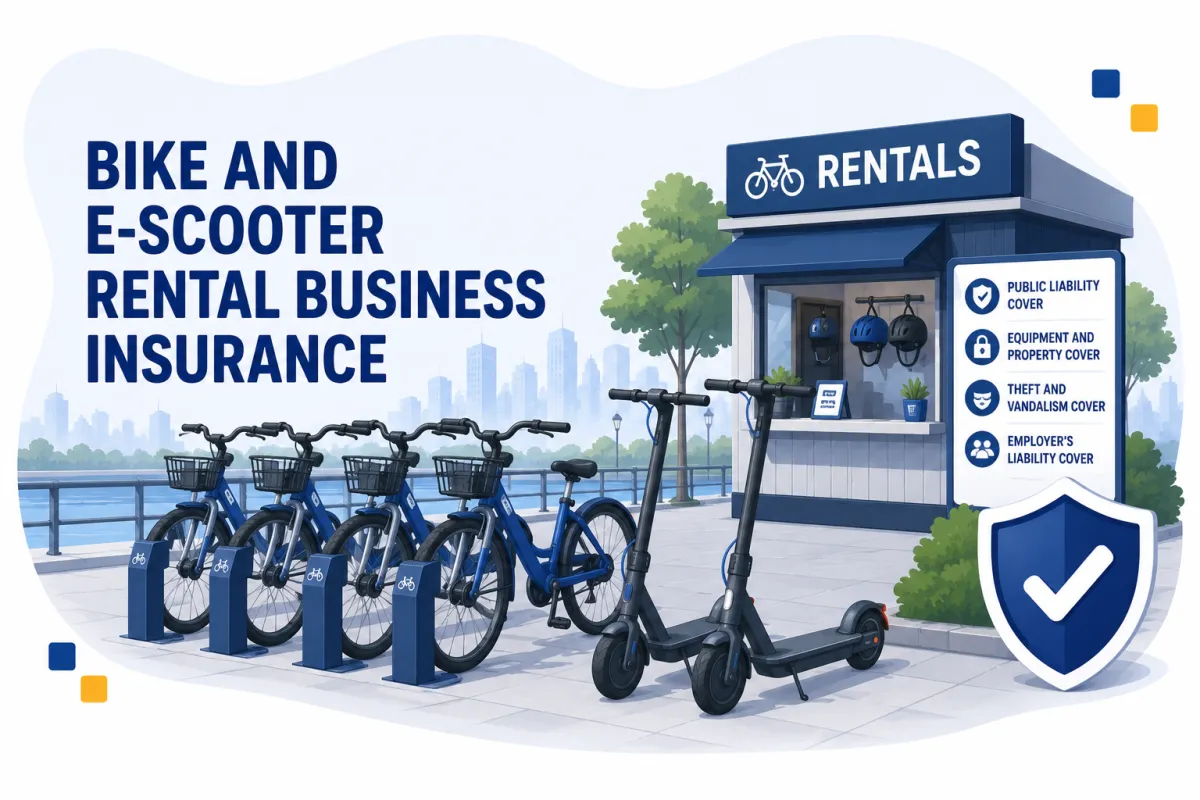
Bike & E-Scooter Hire Insurance UK: Rental Business Cover
Why This Sector Needs Specialist Insurance
Bike and e-scooter rental businesses operate in a gap that most standard commercial insurance policies were not designed to fill. You are not a motor business — your vehicles are not registered and most do not require a licence to ride. You are not a standard retailer — you have no shop counter where transactions conclude. You are not a logistics company — your customers take your assets into unpredictable environments and return them in unpredictable condition. And increasingly, your entire customer relationship exists through a smartphone app that carries its own data and cyber exposure.
The result is a business that sits uncomfortably across four or five insurance categories simultaneously, with gaps between them that only become apparent when a claim arises. A customer collides with a pedestrian on a rental e-bike. A fire breaks out at your charging depot overnight. Fifty vehicles are stolen from an outdoor docking station. Your booking app goes down for 36 hours during peak summer weekend. Each of these is a real scenario that rental businesses in the UK have faced — and each requires a different part of a properly structured insurance programme to respond.
1. Legal Requirements and the E-Scooter Regulatory Position
The Only Statutory Insurance Requirement
Employers' liability (EL) insurance is legally required under the Employers' Liability (Compulsory Insurance) Act 1969 for any rental business with employees — mechanics, depot staff, customer service teams, or operations managers. The minimum is £5 million and the fine for non-compliance is up to £2,500 per day. For small operations run by a sole trader with no employees, EL is not required — but every other core cover still is in practice.
The E-Scooter Legal Framework in 2026
The legal status of e-scooters in the UK in 2026 remains in transition, and understanding it is essential for structuring the right insurance.
The current position is:
- Privately owned e-scooters cannot legally be ridden on public roads, cycle lanes, or pavements. They are classified as motor vehicles under the Road Traffic Act 1988 but do not meet the requirements for road legal use. A rider using a privately owned e-scooter on a public road is uninsured and committing a traffic offence.
- Rental e-scooter schemes operate under a Department for Transport trial framework that authorises specific operators to run rental schemes in designated local authority areas. The trial framework effectively creates a legal exemption for rental riders within defined trial zones.
- Insurance implications of the trial framework — operators participating in DfT trials must meet specific insurance requirements set by the DfT. These include minimum public liability limits and specific policy structures. Standard bike hire policies are not adequate for e-scooter trial operations.
E-Bikes — A Simpler Legal Position
Electrically assisted pedal cycles (EAPCs) — commonly called e-bikes — have a much cleaner legal status. An e-bike that meets EAPC regulations (motor no more than 250W, pedal-assist only that cuts out at 15.5mph) is treated as a conventional bicycle in UK law. It can be used on roads and cycle lanes, requires no registration, licence, or road tax, and riders need not be insured under the Road Traffic Act. For rental businesses, this means e-bikes sit within standard bicycle hire insurance frameworks — with the addition of battery fire risk, which must be specifically addressed.
2. Core Covers Every Rental Business Needs
Public Liability
Public liability (PL) is the most important cover for any rental operation. It responds when your business is held responsible for injury to a third party or damage to third-party property arising from your operations or your fleet. In a rental business, the PL exposure is unusually broad because your assets are in the hands of unpredictable customers across unpredictable environments — often on busy roads, pavements, and shared cycling infrastructure.
Common PL claims in bike and e-scooter rental:
- A rental customer collides with a pedestrian — the pedestrian claims against your business for inadequate safety instructions or a defective vehicle
- A rental bike's brakes fail — the customer sustains injuries and claims the vehicle was not roadworthy
- A docked e-scooter falls onto a parked car — the car owner claims against your business for the docking station placement
- A rental e-bike catches fire at a customer's home during charging — property damage claim against your business for supplying a defective product
PL limits for rental businesses should be a minimum of £5 million. For e-scooter operators within DfT trial zones, £10 million is typically required by the trial framework and by the local authorities involved. The premium difference between £5 million and £10 million is usually modest — go to £10 million as a baseline for any operation that includes e-scooters or e-bikes.
Product Liability
Product liability is distinct from public liability and critically important for rental businesses. PL covers what happens on your premises or as a result of your operations. Product liability covers harm caused by the vehicles themselves — equipment that is defective, poorly maintained, or that fails during use. Confirm that product liability is included within your PL section at the full limit, not as a sub-limited add-on.
Fleet Cover
Your fleet is your primary business asset. Fleet insurance covers bikes, e-bikes, and e-scooters against theft, accidental damage, vandalism, and fire. For rental fleets specifically, fleet cover must address:
- Theft while docked or parked in public spaces — with GPS tracking conditions
- Damage by customers during rental periods
- Accidental damage during transit to and from depot
- Fire — including lithium battery fires during charging (addressed in detail in Section 5)
- Vandalism and malicious damage
Business Interruption
For a rental business, business interruption (BI) can be triggered by a depot fire, a flood, a charging infrastructure failure, or a regulatory suspension. BI covers lost revenue and ongoing fixed costs during the period you cannot trade. The indemnity period should reflect how long it would realistically take to restore your operation — replacing a large fleet of damaged or destroyed e-bikes can take months given current supply chain conditions for quality rental-grade vehicles.
3. Fleet Type Cover Checker
The insurance you need depends significantly on what you operate. Select your fleet type for a tailored cover checklist.
Rental Fleet Cover Checker
Select your fleet type to see the recommended insurance programme
Pedal Bike Hire — Traditional Bicycles
- LEGAL Employers' Liability — if you have any staff; minimum £5m
- ESSENTIAL Public Liability — minimum £5m; product liability must be included at same limit
- ESSENTIAL Fleet cover — all-risks cover for theft, accidental damage, vandalism; valued at replacement cost not depreciated value
- ESSENTIAL Helmets and accessories — if you supply helmets, lights, locks, or child seats; include in fleet or contents sum insured
- RECOMMENDED Business Interruption — particularly if seasonal; covers lost revenue and depot fixed costs during enforced closure
- RECOMMENDED Contents and equipment — workshop tools, maintenance equipment, point-of-sale equipment at hire stations
- RECOMMENDED Goods in transit — bikes being transported between depots, events, or servicing locations
- RECOMMENDED Personal accident — for staff involved in bike servicing and maintenance; cuts and injuries from bike components are common
- CONSIDER Legal expenses — for disputes with customers over damage charges, or local authority disputes about docking station placement
- CONSIDER Event cover extension — if you operate at fairs, festivals, or tourist sites; confirm off-site cover is included
E-Bike Hire — Electrically Assisted Cycles
- LEGAL Employers' Liability — minimum £5m; include battery handling and charging safety in your risk assessment
- ESSENTIAL Public Liability — minimum £5–10m; e-bikes are faster and heavier than pedal bikes; injury claims will be larger
- ESSENTIAL Fleet cover declared as e-bikes — standard bike fleet policies may exclude or restrict electrically assisted vehicles; confirm explicitly
- ESSENTIAL Battery fire cover — lithium-ion battery fires must be explicitly covered under both fleet policy (vehicle) and property policy (depot/charging facility)
- ESSENTIAL Replacement value sum insured — quality rental e-bikes cost £500–£2,000+ each; depreciated or inadequate sums insured are common and costly
- RECOMMENDED Charging infrastructure cover — charging stations, smart docks, and power management equipment as contents or equipment cover
- RECOMMENDED Battery replacement as a first-party loss — batteries degrade and can fail outside normal damage; confirm cover position with your insurer
- RECOMMENDED Business Interruption — e-bike fleets are expensive to replace; a major theft or fire event can halt trading for months
- RECOMMENDED Cyber insurance — if you use app-based booking, GPS fleet management, or customer data platforms
- CHECK EAPC compliance — your fleet must meet EAPC regs (max 250W, cuts out at 15.5mph) to be treated as bicycles in law; non-compliant vehicles may need motor insurance
E-Scooter Rental — DfT Trial Scheme Operator
- LEGAL Employers' Liability — minimum £5m; operations and maintenance staff
- CRITICAL DfT trial insurance requirements — your policy must meet the specific insurance requirements of your trial authorisation; standard commercial policies are not adequate
- ESSENTIAL Public Liability — £10m minimum; required by DfT trial framework and most participating local authorities
- ESSENTIAL Product Liability at full PL limit — e-scooter defects causing injury at 15–25mph generate significant personal injury claims
- ESSENTIAL Fleet cover for e-scooters — higher theft risk than bikes; GPS tracking condition likely; replacement values significant at scale
- ESSENTIAL Battery fire cover — e-scooter battery fires at charging depots are the sector's most serious property risk
- ESSENTIAL Regulatory compliance cover — legal expenses for licensing hearings, DfT compliance reviews, and local authority permit renewals
- RECOMMENDED Business Interruption with regulatory suspension extension — if the trial is suspended or your permit is reviewed, BI cover must respond
- RECOMMENDED Cyber insurance — app-based operations with GPS tracking and customer identity data create significant cyber exposure
- RECOMMENDED Crisis management — a serious pedestrian injury involving one of your scooters can generate significant media and reputational exposure
- CONSIDER Third-party motor liability — check whether the DfT trial framework requires any motor liability element and whether your policy includes it
Dockless Multi-City Fleet Operator
- LEGAL Employers' Liability — across all operating cities; must reflect total workforce including field operations staff
- ESSENTIAL Public Liability — £10m+ minimum; multi-city footprint increases exposure significantly; confirm all operating areas are covered geographically
- ESSENTIAL Fleet cover across all locations — dockless vehicles in public spaces have higher theft and vandalism exposure than docked fleets; GPS tracking conditions will apply
- ESSENTIAL Aggregate fleet value accuracy — large dockless fleets have high total values; confirm your aggregate sum insured reflects your current fleet size at replacement cost
- ESSENTIAL Geographic scope — confirm your policy covers all cities and regions where you operate; some policies restrict coverage to named locations
- ESSENTIAL Cyber insurance — dockless operations are 100% app-dependent; platform downtime and data breaches have direct and immediate revenue impact
- RECOMMENDED Project-specific cover for new city launches — new operating areas may have different risk profiles; notify your insurer before launching in a new city
- RECOMMENDED Rebalancing and logistics cover — vehicles in transit between areas, on vans, and at servicing hubs need cover between rentals
- RECOMMENDED D&O insurance — at scale, dockless operators may face regulatory or investor scrutiny; D&O protects directors personally
- CONSIDER Mid-term fleet adjustments — notify your insurer when fleet size grows significantly; underinsurance on a large fleet triggers the average clause
E-Cargo and Delivery Bike Rental
- LEGAL Employers' Liability — if you employ drivers or maintenance staff; minimum £5m
- ESSENTIAL Public Liability — minimum £5–10m; cargo bikes are heavier and slower-stopping than standard bikes; pedestrian collision claims are more severe
- ESSENTIAL Goods in transit for renters' cargo — if your rental customers use the bikes to carry third-party goods, confirm whether their cargo liability falls on your policy or theirs
- ESSENTIAL Fleet cover declared as e-cargo — cargo e-bikes are significantly more expensive than standard rental bikes (£2,000–£6,000+); accurate replacement values are essential
- ESSENTIAL Battery fire — large cargo e-bike batteries carry a higher fire risk than standard e-bike batteries; charging depots must have appropriate fire suppression
- RECOMMENDED Commercial use declaration — cargo bikes are rented for commercial delivery purposes; standard leisure hire policies may not cover commercial use; declare explicitly
- RECOMMENDED Business Interruption — cargo rental serves businesses with operational dependencies; a fleet outage creates downstream commercial claims risk
- RECOMMENDED Employer's liability for subcontracted delivery riders — if your rental customers are sole-trader couriers; confirm the EL position for each rental arrangement
- CONSIDER Product recall — if you supply modified or white-labelled cargo bikes; a safety recall generates direct costs beyond normal fleet insurance
Mixed Fleet — Bikes, E-Bikes, and E-Scooters
- LEGAL Employers' Liability — minimum £10m; mixed operations require careful workforce declaration
- ESSENTIAL Public Liability — minimum £10m; worst-case claim scenario is set by your highest-risk vehicle type — e-scooters set the PL limit floor for the whole fleet
- ESSENTIAL Declare all vehicle types at inception — each vehicle type has a different risk profile; undisclosed vehicle types are uninsured vehicle types
- ESSENTIAL Battery fire cover across all electric vehicles — e-bikes and e-scooters in mixed charging depots compound the battery fire risk; must be explicitly covered
- ESSENTIAL Fleet values per vehicle type — insurers rate each type separately; ensure your sum insured breaks down accurately by vehicle category
- ESSENTIAL DfT trial compliance — if e-scooters are in the mix; the trial framework insurance requirements govern the whole fleet structure
- RECOMMENDED Single combined policy — a single policy covering all vehicle types under one programme is more efficient and eliminates inter-policy gaps
- RECOMMENDED Cyber insurance — mixed fleets typically use sophisticated app and fleet management platforms; the cyber exposure is real and significant
- RECOMMENDED Mid-term notification protocol — mixed fleets change frequently; establish with your broker how and when to notify changes in fleet composition or size
4. Fleet Insurance — Theft, Damage, and Battery Fire
Theft — The Primary Fleet Risk
Rental bikes and e-scooters are attractive theft targets. They are publicly accessible by design, often left unattended between rentals, and — particularly in the case of higher-specification e-bikes and e-scooters — represent real resale value to thieves. For dockless fleets, the challenge is acute: the vehicles are intentionally scattered across public spaces, and the window between a customer ending a rental and a thief acting is measured in minutes.
Insurers have responded to the theft risk in micromobility by imposing conditions rather than simply charging higher premiums. Common conditions for rental fleet theft cover include:
- GPS tracking on all vehicles — live tracking, not passive logging
- Geofencing — alerts triggered when a vehicle leaves its authorised operating area
- Overnight storage — many insurers require vehicles to be returned to a secured depot overnight rather than left docked in public spaces
- Lock specifications — docking or locking standards for vehicles left in public spaces
- Fleet audit records — regular physical confirmation of fleet location and condition
Lithium Battery Fire — The Fastest-Growing Risk
Lithium-ion battery fires have become the most significant property risk in the micromobility sector since 2022. Battery fires burn at extremely high temperatures, can reignite after initial suppression, and release toxic gases. A fire starting in a single charging e-bike or e-scooter can spread to adjacent vehicles within minutes, and a depot fire that starts overnight can destroy an entire fleet before the fire service arrives.
For rental businesses, the battery fire exposure is concentrated and predictable — it happens in charging facilities. The risk management response is equally clear:
- Charge batteries in a dedicated, fire-separated space with appropriate suppression — not in a general storage area
- Never charge damaged batteries — inspect for swelling, cracking, or heat damage before charging
- Install lithium battery-specific fire suppression (aerosol suppression units or CO₂ systems) in charging areas
- Use smart charging systems that cut power when charging is complete and detect temperature anomalies
- Ensure your buildings and contents insurer is aware that lithium battery charging takes place on the premises
5. Liability — The Operator–Rider–Third Party Triangle
Understanding who is liable for what is the most commercially important question in rental business insurance, and the answer is more nuanced than most operators appreciate. There are three parties involved in every potential liability event: your business as the operator, your customer as the rider, and any third party who might be affected.
Your Liability as Operator
As the rental operator, you have a duty of care in several distinct areas:
- Fitness of the vehicle for use — you must supply a vehicle that is mechanically sound, properly maintained, and safe to ride. If a brake cable snaps during a rental and causes an accident, and investigation shows the cable was worn and should have been replaced at the last service, the operator has a strong liability exposure.
- Adequacy of safety information — you must provide riders with sufficient information to use the vehicle safely. This means helmet advice, operating instructions for e-bikes and e-scooters, age and competency requirements, and local rules about where the vehicles can and cannot be used.
- Vehicle suitability for the customer — supplying a high-powered e-scooter to an elderly customer who has never ridden one, without any competency assessment, creates a foreseeable risk that the operator has failed to manage.
Your Customer's Liability — And the Gap
Your customer is personally liable for their own negligent riding. If a customer rides through a red light and injures a pedestrian, that is primarily the customer's liability. However, the injured pedestrian may also pursue your business — as the entity that supplied the vehicle and (potentially) failed to ensure the customer was competent to ride it safely.
This is the liability gap that rental agreements try to address but cannot fully close. Waivers and liability disclaimers are not enforceable against the injured third party — they are only relevant to disputes between you and the customer. Your PL policy responds to claims from injured third parties regardless of what your rental agreement says.
Customer Damage to Your Fleet
Customers damaging your vehicles is a constant operational reality. Most rental businesses use security deposits and damage waivers to manage this exposure. From an insurance perspective, damage caused by the customer during a rental is typically covered under your fleet policy (subject to the policy excess and any per-vehicle sub-limit). However, deliberate or reckless damage — where the customer has acted well outside the bounds of normal use — may be treated differently by some insurers. Ensure your rental agreement gives you clear grounds to pursue customers for excessive damage costs beyond any insurance recovery.
6. Fleet Risk Calculator — Know Your Exposure
Enter your fleet details to see your total asset exposure and understand the recommended cover levels for your operation.
Fleet Exposure Calculator
Enter your fleet details to see your total asset exposure and recommended cover
Your Fleet Risk Summary
7. E-Scooter Trials — What the Regulatory Framework Means for Insurance
The DfT e-scooter trial framework is the legal mechanism that allows rental e-scooter schemes to operate legally in the UK. Understanding how it works — and what it requires from an insurance perspective — is essential for any operator in this space.
How the Trial Framework Works
Under the trial framework, operators must be authorised by the DfT and must partner with a local authority to operate within that authority's area. The trial creates a specific legal environment in which rental e-scooter riders are covered by the operator's insurance rather than their own motor insurance — since privately owned e-scooters have no insurance equivalent. This makes your PL and product liability cover the only insurance protection that exists between an injured third party and an uncompensated loss.
Insurance Requirements Under the Trial
The DfT's trial operator requirements specify minimum insurance obligations. These typically include:
- Public liability at a minimum of £10 million per occurrence
- The policy must explicitly cover e-scooter rental operations within the trial area
- The insurer should be a reputable, FCA-authorised UK insurer
- Evidence of adequate insurance is usually required as part of the operator application and annual renewal
What Happens When a Trial Ends or Changes
Trial periods have defined end dates. When a trial concludes, the legal authorisation for e-scooter rental in that area lapses unless renewed or replaced by permanent legislation. If you are operating in a trial area and the trial ends without legislative replacement, you must cease e-scooter rental operations immediately — continuing to operate would mean your vehicles are being used without legal authority, which almost certainly voids your insurance cover.
8. Cyber Insurance for App-Based Rental Platforms
Modern rental operations are fundamentally digital. The booking system, the fleet management platform, the GPS tracking network, the customer payment processing, and the identity verification database — all of these exist in digital form and all of them represent potential points of failure or attack.
The Specific Cyber Risks for Rental Businesses
| Risk | Potential Impact | Insurance Response |
|---|---|---|
| Booking platform attack or outage | Zero rental revenue until restored; reputational damage; customer compensation demands | Cyber BI — covers lost revenue during system downtime caused by a cyber event |
| Customer data breach | ICO investigation and fines (up to 4% global turnover or £17.5m); customer compensation claims; legal costs | Cyber liability — covers investigation costs, legal fees, and customer notification |
| Ransomware attack on fleet management | Loss of GPS control; inability to lock/unlock vehicles; total operational paralysis until resolved | Cyber response — incident response costs, forensic investigation, ransom negotiation |
| Fraudulent payment processing | Chargeback losses; fraudulent rentals; payment processor sanctions | Cyber crime cover — fraudulent instruction and payment fraud losses |
| Identity document fraud | Fake customers using stolen identities to rent and not return vehicles; regulatory scrutiny of verification procedures | Addressed through robust KYC procedures; legal expenses cover for related disputes |
For a rental business that is 100% app-dependent — which most modern operations are — the financial impact of a cyber incident can match or exceed the impact of a physical event like a fleet fire. Yet cyber insurance is consistently the most underpurchased cover in the SME sector. A standalone cyber insurance policy for a small to medium rental business is typically £500–£2,000 per year — a fraction of the potential loss from even a modest incident.
9. What Drives the Cost of Rental Business Insurance
| Rating Factor | Impact on Premium | What You Can Do |
|---|---|---|
| Fleet size and total value | Primary rating basis for fleet cover; higher fleet value = higher premium; ensure accurate replacement values | Keep your fleet sum insured current; notify mid-year growth promptly to avoid underinsurance |
| Vehicle type | E-scooters rated higher than e-bikes; e-bikes higher than pedal bikes; cargo bikes rated by individual value and use | Declare each vehicle type accurately; mixed fleets are rated by the highest-risk component |
| Operating location | City centre and tourist locations attract higher PL and theft premiums; rural operations rated lower | Invest in GPS and security measures; present these to your broker at renewal as evidence of risk management |
| Security measures | GPS tracking, geofencing, secure overnight storage can all reduce fleet theft premium meaningfully | Document all security measures; maintain GPS functionality and service records; present evidence at renewal |
| Claims history | Frequent theft or PL claims increase premiums; a single large PL claim can affect renewals for several years | Maintain vehicles rigorously; document pre-rental checks; address recurring damage patterns proactively |
| Customer screening procedures | Documented age verification, safety briefings, and damage recording demonstrate risk management; can reduce PL premium | Formalise and document all customer onboarding procedures; present to insurer at renewal |
| Battery charging arrangements | Undisclosed or poorly managed lithium charging significantly increases property and fleet premiums; proper charging infrastructure reduces them | Disclose all battery charging; install appropriate fire suppression; use smart charging systems |
10. Claims — How They Arise and What to Do
Real Claim Example — E-Bike Depot Fire, Bristol 2025
A 60-vehicle e-bike rental business suffered a fire at its charging depot that started in a charging rack overnight. The fire spread through the charging area before the automated suppression activated, destroying 31 e-bikes and causing structural damage to the depot building. Total loss: £38,000 in fleet replacement, £12,000 in building reinstatement, and £22,000 in business interruption over a 10-week period while operations were rebuilt.
The fleet insurer met the vehicle losses in full. The buildings insurer initially queried the claim on the basis that the policy application had not specifically mentioned lithium battery charging on the premises. However, the operator was able to produce the original rental fleet proposal form, which had been submitted to the broker with a fleet description referencing "electric bikes" — a disclosure the broker confirmed had been passed to the buildings insurer at placement. The buildings claim was settled in full.
The lesson: disclosure of battery charging at the buildings stage is as important as declaring it on the fleet policy. If your buildings and fleet insurers are different companies, both must know about your charging operations. If in doubt, tell both in writing.
Claims Management Steps
- For a fleet theft event: report to the police and obtain a crime reference number immediately — this is a condition of most theft claims. Preserve GPS tracking records showing the vehicle's last known location and movement. Provide these to your insurer with the police reference.
- For a customer injury or third-party claim: attend to the injured person first. Then preserve all available evidence — CCTV, GPS data showing the vehicle's route, pre-rental inspection records, the rental agreement, and the customer's identification. Notify your insurer before making any statement to the claimant.
- For a depot fire: notify your insurer and broker immediately. Do not begin remediation work until the loss adjuster has attended — or has given written consent to proceed. Photograph all damage thoroughly before clearing begins.
- For a cyber incident: isolate the affected systems, contact your cyber insurer's 24-hour incident response line, and do not attempt to negotiate with ransomware attackers independently. Your cyber insurer should have a pre-approved incident response team — use them.
- In all cases: do not admit liability to any third party without your insurer's written consent, and notify your insurer within the timeframes specified in your policy — typically 24–48 hours for major incidents.
Frequently Asked Questions
Employers' liability insurance is the only statutory requirement — legally required if you employ any staff, with a minimum of £5 million cover and fines of up to £2,500 per day for non-compliance. Public liability, fleet cover, product liability, and business interruption are not legal requirements, but they are practically essential for any commercial rental operation. Most commercial landlords, local authorities, and event organisers also require proof of adequate public liability before allowing you to operate on their land or premises.
In 2026, rental e-scooter schemes operate under the Department for Transport's trial framework, which authorises specific operators to run rental schemes in designated local authority areas. Privately owned e-scooters remain illegal on public roads. For rental operators, this framework imposes specific insurance requirements — including minimum public liability limits of £10 million — that go beyond standard commercial bike hire policies. The legislative position is expected to be formalised once the Transport Bill completes its Parliamentary passage. Operators should monitor developments and ensure their insurance is reviewed when permanent rules are published.
Yes, fleet insurance covers theft of bikes and e-scooters. However, insurers typically impose conditions including GPS tracking on all vehicles, defined overnight storage security requirements, and regular fleet audits. If a vehicle is stolen and you cannot demonstrate compliance with these conditions — particularly GPS tracking — the insurer may decline that specific claim. Set up tracking on every vehicle, test it regularly, and maintain records of tracker checks. Notify your insurer if fleet expansion temporarily outpaces tracker installation.
Lithium-ion batteries in e-scooters and e-bikes present a serious and growing fire risk, particularly during charging. Battery fires burn intensely, spread rapidly to adjacent vehicles, and are difficult to extinguish. For rental businesses, the risk is concentrated in charging depots. Your property and fleet insurers must both be explicitly informed that lithium battery charging takes place on your premises — failure to disclose can void cover. Install appropriate fire suppression in charging areas, use smart charging systems, and never charge visibly damaged batteries. This is both a safety obligation and an insurance condition.
The rider is primarily liable for their own negligent riding. However, the injured pedestrian may also pursue your business as the operator — on the basis that the vehicle was defective, that you failed to provide adequate safety instructions, or that you failed to ensure the rider was competent. Your public liability policy responds to claims from injured third parties against your business, regardless of what your rental agreement says. Customer waivers manage the operator-to-customer claim dimension but have no effect on third-party claims. This is why adequate PL limits — £5–10 million depending on vehicle type — are essential, not optional.
E-bikes that comply with EAPC regulations (maximum 250W motor, pedal-assist only, cuts out at 15.5mph) are treated as bicycles under UK law and can be included in a standard rental fleet policy — but they must be declared as electrically assisted vehicles. Policies written for pedal bikes may not automatically cover e-bikes. The battery fire risk must be addressed separately in your property insurance. Non-compliant e-bikes — those exceeding the EAPC limits — are classified as motor vehicles and require motor insurance, which is an entirely different product.
A small pedal bike hire business with 20–30 bikes might pay £1,500–£4,000 per year for a combined policy. A mixed e-bike and e-scooter fleet across a single city could cost £5,000–£15,000. Large-scale multi-city operators with hundreds of vehicles may pay significantly more. E-scooter premiums are higher than pedal bike premiums due to higher speed, higher vehicle values, and the more complex liability environment of the DfT trial framework. Security measures, GPS tracking, low claims history, and documented customer screening procedures all reduce premiums meaningfully at renewal.
App-based rental businesses hold customer identity documents, payment card details, and GPS location history — a data breach triggers GDPR notification obligations and potential ICO fines. Beyond data, a cyber attack disabling your booking platform halts revenue immediately with no manual fallback. Cyber insurance should cover incident response costs, business interruption during system downtime, legal fees from data breach claims, and regulatory investigation support. For a rental business of almost any size, a standalone cyber policy is typically £500–£2,000 per year — a fraction of the financial exposure from even a modest incident.
Yes. Your fleet policy insures a declared number of vehicles at a declared total value. If you add vehicles mid-year and do not notify your insurer, those vehicles may not be covered — and if a theft or damage event affects the whole fleet, the average clause can reduce your payout on every vehicle proportionally, including those that were on the policy at inception. Notify your broker whenever fleet size increases by 10% or more, or when you add a new vehicle type. Most fleet policies allow mid-term adjustments with a pro-rata premium adjustment.








Instagram
LinkedIn