FS Register FRN 1029698
Five Star Rated on Google
13+ years specialist broking experience
Drone Operator Insurance UK — 785/2004 Compliant Cover for Commercial Pilots
Specialist UK commercial drone insurance. Assimilated Regulation (EU) No 785/2004 compliant cover for aerial photography, survey, inspection, mapping, and emergency services drone operations. Built for the 2026 CAA framework — Open, Specific, and Certified Categories, A2 CofC, GVC, RPC, and the UK class mark / Remote ID rollout.
UK drone regulation has reset in 2026
UK class marks, Remote ID, and the new RPC pathway have changed what compliance looks like. Standard public liability cover isn't aviation-rated, so it doesn't satisfy 785/2004 — specialist drone placement does.
The three CAA operating categories — and what each needs
UK drone operations sit in one of three categories based on risk. Each has different qualification, registration, and insurance expectations. Knowing which category you operate in is the foundation of compliant cover.
Lower-risk routine operations
Most aerial photography & videography work
- A1 (Over People), A2 (Near People), A3 (Far From People) subcategories
- Max 25kg drone weight
- VLOS only — within visual line of sight
- Max altitude 120m (400ft)
- No CAA Operational Authorisation required
Medium-risk professional operations
Industrial inspection, urban survey, complex commercial work
- Beyond Open Category limits (closer to people, congested areas, etc.)
- Requires CAA Operational Authorisation
- Documented Operations Manual
- Pre-Defined Risk Assessments (PDRAs) or UK SORA bespoke assessment
- Annual renewals and CAA oversight
High-risk aviation-grade operations
Type-certified drones, BVLOS at scale, drone passenger transport
- Operations equivalent in risk to manned aviation
- Type-certified drone (similar to aircraft certification)
- Licensed Remote Pilot
- Approved operator status
- Heavy regulatory oversight
What is 785/2004 and what are the minimum limits?
Assimilated Regulation (EU) No 785/2004 — the retained version of what was EC 785/2004 — sets minimum third-party liability insurance for aircraft operators in the UK, enforced through the Civil Aviation (Insurance) Regulations 2005. It applies to commercial drone operations. Standard public liability cover doesn't satisfy it because it isn't aviation-rated. Minimum limits scale with Maximum Take-Off Mass (MTOM):
Less than 500kg MTOM
Minimum third-party liability per occurrence. Roughly £750,000–£800,000 depending on the SDR/GBP rate. Almost all commercial drones sit here.
500kg to less than 1,000kg MTOM
Minimum third-party liability. Roughly £1.5m–£1.6m. Heavy industrial and agricultural platforms.
Commercial market typical limits
Most UK commercial drone operators carry £1m–£5m; £10m for higher-value contracts, urban operations, and BVLOS work. Contract requirements often set the limit, not the regulation.
Annual vs ad-hoc cover
Annual policies for regular operators; per-flight policies for occasional commercial use. Both must be 785/2004 compliant for commercial work.
The regulation exempts model aircraft under 20kg MTOM, but "model" is read as recreational use only — so commercial flying is caught regardless of weight. Our guide to drone insurance law and CAA rules covers the legal requirement in full. SDR is the IMF Special Drawing Right; the sterling equivalent moves with the exchange rate, so check the current rate when setting limits.
What UK drone operator insurance covers
A modular package — built around the actual exposures of operating commercial drones. 785/2004 third-party liability is the foundation; hull, equipment, PI, and cyber complete the programme.
Third-Party Liability (785/2004)
Aviation-rated third-party liability cover — typically £1m–£10m. The mandatory minimum for any UK commercial drone operation.
Hull / Drone Damage
Cover for damage to your drone, including crash, flyaway, water damage, and theft. Sum insured matched to replacement value.
Payload & Camera Equipment
Cover for cameras, gimbals, thermal imaging modules, LiDAR units, and other payload — often the most valuable element of a drone setup.
Professional Indemnity
Cover for negligent advice, survey errors, mapping inaccuracies, and inspection oversights. Critical for surveyors and inspectors.
Employers' Liability
Legally required if you employ pilots, observers, or ground crew. The statutory minimum is £5m; most policies are issued at £10m as standard.
Public Liability (Non-Aviation)
Non-aviation public liability for incidents during ground operations, setup, breakdown, and client engagement at site.
Equipment in Transit
Cover for drones, payloads, controllers, batteries, and accessories in vehicles, hotels, and during international shipping.
Cyber & Data Cover
Cover for survey data breaches, GDPR exposure on inspection footage, and cyber attack on flight planning / drone control systems.
Legal Expenses
CAA investigations, ANO breach defence, client contract disputes, privacy complaints, and incident defence costs.
What drone insurance does my operation need?
Select your operation type for a general guide to the cover typically arranged
Aerial Photography Cover
- Mandatory 785/2004 third-party liability £1m–£5m
- Core Hull / drone damage cover
- Core Camera and gimbal payload cover
- Core Equipment in transit
- Core Public Liability (non-aviation) for ground ops
- Core A2 CofC qualification documented (typical operating category)
- Add Cyber for client image/footage data
- Add Legal Expenses with privacy complaint scope
Drone Survey & Inspection Cover
- Mandatory 785/2004 third-party liability £5m–£10m
- Core Professional Indemnity £500k–£1m (survey accuracy)
- Core Hull cover (often heavier industrial drone)
- Core Specialist payload cover (thermal, LiDAR, multispectral)
- Core GVC / RPC-L1 + Operational Authorisation documented
- Core Cyber for survey data & client deliverables
- Core Equipment in transit
- Core Legal Expenses with CAA scope
Construction Monitoring Cover
- Mandatory 785/2004 £5m–£10m (often contract-mandated)
- Core GVC / RPC-L1 for Specific Category congested-site work
- Core Professional Indemnity £1m+ (data accuracy in progress reports)
- Core Hull and payload (heavy industrial drones)
- Core Public Liability £5m for site ground operations
- Core Method statement and risk assessment evidence
- Core CSCS / SMSTS-equivalent training documented
- Add CDM 2015 awareness
Film & TV Production Cover
- Mandatory 785/2004 £5m–£10m (production contract minimum)
- Core GVC / RPC-L1 for Specific Category (filming near people)
- Core Hull cover for cinema-grade drones (often £20k+)
- Core Cinema camera payload cover
- Core Equipment in transit (incl. international)
- Core Public Liability £5m for crew/cast on set
- Core Production indemnity for filming overruns
- Add Loss of footage / re-shoot cover
Agricultural Drone Operations Cover
- Mandatory 785/2004 £1m–£5m
- Core Hull cover (often heavy spray/seed drones)
- Core Public Liability £2m–£5m
- Core Pesticide / herbicide application scope (if applicable)
- Core Aerial application authorisation documented
- Core Environmental Impairment Liability (chemical drift)
- Add PI for crop assessment recommendations
- Check Specific Category Operational Authorisation typical
BVLOS Specialist Cover
- Critical Specialist aviation market placement essential
- Mandatory 785/2004 £10m+ third-party liability
- Core Specific Category Operational Authorisation with BVLOS scope
- Core Bespoke risk assessment (UK SORA methodology)
- Core RPC-L1 Part B or higher remote pilot qualification
- Core Detect and Avoid (DAA) system documented
- Core Hull cover for specialist airframes
- Core PI £1m–£2m
- Core Cyber for command and control link security
General information about cover commonly arranged for each operation type. It is not a personal recommendation and does not take account of your circumstances. Speak to us for advice on what your operation actually needs.
Why choose Miller & Partner for drone operator insurance?
Standard public liability cover isn't aviation-rated, so using it for commercial drone work can leave you exposed on every flight. Specialist drone placement gets you compliant cover at the right limit for your Operating Category.
Regulated & Accountable
Appointed Representative of Gauntlet Risk Management Ltd. Miller & Partner FRN 1029698.
Specialist Market Access
Access to specialist aviation markets — the route to compliant BVLOS, Certified, and high-limit drone cover.
CAA Framework Aware
Open / Specific / Certified, A2 CofC / GVC / RPC, 785/2004, UK class marks — we know the framework.
Claims Support
When a flyaway, crash, or third-party claim hits, we coordinate the aviation loss adjuster response.
Indicative UK drone operator insurance premium
Pricing depends heavily on Operating Category, drone value, and operations type. The estimator shows broad market ranges for illustration only — it is not a quote, and your terms depend on declared operations, qualifications, claims history, and limits.
Drone Operator Insurance Premium Guide
Illustrative annual UK drone insurance premium ranges
Please select both an operation type and a turnover band.
Illustrative market range only — this is not a quotation and no cover is offered on the basis of it. Actual premium depends on drone value, payload, claims history, qualification level, Operating Category, BVLOS scope, and limits. Get an exact quote →
Frequently asked questions
Drone operator insurance is specialist aviation-rated commercial cover for UK businesses operating drones (unmanned aircraft systems / UAS) for commercial purposes. The core component is 785/2004-compliant third-party liability — the legal minimum for any commercial drone operation. Modular extensions include: hull / drone damage cover; payload cover (cameras, gimbals, thermal imaging, LiDAR); Professional Indemnity for survey/inspection work; Employers' Liability for staff pilots and observers; equipment in transit; Cyber for data and command link security; and Legal Expenses with CAA investigation scope. Standard public liability cover doesn't satisfy 785/2004 because it isn't aviation-rated.
Assimilated Regulation (EU) No 785/2004 — the retained UK version of what was EC 785/2004 — sets the mandatory minimum third-party liability insurance for aircraft operators, enforced through the Civil Aviation (Insurance) Regulations 2005. It applies to commercial drone operations. Minimum limits scale with Maximum Take-Off Mass: drones under 500kg need 750,000 SDR (Special Drawing Rights — roughly £750,000–£800,000 depending on the exchange rate); 500kg–1,000kg needs 1,500,000 SDR. In practice, most UK commercial operators carry £1m–£5m as standard, rising to £10m+ for construction, urban, BVLOS, and high-value contract work — usually because the client contract demands it rather than the regulation. The point worth repeating: ordinary business Public Liability cover doesn't satisfy 785/2004. You need aviation-rated cover specifically.
The Civil Aviation Authority's three-tier framework for UK drone operations: Open Category covers routine lower-risk flying (max 25kg, VLOS, max 120m altitude). Three subcategories: A1 (Over People), A2 (Near People — needs A2 CofC), A3 (Far From People). No CAA Operational Authorisation required. Specific Category covers medium-risk operations beyond Open Category limits — congested-area work, closer to people, larger drones, certain industrial uses. Requires a CAA Operational Authorisation, Operations Manual, and GVC or RPC-L1 qualification. Certified Category covers high-risk aviation-grade operations including BVLOS at scale, passenger transport, and type-certified drones. Behaves like manned aviation regulation. Your insurance scope must match your Operating Category.
The A2 Certificate of Competency (A2 CofC) is the qualification that unlocks Open Category A2 subcategory operations — flying drones closer to uninvolved people than A3 allows. Issued by CAA-recognised assessment entities via online theory exam and self-declared practical training. Valid five years. Under the 2026 framework, an A2 CofC holder flying a UK2 or C2 class-marked drone up to 4kg can fly as close as 30m to uninvolved people (5m in low-speed mode). Without A2 CofC, you're restricted to A3 — far from people and built-up areas. For commercial aerial photography, videography, and real estate work, A2 CofC is typically the minimum useful qualification. Separately, note that a Flyer ID is now required for anything 100g or over, and an Operator ID for drones 100g or over with a camera.
Both are remote pilot qualifications for Specific Category operations requiring CAA Operational Authorisation. GVC (General Visual Line of Sight Certificate) has been the main route for years — theory exam, practical flight test, and Operations Manual. RPC-L1 Part A is the newer certificate aligned to UK SORA, covering VLOS Specific Category operations, with Part B extending to BVLOS visual mitigation and RPC-L2 / L3 above it. The CAA will stop issuing the GVC on 31 December 2027; after that only RPC-L1, L2 and L3 will be available. Existing GVCs remain acceptable until they expire, provided the Operational Authorisation states that a GVC is acceptable evidence of competence — and bridging courses exist for GVC holders converting across. New entrants are generally better starting on RPC-L1.
Broad market ranges for illustration (£75k–£200k turnover): aerial photography £550–£1,400; survey and inspection £1,200–£3,200; construction monitoring £1,800–£4,500; film and TV production £2,200–£5,800; agricultural operations £1,800–£4,800; BVLOS specialist £4,500–£12,000+. Per-flight policies for occasional commercial operators typically start in the low tens of pounds per flight. Pricing scales with drone value, payload value, Operating Category, qualifications, claims history, location, and limits — so treat these as orientation, not a quote. Things that genuinely move the premium: A2 CofC / GVC / RPC documented; declared operations limited to specific use cases; trackers and Remote ID compliance; several years of continuity; and specialist placement rather than a comparison site.
Hull (drone) and payload (camera, gimbal, thermal, LiDAR) cover are usually arranged as separate sections within a single drone insurance policy. Hull cover protects the drone itself against crash, flyaway, water damage, theft, and accidental damage — sum insured matched to replacement value. Payload cover protects the camera and sensor equipment, often the highest-value element of a commercial drone setup. Cinema-grade payloads can run to £30k+; thermal imaging and LiDAR units are commonly £5k–£20k. Both sections need clearly declared sums insured; sub-limits and excesses vary by insurer, so check what any given policy actually caps.
For survey, inspection, and mapping work, yes — in practice it's essential. PI responds where a client claims your survey data was inaccurate, your inspection missed a defect, your mapping had errors, or your recommendation caused loss. Examples: a missed roof defect on a thermal inspection leading to subsequent water damage; a volumetric survey error affecting earthworks pricing; a missed structural crack on a bridge inspection. Limits are typically £500k for smaller operators and £1m–£2m for established surveying and inspection businesses, higher where industrial clients set the requirement. Without PI, the consequences of every survey deliverable sit with you. See our Professional Indemnity insurance guide for cover principles.
From 1 January 2026, Remote ID is mandatory for UK1, UK2, UK3, UK5, and UK6 class-marked drones; from 1 January 2028 it extends to UK0, legacy, and privately built aircraft of 100g or more with a camera. EU C-class marks are recognised as the equivalent UK class mark, and existing legacy drones can still be flown under weight-based rules. Insurance impact: insurers increasingly ask for evidence that operated drones meet current UK class mark and Remote ID requirements; flying a non-compliant drone commercially may be a regulatory breach and could affect cover; declared drones at proposal should specify class mark and Remote ID status. Replacement drones added mid-policy should be declared and the class mark confirmed. Update your declared aircraft list whenever you add or retire equipment.
Yes — but it needs specialist aviation market placement. BVLOS (Beyond Visual Line of Sight) sits in the Specific or Certified Category depending on risk profile and requires a CAA Operational Authorisation with a bespoke UK SORA risk assessment. Insurance considerations: £10m+ third-party liability is typical; Detect and Avoid (DAA) system documentation; command and control link cyber security; specialist hull cover for purpose-built BVLOS airframes; and PI scope. Mainstream commercial drone markets often can't quote BVLOS at all. The placement work is significant, but the cover is available.
Increasingly yes — but check the policy wording carefully. UK GDPR exposure on drone footage and survey data is rising as drones capture identifiable people, property, and confidential locations. Cyber and Legal Expenses cover should respond to: ICO investigations following drone footage complaints; privacy claims from individuals captured incidentally; data breach claims if survey data is stolen or leaked; and client data confidentiality breach. Specialist drone Cyber cover with aviation-aware scope addresses this; generic SME Cyber policies often don't contemplate the drone-specific exposure. Document your data retention policy, blurring procedures for incidental capture, and client data handling.
Several levers tend to work: A2 CofC / GVC / RPC qualification documented and current; a clean claims and incident history; declared operations limited to lower-risk use cases rather than blanket "any commercial use" wording; flight log and maintenance log discipline; trackers and Remote ID compliance across the fleet; a specific declared drone list instead of blanket fleet cover; limits matched to actual contract requirements; continuity with the same insurer; annual rather than monthly payment; and specialist placement rather than a comparison site. Stack them rather than choosing between them. For commercial drone operators, the cheapest cover is rarely the best value — at claim stage, the saving is easily dwarfed by a compliance gap or aviation defence costs.
Related guides from Miller & Partner
Important information
Miller & Partner Ltd is an Appointed Representative of Gauntlet Risk Management Ltd, which is authorised and regulated by the Financial Conduct Authority (FRN 308081). Miller & Partner Ltd is entered on the FCA Register under reference 1029698. Registered in England and Wales, company number 16206282. Registered office: Vivian House, Roman Bridge Close, Mumbles, Swansea, SA3 5BG.
This page is general information about commercial drone insurance and the regulatory framework around it. It is not a personal recommendation, a quotation, or an offer of cover, and it doesn't take account of your circumstances. Cover, limits, terms and exclusions vary by insurer and are subject to underwriting.
Regulatory content reviewed 20 August 2026. CAA rules and dates change — always check caa.co.uk/drones for the current position before relying on anything here.
General information, not advice. This page describes the types of cover we arrange. It is not personalised advice, a personal recommendation or an offer of cover, and it does not take account of your own circumstances. Cover is subject to insurer acceptance, underwriting criteria and the full terms, conditions, limits and exclusions of the policy issued. Any figures shown are illustrative and are not quotations. Our full regulatory status and complaints information are set out in the footer of every page.
Real World Example
A drone operator approached Miller & Partner Limited after a mid-flight equipment failure caused their drone to crash into a third-party property, resulting in damage and a liability claim. We immediately engaged insurers under their specialist drone liability policy and coordinated with loss adjusters to assess the incident. By managing the claim efficiently and presenting clear operational records, the matter was resolved without escalation. The client avoided significant financial exposure and was able to continue trading with confidence.
Contacts us now for a chat!
Our Expertise in this Field
At Miller & Partner Limited, we specialise in arranging tailored insurance for drone operators working across commercial and specialist sectors. We understand the unique risks involved, from aviation liability and equipment damage to regulatory compliance and operational interruptions. Our expertise ensures comprehensive protection is in place, including public liability, hull cover, and cover aligned with CAA requirements. With a knowledgeable, hands-on approach, we provide insurance that keeps your operations compliant, protected, and ready for take-off.
Ready to protect your business?
Get expert advice and a tailored commercial insurance quote today.
✔ Independent broker
✔ Access to leading UK insurers
✔ Fast turnaround
Free Insurance Review
& Zero Broker Fee
Let us review your current insurance and see if we can improve your cover while reducing the cost.
You're in 🎉
Thanks for requesting your free review. We'll be in touch shortly.
Check out our Niche Insights and Articles Hub

Check out our related blog on this topic
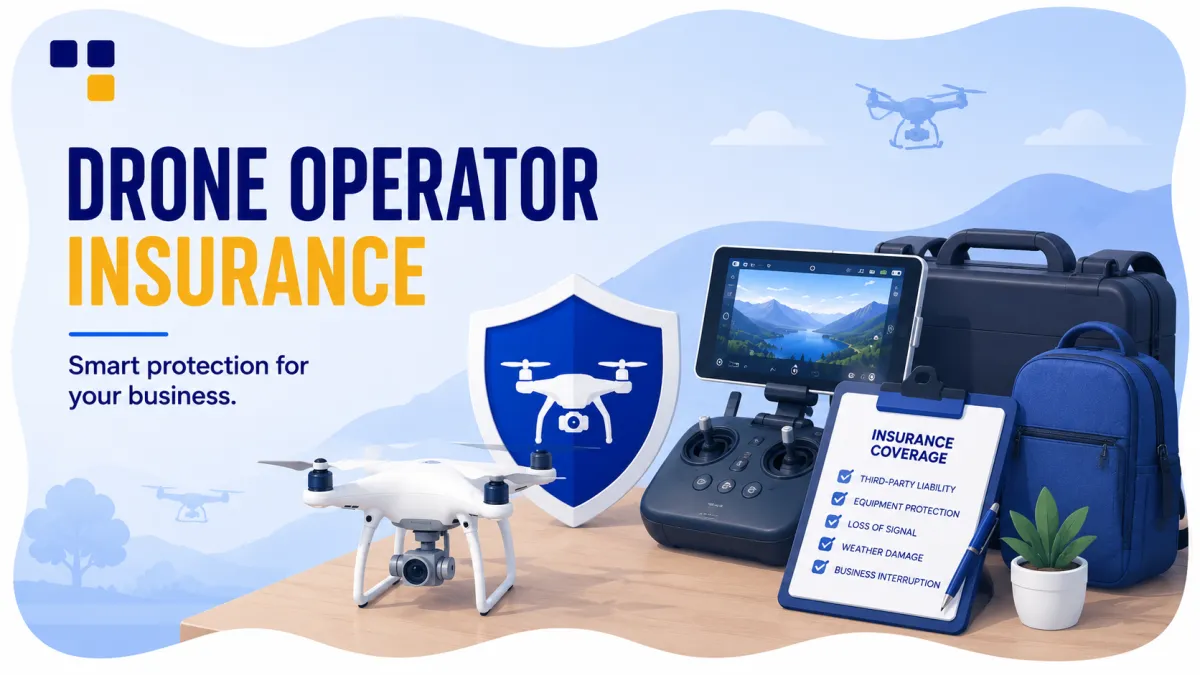
Drone Operator Insurance Guide 2026: Protect Your Flight
John sorted me out for the insurance I needed for my company and provided an excellent service. I can highly recommend Miller & Partner and will be using them again for all my commercial insurance requirements.

I can recommend Miller and Partner. They were prompt, efficient and responsive to my needs.

Very grateful for John’s assistance in finding a suitable policy for our needs, and being helpful and prompt in his advice. Highly recommended!
We're an Appointed Representative of Gauntlet Risk Management Ltd, which is authorised and regulated by the FCA. You can check our entry on the FCA Register.
MEET THE Director
Hey, I'm John!
I started Miller & Partner with the aim to bring back personable, approachable broking to UK businesses who were tired of large corporate brokers and feeling like they were just another number.
I have built this brokerage up with no pushy sales techniques or big business tactics, just honest, approachable and professional relationships with my clients.
Over 13 years experience in business insurance
Client first approach
5* rated broker on Google




Office: Vivian House, Roman Bridge Close, Mumbles, Swansea, SA3 5BG
Call 01792 001350
Email: [email protected]
Instagram
LinkedIn