



Essential Guide to Contractors Combined Insurance 2026
Why do UK contractors need combined insurance rather than individual policies?
For most of the UK construction sector's history, insurance was assembled piecemeal: a Public Liability policy from one insurer, Employers' Liability from another, and perhaps a separate tool cover policy purchased from a hardware retailer's stand. The result was a patchwork of cover with overlapping gaps, mismatched definitions, and no single insurer taking clear responsibility at claim stage. Contractors Combined Insurance was developed precisely to fix this. The concept is simple — one policy, one wording, one renewal date, covering the complete risk profile of a contracting business from site liability to contract works to hired plant.
In 2026, the case for a combined policy is stronger than it has ever been. HSE prosecution activity is sustained at high levels — the regulator achieved a 96% conviction rate in 2024/25 and levied £33 million in fines across UK workplaces. Construction remains the single most dangerous sector: 35 worker fatalities in 2024/25, with falls from height accounting for more than half of them. The Construction (Design and Management) Regulations 2015 (CDM) impose formal planning, coordination, and documentation duties across the contractual chain. Meanwhile, the Building Safety Act 2022 has created new competency and liability requirements for buildings over 18m. Any contractor operating without a properly scoped and fully declared combined policy is exposed — not just in the event of a claim, but in the event of a routine HSE inspection or a client's supply chain audit.
This guide is the definitive 2026 overview of contractors combined insurance — what it covers, what the dangerous gaps are, how CDM and the Building Safety Act change the exposure picture, what it costs, and what the claims evidence tells us about where policies are actually tested. It complements our contractors combined insurance product page and our broader construction cluster including groundworks insurance, demolition insurance, the civil engineering insurance deep-dive, and the complex construction insurance guide.
Key facts at a glance
- Employers' Liability is a legal requirement for any contractor with staff or labour-only subcontractors under the Employers' Liability (Compulsory Insurance) Act 1969 — minimum £5m, typically £10m. Non-compliance: £2,500 per day fine.
- Construction is the UK's most dangerous sector — 35 worker fatalities in 2024/25 (HSE), with falls from height accounting for more than half. Construction accounts for 6% of the workforce but a disproportionate share of workplace injuries.
- CDM Regulations 2015 impose documentation duties on all dutyholders — contractors, principal contractors, designers, and clients. Inadequate pre-construction planning and health and safety files are a prosecution trigger and a cover defence gap.
- Contract works cover (Contractors All Risks) is the section most often misunderstood — it covers damage to works in progress, not just liability. Without it, a flood or fire destroying three months of work becomes the contractor's uninsured loss.
- Subcontractor liability is a common coverage gap — labour-only subcontractors typically engage the principal contractor's EL, and bona fide subcontractors need their own cover declaration for PL. Misclassification of subcontractor status is a major claim dispute trigger.
- The Building Safety Act 2022 introduced new competency requirements and liability for higher-risk buildings (18m/7 storeys+). Contractors working on relevant buildings need PI cover matched to the extended liability period.
- Contractors combined insurance premiums run £800–£25,000+ annually depending on trade type, turnover, number of employees, plant ownership, and work type. Specialist placement through a construction-experienced broker typically delivers better terms than direct-to-insurer or aggregator routes.
1. What does contractors combined insurance actually cover?
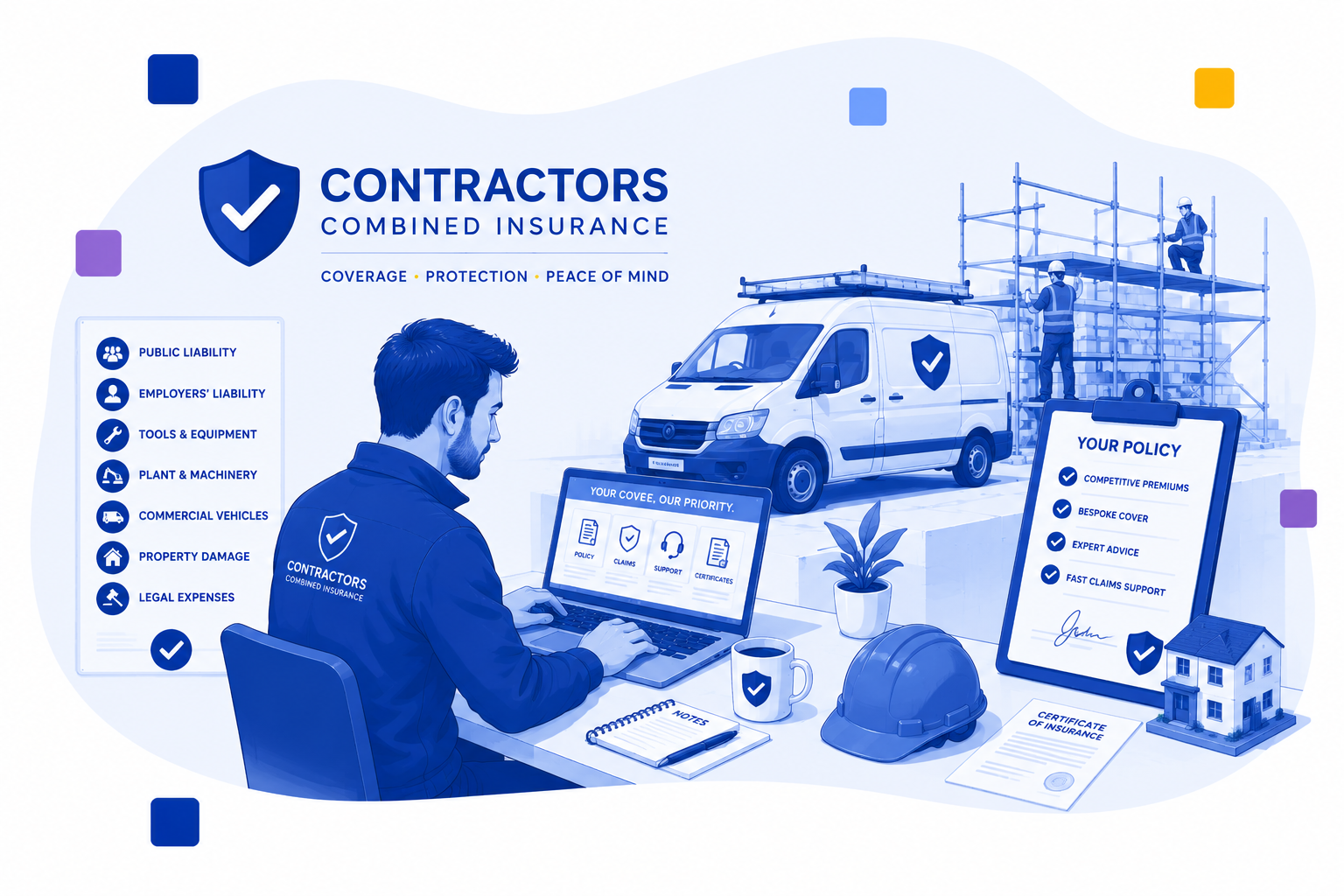
Contractors combined insurance is a multi-section policy that assembles several distinct covers under a single wording and renewal date. Unlike a commercial combined policy (which is typically structured for premises-based businesses), contractors combined is specifically designed for businesses that earn the majority of their income from work undertaken at third-party sites. The core sections and optional extensions are set out below.
| Section | What It Covers | Legal Status | Typical Limit |
|---|---|---|---|
| Employers' Liability (EL) | Claims by employees and labour-only subcontractors for injury or disease arising from their work | Legal requirement | £10m minimum |
| Public Liability (PL) | Third-party bodily injury and property damage claims arising from the business's operations | Contractually required | £2m–£10m |
| Contract Works (CAR) | Physical damage to works in progress, materials on site, and temporary works | Commercially essential | Contract value |
| Own Plant and Machinery | Damage, theft, and breakdown of the contractor's own plant and equipment | Recommended | Agreed value |
| Hired-in Plant | Contractor's liability for damage to or loss of hired equipment while on hire | Contractually required by hire firms | Per-item/aggregate |
| Tools and Equipment | Loss, damage, and theft of hand tools, power tools, and portable equipment | Recommended | Agreed schedule value |
| Professional Indemnity (PI) | Claims arising from design, advice, specification, or survey work undertaken by the contractor | Required if design work undertaken | £250k–£2m |
| Legal Expenses | Defence costs for employment, tax, contract, and regulatory disputes including HSE investigation | Recommended | £50k–£250k |
| Product Liability | Claims arising from products sold, supplied, or installed by the contractor | Commercially essential where products supplied | Typically within PL limit |
| Business Interruption | Loss of income where the contractor's premises are damaged and operations disrupted | Relevant where premises-based operations | Based on gross profit |
| Environmental Impairment Liability (EIL) | Pollution and contamination claims including gradual pollution and cross-boundary spread | Required for groundworks, demolition, drainage | £500k–£2m |
2. Employers' liability — why is it legally required and what does it actually cover?
Employers' Liability — The Non-Negotiable Legal Foundation
Employers' Liability is the legal foundation of any contractors combined policy. Under the Employers' Liability (Compulsory Insurance) Act 1969, any business with employees must hold a minimum £5m EL policy (in practice, the market standard is £10m). The EL certificate must be displayed at the workplace. Non-compliance carries fines of £2,500 per day. The cover responds when an employee (or labour-only subcontractor) suffers bodily injury, illness, or disease in connection with their employment and successfully claims that the employer's breach of duty caused that harm.
The definition of "employee" under the EL Act and the policy is broader than most contractors expect. Labour-only subcontractors — individuals who supply their own labour without materials, operating effectively under the contractor's supervision — are typically treated as employees for EL purposes. Failure to understand this distinction is a frequent coverage gap. Bona fide subcontractors (those who supply both labour and materials, carry their own insurance, and operate with genuine commercial independence) are not employees — they need their own cover.
The dominant EL claim drivers in construction are: falls from height (Work at Height Regulations 2005); struck-by incidents (plant, materials, falling objects); manual handling injuries (MSDs); vibration-induced injury (HAVS from power tools and plant — CVIBRA 2005); and occupational lung disease (silica dust, asbestos exposure). Long-tail disease claims — conditions that develop over years and surface after the operative has left — represent the most complex EL exposure because the claim is notified to an insurer who may no longer be on risk.
EL £10m is the market standard for contractors of all sizes. Specialist construction EL should explicitly cover occupational disease, long-tail conditions, and labour-only subcontractor exposure. The primary claim defence is documentation: site-specific risk assessments, RAMS (Risk Assessment and Method Statements) per task, induction records, PPE issue and inspection records, and health surveillance for HAVS, silica, and other occupational disease exposures.
3. Public liability — what does it cover and what are the dangerous gaps?
Public Liability — Limits, Pollution Exclusions, and Subcontractor Gaps
Public Liability covers the contractor's legal liability to third parties — members of the public, clients, neighbouring property owners, other trades on site — for bodily injury and property damage arising from the contractor's operations. A builder who damages a neighbour's property during excavation, a scaffolder whose erected structure falls and injures a pedestrian, an electrician whose negligent wiring causes a fire destroying a client's premises — all are PL claims.
PL limits for construction contractors: domestic and small commercial work typically requires £2m–£5m; local authority, social housing, and public sector contracts typically require £5m–£10m; some large commercial clients and principal contractors require £10m as a supply chain minimum. Check every contract's insurance requirements before pricing work — carrying £2m PL and winning a £10m PL-requirement contract creates immediate compliance exposure.
Standard PL wordings contain a pollution and contamination exclusion that eliminates cover for claims arising from gradual or sudden pollution events. For most contractors this exclusion is critical: groundworkers, demolition contractors, drainage contractors, civil engineers, and anyone disturbing contaminated land or handling waste all face genuine pollution exposure. The exclusion is typically addressed through an Environmental Impairment Liability extension — but only if specifically requested and activated.
Standard PL covers damage caused by operations in progress. Defective workmanship exclusions can remove cover for property damage that results from the contractor's work being faulty — a particularly important distinction for roofing, waterproofing, and cladding contractors. Products Liability within PL covers products after they leave the contractor's hands. Both need to be explicitly confirmed within the combined policy wording for complete cover.
4. What is contract works cover and why is it the most underestimated section?
Contract Works (Contractors All Risks) — The Overlooked Core Cover
Contract works cover (often called Contractors All Risks or CAR) insures the physical works themselves — the structure under construction, temporary works, materials on site, and often scaffolding — against physical damage or loss. It is triggered when the works are damaged before practical completion and the contractor bears the reinstatement cost. Common triggers: storm damage to partially completed roofing, flooding of excavated foundations, fire destroying timber frame, vandalism and malicious damage on unoccupied sites, and theft of materials stored on site.
Under JCT contract forms (the construction industry standard), responsibility for insuring works in progress is typically allocated either to the employer (client) or to the contractor, depending on contract type and whether the works are on an existing structure. Domestic sub-contract work (JCT Domestic Building Contract) typically places the obligation on the contractor. Many main contractors require subcontractors to carry their own contract works cover for subcontract packages. Check the contract risk allocation before assuming the client's policy responds.
Contract works is typically insured on a contract value basis. Under-declaration is common — contractors declare an annual turnover figure without accounting for individual high-value contracts or materials-heavy projects. If a £300,000 contract suffers total loss and the declared contract value is £150,000, the insurer applies average and pays only 50% of the loss. Annual contract value review at renewal is essential.
When contractors work on or in an existing structure (refurbishments, extensions, fit-outs), the client's building itself may be at risk. Existing structures cover extends the contract works section to respond if the contractor's operations damage the surrounding building — a critical extension for any renovation or fit-out contractor.
5. How does plant, tools, and equipment cover work within a contractors combined policy?
Plant, Tools, and Equipment — Own and Hired-In
Plant, tools, and equipment cover sits within the combined policy as a property section addressing the contractor's physical assets. It is divided into three distinct exposures: own plant (excavators, dumpers, compressors, generators, scaffolding owned by the contractor); hired-in plant (the same categories hired from a plant hire company, where the hire agreement makes the contractor responsible for loss or damage while on hire); and tools and equipment (hand tools, power tools, site instruments, portable plant).
Plant hire agreements almost universally place full responsibility for the equipment on the hirer from the moment it arrives on site. This includes damage caused by third parties, weather, vandalism, and theft — irrespective of fault. The hired-in plant section of a contractors combined policy covers this contractual liability, including crane and specialist plant hire. Contractors who hire plant without the hired-in section activated are fully exposed to the hire company's recovery action.
Tools cover is often subject to sub-limits and conditions that catch contractors off guard: overnight storage conditions (tools must be locked in a van body, not visible); single item limits (expensive survey instruments, laser levels, or specialist tools may each exceed a single-item limit); and unattended vehicle clauses (some policies exclude theft from unattended vehicles entirely unless specific security requirements are met). Check the conditions, not just the aggregate limit.
Breakdown cover for own plant protects against mechanical or electrical breakdown causing physical damage to the plant itself — separate from fire and theft cover. For contractors with significant plant assets (£50,000+), an engineering inspection combined with breakdown cover provides both statutory compliance (Lifting Operations and Lifting Equipment Regulations 1998 require periodic thorough examination) and insurance protection.
6. When do contractors need professional indemnity insurance?
Professional Indemnity — The Design-and-Build Trigger
Professional Indemnity has historically been viewed as a professional services product — for architects, engineers, and surveyors — rather than a contractors' product. That view is outdated. Three developments have made PI a mainstream requirement for a significant proportion of UK contractors in 2026:
- Design-and-build contracts — contractors who take on design liability as part of a D&B package take on liability that standard PL does not cover. A contractor who designs a structural element that subsequently fails faces a PI claim, not a PL claim.
- Building Safety Act 2022 — for higher-risk buildings (over 18 metres or 7 storeys), the Act creates new accountable person duties and extends the limitation period for structural claims. Contractors working on HRBs should carry PI cover matched to the extended liability window — potentially 15 years or more.
- Survey, specification, and advisory work — many contractors informally provide advice to clients on specification, materials, or approach. Where that advice proves incorrect and loss follows, the claim is a PI claim. The informal nature of the advice doesn't prevent the claim.
See our professional indemnity insurance guide for full cover principles and limit recommendations. For contractors on higher-risk building projects specifically, run-off cover — PI that continues to respond after the policy ends for work performed during the policy period — is essential.
7. Contractors combined insurance cover checker — what does your business profile require?
Select your trade type to see the recommended insurance programme for your specific risk profile. For a direct quote, see our contractors combined insurance product page.
Contractors Combined Insurance Cover Checker
Select your primary trade to see the recommended sections and limits matched to your specific risk profile
Builder / General Contractor
- LEGAL Employers' Liability £10m — including labour-only subcontractor scope explicitly declared
- ESSENTIAL Public Liability £5m minimum — £10m if working on local authority, social housing, or commercial contracts
- ESSENTIAL Contract Works (CAR) — at full reinstatement value for highest-value single contract, plus existing structures extension for refurbishments
- ESSENTIAL Tools and equipment — check single-item limits and unattended vehicle conditions
- ESSENTIAL Hired-in plant — activated where any hired plant used
- ESSENTIAL Legal Expenses with HSE investigation scope
- RECOMMENDED Professional Indemnity — essential if any design-and-build work or specification advice given
- RECOMMENDED Products Liability within PL for materials and completed operations
- CONSIDER Commercial vehicle/fleet extension — confirm tools and materials in transit are covered
Groundworks / Civil Engineering
- CRITICAL Environmental Impairment Liability — standard PL pollution exclusion eliminates cover for contaminated land and groundwater claims
- LEGAL Employers' Liability £10m — HAVS and silica dust occupational disease scope explicitly included
- ESSENTIAL Public Liability £5m–£10m — third-party structural damage, services strikes, subsidence exposure
- ESSENTIAL Contract Works — includes temporary works, sheet piling, and temporary support structures
- ESSENTIAL Own Plant — excavators, dumpers, compactors at agreed replacement value
- ESSENTIAL Hired-in Plant at full hire agreement terms
- ESSENTIAL Legal Expenses with HSE and Environment Agency scope
- RECOMMENDED Professional Indemnity where any specification, survey, or advisory work undertaken
- RECOMMENDED Goods-in-transit for materials and aggregates
Demolition / Structural
- CRITICAL Specialist demolition underwriting required — standard contractors combined underwriters often exclude or sub-limit demolition above 10m
- LEGAL Employers' Liability £10m — asbestos, silica, noise, vibration occupational disease exposure explicitly declared
- ESSENTIAL Public Liability £5m–£10m with collapse and neighbouring structure scope
- ESSENTIAL Environmental Impairment Liability — asbestos removal, hazardous waste, contamination spread
- ESSENTIAL Contract Works including temporary shoring and temporary structures
- ESSENTIAL Own Plant at replacement value — specialist plant assets
- ESSENTIAL Legal Expenses with HSE, Environment Agency, and local authority scope
- RECOMMENDED Professional Indemnity where pre-demolition surveys, structural assessments, or spec work undertaken
Scaffolding Contractor
- CRITICAL Falls from height is the dominant EL and PL exposure — documented PASMA/NASC scheme membership and inspection records are essential claim defence
- LEGAL Employers' Liability £10m — falls from height, manual handling, and vibration scope
- ESSENTIAL Public Liability £5m–£10m — collapsed or defective scaffold causing third-party injury or property damage
- ESSENTIAL Scaffold structure cover (own plant) — theft and damage to erected and unerected scaffold components
- ESSENTIAL Contract Works — temporary works cover for erected structure during hire period
- ESSENTIAL Legal Expenses with HSE investigation scope
- RECOMMENDED Products Liability where components supplied or sold to other contractors
- CONSIDER Professional Indemnity where design of complex scaffolding systems undertaken
Roofing / Cladding
- CRITICAL Falls from height is the single biggest EL and PL exposure — Work at Height Regulations 2005 compliance documentation is the primary claim defence
- LEGAL Employers' Liability £10m — edge protection, fall arrest, personal fall protection records required
- ESSENTIAL Public Liability £5m — water ingress and existing structure damage from negligent roofwork is a high-frequency claim type
- ESSENTIAL Contract Works — materials on site, roofing components, and temporary weatherproofing
- ESSENTIAL Defective workmanship extension — water ingress from defective installation is excluded under standard PL wordings without it
- ESSENTIAL Products Liability — roofing materials and components installed
- RECOMMENDED Professional Indemnity — Building Safety Act exposure for cladding contractors on HRBs
- RECOMMENDED Legal Expenses with Building Safety Regulator scope
Drainage / Utilities
- CRITICAL Services strike (gas, electricity, water, telecoms) is the dominant PL exposure — PAS 128 utility surveys and dial-before-you-dig compliance are essential claim defence
- LEGAL Employers' Liability £10m — confined space, HAVS, and flooding exposure
- ESSENTIAL Public Liability £5m–£10m — services strike claims can exceed £500,000 for major gas or electricity supply disruption
- ESSENTIAL Environmental Impairment Liability — sewage, fuel, and chemical spillage exposure
- ESSENTIAL Contract Works — trench reinstatement, pipe materials on site
- ESSENTIAL Own Plant — CCTV survey equipment, jetting units, excavators
- ESSENTIAL Hired-in Plant
- RECOMMENDED Legal Expenses with HSE and utility regulatory scope
8. CDM 2015 compliance and insurance readiness self-check
The Construction (Design and Management) Regulations 2015 impose documentation duties on all contractual parties — client, principal designer, principal contractor, and individual contractors. Tick each compliance discipline your operation has in place. Unchecked items are simultaneously regulatory gaps and insurance claim defence gaps.
CDM 2015 Compliance and Insurance Readiness Self-Check
Click each compliance discipline you have in place. These documents are both your regulatory obligation under CDM and your primary defence in any EL, PL, or HSE prosecution.
- Site-specific Risk Assessment per task — not generic; identifies specific hazards for each operation undertaken on each site
- Method Statement (RAMS) per task — how work will be carried out safely, reviewed and signed by operatives before commencement
- Construction Phase Plan — required for all notifiable projects; sets out how H&S will be managed during construction
- Work at Height pre-work planning documented — edge protection, fall arrest systems, access/egress routes all identified and recorded before work commences
- PPE issue records — signed records confirming correct PPE issued to each operative per task, with inspection and replacement schedule
- Site induction records — documented induction for every operative, visitor, and subcontractor operative on site; signed confirmation
- Subcontractor management documentation — copies of subcontractors' EL and PL certificates, evidence of competence, site-specific RAMS approval before commencement
- HAVS and vibration monitoring records — exposure time tracking for operative use of vibrating tools and plant; health surveillance programme in place
- Lifting Operations records — LOLER (Lifting Operations and Lifting Equipment Regulations 1998) thorough examination certificates current for all lifting equipment
- Near miss and incident reporting system — documented near-miss reporting culture with investigation and remedial action records
- RIDDOR reporting compliance — process for identifying RIDDOR-reportable incidents (over-7-day injuries, specified injuries, dangerous occurrences) and reporting to HSE within required timeframes
- Insurance declarations match actual work types — written broker confirmation that every trade you undertake is within the scope of your combined policy's declared activities
9. Construction operation risk assessor — what is your risk profile?
Two factors drive construction insurance risk above all others: work type complexity and health and safety documentation maturity. Use the selectors below for your specific profile.
Construction Operation Risk Assessor
Select your primary trade discipline and documentation maturity to see your risk profile and recommended insurance programme.
10. What are the most dangerous exclusions in contractors combined insurance?
Most contractors combined policy disputes at claim stage don't arise from coverage that was explicitly excluded — they arise from conditions, exclusions, and endorsements that were buried in the policy schedule or wording and never properly explained at proposal. The exclusions below are the ones that cause the most pain in practice.
The Pollution and Contamination Exclusion
Standard PL wordings contain a blanket pollution and contamination exclusion that removes cover for any claim arising from gradual or sudden pollution, including groundwater contamination, soil contamination, and airborne contamination. For groundworkers, demolition contractors, drainage contractors, and anyone disturbing contaminated ground, this exclusion can be the difference between a £200,000 claim that's covered and a £200,000 uninsured loss. The fix is Environmental Impairment Liability (EIL) — a separate or extension section that specifically covers pollution events. EIL must be specifically activated; it is not included by default in most combined policy wordings.
The Defective Workmanship Exclusion
Standard PL wordings cover property damage caused by the contractor's operations, but exclude damage that is directly attributable to defective workmanship in the contractor's own work — i.e. the cost of making good the faulty work itself. They also typically exclude consequential damage that flows from defective workmanship. For a roofing contractor whose negligent installation allows water ingress that then damages a client's interior, the PL policy may respond to the interior damage but not the defective roof installation that caused it. Some wordings include a Defective Workmanship extension to address this gap; others require it to be specifically added.
The Unattended Vehicle and Overnight Storage Conditions
Tools and equipment cover almost universally contains conditions about overnight storage and vehicle security. Typical conditions: tools must be stored in a locked hard-sided van body (not a pickup truck bed, open trailer, or soft-sided van); no tools visible from outside the vehicle; all tools removed from vehicles after dark or where unattended for more than a specified period (commonly 12 hours). Breach of these conditions — typically undiscovered until the first theft claim — results in total loss of the tools cover for that claim. Read the conditions before buying, and make operational changes to comply before storing tools in vehicles.
The Subcontractor and Labour Classification Conditions
EL policies typically contain conditions about who is classified as an employee vs a subcontractor. Labour-only subcontractors — who provide their own labour without materials, under the contractor's supervision — are treated as employees for EL purposes and must be declared. Bona fide subcontractors — who provide their own materials, carry their own insurance, and operate with genuine independence — are typically excluded from the EL and must hold their own cover. Misclassification either way creates exposure: under-declaring labour-only subs leaves EL claims undefended; over-declaring bona fide subs creates premium inflations that don't translate to actual cover.
11. How does subcontractor liability work under contractors combined insurance?
Subcontractor liability is one of the most complex areas of contractors combined insurance, and one of the most litigated at claim stage. The core issue is that UK construction projects typically involve layers of subcontracting — principal contractor, subcontractors, sub-subcontractors — and the liability trail at the point of a serious incident is rarely straightforward.
Labour-only subcontractors (LOSC) — the EL classification issue
A labour-only subcontractor is someone who provides their labour only — no materials, no plant, working under the contractor's supervision and direction. HMRC employment status tests and the courts apply a similar analysis: control, integration, and economic dependence. A LOSC who fails the self-employment tests is an employee for EL purposes. The contractor's EL policy must specifically confirm cover extends to labour-only subcontractors; most specialist wordings do, but the declaration at proposal must accurately reflect the proportion of LOSC labour in the workforce.
Bona fide subcontractors (BFSC) — supply chain insurance management
A bona fide subcontractor carries their own materials, plant, and risk. Under a PL policy, any claim arising from a BFSC's operations is typically the BFSC's own insurance matter — the principal contractor's PL responds if the principal contractor's own operations contributed to the loss, but not if the loss is entirely the BFSC's fault. Practically, this means the principal contractor needs to: obtain copies of all BFSC insurance certificates before commencement; confirm each BFSC's PL and EL limits meet the contract requirements; verify BFSC certificates are current at the time work is undertaken; and retain these records as part of the subcontractor management file.
Subcontractor work as a PL turnover declaration factor
PL premiums are typically rated on turnover. Most policy wordings treat the full value of subcontracted work as part of the contractor's declared turnover for PL purposes — even if the work is entirely subcontracted. Some wordings allow a deduction for subcontracted work where BFSC insurance certificates are held and maintained on file. This creates a direct financial incentive for rigorous subcontractor management: documented BFSC certificates can materially reduce the PL premium.
12. What drives the cost of contractors combined insurance in 2026?
Contractors combined insurance pricing in 2026 reflects the sustained HSE prosecution environment, rising liability claim values, and the regulatory complexity introduced by the Building Safety Act. Indicative annual premium ranges by contractor profile:
| Contractor Profile | Indicative Annual Premium 2026 |
|---|---|
| Sole trader, basic building/trades — £50k–£150k turnover, EL, PL, tools, van | £800–£2,200 |
| Small builder (2–5 employees) — £150k–£400k turnover, EL, PL, contract works, tools | £2,200–£5,500 |
| Specialist trade (roofing, scaffolding, cladding) — £200k–£500k turnover, full programme | £3,500–£8,000 |
| Groundworks / civil engineering — £300k–£800k turnover, EIL included, own plant | £5,500–£12,000 |
| Principal contractor / design-and-build — £500k–£1.5m turnover, PI included | £7,500–£18,000 |
| Mid-sized regional contractor — 10–25 staff, £1m–£3m turnover, full multi-discipline | £12,000–£28,000+ |
The factors below drive both insurance premium and overall risk management investment. Documentation maturity is the single most controllable premium lever — and it is the same documentation that serves as claim defence.
| Rating Factor | Impact on Premium | What You Can Do |
|---|---|---|
| Trade type and work mix | Basic building lowest; demolition, scaffolding, HRB highest | Declare every trade type specifically; misdeclaration is the dominant claim dispute driver |
| Annual turnover and number of employees | Primary scaling factors for EL and PL | Declare accurately; include subcontract labour where LOSC status applies |
| Contract works sum insured | Directly drives CAR premium; under-declaration creates average at claim | Insure at highest single-contract value, not average project value |
| H&S documentation maturity | Mature CDM-compliant documentation reduces premium 15–25% | Site-specific RAMS, induction records, subcontractor management, RIDDOR compliance |
| CSCS / CITB / trade certification | Recognised trade certification reduces premium 5–10% and signals competence | Maintain at operative level; evidence at every renewal |
| Plant ownership and value | Own plant section adds to premium proportionate to replacement values | Accurate plant schedule at replacement value; LOLER current for lifting equipment |
| Professional Indemnity scope | D&B and design PI adds 20–40% to PI line but essential where design liability held | Don't try to save here; an uninsured D&B PI claim can exceed £200,000 |
| Work at height exposure | Confirmed fall prevention protocols, PASMA/NASC scheme membership reduces EL loading | Document edge protection, fall arrest deployment, and inspection records |
| Claims history | 5+ year impact; EL falls and PL structural damage claims particularly material | Root cause analysis and remedial documentation after any claim |
| Geographic operating area | London and South East typically 10–20% higher across programme | Declare typical operating area accurately |
| Broker placement | Specialist construction brokers access better terms than generic placement | Use a broker with construction underwriting access and experience |
| Annual vs monthly payment | Monthly premium payment typically adds 5–10% finance charge | Annual payment where cashflow allows; premium finance cost is real |
13. Real claims and how to manage them
Claim — EL Fall From Height, £94,000 Settlement
A five-operative roofing contractor was completing a domestic extension re-roof in the East Midlands. The operative was working on a low-pitched roof at approximately 4 metres from ground level. Edge protection had been identified in the pre-work RAMS as required but had not been erected on the day of the incident — the site supervisor had decided it wasn't needed for a two-hour job. The operative slipped on a wet tile, fell from the eaves, and sustained a compound leg fracture and wrist fractures. He was unable to work for 11 months and was left with permanent reduced mobility in his ankle.
The operative brought an EL claim alleging breach of the Work at Height Regulations 2005 — specifically the failure to provide collective fall prevention measures. Investigation confirmed: edge protection was in the contractor's RAMS as required; the supervisor had no documented authority to waive RAMS requirements; the edge protection equipment was present on-site but not erected. The EL policy responded. Settlement: £94,000 (lost earnings, medical costs, future care and mobility aids, general damages). Defence costs: £14,200. Total: £108,200.
Post-claim renewal: EL premium increased 38%. Insurer required: daily site supervisor sign-off that RAMS measures are in place before work commencement; documented supervisor authority boundaries; edge protection deployment inspection record. The firm implemented these and at the second post-claim renewal premium returned to a 20% loading over baseline.
The lesson: falls from height claims are the dominant EL exposure for any contractor working above ground level. The RAMS exists; the failure is in the implementation and supervision discipline. The documentation that defends these claims is the daily site sign-off, not just the pre-work RAMS.
Claim — PL Services Strike, £187,000 Settlement
A drainage contractor was undertaking a trench excavation for a soakaway installation in a residential street in South London. The contractor had obtained utility drawings from the relevant utility companies but had not commissioned a PAS 128 utility survey (the recognised standard for underground utility detection). During excavation, the digger bucket struck a high-pressure gas main that was offset from its mapped position. The gas main was severed, causing a gas escape that required emergency isolation of supply to 34 properties for 18 hours.
The gas distribution network operator brought a PL claim for emergency repair costs and supply restoration costs. Three residents also brought claims for contents damage from condensation damage to unheated properties during the winter outage. The contractor's PL policy responded — the environmental exclusion did not apply because the claim was pure property damage rather than contamination. Settlement: £187,000 (emergency repair costs, supply restoration, contents damage claims, alternative accommodation). Defence costs: £21,500. Total: £208,500.
Post-claim renewal: PL premium increased 45%. Insurer added endorsement requiring: PAS 128 utility survey on all trench excavation works below 600mm in urban areas; ground penetrating radar (GPR) scanning records; documented dial-before-you-dig confirmation per job. The firm implemented these and at the following renewal premium returned to a 25% loading over baseline.
The lesson: services strikes are a high-severity, mid-frequency claim type for drainage and groundworks contractors. Utility drawings alone are not adequate risk management — a PAS 128 survey is the recognised standard and the insurer's post-claim endorsement effectively made it a policy condition. The survey cost per job is typically £150–£400; the average services strike claim is substantially higher.
Claim — Contract Works Flood, £76,000 Loss
A general building contractor was undertaking a substantial rear extension and loft conversion for a private client in the South East. The contract value was £165,000. The contractor had declared an annual turnover of £380,000 but had not updated the maximum single-contract value within the contract works section, which was set at £80,000 from a previous renewal when smaller projects were typical. After 14 weeks of work, the partially completed extension was inundated by a flash flooding event that deposited significant water and silt through the open structural elements. Structural materials, blockwork, insulation, timber framing, and mechanical rough-in were all write-offs, requiring complete strip-out and reinstatement.
The contractor notified their contract works section. The insurer assessed the declared maximum single-contract value as £80,000 against the actual contract value of £165,000 — a ratio of 48.5%. The insurer applied average: the policy would pay only 48.5% of the loss, not the full reinstatement cost. Actual reinstatement cost: £76,000. Insurer paid: £36,860. Contractor bore: £39,140 uninsured.
There was no dispute about the cause of loss and no claim for negligence; this was a straightforward weather event. The entire uninsured element was attributable to a failure to update the contract works sum insured at renewal as project values grew. Defence costs: nil (no liability dispute). Uninsured loss: £39,140.
Post-claim renewal: insurer required annual declaration of maximum single-contract value with specific confirmation of the three highest-value live contracts at renewal date. The contractor implemented this as a renewal checklist item.
The lesson: contract works under-declaration is one of the most common and entirely preventable claim shortfalls. The insurer applies average without any fault finding — it is simply an arithmetic consequence of under-declaration. Review maximum single-contract value at every renewal; if taking on a project materially larger than typical, notify the broker mid-term. See our contractors all risks insurance guide for full contract works declaration guidance.
Claims Management Steps
How to respond to a construction incident, insurance claim, or regulatory engagement — the steps below are critical given the multi-policy and multi-regulator exposure typical of the 2026 construction environment:
- Make the site safe and protect persons first. All other steps are secondary. If injury has occurred, arrange emergency medical response (999 for life-threatening; urgent care within 24 hours for less severe injuries). Secure the site to prevent further incidents.
- Preserve the scene where safe to do so. Do not clear or remediate the site in a way that destroys evidence. Photographs, measurements, and witness accounts taken immediately after an incident are the primary factual record. Appoint a responsible person to manage evidence preservation.
- Notify your insurer immediately for any potential claim. Construction incidents typically engage multiple policies simultaneously (EL, PL, contract works, legal expenses). Single notification triggers coordinated multi-insurer response. The notification threshold is "may give rise to a claim" — much lower than "formal claim received".
- Assess RIDDOR obligations. Under the Reporting of Injuries, Diseases and Dangerous Occurrences Regulations 2013, certain injuries (specified injuries, over-7-day absences, dangerous occurrences) must be reported to HSE. Assess the reporting obligation immediately; failure to report is itself a breach that can aggravate HSE's response.
- Do not admit liability or fault. Provide factual information about what happened, what work was being done, and what the methodology was. Do not apologise in writing, accept fault, or commit to remedial action that could be interpreted as admission of liability.
- Engage Legal Expenses immediately if HSE attends or notifies. HSE inspectors attending following a RIDDOR-reportable incident are conducting a potential prosecution investigation. Engage your Legal Expenses insurer before providing any written statement. Cooperate factually with the inspector but do not produce documentation on demand without legal advice.
- Pull the documentation pack. Site-specific RAMS for the task; induction records for all operatives present; PPE issue records; LOLER certificates for any lifting equipment; subcontractor management records; pre-work photographs. The documentation pack is simultaneously your insurance defence and your HSE prosecution defence.
- Conduct root cause analysis and document remedial action. Identify the underlying cause (supervision failure, procedural gap, equipment defect, subcontractor issue) and implement documented remedial action. Insurers reviewing renewal and HSE reviewing prosecution both require evidence of what's changed since the incident.

Glossary of contractors combined insurance terms
- Contractors Combined Insurance
- A multi-section insurance policy specifically designed for contracting businesses, combining Employers' Liability, Public Liability, Contract Works, Plant, Tools, and optional extensions (PI, EIL, Legal Expenses) under a single wording and renewal date.
- Contractors All Risks (CAR)
- The contract works section of a contractors combined policy — covers physical damage to works in progress, materials on site, and temporary works. Responds to fire, flood, storm, vandalism, and theft of works before practical completion.
- Employers' Liability (EL)
- Compulsory insurance covering the employer's legal liability to employees and labour-only subcontractors for injury, illness, or disease arising from their employment. Minimum £5m; market standard £10m. Required under the Employers' Liability (Compulsory Insurance) Act 1969.
- Public Liability (PL)
- Cover for the contractor's legal liability to third parties (members of the public, clients, adjacent property owners, other contractors) for bodily injury and property damage arising from the contractor's operations.
- Labour-Only Subcontractor (LOSC)
- A subcontractor who provides labour only — no materials, no plant — working under the contractor's supervision. Treated as an employee for Employers' Liability purposes. Must be declared within the EL policy and included in the employee headcount.
- Bona Fide Subcontractor (BFSC)
- A subcontractor who provides their own labour, materials, and risk — operating with genuine commercial independence. Must hold their own EL and PL insurance. Not included in the principal contractor's EL but their PL turnover typically remains within the principal contractor's PL declaration.
- CDM Regulations 2015
- The Construction (Design and Management) Regulations 2015 — the principal health and safety regulations governing UK construction projects. Impose duties on clients, principal designers, principal contractors, and individual contractors for planning, coordination, and documentation of health and safety. Core documentation requirements include the Construction Phase Plan, Health and Safety File, and site-specific Risk Assessments and Method Statements.
- RAMS (Risk Assessment and Method Statement)
- The combined document that identifies risks for a specific task and describes the method by which the work will be carried out safely. Site-specific RAMS per task are the primary insurance claim defence and HSE prosecution defence for construction contractors.
- Environmental Impairment Liability (EIL)
- Specialist insurance covering pollution, contamination, and environmental damage including gradual and sudden pollution events. Essential for groundworkers, demolition contractors, and drainage contractors whose work creates genuine pollution exposure not covered by standard PL pollution exclusions.
- Professional Indemnity (PI)
- Cover for claims arising from professional advice, design, or specification work. Increasingly relevant for contractors undertaking design-and-build contracts or providing informal specification advice to clients. Run-off cover is essential where Building Safety Act liability windows apply.
- Work at Height Regulations 2005
- UK regulations requiring employers to plan, supervise, and carry out all work at height in a way that minimises risk. Places duties to use collective protection measures (edge protection, safety nets) before personal protective measures (harnesses, fall arrest). Breach is the primary EL prosecution driver in construction.
- Average (under-insurance)
- The principle applied by insurers when a sum insured is found to be less than the actual value of the insured property or works at the time of a claim. The insurer pays only the proportion of the loss that the declared sum insured bears to the actual replacement value. Contract works under-declaration is the most common trigger in construction insurance.
- Building Safety Act 2022 (BSA)
- Legislation introducing a new regulatory regime for higher-risk buildings (18 metres or 7 storeys and above). Creates accountable person duties, extends the limitation period for structural claims, and imposes new competency requirements on design and construction professionals. Materially affects PI and run-off cover requirements for contractors working on qualifying buildings.
- RIDDOR (Reporting of Injuries, Diseases and Dangerous Occurrences Regulations 2013)
- Regulations requiring employers to report certain workplace incidents to HSE including specified injuries, over-7-day absences, fatalities, and dangerous occurrences. Mandatory reporting obligation; failure to report is itself a criminal offence.
- Defective Workmanship Extension
- An extension to a Public Liability policy that adds cover for property damage resulting directly from the contractor's defective workmanship — addressing the gap in standard PL wordings that exclude damage attributable to the faulty work itself rather than the operations causing it.
- Hired-in Plant Cover
- Section of a contractors combined policy covering the contractor's contractual liability to plant hire companies for loss or damage to hired equipment while on hire. Essential where any plant is hired, as hire agreements universally place full responsibility for damage on the hirer from collection.
- Fee for Intervention (FFI)
- HSE's cost-recovery scheme allowing the regulator to charge businesses for the time spent investigating material health and safety breaches. In 2024/25, FFI charges totalled £4.5 million across 5,143 UK businesses, averaging £875 per business. Construction accounts for a disproportionate share of FFI notices.
Frequently asked questions
Contractors combined insurance is a specialist multi-section policy for UK construction and contracting businesses that consolidates all the core insurance requirements under a single wording and renewal date. Core sections include Employers' Liability (legally required), Public Liability, Contract Works (Contractors All Risks), own and hired-in plant, and tools and equipment. Optional extensions include Professional Indemnity, Environmental Impairment Liability, Legal Expenses, Products Liability, and Business Interruption. The key advantage over buying sections separately is that a combined wording eliminates the coverage gaps and "who responds?" disputes that arise when multiple separate policies interact with a single claim event.
Employers' Liability is legally required if you have employees or labour-only subcontractors — minimum £5m, market standard £10m, under the Employers' Liability (Compulsory Insurance) Act 1969. Non-compliance: £2,500 per day fine. The other sections — Public Liability, Contract Works, Plant, Tools, PI — are not legally required but are contractually required by virtually every commercial client, principal contractor, and local authority in the supply chain. Operating without EL cover is a criminal offence; operating without adequate PL cover will mean being unable to bid for most commercial construction work.
Indicative 2026 annual premiums: sole trader (basic building) £800–£2,200; small builder (2–5 employees) £2,200–£5,500; specialist trade (roofing, scaffolding, cladding) £3,500–£8,000; groundworks / civil engineering £5,500–£12,000; principal contractor / D&B £7,500–£18,000; mid-sized regional contractor £12,000–£28,000+. The single biggest controllable premium lever is H&S documentation maturity — a CDM-compliant documentation pack typically reduces premium 15–25% across the programme. Trade type, turnover, plant values, claims history, and broker placement all affect pricing significantly.
Contractors All Risks (CAR) is specifically the contract works section — covering physical damage to works in progress, materials, and temporary works. It can be bought as a standalone policy for a specific project or as a section within a contractors combined policy. Contractors combined is the full multi-section package that includes CAR plus EL, PL, plant, tools, and optional covers. Most ongoing contracting businesses buy contractors combined (which includes CAR as a section) rather than standalone CAR, because the combined policy also covers their ongoing EL and PL exposures. Project-specific CAR policies are common for large one-off projects where specific contract values, completion periods, and handover terms need project-matched cover. For a full analysis, see our contractors all risks insurance guide.
You need PI if you undertake any design-and-build work, provide specification advice, produce construction drawings, or offer any professional recommendations to clients — even informally. Under the Building Safety Act 2022, contractors working on higher-risk buildings (18m/7 storeys+) also need PI with a run-off period matched to the extended BSA liability window. Generic contractors combined policies often include PI as an optional extension at relatively modest additional premium. See our professional indemnity insurance guide for limit recommendations and run-off cover principles.
It depends on the subcontractor's status. Labour-only subcontractors (those who supply their own labour only, working under your supervision) are typically covered under your EL section and must be declared. Bona fide subcontractors (who supply their own labour, materials, plant, and risk) are not covered under your EL and need their own insurance. For PL purposes, the full turnover including subcontract work is typically declared, though some wordings allow a reduction where bona fide subcontractor insurance certificates are held on file. Getting this classification right at proposal is critical — misclassification is the most common EL claim dispute driver in construction.
Contract works covers physical damage to the works themselves — the structure being built, materials on site, temporary works, and temporary buildings. It responds to fire, flood, storm, vandalism, malicious damage, collapse, and theft of works in progress. It does not typically cover pre-existing structures (unless the existing structures extension is activated), plant and equipment (separate plant section), or consequential losses beyond reinstatement. The sum insured must reflect the full reinstatement value of the highest-value single contract being undertaken — under-declaration triggers average at claim stage, reducing the insurer's payment proportionately.
Standard PL wordings exclude claims arising from any pollution or contamination event — including groundwater contamination, soil contamination, and airborne contamination. For most contractors this exclusion is significant: groundworkers, demolition contractors, drainage contractors, and anyone disturbing contaminated land have genuine pollution exposure that the standard PL does not cover. The exclusion is addressed by adding Environmental Impairment Liability (EIL) — either as an extension within the combined policy or as a standalone policy. EIL must be specifically requested and activated; it is not included by default. Contractors who work with contaminated ground or hazardous materials without EIL are carrying an uninsured risk that can run to six figures.
Criminal fines themselves are uninsurable under UK public policy. The defence costs of an HSE investigation and prosecution — barrister fees, solicitor fees, expert witness costs — are insurable under a Legal Expenses policy or Legal Expenses section of the contractors combined policy. Defence costs for a contested HSE prosecution routinely run £50,000–£250,000; the Legal Expenses section responds to these. Directors and Officers (D&O) liability cover provides defence cost cover for individual directors personally prosecuted under Section 37 of the Health and Safety at Work Act 1974. Both should be included in any contractors combined programme where HSE prosecution risk is material — which it is for any construction contractor. See our construction insurance claims examples guide for prosecution case studies.
As principal contractor under CDM 2015, you carry the duty to plan, manage, monitor, and coordinate all construction phase health and safety. The insurance programme required: EL £10m (legal requirement); PL £5m–£10m (coordinate with client's minimum requirements); Contract Works at full contract value for the project; PI where any design liability is held or specification advice given; Legal Expenses with HSE investigation scope (CDM principal contractors are a priority HSE inspection target); and EIL where groundworks, demolition, or contaminated land is involved. Beyond insurance, CDM requires a Construction Phase Plan, ongoing RAMS review for each work package, subcontractor management documentation, and a Health and Safety File at handover. See our complex construction insurance guide for principal contractor risk profiles.
Look for brokers with specific construction and contracting experience evidenced by: specialist guides on CDM compliance, contract works cover, and trade-specific risks; willingness to discuss specific exposures (subcontractor status, pollution exclusions, contract works sums insured, Building Safety Act PI) in detail; access to specialist construction markets and Lloyd's rather than just aggregator or standard commercial markets; FCA authorisation. Avoid brokers who can only offer a single-market "contractor's package" without discussing trade-specific exposures. Miller & Partner specialise in this sector — see our contractors combined insurance product page and broader contractors insights hub.
Yes, materially, if you work on higher-risk buildings (18 metres or 7 storeys and above). The BSA 2022 extends the limitation period for defective construction claims — meaning a cladding, structural, or fire safety defect can generate a claim many years after practical completion. This creates a run-off PI cover requirement: you need PI cover that continues to respond to claims arising from work performed during the policy period, even after the policy itself has ended. Standard PI is annual "claims-made" cover — claims notified after policy lapse are not covered by the expired policy. For HRB work, run-off cover must be maintained for the full BSA liability window at every policy renewal or when you cease trading. See our PAS 2035 contractor insurance guide for related regulatory insurance requirements.






Instagram
LinkedIn