


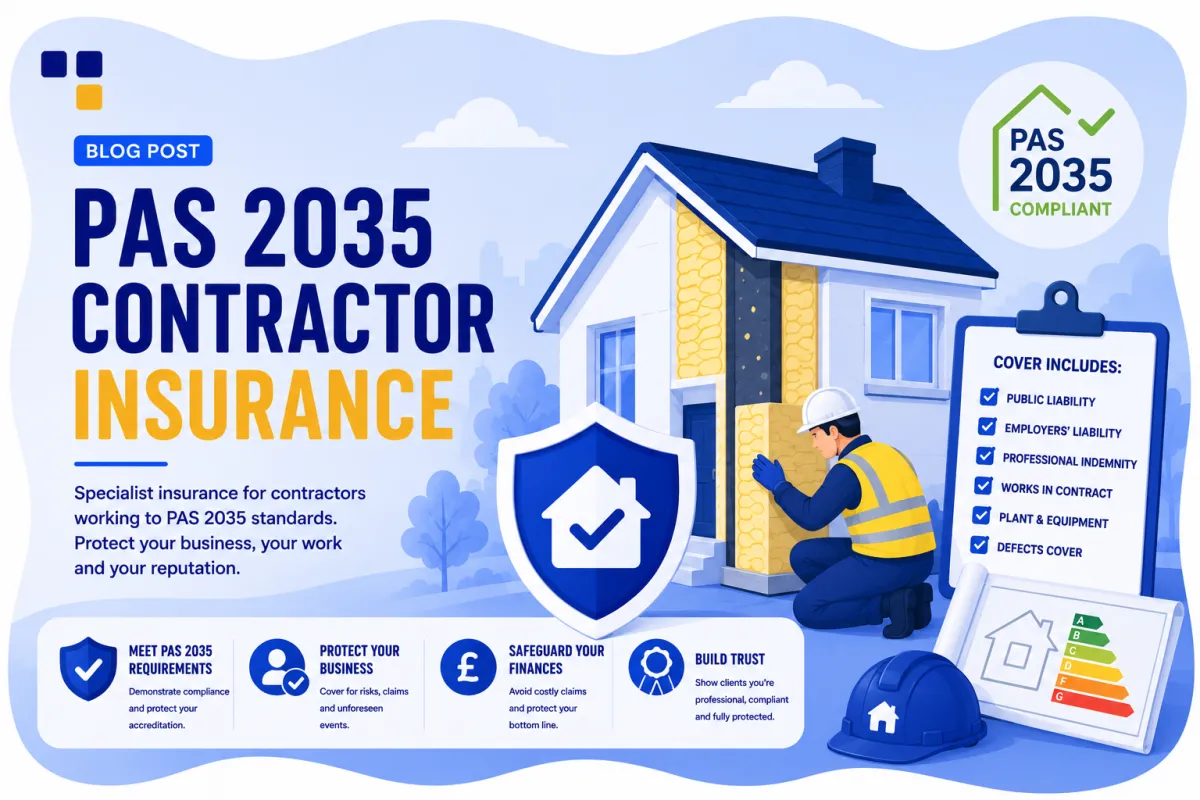
PAS 2035 Contractor Insurance UK: Retrofit PI & Liability
Why does PAS 2035 demand specialist insurance?
PAS 2035 is the most consequential UK retrofit standard of the last decade — and it has created an insurance market that off-the-shelf trade policies were never built for. Introduced after the Each Home Counts review and updated significantly in the 2023 edition (in force from 30 March 2025 with the withdrawal of PAS 2035:2019), the standard governs the design, coordination, installation and evaluation of every government-funded domestic retrofit in the UK. It is the gateway to ECO4, the Great British Insulation Scheme, the Social Housing Decarbonisation Fund (SHDF), the Warm Homes: Local Grant and the new £6.6 billion Warm Homes Plan funding 5 million home upgrades over five years.
Three things make PAS 2035 contractor insurance genuinely different from general construction or tradesman cover. First, the five-role accountability structure — Retrofit Assessor, Retrofit Coordinator, Retrofit Designer, Retrofit Installer (PAS 2030) and Retrofit Evaluator each carry different liability profiles, and insurers price them very differently. Second, the long-tail nature of retrofit claims — damp, mould, condensation, structural deterioration, render failure, and ventilation defects often emerge 18 months to 5 years after installation, well after standard project warranties have expired. The TrustMark Insurance-Backed Guarantee (IBG) covers a 25-year window for funded works, which means the contractor's professional indemnity exposure extends across the same period. Third, the regulatory cascade — TrustMark scheme provider requirements, BSI auditing, DESNZ scheme rules, and local authority procurement frameworks all impose specific insurance conditions that must be evidenced before any work begins.
Add to that the rapid expansion of the retrofit market — with public funding accelerating sharply through 2026 and beyond — and you have a sector where the wrong insurance position blocks work, creates director liability, and exposes long-running PI claims that may not surface until years after the project ledger has closed. This guide is the most comprehensive UK PAS 2035 contractor insurance resource we publish.
Key facts at a glance
- PAS 2035:2023 has been in force since 30 March 2025 — replacing PAS 2035:2019; all publicly funded retrofit work must now comply with the 2023 edition.
- Retrofit Coordinator is the only mandatory role across every PAS 2035 risk pathway — and the role with the highest professional indemnity exposure.
- TrustMark Insurance-Backed Guarantees cover a 25-year period — meaning your professional indemnity exposure runs in parallel for the same duration, well after project completion.
- The Warm Homes Plan commits £6.6 billion over 5 years for 5 million UK home upgrades — driving rapid expansion of the PAS 2035 contractor population.
- Retrofit Coordinators need PI £500k–£2m typically; large social housing programmes increasingly demand £5m+ aggregate.
- PAS 2030 installer PL typically £5m–£10m with explicit moisture, condensation, and unintended consequences cover — standard tradesman PL rarely includes these.
- Typical 2026 PAS 2035 contractor insurance cost: £700–£1,400 sole RC; £1,800–£4,500 small consultancy; £5,000–£18,000 PAS 2030 installer; £15,000–£60,000+ multi-role retrofit firm.
1. What is PAS 2035 and how does it differ from PAS 2030?
PAS 2035 (Publicly Available Specification 2035) is the British Standards Institution's framework for the energy retrofit of domestic buildings. It works alongside PAS 2030 (the installation standard), and both were updated to 2023 editions on 28 September 2023 with full force from 30 March 2025. Together they form the foundation of UK government retrofit policy.
PAS 2035 — The Whole-House Design and Coordination Standard
PAS 2035:2023 governs the process of retrofit: how dwellings are assessed, how measures are designed, how the project is coordinated, and how outcomes are evaluated. It introduces the five specialist roles, mandates a structured risk-based pathway (A, B or C depending on dwelling complexity), and requires every project to produce a Medium Term Improvement Plan covering 20-30 years of phased upgrades. Key principles:
- Fabric first — upgrade walls, roofs, floors and windows before adding new systems
- Whole-house approach — treat the dwelling as an integrated system, not a sequence of independent measures
- Build tight, ventilate right — airtightness balanced with proper ventilation to prevent moisture problems
- Risk-based pathways — Path A (simpler dwellings), Path B (more complex), Path C (traditional/historic buildings, treated under BS 7913)
- Quality, quality, quality — explicit on minimising defects and unintended consequences
PAS 2030 — The Installation Standard
PAS 2030:2023 governs how the physical installation work is delivered: methodologies, supervision, quality control, commissioning, and testing. PAS 2030 certification is held at company level by retrofit installers (with measure-by-measure scope), and is mandatory for any installer working on government-funded retrofit work. Without PAS 2030 certification, you cannot install ECO4, GBIS, SHDF, Warm Homes or any other funded measure.
The Critical 2023 Changes
Several PAS 2035:2023 changes have material insurance implications:
- Path A assessments must now be undertaken by a Retrofit Assessor (Domestic Energy Assessor or qualified surveyor) — previously could be done by a Retrofit Coordinator. This separates assessment and coordination duties more clearly.
- Traditional/historic buildings require Level 3 Award in Energy Efficiency for Older and Traditional Buildings.
- Airtightness strategy required for all projects — with optional but encouraged air leakage testing.
- Moisture guidance aligned with BS 5250:2021 — significantly stricter on condensation risk.
- Annex C simplified and brought into line with the updated Approved Document F (ventilation).
- Scale retrofit clauses permitting design based on archetype assessments where appropriate.
2. Which PAS 2035 role are you — and what does it mean for cover?
The five PAS 2035 roles carry materially different insurance profiles. Understanding which role(s) you perform — and which create the highest exposure — is foundational to scoping the right cover.
| Role | Core Responsibility | Primary Insurance Exposure |
|---|---|---|
| Retrofit Assessor (RA) | Conducts dwelling assessment including condition survey, occupancy assessment, and energy report. Must be a qualified DEA or professional surveyor; Level 3 Award for traditional buildings. | PI for inaccurate or missed defects in the assessment — feeds the whole project design, so errors propagate |
| Retrofit Coordinator (RC) | Overall project management; oversees risk assessment, design coordination, Medium Term Improvement Plan, lodgement to TrustMark. Mandatory role across all paths. Level 5 Diploma in Retrofit Coordination required. | Highest PI exposure — responsible for whole-project outcome, MTIP correctness, and coordination across roles. Long-tail liability. |
| Retrofit Designer (RD) | Bespoke design of energy efficiency measures, including specification, junction detailing, and moisture/ventilation strategy. | PI for design errors — specification failures, junction detail issues, moisture risk miscalculation. Direct line to defect claims. |
| Retrofit Installer (PAS 2030 certified) | Physical installation of energy efficiency measures (EWI, IWI, cavity wall insulation, loft insulation, ventilation, heating systems). | PL for site work and third-party damage; product liability for installed measures; long-tail responsibility under TrustMark IBG. |
| Retrofit Evaluator | Post-completion monitoring and evaluation; documents performance against design intent. | PI for evaluation methodology and reporting errors. Lower exposure than RC/RD but still meaningful. |
3. PAS 2035 insurance comparison: which policy responds to which claim?
| Claim Type | Professional Indemnity | Public Liability | Product Liability | Contract Works |
|---|---|---|---|---|
| Inaccurate retrofit assessment missing condition defect | Yes — primary (RA role) | No | No | No |
| Design error causing moisture / condensation issue | Yes — primary (RD/RC role) | No | No | No |
| EWI / IWI installation defect causing damp | Partial (depends on cause) | Sometimes (subsequent damage) | Yes — primary | No |
| Ventilation specification fault causing mould | Yes (design responsibility) | Sometimes (occupier impact) | Sometimes (installed product) | No |
| Third-party property damage during installation | No | Yes — primary | No | No |
| Personal injury to occupant during work | No | Yes — primary | No | No |
| Failure of installed EWI render system | Partial (if design) | Sometimes | Yes — primary | No |
| Damage to own work in progress | No | No | No | Yes — primary |
| Failed lodgement / regulatory non-compliance | Yes (RC role) | No | No | No |
| Long-tail claim 5+ years post-completion | Yes (PI retroactive date critical) | Less common | Yes (TrustMark IBG window) | No |
4. Which insurance does a PAS 2035 contractor actually need?
Professional Indemnity (PI)
The foundation cover for every PAS 2035 role except possibly the pure installer. Professional indemnity insurance for retrofit must specifically cover: retrofit assessment work; coordination and project management; design and specification; medium-term improvement plan errors; lodgement and compliance failures; and unintended consequences from coordinated retrofit. Typical limits:
- Single Retrofit Coordinator / Assessor / Designer: £500k–£2m
- Small consultancy with multiple roles: £1m–£5m
- Large social housing / multi-measure delivery: £5m–£10m+
- Aggregate vs each-and-every: scrutinise the structure carefully
Public Liability (PL)
Essential for PAS 2030 installers and for any role with site presence. PL for PAS 2030 work must specifically cover:
- Subsequent damage from installed measures (moisture, condensation, mould)
- Hot works (torch work for roofing, gas appliance commissioning)
- Working at height (EWI, roof insulation, scaffold work)
- Occupier-in-residence claims (most retrofit work is in occupied homes)
- Tenanted property work where the occupier is not the contracting party
Product Liability
Often bundled with PL but separately scrutinised for retrofit. Where you install proprietary EWI systems, ventilation units, heating systems, or insulation products, you take on chain-of-supply liability for the installed product. Confirm the wording specifically addresses: failure of installed product; long-tail liability matching the IBG window; subsequent damage to building fabric; and consequential losses (alternative accommodation, repair, redecoration).
Employers' Liability
Statutory requirement under the Employers' Liability (Compulsory Insurance) Act 1969 if you employ anyone. Minimum £5m; market standard £10m. Include labour-only subcontractors under your direction.
Contract Works (Contractors All Risks / CAR)
Covers physical damage to your work in progress. For retrofit installers, particularly important during EWI installation where works can be left part-complete and weather-exposed across multiple days. Contractors combined structures often include CAR; standalone trade policies may not.
TrustMark-Aligned Insurance-Backed Guarantee Provisioning
Separate from your business insurance, your PAS 2030 work must be backed by a TrustMark-registered Insurance-Backed Guarantee (IBG). The IBG is purchased on a per-project basis through a TrustMark-recognised guarantee provider and covers the homeowner for 25 years against installer failure or defects emerging post-completion. Your business insurance and the per-project IBG sit alongside each other; both are essential.
Cyber Insurance
Retrofit businesses handle substantial occupier personal data (assessments include occupancy details, vulnerable resident flags, property information). Data breach exposure is real, and TrustMark scheme provider audit frameworks increasingly ask about data security. Cyber insurance covers GDPR breach response, ICO investigation, customer notification, and business interruption from system outage.
Directors' & Officers' (D&O)
Increasingly relevant given the regulatory cascade affecting retrofit businesses — TrustMark suspension/expulsion, DESNZ scheme rule changes, criminal liability for misrepresentation in funded scheme claims. D&O covers personal director liability separately from corporate liability.
Legal Expenses
Covers legal costs in disputes — TrustMark scheme provider investigations, ECO funder disputes, contract disagreements, employment matters, tax investigations. Particularly valuable in retrofit given the regulatory complexity and audit-heavy environment.
Commercial Vehicle / Fleet
For installers, surveyors, and coordinators making site visits. Commercial vehicle cover at Class 3 business use; fleet for 3+ vehicles.
5. PAS 2035 role-based cover checker
Select your primary role below for a tailored cover checklist showing exactly what you need.
PAS 2035 Role Cover Checker
Select your role to see the recommended insurance programme
Retrofit Assessor (RA)
- CRITICAL Professional Indemnity £500k–£1m specifically covering retrofit assessment work — declare DEA qualification and Level 3 Award for traditional buildings
- ESSENTIAL PI retroactive date — assessment errors can surface years later when subsequent design or installation fails
- ESSENTIAL Public Liability £2m–£5m for site visits and occupier interaction
- ESSENTIAL Cyber insurance — occupancy assessments capture sensitive personal data including vulnerability information
- ESSENTIAL Commercial vehicle / business use insurance — Class 3 for site visits
- RECOMMENDED Personal Accident — sole-trader assessors typically at risk during inspections
- RECOMMENDED Legal Expenses with TrustMark/scheme provider investigation cover
- CONSIDER Employers' Liability if you take on any associate assessors or admin support
Retrofit Coordinator (RC)
- CRITICAL Professional Indemnity £1m–£2m+ — the role with the highest PI exposure in PAS 2035; coordination errors propagate through every project
- ESSENTIAL PI must explicitly cover: project management; MTIP errors; lodgement failures; risk pathway misapplication; coordination failure between roles
- ESSENTIAL Full retroactive date — TrustMark IBG runs 25 years; coordination errors may surface late
- ESSENTIAL Public Liability £2m–£5m for site presence
- ESSENTIAL Cyber insurance — coordinators handle multi-project data and TrustMark lodgement systems
- ESSENTIAL Legal Expenses including TrustMark scheme provider, ECO funder, and local authority dispute cover
- RECOMMENDED D&O liability — TrustMark suspension/expulsion can create personal director exposure
- RECOMMENDED Run-off PI provisions if you sell, close, or restructure — claims emerge years post-engagement
Retrofit Designer (RD)
- CRITICAL Professional Indemnity £500k–£2m — design errors are the highest-severity PAS 2035 PI claim category (moisture, condensation, structural)
- ESSENTIAL PI explicitly covering: design and specification; junction detailing; moisture / ventilation strategy; airtightness design; thermal modelling
- ESSENTIAL PI alignment with BS 5250:2021 (moisture) and BS 7913 (historic) where relevant — declare scope of work types
- ESSENTIAL Full retroactive date — moisture and condensation defects often appear 18 months to 5 years post-completion
- ESSENTIAL Public Liability for site visits
- ESSENTIAL Cyber insurance for design data and client information
- RECOMMENDED Specialist scheme placement — many mainstream PI markets don't underwrite retrofit design well
- CONSIDER Hybrid civil engineering / construction PI programme if also doing wider building design
PAS 2030 Installer
- LEGAL Employers' Liability £10m
- CRITICAL Public Liability £5m–£10m with explicit cover for: moisture/condensation subsequent damage; hot works; working at height; occupier-in-residence claims
- ESSENTIAL Product Liability covering installed measures — EWI render systems, ventilation units, heating systems
- ESSENTIAL Long-tail product liability matching TrustMark IBG 25-year window
- ESSENTIAL Contract Works cover for projects in progress, especially weather-exposed phases
- ESSENTIAL Tools and plant cover at full replacement value
- ESSENTIAL Commercial vehicle / fleet insurance for installation teams
- RECOMMENDED Per-project Insurance-Backed Guarantee through TrustMark-registered provider (separate from business insurance)
- RECOMMENDED Legal Expenses with HSE investigation and TrustMark scheme provider cover
Multi-Role Retrofit Consultancy
- CRITICAL Combined PI £2m–£5m covering all roles you perform — declare each role separately at proposal
- ESSENTIAL PI scope explicitly listing: assessment; coordination; design; evaluation; any combination thereof
- ESSENTIAL Full retroactive date covering all roles for full business history
- ESSENTIAL Employers' Liability £10m
- ESSENTIAL Public Liability £5m
- ESSENTIAL Cyber insurance with multi-project scope
- ESSENTIAL Office contents and equipment
- ESSENTIAL Commercial vehicle / fleet
- RECOMMENDED D&O liability if limited company
- RECOMMENDED Legal Expenses with comprehensive scheme provider and ECO funder cover
Principal Contractor / Scheme Delivery Partner
- CRITICAL Cover must match the largest single contract value — scheme delivery contracts can run into tens of millions
- ESSENTIAL PI £5m–£25m covering all delivered roles and supply chain coordination
- ESSENTIAL Public Liability £10m minimum; £25m increasingly for large social housing programmes
- ESSENTIAL Employers' Liability £10m
- ESSENTIAL Product Liability at substantial limits — aggregate exposure across hundreds of installations
- ESSENTIAL Contract Works (CAR) at full programme value
- ESSENTIAL Subcontractor management cover — vetting, indemnification, performance
- ESSENTIAL D&O liability at substantial limits
- ESSENTIAL EPL (Employment Practices Liability) — large workforce exposure
- ESSENTIAL Comprehensive cyber programme
- RECOMMENDED Specialist Lloyd's market placement — contact Miller & Partner directly
6. PAS 2035 / TrustMark IBG readiness checker
The single most common cause of TrustMark scheme provider audit failures and IBG rejection is missing or incomplete documentation. Tick each item you have in place before lodging any project:
PAS 2035 Compliance Documentation Checker
Click each item you have in place. The more you tick, the stronger your audit position and the smoother your IBG registration.
-
Retrofit Assessor qualification evidence — DEA certificate, RICS/relevant professional surveyor membership, plus Level 3 Award for traditional buildings where applicable
-
Retrofit Coordinator Level 5 Diploma in Retrofit Coordination and Risk Management — held by the named RC on every project
-
TrustMark scheme provider registration active and renewed — required for project lodgement
-
PAS 2030:2023 certification held by installer (with current scope matching the measures installed)
-
Professional Indemnity certificate with current period, evidence of scope covering all roles performed, and full retroactive date
-
Public Liability certificate at limits meeting scheme provider and funder requirements (typically £5m+ for installers)
-
Project Medium Term Improvement Plan documented for every dwelling, covering 20–30 year sequencing of measures
-
Retrofit Risk Assessment completed per dwelling, applying the correct PAS 2035 Path (A, B, or C) and documented airtightness strategy
-
Per-project Insurance-Backed Guarantee arranged through a TrustMark-recognised IBG provider before installation completes
-
Installation evidence pack — photographs of works, commissioning records, ventilation testing, completion certificates, EPC update
-
TrustMark Data Warehouse lodgement completed by the Retrofit Coordinator within scheme provider deadlines
7. Retrofit exposure risk assessor
Two factors drive PAS 2035 contractor insurance risk more than any others: the property type you work on, and the measures you deliver. Use the tool below for your specific risk profile.
PAS 2035 Retrofit Risk Assessor
Select your typical property type and primary measure type to see your specific risk profile

8. How does TrustMark, IBG and the Code for Adoption affect cover?
PAS 2035 doesn't operate in isolation. It sits within a quality assurance and consumer protection framework anchored by TrustMark — the UK government-endorsed quality scheme for work in or around the home. For any contractor working on government-funded retrofit, TrustMark scheme membership and Insurance-Backed Guarantee provisioning aren't optional extras; they're the foundation of being able to operate. Understanding how these interact with your business insurance is essential.
TrustMark Scheme Provider Registration
To deliver PAS 2035 work on funded schemes, you must be registered with a TrustMark-approved scheme provider. The scheme provider conducts initial vetting, ongoing audits, and quality assurance — and imposes insurance requirements as a condition of registration. Common scheme provider insurance demands:
- Professional Indemnity at specified minimum limits (commonly £1m–£2m for assessors/coordinators; £5m for designers; higher for principal contractors)
- Public Liability at £5m–£10m
- Employers' Liability at £10m
- Product Liability for installers, often integrated with PL
- Evidence of run-off provisions if cover changes mid-period
- Specific wording requirements — retrofit scope, BS 5250:2021 alignment, ventilation cover
Insurance-Backed Guarantee (IBG)
For every funded retrofit installation, an IBG must be registered with TrustMark before completion. The IBG covers a 25-year window and protects the homeowner against installer failure or defects emerging post-completion. Key points:
- The IBG is separate from your business insurance — it's a per-project product purchased through a TrustMark-recognised guarantee provider
- The IBG does not replace your PI and PL cover — your business insurance continues to respond to claims within its scope; the IBG is a homeowner-facing warranty
- The IBG remains valid even if the original installer ceases trading — because the warranty is underwritten by an independent insurer
- The 25-year window aligns with the typical lifetime of insulation and renewable systems
- IBG cost is typically £150-£400 per dwelling depending on measure type and warranty provider
How the IBG Affects Your PI Exposure
The 25-year IBG window has a direct consequence for your professional indemnity position: defect claims emerging through that period — particularly in years 3-15 post-completion when moisture, condensation, and structural deterioration commonly surface — flow back to the responsible PAS 2035 role. The IBG ensures the homeowner is protected; it does not protect you. The original Retrofit Coordinator, Designer, Assessor, or Installer carries professional liability for the original work for the full duration. This makes PI retroactive date and run-off provisions particularly critical for retrofit businesses:
- Retroactive date must cover all your past work — restricting it to save premium leaves prior years uninsured
- Run-off cover must continue if you sell, restructure, or close the business — typically 6-12 years post-cessation as standard, longer for retrofit given the 25-year IBG window
- Continuous renewal — claims-made policies require uninterrupted cover to respond to claims arising from past work
9. What insurance do ECO4, GBIS, SHDF and Warm Homes Plan demand?
UK retrofit funding schemes each impose specific insurance requirements that flow down through the supply chain to the working contractor. Understanding which scheme demands what — and how those demands change — is part of operating in the sector.
ECO4 (Energy Company Obligation, 2022–2026)
The current iteration of the Energy Company Obligation places statutory duties on large energy suppliers to fund energy efficiency measures for fuel-poor and vulnerable households. ECO4 work must be delivered under PAS 2035:2023 (since 30 March 2025). Insurance requirements typically demanded by ECO4 obligated suppliers from their delivery partners include:
- PI £2m–£5m for design and coordination roles
- PL £5m–£10m for installation
- EL £10m
- Product Liability for installed measures with long-tail provision
- Evidence of TrustMark scheme provider registration
- Per-project IBG provisioning
Great British Insulation Scheme (GBIS)
GBIS is a 3-year £1bn programme running alongside ECO4, targeting basic insulation measures in less energy-efficient homes. Single-measure focused but still requires PAS 2035 coordination and PAS 2030 installation. Insurance requirements similar to ECO4 but typically at the lower end of the range given the simpler scope.
Social Housing Decarbonisation Fund (SHDF)
SHDF funds whole-house retrofit in social housing. SHDF projects are typically larger, multi-measure, and procured through framework agreements that impose substantial insurance requirements:
- PI £5m–£10m+ (the scale and complexity drives higher limits)
- PL £10m+ with explicit cover for occupied premises and tenant interaction
- EL £10m+
- Contract Works at full project value
- Performance bonds and warranties
- Specific scheme provider requirements depending on framework
Warm Homes: Local Grant
Delivered through local authorities, the Warm Homes: Local Grant funds retrofit for low-income households in areas identified as having significant fuel poverty. Insurance requirements are set by individual local authority procurement teams but typically follow the SHDF pattern with some local variation.
Warm Homes Plan (2025-2030)
The new Warm Homes Plan represents the largest single retrofit funding commitment in UK history — £6.6 billion over 5 years targeting 5 million homes. Delivery rules are still being finalised but the framework will impose:
- Mandatory PAS 2035:2023 coordination
- Mandatory PAS 2030:2023 installer certification
- TrustMark scheme provider registration
- Per-project IBG
- Specific insurance limits aligned to programme scale
10. What does a real PAS 2035 claim look like?
PAS 2035 contractor claims have a distinctive profile that sets them apart from general construction claims. Understanding the patterns is essential for both managing risk and structuring cover correctly.
The Long-Tail Pattern
Unlike most construction claims (which typically surface during or shortly after the works), PAS 2035 retrofit claims often emerge years later. The typical timeline:
- Months 0-6 post-completion: Acute installation defects (visible cracks, immediate render failure, ventilation not commissioned correctly)
- Months 6-24: Initial moisture and condensation issues; occupant comfort complaints; mould emergence in cold spots
- Years 2-5: Established moisture and mould patterns; render failures; thermal bridging effects becoming visible; significant remediation required
- Years 5-10: Structural consequences of moisture (timber rot, render delamination, internal plasterboard deterioration); EPC performance failure
- Years 10-25: Late-stage product life issues; warranty claims under TrustMark IBG; older installations showing system-level failures
The Coordination Liability Gap
PAS 2035 claims frequently arise not from any single role's error but from coordination failures between roles. A common pattern:
- Assessor identifies dwelling as cavity-wall suitable; misses signs of damp in the existing fabric
- Designer specifies cavity insulation based on assessor's report
- Installer installs to spec
- Coordinator lodges the project
- 18 months later, occupant reports increasing damp; investigation finds cavity insulation has bridged moisture from existing problems
- Claim brought against all four roles; insurer investigation establishes the coordination failure was the proximate cause
The Retrofit Coordinator typically takes the largest share of liability — because the role's whole purpose is to prevent exactly this coordination gap.
The "Unintended Consequences" Claim
PAS 2035 explicitly references "unintended consequences" — the standard's foundational concept reflecting the lessons of earlier insulation schemes where measures installed in good faith caused subsequent damage. From an insurance perspective, unintended consequences claims include:
- Moisture trapped behind wall insulation causing damp
- Reduced ventilation following airtightness measures causing condensation and mould
- Thermal bridging at junctions causing localised cold spots and condensation
- External wall insulation causing render failures, thermal cracking, or fixings issues
- Cavity insulation causing rain penetration in exposed locations
- Heat pump installation revealing inadequate fabric performance and high running costs
11. What drives the cost of PAS 2035 contractor insurance?
| Rating Factor | Impact on Premium | What You Can Do |
|---|---|---|
| Role(s) performed | RC highest PI; RA moderate; RD high; Installer high PL/Product; Evaluator lowest | Declare all roles accurately; misdeclaration creates fundamental cover dispute |
| Annual turnover / project volume | Primary scaling factor for PI and PL premium | Declare accurately including projected growth |
| Property age and type | Modern cavity-wall lowest; pre-war solid wall higher; traditional/historic Path C highest | Match property mix declaration to actual work; declare BS 7913 / Level 3 Award where held |
| Measure mix | Loft/cavity lower; IWI/EWI substantially higher; whole-house highest | Document moisture and ventilation strategy on every project |
| Limits selected | PI £500k vs £1m vs £5m all rate differently; aggregate structure matters | Match limits to scheme provider, funder, and contract requirements |
| Retroactive date | Full retroactive significantly more expensive than restricted | Always opt for full retroactive — restricted dates leave prior years uninsured against 25-year IBG window |
| Scheme accreditation evidence | TrustMark, PAS 2030, MCS where relevant — all reduce premium | Maintain and present accreditation evidence at every renewal |
| Qualifications evidence | Level 5 Diploma for RC, DEA/RICS for RA, Level 3 Award for traditional — all reduce premium | Maintain CPD records and present at renewal |
| Claims history | Material multi-year impact on PI given long-tail nature of retrofit claims | Address root causes; documented quality systems support renewal terms |
| Documented quality systems | BS 5250:2021 alignment, ventilation testing protocols, condition reporting — all reduce premium | Maintain documented procedures; auditable evidence for every project |
| Insurer market and placement | Mainstream construction PI vs specialist retrofit market — material difference in terms | Use a broker who places specialist retrofit risk rather than generic construction |
12. Real claims and how to manage them
Claim — Internal Wall Insulation Causing Severe Condensation, Retrofit Coordinator
A Retrofit Coordinator delivered an ECO4-funded internal wall insulation (IWI) project on a 1930s solid-wall semi-detached property. The retrofit assessment correctly identified the property as Path B; the design specified mineral wool IWI with vapour control layer and uprated extract ventilation. The installation completed without immediate issue, the project was lodged with TrustMark, and the IBG was registered.
14 months post-completion, the occupant reported widespread mould growth on the IWI walls, particularly behind furniture and in corners. Initial inspection confirmed severe condensation and mould; testing identified that the uprated mechanical extract ventilation had been installed but never commissioned to design flow rates, and the vapour control layer had been incorrectly lapped at junctions, allowing moist air to penetrate behind the insulation.
The homeowner claimed against the Retrofit Coordinator under TrustMark dispute resolution and separately as a professional negligence claim. Remediation cost: removal of affected IWI (£8,400), full re-installation with correct VCL detailing (£14,200), ventilation commissioning (£2,800), redecoration (£3,200), occupant accommodation during works (£4,600). Total: £33,200. Subsequent claim for impact on occupant health and property value: £18,000.
The Coordinator's £1m PI policy responded. The insurer's investigation identified that coordination of installer commissioning had been inadequate — the Coordinator had not required or verified ventilation commissioning records before lodgement. The claim settled at £48,400 plus £14,200 defence costs. The Coordinator's premium increased by 45% at next renewal, and the insurer imposed a "commissioning verification" condition requiring documented evidence of ventilation testing for all subsequent projects.
The lesson: the Retrofit Coordinator's role isn't administrative — it's substantively responsible for project outcomes. Coordination failures around commissioning, testing, and verification are increasingly the primary claim driver in PAS 2035 PI claims. Documented verification protocols save claims.
Claim — External Wall Insulation Render Failure, PAS 2030 Installer
A PAS 2030 installer completed EWI installation on a terrace of six SHDF-funded social housing properties. The EWI system was a proprietary EPS-with-render system installed to manufacturer specification under a Retrofit Designer's package. Installation was signed off; properties were occupied; the project was lodged.
30 months post-completion, hairline cracks appeared in the render across multiple properties. By month 36, the cracks had widened, allowing water ingress; sections of render began to delaminate from the EPS substrate. Investigation by a chartered surveyor concluded the failures were caused by inadequate base coat application thickness — installer error rather than system design or specification fault.
The social housing landlord claimed against the installer for full system remediation across all six properties. Quotes for remediation: £148,000 (strip back and re-apply render system across full elevation areas). The installer's £5m PL with product liability extension responded. Initial loss adjuster assessment: settle on a per-property basis after detailed investigation.
The TrustMark IBG was also engaged — the homeowner-side warranty paid for emergency repairs and weatherproofing during the dispute, recovered from the installer's PL settlement. Total claim against the installer's policy: £128,400 (negotiated down from £148,000 with the loss adjuster). Defence costs and expert fees: £24,800. Total impact: £153,200. The installer's PL premium increased 60% at next renewal, and TrustMark scheme provider imposed enhanced supervision and commissioning protocols as a condition of continued registration.
The lesson: PAS 2030 installer claims combine product liability (installed measure failure) with the supply chain involvement of the manufacturer, designer, and installer. The wording of the PL — particularly whether product liability is included, the limits structure, and the long-tail provision — determines whether the installer is fully covered or carries significant uninsured exposure. The TrustMark IBG is the homeowner's protection; the installer's PL is the installer's protection. Both are needed.
Claim — Retrofit Assessment Missing Subsidence Indicator, Retrofit Assessor
A Retrofit Assessor conducting an ECO4 funding eligibility assessment on a Victorian terrace property completed the dwelling assessment, condition survey, and occupancy assessment in line with PAS 2035:2023 requirements. The assessment did not identify any indicators of pre-existing structural movement, and the property proceeded to design and installation of EWI on the front elevation.
22 months post-completion, the homeowner reported new cracks appearing in internal plaster and external render. Structural investigation revealed pre-existing subsidence on the front bay window, which had been undisturbed for many years until the EWI installation added load and altered the elevation's drying characteristics. The EWI installation accelerated movement that would otherwise have remained stable.
The homeowner brought claims against multiple parties. The Retrofit Assessor's PI policy was notified. The insurer's expert assessment focused on whether the original assessment should have identified subsidence indicators — examining cracks (if any) existing at assessment date, photographic evidence, and the assessor's documentation.
The assessor's site photographs taken at the time of assessment did show a hairline crack in the bay rendering, but the assessor had not flagged it as significant. The expert view was that an appropriately trained assessor working on a pre-1900 property should have flagged the indicator and triggered Path C treatment (BS 7913) including structural assessment. The claim settled at £58,000 plus £18,400 defence costs against the £500k PI limit. The assessor's premium increased substantially and the insurer required Level 3 Award completion as a renewal condition.
The lesson: Retrofit Assessment errors propagate through the entire project. Single missed indicators at assessment stage can trigger five- and six-figure remediation claims years later. For traditional buildings, Level 3 Award training isn't just a PAS 2035:2023 procedural requirement — it's the insurance position that determines whether the assessor's PI responds cleanly.
Claims Management Steps
How to respond to a PAS 2035 contractor insurance claim — particularly given the long-tail nature of retrofit claims, the steps below are critical:
- Notify your insurer immediately on becoming aware of a claim or circumstance that may give rise to a claim. PI is claims-made — the policy in force when you receive the claim (or circumstance notification) is the policy that responds. Late notification can void cover entirely. The threshold is "circumstance that may give rise" — much lower than "formal claim received".
- Engage TrustMark scheme provider for any homeowner complaint received via the TrustMark dispute resolution route. Cooperate with their investigation; do not respond directly to the homeowner without scheme provider and insurer input.
- Preserve all project documentation. Retrofit Assessment Report, Medium Term Improvement Plan, design package, installation evidence pack, commissioning records, TrustMark lodgement, IBG certificate. The documentation IS the defence.
- Do not admit liability. Retrofit claims often involve technical complexity where causation isn't obvious. Provide factual information; leave assessment to the insurer's appointed expert and solicitor.
- Manage the multi-party investigation. Retrofit claims often involve multiple roles (assessor, coordinator, designer, installer). Each role's insurer will conduct its own investigation. Your insurer will coordinate; do not engage directly with other roles' insurers without your own insurer's coordination.
- Engage the technical expert process. Retrofit defect claims turn on expert assessment of causation — moisture testing, thermal imaging, ventilation flow measurement, fabric performance testing. Your insurer's expert will conduct these; cooperate fully with site access.
- Document the response. Every decision, every communication, every site visit logged with timestamps. The claim file you create supports both this settlement and any subsequent regulatory or TrustMark proceedings.
- Conduct root cause analysis. Beyond responding to this incident, identify the underlying cause and address it. Insurers reviewing renewal terms will ask what's changed since the claim. TrustMark scheme providers will require evidence of remedial action.

Glossary of PAS 2035 insurance terms
- PAS 2035:2023
- The current BSI Publicly Available Specification for the retrofit of domestic buildings, published 28 September 2023 and in full force from 30 March 2025. Replaces PAS 2035:2019. Governs assessment, design, coordination, installation, and evaluation of energy efficiency measures.
- PAS 2030:2023
- The companion BSI specification governing the installation of energy efficiency measures. Held at company level by installers; mandatory for any installer working on government-funded retrofit work.
- Retrofit Coordinator (RC)
- The mandatory PAS 2035 role responsible for whole-project coordination. Must hold the Level 5 Diploma in Retrofit Coordination and Risk Management. Highest PI exposure of the five PAS 2035 roles.
- Retrofit Assessor (RA)
- The PAS 2035 role conducting dwelling assessment, condition survey, and occupancy assessment. Must be a qualified Domestic Energy Assessor or professional surveyor; Level 3 Award required for traditional buildings.
- Retrofit Designer (RD)
- The PAS 2035 role producing the bespoke design of energy efficiency measures, junction detailing, moisture and ventilation strategy. High PI exposure for design errors.
- TrustMark
- The UK government-endorsed quality scheme for work in or around the home. TrustMark scheme provider registration is mandatory for PAS 2035 delivery on funded schemes.
- Insurance-Backed Guarantee (IBG)
- A per-project warranty product registered with TrustMark covering the homeowner for 25 years against installer failure or defects emerging post-completion. Separate from the contractor's business insurance.
- ECO4 (Energy Company Obligation)
- The current iteration (2022-2026) of the statutory energy supplier obligation funding energy efficiency measures for fuel-poor and vulnerable households. Must be delivered under PAS 2035:2023 from 30 March 2025.
- GBIS (Great British Insulation Scheme)
- 3-year £1bn programme alongside ECO4, targeting basic insulation measures in less energy-efficient homes. PAS 2035 coordination and PAS 2030 installation required.
- SHDF (Social Housing Decarbonisation Fund)
- Government funding for whole-house retrofit in social housing. Typically larger multi-measure projects procured through framework agreements with substantial insurance requirements.
- Warm Homes Plan
- £6.6 billion 5-year funding commitment targeting 5 million UK home retrofits, announced 2024-2025. Largest single retrofit funding commitment in UK history; delivery rules being finalised.
- Medium Term Improvement Plan (MTIP)
- 20-30 year retrofit roadmap produced by the Retrofit Coordinator for every PAS 2035 project. Sequences recommended measures and identifies long-term retrofit pathway.
- Path A, B, C
- PAS 2035 risk-based pathways: Path A (simpler dwellings, standard process), Path B (more complex), Path C (traditional/historic buildings, BS 7913 compliance). Pathway determines design and assessment requirements.
- BS 5250:2021
- British Standard for the management of moisture in buildings — referenced by PAS 2035:2023 for moisture and condensation risk assessment in retrofit design.
- BS 7913
- British Standard "Guide to the conservation of historic buildings" — referenced for Path C projects on traditional and historic buildings.
- Unintended Consequences
- Foundational PAS 2035 concept referencing the lessons of earlier insulation schemes where measures installed in good faith caused subsequent damp, mould, structural deterioration, or other harms. The standard's quality assurance framework is designed to prevent unintended consequences.
Frequently asked questions
The core programme depends on which PAS 2035 role you perform. Retrofit Assessors, Coordinators, Designers and Evaluators primarily need professional indemnity at limits matching scheme provider and contract requirements (typically £500k–£5m). PAS 2030 installers primarily need public liability with explicit moisture/condensation cover plus product liability matching the 25-year TrustMark IBG window. Multi-role retrofit businesses need combined PI/PL covering every role performed. Employers' liability is the only legal statutory requirement if you have staff. TrustMark scheme provider registration, PAS 2030 certification (for installers), and per-project IBG provisioning are scheme-driven requirements that work alongside business insurance.
PAS 2035 is the process and design standard — it governs assessment, coordination, design, and evaluation of retrofit projects through the five specialist roles. PAS 2030 is the installation standard — it governs how the physical installation work is delivered, including methodology, supervision, quality control, commissioning, and testing. Both were updated to 2023 editions on 28 September 2023 with full force from 30 March 2025. PAS 2030 certification is held at company level by installers; PAS 2035 roles are held by qualified individuals (Retrofit Coordinator with Level 5 Diploma, Retrofit Assessor with DEA qualification, etc.). Both are mandatory for government-funded retrofit work — assessors/coordinators/designers work under PAS 2035; installers work under PAS 2030.
Because the TrustMark Insurance-Backed Guarantee provided to homeowners covers a 25-year window — meaning defect claims can flow back to the responsible PAS 2035 role for the same 25 years. While your IBG protects the homeowner, your professional indemnity policy is what protects you against claims from those defects. PI is written on a claims-made basis, meaning the policy in force when a claim is received responds — not the policy in force when the original work was done. To preserve cover for the full 25-year window, you need continuous PI cover with full retroactive date. Restricting retroactive date to save premium leaves prior years uninsured; lapsing PI cover even briefly creates uninsured gaps. For retrofit, run-off provisions are also critical if you sell, restructure, or close the business.
No. The IBG is a homeowner-facing warranty that protects the homeowner against installer failure or defects emerging in the 25 years after installation. It does not protect the contractor from professional liability claims. The two operate in parallel: (1) the IBG pays the homeowner for remediation if a defect emerges and the original installer cannot or will not remedy it; (2) your business insurance (PI, PL, Product Liability) responds to claims brought against you for the original work. In many real-world claims, both operate — the IBG covers emergency remediation while the dispute is being resolved, and the IBG provider then seeks recovery from the contractor's business insurance. You need both, and they are not substitutes.
The minimum scheme provider requirement is typically £1m, but the practical limit depends on portfolio. For a Retrofit Coordinator handling 20-30 dwellings per year on standard funded schemes, £1m–£2m is the working range. For larger volumes (50+ dwellings per year), £2m–£5m is increasingly the working baseline. For RC roles on SHDF or large social housing programmes coordinating hundreds of dwellings, £5m–£10m is often required and contractually demanded. The PI limit should reflect aggregated exposure across the active portfolio, not just any single dwelling — because a systemic coordination failure (e.g. inadequate ventilation specification applied across multiple projects) can generate aggregated claims well above any single-dwelling value.
It should, but confirm specifically. Standard tradesman PL often excludes "damage to the work itself" — meaning if your installed EWI causes subsequent moisture damage to the wall structure behind it, the wall damage may be covered (third-party property) but the EWI itself may not (your work). For PAS 2030 installers, you need PL specifically scoped to retrofit work, with explicit cover for: subsequent moisture and condensation damage; long-tail product liability matching the 25-year IBG; structural damage caused by your measure (thermal cracking, render failure, fixings issues); and consequential losses including alternative accommodation and redecoration. Standard construction PL is rarely adequate for PAS 2030 work — specialist retrofit PL placement is the standard route.
Requirements vary by TrustMark-approved scheme provider but typically include: PI £1m+ for assessors/coordinators (£2m+ for designers); PL £5m–£10m with retrofit-specific scope; EL £10m if employing staff; product liability for installers; evidence of run-off provisions; full retroactive date. The PAS 2035:2023 scheme provider documentation (Retrofit Coordinator Scheme Requirements, Retrofit Assessor Scheme Requirements) sets out specific minimum standards. Confirm requirements with your specific scheme provider — they vary in detail even where the underlying TrustMark framework is consistent.
Path C work on traditional and historic buildings (pre-1900 typically, listed buildings, and properties with traditional construction) represents the highest-risk PAS 2035 segment. Insurance requirements: Level 3 Award in Energy Efficiency for Older and Traditional Buildings held by all RA, RC, RD roles; BS 7913 compliance evidence documented per project; PI cover specifically extended to Path C work (some mainstream policies exclude pre-1900 dwellings); higher PI limits typically (£2m–£5m+); specialist placement often required through Lloyd's market or specialist MGAs. Mainstream construction PI markets frequently decline Path C work or impose substantial loadings; using a broker who places specialist retrofit and heritage risk is essential.
PI is claims-made — when you stop trading, the policy ceases to respond to new claims unless you arrange run-off cover. Run-off is essential for retrofit given the 25-year IBG window — defect claims may emerge years after you've stopped trading and ordinary cessation of cover leaves you personally exposed. UK retrofit businesses should arrange run-off cover for: minimum 6 years (standard professional services); recommended 12 years (matching typical building defect liability periods under the Limitation Act 1980); ideally 25 years (matching the full TrustMark IBG window). Run-off cover is purchased at cessation; pricing is typically a multiple of the final annual premium, paid as a one-off. Plan run-off into any business succession, sale, or restructure strategy from the outset.
Indicative 2026 pricing for compliant PAS 2035 cover:
- Sole Retrofit Assessor or Coordinator: £700–£1,400 per year (PI £500k–£1m, PL £2m, no staff)
- Small consultancy with multiple roles (2-4 staff): £1,800–£4,500 per year
- Retrofit Designer with substantial design portfolio: £2,500–£6,000 per year
- PAS 2030 installer (small-to-medium): £5,000–£18,000 per year
- Multi-role retrofit firm (£500k-£2m turnover): £8,000–£25,000 per year
- Principal contractor / SHDF delivery partner: £20,000–£75,000+ per year
- Path C / heritage specialist: specialist placement, typically £4,000–£15,000+ depending on portfolio
Largest cost drivers: role(s) performed, turnover and project volume, property age mix, measure mix (EWI/whole-house highest), limits selected, retroactive date scope, and accreditation evidence. Maintaining TrustMark, PAS 2030, MCS, and Level 5/Level 3 qualifications all materially reduce premium.
No — the IBG is purchased per project through a TrustMark-recognised IBG provider, not through your business insurer. Typical IBG cost is £150–£400 per dwelling depending on measure type and the warranty provider. The IBG provider underwrites the homeowner-facing warranty independently. Your business insurance (PI, PL, Product Liability) covers your liability separately; the IBG covers the homeowner. Both must be in place. Many retrofit businesses arrange IBG provisioning through the same broker who arranges their business insurance, but the products are technically separate and underwritten by different markets.
General construction PI is designed for traditional construction work — typically new-build, refurbishment, or extension — where moisture, ventilation, and unintended consequences claims are rare and short-tail. PAS 2035 cover specifically addresses: long-tail moisture and condensation claims (the highest-frequency retrofit PI claim category); ventilation specification liability; airtightness design liability; coordination liability for the RC role; BS 5250:2021 and BS 7913 compliance; the 25-year IBG window; TrustMark scheme provider audit and investigation cover; and specific exclusion of generic construction defects in favour of retrofit-specific causation. Using general construction PI for PAS 2035 work often creates coverage disputes at claim stage — the underwriter argues the claim was outside the policy's intended scope. Specialist retrofit PI placement is the safer route, even at a modest premium loading.







Instagram
LinkedIn