

Print on Demand Business Insurance UK: Complete Guide
Why Print on Demand Needs Specialist Insurance
Print on demand looks like one of the lowest-risk e-commerce business models on paper. You don't hold stock. You don't ship product. You don't operate a factory. A customer orders, Printful or Printify or Gelato or a similar partner manufactures the item, the courier delivers it, the customer is happy, and you receive a margin. Where exactly is the risk?
The risk sits in three places that aren't visible until something goes wrong. First, UK consumer protection law treats you — the brand owner who marketed the product — as the producer for liability purposes, even when you've never touched the product. Second, intellectual property infringement is the most common operational failure in POD: a design that uses a trademarked phrase, a font with a restricted licence, an AI-generated image trained on copyrighted work, or a parody that doesn't qualify for fair dealing under UK copyright law. Third, the platforms themselves — Etsy, Shopify, Amazon Merch on Demand, Redbubble — can suspend accounts, withhold payouts, and disable listings at any time. If you also produce physical goods yourself rather than only via a partner, see our guides to 3D printing product liability and electronics design business insurance, which cover the same producer question from the manufacturing side, frequently with limited appeal. None of these exposures are addressed by your platform partner's terms of service.
This guide is the most comprehensive UK print on demand insurance resource we publish. It addresses the Consumer Protection Act 1987 position that catches POD sellers out at claim stage, the specific dropshipping rules that insurers impose (5% physical inspection, rights of recourse), the IP infringement exposure that has generated multi-million-dollar judgments in similar businesses, and how to structure cover that actually reflects the way print on demand businesses operate in 2026.
1. The Three Insurance Myths That Cost POD Sellers Money
Talk to any UK print on demand seller and you'll usually find at least one of these three misconceptions baked into how they think about insurance. Each one is wrong, and each one has cost real money to real sellers when claims have actually arisen.
Myth 1 — "The platform handles it"
Printful, Printify, Gelato, Redbubble, Teespring, Amazon Merch on Demand and the rest all have terms of service that, on a casual reading, look like they cover the seller for product issues. They generally don't. Platform terms typically:
- Disclaim liability for product defects beyond reprinting or refunding the affected order
- Push responsibility for design legality and IP compliance onto the seller
- Include broad indemnification clauses requiring you to indemnify them for IP claims arising from your designs
- Give the platform unilateral suspension rights with limited appeal
- Limit any compensation to fees paid in the preceding 30, 60 or 90 days
When a customer raises a claim against a POD seller — whether for a defective product, an injury caused by a product, or an IP infringement allegation — the seller is the named party, not the platform. The platform's protection for the seller is limited to their fulfilment-quality obligation, which is itself capped and excludes consequential losses.
Myth 2 — "I don't hold stock, so I don't need product liability"
This is the most expensive POD myth. Not holding stock has no bearing on product liability — what matters is whether the law treats you as the producer. Under the Consumer Protection Act 1987, the producer includes anyone who "holds himself out as the producer by putting his name on the product, or using a trade mark or other distinguishing mark in relation to the product". For POD sellers, that's exactly what you're doing — putting your brand name and your designs on the product, marketing it as yours, taking the customer's money for what they perceive as your product. You are the producer in the eyes of UK consumer protection law, regardless of who physically printed the garment.
Myth 3 — "My home insurance covers my online business"
Standard UK home insurance excludes business activity. The moment you start running a print on demand business from your home — even part-time, even as a side hustle, even with zero physical stock — you have introduced commercial activity into a property insured for residential use. Some home insurers permit limited "clerical" business use; almost none extend to e-commerce with customer interaction, business equipment, and trading income. Failing to disclose business activity can void the policy entirely, including for unrelated claims like a kitchen fire that has nothing to do with your POD business.
2. The Consumer Protection Act 1987 — Why You're the Producer
UK product liability law is governed primarily by the Consumer Protection Act 1987, which implements the EU Product Liability Directive (now retained in UK law). Section 2 of the Act defines who is liable for damage caused by a defective product, and it is broader than many POD sellers realise.
Who Is "The Producer"
Under section 1(2) of the Act, "producer" includes:
- The person who manufactured the product
- The person who won, abstracted, or obtained the material
- "Any person who, by putting his name on the product or using a trade mark or other distinguishing mark in relation to the product, has held himself out to be the producer of the product" — section 2(2)(b)
- The person who imported the product into the UK (for liability purposes) where the original producer is outside the UK
The third category — the "own brander" — is precisely the legal position of a print on demand seller. You add your brand name, your trade mark, or your distinguishing mark to the product. Under the CPA you are held out as the producer for liability purposes, regardless of who physically manufactured the item.
What "Defective" Means
The standard for product defect under section 3 is broad: a product is defective if "the safety of the product is not such as persons generally are entitled to expect". For POD sellers, defects can include:
- Manufacturing defects — fabric that bleeds dye onto skin, faulty stitching that causes injury, structural failure in a phone case
- Material defects — fabric containing chemicals that trigger allergic reactions, ink that causes contact dermatitis, plastic that releases harmful substances
- Design defects — even where the design is functional (artwork, slogan), accompanying product features that prove unsafe
- Warning defects — missing or inadequate care instructions, allergen warnings, age-appropriateness
Strict Liability — No Need to Prove Fault
The CPA imposes strict liability — the claimant doesn't need to prove that you were negligent, only that the product was defective and caused the damage. Your defence positions are limited to specific statutory defences (the defect didn't exist when you supplied the product; the state of scientific knowledge at the time meant you couldn't have known; you didn't supply the product in the course of business). The practical position for POD sellers: if a product bearing your brand causes harm, the burden is on you to defend, not on the claimant to establish your fault.
The Rights of Recourse Question
Theoretically, where the manufacturing defect originated with your POD partner, you can pursue them for indemnification under your supply contract. In practice this is difficult:
- Many POD partners are outside the UK (Printful is based in the US and Latvia; Printify operates globally; many smaller white-label suppliers are in Asia)
- Enforcement of UK judgments in foreign jurisdictions is slow and expensive
- Platform terms typically cap their liability to fees paid, not to consequential damages
- Indemnification clauses are often weighted heavily against the seller
Your product liability cover is the practical first line of defence; the rights of recourse against your supplier is a secondary consideration. Worth knowing that liability and recall are separate purchases: if a print run has to come back off customers' shelves, product recall insurance funds the retrieval, replacement and notification costs that Products Liability expressly excludes.
3. Core Covers Every POD Business Needs
Product Liability Insurance
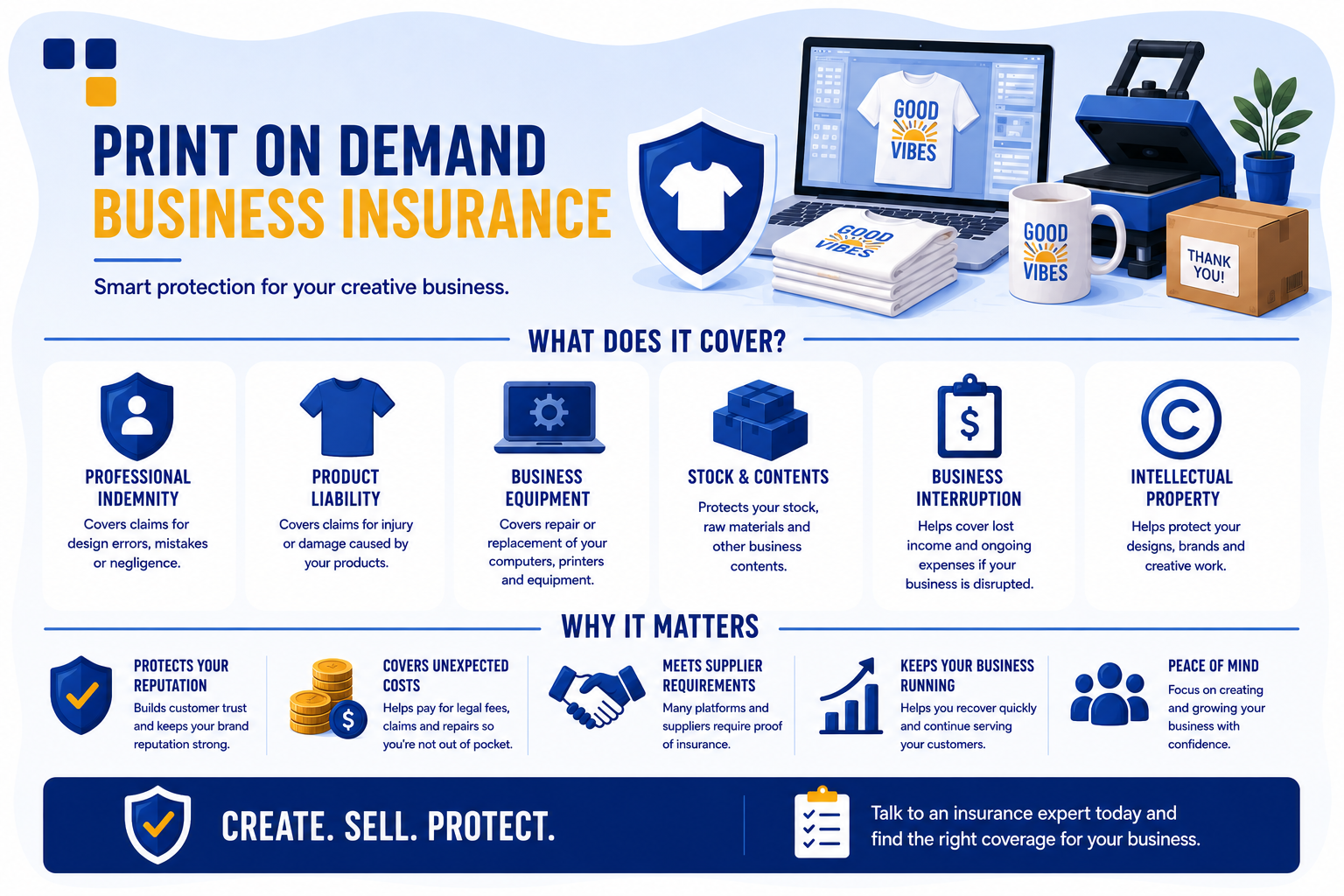
The most important cover for any print on demand business. PL responds to claims arising from products bearing your brand — bodily injury, property damage, allergic reactions, defective fulfilment. Minimum £2 million; £5 million is the working baseline for sellers of any meaningful scale. Confirm explicitly with your insurer that:
- Cover extends to products you do not physically manufacture or hold
- The territorial scope matches your customer geography
- The retroactive position covers products supplied in prior periods
- Your specific product categories (apparel, mugs, posters, phone cases, etc.) are within scope
Public Liability Insurance
Covers third-party injury or property damage from your business operations — visitors to your premises, courier collections, trade shows or pop-ups. Minimum £2m, £5m increasingly standard. Particularly relevant if you do any in-person trading, attend craft fairs, or have a studio that suppliers visit.
Intellectual Property Infringement Insurance
The most important specialist cover for POD businesses, and the most commonly missing. IP infringement is the dominant operational risk in print on demand — the volume of designs, the speed of trend-following, the global pool of trademark and copyright holders ready to enforce. IP infringement cover typically responds to:
- Defence costs in IP infringement actions brought against you
- Settlement payments and damages awards
- Costs of design takedown and replacement
- In some wordings, pursuit cover where someone infringes your IP
Standard professional indemnity and product liability policies typically exclude intentional IP infringement and may have restricted cover for unintentional infringement. Specialist IP cover or specifically negotiated extensions to PI are the only reliable route. See our wider professional indemnity guide for the broader context.
Cyber Insurance
POD businesses are entirely digital — your store, your customer data, your design files, your platform integrations, your payment processing. A cyber incident is operationally severe and triggers GDPR notification obligations. Cyber insurance covers breach response, business interruption from platform outage, ransomware, social engineering fraud, and increasingly the platform account takeover scenarios that affect POD sellers specifically — where a bad actor gains access to your Etsy, Shopify, or Printful account and redirects orders or payouts.
Professional Indemnity (Where Relevant)
If your POD business includes design services for clients, branding work, or any element of bespoke creative advice, PI covers claims arising from negligent professional services. Often combined with IP infringement in a single PI placement for design-focused POD businesses.
Business Interruption
For POD, business interruption looks different from traditional retail. The trigger isn't a fire at your shop — it's:
- Platform suspension or termination (Etsy ban, Shopify shutdown, Printful account hold)
- Cyber attack on your store or fulfilment systems
- Major supplier failure (your primary POD partner closing or going dark)
- Payment processor freeze (Stripe, PayPal, platform payouts)
Standard BI typically requires physical damage to property to trigger — which doesn't match POD reality. Cyber BI, contingent business interruption, and platform suspension cover are the right routes; standard BI alone is usually inadequate.
Stock and Equipment (Where Applicable)
Pure POD businesses hold no stock, but many sellers maintain small inventories of samples, swatch books, packaging materials for direct-fulfilment exceptions, and design equipment (computers, tablets, drawing hardware, photography setup). Replace at full value; consider away-from-premises cover if you take equipment to events.
Employers' Liability
Statutory requirement under the Employers' Liability (Compulsory Insurance) Act 1969 if you employ anyone — including a partner or family member helping with the business if they're paid. Minimum £5 million; penalties for trading without it can reach £2,500 per day.
Goods in Transit (Specific Scenarios)
POD's normal model is direct shipment from manufacturer to customer — outside your control and typically outside your insurance. But if you take any stock yourself (samples, fulfilment exceptions, market stock for events), vehicle business use and transit cover may apply.
4. Business Type Cover Checker
Select your POD business model below for a tailored cover checklist showing exactly what you need and where the typical gaps are.
Print on Demand Business Cover Checker
Select your business model to see the recommended insurance programme
Side Hustle — Single Platform, Low Volume
- CRITICAL Notify your home insurer of business activity — undeclared e-commerce can void cover
- ESSENTIAL Product Liability minimum £2m, preferably £5m — applies even to part-time sellers under Consumer Protection Act 1987
- ESSENTIAL Public Liability minimum £2m for any visitor or in-person trading exposure
- ESSENTIAL IP infringement cover or specifically extended PI — even single-design infringement claims can run to four figures in defence costs
- ESSENTIAL Cyber insurance — store data, customer information, platform login credentials all in scope
- RECOMMENDED Legal expenses for platform disputes and HMRC investigations
- RECOMMENDED Combined small business package — usually best value at side-hustle scale
- CONSIDER Sole proprietorship insurance package as the simplest structural fit
Full-Time Seller — Own Shopify Store
- ESSENTIAL Product Liability £5m minimum, £10m for higher-volume operations; explicit cover for products you don't manufacture
- ESSENTIAL Public Liability £5m typical baseline
- ESSENTIAL IP infringement cover with defence costs and settlements; this is your highest-frequency claim exposure
- ESSENTIAL Cyber insurance with platform integration coverage; GDPR breach response; business interruption from cyber events
- ESSENTIAL Business interruption with platform-specific triggers — Shopify outage, payment processor freeze, fulfilment partner failure
- ESSENTIAL Stock and equipment cover for design hardware, sample inventory, photography gear
- ESSENTIAL US/Canada territorial extension on PL if you sell to North American customers (standard UK PL excludes)
- RECOMMENDED Employers' Liability if you have any paid help including family members
- RECOMMENDED Legal expenses cover for platform disputes, HMRC, and freelance contracts
Multi-Platform — Etsy + Shopify + Amazon
- CRITICAL Multi-channel exposure compounds risk — each platform has its own suspension policies, IP enforcement processes, and dispute mechanisms
- ESSENTIAL Product Liability £5m–£10m with worldwide territorial scope
- ESSENTIAL IP infringement cover with explicit Etsy / Amazon counter-notice and brand registry coverage
- ESSENTIAL Cyber insurance covering multi-platform account compromise — bad actors increasingly target sellers with multiple linked accounts
- ESSENTIAL Business interruption covering platform suspension at any single channel; aggregate exposure across multiple platforms
- ESSENTIAL US/Canada PL extension — Amazon and Etsy in particular drive significant US customer flow
- RECOMMENDED Legal expenses for platform appeals — Amazon suspension reinstatement can be a £5,000+ legal exercise
- RECOMMENDED Trade credit cover if you accept any wholesale or B2B orders on credit terms
- CONSIDER Specialist shop and e-commerce insurance route rather than off-the-shelf SME cover
Designer-Led — Selling Original Artwork
- ESSENTIAL IP infringement cover including defence and pursuit — your original work is itself an IP asset worth protecting
- ESSENTIAL Product Liability at standard limits — physical products bearing your designs
- ESSENTIAL Professional Indemnity if you take commissions or licence designs to other brands
- ESSENTIAL Cyber insurance — design files and customer data both in scope; original artwork loss is catastrophic
- ESSENTIAL Documents and electronic data cover for original design files — reconstruction cost for lost source files is meaningful
- RECOMMENDED Trademark registration of brand name and key designs through IPO (not insurance but supports your IP position)
- RECOMMENDED AI-generated content position documented — keep prompts, training data sources, and licence records for any AI tools used
- CONSIDER Sole trader vs limited company structure for IP ownership and liability protection
Hybrid POD — Some Stock + Some Fulfilment
- ESSENTIAL Combined retail-and-POD wording — generic POD policies often exclude stock; generic retail wordings often exclude no-stock dropshipping
- ESSENTIAL Stock cover at full replacement value for any held inventory
- ESSENTIAL Goods in transit for your self-fulfilment activity
- ESSENTIAL Product Liability £5m+ explicitly covering both manufactured stock and POD partner product
- ESSENTIAL Premises cover if you rent commercial space (studio, lockup, fulfilment unit)
- ESSENTIAL Vehicle business use class — declared correctly to your motor insurer
- RECOMMENDED Personal accident cover — physical handling injuries are a real exposure once stock is involved
- RECOMMENDED Money cover if you handle cash at any in-person trading
POD Agency — Designing for Client Brands
- CRITICAL You are now providing professional services — PI becomes your primary cover, not PL
- ESSENTIAL Professional Indemnity £1m–£5m with explicit design services scope; long retroactive date
- ESSENTIAL IP infringement cover with both defence and indemnification of clients you advise
- ESSENTIAL Product Liability where designs reach physical product through any route
- ESSENTIAL Cyber and data protection — client confidential data and design files
- ESSENTIAL Contract review — many client brand contracts include indemnities you can't fulfil without PI
- RECOMMENDED Documents and electronic data cover for design files
- CONSIDER Match PI limit to largest client contract value rather than to turnover
5. IP & Channel Risk Assessor
Most POD insurance gaps trace back to either IP exposure or platform/channel concentration. Select your design source and channel mix below to identify your specific risk profile.
POD IP & Channel Risk Assessor
Select your design source and channel mix to see your specific risk profile and coverage priorities
6. The IP Infringement Nightmare — Why Platforms Won't Save You
Intellectual property infringement is the most common and most expensive operational failure in print on demand. Unlike traditional retail — where you typically know what you're buying from a wholesaler — POD lets you upload a design and have it on a product within minutes. The speed that makes POD attractive is exactly what makes IP infringement systemic: no due diligence between concept and customer purchase, no clearance review, no trademark check.
The Three Types of IP Claim POD Sellers Face
UK POD sellers most commonly face one of three IP claim types:
- Copyright infringement — using artwork, illustrations, photographs, or text protected by copyright. Copyright in the UK arises automatically upon creation; no registration needed. Includes images from search results, fan art of characters, screenshots from films and TV, AI-generated images that may have used copyrighted training data.
- Trade mark infringement — using a registered trade mark on or in relation to goods or services. Includes brand names, logos, slogans, product names, even similar-sounding marks. Trade mark protection is jurisdictional — a UK registered mark only protects in the UK; a US registered mark protects in the US.
- Registered design infringement — using designs that are registered with the UK IPO or under EU/international design protection. Less common in POD but increasingly relevant for product shape and surface decoration.
UK Fair Dealing Is Narrow — Don't Rely on It
Many POD sellers assume that "fair use" allows them to use copyrighted material for parody, commentary, or transformation. The US "fair use" doctrine is broad and famously contextual; UK "fair dealing" is significantly narrower. Under the Copyright, Designs and Patents Act 1988, fair dealing applies only to:
- Research and private study (non-commercial)
- Criticism, review, and quotation (with attribution)
- Reporting current events
- Caricature, parody, or pastiche (introduced 2014)
The parody exception is the most relevant for POD — but "fair dealing for the purposes of caricature, parody or pastiche" is a much narrower test than US fair use. It requires the work to be a genuine parody (commenting on or making fun of the original), used to an extent that's fair (typically not the whole work), and used in a way that doesn't unreasonably prejudice the rights holder. A t-shirt that simply reproduces a copyrighted character with a slogan added is almost never protected by UK parody fair dealing. Don't rely on this defence without legal advice.
The Harley-Davidson v Sunfrog Precedent
The most cited POD IP case is Harley-Davidson Motor Company Group LLC v Sunfrog LLC, where a federal judge in 2018 awarded Harley-Davidson $19.2 million in damages against the POD platform Sunfrog for failing to adequately police third-party sellers' infringing designs. The case is US — not directly applicable in UK law — but the principle has been internalised by the industry: POD platforms now actively police seller designs and aggressively remove and ban infringers because they face the residual liability. The downstream effect for sellers:
- Platforms are quick to remove listings, withhold payouts, and suspend accounts on the basis of even unsubstantiated IP complaints
- Counter-notice and appeal processes are slow and onerous
- Repeat infringement allegations result in permanent platform bans
- Platform suspensions are not insurable events without specific business interruption / platform suspension cover
The AI-Generated Content Question
AI image generation (Midjourney, DALL-E, Stable Diffusion, and the rest) has created a category of IP risk that traditional POD frameworks weren't designed for. Three open questions in UK law:
- Who owns AI-generated work? Under section 9(3) of the Copyright, Designs and Patents Act 1988, computer-generated works have copyright protection with the author being "the person by whom the arrangements necessary for the creation of the work are undertaken". The exact application to modern generative AI is being litigated.
- Does the training data create infringement? AI models trained on copyrighted images may produce outputs that reproduce protected elements. Litigation against image generators is ongoing.
- Does your use create infringement? If you prompt an AI to generate "Mickey Mouse style" or similar, you have created a clearer infringement case than a generic prompt.
The practical insurance position in 2026: insurers are increasingly asking about AI use in proposal forms; some are excluding AI-generated content from IP cover; specialist cover for AI-content businesses is emerging but limited. Document your AI use carefully — prompts, tools, licence terms — as both a risk-management practice and an insurance disclosure.
7. Dropshipping Rules — The Insurer Conditions That Catch POD Out
Print on demand is functionally a form of dropshipping — you sell products that are manufactured and shipped directly to customers by a third party. UK insurers have developed specific conditions for dropshipping cover because the model creates underwriting challenges: no inspection of stock, no control over manufacturing quality, supplier failure risk, and territorial uncertainty about where products are actually made. The conditions most insurers apply:
The 5% Physical Inspection Rule
One of the most widely applied conditions: as the seller, you must "physically inspect a sample of at least 5% of the stock of all items listed for sale at regular intervals and keep records of this inspection". For a POD seller, this means:
- Ordering samples of products you list — at least 5% of your product range
- Inspecting them for manufacturing quality, print quality, fabric quality, and any defects
- Documenting the inspection with photos, notes, and a date-stamped record
- Repeating this on an ongoing basis as you add new products
This isn't optional — it's a policy condition. Failure to comply can void cover at claim stage. The good news is that it's also good business practice: ordering samples shows you what your customers will receive, lets you identify quality issues before customer complaints, and gives you photography stock for your store.
The Rights of Recourse Condition
The alternative condition (some insurers offer either/or): you must "maintain rights of recourse against a UK or EU-based manufacturer or wholesaler for all products you sell in relation to faults and safety issues". In practice this means:
- Your supplier contract must include enforceable indemnification provisions
- The supplier must be based in the UK or EU (US, Asia-based suppliers often don't qualify)
- You must not have waived your common law liability rights in your contract with the supplier
- Documentation supporting these rights must be retained and producible at claim stage
This condition can be difficult to satisfy in modern POD because the largest platforms (Printful, Printify, Gelato) operate globally and route fulfilment through multiple territories. If you cannot satisfy the rights of recourse condition, the 5% inspection route is typically the only insurance-compliant path.
Prohibited Product Categories
Insurers offering dropshipping or POD cover typically exclude:
- Products that don't meet UK health or safety requirements
- Age-restricted products (e-cigarettes, weapons, knives, fireworks, certain solvents)
- Products subject to product recall or known to be defective
- Counterfeit or infringing goods
- Medical devices or supplements (separate specialist cover required)
- Food and ingestible products (separate specialist cover required)
If your POD product range includes any of these categories, declare it explicitly at proposal stage — even where it's a small percentage of your range. Undisclosed prohibited categories can void cover entirely.
Territorial Conditions
Standard UK PL excludes the US and Canada. If your POD partner ships to North American customers — which most do, by default — you need a US/Canada territorial extension on your product liability. This must be arranged at inception, not retrospectively. The cost is typically modest relative to the exposure: US product liability litigation is the highest-cost environment in the world and the class action mechanism can multiply exposure quickly.
8. Home Insurance, Business Use, and the Void Position
The vast majority of UK print on demand businesses start, and many continue, as home-based operations. This is one of the model's attractions — low overhead, no commercial premises, work from anywhere. It is also one of the most common sources of uninsured loss because of how UK home insurance treats commercial activity.
What Standard Home Insurance Excludes
Almost every standard UK home insurance policy excludes one or more of the following:
- Business stock — any goods held for sale
- Business equipment beyond a low "office equipment" sub-limit
- Business records and data
- Public liability arising from business activity
- Theft of business-related items
- Damage caused by business activity
- Loss of business income
For a print on demand seller running the business from a home office, the practical implications:
- Your computer, design tablet, photography equipment may be insured only up to a small office-equipment sub-limit
- Any sample stock you hold is uninsured against fire, theft, or water damage
- If a courier or supplier visits and is injured, you have no public liability cover
- If a fire damages your home and disrupts your POD operation, business interruption is excluded
The Bigger Problem — Voiding the Policy
The harder problem is not just that business activity isn't covered — it's that undisclosed business activity can void the entire home insurance policy. If your home insurer was not aware you were running a business from the property and a claim arises (even one unrelated to the business), they may decline the claim on the basis of material non-disclosure. The same kitchen fire that would have been routinely covered as a domestic claim becomes uninsured because the policy was issued on the basis of residential-only occupation.
What To Do
Three options, in order of robustness:
- Disclose to your home insurer — some will permit limited e-commerce activity with disclosure, sometimes with a small premium loading. Get the extension in writing and check the limits.
- Add a small business policy alongside — covers the specific business activity (PL, PI, IP, stock, equipment) while leaving the home insurance intact for residential cover. This is the most common structure for working-from-home POD sellers.
- Move to a commercial premises policy — appropriate only once the business has outgrown home operation; significantly higher cost.
For most POD businesses operating at any meaningful scale, option 2 is the right structural answer. The home insurance handles residential cover; a small business or sole proprietorship insurance package handles the commercial activity. The two policies should be coordinated so neither becomes void through the other's existence.
9. What Drives the Cost
| Rating Factor | Impact on Premium | What You Can Do |
|---|---|---|
| Annual turnover | Primary PL rating basis — higher turnover = more product in customers' hands = more exposure | Declare accurately at proposal and update at renewal; insurers expect growth trajectory disclosure |
| Product categories | Apparel and stationery lower; phone accessories, glassware, ceramics higher; ingestibles and electronics typically excluded | Declare full product range; staying in lower-risk categories materially reduces premium |
| Territorial scope | UK-only lowest; EU adds modest loading; US/Canada significantly higher | Match to actual customer geography — over-buying territorial cover is expensive |
| Design source | Original work lower; AI-assisted, trend-led, parody/fan art significantly higher | Original design work is both lower premium and lower operational risk |
| Channel concentration | Single platform lowest; multi-platform with Amazon highest | Cannot easily diversify, but document your dispute and counter-notice processes |
| IP infringement claims history | Material multi-year impact on premium and insurability | Implement clearance process for all designs; document your due diligence |
| POD partner stability | Concentration risk on a single partner adds rating; using major established platforms (Printful, Printify) reduces it | Document partner relationships; maintain a backup partner |
| Limit selection | £2m, £5m, £10m all rate differently; IP infringement sub-limits separately rated | Match limit to worst-case claim, not minimum spend |
| Cyber and BI inclusion | Comprehensive cyber and BI adds premium but closes the most common claim gaps | Bundle into combined small business policy for best value |
| Disclosed business structure | Sole trader vs limited company; home-based vs studio | Declare accurately; structure changes mid-policy must be notified |
10. Real Claims and How to Manage Them
Claim — Trademark Infringement Cease and Desist, T-Shirt POD Seller
A UK print on demand seller running a Shopify store with Printful fulfilment built a successful line of slogan t-shirts referencing music and pop culture. One of the bestselling designs used a four-word phrase associated with a well-known British band's most famous album. Approximately 1,400 units had been sold over 14 months at an average margin of £8 per unit (total margin: £11,200). The seller's annual store revenue was around £85,000.
The band's licensing company sent a formal cease and desist letter alleging trade mark infringement (the phrase was a registered UK trade mark in the relevant class) and demanded immediate cessation of sales, account of profits, destruction of any inventory, and reasonable legal costs. The seller's instinct was to remove the listing and apologise — which is the right operational instinct but exposes you to the demand for account of profits and legal costs.
The seller's small business policy had an IP infringement extension at £25,000 limit. The insurer engaged a specialist IP solicitor. After negotiation, the matter settled at £8,400 paid to the band's licensing company (account of profits on a discounted basis) plus £6,200 in legal costs. Total claim against the policy: £14,600 (well within the £25,000 limit).
Without the IP infringement extension, the seller would have faced the full settlement and legal costs personally. The seller subsequently implemented a trade mark clearance process for all slogan designs (UK IPO TMview search before listing) and removed several other potentially-exposed designs proactively. Annual premium increased by approximately 25% at renewal reflecting the claim.
The lesson: trade mark claims are the most common IP exposure for slogan-driven POD businesses. Active clearance (UK IPO trade mark search) is cheap and largely closes the inadvertent infringement risk. An IP infringement extension to your PI or PL policy is essential for any POD seller working in trend or slogan-led categories.
Claim — Allergic Reaction to Print Chemistry, Children's Apparel Seller
A POD seller specialising in children's clothing — t-shirts and sweatshirts with original illustrations targeted at the 3-7 age range — was contacted by a customer whose 4-year-old child had developed contact dermatitis after wearing one of the products. Medical investigation identified a specific dye component in the print as the likely allergen. The product had been manufactured by a UK Printful fulfilment partner using the platform's standard DTG (direct-to-garment) printing process.
The parents claimed against the seller for the child's medical costs (private GP and dermatologist consultations), associated travel, and general damages for the child's discomfort. Total claim presented: £4,800. The seller notified their product liability insurer.
Investigation showed that the print chemistry was within standard safety parameters for the platform's process; the issue was the child's specific sensitivity, which couldn't reasonably have been anticipated. However, the product carried no allergen warning or care instructions, and the seller had not pursued formal product safety testing. The PL insurer settled at £3,600 plus £2,400 of investigation and legal costs. Total: £6,000 against a £5m PL limit.
The seller's contractual position with Printful was that the platform was liable for manufacturing defects but not for design or marketing decisions made by the seller. As a brand owner under the Consumer Protection Act 1987, the seller was the producer for liability purposes — Printful's contractual indemnity didn't extend to consumer-facing reputation or to claims of inadequate warning. The lesson: even when your POD partner physically makes the product, you bear the legal producer responsibility. Adequate product information, care instructions, and allergen advisories on your listings reduce both claim frequency and severity.
Claim — Etsy Account Suspension and Business Interruption
A POD seller operating exclusively on Etsy with approximately £4,200 monthly revenue received an automated message from Etsy that their shop had been suspended pending review for "policy violations". The specific complaint was a single design that had been reported by another seller as infringing a registered trade mark. Etsy froze the shop, held existing payouts (£2,800 in pending balance), and gave no immediate appeal timeline. The seller's primary revenue source disappeared overnight.
The seller had a small business policy including business interruption with a specific platform suspension extension. The extension paid out £4,200 per month against documented historical revenue, with a 14-day waiting period, for up to 6 months. The Etsy appeal process took 7 weeks before the shop was reinstated (Etsy concluded the complaint was unsubstantiated). BI paid £4,200 for the period beyond the 14-day waiting period — total settlement £8,400.
The seller subsequently diversified to a Shopify own-store and a secondary Etsy account, reducing single-platform concentration risk. The lesson: platform suspension is one of the most common operational catastrophes in POD. Standard business interruption rarely covers it — specific platform suspension cover, where available, is the only way to fund the revenue gap during an appeal. The mitigation is operational (multi-channel diversification) rather than purely insurance-based, but BI protects you while the operational diversification is being built.
Claims Management Steps
- For an IP infringement cease and desist: do not respond or admit anything before notifying your insurer. Even an apology email can be treated as an admission. Notify your insurer immediately and engage their legal panel.
- For a customer product liability complaint: notify your insurer; preserve any relevant product, packaging, and listing screenshots; gather the customer's full description of the incident in writing.
- For a platform suspension: document the suspension notice; preserve all platform correspondence; submit the appeal through the platform's process; notify your BI insurer if the suspension extends beyond any waiting period.
- For a payment processor freeze: document the trigger reason from the processor; gather supporting evidence (customer satisfaction, dispute resolutions, business records); notify your insurer; payment processor freezes can trigger BI under some wordings.
- For a cyber incident: isolate affected systems; preserve evidence of the breach; notify your cyber insurer's response team immediately; consider GDPR notification obligations (within 72 hours of becoming aware of a personal data breach).
- For supplier failure: document customer orders that can't be fulfilled; communicate proactively with customers; identify substitute suppliers; consider whether contingent business interruption applies.
- Preserve evidence ruthlessly. Platform messages, design files, dispute correspondence, customer interaction logs, payment records, supplier agreements — preserve all of it. Platforms regularly delete old correspondence and listings; once gone, you cannot recreate them.
- Document everything in writing. Phone calls and verbal undertakings count for little in disputed claims. Email summaries of every conversation; preserve files time-stamped.
Frequently Asked Questions
Yes. Under the Consumer Protection Act 1987, you are treated as the producer of any product bearing your brand name — even when Printful, Printify, or another partner physically manufactures it. This means product liability claims attach to you, not to your fulfilment partner. You also face IP infringement exposure (the most common claim type), platform suspension risk, and cyber liability. Standard home insurance excludes business activity entirely. Even part-time POD sellers benefit from a small business policy covering product liability, IP infringement, public liability, and cyber.
No. Platform terms of service cap liability to fees paid (typically over a 30-90 day window) and disclaim responsibility for design legality, IP compliance, and most consequential losses. The platform's protection covers their liability for fulfilment quality, not your liability as the brand-owner producer. When a customer claims against the brand they bought from, that's you, not Printful. Read your platform agreement carefully — the indemnification typically runs the other way: you indemnify them for IP claims arising from your designs.
A condition imposed by many UK insurers offering dropshipping or POD cover. You must physically inspect a sample of at least 5% of the items you list for sale, at regular intervals, and keep records of the inspection. For a POD seller this means ordering samples of your products, checking quality, and documenting the process with photographs and dated records. The alternative condition is "rights of recourse" — having enforceable indemnification from a UK or EU-based manufacturer. Most POD sellers find the 5% inspection route more practical because major platforms (Printful, Printify) operate globally and may not meet the UK/EU rights of recourse requirement.
Potentially yes. Under section 2(2)(b) of the Consumer Protection Act 1987, anyone who "holds himself out to be the producer of the product" by putting their name or trade mark on it is treated as a producer for liability purposes. As a POD seller branding the product as yours, you fall within this definition regardless of who physically printed it. You may have rights of recourse against your platform partner under your supply contract, but the consumer claim attaches to you first. Product liability insurance handles the claim defence and settlement; you pursue the platform separately if recourse is available.
Not automatically. Most standard professional indemnity and product liability policies exclude intentional IP infringement entirely and may have restricted cover for unintentional infringement. For POD businesses — where IP infringement is the dominant operational risk — specific IP infringement cover or a negotiated PI extension is essential. Confirm in writing with your insurer what's covered, what limits apply, and whether defence costs are inside or outside the limit. Without explicit IP cover, even a successful defence of an unfounded claim can cost five-figure sums in legal fees that fall entirely on the business.
AI-generated content is an evolving area of UK IP law. Under section 9(3) of the Copyright, Designs and Patents Act 1988, computer-generated works can have copyright protection, but the exact application to modern generative AI is being litigated. The practical insurance position in 2026: many insurers now ask about AI use in proposal forms; some exclude AI-generated content from IP cover; specialist cover for AI-content businesses is emerging. Document your AI use carefully — prompts, tools used, licence terms — as both risk management and insurance disclosure. Avoid prompts that explicitly reference protected works ("in the style of [protected artist]", named characters, etc.) as these significantly weaken your defence position.
Almost certainly not, and the bigger problem is that undisclosed business activity can void the entire home insurance policy. Standard UK home insurance excludes business stock, business equipment beyond a small sub-limit, business public liability, and loss of business income. If you don't disclose the business to your home insurer and a claim arises (even one unrelated to the business), the insurer may decline on material non-disclosure grounds. Best practice: disclose to your home insurer and add a separate small business policy alongside. The two policies should be coordinated so neither becomes void through the other.
Platform suspensions are common in POD and can halt revenue immediately. Standard business interruption insurance typically requires physical damage to property to trigger — which doesn't match platform suspension. Specific "platform suspension" or "cyber business interruption" cover is available with some insurers and pays a defined daily or monthly amount against documented historical revenue during the suspension period, typically after a waiting period (often 14 days) and up to a maximum benefit period (often 3-6 months). The mitigation is also operational — diversify across multiple platforms so a single suspension doesn't take down the whole business.
Yes, and you need a specific US/Canada territorial extension on your UK product liability policy. Standard UK PL excludes the US and Canada because of the very different litigation environment — higher jury awards, broader product liability standards, and the class action mechanism that allows multiple claimants to consolidate. For POD sellers, this is particularly important because Printful, Printify, and most major platforms ship to US customers by default. The extension cost is typically modest relative to the exposure, but must be arranged at inception. Do not assume your UK PL extends to US sales.
A side-hustle POD seller with annual revenue under £20,000 typically pays £180–£400 per year for a combined small business package including PL, PI, IP extension and cyber. A full-time POD seller with revenue £50,000–£150,000 typically pays £600–£1,400. A multi-channel operation with £200,000+ revenue, US/Canada sales, and active IP exposure typically pays £1,800–£4,500. POD agencies and design-led businesses pay more because of the higher PI exposure. The largest cost drivers are turnover, IP exposure (original designs vs trend-led / parody), territorial scope, and design source (AI use, licensed assets, etc.). Claims history has material multi-year impact.
Print on demand is a specific form of dropshipping — products are manufactured on demand by a third party and shipped directly to the customer. From an insurance perspective, the policies overlap significantly: both apply the same Consumer Protection Act 1987 producer-liability logic, both face the 5% inspection or rights of recourse condition, both deal with platform suspension risk. The main differences in POD: IP infringement is more prominent (designs are typically created by the seller); product categories are narrower (apparel, accessories, homewares); customisation and bespoke production raise specific quality concerns. Most UK insurers offering dropshipping cover will accept POD with the same conditions.




Instagram
LinkedIn