

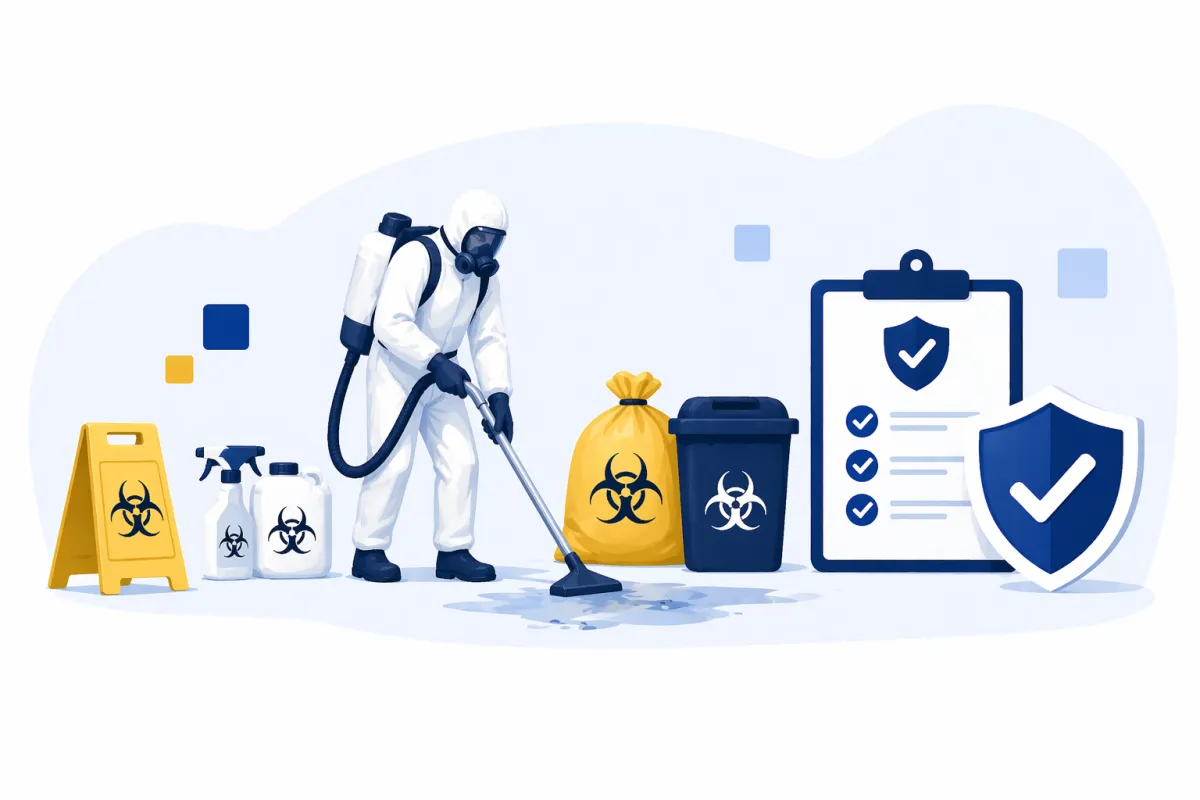
What is Biohazard Cleaning Insurance? (Complete Guide)
Why does biohazard cleaning need specialist insurance?
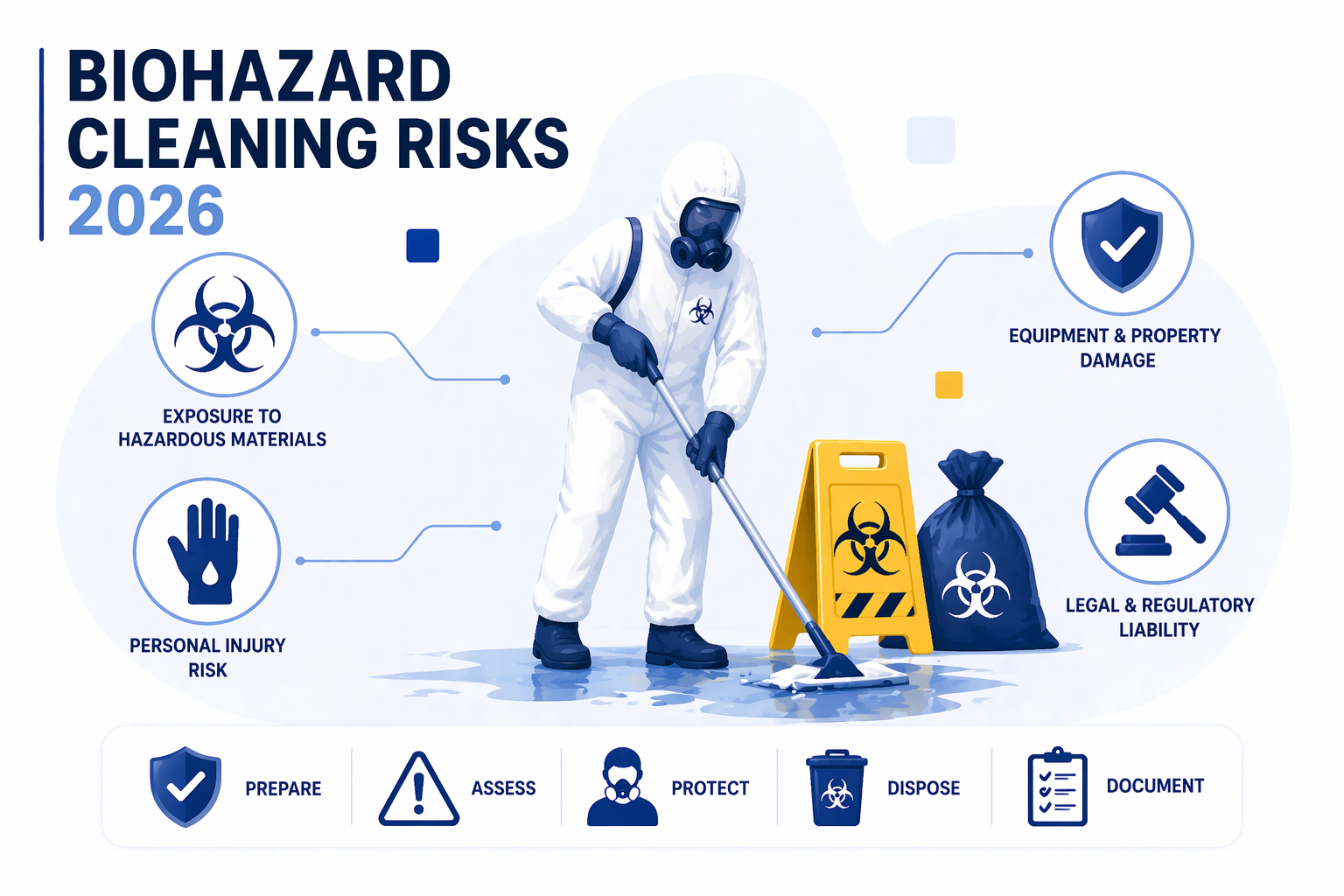
If you've arrived at this page, you almost certainly already suspect that the cleaner's package policy you bought through a comparison site, or the one your accountant recommended, isn't quite right for what your business actually does. You'd be correct. Biohazard cleaning sits in a regulatory and operational category of its own — COSHH Hazard Group 3 biological agents, regulated hazardous waste, lone working, 24/7 emergency response, and emotionally demanding scenes that look nothing like office cleaning or end-of-tenancy work. The standard "cleaner's package" insurance product sold in the volume market is built for low-risk commercial and domestic cleaning. It's not built for blood, bodily fluids, sharps, drug residue, decomposition, or hoarding. When you put biohazard work under a cleaner's policy without specific declaration, you're not insured — you have a piece of paper that won't respond when you need it.
This guide is the definitional explainer for biohazard cleaning insurance. We explain what the product is, what it actually covers, how it differs from standard cleaner's cover, who needs it, how to buy it correctly, and the most common mistakes that leave operators uninsured at claim stage. For deeper dives into specific aspects, see our companion guides: the biohazard cleaning insurance cost guide for pricing benchmarks; the risks of biohazard cleaning businesses guide for the operational risk register; the trauma cleaning insurance guide for unattended death and suicide scene work; the crime scene cleaning insurance guide for police-channel and forensic work; the asbestos removal insurance page where a strip-out or clearance uncovers licensed material; pest control insurance where infestation and contamination overlap on hoarding and void-property work; and the sharps removal insurance guide for needle sweep and sharps disposal operations. Our main biohazard cleaning insurance product page is the place to start a quote conversation; this article is the place to start understanding the product itself.
Key facts at a glance
- Biohazard cleaning insurance is specialist cover, not a generic cleaner's policy — built specifically for businesses handling blood, bodily fluids, sharps, decomposition, drug residue, hazardous chemicals, regulated waste, and trauma scenes.
- Standard "cleaner's package" policies typically exclude biohazard work entirely — operating biohazard cleaning under a generic cleaner's policy without specific declaration creates non-disclosure exposure under the Insurance Act 2015 with potentially every claim affected.
- The core policy combines Public Liability, Employers' Liability, and specialist biohazard cover — usually wrapped with vehicle cover, equipment cover, and Environmental Impairment Liability for chemical and pollution exposure.
- Employers' Liability insurance is legally required if you employ anyone — under the Employers' Liability (Compulsory Insurance) Act 1969, with minimum £5m cover required and fines of £2,500 per day for non-compliance.
- Public Liability of £5m–£10m is standard for biohazard work — well above the £1m–£2m typical for standard cleaning, reflecting the higher contamination spread and third-party injury exposure.
- Professional Indemnity matters where you sign off "safe" properties — decontamination certification, infection control advice, and risk assessment work all create PI exposure that PL cover does not respond to.
- The single biggest mistake is buying through a generalist broker — biohazard cleaning needs specialist placement with insurers who actively want the risk; generic placements often produce technically valid but practically inadequate cover.
1. What is biohazard cleaning insurance? The simple definition
Biohazard cleaning insurance
Biohazard cleaning insurance is a specialist UK commercial insurance package designed for businesses that clean, decontaminate, or remediate environments containing biological, chemical, or hazardous waste contamination. It combines Public Liability, Employers' Liability, specialist biohazard-scope extensions, and supporting covers (vehicle, equipment, Environmental Impairment Liability) into a programme matched to the elevated risk profile of trauma cleaning, crime scene cleaning, sharps removal, hoarding clearance, infectious decontamination, drug residue remediation, and similar work.
The phrase "biohazard cleaning insurance" doesn't refer to a single off-the-shelf product sold by every UK insurer. It refers to a category of placement — a specialist arrangement assembled by a broker who understands the work, presented to insurers who actively underwrite the risk. The components are standard insurance products (PL, EL, vehicle, equipment), but the wordings, exclusions, scope declarations, and limits are calibrated to biohazard work specifically. A "biohazard cleaning insurance policy" is what you end up with after that placement — typically a commercial combined or contractors combined policy with the scope of work declared as biohazard, trauma, crime scene, hoarding, or whatever specific subset you operate in.
This matters because the difference between cover that responds and cover that doesn't isn't usually a different insurer — it's a different declaration of the same insurer. The same underwriter who declines biohazard work under a generic cleaner's proposal will often accept it under a properly scoped biohazard proposal, sometimes at lower premium because the underwriter actually understands what they're being asked to cover. Specialist placement isn't about finding the one secret insurer; it's about presenting the risk so the mainstream market can underwrite it properly.
2. How is biohazard cleaning insurance different from standard cleaner's insurance?
The difference is structural, not cosmetic. A standard cleaner's package policy is built for predictable, low-severity risks — broken glass, slip-and-trip injuries, water damage from a leaking hose, accidental damage to a customer's furniture. The underwriting assumes the work happens in offices, residential homes, retail premises, and similar environments during normal business hours. Biohazard cleaning breaks every one of those assumptions. The table below compares the two side-by-side:
| Cover Element | Standard Cleaner's Insurance | Biohazard Cleaning Insurance |
|---|---|---|
| Scope of work declared | General commercial and domestic cleaning | Biohazard, trauma, crime scene, hoarding, sharps, drug residue specifically declared |
| Public Liability typical limit | £1m–£2m | £5m–£10m |
| Contamination spread cover | Typically excluded | Specifically covered subject to documented protocols |
| Bloodborne virus (BBV) occupational disease | Not contemplated in underwriting | Specifically scoped in Employers' Liability extension |
| Hazardous chemicals in use | Typically excluded or sub-limited | Specifically declared and covered |
| Regulated waste (consignment notes, EWC codes) | Not covered | Specifically covered with Environmental Impairment Liability |
| Lone working / out-of-hours / weekend | May be excluded or sub-limited | Specifically scoped with documented protocols |
| Psychological injury / PTSD / vicarious trauma | Not contemplated | Covered under EL with documented welfare programme |
| Vehicle hazardous goods declaration | Typically not declared (and therefore not covered) | Specifically declared on commercial vehicle policy |
| Decontamination sign-off / certification | Not covered (no PI scope) | Covered via Professional Indemnity extension |
| Cost | £200–£600 per year typical | £600–£3,000+ per year typical depending on size and scope |
| Claims behaviour | Insurer may avoid policy at claim stage for non-disclosure | Insurer expects and accepts the work — claims handled within scope |
3. Who needs biohazard cleaning insurance? The work types covered
Biohazard cleaning insurance is the right product for any UK business that routinely handles environments classified as biohazardous, hazardous, or regulated. The work types below all sit firmly within the biohazard cleaning insurance category — none of them can be safely placed under a generic cleaner's policy:
- Trauma cleaning — unattended deaths, suicides, severe injury scenes, decomposition cleanup. Highest psychological burden and most variable site conditions. Covered in depth in our trauma cleaning insurance guide.
- Crime scene cleaning — homicides, violent assaults, post-forensic remediation. Police-channel work brings chain-of-custody Professional Indemnity exposure. Covered in our crime scene cleaning insurance guide.
- Sharps removal and needle sweeps — needle exchange site clearance, abandoned drug paraphernalia, public space sharps recovery. BBV exposure is the dominant risk. Covered in our sharps removal insurance guide.
- Hoarding clearance / extreme cleaning — properties affected by severe self-neglect, animal hoarding, hoarding disorder. Safeguarding and vulnerable adult considerations apply.
- Infectious disease decontamination — Covid response, MRSA outbreaks, tuberculosis decontamination, norovirus. Engagement with UKHSA framework expected.
- Drug residue / clandestine lab decontamination — methamphetamine production sites, fentanyl contamination, cocaine processing residues. Highest chemical and PPE exposure.
- Bodily fluid cleanup — accident scenes, medical incidents in public spaces, hospital and care home spill response.
- Sewage and waste contamination — burst sewer remediation, septic tank failures, fatberg removal in commercial premises.
- Void property and squatter clearance — vacant property recovery where biological contamination, drug residues, or unknown hazardous materials may be present.
- Custody suite cleaning — police custody cells, court holding facilities, mental health unit decontamination.
- Vehicle decontamination — ambulance, police vehicle, taxi, and private hire decontamination after biological contamination.
- Mould remediation with biohazard scope — water-damaged properties where mould growth has combined with sewage or other biological contamination.
The common thread across all of these is the presence of biological, chemical, or regulated hazardous waste at the scene — and the regulatory framework (COSHH, RIDDOR, Environmental Protection Act, Hazardous Waste Regulations) that applies to working with such materials. If your business does any of these work types regularly, biohazard cleaning insurance is the correct product. If you do them occasionally alongside general cleaning, you still need biohazard scope declared on your policy — the frequency doesn't change the regulatory category.
4. What does a biohazard cleaning insurance policy actually cover?
A properly structured biohazard cleaning insurance programme has six core components. They aren't separate policies in most cases — they're usually combined into a single commercial combined or contractors combined wrapper — but they're priced and underwritten as distinct elements. The structure below is the working norm for UK biohazard cleaning operations:
4.1 Public Liability Insurance — the core third-party cover
Public Liability (PL) covers third-party injury or property damage claims arising from your work or operations. For biohazard cleaning, this is the dominant cover because the highest-severity claims are typically third-party — a family member exposed to inadequately decontaminated bodily fluids; contamination spread to adjacent properties; chemical damage to a client's flooring or fixtures; allergic reaction to biocide residue. Standard cleaner's PL of £1m–£2m is materially below what biohazard work typically requires. Limits of £5m and £10m are the working norm; £25m may be required for major panel contracts. Our commercial insurance pages explain PL structure in more detail.
4.2 Employers' Liability Insurance — the legal foundation
Employers' Liability (EL) is legally required if you employ anyone, under the Employers' Liability (Compulsory Insurance) Act 1969. Minimum cover is £5m but most insurers issue £10m as standard. For biohazard cleaning, EL is the cover that responds to BBV occupational disease claims, manual handling injuries, chemical exposure injuries, lone working incidents, and psychological injury (vicarious trauma, PTSD). The cover must specifically contemplate biohazard work — a standard cleaner's EL is technically valid but practically inadequate when a Hepatitis C transmission claim lands.
4.3 Specialist biohazard cover — the discipline-specific extensions
This is the cover layer that distinguishes biohazard cleaning insurance from generic cleaner's insurance. It includes: contamination spread cover (the scenario where your work, or inadequate work, allows contamination to extend beyond the original site); decontamination methodology cover (where your protocol failed to achieve the required cleanliness standard); specialist PPE and equipment cover (HEPA vacuums, foggers, atomisers, often £20,000+ in equipment); biocide and chemical residue cover; emergency response cost cover; and confidentiality and reputational protection for high-profile cases. These extensions are typically negotiated into the PL wording or appear as named extensions on a schedule.
4.4 Commercial Vehicle Insurance with hazardous goods declaration
Biohazard cleaners routinely transport regulated waste, hazardous chemicals, and contaminated materials between sites and disposal facilities. Standard commercial vehicle insurance typically doesn't contemplate hazardous goods transport — and a traffic incident involving a vehicle carrying contaminated waste triggers Environment Agency notification, spill response costs, and load recovery alongside standard insurance claims. The vehicle policy must declare hazardous goods specifically. Higher-volume operators often need fleet cover with multi-driver, multi-vehicle scope.
4.5 Equipment, tools, and stock cover
Biohazard cleaners carry significant equipment value — HEPA filtration systems, atomising foggers, professional-grade biocides, PPE stocks, specialist sharps containers, decontamination chambers for major sites. Theft from vehicles and depots is a meaningful exposure (van break-ins targeting specialist cleaning equipment are increasingly common); accidental damage and contamination of equipment is another. Equipment cover at full replacement value, with theft and accidental damage scope, is essential.
4.6 Environmental Impairment Liability (EIL)
Environmental Impairment Liability covers pollution and environmental damage incidents — chemical spills, contamination of watercourses, regulated waste mismanagement, soil contamination. For biohazard cleaning, EIL is important because the regulatory framework (Environmental Protection Act 1990, Hazardous Waste Regulations 2005) creates direct liability for waste mismanagement that PL typically excludes. EIL is increasingly required by major panel contractors and is a strong defensive position even where not contractually required.
5. What extensions, add-ons, and specialist covers should I consider?
Beyond the six core components, several extensions matter for specific operational profiles. None are universally required but each is worth knowing about:
- Professional Indemnity (PI) — essential if you provide decontamination sign-off, infection control advice, risk assessment work, or any form of certification that a site is "safe". Standard PL doesn't respond to claims arising from professional advice or sign-off — those claims fall under PI specifically. Limits from £500,000 are typical for biohazard work; £1m–£2m for crime scene and panel contractor work. See our Professional Indemnity Insurance guide for detail.
- Personal Accident (PA) — particularly important for sole traders and owner-operators whose income depends on their personal ability to work. PA pays a lump sum or weekly benefit if you're injured or unable to work. For biohazard operators facing BBV, MSD, and psychological injury exposure, PA is meaningful income protection.
- Business Interruption (BI) — covers loss of income if your operations are forced to pause after a fire, flood, theft, or other insured event affecting your premises or equipment. For biohazard operators, BI is increasingly important given the equipment dependency of the work. Note that post-Covid, pandemic-related BI is significantly restricted in most policies.
- Legal Expenses Insurance — covers defence costs for HSE investigations, Environment Agency enforcement, ICO investigations, contract disputes, and employment tribunals. Defence costs for a contested HSE prosecution routinely run to £50,000–£250,000; Legal Expenses cover is materially cheaper than uninsured defence. Scope should include regulatory investigation specifically.
- Cyber Insurance — covers data breach, ransomware, and business email compromise incidents. Biohazard cleaners handle sensitive client data (crime scene case details, deceased identities, vulnerable adult information, panel contractor data) and are increasingly targeted by ransomware operators. See our cyber insurance guide.
- Directors and Officers (D&O) Liability — covers individual directors against personal liability for management decisions. Becomes important once the business has multiple directors or significant contract exposure; specifically valuable for defending Section 37 HSAW 1974 prosecutions against directors personally.
- Fidelity Guarantee — covers theft by employees, relevant where operatives access valuable properties or vacant premises where theft opportunities exist.
- Reputational and Crisis Management cover — covers PR and communications costs after high-profile incidents. Valuable for operators working on high-profile cases (homicide, mass casualty events, public infrastructure decontamination) where media exposure is realistic.
- Trade Credit Insurance — covers debt loss if customers fail to pay. Increasingly relevant for biohazard operators with significant invoice debtors from local authorities, insurance panels, or housing associations. See our trade credit insurance guide.
- Commercial Property and Contents — covers your premises, depot, office and stored equipment. Standard cover for any operator with fixed premises; sub-limits and theft protection should match the equipment value stored.
The right extensions depend on your business profile — the interactive checker below recommends the typical extensions for different operator types.
6. Biohazard cleaning insurance cover checker
Select your business profile below to see the typical cover programme matched to it. For pricing benchmarks across these profiles, see our biohazard cleaning insurance cost guide; to start a quote conversation, see our main biohazard cleaning insurance product page.
Biohazard Cleaning Insurance Cover Checker
Select your business profile to see the typical cover programme matched to it
Sole Biohazard Operator / Sole Trader
- ESSENTIAL Public Liability £2m–£5m with biohazard, trauma, and contamination scope explicitly declared
- ESSENTIAL Personal Accident — primary income protection given the personal exposure
- ESSENTIAL Tools and equipment cover at replacement value
- ESSENTIAL Commercial vehicle insurance with hazardous goods declared
- ESSENTIAL Environment Agency upper-tier waste carrier licence (regulatory, not insurance, but a working precondition)
- RECOMMENDED Environmental Impairment Liability — chemical and pollution exposure
- RECOMMENDED Legal Expenses insurance with HSE and Environment Agency scope
- RECOMMENDED Cyber insurance — even sole traders handle sensitive client data
- CONSIDER Employers' Liability immediately if you engage any subcontract help — legal requirement, even for occasional help
- CONSIDER See our sole proprietorship insurance guide for the broader sole trader insurance picture
Small Biohazard Firm (2-5 Staff)
- LEGAL Employers' Liability £10m with BBV, lone working, MSD, and psychological injury scope
- ESSENTIAL Public Liability £5m with biohazard scope explicitly declared
- ESSENTIAL Hepatitis B vaccination programme documented (operational, not insurance — but feeds into insurance rating)
- ESSENTIAL Tools, plant, and PPE cover
- ESSENTIAL Commercial vehicle / multi-driver cover with hazardous goods declared
- ESSENTIAL Environmental Impairment Liability
- ESSENTIAL Legal Expenses with comprehensive regulatory scope
- RECOMMENDED Professional Indemnity £500k for any sign-off or risk assessment work
- RECOMMENDED Cyber insurance for client and case data protection
- RECOMMENDED Personal Accident cover for owner-director
Mid-Sized Regional Operator
- LEGAL Employers' Liability £10m comprehensive scope
- ESSENTIAL Public Liability £10m with full biohazard scope
- ESSENTIAL Professional Indemnity £1m for methodology and sign-off exposure
- ESSENTIAL Environmental Impairment Liability comprehensive scope
- ESSENTIAL Fleet insurance covering multi-vehicle, multi-driver, hazardous goods
- ESSENTIAL Property and contents at premises and depots
- ESSENTIAL Business Interruption — operational continuity matters at this scale
- ESSENTIAL Cyber insurance comprehensive scope
- ESSENTIAL Directors and Officers (D&O) liability
- ESSENTIAL Legal Expenses with regulatory, employment, and contract scope
Specialist Trauma / Crime Scene Operator
- CRITICAL Specific declaration of trauma and/or crime scene work — under-declaration is the #1 cover dispute
- LEGAL Employers' Liability £10m with psychological injury scope
- ESSENTIAL Public Liability £10m with crime scene contamination and chain-of-custody scope
- ESSENTIAL Professional Indemnity £1m with chain-of-custody scope — see crime scene cleaning insurance guide
- ESSENTIAL Enhanced DBS for staff if any police-channel work
- ESSENTIAL Environmental Impairment Liability
- ESSENTIAL Confidentiality and reputational cover
- ESSENTIAL Documented occupational health and welfare programme — see trauma cleaning insurance guide
- ESSENTIAL Cyber insurance comprehensive
- RECOMMENDED Specialist Lloyd's market placement essential at this profile
Biohazard Cleaning Startup / New Business
- CRITICAL Do not start trading without biohazard scope explicitly declared on every relevant policy
- ESSENTIAL Public Liability £2m–£5m with biohazard scope
- LEGAL Employers' Liability £5m–£10m if any staff — required from day one of employment
- ESSENTIAL Commercial vehicle insurance with hazardous goods declared
- ESSENTIAL Environment Agency upper-tier waste carrier licence
- ESSENTIAL Tools and equipment cover (build the schedule as you buy)
- RECOMMENDED Personal Accident for owner during ramp-up
- RECOMMENDED Legal Expenses with HSE scope from day one
- CONSIDER Mentoring with established operator on documented compliance package — cheaper than learning by claim experience
- CONSIDER See our business insurance quote guide for how to approach proposal
National Multi-Vehicle Biohazard Firm
- CRITICAL Specialist coordinated programme essential at this scale
- ESSENTIAL Public Liability £10m–£25m for major panel work
- LEGAL Employers' Liability £10m with full comprehensive scope
- ESSENTIAL Professional Indemnity £2m–£5m
- ESSENTIAL Comprehensive Environmental Impairment Liability programme
- ESSENTIAL Fleet insurance comprehensive — multi-depot multi-vehicle
- ESSENTIAL Property and BI at all premises
- ESSENTIAL Directors and Officers (D&O) at substantial limits
- ESSENTIAL Cyber insurance comprehensive scope
- ESSENTIAL Reputational, confidentiality, and PR crisis cover
- RECOMMENDED Specialist Lloyd's market placement — contact Miller & Partner directly
7. Do I need biohazard cleaning insurance? Self-check
If you're unsure whether your work needs biohazard cleaning insurance specifically (rather than a generic cleaner's policy), the checklist below resolves the question. Tick each statement that applies to your business — even one ticked box means biohazard cleaning insurance is the correct product, not a generic cleaner's policy:
Do I Need Biohazard Cleaning Insurance? Self-Check
Click each statement that applies. If any are ticked, you need biohazard cleaning insurance — not a generic cleaner's policy.
- I clean scenes involving blood or bodily fluids — including accident scenes, medical incidents, suicide aftermath, unattended deaths, or violent crime scenes
- I handle sharps — needles, broken glass with biological contamination, or drug paraphernalia
- I clean properties affected by decomposition — long-undiscovered deaths or animal decomposition
- I do hoarding clearance — extreme cleaning of properties affected by hoarding disorder or severe self-neglect
- I do infectious disease decontamination — Covid response, MRSA, tuberculosis, norovirus, or other transmissible pathogens
- I work on drug residue or clandestine lab decontamination — methamphetamine, cocaine processing, fentanyl, or other drug-related contamination
- I transport regulated hazardous waste — needing EWC codes, consignment notes, and Environment Agency licensing
- I use professional-grade biocides or chemical disinfectants — quaternary ammonium compounds, peracetic acid, hydrogen peroxide vapour, glutaraldehyde, or similar regulated chemicals
- I issue decontamination sign-off or "safe to occupy" certification — for landlords, insurance contractors, or panel work
- I work on insurance panel contracts — for claims management companies, loss adjusters, or insurance company supply chains
- I work on police-channel referrals — Crime Scene Manager engagements, custody facility cleaning, or victim support contracts
- I operate 24/7 emergency response — out-of-hours, weekend, or callout work in unfamiliar premises
8. Biohazard cleaning insurance fit assessor
Two factors determine the right biohazard cleaning insurance fit: what work types you actually do, and what business stage you're at. Use the assessor below to see your specific fit profile:
Biohazard Cleaning Insurance Fit Assessor
Select your work mix and business stage to see your insurance fit profile
9. What is typically excluded from biohazard cleaning insurance?
Understanding what's excluded matters as much as understanding what's covered. Even properly scoped biohazard cleaning insurance has standard exclusions — these aren't gaps unique to biohazard cover but standard UK commercial insurance exclusions that operators should know about:
9.1 Standard exclusions you'll encounter on every UK commercial policy
- Deliberate or fraudulent acts — claims arising from intentional wrongdoing by the policyholder or its directors are excluded. Insurance covers accidents and negligence, not intent.
- Asbestos exposure — asbestos is typically excluded from standard PL and EL policies. Operators working in properties where asbestos may be present need specific asbestos cover or licensed asbestos contractor arrangements.
- Nuclear and radioactive material — standard exclusion across UK commercial markets.
- War, terrorism, and civil unrest — separate terrorism cover available where required.
- Cyber-related losses — standard liability policies typically exclude cyber events. Cyber insurance is a separate placement.
- Communicable disease (post-Covid restrictions) — Business Interruption policies post-Covid typically exclude pandemic-related disruption. Some pandemic extensions are available but with significant sub-limits and caveats.
9.2 Exclusions specific to biohazard cleaning operations
- Undeclared work types — if your policy declares "biohazard cleaning" but you're doing crime scene work, the crime scene work isn't covered. Each discipline must be specifically named.
- Work outside declared geographic area — policies typically declare an operating area; work outside that area may not be covered without specific notification.
- Work with subcontractors who don't meet specified standards — if you subcontract and the subcontractor isn't properly insured, your policy may not respond.
- Failure to follow documented protocols — claims where the operator demonstrably failed to follow their own COSHH risk assessment or methodology may be reduced under policy conditions.
- Pre-existing contamination claims — if a property was already contaminated when you arrived and the contamination caused harm, this is typically a claim against the previous controller, not your policy.
- Fines and penalties — HSE fines, Environment Agency fines, ICO fines, and similar regulatory penalties are uninsurable in the UK under public policy. Legal Expenses covers defence costs but not the fines themselves.
- Loss of contract or future earnings — claims for consequential commercial loss (lost contracts, panel removal, reputational damage costs) are typically not covered under standard liability policies. Specific reputational cover or trade credit cover may respond.
The pattern in these exclusions is that they're predictable and manageable through operational discipline (documented protocols, proper subcontractor management, accurate work declaration). The exclusions become problematic when operational discipline lapses; the insurance doesn't fix operational gaps.
10. Is biohazard cleaning insurance legally required in the UK?
The honest answer is: parts of it are, parts of it aren't, and the legal/operational distinction matters. Here's the breakdown:
10.1 What's legally required
- Employers' Liability Insurance — legally required under the Employers' Liability (Compulsory Insurance) Act 1969 for any business that employs people in the UK. Minimum £5m cover, in practice £10m is the issued standard. Failure to maintain EL when required attracts fines of £2,500 per day until remedied. There are very limited exemptions (sole traders with no employees; certain family businesses).
- Motor Insurance with appropriate use — legally required under the Road Traffic Act 1988 for any vehicle used on UK roads. Commercial use must be declared, and for biohazard operators, hazardous goods carriage should be specifically declared. Driving without insurance is a criminal offence with mandatory licence endorsement.
- Environment Agency Upper Tier Waste Carrier Licence — not insurance but regulatory; biohazard cleaners transporting regulated waste must hold this. Penalties for non-compliance under the Environmental Protection Act 1990 can reach £50,000 in magistrates' court (unlimited in Crown Court).
10.2 What isn't legally required but is contractually or practically required
- Public Liability Insurance — not legally required by statute but required by virtually every commercial contract, panel agreement, and major customer. Trading without PL is technically legal but commercially unfeasible — and exposes the business directly to claim costs that often exceed the business's net worth.
- Professional Indemnity — required by many panel contracts where decontamination sign-off is involved. Not legally mandated for biohazard cleaning but practically essential where certification work is involved.
- Environmental Impairment Liability — increasingly required by panel contractors and public sector clients. Not legally required but the Environment Agency Duty of Care exposure makes it strongly advisable.
- Specific biohazard scope declarations — not legally required but practically essential under the Insurance Act 2015 fair-presentation requirement. Without specific declaration, cover that should respond may not.
11. How do I buy biohazard cleaning insurance correctly?
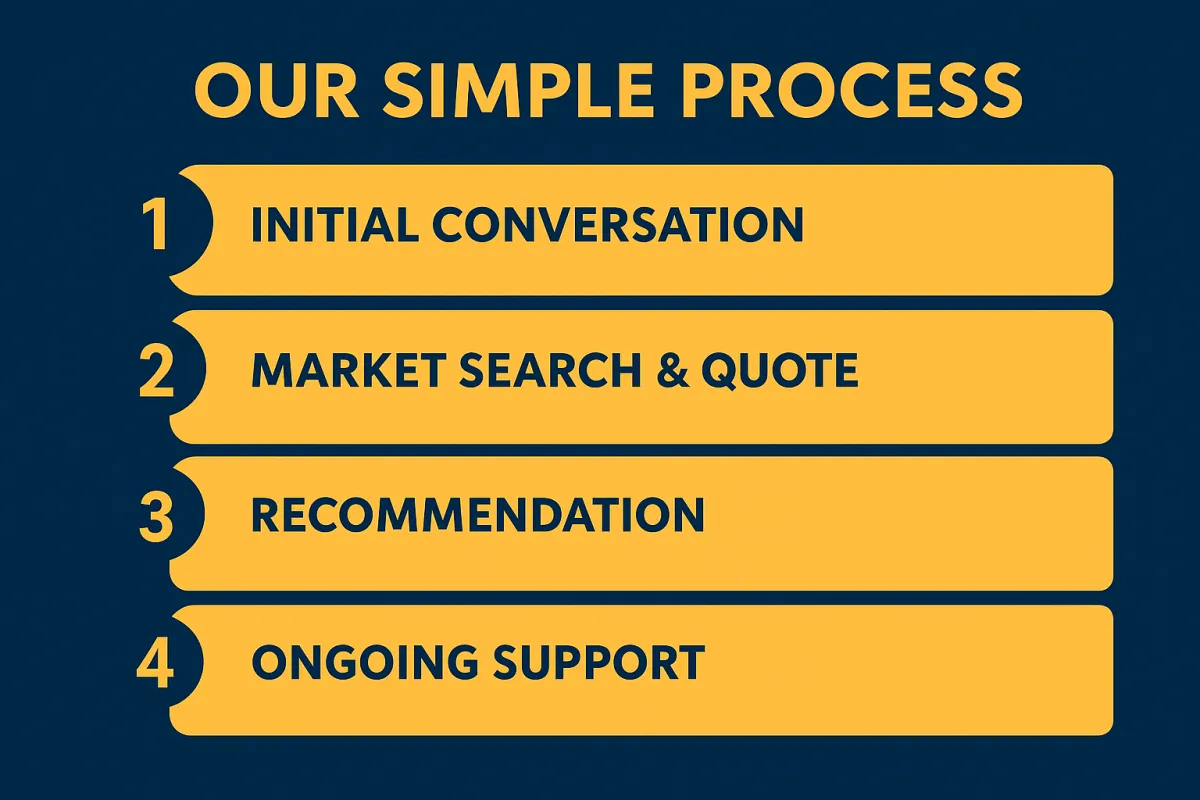
Buying biohazard cleaning insurance correctly is a process, not a transaction. The steps below are the working method we recommend to every biohazard cleaning operator who comes to us:
- List every work type you actually do — and every work type you might do in the next 12 months. This is the most important step. The list becomes the proposal declaration; missing items become claim exclusions. Be specific: "biohazard cleaning" isn't enough; "biohazard cleaning including trauma, unattended death, sharps removal, hoarding clearance, infectious decontamination, and occasional crime scene work via police channel referral" is the level of detail needed.
- Document your operational infrastructure. COSHH risk assessment templates; Hepatitis B vaccination programme records; training matrix with renewal dates; PPE inventory and inspection records; lone working protocols and devices; mental health programme; waste carrier licence; transfer note templates; subcontractor vetting documentation. This pack is presented at proposal — insurers rate businesses significantly lower when this documentation exists.
- Identify a specialist broker. Generic brokers selling cleaner's package insurance through comparison sites typically don't have access to biohazard-specialist markets, won't make the specific declarations correctly, and won't fight your corner at claim stage. A specialist broker has direct market access, knows the right wordings, and understands what each insurer wants to see at proposal.
- Have the broker present the risk properly. The broker presents your business to multiple insurers using a "Market Submission" that includes the work declaration, operational documentation, claims history, and any specific extensions required. Insurers respond with terms. The broker compares terms — not just on price but on cover scope, sub-limits, exclusions, and claims handling reputation.
- Read the policy schedule and wording carefully before binding. Specifically check: the scope of work as declared on the schedule (does it match what you actually do?); the limits and sub-limits (are they realistic for the largest claim scenario?); the conditions and warranties (what operational requirements does the insurer impose?); the territorial limits (do they cover where you actually work?); the claims notification clauses (what timescales apply and what triggers notification?).
- Get specific written confirmation of biohazard scope. If anything in your work mix is unusual or specific, get it confirmed in writing by the broker that the cover responds. Email confirmation is sufficient evidence; verbal assurance is not.
- Pay attention to mid-term and renewal disclosures. If you take on new work types during the year, notify your broker immediately. At renewal, review the work declaration and update it for any changes. Non-disclosure at renewal is just as damaging as non-disclosure at original proposal.
- Build a relationship with your broker. The broker who placed the cover should be the same broker handling claims, renewals, and mid-term queries. Continuity matters — the broker who knows your business handles claims more effectively than a stranger working from a file. Specialist brokers earn their fees most clearly at claim stage.
12. What does biohazard cleaning insurance cost?
Costs vary widely with business size, work mix, claims history, and operational maturity. The figures below are 2026 working benchmarks; for detailed pricing analysis see our dedicated biohazard cleaning insurance cost guide.
| Operator Profile | Annual Cost Range (2026) | What's Typically Included |
|---|---|---|
| Sole trader / single-operator | £600–£1,800 per year | PL £2m, equipment cover, vehicle cover, Personal Accident, basic EIL |
| Small firm (2-5 staff) | £1,800–£4,800 per year | PL £5m, EL £10m, equipment, vehicle, EIL, Legal Expenses, basic PI |
| Mid-sized regional (6-20 staff) | £4,800–£12,000 per year | PL £10m, EL £10m, PI £1m, comprehensive EIL, fleet, property, BI, Cyber, D&O |
| Specialist trauma/crime scene operator | £3,500–£15,000 per year | Premium loaded for specialist scope including chain-of-custody PI, confidentiality cover, enhanced EIL |
| National multi-vehicle firm | £15,000–£50,000+ per year | Coordinated Lloyd's programme covering all components at substantial limits |
What drives the cost up or down
| Rating Factor | Impact on Premium | What You Can Do |
|---|---|---|
| Work mix complexity | Basic biohazard lowest; crime scene and drug residue highest | Declare every work type — under-declaration creates non-disclosure not savings |
| Turnover and staff numbers | Primary scaling factors for PL and EL | Declare accurately including planned growth |
| Hepatitis B vaccination programme | Documented programme materially reduces EL premium | Implement, document, evidence at every renewal |
| Site-specific COSHH risk assessments | Material discount where documented per-job | Build template, train operatives, present at renewal |
| Lone working protocols | Safety devices and check-in protocols reduce EL premium | Document protocol, issue devices, audit compliance |
| Mental health programme | Documented occupational health reduces psychological injury rating | EAP access, debriefing protocols, supervision documentation |
| Limits selected | £5m vs £10m PL is material; PI tiers similar | Match to contract requirements — oversized limits are insurance waste |
| Claims history | 5-year impact for biohazard work; BBV claims particularly heavy | Root cause analysis and documented remedial action after any claim |
| NASC/NACSC certification | Recognised certification reduces premium | Maintain at staff level; evidence at every renewal |
| Specialist broker placement | Specialist placement materially affects rating compared to generic | Use a broker with biohazard underwriting experience and direct market access |
| Audit-ready documentation pack | Premium scales materially with documentation maturity | Maintain pack as operational discipline, not annual scramble |
13. What are the most common mistakes when buying biohazard cleaning insurance?
After thirteen years placing specialist commercial insurance, certain patterns repeat. The mistakes below are the most common — and the most expensive — that we see biohazard cleaning operators make when buying cover:
13.1 Buying through a generalist broker or comparison site
Generic brokers and comparison sites are set up for volume placement of standard risks. They don't have access to specialist biohazard markets, don't know the specific declarations that biohazard work requires, and don't follow up at claim stage. The cost difference between specialist and generic placement is often nil or favourable — but the cover certainty is materially different.
13.2 Under-declaring work types to save premium
The temptation to declare "general commercial cleaning" rather than the full biohazard scope, to save £200 on annual premium, is the single most expensive mistake operators make. The £200 saving becomes a £58,000 unpaid claim. The Insurance Act 2015 fair-presentation requirement means under-declaration isn't a grey area — it's a clear ground for the insurer to avoid cover.
13.3 Setting limits too low to match contract requirements only
Setting PL at £2m because that's what the panel contract requires, when the realistic maximum claim scenario could reach £5m–£10m, leaves the operator personally exposed for the excess. PL limits should match the realistic maximum claim, not the minimum contract requirement.
13.4 Not buying Professional Indemnity when sign-off work is involved
Any operator providing "safe to occupy" certification, decontamination sign-off, or risk assessment work has PI exposure. PI exposure isn't covered by PL — they respond to different claim types. The operator who signs off as "safe" and the property later turns out to be contaminated faces a PI claim, not a PL claim. Without PI cover, the operator pays personally.
13.5 Ignoring Environmental Impairment Liability
The Environment Agency Duty of Care under EPA 1990 Section 34 persists even after waste has been transferred to a third party. If your waste is fly-tipped — even by a subcontracted carrier — you can face EA enforcement personally. EIL is the cover that responds to these claims; EL and PL don't.
13.6 Not documenting operational compliance
Insurance rating is driven by documented operational discipline as much as by the underwriting fundamentals. Operators with audit-ready compliance documentation pay materially less than operators who lack it, for the same underlying business. The cost of building the documentation is a fraction of the premium saving and risk reduction it provides.
13.7 Treating insurance as an annual transaction rather than a relationship
Operators who buy cover, file the schedule, and never speak to their broker until renewal miss the value of the relationship. The broker who knows your business handles claims more effectively, advises on mid-term changes, and structures renewals to match operational evolution. The broker who placed your cover should be the same broker calling about renewal — continuity is part of the value proposition.
13.8 Not reviewing the policy wording before binding
The schedule, the conditions, the warranties, the exclusions — all of these matter at claim stage. Operators who haven't read the wording can be surprised by sub-limits, exclusions, or conditions they didn't know applied. The broker should walk through the wording at binding; the operator should ask questions about anything unclear.
14. Real claims and how they unfolded
Claim — Generic Cleaner's Policy Voided, £142,000 PL Claim Uninsured
A two-operative biohazard cleaning firm had been trading for four years on a "cleaner's package" policy bought through a comparison site for £380 per year. The policy declaration described the business as "domestic and commercial cleaning". The firm had been doing trauma cleaning, unattended death cleanup, and occasional crime scene work throughout the period without notifying the broker.
The claim arose from a trauma cleaning job at a residential property where the firm had been engaged to remediate after a long-undiscovered death. After the work was complete, the family member who arranged the clean returned to the property and developed a severe allergic reaction to residual cleaning chemicals — requiring hospital treatment and resulting in a Public Liability claim of £142,000 (medical costs, lost earnings, general damages, ongoing health management).
The insurer's claim investigation identified that the work performed (trauma cleaning) was materially different from the work declared (domestic and commercial cleaning). The insurer relied on Insurance Act 2015 to avoid the policy. The firm's PL did not respond.
The firm did not have the resources to pay the £142,000 personally. The directors entered an Individual Voluntary Arrangement; the company was dissolved. The trauma cleaning work had been a small but profitable part of the business — but had never been declared to the insurer. The £380 annual policy that seemed cheap turned out to be uninsured for the work that mattered most.
The lesson: under-declaration isn't a saving, it's a gamble — and the consequence of losing the gamble can be terminal. Specialist placement at proposal would have cost perhaps £1,500–£2,000 annually — material premium, but a fraction of the catastrophic outcome of voided cover. The Insurance Act 2015 fair-presentation requirement isn't a technicality; it's the underlying principle of UK insurance.
Claim — Specialist Cover Responding Properly, £87,000 EL Settlement, No Premium Spike
A small biohazard cleaning firm (4 operatives) had been placed via specialist biohazard placement two years previously. The cover included PL £5m, EL £10m with specific BBV occupational disease scope, and the operational compliance pack (Hepatitis B vaccination programme, site-specific COSHH risk assessments, structured training matrix, mental health programme) had been presented at every renewal.
An operative sustained a needle-stick injury during a sharps removal job at a needle exchange site. The needle was uncapped and not contained in the expected sharps container. The operative followed correct post-exposure protocols (A&E within 90 minutes, baseline serology, occupational health follow-up). Two months later, baseline serology showed Hepatitis C seroconversion attributable to the exposure.
The operative brought an EL claim for occupational disease. The firm's specialist EL responded immediately. Settlement: £87,000 (medical costs, antiviral treatment, lost earnings during treatment, career change to non-biohazard cleaning, general damages, ongoing care). Defence costs: £18,000.
Critically — because the operational compliance documentation was complete and the work had been specifically declared — the insurer did not seek to avoid or reduce. The claim was paid in full within standard timescales. Post-claim renewal: EL premium increased 8% (a small loading rather than the 40%+ that follows poorly-documented claims). The firm continued operating without operational disruption.
The lesson: specialist placement combined with documented operational compliance produces materially different claim outcomes than generic placement. The same incident under a generic cleaner's policy would likely have resulted in non-disclosure dispute and partial or no payment. Specialist placement is the cover that actually responds.
Claim — Professional Indemnity Filling the Gap, £215,000 Settlement
A mid-sized biohazard cleaning firm had been placed via a specialist programme that included PL £10m, EL £10m, and PI £1m specifically scoped to include decontamination sign-off and certification work. The firm regularly provided "safe to occupy" certificates after trauma cleaning jobs for housing association clients.
The claim arose from a property where the firm had certified the property as decontaminated and safe for new tenant occupation after a hoarding clearance. The new tenants moved in and within 8 weeks developed serious respiratory symptoms. Independent testing identified residual mould contamination in cavity walls and behind kitchen units that had not been identified or remediated during the original clearance. Three tenants brought claims for personal injury, loss of earnings, alternative accommodation costs, and property damage.
The claim profile was specifically PI rather than PL — the certificate had been issued, the tenants relied on it, and the underlying decontamination was inadequate. Standard PL cover doesn't respond to "negligent advice/certification" claims; that's the PI cover layer.
The firm's PI £1m responded. Settlement across the three claimants: £215,000. Defence costs: £42,000.
Post-claim review: insurer required documented decontamination certification methodology specifically for hoarding clearance work, including cavity and concealed-space inspection protocols. Premium impact: PI +25% at renewal; subsequent renewal returned to baseline once the methodology change had been demonstrated for 18 months.
The lesson: PI cover for certification and sign-off work is essential where the work is being done. PL cover would not have responded — those claims fall structurally under PI. The cost of including PI in the original placement (a few hundred pounds annually) was a fraction of the claim it ultimately covered.
Claims Management Steps
If you do face a claim, the steps below are the working method we recommend across our biohazard cleaning placements:
- Make the site safe and protect persons first. Standard biohazard response. If BBV exposure has occurred, medical response (A&E for needle-stick, occupational health within 24-48 hours) takes priority over administrative steps.
- Notify your insurer immediately. The notification threshold is "may give rise to a claim" — much lower than "formal claim received". Biohazard incidents often engage multiple policies (EL, PL, PI, EIL, Legal Expenses, Cyber); single notification triggers coordinated response across all of them.
- Preserve all documentation rigorously. Site-specific risk assessment; methodology applied; chemicals used; equipment used; operatives present; photographs before/during/after; waste consignment notes; communications with client; PPE and training records. The documentation pack is the claim defence.
- Do not admit liability or fault. Provide factual information about what happened, what work was done, and methodology followed. Do not accept fault, apologise in writing, or commit to remedial work that could be interpreted as admission.
- Manage regulator engagement carefully. If HSE, Environment Agency, ICO, or local authority enforcement officers attend or notify, engage your Legal Expenses insurer immediately. Cooperate factually with inspectors but do not provide written statements without legal representation.
- Complete RIDDOR reporting where applicable. Regulation 7 (dangerous occurrences) for BBV exposure with potential transmission of Hazard Group 3 agent; over-7-day injury reporting where applicable. Late reporting is itself an offence; complete within required timeframes.
- Document the response and remediation comprehensively. Every decision, communication, site visit, training intervention, policy change after the incident. Post-incident response file supports settlement and future insurance terms.
- Conduct root cause analysis and address. Identify underlying cause and implement remedial action. Insurers reviewing renewal will ask what's changed since the claim; regulators will require evidence of remedial action.
Glossary of biohazard cleaning insurance terms
- Biohazard Cleaning Insurance
- Specialist UK commercial insurance package designed for businesses cleaning, decontaminating, or remediating environments containing biological, chemical, or hazardous waste contamination. Combines Public Liability, Employers' Liability, specialist biohazard extensions, vehicle, equipment, and Environmental Impairment Liability cover.
- Public Liability (PL)
- Insurance covering third-party injury or property damage claims arising from your business activities. The core third-party cover for biohazard work. Standard limits £5m–£10m for biohazard operators.
- Employers' Liability (EL)
- Legally required insurance under the Employers' Liability (Compulsory Insurance) Act 1969 for any business employing people in the UK. Minimum £5m cover; standard issued at £10m. Responds to staff injury and occupational disease claims.
- Professional Indemnity (PI)
- Insurance covering claims arising from professional advice, certification, or sign-off work. Essential for biohazard operators issuing "safe to occupy" certificates, decontamination sign-off, or risk assessment work. Limits from £500,000 typical; £1m–£2m for crime scene and panel work.
- Environmental Impairment Liability (EIL)
- Insurance covering pollution and environmental damage incidents — chemical spills, watercourse contamination, regulated waste mismanagement, soil contamination. Important for biohazard operators given Environment Agency Duty of Care exposure.
- Insurance Act 2015
- UK legislation requiring businesses to make a "fair presentation of the risk" to insurers — proactively disclosing every material fact the insurer would want to know. Failure allows the insurer to avoid the policy, reduce claims proportionally, or impose terms that would have applied with proper disclosure.
- Fair Presentation of Risk
- The Insurance Act 2015 standard requiring policyholders to proactively disclose material information at proposal and renewal, not just respond to specific questions. The basis on which biohazard cleaning work must be specifically declared.
- Specialist Placement
- Insurance placement through a broker with direct access to insurers who actively underwrite the specific risk category — in this case, biohazard cleaning. Distinguished from generic placement (e.g. cleaner's package policies) which often miss the specific declarations required.
- Scope of Work Declaration
- The specific description of business activities declared at proposal stage. Forms the basis of cover; activities outside scope are not insured. Must include every work type the operator does or might do during the policy period.
- COSHH (Control of Substances Hazardous to Health Regulations 2002)
- Cornerstone UK regulation governing exposure to hazardous substances including biological agents. Site-specific COSHH risk assessments are an insurance underwriting expectation for biohazard work.
- BBV (Bloodborne Virus)
- Viruses transmitted through blood and bodily fluids — primarily HIV, Hepatitis B (HBV), and Hepatitis C (HCV). Classified by HSE in COSHH Hazard Group 3. The dominant occupational disease exposure for biohazard cleaners.
- Hepatitis B Vaccination Programme
- HSE-recommended employer-provided vaccination programme for staff exposed to BBV. Increasingly an insurance underwriting condition for biohazard cleaning EL cover; documented programme materially reduces premium.
- EWC Code (European Waste Catalogue)
- Six-digit codes classifying waste types for regulatory tracking. Hazardous wastes marked with asterisk. Required on waste transfer documentation for biohazard cleaning operations.
- Chain-of-Custody PI
- Professional Indemnity extension specifically scoped to cover claims arising from chain-of-custody failures in forensic or evidence-related contexts. Essential for crime scene cleaning operators working on police-channel referrals.
- Section 34 EPA 1990 (Duty of Care)
- Section 34 of the Environmental Protection Act 1990 imposes Duty of Care on waste producers, requiring them to ensure waste is transferred only to licensed carriers and to maintain transfer documentation. Duty persists after waste has been transferred to a third party.
- Sub-Limit
- A lower limit within an overall policy limit that applies to specific claim types. For example, a £10m PL policy may have a £1m sub-limit for contamination spread; understanding sub-limits is critical to understanding actual claim response.
- Warranty / Condition
- Policy requirement that must be met for cover to respond. Common conditions in biohazard cover include: documented training; PPE provision; subcontractor vetting; risk assessment per site. Breach of warranty can void cover.
Frequently asked questions
Biohazard cleaning insurance is a specialist UK commercial insurance package designed for businesses handling high-risk environments — blood, bodily fluids, sharps, decomposition, drug residue, infectious contamination, and regulated hazardous waste. It combines Public Liability, Employers' Liability, specialist biohazard-scope extensions, vehicle insurance with hazardous goods declared, equipment cover, and Environmental Impairment Liability into a programme matched to the elevated risks of trauma cleaning, crime scene cleaning, hoarding clearance, sharps removal, and similar work. It's structurally different from generic cleaner's package insurance and cannot be replaced by it.
A properly structured biohazard cleaning insurance programme covers six core elements: Public Liability for third-party injury and property damage; Employers' Liability for staff injury and occupational disease (including BBV exposure); specialist biohazard extensions for contamination spread, decontamination methodology, and specialist equipment; commercial vehicle insurance with hazardous goods declared; equipment, tools, and stock cover including theft and accidental damage; and Environmental Impairment Liability for chemical spills, regulated waste incidents, and pollution events. Common optional additions include Professional Indemnity (for sign-off work), Cyber, Legal Expenses, Personal Accident, Business Interruption, and Directors and Officers liability.
Parts of it are; parts aren't. Employers' Liability insurance is legally required under the Employers' Liability (Compulsory Insurance) Act 1969 for any business employing people, with £5m minimum cover and fines of £2,500 per day for non-compliance. Motor insurance with appropriate use declaration is legally required under the Road Traffic Act 1988 for any vehicle used on UK roads. Public Liability, Professional Indemnity, and Environmental Impairment Liability are not legally required by statute but are practically required by virtually every commercial contract, panel agreement, and major customer. The Environment Agency upper-tier waste carrier licence is a regulatory requirement (not insurance) for biohazard cleaners transporting regulated waste.
Because standard cleaner's insurance policies are built for predictable low-risk work — offices, retail, residential, end-of-tenancy — and typically exclude biohazard work explicitly or by implication. Operating biohazard cleaning under a generic cleaner's policy without specific declaration creates non-disclosure exposure under the Insurance Act 2015, which allows the insurer to void the policy entirely at claim stage. The cover that should respond doesn't. The fix at proposal stage costs little (often nothing in premium terms); the retrospective cost can be every claim made on the policy across multiple years. Specialist placement isn't optional for biohazard work — it's the basic structure that makes cover actually respond.
Indicative 2026 ranges by operator profile: sole trader £600–£1,800 per year; small firm (2-5 staff) £1,800–£4,800; mid-sized regional (6-20 staff) £4,800–£12,000; specialist trauma/crime scene operator £3,500–£15,000; national multi-vehicle firm £15,000–£50,000+. Costs are driven by work mix complexity, turnover and staff numbers, claims history, operational compliance maturity (Hepatitis B programme, training matrix, COSHH risk assessments), limits selected, NASC/NACSC certification, and broker placement quality. See our dedicated biohazard cleaning insurance cost guide for detailed pricing analysis.
You need Professional Indemnity (PI) cover if your work involves any form of professional advice, certification, or sign-off — including "safe to occupy" certificates after decontamination, infection control consultancy, risk assessment work, or any documentation that a third party will rely on. PI responds to claims arising from negligent advice or sign-off work; PL doesn't. Standard biohazard cleaning where you simply clean and leave (without certification) may not need PI, but the moment you provide written confirmation that work has been completed to a specific standard, PI exposure is created. Limits from £500,000 are typical; £1m–£2m for crime scene and panel contractor work. See our Professional Indemnity guide for detail.
Trauma cleaning insurance is a subset of biohazard cleaning insurance focused specifically on trauma scene work — unattended deaths, suicide aftermath, severe injury cleanup, decomposition cleanup. Biohazard cleaning insurance is the broader umbrella covering trauma cleaning alongside crime scene cleaning, sharps removal, hoarding clearance, infectious decontamination, drug residue cleanup, and other regulated biohazardous work. Most operators need biohazard cleaning insurance with the specific subset of work declared (trauma, crime scene, hoarding etc.) — not a separate "trauma cleaning insurance" policy. The trauma-specific considerations (psychological injury cover, occupational health programme) are extensions within biohazard cleaning insurance rather than a separate product. See our trauma cleaning insurance guide for trauma-specific detail.
Only if crime scene work is specifically declared. Crime scene cleaning brings specific exposures that biohazard cover doesn't automatically include — chain-of-custody Professional Indemnity, enhanced DBS clearance requirements, confidentiality and reputational considerations, police panel-specific contract terms. A biohazard cleaning policy with "crime scene work" specifically declared and scoped will respond; the same policy with only "biohazard" declared will not. The proposal declaration matters more than the product label. See our dedicated crime scene cleaning insurance guide for crime scene specific requirements.
Frequency doesn't change the regulatory category or the insurance scope requirement. A single trauma cleaning job per year still creates the same regulatory exposure (COSHH, RIDDOR, EA Duty of Care) and the same potential for catastrophic claim (BBV exposure, contamination spread, third-party injury). The work type must be declared regardless of frequency. The cost impact of occasional biohazard work on premium is typically smaller than the cost impact of declaring it as primary work — but the declaration is still essential. Operating biohazard work "occasionally" without declaring it is exactly the scenario that creates non-disclosure exposure at claim stage. If you do it, declare it.
Yes. Specialist biohazard cleaning insurance is available for startups with no operational history, provided the proposal demonstrates competence, qualifications (NASC/NACSC training), proper PPE and equipment, COSHH risk assessment templates, Hepatitis B vaccination programme, and appropriate Environment Agency waste carrier licensing. Premium loading for new businesses (versus established operators with claims history) is typically 15-30% but reduces materially after the first 12-24 months of clean trading. Critically, the operational compliance package matters more than business age for new operators — insurers evaluate the documented system more than the trading history. Buying through a specialist broker from day one (rather than starting on a generic cleaner's policy and upgrading later) avoids non-disclosure exposure during the startup phase when it's most likely.
The typical broker proposal pack for biohazard cleaning includes: full description of work types (trauma, crime scene, hoarding, sharps, decontamination etc.); turnover figures (last year actual, current year forecast); staff numbers (employed and subcontracted); claims history (5 years typical); operational documentation (COSHH risk assessment templates, training matrix, Hepatigis B programme records, PPE inventory, lone working protocols, mental health programme); qualifications and certifications (NASC, NACSC, individual operative tickets); Environment Agency waste carrier licence; vehicle details (makes, models, hazardous goods declarations); equipment schedule and replacement values; any specific contract requirements (panel work, public sector tenders); intended limits (PL, EL, PI). The more comprehensive the pack, the better the terms — specialist insurers rate on documented evidence rather than declarations alone.
Look for brokers with specific biohazard, trauma, or specialist cleaning sector experience evidenced by: detailed articles on biohazard cleaning insurance (not generic cleaner's material); willingness to discuss specific exposures (BBV, chain-of-custody, EIL, contamination spread, COSHH compliance) in detail at proposal; access to Lloyd's market and specialist MGAs rather than just mainstream commercial markets; FCA authorisation and documented track record; willingness to walk through policy wording and exclusions at binding. Avoid: brokers offering "cleaner's package" without discussing biohazard specifics; brokers limited to one or two markets; brokers who don't ask about specific work types in detail at proposal; brokers who don't request operational documentation. Miller & Partner specialise in this sector — see our biohazard cleaning insurance product page and broader biohazard cleaning insights hub.





Instagram
LinkedIn