


Biohazard Cleaning Insurance Cost UK: £50–£400/Month (2026)
Why is biohazard cleaning insurance priced higher than standard cleaner's cover?
Biohazard cleaning insurance sits in a different pricing tier from standard commercial cleaner's cover, and the gap is wider than most operators realise. A domestic cleaner working through a comparison site can buy £1m Public Liability for under £100 a year. A biohazard cleaner running an identical structure — same turnover, same staff count, same vehicle — pays four to ten times that, sometimes more. The same broad activity, but priced for a fundamentally different risk.
The reason isn't a markup or a captive market. It's the underlying claim profile. Biohazard work engages COSHH Hazard Group 3 biological agents, regulated hazardous waste under the Environmental Protection Act 1990, lone working in unfamiliar premises, psychologically demanding environments, and out-of-hours emergency response. Each of those risks adds a loading. When they combine — as they do in any properly scoped biohazard cleaning programme — the underwriter prices the whole package, not the individual lines.
This guide is the definitive 2026 cost breakdown. It sets out: realistic price ranges by business profile; line-by-line policy pricing rather than vague monthly totals; what each rating factor actually does to your premium; the savings playbook that materially reduces cost; the false economies that look cheap up front but cost more across a claim; and real placement pricing from current Miller & Partner cases. It complements our broader cluster — the main biohazard cleaning insurance product page, the what is biohazard cleaning insurance explainer, the risks of biohazard cleaning businesses guide, and the discipline-specific deep-dives on trauma cleaning, crime scene cleaning, and sharps removal insurance. Two adjacent trades price on a similar basis and are worth comparing if your work mix overlaps: asbestos removal insurance, where licensed material turns up in void and hoarded properties, and pest control insurance, where infestation accompanies contamination.
Key cost facts at a glance
- UK biohazard cleaning insurance in 2026 typically costs £600–£12,000+ per year — sole traders £600–£1,500, small teams £1,800–£4,800, mid-sized regional operators £6,000–£15,000, national multi-vehicle firms £20,000+. The range reflects work mix, turnover, staff count, and limits.
- Specialist biohazard placement costs 3–6× generic cleaner's cover — and is dramatically cheaper than uninsured exposure. A single declined claim for non-disclosure can exceed 10 years of correctly priced premium.
- Employers' Liability is typically the largest single line for any biohazard operator with staff — BBV exposure, lone working, manual handling, and psychological injury all load the rating.
- Documented compliance reduces premium by 15–30% versus undocumented operations at the same turnover and staff count — site-specific COSHH risk assessments, Hepatitis B vaccination programme, structured training matrix, and lone working protocols all evidence at proposal.
- Crime scene and drug residue work attract the highest loadings — typically 50–100%+ above basic biohazard rating, reflecting chain-of-custody PI exposure and clandestine decontamination chemical risk.
- Non-disclosure under the Insurance Act 2015 is the single biggest hidden cost — operating biohazard work under a generic cleaner's policy looks cheaper until a claim is declined or reduced for failure to make a "fair presentation of the risk".
- Renewal pricing rewards continuity — moving insurer every year costs more in aggregate than holding a competitively priced specialist programme. Insurers price loyalty into specialist sectors where claims experience matters.
2. What does biohazard cleaning insurance actually cost in 2026?
Headline ranges first, then the detail. These bands reflect actual 2026 UK broker market pricing for properly scoped specialist biohazard cleaning programmes — not generic cleaner's package estimates with a biohazard sticker, and not the loss-leader online quotes that ignore declared work types.
Sole biohazard cleaner
- 1 person, no staff
- Turnover £30k–£80k
- Basic biohazard + minor trauma
- PL £2m–£5m, vehicle, tools
Small biohazard firm (2–5 staff)
- 2–5 staff including owner
- Turnover £100k–£350k
- Trauma + hoarding + basic biohazard
- EL £10m, PL £5m, PI, EIL
Regional operator
- 6–15 staff, multi-vehicle
- Turnover £400k–£1.2m
- Full multi-discipline
- EL £10m, PL £10m, full programme
Insurance panel contractor
- Panel approval requires £10m PL
- Turnover £500k–£2m
- Full multi-discipline + claims handling
- Enhanced PI, cyber, confidentiality
National multi-vehicle firm
- 20+ staff, multi-depot
- Turnover £2m+
- PL £10m–£25m, full programme
- D&O, BI, reputational, cyber
New biohazard startup
- 1–2 staff, building portfolio
- Turnover under £80k year 1
- Modest limits, building track record
- Premium falls in year 2–3 as claims-free
3. How does the cost break down by policy line?
"£3,000 a year" tells you nothing about what you're buying. The breakdown below shows where that £3,000 actually goes for a typical small biohazard firm (3 staff, £200k turnover, full multi-discipline scope). Understanding the line-by-line cost is essential to comparing quotes and identifying gaps.
| Policy Line | Typical Annual Cost | What It Covers |
|---|---|---|
| Employers' Liability £10m | £900–£1,800 | Staff injury and illness — BBV exposure, lone working incidents, manual handling, psychological injury. Largest single line for any operator with staff. Legal requirement under Employers' Liability (Compulsory Insurance) Act 1969. |
| Public Liability £5m | £450–£950 | Third party injury or property damage during cleaning operations including contamination spread, chemical exposure to bystanders, and damage to client premises. Often required by clients before engagement. |
| Professional Indemnity £500k | £280–£550 | Methodology disputes, sign-off failures, decontamination certification errors. Material where the operator certifies premises as decontaminated or signs off methodology for handover. |
| Environmental Impairment Liability | £250–£600 | Chemical exposure, contamination of land or water, pollution release. Often required by panel work and material given biohazard cleaning's regulated waste profile. |
| Commercial Vehicle (hazardous goods) | £600–£1,400 per vehicle | Vehicle insurance with hazardous goods declaration. Per-vehicle cost; multi-vehicle fleets typically attract per-vehicle discount. |
| Tools, plant, and equipment | £120–£380 | HEPA vacuums, foggers, ozone generators, PPE stock, decontamination equipment. Replacement value cover; typical biohazard firm carries £15k–£30k of equipment. |
| Legal Expenses (HSE scope) | £280–£550 | HSE investigation defence costs, Environment Agency enforcement defence, employment tribunal defence, contract dispute defence. Material given HSAW 1974 exposure. |
| Cyber insurance (basic) | £180–£420 | Client data breach, ransomware, business interruption from cyber incident. Material given the sensitivity of client and case data biohazard cleaners hold. |
| Personal Accident (owner) | £120–£280 | Income protection lump sum and weekly benefit for owner-director injury. Particularly valuable for sole operators and small-team owner-managers. |
For the small firm profile above, line-by-line totals come to roughly £3,200–£6,900 annually depending on positioning within each band. The lower end assumes documented compliance and specialist broker placement; the upper end reflects generic placement or claims activity.
4. How much should each business profile pay?
The headline ranges in Section 2 are useful starting points, but the spread within each band is where pricing decisions are made. The table below shows what each business profile typically pays at the lower (best case), middle (realistic), and upper (worst case) end of the band, plus the factors that push pricing in each direction.
| Business Profile | Lower (best case) | Middle (realistic) | Upper (worst case) |
|---|---|---|---|
| Sole biohazard operator Basic biohazard, £30k–£80k turnover | £600–£800 | £900–£1,200 | £1,300–£1,500 |
| Sole + minor trauma Basic biohazard + occasional trauma, £40k–£100k | £800–£1,100 | £1,200–£1,600 | £1,700–£2,200 |
| Small firm (2–3 staff) Trauma + hoarding, £100k–£200k | £1,800–£2,400 | £2,500–£3,400 | £3,500–£4,800 |
| Small firm (4–5 staff) Full multi-discipline, £200k–£350k | £2,800–£3,600 | £3,700–£4,800 | £4,900–£6,800 |
| Mid-sized regional 6–10 staff, £350k–£700k | £5,200–£7,200 | £7,300–£10,400 | £10,500–£15,000 |
| Mid-sized regional 10–15 staff, £700k–£1.2m | £8,500–£11,000 | £11,000–£15,500 | £15,500–£22,000 |
| Insurance panel contractor £500k–£2m, full multi-discipline | £8,000–£12,000 | £12,000–£16,500 | £16,500–£24,000 |
| National multi-vehicle 20+ staff, £2m+ turnover | £20,000–£28,000 | £28,000–£42,000 | £42,000–£60,000+ |
Movement within a band is driven mostly by documented compliance, claims history, and specialist broker placement — covered in detail in Sections 7 and 10. Movement between bands is driven by turnover, staff count, and work mix complexity — covered in Sections 8 and 9.
5. Biohazard cleaning insurance premium calculator
Select your business profile and work mix below for an indicative 2026 premium band. Real quotes vary based on specific declarations, claims history, and limits — but the calculator gives a realistic working range to start from.
Biohazard Cleaning Premium Calculator
Indicative annual premium based on 2026 UK specialist broker market pricing
6. What rating factors actually drive your premium?
Underwriters assess biohazard cleaning operators against a defined set of rating factors. Some are within the operator's control; some are structural. Understanding which is which is the foundation of any premium reduction strategy.
| Rating Factor | Premium Impact | Within your control? |
|---|---|---|
| Annual turnover | Primary scaling factor — PL, EL, PI, EIL all rate against turnover | Structural (but accurate declaration matters) |
| Staff count and payroll | Primary EL rating factor — also affects PL loading | Structural |
| Work mix declared | Basic biohazard is the baseline; trauma +10–15%, hoarding +15–25%, crime scene +40–60%, drug residue +50–80% | Yes — declare accurately, scope to actual work |
| Documented compliance | Mature compliance reduces premium 15–25%; basic loading 10–25% above baseline | Yes — site-specific RAs, HepB, training matrix, lone working |
| Hepatitis B vaccination programme | Documented programme reduces EL premium 8–15% specifically | Yes — implement and evidence at renewal |
| Claims history (last 5 years) | Clean history baseline; minor claim +10–15%; material claim +25–40%; multiple claims +50%+ or market exit | Partly — root cause remediation reduces renewal impact |
| Limits selected | £5m vs £10m PL typically adds 25–40% to PL line; £5m vs £10m EL adds 15–25% to EL line | Yes — match limits to actual contract requirements |
| NASC/NACSC certification | Recognised certification at staff level reduces premium 5–10% | Yes — invest in certification |
| Geographic operating area | Postcode loadings for vehicle theft, urban density, and operational risk — London +10–20% on vehicle and tools | Structural |
| Vehicle count and value | Per-vehicle rating; high-value equipment-laden vans attract loadings | Structural (but accurate declaration matters) |
| Subcontractor use | Heavy subcontracting attracts loadings and specific exclusions; some markets decline if subcontracted hazardous waste transfer involved | Yes — document subcontractor verification |
| Broker placement type | Specialist biohazard broker accesses better terms than generic placement — typical difference 10–20% | Yes — use specialist broker |
| Continuity with insurer | 3+ years with same insurer typically reduces renewal premium 5–10% versus switching annually | Yes — strategic continuity decision |
| Payment frequency | Annual payment vs monthly typically saves 6–12% on smaller premiums; less material on larger placements | Yes — cashflow decision |
7. How does work mix change the price?
Work mix is the single largest discretionary rating factor — meaning it's the factor most often under the operator's control that materially changes premium. Different disciplines attract different loadings because they carry different claim profiles. The table below shows typical loading vs basic biohazard baseline.
| Work Discipline | Loading vs Baseline | Why It Loads |
|---|---|---|
| Basic biohazard cleaning Bodily fluid, accident scene, sanitation | Baseline | Routine biological agent exposure, sharps risk, but predictable methodology and limited third-party exposure |
| Trauma cleaning Unattended death, suicide aftermath | +10–15% | Higher BBV exposure, decomposition complexity, psychological injury exposure. See trauma cleaning insurance guide. |
| Hoarding clearance | +15–25% | Manual handling intensity, hidden hazards, third party (occupant) aggression risk, safeguarding exposure |
| Sharps removal | +20–30% | Concentrated BBV exposure risk; public-area scenarios introduce third-party exposure. See sharps removal insurance guide. |
| Crime scene cleaning Forensic-released scenes, police-channel | +40–60% | Chain-of-custody PI exposure, evidence preservation requirements, confidentiality and reputational exposure, panel requirements. See crime scene cleaning insurance guide. |
| Infectious disease decontamination Norovirus, C. diff, MRSA, TB | +30–50% | Outbreak response chemical exposure, higher PPE intensity, infection control sign-off PI |
| Drug residue decontamination Methamphetamine, fentanyl, processing residues | +50–80% | Clandestine chemical exposure, structural contamination assessment, certification sign-off PI exposure, EIL exposure |
| Custody / police cell cleaning | +25–40% | Enhanced DBS requirements, security clearance, panel-specific contract terms |
| Mould remediation | -5 to +10% | Generally lower BBV exposure but EIL exposure for cross-contamination; loading depends on scope |
8. What does each profile actually pay? Cover and price checker
Select your business profile below to see the typical insurance programme, line-by-line cost breakdown, and total premium band for 2026 UK placement.
Biohazard Cleaning Cover and Price Checker
Indicative cover and 2026 premium pricing matched to specific business profiles
Sole Biohazard Operator
- ESSENTIAL Public Liability £2m–£5m with biohazard scope £300–£500
- ESSENTIAL Personal Accident — sole-trader income protection £140–£280
- ESSENTIAL Tools and equipment cover £80–£180
- ESSENTIAL Commercial vehicle with hazardous goods £550–£850
- RECOMMENDED Environmental Impairment Liability £180–£320
- RECOMMENDED Legal Expenses with HSE scope £200–£380
- RECOMMENDED Basic cyber insurance £120–£280
New Biohazard Startup (Year 1)
- ESSENTIAL Public Liability £2m–£5m with biohazard declared £320–£550
- LEGAL Employers' Liability £5m–£10m if any staff £450–£900
- ESSENTIAL Commercial vehicle hazardous goods £600–£900
- ESSENTIAL Tools and equipment £100–£250
- RECOMMENDED Legal Expenses with HSE scope £220–£420
- RECOMMENDED Personal Accident for founder £150–£280
Small Biohazard Firm (2–5 Staff)
- LEGAL Employers' Liability £10m with BBV, lone working, psychological scope £900–£1,800
- ESSENTIAL Public Liability £5m with biohazard, contamination scope £450–£950
- ESSENTIAL Professional Indemnity £500k £280–£550
- ESSENTIAL Environmental Impairment Liability £250–£600
- ESSENTIAL Commercial vehicle fleet hazardous goods £600–£1,400 per vehicle
- ESSENTIAL Tools, plant, PPE schedule £180–£420
- ESSENTIAL Legal Expenses comprehensive scope £300–£600
- RECOMMENDED Cyber insurance £180–£420
Mid-Sized Regional Operator
- LEGAL Employers' Liability £10m comprehensive £1,800–£3,800
- ESSENTIAL Public Liability £10m biohazard scope £1,200–£2,400
- ESSENTIAL Professional Indemnity £1m £550–£1,100
- ESSENTIAL Environmental Impairment Liability comprehensive £600–£1,400
- ESSENTIAL Fleet insurance multi-vehicle hazardous goods £3,500–£8,000
- ESSENTIAL Property and contents at depot £600–£1,400
- ESSENTIAL Business Interruption £450–£900
- ESSENTIAL Cyber insurance £280–£700
- ESSENTIAL Directors and Officers (D&O) £550–£1,200
- ESSENTIAL Legal Expenses comprehensive £450–£900
Insurance Panel Contractor
- LEGAL Employers' Liability £10m comprehensive £2,400–£4,800
- ESSENTIAL Public Liability £10m (panel requirement) £2,200–£3,800
- ESSENTIAL Professional Indemnity £1m–£2m £900–£2,400
- ESSENTIAL Environmental Impairment Liability £800–£1,800
- ESSENTIAL Fleet insurance £3,500–£7,500
- ESSENTIAL Cyber insurance (panel data exposure) £600–£1,400
- ESSENTIAL Confidentiality and reputational cover £400–£900
- ESSENTIAL Legal Expenses comprehensive £550–£1,100
National Multi-Vehicle Biohazard Firm
- LEGAL Employers' Liability £10m full scope £5,500–£12,000
- ESSENTIAL Public Liability £10m–£25m £4,500–£10,000
- ESSENTIAL Professional Indemnity £2m–£5m £2,200–£5,500
- ESSENTIAL Environmental Impairment Liability comprehensive £1,800–£4,500
- ESSENTIAL Fleet insurance (multi-depot, multi-vehicle) £8,000–£18,000
- ESSENTIAL Property and BI at multiple premises £2,200–£5,500
- ESSENTIAL Directors and Officers (D&O) £1,500–£3,800
- ESSENTIAL Cyber insurance comprehensive £1,400–£3,500
- ESSENTIAL Reputational and crisis management £900–£2,400
- ESSENTIAL Legal Expenses comprehensive £800–£1,800
9. Premium savings playbook — what reduces cost?
Tick each step you've already taken. Each one is a documented premium reduction lever in the 2026 UK biohazard cleaning insurance market. The unchecked items are your savings opportunity.
Premium Savings Playbook — What Reduces Cost
Click each item you've already implemented. The unchecked items are your premium reduction opportunity.
- Documented Hepatitis B vaccination programme with immunity testing and booster schedule, evidenced at every renewal 8–15% off EL
- Site-specific COSHH risk assessments per job rather than generic template applied to every scene 10–15% off PL/EL
- Structured training matrix with renewal dates for all staff including manual handling, BBV awareness, chemical safety, lone working 5–12% off EL
- Lone working safety devices with documented check-in protocol and escalation procedure 3–8% off EL
- Mental health and welfare programme with EAP access, debriefing protocols, occupational health for staff 3–7% off EL
- NASC, NACSC, or equivalent staff certification evidenced at proposal and renewal 5–10% across programme
- Environment Agency upper-tier waste carrier licence current and waste consignment notes audit-ready Required for cover
- Limits matched to actual contract requirements rather than over-bought "for safety" (oversized limits waste premium) 10–25% across PL/EL
- Accurate work mix declaration at proposal — every discipline specifically declared, no under-declaration to chase a lower premium Protects cover certainty
- 3+ years continuity with same insurer typically reduces renewal premium vs annual switching 5–10% off renewal
- Annual payment vs monthly direct debit on smaller premiums (avoid 6–12% finance loading on £1k–£5k premiums) 6–12% off small premiums
- Specialist biohazard broker placement rather than generic cleaner's broker (specialist accesses better terms) 10–20% across programme
- Audit-ready compliance pack presented proactively at proposal and renewal, not requested by underwriter 5–15% across programme
10. Why is the cheapest quote almost always the most expensive?
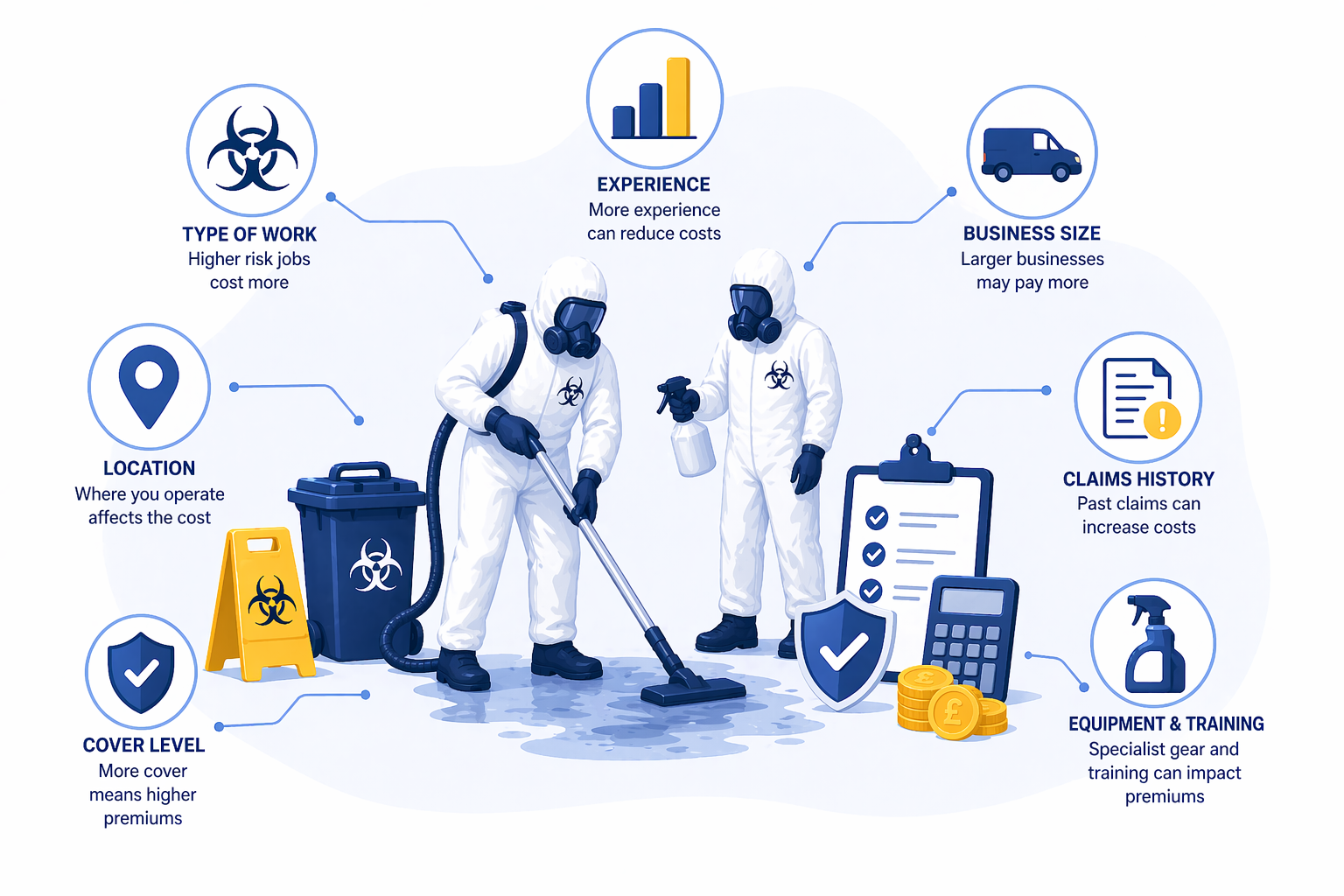
Operators new to biohazard insurance commonly ask why we don't just place with the cheapest market. The honest answer is that "cheapest" in this sector is almost always a function of what's been left out of cover, not what's been priced more efficiently. The real cost of insurance isn't the premium — it's the premium plus the uninsured loss when a claim hits.
The three patterns that produce a "cheap" quote
Cheap biohazard cleaning quotes in 2026 typically arise from one of three patterns, each with serious consequences at claim stage:
- Generic cleaner's package with biohazard work undeclared. The cheapest quotes online are domestic and commercial cleaner's packages priced for low-risk activity. Biohazard work isn't declared because the proposal form doesn't ask in sufficient detail. The premium reflects a £200k turnover domestic cleaner, not a £200k turnover biohazard operator — typically 3–5× less than correctly scoped cover. At claim stage, the insurer relies on the declared activity at proposal, and biohazard claims aren't in scope.
- Pollution and contamination exclusion applied to biohazard activity. Many standard PL policies carry pollution and contamination exclusions as default. The premium looks competitive because the exclusion strips out exactly the cover biohazard operators need. A claim for contamination spread, chemical exposure, or biological release is declined under the exclusion.
- Sub-limits invisible at proposal. Some quotes show £5m headline PL but carry sub-limits — £100k for biohazard, £50k for contamination spread, £25k for pollution. The £5m headline figure is illusory for the actual exposures the operator faces.
What "cheap" should look like vs what it usually means
| What cheap should mean | What cheap usually means |
|---|---|
| Correctly declared work mix, modest limits, no claims, mature compliance | Undeclared work mix, exclusions applied, no claims data yet |
| Specialist broker access to lower-rated specialist markets | Comparison site placement with markets that don't underwrite biohazard |
| Annual payment vs monthly direct debit | Headline figure without finance loading disclosed |
| Stacked compliance levers — HepB, training, lone working, mental health | No compliance evidence requested or considered |
| Continuity discount with same insurer 3+ years | New business loading not yet applied |
11. How should I compare biohazard cleaning insurance quotes?
Like-for-like comparison is the foundation of good insurance buying — and the absence of like-for-like comparison is why the market has so much variation in apparent pricing. Use the framework below for every quote you receive.
The 8-point comparison checklist
- Work mix declared. Every quote should specifically list the work types in scope: basic biohazard, trauma, hoarding, crime scene, sharps, drug residue, etc. "Cleaning" alone is insufficient. If the quote document doesn't specify, the cover may not apply.
- Pollution and contamination scope. Pollution and contamination should be explicitly within scope, not excluded or sub-limited. Check the schedule, not just the proposal acknowledgement.
- BBV and biological agent cover. EL should explicitly contemplate BBV occupational disease. PL should contemplate contamination spread. If the policy doesn't name these exposures, ask the broker to confirm in writing.
- Limits and sub-limits. Headline limits matter less than sub-limits. A £5m PL with £100k biohazard sub-limit is materially less cover than £2m PL with full biohazard scope. Read the schedule carefully.
- Excess structure. Higher excesses reduce premium but increase exposure. £500 excess vs £1,000 excess vs £2,500 excess across PL/EL can materially change premium — and materially change your out-of-pocket cost at claim stage. Compare excesses, not just premiums.
- Lone working scope. Some EL policies sub-limit or exclude lone working. Confirm explicit scope.
- Psychological injury scope. EL should contemplate psychological injury claims from vicarious trauma and PTSD. Older or generic wordings sometimes don't.
- Renewal commitment and growth scope. Cover should accommodate planned turnover growth without mid-policy renegotiation. Confirm headroom in the declared turnover.
Compare the quote, not just the premium
If three quotes come back £2,800, £3,400, and £4,800 — the £2,800 isn't automatically the winner. Run each through the 8-point checklist. Often the £4,800 is correctly scoped, the £3,400 has subtle exclusions, and the £2,800 has misdeclared the work mix. The correct purchase is the one that pays when needed, not the one that looks lowest at proposal.
12. Real broker pricing scenarios — what we've placed in 2026
The pricing scenarios below are anonymised but reflect real Miller & Partner placements in the 2026 UK biohazard cleaning market. They show what's actually being paid in the market — not theoretical pricing or comparison site estimates.
Placement A — Sole Trauma Cleaner, South-West England
Profile: Sole operator, 18 months trading, £62,000 turnover, focused on trauma cleaning and minor biohazard. No staff. One vehicle. Clean claims history. Documented HepB vaccination, basic compliance pack, NACSC trained.
Programme placed: PL £5m with biohazard and trauma declared, Personal Accident £100k lump sum plus £400/week benefit, tools £8k schedule, commercial vehicle hazardous goods, basic cyber, Legal Expenses with HSE scope.
Total annual premium: £1,180. Paid annually to avoid finance loading. The compliance evidence at proposal pushed pricing toward the lower end of the sole-trader band. Renewal projected to reduce 8–10% at year 2 assuming claims-free continuation.
Placement B — Small Multi-Discipline Firm, North-West England
Profile: 4 staff including owner-director, £280,000 turnover, full multi-discipline (trauma, hoarding, crime scene, infection decontamination). Two vehicles. One minor claim 3 years ago (£4,800 PL, manual handling related). Mature compliance — site-specific RAs, HepB programme, NASC certification, structured training matrix, lone working devices, EAP access.
Programme placed: EL £10m comprehensive scope, PL £5m biohazard scope, PI £500k with chain-of-custody extension, EIL £1m, two-vehicle fleet hazardous goods, tools £18k schedule, Legal Expenses comprehensive, cyber, D&O £500k for owner-director.
Total annual premium: £3,420. The mature compliance package and modest claim history positioned the placement at the lower-middle of the small-firm band. Prior cleaner's package broker had been quoting £5,200 for inferior cover — the specialist placement was both cheaper and broader.
Placement C — Mid-Sized Regional Operator with Recent Claim, Midlands
Profile: 11 staff, £820,000 turnover, full multi-discipline, mixed insurance panel work. Five vehicles. One material claim in last 5 years: £58,400 EL (manual handling back injury, hoarding clearance). Mature compliance post-claim including documented remedial training and mechanical lifting aids.
Programme placed: EL £10m, PL £10m, PI £1m, EIL £2m, fleet (5 vehicles), property at depot, BI £500k, D&O £1m, cyber, Legal Expenses, reputational.
Total annual premium: £14,200. The material claim attracted a 22% loading vs equivalent clean-history placement. The documented remedial action since the claim (mechanical aids issued, training refreshed, site-specific RA template for hoarding) prevented a more severe loading. Renewal in 12 months projected to reduce 8–12% as claim ages and remedial action evidences sustained.
Placement D — National Multi-Vehicle Firm, Greater London Operating Area
Profile: 28 staff across two depots, £3.4m turnover, full multi-discipline including insurance panel work and police-channel crime scene work. 12 vehicles. Clean claims history last 5 years. Comprehensive compliance package, NASC accredited, audit-ready documentation.
Programme placed: Lloyd's market placement. EL £10m, PL £15m, PI £2m with chain-of-custody, comprehensive EIL £5m, 12-vehicle fleet, property and BI at two depots, D&O £2m, cyber comprehensive, reputational and crisis management, Legal Expenses.
Total annual premium: £38,400. Lloyd's placement was the only viable route for the comprehensive scope. The clean claims history and comprehensive compliance package secured terms 18% below initial market submission. Quarterly payment terms negotiated to manage cashflow.
Placement E — New Startup, First Year Trading, East Anglia
Profile: Owner plus one trainee staff member, 4 months trading, projected first-year turnover £45,000. Trauma and biohazard focus, building portfolio. NASC-trained owner, HepB programme documented, basic compliance.
Programme placed: EL £5m (1 staff), PL £2m with biohazard declared, commercial vehicle hazardous goods, tools schedule £5k, Personal Accident for owner.
Total annual premium: £1,420. First-year placement; renewal at year 2 projected £1,150–£1,250 assuming claims-free and 30%+ turnover growth — the loading reduces as classification stability and claims data accumulates.
13. How to get an accurate biohazard cleaning insurance quote
The quality of the quote you receive reflects the quality of the information you provide. Generic responses to "how much do you need" produce generic quotes. The structured approach below gets you accurate pricing efficiently.
- Document your actual work mix. Every discipline performed, even occasionally. Basic biohazard, trauma, hoarding, sharps, crime scene, drug residue, infection decontamination, mould, custody, vehicle cleaning. Estimate the proportion of turnover from each. Don't under-declare to chase lower premium.
- Calculate actual turnover and project growth. Last 12 months actual; current 12 months projected. Insurers prefer accurate declarations with realistic growth headroom over conservative under-declaration that requires mid-policy adjustment.
- Document staff and payroll. Total staff count, payroll value, employment types (PAYE vs subcontractor vs zero-hours). EL premium scales primarily on these.
- Gather compliance evidence. Site-specific risk assessment templates, HepB vaccination records, training matrix, lone working protocol, NASC/NACSC certificates, Environment Agency waste carrier licence, waste consignment note samples. Present this proactively; don't wait for the underwriter to request.
- List claims history accurately. Every claim or notification in the last 5 years, whether settled, declined, or withdrawn. Insurers verify against claims databases; inaccurate disclosure is a renewal-killer.
- Specify required limits. Based on actual contract requirements, not "for safety". £5m PL is sufficient for most contracts; £10m needed for major insurance panel work; £25m only for largest contracts.
- Engage a specialist broker rather than a comparison site. Comparison sites can't handle the specific declarations biohazard work requires. A specialist broker accesses Lloyd's market and specialist MGAs that generic placements don't reach.
- Allow 5–10 working days for proper placement. Specialist underwriting takes time. Same-day quotes are typically generic cleaner's package responses. Quality placement requires multi-market submission, underwriter Q&A, and properly drafted schedule — usually a 1–2 week process for first-time placements, faster for renewals.
14. Common biohazard cleaning insurance pricing mistakes
The mistakes below appear in roughly 70% of biohazard cleaning insurance placements we review for the first time. Each one costs the operator money — sometimes immediately in over-payment, sometimes later in declined claims.
- Buying a generic cleaner's package and assuming biohazard work is in scope. The single most common mistake. The premium looks attractive; the cover almost certainly doesn't extend to biohazard activity. Confirm in writing with the broker that every work type is explicitly declared and within scope.
- Under-declaring work mix to chase lower premium. Specifically declaring "biohazard" while privately also doing trauma and crime scene work. Insurance Act 2015 requires fair presentation of risk; under-declaration voids cover. The 5–15% premium difference between accurate declaration and under-declaration isn't worth the cover loss at claim stage.
- Over-buying limits without contract justification. £10m PL when actual contracts require £2m. Each £5m increment adds 25–40% to PL premium without claim defence value at typical biohazard claim sizes. Match limits to contract requirements.
- Annual market shopping vs continuity strategy. Moving insurer every year for £100 saving forfeits continuity discounts of £400–£800 at year 3+ and damages claim defence when claims history splits across multiple insurers. Strategic continuity with right-priced specialist insurer typically wins over annual switching.
- Paying monthly direct debit on small premiums. 6–12% finance loading on £1,200 premium = £75–£140 wasted annually. Annual payment is the right choice for any business that can cashflow it.
- Ignoring the excess structure. £500 vs £2,500 excess across PL/EL can change premium by 15–25%, but increases out-of-pocket exposure on every claim. Match excess to risk appetite and cashflow capacity.
- Failing to evidence compliance at proposal. Insurers can't price for documented compliance they don't know exists. Present HepB programme, training matrix, site-specific RAs, NASC certification proactively — not when the underwriter asks.
- Not reviewing cover when work mix evolves. Mid-policy expansion into crime scene or drug residue work without notification to insurer is non-disclosure. Update broker as soon as new work types are taken on, not at renewal.
15. Glossary of biohazard insurance cost terms
Glossary of biohazard cleaning insurance cost terms
- Premium
- The annual cost of the insurance policy. May be paid annually (typically discounted) or monthly (typically loaded 6–12% for finance).
- Rating Factor
- A characteristic of the business that influences premium pricing. Includes turnover, staff count, work mix, claims history, limits, compliance maturity, and broker placement type.
- Loading
- A percentage increase to baseline premium reflecting a specific risk factor. E.g. drug residue work attracts a 50–80% loading vs basic biohazard baseline.
- Sub-limit
- A reduced cover limit applied to a specific type of loss within a larger policy. E.g. £5m PL with £100k biohazard sub-limit means only £100k is actually available for biohazard claims despite the £5m headline.
- Excess (Deductible)
- The amount the policyholder pays toward each claim before insurance responds. Higher excess reduces premium but increases out-of-pocket exposure per claim.
- Fair Presentation of Risk
- Insurance Act 2015 standard requiring policyholders to proactively disclose every material fact the insurer would want to know — not just answering specific questions but volunteering relevant information.
- Non-disclosure
- Failure to disclose material facts at proposal or renewal. Permits insurer to avoid the policy, reduce claims proportionally, or impose retrospective terms.
- Continuity Discount
- Premium reduction applied at renewal for maintained insurer relationship across multiple years. Specialist sectors typically offer 5–10% by year 3+.
- Pollution and Contamination Exclusion
- Standard PL exclusion removing cover for pollution and contamination-related claims. Default in many cleaner's packages; must be specifically removed or contradicted for biohazard cover.
- BBV (Bloodborne Virus)
- Viruses transmitted through blood and bodily fluids — primarily HIV, Hepatitis B (HBV), and Hepatitis C (HCV). Classified by HSE in COSHH Hazard Group 3. Primary EL exposure for biohazard cleaners.
- Chain of Custody
- The documented continuous record of evidence handling from scene to laboratory. Critical for crime scene cleaning PI cover; methodology disputes around chain of custody are the primary PI exposure.
- Environmental Impairment Liability (EIL)
- Specialist insurance covering pollution, contamination, and environmental damage. Material for biohazard cleaners handling regulated waste under Environmental Protection Act 1990.
- Directors and Officers (D&O)
- Insurance covering personal liability of company directors and officers for management decisions. Material for biohazard operators given Section 37 HSAW 1974 director prosecution exposure.
- Lloyd's Market
- The specialist insurance market in London accessible only through approved brokers. Provides cover for specialist risks that mainstream UK commercial markets won't underwrite or scope properly.
- MGA (Managing General Agent)
- A specialist underwriting agency with delegated authority from insurers to write specific classes of business. Specialist MGAs often offer better biohazard cleaning terms than mainstream commercial markets.
- NASC / NACSC
- Recognised UK trade certifications for specialist cleaning operatives. National Association of Specialist Cleaners (NASC) and similar bodies. Certification at staff level typically reduces premium 5–10%.
- Upper-Tier Waste Carrier Licence
- Environment Agency licence required for hazardous waste transfer. Approximately £165 for 3 years. Mandatory for biohazard cleaning operators and an insurance precondition.

Frequently asked questions
Sole biohazard operators typically pay £600–£1,500 per year; small firms (2–5 staff) £1,800–£4,800; mid-sized regional operators £6,000–£15,000; insurance panel contractors £8,000–£20,000; and national multi-vehicle firms £20,000–£60,000+. Pricing depends on work mix (basic biohazard, trauma, hoarding, crime scene, drug residue), turnover, staff count, claims history, documented compliance, limits selected, and broker placement type. Specialist biohazard placement is typically 3–6× generic cleaner's cover but dramatically cheaper than the uninsured exposure from non-disclosure under the Insurance Act 2015.
Biohazard work engages COSHH Hazard Group 3 biological agents, regulated hazardous waste, lone working, manual handling, psychological exposure, chemical risk, and out-of-hours response. Standard cleaner's PL policies typically carry pollution and contamination exclusions and aren't underwritten for BBV occupational disease. The premium differential reflects the genuine claim exposure differential, not markup. The cheap generic cleaner's quote that doesn't specifically declare biohazard work isn't comparable cover — it's a different product entirely.
The biggest premium reduction levers in 2026 are stackable: documented Hepatitis B vaccination programme (8–15% off EL); site-specific COSHH risk assessments (10–15% off PL/EL); structured training matrix (5–12% off EL); lone working safety devices and check-in protocols (3–8% off EL); mental health and welfare programme (3–7% off EL); NASC/NACSC certification (5–10% across programme); accurate work mix declaration (protects cover certainty); limits matched to actual contract requirements (10–25%); 3+ years continuity with same insurer (5–10% off renewal); annual payment vs monthly (6–12% on small premiums); specialist broker placement (10–20% across programme); audit-ready compliance pack presented at proposal (5–15%). Stack them, don't choose between them.
Usually not. Cheap quotes typically arise from one of three patterns: generic cleaner's package with biohazard work undeclared; pollution and contamination exclusion applied to biohazard activity; or sub-limits invisible at proposal that strip out the cover actually needed. The £15,000 premium saving across three years can become a £150,000+ uninsured loss when a single BBV occupational disease, chemical exposure, or contamination spread claim hits. The right purchase is the one that pays when needed, not the one that looks lowest at proposal. Always run quotes through the 8-point comparison checklist.
Trauma cleaning typically attracts a 10–15% loading vs basic biohazard baseline; crime scene cleaning attracts 40–60% loading. The difference reflects chain-of-custody PI exposure, evidence preservation requirements, confidentiality and reputational risk, and insurance/police panel requirements specific to crime scene work. Drug residue decontamination attracts the highest loadings at 50–80%+ due to clandestine chemical exposure and structural contamination assessment risk. See our dedicated trauma cleaning insurance guide and crime scene cleaning insurance guide for discipline-specific deep dives.
Employers' Liability for biohazard operators with comprehensive scope (BBV, lone working, manual handling, psychological injury) typically costs £900–£1,800 for a 3-staff firm; £1,800–£3,800 for a 6–15 staff firm; £5,500–£12,000 for 20+ staff operations. EL is the largest single line for any operator with staff because the underlying claim severity is high — BBV occupational disease can reach £250k+, manual handling claims £60k+, psychological injury £100k+. Documented Hepatitis B vaccination programme, structured training matrix, and lone working protocols reduce EL premium materially and improve claim defensibility.
Generally no. Each £5m increment on PL typically adds 25–40% to PL premium. £5m vs £10m EL adds 15–25% to EL premium. Buying £10m PL when your largest contract requires £2m wastes 25–40% on the PL line. Match limits to actual contract requirements with modest headroom. The exception is mid-sized operators looking at panel work where £10m PL is a panel approval prerequisite — there the limit isn't optional. Review limit requirements at every renewal as contract mix evolves.
Monthly direct debit typically loads premium 6–12% for finance — meaning a £1,200 annual premium becomes £1,272–£1,344 paid monthly. The loading is more material on smaller premiums; on £10,000+ placements the percentage impact narrows. If cashflow permits, annual payment is the right choice for any small premium. Some insurers offer quarterly payment as a middle ground with smaller finance loading. Discuss with broker — finance terms vary by insurer.
EIL typically costs £250–£600 for a small biohazard firm; £600–£1,400 for a mid-sized regional operator; £1,800–£4,500 for a national operation. EIL covers chemical exposure, contamination of land or water, and pollution release — material risks given biohazard cleaning's regulated waste profile under the Environmental Protection Act 1990. Often required by insurance panel work and by client contracts on commercial cleaning engagements. The cost is modest relative to the Environment Agency enforcement and pollution liability exposure it covers.
Insurers typically look back 5 years. Clean history is the baseline. A single minor claim under £10,000 typically adds 10–15% loading. A material claim £10k–£50k adds 25–40%. Multiple material claims can add 50%+ or trigger market exit (insurers declining renewal). Documented root cause analysis and remedial action after any claim materially reduces the loading impact at next renewal. The loading also fades over time — a claim from 4 years ago has less impact than one from 4 months ago. Strategic continuity with the same insurer where possible spreads claim impact better than switching annually.
Modest difference. Limited companies typically attract slightly higher PL pricing for the same turnover (structural rating factor) but gain access to Directors and Officers cover that sole traders don't need. The bigger structural difference is that limited companies with employees need Employers' Liability (legally required); sole traders without staff don't. EL is typically the largest single premium line for any operator with staff, so the legal structure matters less than the staff structure. See our sole proprietorship insurance guide for the structural considerations.
Look for brokers with specific biohazard, trauma, or specialist cleaning experience evidenced by: specialist articles or guides (not generic cleaner's package material); willingness to discuss specific exposures in detail; access to Lloyd's market and specialist MGAs rather than just mainstream commercial markets; FCA authorisation and documented track record. Avoid brokers offering "cleaner's package" without biohazard specifics; brokers quoting from only one or two markets; brokers not asking about work types in detail at proposal. Miller & Partner specialise in this sector — see our biohazard cleaning insurance product page and broader biohazard cleaning insights hub.






Instagram
LinkedIn