


Ai Consultancy Insurance Guide: Navigating 2026 with Confidence
Why has UK AI consultancy insurance fundamentally changed in 2026?
Twelve months ago, UK AI consultants were largely insured under generic IT consultant or management consultant Professional Indemnity packages. The market hadn't yet developed AI-specific exclusions; underwriters hadn't yet developed AI-specific questions; consultants hadn't yet developed AI-specific exposure consciousness. That position has unwound completely across 2025 and the first half of 2026.
The trigger is a regulatory pincer movement. On 2 August 2026 the bulk of the EU AI Act becomes fully applicable, including the high-risk AI system obligations under Annex III. The Act applies to any provider, deployer, importer, or distributor placing AI on the EU market — and crucially also to any third-country provider (including UK consultants and their clients) where the AI system's output is used inside the EU. Fines reach €35 million or 7% of global turnover for prohibited practices, and €15 million or 3% for high-risk obligation breaches. Meanwhile, on 5 February 2026 the core data protection reforms in the Data (Use and Access) Act 2025 commenced in the UK, reshaping the automated decision-making rules in UK GDPR Article 22 from a prohibition with exceptions into a right of challenge with safeguards, while preserving stricter rules for special category data.
For UK AI consultants — whether advising on strategy, implementation, governance, fine-tuning, or deployment — this changes the PI exposure profile fundamentally. Clients can no longer simply absorb regulatory risk and apologise after a failure; they now operate under enforceable timeframes, conformity assessment duties, transparency obligations, and significant fine exposure. When AI advice or implementation produces a hallucination that misleads a customer, a biased output that triggers an Equality Act claim, an IP-infringing training dataset that draws a copyright suit, or a high-risk classification error that exposes the client to AI Act fines, contractual fault now flows back to the consultant through PI claims that look very different from the consulting claims of 2023.
This guide is the definitive 2026 UK AI consultancy business insurance article — built around the two-front regulatory shift, the genuine claim-driving exposures, the cover architecture that responds, and the operational documentation that makes both compliance and claim defence possible. It complements our broader AI and Tech insurance product page, our Professional Indemnity insurance guide, and our Cyber Insurance product page, and sits alongside our technology cluster including the SaaS business insurance guide, IT contractor insurance, and automation engineer insurance.
Key facts at a glance
- The EU AI Act becomes fully applicable on 2 August 2026 with high-risk AI system obligations, conformity assessments, technical documentation, post-market monitoring, and registration in the EU high-risk AI database. UK consultants advising on AI used in the EU market are squarely in scope.
- UK Data (Use and Access) Act 2025 reforms commenced 5 February 2026 — restructuring UK GDPR Article 22 on automated decision-making, with stricter rules retained for special category data. AI consultants advising on ADM deployment carry direct PI exposure for client compliance failures.
- AI hallucination and erroneous output is now the dominant PI claim category for AI consultants — where AI-generated content, recommendations, or decisions implemented under consultant advice cause client financial loss, contractual recovery claims flow back to the consultant.
- ICO enforcement collected approximately £19.6 million in 2025, a sevenfold increase from 2024's £2.7 million, with two-thirds of fines for UK GDPR breaches. The ICO is shifting from one-off incident response to systematic governance failure enforcement — AI consultancy work sits at the centre of that pivot.
- Generic IT consultant PI policies increasingly contain AI exclusions — adding AI-specific exclusions for hallucinated output, foundation model errors, training data IP infringement, or AI-driven discrimination is standard underwriting practice in 2026. Specialist placement is essential.
- UK AI consultancy PI premiums typically run £750–£4,500 for solo advisors and £5,500–£25,000+ for established AI consultancies with EU-facing work, depending on work mix, deal sizes, governance documentation maturity, and limits. Limits below £1m are increasingly inadequate for serious enterprise AI advisory.
- Insurance non-disclosure under the Insurance Act 2015 is the most preventable catastrophe — operating as an AI consultant under generic "IT consultant" cover without specific AI declaration creates an uninsured loss exposure that can dwarf years of correctly priced premium.
1. The 8 biggest AI consultancy risks: summary table
The risks below are ranked by combined frequency, severity, and regulatory consequence under the 2026 EU AI Act and DUAA framework. Some — hallucinated output, IP exposure — are everyday operational realities. Others — AI Act classification errors, insurance non-disclosure — are infrequent but business-ending when they occur. The intelligent AI consultant manages all eight simultaneously rather than addressing them in priority order.
| Risk | Frequency | Severity | Primary Cover |
|---|---|---|---|
| Hallucination / erroneous AI output (PI) | Common — now the dominant PI claim | Medium-High (£15k–£150k typical) | Professional Indemnity with AI scope |
| IP infringement / copyright exposure | Rising sharply post-DUAA | High (£25k–£500k+) | PI with IP cover; Media Liability |
| Data protection / confidentiality breach | Common | High (£20k–£200k+ ICO fines plus civil) | Cyber with regulatory defence; PI |
| Bias, discrimination, Equality Act exposure | Rising under ICO scrutiny | High (£15k–£100k+ per claim) | PI with bias / discrimination scope |
| AI Act classification / conformity failure | Rising sharply post-August 2026 | Catastrophic (€7.5m–€15m+ EU fines) | PI with regulatory scope; D&O |
| Third-party vendor / supply chain risk | Common | Medium-High (£10k–£150k typical) | PI with vendor failure scope; Cyber |
| Cyber, prompt injection, model security | Rising rapidly | High (£25k–£250k+) | Cyber with AI scope; Tech E&O |
| Insurance non-disclosure | Common but often unnoticed | Catastrophic (uninsured loss exposure) | No cover responds — proposal stage fix |
2. How does the EU AI Act and DUAA transform AI consultant liability in 2026?
UK AI consultants in 2026 sit at the intersection of two regulatory regimes whose application dates land within months of each other, and whose combined effect transforms the contractor liability picture. Understanding both is essential to scoping PI cover correctly.
Regime 1: The EU AI Act (full applicability 2 August 2026)
The EU AI Act is the world's first comprehensive AI regulation. It uses a risk-based classification:
- Prohibited AI practices (social scoring, certain biometric categorisation, manipulative AI) — banned since 2 February 2025. Fines up to €35m or 7% of global turnover.
- High-risk AI systems under Annex III — covering recruitment and HR, credit scoring, insurance pricing, education, law enforcement, migration, justice, critical infrastructure, and AI used as safety components in regulated products. Full obligations apply from 2 August 2026. Fines up to €15m or 3% of global turnover.
- General-Purpose AI (GPAI) models — governance and provider obligations since 2 August 2025.
- Limited-risk AI — transparency obligations (e.g. chatbot disclosure, deepfake labelling) from 2 August 2026.
- Minimal-risk AI — largely unregulated.
For UK consultants, three points matter most. First, the Act has extraterritorial reach: it applies to UK consultants where their AI work's output is used inside the EU. Second, the high-risk obligations are substantial — risk management systems, data governance, technical documentation, human oversight architecture, post-market monitoring, conformity assessment, and EU database registration. Third, classification is the single most consequential consultant decision: misclassifying a high-risk system as limited-risk exposes the client to retrospective non-compliance, which flows back to the consultant through PI claims. The European Commission's Digital Omnibus proposal of November 2025 may adjust some timelines, but the consensus among compliance lawyers in 2026 is "build for August, treat any extension as a margin of safety, not a reason to delay".
Regime 2: The Data (Use and Access) Act 2025 (commenced 5 February 2026)
The DUAA fundamentally restructured UK data protection law. The core changes most relevant to AI consultants:
- Automated decision-making reforms — UK GDPR Article 22 was replaced with new Articles 22A–D. ADM based on ordinary personal data is generally permitted on any lawful basis (other than the new "recognised legitimate interest" basis), shifting the regime from "prohibition with exceptions" to "right of challenge with safeguards". Special category data retains the stricter regime.
- Expanded ICO enforcement powers — including powers to require individuals to answer questions and to require organisations to commission approved-person reports on specified matters.
- Divergence from EU GDPR — UK-compliant AI strategies no longer automatically satisfy EU AI Act / EU GDPR requirements for the same client.
For UK AI consultants advising on ADM deployment, the DUAA creates significant exposure. A consultant who advises a client to roll out an AI-driven recruitment screening tool under the new permissive UK regime, without applying the stricter EU regime for any EU-facing operations, creates a cross-jurisdictional compliance gap. The ICO's draft guidance on ADM is in consultation and expected in spring 2026 — meaning consultants are advising clients during a guidance vacuum, with full retrospective regulatory risk.
Regime 3: The wider UK regulatory landscape
Sector-specific UK regulators (FCA, ICO, MHRA, CMA, Ofcom, EHRC) continue to issue AI guidance applied through their existing powers. The UK Artificial Intelligence (Regulation) Bill remains a Private Members' Bill as of May 2026 — the government has signalled it is focused on innovation through AI Growth Zones and AI Growth Labs (regulatory sandboxes) rather than a comprehensive UK AI Act. For consultants this means navigating principles-based UK guidance alongside prescriptive EU obligations — a complex picture where errors in cross-regime translation create immediate PI exposure.
3. Risk 1: AI hallucination and erroneous output — the dominant PI exposure
AI Hallucination and Erroneous Output — The 2026 Top PI Claim
The largest single claim category for UK AI consultants in 2026 is hallucinated or erroneous AI output that produces client financial loss. The pattern: a consultant designs, configures, or recommends an AI system; the system generates output (a customer recommendation, an automated decision, a generated document, a forecast); the output is materially wrong because the underlying model hallucinated, generalised incorrectly, or was trained on flawed data; the client acts on the output and suffers loss. Where the consultant's advice or implementation can be characterised as negligent — inadequate testing, insufficient human-in-the-loop safeguards, missing validation steps, inadequate documentation of limitations — the loss is recoverable from the consultant.
Documented model evaluation methodology before recommendation; written assessment of hallucination risk for the specific use case; mandatory human-in-the-loop protocols documented with client; clear written scope of limitations of the AI system including known failure modes; written client acknowledgements of validation responsibility for outputs; documented testing regime with sample volumes and pass/fail criteria; ongoing performance monitoring recommendations with frequency; warranty and exclusion terms in engagement letter; written guidance on when AI output requires expert review before action.
Professional Indemnity with explicit AI scope and hallucination cover. Generic IT consultant PI typically responds to negligent advice claims but may not contemplate AI-generated content specifically — and the distinction is increasingly being tested at claim stage. Specialist AI consultancy PI should explicitly cover: AI model errors and hallucination; AI-driven decision errors; algorithmic bias claims; training data quality disputes; foundation model dependencies. Limits typically £500k for solo advisors; £1m–£5m for established consultancies. Claim values £15k–£150k typical; large enterprise AI failures can reach £500k+.
4. Risk 2: IP infringement and copyright exposure
IP Infringement and Copyright Exposure — The Training Data Trap
The use of copyrighted material to train AI models remains one of the most contested questions in UK and EU law. The UK government's 2024–2025 consultation on copyright and AI training proposed (among other options) a copyright exception for text and data mining. Following parliamentary pressure during the passage of the Data (Use and Access) Act 2025, the government agreed to publish an economic impact assessment and a report on copyright works used in AI development. As of May 2026 the position remains unresolved — meaning UK AI consultants and their clients face genuine litigation risk on training datasets, fine-tuning datasets, and outputs that reproduce copyrighted material.
Three claim drivers dominate. First, advising clients to fine-tune foundation models on datasets that include copyrighted material without licence — exposing both parties to infringement claims. Second, deploying generative AI systems that produce outputs reproducing distinctive elements of copyrighted works. Third, training proprietary models on scraped data that includes copyrighted content where licensing was unclear. In each case, contractual indemnity provisions typically push liability back to the consultant who advised on data sourcing.
Documented data provenance review for any training or fine-tuning dataset; written assessment of licensing position for foundation models recommended; clear written advice to clients on UK and EU copyright positions where divergent; explicit contractual carve-out for client-provided datasets where consultant did not source data; output filtering and watermarking recommendations documented; ongoing monitoring of copyright litigation against major foundation models; written caveat in engagement letters specifically on copyright position uncertainty.
Professional Indemnity with explicit IP infringement scope is essential. Generic PI typically excludes IP infringement or sub-limits it materially; specialist AI consultancy PI should provide explicit cover for copyright, trademark, and patent infringement arising from AI work — typically with named limits between £250k and £2m. Media Liability extension may be appropriate where the AI work involves content generation. Claim values £25k–£500k+ are realistic; class-action style copyright claims against major model providers create indirect exposure for consultants who recommended those models without adequate caveats.
5. Risk 3: Data protection and confidentiality breaches
Data Protection and Confidentiality — Post-DUAA Exposure
AI consultancy work routinely involves access to substantial volumes of client personal data — for model training, fine-tuning, evaluation, and deployment testing. Each stage creates data protection exposure. The DUAA reforms commencing February 2026 have not reduced this exposure; they have restructured it. Special category data (health, biometric, sexual orientation, ethnicity, religious belief, trade union membership) retains the stricter pre-DUAA regime. EU GDPR continues to apply where the client has EU operations. Cross-regime translation errors create direct consultant exposure.
The ICO's enforcement strategy in 2025 shifted material: £19.6m in total fines, with focus on systematic governance failures rather than isolated incidents. The Capita settlement at £14m in October 2025 was the ICO's largest ever. The composition of fines shifted from PECR (marketing) breaches to UK GDPR breaches — directly relevant to AI consultancy work which typically touches personal data architecture rather than marketing operations. The ICO's targeted action plan for 2025/2026 includes scrutinising ADM use in recruitment by major employers and platforms, securing assurances from foundation model developers on training data, and developing a statutory code of practice on AI and ADM.
DPIA support documented per project where applicable; written advice on lawful basis for AI processing; explicit advice on UK / EU regime divergence where client operates cross-border; documented data minimisation review for training datasets; pseudonymisation and synthetic data alternatives proposed and documented; written confidentiality undertakings with each client; documented data flow mapping for AI systems advised on; written advice on Article 22A–D ADM safeguards under UK regime and Article 22 under EU regime; recommendation of named AI risk owner or AI Responsible Officer role at client side.
Two-policy response required. Cyber insurance with regulatory defence cost cover responds to ICO investigation costs and any civil claims arising from data breach incidents during consultancy work. PI responds where the consultant's advice on data protection compliance proved negligent and the client suffered consequential loss. Note that fines themselves are uninsurable under UK public policy, but defence costs are insurable and typically run £25k–£150k for a contested ICO investigation. Cyber limit £1m+ typical; PI scope must explicitly contemplate data protection negligence.
6. Risk 4: Bias, discrimination, and Equality Act exposure
Bias and Discrimination — The Equality Act and ICO Pincer
AI systems can perpetuate or amplify discrimination across the nine protected characteristics under the Equality Act 2010 — age, disability, gender reassignment, marriage and civil partnership, pregnancy and maternity, race, religion or belief, sex, and sexual orientation. The EHRC has published guidance on this risk specifically for public sector bodies but the principles apply across all AI deployment. Employment-related AI (recruitment, performance management, promotion decisions) sits at the highest claim risk. Credit scoring, insurance pricing, and service delivery AI all create discrimination claim exposure under both the Equality Act and the EU AI Act high-risk Annex III categories.
The 2025 Court of Justice of the EU ruling in C-203/22 Dun & Bradstreet Austria confirmed individuals are entitled to a genuine explanation of the logic and results of automated decisions under EU GDPR. UK divergence under DUAA reframes but does not eliminate this duty. Consultants who advise clients on AI deployment without addressing bias testing, explainability architecture, and protected characteristic monitoring create direct exposure for both client and themselves when discrimination claims surface.
Documented bias testing methodology for any AI system advised on, including pre-deployment testing across protected characteristics; documented advice on EHRC guidance and Equality Act position; explainability architecture recommendations with client sign-off; monitoring framework for ongoing bias detection with frequency specified; written advice where AI is being deployed in Annex III high-risk EU contexts (recruitment, credit, education) with explicit reference to the AI Act fundamental rights impact assessment; written guidance on contestability and appeals mechanisms.
PI with explicit bias and discrimination scope is essential. Generic PI may include discrimination liability for the consultant's own employment practices but exclude discrimination claims arising from advice. Specialist AI PI should explicitly cover claims where consultant advice contributed to a client's discrimination exposure. Class-action style discrimination claims (e.g. against AI recruitment tools used by major employers) create the highest severity exposure. Claim values £15k–£100k+ per individual claim; aggregate claims can exceed £500k. Legal Expenses with EHRC investigation scope is a useful addition.
7. Risk 5: AI Act classification errors and conformity failures
AI Act Classification Errors — The 2026 Catastrophic Exposure
From 2 August 2026, classification of AI systems against the EU AI Act risk tiers becomes the single most consequential consultant decision for clients with EU exposure. A consultant who advises that a system is "limited-risk" when it falls under Annex III (and is therefore high-risk) exposes the client to retrospective non-compliance with substantial obligations: risk management system, data governance, technical documentation, human oversight, post-market monitoring, conformity assessment, and EU database registration. Fines reach €15 million or 3% of global turnover. The client's first line of recovery is the consultant's PI policy.
The misclassification risk is particularly acute around recruitment AI, credit scoring AI, insurance pricing AI, education AI, and AI used as safety components in regulated products. These are explicit Annex III categories. Other classification questions — GPAI with systemic risk thresholds, transparency obligations for limited-risk systems, the boundary between AI system and AI model — are technically complex and the European Commission's guidance remains in development through 2026.
Documented classification methodology with version control; written classification assessment per system advised on with reasoning; explicit reference to Annex III text where applicable; written advice on conformity assessment requirements; documented technical file structure recommendations under Article 11; human oversight architecture under Article 14; post-market monitoring framework; advice on EU AI database registration where applicable; written caveat on ongoing Commission guidance evolution; ongoing client communication framework for classification changes as Commission guidelines emerge.
PI with explicit EU AI Act regulatory scope is essential for any UK AI consultant whose clients have EU operations. Limits should match the regulatory fine exposure clients face — £1m minimum, £2m–£5m for established consultancies with enterprise clients. Regulatory defence costs are insurable (fines themselves are not under UK public policy). Specialist Lloyd's market placement is increasingly required for full EU AI Act scope. D&O cover for individual consultant defence in regulatory investigations. Run-off cover is essential — AI Act conformity claims may surface 2–5 years after the original advice as the EU AI Office and national competent authorities build enforcement capacity.
8. AI consultancy insurance cover checker
Select your business profile below to see the cover matched to your specific risk profile. For Miller & Partner's main AI and tech product page see AI and tech insurance, or our broader Professional Indemnity guide.
AI Consultancy Insurance Cover Checker
Select your business profile to see the recommended insurance programme matched to the 8 main AI consultancy risks
Solo AI Advisor / Strategist
- ESSENTIAL Professional Indemnity £500k–£1m with explicit AI scope (hallucination, bias, IP infringement, regulatory advice)
- ESSENTIAL Public Liability £2m–£5m for client meetings and on-site work
- ESSENTIAL Cyber insurance with regulatory defence — ICO investigation scope
- ESSENTIAL Tools and equipment cover for laptops, devices, dev hardware
- RECOMMENDED Legal Expenses with regulatory investigation scope
- RECOMMENDED Personal Accident — primary income protection
- CONSIDER Employers' Liability immediately if any subcontract help engaged — legal requirement
AI Implementation Consultant
- CRITICAL Implementation work elevates PI exposure — third-party vendor failures and model performance issues flow back through delivery contracts
- ESSENTIAL Professional Indemnity £1m–£2m with AI implementation scope
- ESSENTIAL Tech E&O extension for software-related claims
- ESSENTIAL Cyber insurance £1m+ with regulatory defence and incident response
- ESSENTIAL Public Liability £5m
- ESSENTIAL Run-off PI cover — implementation claims surface 2–5 years post-delivery
- ESSENTIAL Legal Expenses with regulatory scope
- RECOMMENDED IP infringement extension £250k+ specifically for training data and output disputes
AI Governance / Compliance Consultant
- CRITICAL Compliance advisory carries direct exposure to client regulatory fines — PI scope must contemplate regulatory advisory specifically
- ESSENTIAL Professional Indemnity £1m–£3m with explicit EU AI Act, DUAA, and ICO regulatory advisory scope
- ESSENTIAL Run-off PI cover with extended notification period — regulatory claims surface years after advice
- ESSENTIAL Cyber with regulatory defence £1m+
- ESSENTIAL Legal Expenses with ICO, EHRC, and EU regulatory investigation scope
- ESSENTIAL Confidentiality cover for sensitive client governance documentation
- RECOMMENDED D&O cover where holding fractional CAIO / AI Officer roles at client side
EU-Facing AI Consultancy
- CRITICAL EU AI Act extraterritorial scope means UK consultants are squarely exposed to EU regulatory recovery claims through client indemnity provisions
- ESSENTIAL Professional Indemnity £2m–£5m with explicit EU AI Act, EU GDPR, and cross-regime advisory scope
- ESSENTIAL EU territorial scope confirmed on policy — generic UK PI may sub-limit or exclude EU work
- ESSENTIAL Cyber insurance with EU GDPR regulatory defence scope
- ESSENTIAL IP infringement extension with EU coverage
- ESSENTIAL Run-off PI cover — typically 6 years minimum
- ESSENTIAL Legal Expenses comprehensive with EU regulatory scope
Enterprise AI Consultancy
- LEGAL Employers' Liability £10m where staff employed
- ESSENTIAL Professional Indemnity £2m–£10m with full AI scope (hallucination, bias, IP, regulatory, vendor)
- ESSENTIAL Cyber insurance £2m–£5m with comprehensive scope
- ESSENTIAL Tech E&O extension
- ESSENTIAL IP infringement extension £500k+
- ESSENTIAL Public Liability £10m
- ESSENTIAL D&O liability for director defence in regulatory investigations
- ESSENTIAL Legal Expenses comprehensive
- ESSENTIAL Business Interruption — operational continuity at this scale
- RECOMMENDED Trade Credit insurance — enterprise AI consultancy fee balances often material
AI Product / SaaS Consultancy
- CRITICAL Product / SaaS work blends consultancy with technology provider risk — both PI and Tech E&O essential
- ESSENTIAL Professional Indemnity £1m–£3m with AI scope
- ESSENTIAL Technology Errors and Omissions £1m–£5m
- ESSENTIAL Cyber insurance £2m+ with breach response and regulatory defence
- ESSENTIAL Media Liability extension for content / generative output exposure
- ESSENTIAL IP infringement extension £500k+
- ESSENTIAL Product Liability where the AI is embedded in a deliverable
- ESSENTIAL Run-off cover for both PI and Tech E&O
- RECOMMENDED SaaS-specific cyber extensions for hosted service exposures — see our SaaS business insurance guide
9. AI governance readiness self-check
The EU AI Act and DUAA have reset the documentation expectations for any consultant advising on AI deployment. Tick each governance discipline your consultancy has in place. The unchecked items are your priority compliance and insurance gaps.
AI Consultancy Governance Readiness Self-Check
Click each governance discipline you have in place. The more ticked, the lower your EU AI Act and DUAA downstream exposure.
-
Written engagement letter scope per project — clearly defining what the AI work covers and what it excludes, with bias testing and validation responsibilities allocated
-
EU AI Act classification methodology documented — your standard approach to classifying systems against Annex III with reasoning recorded per system
-
Hallucination and erroneous output risk assessment per project with documented mitigations and human-in-the-loop requirements
-
Bias testing methodology documented and applied to all advised systems with results recorded across protected characteristics
-
Training data provenance review — documented assessment of licensing and copyright position for all training datasets advised on
-
Cross-regime advisory framework — written approach to UK / EU divergence (DUAA vs EU GDPR, UK principles vs EU AI Act)
-
DPIA support framework for AI processing of personal data with documented advice on lawful basis and safeguards
-
Human oversight architecture documented for each high-risk system with named oversight roles and intervention authority
-
Post-market monitoring framework recommended to clients with frequency and trigger metrics
-
Third-party vendor due diligence framework for foundation models and AI tools recommended to clients
-
Incident response and disclosure framework recommended to clients for serious AI incidents under EU AI Act Article 73 and UK GDPR breach rules
-
PI insurance specifically declared for AI work — written broker confirmation that hallucination, bias, IP, regulatory advisory, and AI implementation are all within scope
10. AI consultancy risk assessor
Two factors drive AI consultancy operational risk above all others: the work mix (advisory vs implementation vs product) and the maturity of governance documentation. Use the tool below for your specific risk profile.
AI Consultancy Risk Assessor
Select your work mix and your governance maturity to see your specific risk profile and indicative insurance package
11. Risk 6: Third-party AI vendor and supply chain risk
Third-Party Vendor and Supply Chain — The Foundation Model Dependency
Modern AI consultancy work rarely involves bespoke model development; it overwhelmingly involves recommending, integrating, and configuring third-party foundation models, API services, vector databases, RAG infrastructure, and AI orchestration tools. Each layer introduces vendor dependency risk. When a foundation model provider changes terms, deprecates a model, suffers an outage, or faces a copyright lawsuit, the consultant's clients face direct downstream consequences — and contractual recovery typically runs back through the consultant who recommended the stack.
The risk surface includes: model deprecation forcing emergency migration; API pricing changes blowing through client budgets; foundation model copyright litigation creating retrospective compliance risk; vendor terms of service prohibiting specific use cases the client deployed; vendor security incidents creating data exposure; vendor changes to safety filters affecting production systems; and dependency chains where a recommended vendor itself depends on another vendor that fails.
Documented vendor due diligence framework per recommendation; written assessment of vendor terms of service for client use case; documented contingency planning for model deprecation; written advice on multi-vendor architectures where critical; explicit written caveat on vendor risk in engagement letters; documented review of vendor SLAs and contractual remedies; monitoring of vendor regulatory and litigation status; written advice on contractual indemnities and pass-through provisions where clients deal directly with vendors.
PI with explicit vendor advisory scope. Generic IT consultant PI typically excludes claims arising from third-party software or services; specialist AI PI should explicitly cover claims arising from negligent vendor selection or vendor failure advisory. Where the consultant is acting as a reseller or integrator, additional Technology Errors and Omissions cover may be required. Claim values £10k–£150k typical; major foundation model litigation creating client class-action exposure can produce indirect claims of £200k+.
12. Risk 7: Cyber, prompt injection, and model security exposure
AI-Specific Cyber Exposure — Prompt Injection and Model Attacks
AI systems introduce attack surfaces that didn't exist in traditional software architectures. Prompt injection attacks where an attacker embeds malicious instructions in input data that the AI then executes; training data poisoning where adversarial data is introduced to corrupt model behaviour; model extraction attacks where adversaries reconstruct proprietary models through API querying; jailbreak techniques that bypass safety guardrails; indirect prompt injection through retrieved content in RAG systems; and supply chain attacks on AI development pipelines. The OWASP Top 10 for LLM Applications has become the working reference framework in 2026 for AI-specific security risks.
AI consultants advising on system architecture, deployment, and security carry direct exposure when these attacks succeed. The consultant's recommendation to deploy without adequate input sanitisation, output filtering, rate limiting, or monitoring becomes the documented cause of the client's incident. Cyber claim values for AI-specific incidents are escalating as systems become more business-critical.
Documented security architecture review per AI deployment; written assessment against OWASP LLM Top 10; input sanitisation and output filtering recommendations documented; rate limiting and monitoring framework specified; red team testing recommendations; incident response framework specifically for AI security events; written advice on model isolation, secrets management, and prompt boundary enforcement; ongoing monitoring of emerging attack techniques and patching guidance.
Cyber insurance with explicit AI scope is essential — generic cyber policies may not contemplate prompt injection, model extraction, or training data poisoning specifically. Look for cover including: AI-specific incident response; cost of forensic investigation including AI system audit; regulatory defence costs; business interruption from AI system compromise; first-party costs of model retraining or replacement. PI responds where consultancy advice on security architecture proved negligent. Claim values £25k–£250k+ typical; major incidents involving customer data exposure through AI systems can reach £1m+. See our cyber insurance specialist guide for sector-adjacent context.
13. Risk 8: Insurance non-disclosure under the Insurance Act 2015
Insurance Non-Disclosure — The Most Preventable Catastrophe
The single most common reason UK insurance claims are reduced or declined isn't underwriting fraud or bad luck — it's non-disclosure at the proposal or renewal stage. AI consultants routinely buy generic IT consultant or management consultant PI policies without specifically declaring AI advisory, AI implementation, regulatory compliance advisory, EU-facing work, or high-risk Annex III work. The Insurance Act 2015 requires businesses to make a "fair presentation of the risk" — proactively disclosing every material fact the insurer would want to know. Failure to do so allows the insurer to: avoid the policy (treating it as never having existed); reduce the claim proportionally; impose terms that would have applied with proper disclosure.
Annual review of declared activities against actual operations; written confirmation from broker that all current activities are within scope; specific declaration of each AI work type at proposal (strategy advisory, implementation, governance, regulatory advisory, EU-facing, Annex III, training data, foundation model integration); mid-term notifications to broker when new work types are taken on; documented response to broker enquiries at renewal; retention of policy documents and broker correspondence as evidence; explicit confirmation that any silent renewal exclusions have been removed or addressed.
There is no insurance response to insurance non-disclosure — that's the whole point. The cover that should have responded doesn't. The only mitigation is at the proposal stage: detailed declaration, broker discipline, and renewal review. Specialist AI consultancy broker placement makes a material difference here — generic brokers often miss the specific declarations that AI work requires, while specialist brokers know exactly what each insurer expects to see at proposal.
14. What drives the cost of AI consultancy insurance in 2026?
UK AI consultancy insurance pricing in 2026 reflects the regulatory transformation under EU AI Act and DUAA, plus the genuine claim exposure differential vs generic IT consultancy. Indicative annual premium ranges:
| Business Profile | Indicative Annual Premium 2026 |
|---|---|
| Solo AI advisor / strategist — written reports, advice only, £40k–£100k turnover | £750–£2,200 |
| AI implementation consultant — building / deploying systems, £100k–£300k turnover | £2,500–£6,500 |
| AI governance / compliance consultant — regulatory advisory, £150k–£400k turnover | £3,500–£8,500 |
| EU-facing AI consultancy — clients with EU operations, £200k–£600k turnover | £5,500–£12,000 |
| High-risk Annex III specialist — recruitment, credit, education, healthcare AI | £8,000–£18,000 |
| Enterprise AI consultancy — 5–20 staff, £500k–£2m turnover, multi-discipline | £12,000–£25,000+ |
The factors below drive both insurance premium and overall risk management investment. The rating impact within each profile band is typically larger than the differential between profile bands — meaning a solo advisor with poor documentation can pay more than a small consultancy with excellent documentation.
| Rating Factor | Impact on Premium | What You Can Do |
|---|---|---|
| Work mix and discipline complexity | Strategy advisory lowest; implementation and high-risk Annex III highest | Declare every work type specifically; misdeclaration is the #1 claim dispute |
| Annual turnover and fee values | Primary scaling factor for PI | Declare accurately including planned growth as EU AI Act drives demand |
| EU exposure | EU-facing work adds 25–40% to PI typically — extraterritorial AI Act scope | Confirm EU territorial scope on policy; specialist placement essential |
| Governance documentation maturity | EU AI Act / DUAA-ready documentation reduces premium 15–25% across programme | Engagement letters, classification methodology, bias testing, provenance review |
| High-risk Annex III work | Recruitment, credit, education, healthcare AI adds 30–50% to PI | Specialist scope essential; £2m+ limits typically required |
| IP infringement scope | Specific IP cover adds 10–20% to PI line — essential for training data exposure | Don't try to save here; copyright class action exposure is material |
| Foundation model dependencies | Vendor advisory adds 10–20% to PI; documentation reduces uplift | Document vendor due diligence framework; declare vendor advisory scope |
| Limits selected | £1m / £2m / £5m PI rate differently; enterprise clients often require £2m+ | Match to typical contract requirements; review at every renewal |
| Claims history | 5+ year impact; AI hallucination and IP claims particularly material | Root cause analysis and remedial documentation after any claim |
| Run-off cover requirements | Extended notification periods add 10–25% to PI | Essential for governance advisory — claims surface 2–5 years later |
| Broker placement | Specialist AI consultancy brokers access materially better terms | Use a broker with active AI / tech consultancy underwriting experience |
| Continuity with insurer | 3+ years with same insurer typically reduces renewal premium 5–10% | Strategic continuity decision; don't chase £200 savings against silent exclusions |
15. Real claims and how to manage them
Claim — AI Hallucination PI, £85,000 Settlement
A solo AI consultant designed and recommended a generative AI customer service deployment for a mid-sized UK retailer. The system was built on a leading foundation model with retrieval-augmented generation against the retailer's product catalogue and returns policy. The consultant delivered a methodology document, configuration recommendations, and a one-week supervised rollout. The engagement letter described the work as "AI customer service implementation advisory" with no specific reference to hallucination risk, output validation responsibility, or human-in-the-loop requirements for refund decisions.
Three months post-deployment, the system began authorising customer refunds significantly outside the retailer's actual policy — including refunds for items not eligible, refunds beyond the 28-day window, and in some cases refunds for items the customer hadn't purchased. The retailer estimated 2,400 incorrect refund authorisations over a six-week period before pattern detection, totalling £73,400 in actual loss plus operational and reputational impact. Investigation revealed the AI was hallucinating policy provisions and authorising decisions that should have routed to human review.
The retailer brought a PI claim alleging negligent methodology — specifically that the consultant should have built mandatory human-in-the-loop for any monetary decision above a defined threshold, should have configured hallucination guardrails against the actual returns policy, and should have documented validation testing pre-rollout. The consultant's documentation comprised the methodology document and email correspondence; no formal hallucination risk assessment; no documented testing regime; no written guidance on validation responsibility allocation between consultant and client.
The consultant's £1m PI responded but only after dispute. Settlement: £85,000 (actual refund losses, secondary remediation costs, operational impact, legal). Defence costs: £14,200. Total claim: £99,200. Post-claim renewal: PI premium increased 55%. Insurer required: documented hallucination risk assessment per project; written engagement letter scope including validation allocation; mandatory testing regime documentation; human-in-the-loop architecture for monetary decisions; written limitations and warranty terms. The consultant implemented these and at the following renewal premium returned to a 22% loading over baseline.
The lesson: hallucination is now the dominant AI consultancy PI claim category. The documentation that defends these claims is the same documentation that prevents them. Generic IT consultant PI doesn't always contemplate AI-generated content errors specifically; specialist AI PI does — and the premium uplift is dramatically cheaper than the claim exposure.
Claim — IP Infringement, £210,000 Settlement
A small AI consultancy (3 staff, £280k turnover) advised a UK media business on building a proprietary content generation AI fine-tuned on the client's editorial archive plus a broader corpus the consultancy recommended for stylistic diversity. The recommended corpus included substantial volumes of copyrighted journalism scraped from multiple major UK and US publications. The consultancy's written advice characterised the dataset as "industry-standard training corpus" with brief reference to "fair use" — a US concept that does not directly apply in UK or EU law — and did not document any review of UK or EU copyright position, licensing inquiries, or specific publisher permissions.
Eighteen months later, two major UK publishers and one US publisher brought combined copyright claims against the media business, alleging the AI's output reproduced distinctive elements of their journalism and that the training process itself constituted reproduction of copyrighted material without licence. The media business settled the publisher claims for approximately £680,000 plus undertakings on training data and ongoing monitoring. The media business then pursued the consultancy under the advisory engagement contract, alleging negligent advice on training data sourcing and licensing position.
The consultancy's PI was £1m with a standard IP infringement sub-limit of £250,000. Settlement: £210,000 paid through the PI (capped at the sub-limit plus some negotiation). Defence costs: £28,400. Total PI claim: £238,400. The consultancy faced exposure for the balance of the media business's claim above the sub-limit — only avoided through a commercial settlement that included a 12-month engagement extension at reduced fees.
Post-claim renewal: PI premium increased 80% and IP sub-limit was raised to £500,000. Insurer required: documented training data provenance review per dataset; written UK and EU copyright position assessment; documented licensing inquiry framework; written caveats in engagement letters specifically on copyright position uncertainty; ongoing monitoring framework for emerging copyright litigation.
The lesson: IP infringement is the highest-severity claim category for AI consultants advising on training data or generative AI deployment. The "industry standard practice" defence does not hold when industry practice itself is being tested in litigation. Specific written advice on UK and EU copyright position, documented provenance review, and explicit caveats are the operational documentation that supports both regulatory compliance and PI claim defence. £250k IP sub-limits are increasingly inadequate; £500k+ is the working specification for AI consultancies with content generation exposure.
Claim — Bias and Discrimination, £124,000 Settlement
A specialist AI consultancy (8 staff, £620k turnover) was retained by a large UK employer to design and deploy an AI-driven recruitment screening system for high-volume entry-level roles. The system ranked applicants against historical successful hire patterns from the previous 5 years. The consultancy delivered the system over a 4-month engagement with delivery documentation including technical specification, model documentation, and rollout plan. The bias testing regime was documented as "automated bias testing using standard fairness metrics" but the actual testing comprised demographic parity testing on gender only; no testing on age, disability, ethnicity, or other protected characteristics.
Eleven months post-deployment, an employment tribunal claim was brought by a candidate alleging indirect age discrimination — the AI scored applicants over 45 significantly lower than applicants 25–35, even where qualifications and experience were equivalent. EHRC investigation followed. The employer's analysis confirmed the model had encoded an age bias inherited from the training data (the previous 5 years' "successful hires" skewed strongly young). The employer settled the tribunal claim, faced an EHRC investigation that resulted in a published action plan, and brought a PI claim against the consultancy for negligent methodology — specifically inadequate bias testing across protected characteristics.
The consultancy's £2m PI responded. Settlement: £124,000 (tribunal settlement contribution, EHRC investigation costs, system rebuild costs, employer's secondary recruitment costs). Defence costs: £22,800. Total claim: £146,800. Class-action style exposure was avoided only because the employer chose not to litigate against historical candidates.
Post-claim renewal: PI premium increased 65%. Insurer required: documented bias testing methodology covering all nine Equality Act protected characteristics; documented engagement letter scope with bias testing responsibility explicit; written advice on EHRC guidance per project; ongoing monitoring framework with frequency specified; explicit reference to EU AI Act Annex III high-risk classification for recruitment AI.
The lesson: bias claims against AI recruitment, credit, and insurance systems are rising sharply under both the Equality Act 2010 and EU AI Act Annex III. Bias testing on a single protected characteristic is inadequate — comprehensive testing across all protected characteristics is the working standard. Recruitment AI specifically sits at the intersection of Equality Act, EU AI Act high-risk, and DUAA ADM regimes; consultants advising on it carry direct exposure across all three. Documentation of comprehensive bias testing is both the prevention and the defence.
Claims Management Steps
How to respond to an AI consultancy incident, claim, or regulatory engagement — the steps below are critical given the multi-policy and multi-regulator exposure typical of 2026 AI consultancy work:
- Stop, preserve evidence, and contain the incident. Where an AI system is producing erroneous output, work with the client to suspend or contain the system rather than attempt unilateral fixes. Preserve logs, model versions, prompts, outputs, and configuration state. The technical record is the defence.
- Notify your insurer immediately for any potential claim. AI incidents often engage multiple policies (PI, Cyber, Tech E&O, Legal Expenses, D&O). Single notification triggers coordinated response. Threshold is "may give rise to a claim" — much lower than "formal claim received". Don't try to assess the claim before notifying.
- Preserve all documentation rigorously. Engagement letter and SOW; methodology documents; classification assessments; bias testing records; training data provenance documentation; vendor due diligence records; client communications including email and chat; meeting minutes; project management records. The documentation pack is the defence across all coverage layers.
- Do not admit liability or fault. Provide factual information about what was done, methodology followed, and recommendations made. Do not accept fault, apologise in writing in ways that admit liability, or commit to remedial work that could be interpreted as admission. Engage your insurer's appointed solicitor before any formal client communication.
- Manage ICO / EHRC / EU competent authority engagement carefully. If regulators attend or notify, engage your Legal Expenses insurer immediately. Cooperate factually with inspectors but do not provide written statements without legal representation. Regulatory investigation can become enforcement action with significant fines.
- Engage with EU AI Act Article 73 incident reporting if applicable. Where the incident involves a high-risk AI system advised on or implemented, understand whether Article 73 serious incident reporting applies and engage the client's compliance team. The client remains the regulated party, but contractual fault flows back to the consultant.
- Conduct root cause analysis and document remedial action. Identify underlying cause and implement remedial action across the consultancy's methodology, engagement templates, and project documentation. Insurers reviewing renewal will ask what's changed since the claim; regulators will require evidence of remedial action.
- Update operational documentation to address gap. Where the claim identified a documentation gap (no classification assessment, no bias testing record, no provenance review, no human-in-the-loop architecture), update the standard operating procedure and engagement letter template to close the gap going forward. This is both insurance and regulatory defence.

Glossary of AI consultancy insurance terms
- EU AI Act
- Regulation (EU) 2024/1689 — the world's first comprehensive AI regulation. Entered into force 1 August 2024; full applicability 2 August 2026 (with high-risk product-embedded systems extended to 2 August 2027 under the Digital Omnibus). Uses a risk-based classification: prohibited, high-risk, limited-risk, minimal-risk. Fines up to €35m or 7% of global turnover.
- Annex III High-Risk AI Systems
- The EU AI Act's list of AI use cases classified as high-risk by default: biometrics, critical infrastructure, education and vocational training, employment and worker management, essential services (credit, public assistance), law enforcement, migration and border control, administration of justice, and democratic processes. UK consultants advising on these systems carry the highest claim exposure.
- Data (Use and Access) Act 2025 (DUAA)
- UK legislation reforming data protection law. Core provisions commenced 5 February 2026. Restructured UK GDPR Article 22 on automated decision-making from "prohibition with exceptions" to "right of challenge with safeguards" for ordinary personal data; preserved stricter rules for special category data. Expanded ICO enforcement powers.
- Hallucination
- AI output that is plausible but factually incorrect, fabricated, or unsupported by the input or training data. Common in large language models and generative AI. Now the dominant PI claim driver for AI consultancies — clients suffering loss from AI-generated errors increasingly pursue the consultancy that designed or recommended the system.
- Conformity Assessment
- The EU AI Act process for demonstrating that a high-risk AI system meets the Act's requirements before placing on the EU market. Includes technical documentation, risk management, quality management, and (for some systems) third-party assessment. Required from 2 August 2026.
- Fundamental Rights Impact Assessment (FRIA)
- EU AI Act requirement for certain deployers of high-risk AI systems to assess impact on fundamental rights before deployment. Distinct from DPIA under GDPR though scope overlaps.
- Foundation Model
- A large AI model (typically a neural network) trained on broad data at scale and adaptable to a wide range of downstream tasks. Most generative AI deployment uses foundation models from third-party providers, creating vendor dependency risk for consultancies and clients.
- General-Purpose AI (GPAI) Model
- EU AI Act term for foundation models. GPAI providers face specific transparency, documentation, and copyright obligations from 2 August 2025. GPAI with systemic risk (defined by compute thresholds and impact) face stricter obligations.
- Prompt Injection
- An attack technique where malicious instructions are embedded in input data that an AI system then executes — bypassing intended safety constraints. Particularly relevant for systems integrating user-provided content or retrieval-augmented generation (RAG). On the OWASP Top 10 for LLM Applications.
- Retrieval-Augmented Generation (RAG)
- An architecture where an AI system retrieves relevant content from a knowledge base and uses it to inform generated output. Common in enterprise AI deployments. Creates specific risks around indirect prompt injection through retrieved content and confidentiality breaches through retrieval errors.
- Human-in-the-Loop (HITL)
- Architecture pattern where AI output requires human review and approval before action. Critical for high-risk decisions and a core mitigation against hallucination claims. EU AI Act Article 14 mandates human oversight for high-risk AI systems.
- Bias Testing
- Systematic testing of AI systems for differential outcomes across protected characteristics. Required under both Equality Act 2010 and EU AI Act high-risk obligations. Comprehensive testing across all nine UK protected characteristics is the working standard for 2026 AI consultancy work.
- Training Data Provenance
- Documentation of the source, licensing position, and characteristics of data used to train an AI model. Critical for managing copyright infringement claims, bias risk, and EU AI Act data governance obligations.
- AI Responsible Officer / AI Risk Owner
- A named role at the client or consultancy with accountability for AI governance. Proposed in the UK AI Regulation Bill; recommended best practice for any organisation deploying AI. Functions as the AI equivalent of a Data Protection Officer.
- Tech E&O (Technology Errors and Omissions)
- Specialist cover for technology businesses extending beyond traditional PI to address software-specific risks including code defects, service availability, and integration errors. Increasingly essential alongside PI for AI consultancies undertaking implementation work.
- Run-off Cover
- Professional Indemnity cover that continues to respond to claims notified after the policy has ended (provided the work was performed during the original policy period). Essential for AI consultancy work where claims can surface 2–5 years after the original engagement as regulatory enforcement matures.
- ICO (Information Commissioner's Office)
- UK independent regulatory authority for data protection. Total 2025 fines approximately £19.6m, a sevenfold increase from 2024. The Capita settlement at £14m in October 2025 was the largest ever. Increasingly focused on systematic governance failures rather than isolated incidents.
- EHRC (Equality and Human Rights Commission)
- UK statutory body responsible for promoting and enforcing equality and human rights laws. Has published AI-specific guidance highlighting discrimination risks across the nine protected characteristics under the Equality Act 2010.
Frequently asked questions
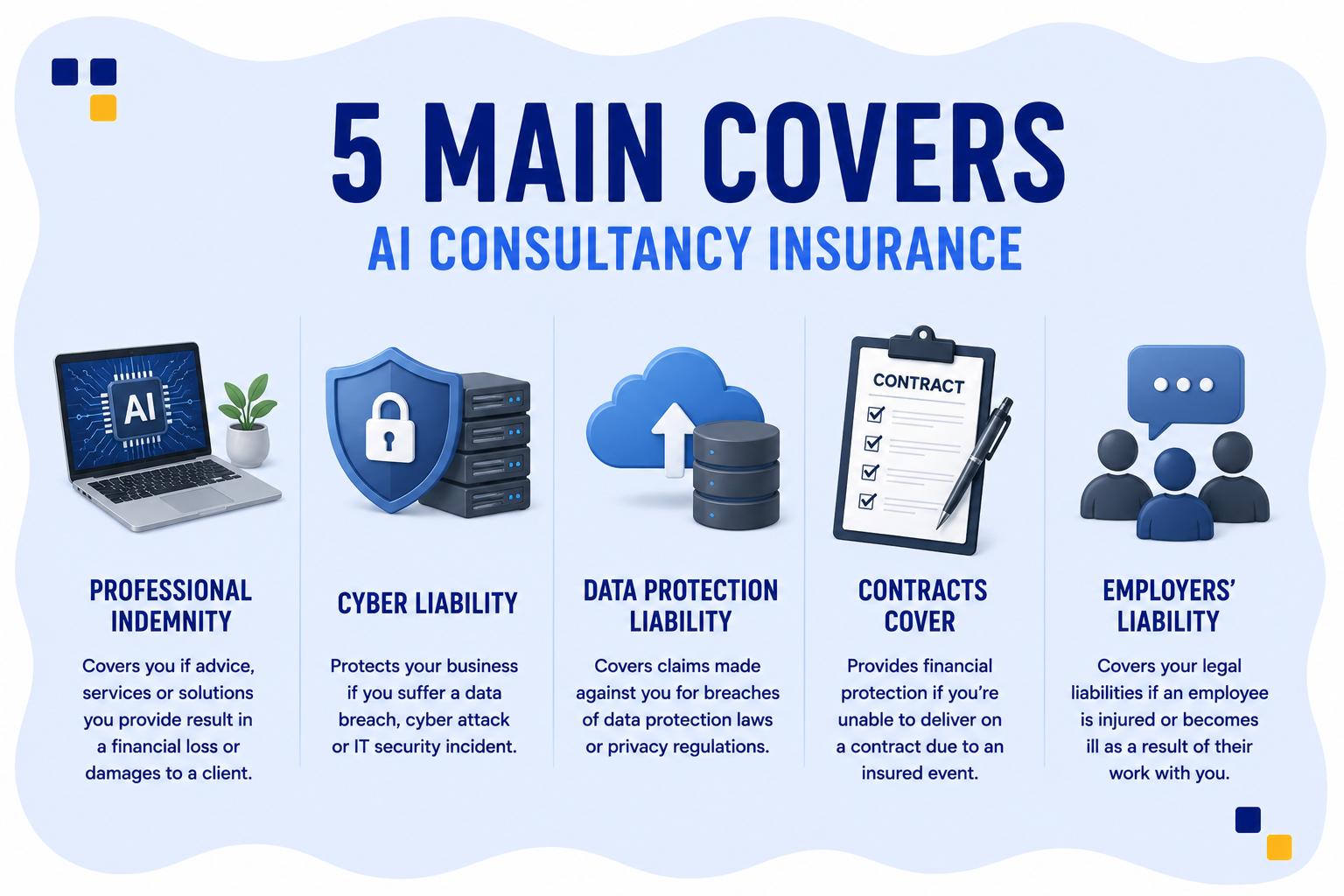
AI consultancy insurance is specialist commercial insurance designed for AI advisors, implementation consultants, AI governance specialists, and AI product consultancies. The core covers in 2026 are: Professional Indemnity with explicit AI scope (hallucination, bias, IP infringement, regulatory advisory); Cyber insurance with regulatory defence cost cover; Technology Errors and Omissions for implementation work; Public Liability; Employers' Liability where staff are employed. The cover differs fundamentally from generic IT consultant or management consultant policies — those increasingly carry silent AI exclusions and don't contemplate hallucination, training data IP, or EU AI Act regulatory exposure specifically.
The EU AI Act applies extraterritorially. UK consultants are in scope where their AI work's output is used inside the EU — meaning any UK consultancy with EU-facing clients is covered. From 2 August 2026, high-risk AI systems under Annex III (recruitment, credit, education, healthcare, law enforcement, justice, critical infrastructure) face full obligations: risk management, data governance, technical documentation, human oversight, post-market monitoring, conformity assessment, EU database registration. Fines reach €15m or 3% of global turnover for high-risk breaches; €35m or 7% for prohibited practices. UK consultants who misclassify systems or advise on inadequate compliance create direct PI exposure as fault flows back through contractual indemnities.
Indicative 2026 annual premiums: solo AI advisors £750–£2,200; AI implementation consultants £2,500–£6,500; AI governance / compliance consultants £3,500–£8,500; EU-facing AI consultancies £5,500–£12,000; high-risk Annex III specialists £8,000–£18,000; enterprise AI consultancies £12,000–£25,000+. Pricing depends on work mix, governance documentation maturity, claims history, EU exposure, IP scope, limits selected, and broker placement type. Specialist placement is typically 1.5–2.5× generic IT consultant cover but the differential reflects genuine claim exposure differential under the new regulatory regime. For broader pricing context see our professional indemnity insurance guide.
Employers' Liability is legally required if you have staff under the Employers' Liability (Compulsory Insurance) Act 1969 — fines of £2,500 per day for non-compliance. Public Liability is not legally required but is contractually required by virtually all enterprise clients. Professional Indemnity is contractually required by virtually all enterprise clients and increasingly by mid-market clients — typical specifications £1m–£2m. Other covers (Cyber, Tech E&O, Legal Expenses) are commercially essential but not legally required.
AI consultancy and IT consultancy sit in the same professional services family but have materially different regulatory and claim profiles. IT consultancy work primarily engages traditional software risks (code defects, integration errors, service availability) with PI exposure dominated by negligent advice and Tech E&O claims. AI consultancy engages AI-specific exposures: hallucinated output, training data IP infringement, bias and discrimination, EU AI Act classification errors, automated decision-making advisory under DUAA. Generic IT consultant PI in 2026 increasingly carries silent AI exclusions; specialist AI consultancy PI explicitly covers these exposures. Operators doing both need specifically declared scope for each — see our IT contractor insurance guide.
Only if specifically scoped. Generic IT consultant PI typically responds to negligent advice claims but may not contemplate AI hallucination specifically — and the distinction matters at claim stage. Worse, many mainstream PI policies now insert silent AI exclusions at renewal, often buried in endorsement schedules, that exclude almost all AI-related claims. Specialist AI consultancy PI should explicitly cover: AI model errors and hallucination; AI-driven decision errors; algorithmic output disputes; training data quality disputes; foundation model dependency claims. Get written broker confirmation that hallucination is within scope. This is the dominant claim category in 2026 and the most common cover gap in existing AI consultancy policies.
Yes — without exception. PI is functionally essential for any AI consultant. The claim drivers are: hallucination and erroneous output causing client financial loss; IP infringement from training data or generative output; bias and discrimination from AI deployment; EU AI Act classification errors creating retrospective compliance failures; data protection breaches under UK GDPR / DUAA; vendor dependency failures. Limits typically £500k for solo advisors; £1m–£3m for established consultancies; £2m–£5m for EU-facing or Annex III specialists. Run-off cover is essential — claims can surface 2–5 years after engagement as regulatory enforcement matures. See our professional indemnity insurance guide for cover principles.
Silent AI exclusions inserted at renewal, combined with non-disclosure under the Insurance Act 2015. The pattern: consultant insures with a mainstream IT consultant PI provider, has been with them for years, and at recent renewal the policy schedule quietly added an AI exclusion ("excludes any claim arising from or in connection with the use, recommendation, deployment, or implementation of artificial intelligence systems"). The consultant doesn't notice. At claim stage the exclusion applies. Separately, the original proposal may have declared "IT consultant" rather than specifically declaring AI advisory, AI implementation, regulatory advisory, and EU exposure — creating Insurance Act 2015 non-disclosure exposure even where exclusions don't apply. The fix is specialist placement with an underwriter who actively wants AI exposure, plus detailed specific declaration of all AI work types at proposal.
The single biggest premium reduction lever is documented governance: written engagement letters per project; EU AI Act classification methodology; bias testing framework across protected characteristics; training data provenance review; hallucination risk assessment; human-in-the-loop architecture; cross-regime advisory framework (UK / EU divergence); vendor due diligence framework; client communication framework. Mature documentation typically reduces premium 15–25% across the programme. Other levers: accurate work mix declaration; limits matched to actual contract requirements; 3+ years continuity with same insurer; specialist broker placement. Stack the levers; don't choose between them. Avoid the trap of buying the cheapest generic IT consultant package with silent AI exclusions — the saving is dwarfed by uninsured claim exposure.
Yes, where scoped correctly. PI with explicit IP infringement extension responds to claims arising from negligent advice on training data sourcing, generative output IP exposure, and copyright position assessment. Generic PI typically excludes IP infringement or sub-limits it materially (£100k–£250k common); specialist AI PI should provide explicit IP cover with limits between £250k and £2m. The UK and EU copyright position on AI training data remains contested as of May 2026 — the UK government's response to its copyright and AI consultation is awaited, and major foundation model copyright litigation continues in multiple jurisdictions. AI consultants advising on training data carry direct exposure regardless of unresolved law. £500k+ IP extension is increasingly the working specification.
Enterprise clients increasingly specify minimum cover requirements aligned to EU AI Act and DUAA downstream exposure. Typical specifications: Professional Indemnity £2m–£5m with explicit AI scope (hallucination, bias, IP, regulatory); Cyber insurance £2m+ with regulatory defence; Public Liability £5m–£10m; Tech E&O for implementation work; Employers' Liability £10m where staff employed; D&O for director defence in regulatory investigations; run-off cover with extended notification periods. Beyond insurance specifically, enterprise clients increasingly require evidence of: documented EU AI Act classification methodology; bias testing framework; engagement letter templates with clear scope and exclusions; vendor due diligence framework; named AI risk owner role. The cover specifications are tightening as the 2 August 2026 EU AI Act application date approaches.
Look for brokers with specific experience in AI consultancy, technology professional indemnity, and emerging technology placement evidenced by: specialist articles on AI consultancy cover and EU AI Act / DUAA exposure; willingness to discuss specific exposures (hallucination, IP infringement, bias, AI Act classification, vendor dependency) in detail; access to Lloyd's market and specialist MGAs rather than just mainstream commercial markets; FCA authorisation and documented track record. Avoid brokers offering "IT consultant package" without discussing AI specifics; brokers who can only quote one or two markets; brokers who don't ask about regulatory advisory scope or EU exposure in detail at proposal. Miller & Partner specialise in this sector — see our AI and tech insurance product page and broader AI and tech insights hub.





Instagram
LinkedIn