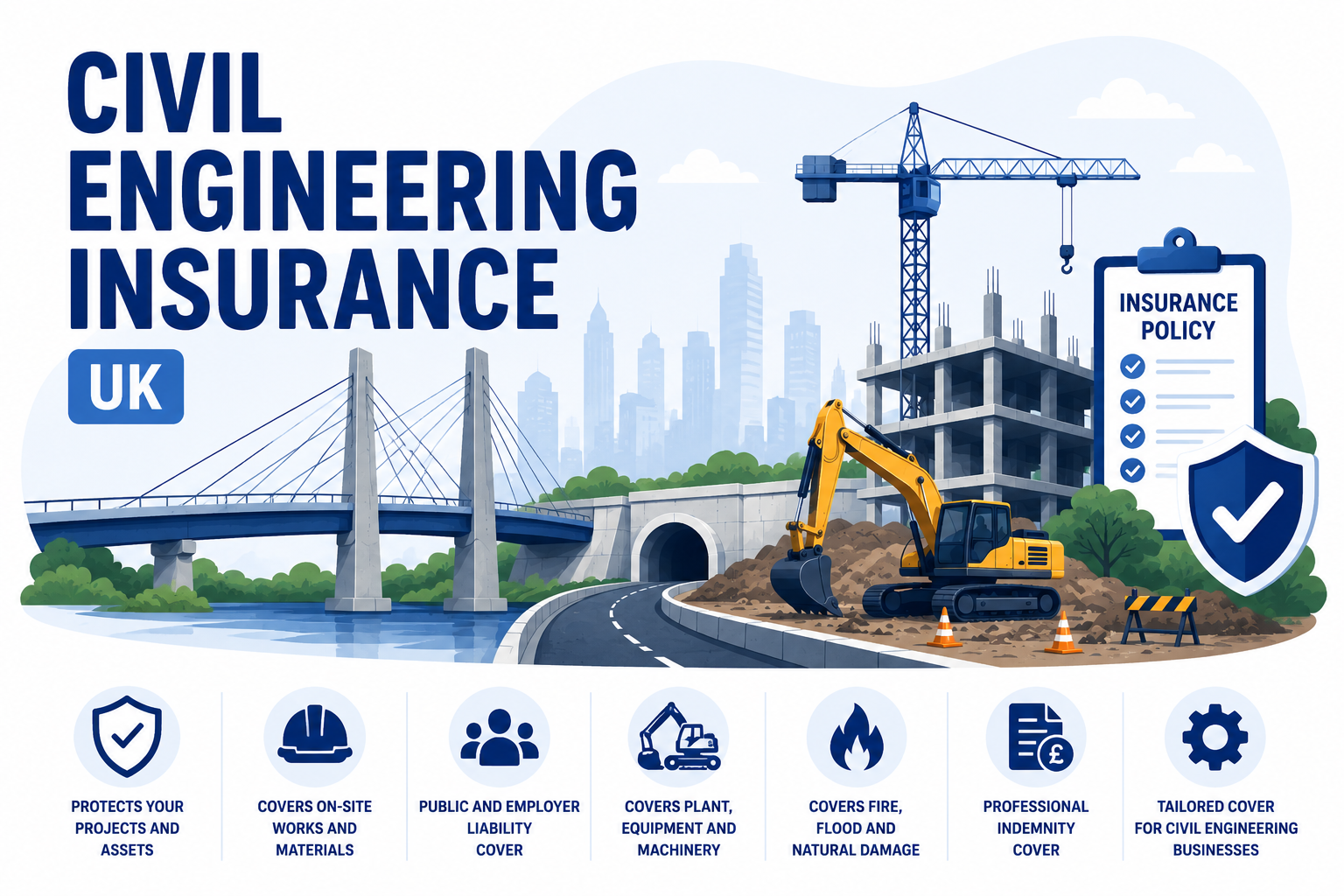
Civil Engineering Insurance UK

Civil Engineering Insurance UK: What Firms Need in 2026 | Miller & Partner

January 20, 202611 min read

This is the best guide on civil engineering insurance in the UK. We are specialists at sourcing this cover...

Custom HTML/CSS/JAVASCRIPT

Civil engineering companies carry some of the heaviest risk exposures of any sector in the UK. You are working with high-value plant, complex multi-party contracts, publicly accessible sites, and design liability that can follow a project for years after practical completion. A standard commercial policy built for a small contractor will not cut it.

This guide is written for civil engineering firms — from SME groundworkers and drainage contractors to principal contractors running major infrastructure schemes — who want to understand what cover they genuinely need, what it costs, and how to avoid the gaps that only become apparent when a claim lands.


Why Civil Engineering Insurance Is Different

The distinction matters because the risks are genuinely different in scale and nature. A retail business has public liability exposure. So does a civil engineering firm — but it also has professional indemnity exposure from design and specification work, contractors' all risks exposure across multi-million pound contracts, environmental liability from groundwork and excavation, and plant theft risk running into hundreds of thousands of pounds per incident.

Add to that the contractual insurance requirements imposed by local authorities, Network Rail, Highways England, and major framework clients — all specifying minimum limits across multiple policy types — and you quickly see why a tailored engineering insurance programme is essential rather than optional.

The UK civil engineering sector is also expanding. Infrastructure investment from both public and private sources means more firms are tendering for larger, more complex contracts. That growth increases aggregate risk, and it means insurers are scrutinising civil engineering firms more carefully at renewal.

Understanding Insurance Risks in Civil Engineering

The Core Covers Every Civil Engineering Firm Needs

Employers' Liability Insurance

If you employ anyone — directly, on a PAYE basis, or in some cases as labour-only subcontractors — employers' liability insurance is a legal requirement under the Employers' Liability (Compulsory Insurance) Act 1969. The statutory minimum is £5 million, though most insurers provide £10 million as standard and many contracts require this higher limit.

Civil engineering sites generate a disproportionate share of serious workplace injuries. Working at depth, operating heavy plant, manual excavation, confined spaces, and overhead hazards all create significant exposure. When an employee is seriously injured and cannot work for months or years, the compensation claim can be substantial — and without valid employers' liability cover, that cost falls entirely on the business.

Public Liability Insurance

Public liability covers injury or property damage suffered by third parties as a result of your operations. On a civil engineering site, the exposure is constant: members of the public near road works, adjacent property owners, and utility companies whose infrastructure sits close to your excavations.

Most contracts with local authorities and major clients specify minimum public liability limits of £5 million. For principal contractors on significant infrastructure projects, £10 million is increasingly the baseline requirement. Check your contract terms carefully before agreeing limits with your insurer.

Contractors' All Risks Insurance

Contractors' all risks (CAR) insurance covers the contract works themselves — the physical structure under construction — along with materials on site, against loss or damage from fire, flood, theft, vandalism, and accidental damage.

On a civil engineering project, this is not a straightforward calculation. Temporary works, cofferdams, earthworks, and materials stored remotely from the main site all need to be reflected in the sum insured. If your policy does not accurately capture the full value of works in progress and materials, you face underinsurance at the point of a claim.

CAR policies can be arranged on a project-specific basis for major contracts or as an annual policy for firms running multiple smaller projects. The right structure depends on your contract pipeline and how your project values fluctuate across the year.

Custom HTML/CSS/JAVASCRIPT

Professional Indemnity Insurance

If your firm provides design, specification, or consultancy services — or if your contracts include a design element, even a modest one — professional indemnity insurance is essential.

Professional indemnity (PI) covers claims arising from errors or omissions in your professional work. In civil engineering, this typically means design failures that lead to structural problems, specification errors that cause delays or remedial costs, or advice that results in financial loss for a client.

PI claims can arise years after the work is complete, which is why the retroactive date on your policy matters. When switching insurers, always ensure the new policy picks up your prior work history. A gap in retroactive cover can leave years of completed projects unprotected.

Public sector and framework contracts often specify minimum PI limits of £1 million to £5 million, depending on project value and complexity.

Plant and Equipment Insurance

Specialist plant is one of the most significant assets a civil engineering firm owns or hires. Excavators, compactors, piling rigs, and crane equipment represent substantial capital — and they are attractive to thieves.

Plant theft costs the UK construction and civil engineering sector tens of millions of pounds annually. Plant and equipment insurance covers owned and hired-in machinery against theft, accidental damage, and breakdown. If you hire plant on a long-term basis, you may carry contractual liability for loss or damage under the hire agreement, making this cover particularly important.

Check whether your policy covers plant in transit between sites, and whether hired-in plant is included under the same terms as owned equipment.

Environmental Liability Insurance

Civil engineering work frequently involves ground disturbance, excavation near contaminated land, and proximity to watercourses. A fuel spill from plant equipment, an accidental breach of a culvert, or disturbing previously unknown contamination can trigger environmental liability claims from regulators, affected landowners, and local authorities.

Clean-up costs and third-party claims from pollution incidents can be significant, and standard public liability policies often exclude pollution-related losses unless they result from a sudden, identifiable, and accidental event. Environmental liability insurance fills this gap, covering remediation costs, regulatory penalties, and third-party claims arising from pollution incidents.

Essential Insurance Covers for Civil Engineering Companies

Covers That Are Increasingly Necessary

Cyber Insurance

Civil engineering firms are increasingly reliant on digital systems — from BIM software and project management platforms to on-site connected equipment and finance systems. A ransomware attack or data breach can halt project delivery, trigger GDPR notification obligations, and result in significant recovery costs.

Cyber insurance covers the cost of incident response, legal advice, data recovery, business interruption arising from a cyberattack, and regulatory fines. For firms that store client data, handle online payments, or operate remotely accessed systems, this cover is no longer a luxury.

Business Interruption Insurance

If your operations are halted following an insured event — a major fire at your depot, flood damage to a yard, or loss of a key piece of plant — business interruption cover replaces the income you lose and helps meet fixed costs during the recovery period.

For civil engineering firms with long-term contracts, business interruption exposure can be significant. Project delay penalties and the cost of mobilising alternative resources can quickly exceed the direct cost of the physical loss.

Legal Expenses Insurance

Contract disputes are a feature of civil engineering life. Whether it is a payment dispute with a principal contractor, a subcontractor bringing a claim, or a regulatory investigation by the HSE, the cost of legal defence can be substantial even when you are ultimately in the right. Legal expenses insurance covers the cost of pursuing or defending civil and regulatory proceedings.


What Civil Engineering Contracts Actually Require

Contract insurance requirements vary considerably depending on the client and the nature of the work. A useful general framework is:

Local authority and public sector contracts typically require public liability cover of at least £5–10 million, employers' liability at £10 million, professional indemnity (where design is involved) at £1–5 million, and contractors' all risks at the full contract value.

Framework agreements (such as those with Highways England or Network Rail) often impose specific insurer approval requirements, minimum limits that exceed standard market terms, and mandatory endorsements such as principal contractor extensions.

Joint ventures and special purpose vehicles may require additional named insured arrangements or combined policy structures that cover all parties under a single programme.

Always review the insurance schedule of your contract before binding cover. Minimum limits specified in a contract override your standard policy choices, and failing to meet them can put the contract itself at risk.

For firms tendering through schemes like CHAS or Constructionline, valid insurance certificates are a prerequisite for accreditation. Ensure your documentation is current and that the cover levels meet scheme requirements.

The Construction (Design and Management) Regulations 2015 also establish clear responsibilities for principal designers and principal contractors that have direct implications for professional indemnity and liability cover.

Legal and Regulatory Insurance Requirements in the UK

What Affects the Cost of Civil Engineering Insurance

Premiums for civil engineering firms vary considerably based on the following:

Annual turnover and contract values — Insurers use these as a proxy for total risk exposure. Higher turnover generally means higher premiums, though the relationship is not linear.

Type of work — Groundworks, demolition, tunnelling, and marine civil engineering carry higher risk profiles than, say, drainage or kerbing. Insurers assess the technical complexity and inherent hazard of your primary activities.

Claims history — A track record of claims, particularly liability or PI claims, signals risk management deficiencies. Firms with clean claims histories and strong safety procedures are rewarded with better terms.

Plant ownership and values — Significant owned plant increases the insurer's exposure and feeds into premium calculations for both plant and CAR policies.

Subcontractor usage — Relying heavily on subcontractors can complicate liability arrangements. Insurers want to know that subcontractors carry their own valid cover and that you have appropriate oversight procedures in place.

Health and safety record and accreditations — Firms holding CHAS, Constructionline, or ISO 45001 certification demonstrate a commitment to risk management that insurers value. This can translate into more competitive premiums and broader policy terms.

Geographic spread — Firms working across multiple regions or on international projects face more complex risk profiles than those operating locally.

To manage costs effectively, review your policy annually, ensure your declared turnover and project values are accurate, and maintain your health and safety accreditations. An experienced broker can also identify opportunities to bundle covers into a contractors combined policy, which can deliver both cost savings and simpler administration.


Choosing the Right Broker

Civil engineering insurance is a specialist area. The insurer appetite for different types of civil engineering work varies considerably, and the policy terms — particularly for professional indemnity and environmental liability — can differ significantly between providers.

A broker with genuine construction and civil engineering expertise will understand the distinction between design and build and design-only appointments, know which insurers take a pragmatic view of groundwork and demolition activities, and be able to negotiate bespoke endorsements where standard policy wordings fall short.

When approaching a broker, come prepared with your annual turnover, a breakdown of activities by type, your largest current and anticipated contract values, details of your plant inventory, and your claims history for the past five years. The more accurate your submission, the more accurately your policy will reflect your actual risk.

At Miller & Partner, we work with civil engineering firms to structure insurance programmes that cover the full scope of your operations — not just the straightforward elements. Request a quote here and we'll come back to you with options tailored to your business.


Frequently Asked Questions

Is public liability insurance a legal requirement for civil engineering firms? It is not a statutory requirement, but it is a practical necessity. Most contracts, client relationships, and accreditation schemes require evidence of valid public liability cover as a condition of doing business.

What is the difference between contractors' all risks and professional indemnity insurance? Contractors' all risks covers physical loss or damage to the works, materials, and plant on site. Professional indemnity covers financial loss arising from errors or omissions in your professional work — design failures, specification errors, or negligent advice.

Do I need separate cover for hired-in plant? Hired-in plant is often excluded from standard plant policies or covered on different terms to owned equipment. Check your hire agreements — they may impose financial liability for loss or damage — and ensure your policy responds accordingly.

What happens if a subcontractor causes damage or injury on my site? Your public liability policy may respond to claims arising from a subcontractor's actions if you are held jointly liable as principal contractor. However, this depends on policy terms and the nature of the incident. It is important to ensure all subcontractors carry their own valid public liability and employers' liability insurance, and to retain copies of their certificates.

How far back does professional indemnity cover go? This is determined by the retroactive date on your policy. Most PI policies are written on a "claims made" basis, meaning they cover claims made during the policy period for work done after the retroactive date. When changing insurers, always align the retroactive date on your new policy with the start date of your previous cover.

Can small civil engineering firms access the same covers as larger contractors? Yes. Specialist insurers and brokers offer tailored programmes for smaller firms that combine essential covers at limits appropriate to their contract values and activities. The key is ensuring the policy accurately reflects your actual operations rather than applying a generic construction template.


Miller & Partner is an Authorised Representative of Gauntlet Risk Management Ltd, authorised and regulated by the Financial Conduct Authority (FCA, Firm Reference 1029698).

Ready to protect your business?
Get expert advice and a tailored commercial insurance quote today.

✔ Independent broker
✔ Access to leading UK insurers
✔ Fast turnaround

[[email protected]]
[Call 01792 001350]

Custom HTML/CSS/JAVASCRIPT
Civil Engineering InsuranceEngineering Insurance BrokerCommercial Insurance Brokers Engineering
Working in the insurance industry for 15 years, I finally decided to go it alone and set up my own brokerage.

John Miller

Working in the insurance industry for 15 years, I finally decided to go it alone and set up my own brokerage.

LinkedIn logo icon
Back to Blog


We’re authorised and regulated by the FCA. You can check our registration on the FCA Register.

Office: Vivian House, Roman Bridge Close, Mumbles, Swansea, SA3 5BG

Miller & Partner is an Authorised Representative of Gauntlet Risk Management Ltd and are authorised and regulated by the Financial Conduct Authority (FCA) under firm reference number 1029698. You may check this on the Financial Services Register by visiting the FCA website, https://www.fca.org.uk/register/ or by contacting the FCA on 0800 111 6768 Privacy Policy