


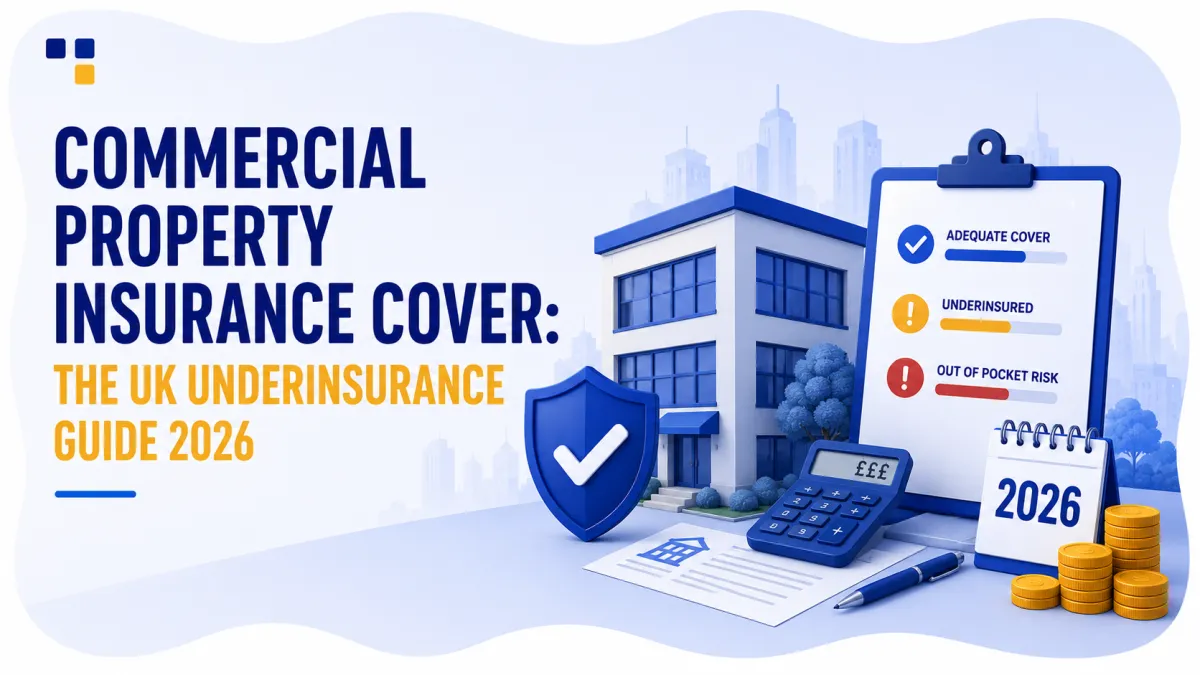
Commercial Property Fire Insurance: Cover, Claims & Limits
Why is so much commercial property insurance cover inadequate in 2026?
Commercial property insurance is the bedrock cover for any UK business that owns or occupies a building — and yet, valuation firm Barrett Corp & Harrington found that 75% of the properties it valued were underinsured. That isn't a niche edge case; across the valuation industry, underinsurance is the normal position. The average underinsured commercial building in the UK is covered for around 67% of what it would cost to rebuild today, meaning that when the worst happens, somewhere between a quarter and a third of the rebuild bill falls back on the owner. For most businesses, that's a number measured in hundreds of thousands of pounds — and for many, it's the difference between recovery and closure.
This isn't a problem about not having commercial property insurance. The owners of those underinsured buildings have policies. They've been paying premiums. They believe they're covered. The problem is that the cover doesn't pay out in full when it's called upon — and the reasons are technical, mechanical, and almost entirely preventable. They sit in the gap between three figures that sound similar but mean very different things: market value, declared value, and sum insured. They sit inside the operation of the Average Clause, which proportionally reduces the payout on every claim — partial losses included — by the same percentage you're underinsured. They sit inside the difference between Reinstatement and Day One Uplift basis, and the difference between what each actually protects against. And in 2026, they sit inside a fast-moving regulatory landscape — the Building Safety Act 2022 as amended through 2024–2026, new evacuation regulations, mandatory second staircases for tall buildings, and a construction cost base that has risen roughly 30–35% over the last five years — that's quietly pushing rebuild costs up faster than indexation can keep pace with.
This guide is the definitive 2026 commercial property insurance cover article — built around how cover actually works at claim stage rather than what the brochure says you've bought. It's the companion piece to the broader product page at commercial property insurance and the cluster of related guides on the property insights hub, including the UK commercial property insurance guide, the broker selection guide, and the landlord building insurance renewal guide. Where those pieces cover the policy as a product, this one covers the cover itself: declared value, sum insured, Average Clause, Day One Uplift, perils, exclusions, and the specific clauses that decide what your claim is actually worth.
Key facts at a glance
- Around three-quarters of properties valued are underinsured — valuation firm Barrett Corp & Harrington found 75% of the properties it assessed were underinsured, and valuation services report underinsured buildings are often covered for around two-thirds of their true rebuild cost.
- UK commercial rebuild costs rose by approximately 30–35% between 2020 and 2025 per BCIS data, and were still around 2% higher in January 2026 than a year earlier per Department for Business & Trade figures — meaning any sum insured set more than three years ago and not properly revalued is almost certainly inadequate.
- The Average Clause reduces every claim proportionally, not just total losses — a building insured for 70% of its true rebuild cost will see a £400,000 partial-loss claim reduced to £280,000, leaving the owner to find £120,000 from working capital.
- Day One Uplift protects against post-loss inflation but not initial underinsurance — a 15% uplift on a declared value that's already 30% too low still leaves the policyholder exposed to Average. The uplift is a buffer for inflation between policy inception and the end of the rebuilding period, not a margin of safety against valuation error.
- The Building Safety Act 2022 drives reinstatement cost inflation in 2026 — mandatory second staircases for new residential buildings over 18m from 30 September 2026, enhanced fire protection requirements, non-combustible cladding rules, and the Building Safety Regulator transfer to MHCLG (27 January 2026) all push reinstatement costs above original construction cost.
- RICS recommends a full Reinstatement Cost Assessment every three to five years with desktop indexation between — most policyholders rely on insurer-applied indexation alone, which industry valuation specialists describe as crude and frequently inadequate when construction costs are moving faster than general inflation.
- Market value is not rebuild cost — a commercial building in a major UK city can have a market value lower than its rebuild cost (land doesn't burn down, demolition and debris removal add 25–35% to construction cost, and modern compliance requirements raise reinstatement spec above the original build).
1. How does commercial property cover actually pay out? Cover mechanics summary table
Commercial property insurance is sold as a single product but contains several distinct mechanical decisions that collectively determine your payout at claim stage. The table below summarises the five mechanics that have the largest single impact on whether your policy responds for £100 in the £ or for considerably less. The rest of this guide unpacks each one.
| Cover Mechanic | What It Controls | What Gets It Wrong |
|---|---|---|
| Declared value | The base figure for everything; the cost of rebuilding the property on day one of cover | Confusing it with market value; using an old figure indexed up rather than properly revalued |
| Sum insured | The maximum policy payout; declared value plus Day One Uplift | Believing the sum insured equals what you'd be paid even if the declared value was wrong |
| Average Clause | Proportionally reduces every claim by the percentage of underinsurance | Assuming Average only applies to total losses; it applies to partial losses too |
| Day One Uplift | Protects against construction cost inflation between policy inception and rebuilding completion | Treating it as a margin of safety against valuation error — it isn't and won't |
| Reinstatement basis | Whether you're paid to rebuild like-for-like ("new for old") or paid the depreciated value (indemnity) | Older policies on indemnity basis paying out far less than rebuild cost |
| Perils covered | Which causes of loss the policy responds to — fire, storm, flood, escape of water, etc. | Assuming "all risks" wording covers everything; it doesn't |
| Endorsements and clauses | Conditions like the alarm warranty, unoccupancy condition, and trade waste clause | Quiet conditions that void cover where you didn't realise they applied |
| Indemnity period (BI) | How long Business Interruption pays out after a loss | Standard 12-month indemnity that doesn't cover the actual rebuild timeframe |
2. What is the UK underinsurance crisis and why does it matter for cover?
If you read only one section of this guide, read this one. The single most important fact about UK commercial property insurance in 2026 is that the cover most people have isn't the cover they think they have — and the reason isn't fraud, mis-selling, or insurer bad faith. It's a quiet drift of construction costs away from declared values over the years since the policy was first arranged.
Valuation specialists Barrett Corp & Harrington reported that 75% of the properties they valued were underinsured. Separate research from valuation service RebuildCostASSESSMENT.com puts the average cover level of underinsured buildings at 67% of true rebuild cost. The drivers are well documented:
- UK rebuild costs rose by approximately 30–35% between 2020 and 2025 per BCIS data, driven by materials inflation and labour shortages.
- Construction material prices were still around 2% higher in January 2026 than a year earlier per Department for Business & Trade figures, with stronger increases in new housing materials and repair and maintenance.
- The Building Safety Act 2022 (and its 2024–2026 amendments) introduced compliance requirements that raise reinstatement costs above the original construction spec for many buildings.
- Insurer-applied indexation typically uses general construction inflation indices that lag behind actual construction cost movement, particularly on complex commercial buildings.
- Reinstatement Cost Assessments (RCAs) are recommended every three to five years by RICS, but most policyholders rely on insurer indexation alone and never commission a formal revaluation.
The consequence is that the typical UK commercial property owner has a policy that looks fine on paper but pays out at roughly 67p in the £ at claim stage. On a small partial loss, that's a cashflow problem. On a serious fire or flood, it's an existential one. The Marsh, Zurich, and FM Affiliated commentary across 2024–2026 has been consistent: regular valuation updates are the single piece of advice most often overlooked by mid-market clients, and the same firms now indicate that insurers are placing greater emphasis on the evidence behind declared sums insured rather than accepting round numbers or simple indexation uplifts.
3. How does declared value differ from sum insured and market value?
The three figures most often confused in commercial property insurance are market value, declared value, and sum insured. They are not the same thing, and getting them confused is the single biggest cause of underinsurance.
Market value
What the property would sell for in the open market today. This includes the land. For commercial property insurance purposes, market value is almost never the right figure. Land doesn't burn down or get washed away; what you're insuring is the cost of rebuilding the building itself. In central London, market value often exceeds rebuild cost because the land is so valuable. In other locations, market value can be lower than rebuild cost — particularly for older industrial buildings, listed buildings, or buildings in low-demand areas where what you'd pay to buy is far less than what you'd pay to rebuild from scratch with modern compliance. Either way, market value is not your insurance figure.
Declared value (day one reinstatement value)
The cost of rebuilding the property on day one of the policy period — meaning at the level of construction costs applying at policy inception. This must include the cost of reinstatement (materials and labour), debris removal, demolition, professional fees (typically architect, surveyor, structural engineer, planning consultant), and compliance with current building regulations. The declared value ignores inflation between policy inception and rebuilding completion — that's what the Day One Uplift is for, not the declared value. This is the single most important figure in your policy.
Sum insured
The maximum policy payout figure. On a Day One Reinstatement policy this is calculated as declared value + Day One Uplift (the uplift typically 15–50% depending on the wording and the type of building). The sum insured is what you'll see on your schedule, but it isn't the figure the Average Clause is tested against — Average is applied against the declared value versus the actual rebuild cost at the time of the loss. This is the misconception that catches policyholders out: they see a healthy-looking sum insured figure and assume it means they're well covered, but if the underlying declared value was wrong from day one, the sum insured offers no protection.
4. How does the Average Clause reduce your claim payout?
The Average Clause is the single mechanism that turns a paperwork drift in declared value into a six-figure problem at claim stage. It's a standard provision in virtually all UK commercial property policies, and its effect is simple: if you're underinsured, your claim payout is reduced proportionally — regardless of whether the claim is a partial loss or a total loss.
The wording in most UK commercial property policies works like this. At the time of the loss, the insurer (or a loss adjuster) determines what the true rebuild cost would have been at the start of the policy period. They compare that figure to the declared value on your policy. If the declared value is less than the true rebuild cost, the insurer's liability is limited to the proportion that the declared value bears to the true rebuild cost. So:
- True rebuild cost £1,000,000; declared value £700,000. You are 30% underinsured.
- Claim: £400,000 partial loss (a fire damaging part of the building).
- Insurer pays: 70% of £400,000 = £280,000.
- Policyholder pays: £120,000 from working capital.
This is the part that catches policyholders most off-guard: the Average Clause applies to partial losses, not just total losses. A routine escape of water claim is subject to the same proportional reduction. A storm damage claim is subject to the same proportional reduction. There's no "as long as it's less than the sum insured I'm fine" exemption — the test is whether your declared value matches true rebuild cost.
Most modern policies include an "85% Average Clause" rather than a strict Average Clause. The mechanic is identical except that no reduction is applied if you are within 85% of the true rebuild cost — i.e. you have a 15% margin before Average kicks in. If you're below 85%, however, the reduction is calculated against the true rebuild cost (not the 85% threshold). The 15% margin is some protection but isn't much — given that the average underinsured UK commercial building is at 67% of rebuild cost, most underinsured policyholders are well below the 85% threshold.
5. What is Day One Uplift and does it protect you from underinsurance?
Day One Uplift is one of the most widely misunderstood concepts in commercial property insurance — partly because it sounds like a margin of safety against valuation error, when in reality it's protection against a quite different problem.
A commercial property policy can be arranged on two main bases:
Reinstatement basis
The sum insured is set at the start of the policy. The maximum payout is the sum insured. If construction costs rise between policy inception and the rebuilding period, the policy doesn't catch up. Reinstatement policies are slightly cheaper but offer no inflation protection during the policy term. They were more common in the days of low and stable inflation; in the 2020s they have become a noticeably riskier choice.
Day One Reinstatement basis
The declared value is set at the start of the policy (representing the rebuild cost on day one). A Day One Uplift is then applied — typically 15%, 25%, or up to 50% on long-lead-time or complex buildings — to give the sum insured. The uplift is intended to absorb construction cost inflation during the period from the loss event to completion of the rebuild. Day One Reinstatement policies are slightly more expensive but offer meaningful protection against inflation between loss and rebuild — particularly important for complex buildings with long planning and construction timelines.
Here's the critical part many policyholders miss: the Day One Uplift protects against inflation between the loss date and the rebuild date, not against initial underinsurance. The Average Clause is tested against the declared value, not the uplifted sum insured. So a Day One Uplift of 15% on a declared value that is already 30% too low does not protect you from Average; you're still proportionally underinsured. The uplift is a buffer for rebuild-period inflation, not a margin of safety against valuation error.
The implication for policyholders: Day One Uplift is essential, but it is not a substitute for getting the declared value right. The two protections do different jobs. Get the declared value right (RICS-based Reinstatement Cost Assessment), then add a Day One Uplift appropriate to the rebuild timeline of your particular building.
6. Why does reinstatement cost differ so dramatically from market value in 2026?
Reinstatement cost — the cost of rebuilding the building like-for-like to current building regulations — diverges from market value for reasons that have intensified sharply since 2020. Understanding the divergence is the foundation for getting declared values right.
Reinstatement is not the same as construction
A new build costs less than a reinstatement of the same building. Reinstatement adds: demolition of the existing damaged structure; debris removal (typically 25–35% of construction cost when combined with demolition and professional fees); shoring up of adjacent property; specialist re-creation of period features in listed or character buildings; potentially temporary works (site hoarding, security, scaffolding); and professional fees for architect, surveyor, structural engineer, planning consultant, and project manager throughout the rebuild period.
Modern compliance raises the spec
When a building is rebuilt, it must comply with current building regulations — not the regulations applicable when it was originally built. For older buildings, this can substantially raise costs: improved fire protection, modern energy efficiency standards (Approved Document L), Part B fire safety, Part M accessibility, current drainage and electrical standards, sound transmission requirements. For listed buildings, conservation officer requirements raise costs further. For higher-risk residential buildings (over 18m), the Building Safety Act 2022 regime applies with substantial cost implications.
Specialist features are routinely under-declared
Commercial properties frequently contain features the original declared value didn't properly capture: high-load specifications for industrial flooring, three-phase electrical infrastructure, sprinkler systems, mezzanine floors, refrigeration plant, racking systems, loading bay equipment, server rooms, bespoke shop-fit, restaurant kitchens with extract canopies and gas interlock. Each of these adds to reinstatement cost in ways that a basic indexation of original construction cost will not capture.
The location effect
Construction cost varies materially by region. London is most expensive (roughly 30–40% above the UK average). Major city centres (Manchester, Birmingham, Edinburgh, Bristol) follow. Welsh towns, North-East England, and rural locations are lowest. The BCIS tender price index produces regional adjustments that a competent RCA will incorporate.
The practical implication: a property with a market value of £600,000 in a UK regional town might have a true rebuild cost of £750,000–£900,000 depending on construction type, age, and modern compliance requirements. Insuring at market value would put the policyholder at roughly 67–80% cover — squarely in the underinsurance zone where Average bites.
7. How does the Building Safety Act 2022 inflate reinstatement costs in 2026?
The Building Safety Act 2022 — as amended through 2024 and 2026 — fundamentally changed the cost base for reinstatement of certain UK buildings, and the regulatory framework continues to evolve. Some key 2026 milestones with direct cover implications:
- Building Safety Regulator transfer to MHCLG (27 January 2026): the BSR transferred out of HSE to a new arm's-length body sponsored by the Ministry of Housing, Communities and Local Government, indicating a more focused regulator and clearer enforcement.
- Mandatory second staircases for new residential buildings over 18m (from 30 September 2026): any reinstatement of such a building must incorporate the second stairwell — a significant additional structural cost that the original declared value cannot have anticipated.
- Fire Safety (Residential Evacuation Plans) (England) Regulations 2025 (in force 6 April 2026): residential evacuation plans required for residents who would struggle to evacuate unaided, in buildings of 18m or 7 storeys and above, and in buildings over 11m with a simultaneous evacuation strategy.
- PAS9980:2022 FRAEW methodology: external wall assessments increasingly required for buildings with cladding, with cost implications where remediation is identified.
- Ban on combustible cladding (in force since late 2018): any reinstatement of a building over 18m with previously-compliant combustible cladding must now use non-combustible alternatives — typically a substantial additional cost.
- Enhanced fire detection, sprinklers, and smoke ventilation: required at certain heights and uses; original declared values frequently don't anticipate the cost of installing these systems at rebuild.
The combined effect is that for any building potentially within the higher-risk regime — and increasingly for buildings just outside it that get caught by adjacent reforms — reinstatement cost in 2026 routinely exceeds the original construction cost by a wide margin even after general indexation. A residential building constructed in 2010 to then-current regulations might cost 50–70% more to reinstate in 2026 than the indexed equivalent of the original construction cost. The implication for commercial property cover is that buildings even adjacent to the HRB regime need professional RCA review rather than indexation alone.
8. Commercial property cover checker — pick your property type
Different property types create different cover priorities. Select the closest match below to see the cover structure typically required for that property — including the declared value approach, Day One Uplift sizing, and the most common cover extensions that property owners overlook. For the underlying product see our commercial property insurance page.
Commercial Property Cover Checker
Select your property type to see the cover structure matched to its specific risk profile and declared value priorities
Single-Tenant Office or Retail Unit
- ESSENTIAL Day One Reinstatement basis with RICS-aligned declared value
- ESSENTIAL Day One Uplift of at least 15% — 25% if rebuilding likely to take over 18 months
- ESSENTIAL Standard perils — fire, lightning, explosion, storm, flood, escape of water, impact, theft following forced entry
- ESSENTIAL Public Liability £5m–£10m where the property is occupied by the policyholder
- ESSENTIAL Business Interruption with indemnity period matching rebuild timeline (typically 24 months minimum)
- RECOMMENDED Subsidence cover where postcode and ground conditions indicate exposure
- RECOMMENDED Trace and access cover for water damage
- CONSIDER Loss of rent cover where leased to a tenant — see landlord building insurance renewal guide
Multi-Let Office or Mixed-Use Building
- CRITICAL RICS-accredited reinstatement valuation every 3 years — multi-let buildings drift fastest
- ESSENTIAL Day One Reinstatement with 25%+ Day One Uplift (longer rebuild lead time)
- ESSENTIAL Property Owners Liability £5m–£10m for tenant and visitor injury exposure
- ESSENTIAL Loss of rent cover with indemnity period matching rebuild timeline
- ESSENTIAL Tenant default cover or rent guarantee where appropriate
- ESSENTIAL Standard perils plus subsidence, trace and access
- ESSENTIAL Engineering inspection cover for lifts, boilers, pressure systems
- RECOMMENDED Terrorism cover for city centre locations
Industrial / Warehouse / Trade Counter
- CRITICAL Racking, mezzanines, and installed plant separately declared, not bundled into contents
- ESSENTIAL Day One Reinstatement with 25–50% Day One Uplift (long lead times for specialist plant)
- ESSENTIAL Stock cover with declared value matched to peak stock levels
- ESSENTIAL Plant and machinery cover at current replacement cost
- ESSENTIAL Business Interruption with indemnity period 24+ months
- ESSENTIAL Goods in transit if stock moves between premises
- RECOMMENDED Sprinkler discount applies where installed and maintained
- RECOMMENDED Money cover where cash on premises
Residential Block (Under 18m)
- CRITICAL RICS RCA every 3 years — service charge recovery requires evidence of appropriate cover
- ESSENTIAL Day One Reinstatement with 25% Day One Uplift minimum
- ESSENTIAL Communal areas, structural fabric, and demised areas declared appropriately
- ESSENTIAL Property Owners Liability £5m–£10m
- ESSENTIAL Loss of rent or alternative accommodation cover
- ESSENTIAL Communal areas — lift, boiler, hot water — engineering inspection cover
- ESSENTIAL Trace and access for escape of water investigation
- RECOMMENDED Directors & Officers cover for the residents' management company
- CONSIDER See block of flats insurance specialist guide for fuller cover detail
Higher-Risk Building (Over 18m)
- CRITICAL RICS RCA modelling current Building Safety Act compliance, second staircase, non-combustible cladding
- CRITICAL Specialist placement essential — generic property cover frequently inadequate
- ESSENTIAL Day One Reinstatement with 50% Day One Uplift (extended rebuild lead time)
- ESSENTIAL Compliance with current and emerging BSR requirements modelled into declared value
- ESSENTIAL Property Owners Liability £10m+ — increased third-party exposure
- ESSENTIAL Loss of rent / alternative accommodation with extended indemnity period (36 months+)
- ESSENTIAL Cladding-specific cover or carve-out clarification
- ESSENTIAL Lift and pressure system engineering inspection cover
- ESSENTIAL Terrorism cover where city centre
- ESSENTIAL D&O for accountable person under BSA regime
Listed Building or Period Property
- CRITICAL Listed status materially raises reinstatement cost — RCA by surveyor experienced in listed property is essential
- ESSENTIAL Day One Reinstatement with 50% Day One Uplift (specialist materials, slow programme)
- ESSENTIAL Specialist insurer placement — high-net-worth or heritage market
- ESSENTIAL Standard perils plus specialist heritage cover
- ESSENTIAL Conservation officer involvement reflected in professional fee allowance
- ESSENTIAL Loss of rent / business interruption with 36+ month indemnity (long planning consent process)
- RECOMMENDED Subsidence cover with full understanding of underpinning options
- RECOMMENDED Theft of fittings cover for valuable period features
- CONSIDER See high value property insurance for residential heritage
9. Underinsurance red flag self-check
The underinsurance crisis isn't theoretical — it's a quiet accumulation of specific paperwork drift over the years since the policy was first arranged. The checks below identify the most common red flags. Each one you tick is a sign that your declared value almost certainly does not match true rebuild cost in 2026, and that your cover is unlikely to pay out in full at claim stage.
Underinsurance Red Flag Self-Check
Click each statement that applies to your current commercial property policy. The more ticked, the higher the probability you are underinsured and exposed to Average at claim stage.
-
Your declared value hasn't been reviewed by a RICS surveyor for over 3 years — only insurer indexation has been applied year on year
-
You set the declared value based on what you paid for the building — i.e. you used purchase price or market value rather than rebuild cost
-
Your declared value is a round number — e.g. exactly £500,000 or £1,000,000 — without a corresponding RCA or valuation that produced that figure
-
The declared value doesn't include professional fees and debris removal — or you're not sure whether it does or doesn't
-
Your property has had significant alterations since the declared value was last set — extensions, mezzanines, plant installation, racking changes, fit-out works
-
Your building has cladding, is over 11m, or sits inside the Building Safety Act regime — and the declared value has not been re-modelled for current compliance requirements
-
Your indemnity period for Business Interruption is 12 months — which is shorter than the realistic time to plan, obtain consent, demolish, and rebuild your property
-
Your sum insured looks healthy but you can't articulate how the underlying declared value was derived — i.e. you trust the schedule without understanding the figure
-
You're on Reinstatement basis (not Day One Reinstatement) — meaning you have no inflation protection between policy inception and rebuild completion
-
Specialist features are bundled into the buildings sum insured rather than declared separately — racking, mezzanines, plant, machinery, server rooms, kitchen extracts
-
Your renewal documentation lists the sum insured but not the declared value separately — the two figures should both be shown so you can sanity-check the underlying RCA basis
-
You've never been asked by your insurer for evidence behind the declared value — increasingly, mainstream insurers are asking for RCA evidence at renewal as underinsurance becomes a strategic issue for the market
10. Commercial property cover gap calculator
Two figures determine your underinsurance exposure: your current declared value, and the true 2026 rebuild cost of your property. The tool below estimates the payout reduction at claim stage. This is an indicative model — for genuine accuracy a RICS-accredited RCA is essential — but it illustrates the financial impact of the gap.
Commercial Property Cover Gap Calculator
Enter your current declared value and an estimated true 2026 rebuild cost to see the indicative impact of the Average Clause on a partial-loss claim
11. How does Business Interruption interact with property cover?
Business Interruption (BI) cover sits alongside the property section of any commercial property policy, and the two interact in ways that drive a substantial proportion of the most expensive cover disputes. Property cover pays to rebuild your building; BI pays the lost gross profit and increased cost of working while you can't trade from it. If property cover is the foundation, BI is the cash flow that keeps the business alive during the rebuild.
Indemnity period — the single biggest BI cover gap
The indemnity period is the maximum length of time BI will pay out after a loss. Standard wordings still default to 12 months. In 2026, that is rarely realistic for any meaningful property reinstatement. The reality of the rebuild timeline for most UK commercial property:
- 1–3 months initial site stabilisation, demolition, insurance investigation, scope agreement.
- 3–6 months design, planning consent, conservation officer engagement (where applicable), Building Safety Regulator approval (where applicable).
- 3–9 months procurement of specialist contractors, materials lead times, programme finalisation.
- 9–18 months construction, fit-out, commissioning, occupation readiness.
- 3–6 months ramp-back to pre-loss trading levels.
For a single-occupier office or retail unit, 18–24 months is realistic. For a multi-let mixed-use building or industrial premises, 24–36 months is realistic. For a Higher-Risk Building under the BSA regime, 36–48 months is realistic — particularly where second staircase requirements, non-combustible cladding specifications, and BSR Gateway approvals are involved. A 12-month indemnity period set against any of those realistic timelines is a structural gap in cover.
Gross profit, increased cost of working, and additional increased cost of working
The BI sum insured is typically based on the business's gross profit (revenue minus the variable costs that wouldn't continue during a stoppage). Most policies also include cover for "increased cost of working" (additional expenses incurred to keep trading from temporary premises) and "additional increased cost of working" (further expenses where doing so prevents a larger BI claim). These three elements together form the practical BI response.
The connection to property underinsurance
The Average Clause applies to BI as well as to property — meaning if your BI sum insured is calculated on out-of-date gross profit figures, the Average Clause proportionally reduces every BI claim by the percentage you're underinsured. For businesses that have grown materially since the policy was last reviewed, this is a real risk. Annual review of BI declared values is as important as annual review of property declared values.
12. Which perils are typically covered, and which are commonly excluded?
The perils a commercial property policy responds to are specified in the wording — usually as a list of insured events (named perils basis) or an "all risks" basis with specific exclusions. Understanding which perils are included, which are sub-limited, and which are excluded is essential to the practical scope of cover.
Standard perils included on virtually all commercial property policies
- Fire, lightning, explosion, aircraft — historic core perils, virtually never excluded.
- Storm and tempest — windspeed-related events, with exclusions for normal weathering.
- Flood — increasingly subject to postcode-based loadings or exclusions in high-flood-risk areas.
- Escape of water — burst pipes, tank failures, escape from fixed appliances; often the highest-volume claim category.
- Impact — vehicles, falling trees, falling debris.
- Theft following forced and violent entry — important wording: theft without forced entry is typically excluded.
- Malicious damage / vandalism — often subject to occupancy conditions.
- Riot and civil commotion — typically included with limited exclusions.
Perils commonly extended or sub-limited
- Subsidence, heave, and landslip — additional cover required in many policies; postcode-driven; often subject to a £1,000+ excess.
- Accidental damage — extension required for cover beyond named perils.
- Trace and access — for water damage investigation; usually limited to £5,000–£25,000.
- Theft of metal — increasingly sub-limited in property cover after copper theft surges.
- Glass breakage — often a separate section.
- Sprinkler leakage — covered but subject to maintenance conditions.
- Pollution and contamination — typically very limited under property cover; specialist Environmental Impairment Liability needed for material exposure.
Perils commonly excluded
- Terrorism — typically excluded; specialist terrorism cover (Pool Re or Lloyd's market) required.
- War, civil war, invasion — universal exclusion.
- Nuclear, radioactive contamination — universal exclusion.
- Wear and tear, gradual deterioration — universal exclusion (this is a maintenance issue, not insurance).
- Faulty workmanship, defective design — typically excluded; covered under construction professional indemnity if at all.
- Cyber-triggered loss — increasingly excluded under "cyber act" exclusion clauses; specialist cyber insurance required.
- Communicable disease — sweeping post-pandemic exclusions across the property market.
- Pollution from a gradual cause — distinct from sudden accidental pollution.
- Unoccupied buildings beyond a defined period — typically 30 or 60 days, after which cover is suspended unless specifically endorsed.
13. How does commercial property fire insurance work?
Fire is the core peril on every UK commercial property policy, and it is usually the largest single loss a building can suffer. A fire claim typically pays to rebuild or repair the building, remove debris and demolish damaged structure, cover professional fees, and replace contents and stock, with business interruption paying lost profit or rent while you cannot trade. You do not normally buy "fire insurance" on its own; it is part of the buildings and contents sections of a commercial property policy.
Fire claims are also where the policy conditions are tested hardest. Insurers will check:
- The fire risk assessment. The Regulatory Reform (Fire Safety) Order 2005 requires the responsible person for most non-domestic premises to carry out and keep a fire risk assessment. The Fire Safety Act 2021 extended this to the structure, external walls and flat entrance doors of multi-occupied residential buildings.
- Electrical inspections. Many insurers require a periodic electrical inspection, typically every five years, and electrical faults are a leading cause of commercial fires.
- Hot works. Contractors using heat on your premises should work under a permit system, and many policies make this a condition.
- Trade waste and housekeeping. Combustible waste stored against the building is a common reason fire claims are reduced.
- Alarms and sprinklers. Where these were declared, they must be maintained and in use.
The biggest risk on a fire claim is not the cover but the sum insured. A serious fire is the event most likely to expose underinsurance, because it is the claim most likely to approach the full rebuild cost. If you have already had a fire, our guide to business insurance after a fire claim explains how to get cover renewed.
14. What limits apply on a commercial property policy?
A commercial property policy has several separate limits, and each one needs checking against your actual exposure:
- Buildings sum insured — the declared value plus any Day One Uplift. This is the limit that drives the Average Clause.
- Contents, stock and plant — usually separate sums insured, with stock often needing a seasonal increase.
- Business interruption — a sum insured for gross profit or rent, plus the indemnity period, which is the time limit on payments.
- Property owners or public liability — commonly £5 million or £10 million for injury or damage to third parties.
- Inner limits and sub-limits — lower caps within the policy for items such as trace and access, theft of metal, money, glass, accidental damage and unoccupied periods.
- Excesses — the amount you pay on each claim, often higher for subsidence, escape of water and unoccupied buildings.
15. What are the policy clauses that quietly reduce your payout?
Beyond the headline declared value and Average Clause mechanics, several specific policy clauses operate in the background and can reduce or void cover at claim stage. These are the clauses that surprise policyholders most because they're rarely explained at proposal.
Unoccupancy condition
Most commercial property policies suspend cover for vandalism, theft, malicious damage, and escape of water if the property is unoccupied for more than a specified period (commonly 30 or 60 days). This catches businesses through routine events — a long holiday closure, a tenant void period, a refurbishment shutdown. The fix is to notify the insurer in advance and arrange an unoccupancy endorsement; the trap is not doing so.
Alarm and security warranty
Where the proposal documented an intruder alarm, fire alarm, sprinkler system, or specific security measures, the policy typically incorporates them as warranties. Failure to maintain — system not serviced, alarm not set, sprinkler isolated — can void cover for related claims. The position has tightened substantially since the Insurance Act 2015 reforms, but warranties remain a genuine exposure where conditions are documented and breached.
Trade waste condition
Most policies require waste, particularly combustible waste, to be stored away from the building and cleared regularly. Where a fire involves combustible waste accumulated against an external wall, claims can be reduced or declined.
Heating and freezing condition
Many policies require minimum heating during winter months for escape of water cover, and require water systems to be drained where heating is not maintained. Failure to do so can void escape of water cover during freeze events.
Reasonable precautions clause
A general condition requiring the insured to take reasonable precautions to prevent loss. Open to interpretation but applied at claim stage where neglect is alleged.
Change in occupation or use
Material changes — converting offices to residential, adding a kitchen, changing trade type — must be notified to the insurer. Unnotified changes can void cover or reduce claim payout under the Insurance Act 2015 fair presentation duty.
Cladding endorsements
Post-Grenfell, many commercial property policies for buildings with cladding now incorporate specific cladding endorsements — sometimes limiting cover, sometimes requiring evidence of cladding type or remediation status. The wording varies materially between insurers and is one of the areas where specialist broker placement matters most.
Average Clause itself
Already covered in detail above, but worth re-stating: the Average Clause is the single biggest hidden cover reducer. Every commercial property policy has it; not every policyholder knows it does.
16. How much does commercial property insurance cost in the UK?
Commercial property insurance is usually priced as a rate per £100 of the buildings sum insured. For most standard UK commercial buildings that rate falls somewhere between about £0.08 and £0.45 per £100, depending on the use, construction, location, security and claims history. As a rough guide, a modern office insured for £1 million at £0.08–£0.14 per £100 would cost around £800–£1,400 a year for the buildings cover, while a restaurant or pub of the same value could cost two to three times that because of the kitchen fire risk.
On top of the premium you pay Insurance Premium Tax, currently 12%. Contents, stock, business interruption and liability are rated separately. These figures are indicative, not quotes.
Commercial property insurance pricing in 2026 is rate-driven against the sum insured, with multiple rating factors. The dominant rate-per-£100 ranges for UK commercial property are remarkably narrow given the variety of properties insured — meaning the right cover is rarely the expensive component. Indicative 2026 ranges:
| Property Type | Typical 2026 Rate (per £100 sum insured) |
|---|---|
| Office (single occupier, modern construction, urban) | £0.08–£0.14 |
| Retail unit (high street, single occupier) | £0.10–£0.18 |
| Multi-let office or mixed-use | £0.12–£0.20 |
| Industrial / warehouse (no high-hazard trade) | £0.10–£0.18 |
| Restaurant, pub, hot food (kitchen and extract risk) | £0.18–£0.40+ |
| Residential block under 18m | £0.08–£0.16 |
| Higher-Risk Building (over 18m, cladding considerations) | £0.15–£0.45+ |
| Listed building / heritage property | £0.15–£0.35 |
The table below sets out the principal factors that drive rates within each property type band. The rating variation within a band is typically larger than the variation between bands — meaning the same warehouse can attract very different rates depending on factors that are within the property owner's control.
| Rating Factor | Impact on Premium | What You Can Do |
|---|---|---|
| Declared value accuracy | Material — under-declared value reduces premium short-term but creates Average exposure | RICS-accredited RCA every 3 years; declare the correct figure |
| Construction type | Standard construction lowest; non-standard, timber-frame, or with combustible cladding highest | Declare construction accurately at proposal |
| Trade / use of property | Office and retail lowest; hot food, manufacturing, hazardous trade highest | Declare all uses including any subletting or change of use |
| Postcode flood, subsidence, theft loadings | Significant — postcode is one of the largest rate drivers | Limited ability to change postcode; document mitigation (flood resilience measures, etc.) |
| Alarm, sprinkler, security | Sprinklers and a monitored intruder alarm with police response can reduce the rate | Install and document; ensure compliance with warranties |
| Day One Uplift selection | Material — 50% uplift costs noticeably more than 15%; reflect rebuild timeline | Match uplift to realistic rebuild timeline for your specific building |
| Excess level | Voluntary excess reduces premium materially | Match excess to cashflow capacity; £1,000 vs £5,000 makes noticeable rate difference |
| Claims history | 5+ year impact; subsidence and escape of water claims most material | Root cause analysis after any claim; remedial documentation |
| Indemnity period (BI) | 24-month vs 12-month indemnity adds modest premium; 36-month more material | Match to realistic rebuild timeline; don't under-buy |
| Tenant covenant (for landlords) | Strong tenant covenant typically supports better rate | Document tenancy structure and tenant credit at proposal |
| Cladding type (where applicable) | Material — combustible cladding can double or triple premium; non-combustible standard | Document cladding type and remediation status with FRAEW |
| Broker placement type | Specialist commercial property brokers access better terms than generic placement | Use a broker with specialist property underwriting experience |
| Continuity with insurer | Insurers value long-term continuity | Strategic continuity decision; don't chase £200 savings on a £5k premium |
17. Illustrative underinsurance claims and how to manage them
The examples below are illustrative composites based on the types of claims seen in commercial property insurance. Names, figures and details are not those of a real business or building.
Illustrative claim — 30% Average reduction on a £180,000 fire, £54,000 shortfall
A small manufacturing business operated from a mixed-use industrial unit purchased in 2017. At purchase, the owner set the declared value at the purchase price (£420,000). Annual insurer indexation had taken the declared value to £495,000 by 2025. A small RCA review commissioned in February 2026 — prompted by an insurer enquiry at renewal — identified the true 2026 rebuild cost as £710,000. The owner was 30% underinsured. He was advised to update; the renewal lapsed and the cover continued at the old figure for administrative reasons.
In August 2026, a fire caused by an electrical fault in a mezzanine office damaged the office area, adjacent stock storage, and the building structure. The damage was assessed at £180,000 (partial loss). The insurer applied the 85% Average Clause — since the declared value was 70% of true rebuild cost (below the 85% threshold), Average applied proportionally. Insurer payout: £126,000 (70% of £180,000). Shortfall: £54,000 absorbed by the business from working capital, plus an additional £18,000 in Business Interruption shortfall from a similar Average application on the BI section.
Total uninsured exposure: £72,000. Defence costs and additional broker fees: £4,200. The business survived but with materially impaired working capital for 18 months.
The lesson: indexation applied year-on-year by the insurer is not a substitute for periodic RCA review. Construction cost inflation between 2017 and 2026 was meaningfully greater than the indexation applied. The cost of a 2024 RCA review (£800) would have caught the gap and a corrective endorsement would have cost an additional £200–£300 in premium. The cost of not doing it was £72,000 plus the working capital impairment.
Illustrative claim — Multi-let office, £320,000 BI shortfall on a 12-month indemnity period
A South-East England landlord operated a four-storey multi-let office building purchased in 2019 with a 2020 RICS RCA setting the declared value at £2.4m. The BI cover (rent receivable from tenants) was set at £180,000 per year with a 12-month indemnity period — reflecting one year's rent receivable. The property cover was reviewed and updated in 2024 with a new RCA producing a declared value of £2.95m.
In March 2026, an escape of water from a third-floor washroom — left running over a weekend — caused extensive damage through the building. The building was uninhabitable. Repairs and dry-out: 14 months. Tenant alternative accommodation, contract reissues, ramp-back: another 6 months. Total period during which rent receivable was disrupted: 20 months. The property element of the claim paid in full (declared value was within 85% of rebuild cost on the BCIS-indexed 2024 RCA, so no Average applied). The BI element paid only 12 months — the maximum indemnity period purchased.
Property claim paid: £680,000 in full. BI claim paid: £180,000 (12 months). BI shortfall (rent receivable on months 13–20): £120,000 plus increased re-letting and incentive costs to bring tenants back of approximately £85,000. Loss of one tenant who relocated permanently during the rebuild and didn't return: lost future income of approximately £115,000 over the following 12 months. Total BI-related uninsured loss: approximately £320,000.
The lesson: indemnity period is a structural cover decision and 12 months is not adequate for any commercial property reinstatement in 2026. Extending the indemnity period to 24 months at the 2024 renewal would have cost approximately £450 in additional BI premium. The cost of not extending was £320,000 in uninsured loss.
Illustrative claim — Residential block, £310,000 shortfall after a fire
An 11-storey residential block had been insured on a declared value of £4.2m set in 2018, indexed each year to £5.05m by 2025. The original valuation had not allowed for post-Grenfell building safety requirements. A specialist reinstatement cost assessment commissioned in late 2025, modelling non-combustible external wall materials, current fire detection and other compliance costs, put the true rebuild cost at £6.95m. The declared value was therefore only 73% of the true figure.
Before the corrected figure was put on cover, a kitchen fire damaged a flat, the common parts and part of the external wall. Reinstatement to current standards cost £1.15m. Because the declared value was below 85% of the true rebuild cost, Average applied: the insurer paid 73%, about £840,000, leaving a shortfall of about £310,000 for the freeholder and, through the service charge, potentially the leaseholders.
The lesson: for buildings over 11m or within the Building Safety Act regime, the declared value must be set by a surveyor who models current building safety requirements, not by indexing an old figure. A specialist assessment typically costs a few thousand pounds at most; the shortfall here ran to six figures, and correcting the figure as soon as it is known matters as much as commissioning the survey.
Claims Management Steps
How to respond to a commercial property loss and manage the claim through to full payout — the steps below are particularly important where the claim is large enough that the Average Clause could be applied:
- Make the site safe and notify emergency services where required. Standard response. Fire brigade attendance, police where there's been a break-in, structural engineer where there's structural damage. Persons before paperwork.
- Notify your insurer immediately — within 24 hours where possible. Most policies require prompt notification; delay can affect cover. Threshold is "may give rise to a claim", much lower than "formal claim".
- Engage a loss assessor on your side if the claim is material. A loss assessor represents your interests; the insurer's loss adjuster represents the insurer. On claims over £50,000, a loss assessor typically pays for themselves in the settlement margin they secure. Their fee is contingent on settlement, typically 5–10% of the recovered claim.
- Preserve evidence rigorously. Photographs (date-stamped) of all damage before any clearance; written timeline of events; CCTV footage; alarm activation records; witness statements; chain-of-custody documentation for any item removed from site.
- Do not start repairs without insurer agreement, except for emergency mitigation. Standard exception: emergency works to prevent further damage (boarding up, water shutoff, structural propping) should proceed and be documented for reimbursement.
- Anticipate the Average Clause discussion. Where the claim is large, the insurer's loss adjuster will independently assess true rebuild cost. If you have a recent RICS RCA evidencing the declared value, present it. If you don't, the loss adjuster's figure will drive the Average calculation and you have limited leverage to dispute it.
- Manage the BI claim alongside the property claim. BI documentation requires accountant input — pre-loss trading patterns, projection of lost trading absent the loss, increased costs of working. Engage your accountant early; BI claims fail more often on documentation than on principle.
- Engage with regulatory authorities procedurally. For HRBs, the Building Safety Regulator needs Gateway approval for any remediation works above defined thresholds. For listed buildings, conservation officer engagement is required. For commercial buildings, local authority building control engagement is required. Each adds programme time to the rebuild.

Glossary of commercial property cover terms
- Declared Value
- The cost of rebuilding the property on day one of the policy period, at construction costs applying at policy inception. Includes reinstatement, debris removal, demolition, professional fees, and current building regulations compliance. Ignores inflation between inception and rebuild completion (that's what Day One Uplift is for).
- Sum Insured
- The maximum payout figure on the policy. On Day One Reinstatement cover, calculated as declared value plus Day One Uplift. The figure that appears on the schedule — but not the figure the Average Clause is tested against.
- Day One Uplift (DOU)
- An additional percentage applied to the declared value (typically 15–50%) representing protection against construction cost inflation between policy inception and the end of the rebuilding period. Protects against post-loss inflation; does not protect against initial valuation error.
- Average Clause
- The policy provision that proportionally reduces every claim — partial losses included — by the percentage of underinsurance. If declared value is 70% of true rebuild cost, the claim payout is 70% of what it would have been. Modern policies often include an 85% threshold below which Average applies; above 85%, no Average reduction.
- Reinstatement Cost Assessment (RCA)
- A formal valuation by a RICS-accredited surveyor of the cost of reinstating the property to its existing condition under current building regulations. The basis for setting a defensible declared value. Recommended every 3–5 years with desktop indexation between full assessments.
- BCIS (Building Cost Information Service)
- The Royal Institution of Chartered Surveyors' construction cost data service. Provides regional and sector-specific construction cost indices used by surveyors and insurers to track cost movement and apply indexation between full RCAs.
- Reinstatement Basis
- A claims settlement basis where the insurer pays to rebuild like-for-like ("new for old") rather than the depreciated value of the damaged property. The standard basis for most modern UK commercial property policies, but indemnity basis still applies to some older policies and to certain assets (e.g. roofs over a certain age).
- Indemnity Basis
- A claims settlement basis where the insurer pays the depreciated value rather than the rebuild cost. Materially less generous than reinstatement basis; usually applies where buildings or items are old or in poor condition. Pre-loss the policyholder needs to understand which basis applies.
- Day One Reinstatement
- The most common UK commercial property policy basis — declared value at day one of the policy period plus a Day One Uplift to absorb inflation through the rebuild period. The maximum payout is the sum insured (declared value + uplift), subject to Average where declared value is below true rebuild cost.
- Business Interruption (BI)
- The cover that responds to lost gross profit and increased cost of working following an insured property loss that prevents trading. Triggered by an insured event under the property section. Subject to its own Average Clause, declared values, and indemnity period.
- Indemnity Period
- The maximum length of time Business Interruption cover will pay out after a loss. Common defaults are 12 months; 24 or 36 months is often more realistic given modern rebuild timelines and regulatory approval processes.
- Increased Cost of Working (ICW)
- BI cover element responding to additional expenses incurred to keep the business trading from temporary premises or alternative arrangements after the insured event. Usually capped at a percentage of gross profit cover.
- FRAEW (Fire Risk Appraisal of External Walls)
- The PAS9980:2022 methodology for assessing the fire risk of external walls and cladding on residential buildings. Increasingly required for insurance of buildings over 11m with cladding. The assessment outcome can drive material premium variation and remediation requirements.
- Higher-Risk Building (HRB)
- A building defined under the Building Safety Act 2022 as at least 18m tall or 7+ storeys, containing 2+ residential units. Subject to enhanced regulatory regime including Building Safety Regulator registration and Gateway approvals at design, construction, and occupation stages.
- Building Safety Regulator (BSR)
- The regulator responsible for the higher-risk building regime under the Building Safety Act 2022. Transferred from HSE to an arm's-length body sponsored by MHCLG on 27 January 2026. Approves design, construction, and occupation of HRBs through three Gateway stages.
- Property Owners Liability (POL)
- The third-party liability cover for property owners — responding to injury to tenants, visitors, and the public, and to property damage caused by the owned property. Sits alongside the property section in most commercial property policies. Typical limit £5m–£10m.
- Loss Assessor
- An independent claims professional engaged by the policyholder to manage the claim. Distinct from a loss adjuster, who acts for the insurer. Loss assessor fees are typically 5–10% of recovered claim, contingent on settlement.
- Insurance Act 2015
- The UK statute governing the duties of insureds and insurers in commercial insurance, including the duty of fair presentation of the risk at proposal and renewal. Failure to fairly present the risk can lead to claim reduction or policy avoidance.
- RICS Red Book Valuation
- A formal RICS-regulated valuation prepared under the RICS Valuation Global Standards (commonly known as the Red Book). For commercial property insurance purposes, the relevant valuation is the Reinstatement Cost Assessment rather than a market value Red Book valuation, but both follow RICS standards.
Frequently asked questions
Commercial property insurance cover pays to reinstate the building and its fixtures, fittings, and (depending on cover scope) trade contents, plant, machinery, and stock following an insured event — typically fire, lightning, explosion, storm, flood, escape of water, impact, theft following forced entry, and malicious damage. Business Interruption cover, usually arranged alongside, pays the lost gross profit and increased costs of working while the business can't trade. The single most important figure on the policy is the declared value — the cost of rebuilding the property on day one of cover. If declared value is below true rebuild cost, the Average Clause proportionally reduces every claim payout. For more detail see our commercial property insurance page.
Valuation specialists Barrett Corp & Harrington found 75% of the properties they valued were underinsured, and underinsured buildings are often covered for only around two-thirds of their true rebuild cost. The drivers are: rapid construction cost inflation 2020–2025 (BCIS data indicates 30–35% rises); insurer-applied indexation that doesn't track real construction cost movement on complex buildings; failure to commission regular Reinstatement Cost Assessments (RICS recommends every 3–5 years); confusion between market value, declared value, and sum insured; and regulatory cost inflation under the Building Safety Act 2022 regime that wasn't anticipated in original declared values. See the UK commercial property insurance guide for the broader context.
The Average Clause is a standard provision in virtually all UK commercial property policies. At the time of a claim, the insurer or loss adjuster determines the true rebuild cost of the property at policy inception. They compare that to the declared value on the policy. If declared value is below true rebuild cost, the insurer's liability is reduced proportionally — for every claim, partial or total. So a building insured at 70% of true rebuild cost has every claim payout reduced by 30%. On a £400,000 partial-loss fire, the insurer pays £280,000 and the policyholder finds £120,000 from working capital. Most modern policies have an 85% threshold below which Average applies — above 85% no Average is applied, below 85% the proportional reduction is calculated against true rebuild cost.
Not directly. Day One Uplift is a percentage uplift (typically 15–50%) applied to the declared value to give the sum insured. It exists to absorb construction cost inflation between policy inception and the end of the rebuilding period — not to provide a margin of safety against initial valuation error. The Average Clause is tested against the underlying declared value, not the uplifted sum insured. A Day One Uplift of 15% on a declared value that is already 30% too low does not protect you from Average. The two protections do different jobs. Get the declared value right via a RICS-accredited Reinstatement Cost Assessment, then add a Day One Uplift appropriate to your specific rebuild timeline.
Declared value is the cost of rebuilding the property on day one of cover, including reinstatement, debris removal, demolition, professional fees, and current building regulations compliance — but excluding inflation between inception and rebuild completion. Sum insured is the maximum policy payout: declared value plus Day One Uplift. The sum insured is the figure on the schedule but the declared value is the figure the Average Clause is tested against at claim stage. If your declared value is wrong, your sum insured doesn't save you. Both figures matter; the declared value matters more.
RICS recommends a full Reinstatement Cost Assessment every 3–5 years for commercial property, with desktop indexation between full assessments using BCIS or similar data. Insurer-applied indexation at renewal is not a substitute — it tends to use general construction inflation indices that lag behind real construction cost movement, particularly on complex buildings or those affected by Building Safety Act compliance. For Higher-Risk Buildings, multi-let buildings, listed buildings, and buildings that have undergone alterations, more frequent review is sensible. The cost of an RCA (typically £500–£2,500) is recovered many times over on a single claim where Average would otherwise apply.
No, and confusing the two is one of the most common causes of underinsurance. Market value is what the property would sell for in the open market today — including land. Rebuild cost (declared value) is what it would cost to physically reconstruct the building from scratch, including debris removal, demolition, professional fees, and current building regulations compliance — excluding land. In some locations market value is higher than rebuild cost (London centre, expensive land); in many locations market value is materially lower than rebuild cost (older industrial, smaller market towns). Insurance based on market value is structurally unreliable; insurance based on rebuild cost via RICS RCA is the working standard.
The indemnity period should match the realistic time to plan, demolish, rebuild, and ramp-back trading after a worst-case loss. Standard 12-month policies are rarely adequate for any commercial property reinstatement in 2026. Typical realistic indemnity periods: single-occupier office or retail 18–24 months; multi-let mixed-use 24–36 months; industrial/warehouse 24–36 months; residential block 24–36 months; Higher-Risk Building 36–48 months; listed building 36–48 months. The premium uplift to extend from 12 to 24 months is typically modest (often under £1,000 on a mid-range BI section). The shortfall on under-bought BI can run to hundreds of thousands.
Typical exclusions: terrorism (specialist cover required); war, civil war, invasion; nuclear and radioactive contamination; wear and tear and gradual deterioration; faulty workmanship and defective design; cyber-triggered loss (specialist cyber insurance required); communicable disease (post-pandemic exclusions); pollution from a gradual cause; and unoccupied buildings beyond a defined period (typically 30 or 60 days). Some perils are routinely sub-limited rather than excluded — subsidence (often with significant excess), accidental damage (extension required), trace and access (limited to £5k–£25k typically). Always check the schedule for sub-limits and exclusions specific to your policy.
For Higher-Risk Buildings (over 18m or 7+ storeys with 2+ residential units), the Building Safety Act 2022 regime applies fully — meaning reinstatement must meet current building regulations including non-combustible cladding (mandatory since late 2018 for new construction over 18m), mandatory second staircases for new residential buildings over 18m from 30 September 2026, enhanced fire detection and sprinklers, and BSR Gateway approvals. Residential evacuation plan duties apply from April 2026 to buildings of 18m or more and to buildings over 11m with a simultaneous evacuation strategy, and PAS 9980:2022 external wall assessments apply to many buildings over 11m. Reinstatement cost on any building potentially affected by these regulations can exceed indexed original construction cost by 30–70%. RICS-accredited RCA modelling current compliance is essential — indexation alone is inadequate.
The most common: Average Clause (proportional reduction for underinsurance — applies to partial losses, not just total); unoccupancy condition (cover suspended after 30–60 days unoccupied unless endorsed); alarm/sprinkler warranties (cover voided where security or sprinkler conditions are breached); trade waste condition (combustible waste storage requirements); heating and freezing condition (minimum heating required for escape of water cover in winter); change of use or occupation not notified (Insurance Act 2015 fair presentation breach); and cladding-specific endorsements on buildings affected by post-Grenfell remediation. Each of these is a quiet cover reducer that surfaces at claim stage rather than at proposal.
The biggest legitimate cost-reduction levers are: install sprinklers where the building scale justifies it; install a monitored intruder alarm with police response; increase voluntary excess to a level your cashflow can comfortably absorb; document risk improvements (fire compartmentation, electrical inspection, security upgrades) with photographic evidence; build 3+ year continuity with a quality insurer; use a specialist commercial property broker; and pay annually rather than monthly. What to avoid: under-declaring the declared value (creates Average exposure); reducing limits below realistic exposure; cutting BI indemnity period to 12 months on a property where the rebuild realistically takes 24+ months. Cost-cutting that creates uninsured loss is not saving money. See our commercial property insurance broker guide.






Instagram
LinkedIn