


Drainage Contractor Insurance UK Requirements 2026
Why do UK drainage contractors need specialist insurance?
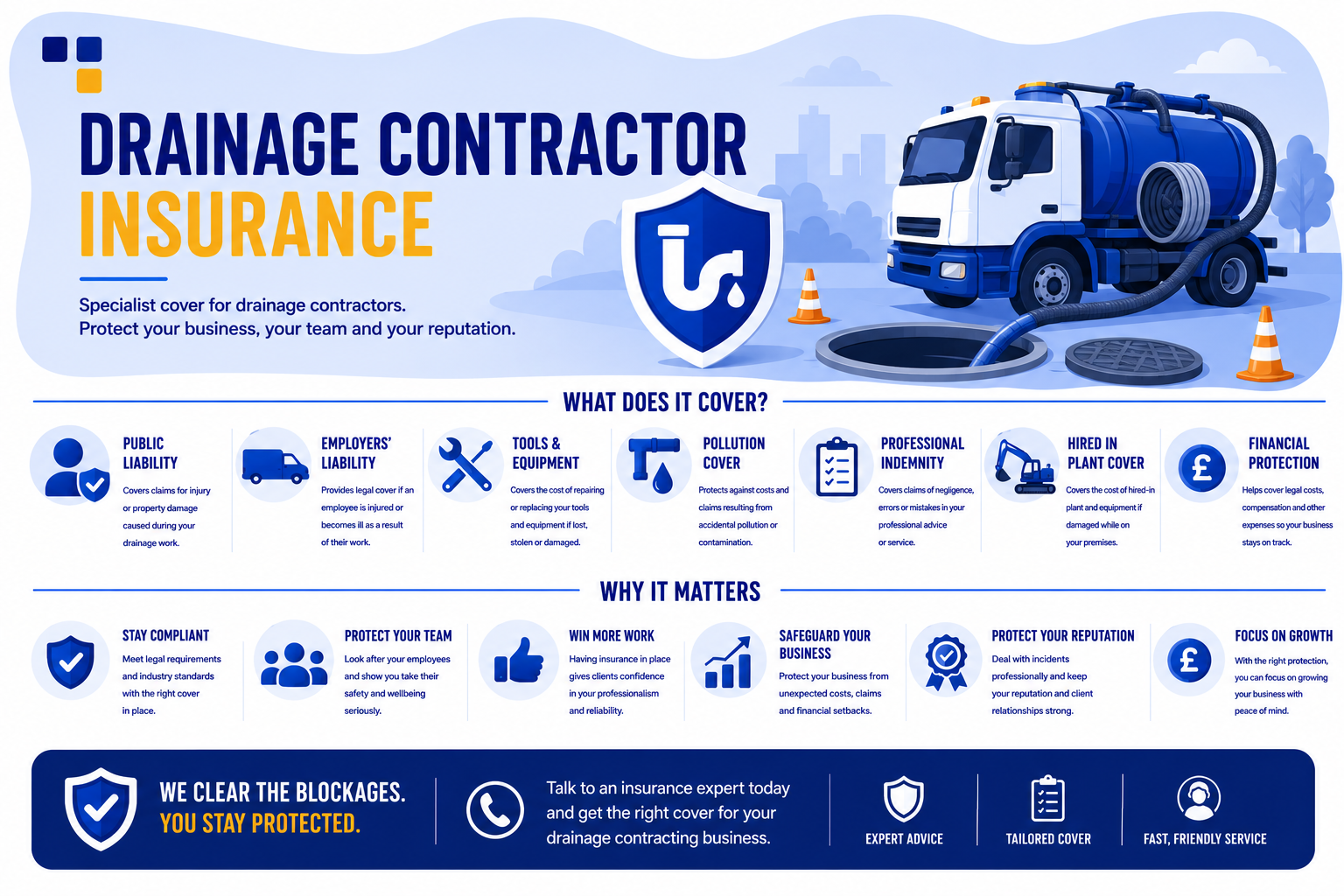
Drainage is one of the most operationally complex trades in UK construction. On any given day, a drainage contractor might be clearing a domestic blockage, running a CCTV survey on a £40,000 inspection vehicle, jetting a commercial sewer, excavating to replace a collapsed section, lining a damaged pipe, or undertaking sewer connection work under a Water Industry Act 1991 agreement. Every one of those activities carries a different insurance exposure, and standard "tradesman insurance" sold to UK contractors typically fails to address most of them properly.
Three things make drainage insurance genuinely different from general construction cover. First, the underground services strike risk — drainage work is, by definition, ground penetration work. The Health and Safety Executive's HSG47 ("Avoiding Danger from Underground Services") is the controlling guidance, and a service strike that hits gas, electricity, water, or telecoms can generate claims running well into six figures even on a simple domestic job. Second, the environmental and pollution exposure — sewage, surface water, and chemical contamination claims are rising sharply, and many standard public liability policies have only limited pollution cover ("sudden and accidental") that misses gradual or repeated incidents. Third, the equipment value — modern drainage businesses carry £25,000–£150,000 of jetting equipment, CCTV survey kit, and specialist tooling, almost always overnight in vans that are themselves a primary theft target.
Add to all that the contract-specific work — Section 104 sewer adoption work, Section 106 sewer connections, Section 185 sewer diversions, Section 50 highway opening notices, and Build Over Agreements under the Water Industry Act 1991 — and you have a trade where the insurance must do real work, not just hang on the wall to satisfy a procurement checklist.
Key facts at a glance
- Employers' Liability is the only statutory requirement for UK drainage contractors with staff — minimum £5m, with penalties up to £2,500 per day for non-compliance.
- Public Liability is functionally mandatory for any drainage contractor working on third-party premises or public sites — typical contract requirements are £2m, £5m or £10m.
- Underground services strike is the highest-frequency claim category — striking a gas, electric, water or telecoms main can generate property damage and consequential loss claims running into six figures.
- Standard PL pollution cover is often "sudden and accidental only" — gradual or repeated contamination, common in drainage work, may need a separate environmental impairment liability policy.
- Water companies require £5m–£10m PL minimum for approved contractor status under Section 104, 106 or 185 of the Water Industry Act 1991.
- HSG47 compliance is the regulatory baseline — failure to follow HSG47 procedures significantly weakens both HSE defence and insurance claims position.
- Typical UK drainage contractor insurance cost in 2026: £700–£1,500 sole trader; £1,800–£4,500 small firm with staff; £5,000–£15,000+ multi-vehicle commercial operator.
1. What insurance is legally required for UK drainage contractors?
The legal position is more nuanced than most general guides suggest. Strictly, only one cover is legally compulsory — but several others are effectively required to win and keep work.
Statutory Requirement: Employers' Liability
Under the Employers' Liability (Compulsory Insurance) Act 1969, any UK business with employees must hold Employers' Liability insurance with a minimum limit of £5 million. The market standard is £10 million. Penalties for trading without it reach £2,500 per day. For drainage contractors, "employees" typically includes any labour-only subcontractors you direct and control on site — the test is operational control, not how the person invoices you. Failure to carry EL is one of the few insurance breaches that creates direct personal director liability.
Contractual Requirement: Public Liability
Public liability is not legally compulsory in the UK, but it is functionally mandatory for drainage contractors because:
- Water company approved contractor schemes (Section 104, 106, 185) require PL cover, typically at £5m–£10m
- Local authority and public sector contracts require PL at £5m or £10m
- Principal contractors on commercial sites require PL evidence from every subcontractor before site access
- Domestic clients increasingly check insurance through trust mark schemes
- Without PL, a single third-party property damage claim — strike on a service main, flood, damage to client property — can end the business
Regulatory Requirement: HSG47 Compliance
HSG47 is HSE guidance, not legislation — but compliance with it is effectively the regulatory baseline for any ground penetration work. If a service strike occurs and the HSE investigates, the first question is whether HSG47 procedures were followed. Non-compliance does not automatically mean prosecution, but it significantly weakens both your defence and your insurer's defence position. The four core HSG47 requirements are:
- Planning — obtaining drawings and plans of underground services before any excavation
- Cable and pipe locating — using detection equipment competently (CAT and Genny scans)
- Safe digging practices — hand digging in vicinity of services, trial holes, supervision
- Permits and authorisation — relevant permits to dig, site-specific risk assessments
Other Regulatory Touchpoints
- CDM Regulations 2015 — Construction (Design and Management) Regulations apply to almost all drainage work, with specific duties for clients, designers, principal contractors and contractors
- Confined Spaces Regulations 1997 — manhole and chamber entry triggers specific competence, permit-to-work, and rescue provision requirements
- Environmental Permitting (England and Wales) Regulations 2016 — discharge consents, waste classification, water resource permits
- Water Industry Act 1991 — Sections 50 (highway opening notices), 104 (sewer adoption), 106 (sewer connection), 185 (sewer diversion) all create insurance requirements
- Streetworks legislation — New Roads and Street Works Act 1991 controls work on public highways
2. Drainage insurance cover comparison: what does each policy do?
| Claim / Exposure | Public Liability | Contract Works | Environmental | Professional Indemnity |
|---|---|---|---|---|
| Damage to third-party property (drain, wall, vehicle) | Yes — primary | No | No | No |
| Underground service strike (gas, electric, water, telecoms) | Yes (subject to conditions) | No | Sometimes | No |
| Sudden & accidental pollution / sewage escape | Usually yes | No | Yes — primary | No |
| Gradual / repeated contamination | Generally no | No | Yes — primary | No |
| Damage to your own work in progress | No | Yes — primary | No | No |
| Negligent CCTV survey / inspection report | No | No | No | Yes — primary |
| Design or specification errors | No | No | No | Yes — primary |
| Personal injury to third parties | Yes — primary | No | No | No |
| Theft of tools, jetters, CCTV kit | No | Sometimes | No | No |
| Subsidence / structural movement caused by your work | Partial (subject to conditions) | No | Sometimes | Sometimes (if design) |
3. Which insurance does a UK drainage contractor actually need?
Employers' Liability
Legally required if you have any staff. Minimum £5m, market standard £10m. Include all labour-only subcontractors under your direction.
Public Liability
The foundation cover. Minimum £2m for purely domestic work; £5m for commercial and most water company schemes; £10m for principal contractor work, major sites, and many local authority frameworks. Confirm specifically:
- Underground services strike cover — included, and at what conditions (HSG47 compliance, scan evidence, plans obtained)
- JCDS / heave / subsidence — vibration, ground movement, and removal of support claims
- Pollution cover scope — sudden and accidental, time limits, sub-limits
- Working depth limits — many policies have depth thresholds (typically 3m or 5m) above which special conditions apply
- Hot works — pipe welding, torch work; usually requires 60-minute fire watch documented
- JCDS jurisdictional scope — Scotland, Northern Ireland and Channel Islands sometimes excluded from standard policies
Tools, Plant and CCTV Equipment Cover
Drainage businesses routinely carry £25,000–£150,000 of equipment. Modern jetters (van-mounted high-pressure water jetting units), CCTV crawler camera systems with push rods, sectional cameras, manhole locators, smoke testers, no-dig lining equipment — each piece can be £8,000–£40,000+. Confirm:
- Sum insured matches realistic replacement cost (not depreciated book value)
- Overnight storage conditions — secure compound, alarm, immobiliser, or vault
- Theft from unattended vehicles — typically conditional on locked, alarmed, out of sight
- Hired-in plant cover — additional sub-limit; declare hire arrangements
- Goods in transit — between sites, to and from depot, transit between vehicles
Contract Works Insurance (CAR)
Covers physical damage to your work in progress and materials on site. Particularly important for excavation, pipe replacement, no-dig lining, and any project where there is a "work in progress" asset over multiple days. Contractors combined structures typically include CAR; standalone trade policies often don't.
Environmental Impairment Liability (EIL)
Specialist cover for pollution events beyond what standard PL covers — gradual contamination, third-party clean-up costs, regulatory clean-up notices, damage to natural habitats, statutory clean-up under the Environmental Damage Regulations. Increasingly required by water company contracts and by environmental risk-aware commercial clients.
Professional Indemnity
Required for any drainage contractor providing surveys, reports, designs, or specifications. CCTV survey reports used in property purchase decisions, lining design specifications, drainage strategy reports, and any consulting work generate PI exposure. Limits typically £250k–£2m. Professional indemnity wordings should specifically cover drainage survey and design work.
Fleet / Commercial Vehicle Insurance
Drainage businesses are often van-heavy operations. Commercial vehicle cover must reflect business use (Class 3 typically), goods-in-transit on the vehicle, and any towing of jetting trailers. Fleet cover from 3+ vehicles is typically more efficient than individual policies.
Personal Accident
Sole-trader drainage contractors are at high physical risk — confined space work, lifting, vehicle use, working in inclement conditions. PA cover provides lump sum or weekly income on injury. Often overlooked, often valuable.
Goods in Transit
Tools, materials, waste, and small plant moving between sites. Often a sub-section of tools cover; confirm transit limit and any conditions on overnight vehicle storage.
Legal Expenses
Covers legal costs for HSE investigations (a real exposure for drainage contractors after any service strike or incident), contract disputes, employment matters, and tax investigations. The HSE extension alone often justifies the premium.
4. Drainage business type cover checker
Select your business model below for a tailored cover checklist showing exactly what you need.
Drainage Contractor Cover Checker
Select your business type to see the recommended insurance programme
Sole Trader — Domestic Blockages and Small Repairs
- ESSENTIAL Public Liability £2m–£5m (£5m increasingly the minimum for trust mark and trade body membership)
- ESSENTIAL Tools and equipment cover at replacement value — typically £5,000–£25,000 declared
- ESSENTIAL Commercial vehicle / van insurance with business use Class 3
- RECOMMENDED Personal Accident — sole-trader income protection
- RECOMMENDED Legal Expenses with HSE investigation cover
- RECOMMENDED Goods in Transit if carrying significant materials between jobs
- CONSIDER Sole proprietorship package bundling these covers efficiently
- CONSIDER Employers' Liability the moment you take on any labour-only help, even informal
CCTV Survey Specialist
- ESSENTIAL Public Liability £2m–£5m
- ESSENTIAL Tools/Equipment cover at substantial limit — CCTV crawler systems alone often £20,000–£40,000+; declare each item
- ESSENTIAL Professional Indemnity £500k–£1m+ — survey reports used in property purchase decisions create direct PI exposure
- ESSENTIAL Theft from vehicle cover — CCTV equipment is one of the highest-frequency drainage theft targets
- ESSENTIAL Goods in Transit including overnight vehicle storage at home address
- RECOMMENDED Confidentiality / data protection cover — survey data shared with clients and conveyancers
- RECOMMENDED Cyber insurance — survey records, client data, payment processing
- CONSIDER Approved contractor accreditation evidence — many water companies and homebuyer survey panels require it
Commercial Drainage Firm with Staff and Vans
- LEGAL Employers' Liability £10m
- ESSENTIAL Public Liability £5m–£10m (£10m typical for commercial clients and major site work)
- ESSENTIAL Tools, plant and CCTV equipment at full schedule of values
- ESSENTIAL Contract Works (CAR) cover for excavation and replacement projects
- ESSENTIAL Fleet insurance — typically more efficient than individual policies at 3+ vehicles
- ESSENTIAL Environmental Impairment Liability — gradual contamination exposure beyond PL pollution cover
- ESSENTIAL Goods in Transit at meaningful limits
- RECOMMENDED Legal Expenses with comprehensive HSE / regulatory cover
- RECOMMENDED Professional Indemnity if delivering reports or design work
- RECOMMENDED Contractors combined structure rather than standalone trade policy
No-Dig / Lining / Patch Repair Specialist
- ESSENTIAL Public Liability £5m–£10m with explicit cover for resin lining work and UV/chemical processes
- ESSENTIAL Professional Indemnity for lining design and specification work — failures can be very expensive to remediate
- ESSENTIAL Contract Works cover for relining projects in progress
- ESSENTIAL Plant and equipment cover at lining-equipment values (UV lining rigs commonly £40,000–£100,000+)
- ESSENTIAL Environmental liability — resin spillage, chemical exposure, run-off into watercourses
- ESSENTIAL Product liability for installed liners (claims can emerge years after installation)
- RECOMMENDED Latent defect / guarantee insurance for liner warranties
- RECOMMENDED COSHH-compliant chemical handling documentation as policy condition
Sewer Connection / Section 104 Contractor
- CRITICAL Public Liability £10m — water company approved contractor schemes routinely require this
- ESSENTIAL Employers' Liability £10m
- ESSENTIAL Contract Works cover at full project values
- ESSENTIAL Professional Indemnity — Section 104 work includes design responsibility; £1m–£2m typical
- ESSENTIAL Environmental Impairment Liability — sewer adoption and connection work directly involves wastewater systems
- ESSENTIAL Plant and equipment cover including specialist sewer connection tooling
- ESSENTIAL Confined space competence documentation as policy condition
- ESSENTIAL Permit-to-dig and Section 50 highway opening procedures documented
- RECOMMENDED Specialist construction insurance via civil engineering programme
24/7 Emergency Drainage / Commercial Contracts
- ESSENTIAL Public Liability £5m–£10m with night working and emergency response explicitly covered
- ESSENTIAL Employers' Liability £10m with shift work and lone working provisions
- ESSENTIAL Fleet insurance with multi-driver, business hours unlimited, breakdown cover
- ESSENTIAL Tools and plant cover with theft cover including night-time vehicle storage
- ESSENTIAL Public Liability covering work in occupied premises (restaurants, hotels, hospitals out of hours)
- ESSENTIAL Environmental liability — sewage backup events in occupied commercial premises
- ESSENTIAL Business interruption cover — your vehicles are revenue generators; theft halts revenue immediately
- RECOMMENDED Cyber cover for call-out booking and customer data systems
- RECOMMENDED Legal Expenses with comprehensive HSE and commercial dispute cover
5. HSG47 pre-dig compliance checker
The single most important contributor to underground services strike claims being denied (or settled with significant deductions for contributory negligence) is missing HSG47 pre-dig procedures. Tick each procedure you complete before every excavation:
HSG47 Pre-Dig Checklist
Click each step you complete before excavation. The more you tick, the stronger your insurance position when (not if) a strike occurs.
-
Utility service plans obtained from gas, electric, water, telecoms providers before any excavation begins
-
CAT and Genny scan performed by a trained operative immediately before breaking ground — and recorded
-
Detected services marked on the ground using paint and identification codes (HSE/NJUG colour-coded)
-
Trial holes hand-dug at known service crossings to confirm precise location and depth
-
Operatives competence-checked — current cable avoidance / HSG47 training certificates on file
-
Site-specific risk assessment completed and signed before work commences
-
Permit to dig issued by the principal contractor or site manager (where applicable)
-
Section 50 highway opening notice served on the highway authority for any work in adopted highway (or Section 81 emergency works notification)
-
Safe digging zones identified — mechanical excavation kept at minimum 500mm from known service routes
-
Documented evidence retained — plans, scan records, photos, risk assessment kept in job file for at least 3 years
6. Drainage risk assessor
Two factors drive drainage insurance pricing and risk profile more than any others: where you work and what you actually do. Use the tool below.
Drainage Operation Risk Assessor
Select your primary work type and environment to see your specific risk profile
7. What is the underground services strike risk?
Underground services strikes are the single highest-frequency serious claim category for UK drainage contractors. Every excavation, every pipe replacement, every connection job carries the risk of striking gas, electric, water, telecoms, or other buried utilities — and the consequences range from inconvenience to fatality. Understanding the risk, and managing it through HSG47 compliance, is both an HSE obligation and an insurance imperative.
The Four Service Types and Their Consequences
| Service Type | Strike Consequence | Claim Profile |
|---|---|---|
| Gas main | Fire, explosion, leak, evacuation, fatal injury | Highest severity — property damage, business interruption, personal injury, fatality, HSE prosecution |
| Electricity cable (LV) | Arc flash, electrocution, fire, supply interruption | High severity — burns and electrical injury, repair costs, supply restoration claims |
| Electricity cable (HV) | Severe arc flash, fatality, widespread power outage | Highest severity — multiple fatality risk, widespread supply interruption claims potentially seven figures |
| Water main | Flooding, pollution, supply interruption, undermining | Moderate-high severity — flood damage, supply restoration, environmental clean-up, third-party property |
| Telecoms cable | Service disruption, repair costs, regulatory consequence (Critical National Infrastructure) | Moderate severity — repair cost, third-party service interruption claims; growing severity for fibre and 5G backhaul |
| Other pipelines | Variable — petrochemical, district heating, industrial process | Severity depends on contents; chemical or fuel pipelines can be catastrophic |
How Strike Claims Develop
- Immediate response — emergency services if injury or fire; utility provider notified; site secured
- Utility provider claims — repair cost of the damaged service (typically £1,500–£15,000 for water and telecoms; £8,000–£60,000+ for gas and electric; HV strikes potentially £100,000+)
- Third-party consequential claims — businesses losing supply, residents displaced, premises affected, traffic disruption
- HSE investigation — formal inquiry where HSG47 compliance is the central question; potential improvement notice, prohibition notice, or prosecution
- Insurance investigation — service plans obtained, scan records, competence, supervision; all examined for contributory negligence
The "Sudden and Accidental" Trap
Most standard PL policies cover underground services strikes only where they are "sudden and accidental". If the investigation finds that the strike resulted from systemic failure to follow HSG47 procedures — no plans obtained, no CAT scan, no trial holes, no permit to dig — the insurer may decline cover entirely or settle at a fraction of the claim with contributory negligence deductions. The "sudden and accidental" wording isn't designed to defeat genuine strike claims; it's designed to ensure cover responds only where reasonable precautions were taken.
8. How does Water Industry Act work and build-over agreements affect your cover?
UK drainage contractors increasingly work on jobs that trigger Water Industry Act 1991 provisions — Section 104 (sewer adoption), Section 106 (sewer connections), Section 185 (sewer diversions), Section 50 (highway opening notices), and Build Over Agreements. Each comes with specific insurance requirements that go beyond standard contractor cover.
Section 104 — Sewer Adoption Agreements
Section 104 of the Water Industry Act 1991 governs the adoption of new sewers by water companies. When you construct drainage that will become part of the public sewer system, you operate under a Section 104 agreement requiring construction to the Water UK Sewers for Adoption (now superseded by the Design and Construction Guide under the Code for Adoption introduced 1 April 2020). Section 104 work creates:
- Design responsibility — even if you didn't design it, working to an adoption standard creates contractor liability for compliance
- Approved contractor status requirements — typically PL £5m–£10m, EL £10m, evidence of competence, H&S policy, confined space training
- Maintenance period liability — typically 12 months between provisional and final vesting certificates
- Bond arrangements — water companies often require performance bonds released only after final inspection
Section 106 — Sewer Connections
Section 106 of the Water Industry Act 1991 gives the right to connect to a public sewer with prior consent. Connection work creates:
- Direct contact with operational public sewers — escape risk during connection
- Confined space entry requirements (Confined Spaces Regulations 1997)
- Specific water company approved contractor requirements
- Notification and inspection obligations
Section 185 — Sewer Diversions
Where development requires moving an existing public sewer, Section 185 allows the developer to apply for diversion. Approved contractor status is required for the diversion work itself. Strategic sewer diversions typically must be undertaken by water company-approved contractors with specific PL and competence requirements.
Section 50 — Highway Opening Notices
Under the New Roads and Street Works Act 1991, work in adopted highway requires a Section 50 licence (planned works) or Section 81 notification (emergency works). The licence is usually granted to a competent person with appropriate insurance — typically PL £5m or £10m as a minimum, depending on highway authority. Trading on the public highway without a Section 50 licence is a regulatory offence and likely invalidates your insurance for that work.
Build Over Agreements (BOA)
Under the Water Industry Act 1991, building within 3 metres of a public sewer or 1 metre of a public lateral drain requires a Build Over Agreement from the relevant water company. The water company will require:
- Approved contractor status to undertake work, or supervision arrangement
- Pre and post-construction CCTV survey (Class 3 BOAs)
- Specific design specifications (Water UK Design and Construction Guide)
- Indemnity insurance — water companies typically require £5m minimum cover for the works
- As-built drawings and survey records on completion
For drainage contractors working on properties with sewers in scope, becoming an approved BOA contractor (under the relevant water company's scheme) is often commercially valuable but requires sustained compliance with their insurance, training, and operational requirements.
9. What environmental liability does drainage work create?
Drainage work, by its nature, involves substances that insurers categorise as pollutants — sewage, wastewater, oils, fuels, chemicals used in lining or rehabilitation work, and contaminated materials excavated from old sites. Environmental claims are rising sharply in 2025-2026, driven by stronger regulatory enforcement and increased awareness of long-term contamination consequences.
The Pollution Cover Gap
The most common UK drainage contractor coverage gap is the difference between standard PL pollution cover and the realistic pollution exposure of the work:
- Sudden and Accidental Only — most standard PL policies cover only pollution events that are both sudden (occurring at a discrete moment) and accidental (unintended). Gradual seepage, repeated discharge, or any incident that develops over time may be excluded.
- Time Limits — many policies require discovery and notification of pollution events within 7 or 14 days of occurrence. Pollution that comes to light weeks or months after the work may be uninsured.
- Sub-Limits — pollution cover within PL often has its own sub-limit, typically £500k or £1m, well below the headline PL limit.
- Clean-up cost — third-party clean-up may be covered but your own clean-up obligation under statutory notice is often excluded.
The Environmental Damage Regulations 2015
The Environmental Damage (Prevention and Remediation) (England) Regulations 2015, and equivalents for the devolved nations, impose strict statutory obligations on operators causing environmental damage. The regulations:
- Require prevention of imminent environmental damage
- Require remediation of actual environmental damage to land, water, and protected species
- Apply on a strict liability basis for some activities (no need to prove fault)
- Allow regulators to require remediation directly and recover costs
Environmental Impairment Liability (EIL) Cover
For drainage contractors with meaningful environmental exposure — sewer adoption work, no-dig lining with chemical resins, contaminated land work, industrial premises drainage — a dedicated Environmental Impairment Liability policy fills the gaps in standard PL pollution cover:
- Gradual pollution and contamination
- Statutory clean-up under Environmental Damage Regulations
- Bodily injury and property damage from pollution incidents
- Natural resource damage
- Third-party clean-up cost claims
- Legal defence in regulatory proceedings
- Business interruption from environmental incidents
10. Why are drainage tools and CCTV equipment such a theft target?
Drainage equipment theft is one of the fastest-growing claim categories in the trade. UK drainage businesses carry high-value, portable equipment that has a ready resale market — and organised theft gangs increasingly target drainage vans specifically. Understanding the pattern and the insurance implications matters.
The Theft Profile
- Van break-ins overnight at home addresses — by far the most common scenario; thieves identify drainage vans through livery or stickered branding
- Site theft during work — vans left unattended at job locations, often the operative is in a confined space or property
- Supermarket and motorway service area theft — particularly during longer breaks
- Insider theft — equipment moved between vans by trusted staff, then reported missing
- Burglary at depot or compound — particularly multi-vehicle operations storing equipment overnight
What's Targeted
- CCTV crawler camera systems (£15,000–£40,000)
- Push rod / sectional cameras (£3,000–£8,000)
- Van-mounted high-pressure jetters (£15,000–£60,000)
- Trailer-mounted jetting units (£25,000–£80,000)
- Locating equipment — sondes, receivers, manhole locators (£2,000–£8,000)
- Hand tools and power tools (cumulative £3,000–£10,000)
Theft Cover Conditions That Catch Drainage Contractors Out
- Overnight vehicle storage — many policies require vehicles to be parked in a locked garage, secure compound, or behind locked gates; parked on the driveway alone may invalidate cover
- Vehicle security devices — policy may require functioning alarm, immobiliser, deadlocks, slam locks, or trackers
- Tool storage — high-value tools may need to be stored in a locked tool vault inside the van
- Visible items — items left in plain sight in unattended vehicles often excluded
- Identification — many policies require equipment serial numbers and photos to be retained for claim purposes
11. What drives the cost of drainage contractor insurance?
| Rating Factor | Impact on Premium | What You Can Do |
|---|---|---|
| Annual turnover | Primary rating basis for PL; scales with exposure | Declare accurately; growth above 25% YoY may trigger mid-term adjustment |
| Work type mix | Unblocking lowest; excavation and sewer adoption highest | Declare accurate split of activities; misdeclaration on activity creates fundamental cover dispute |
| Maximum excavation depth | Sub-3m baseline; 3-5m typically loaded; 5m+ requires specialist terms | Match policy depth to typical operation; declare maximum honestly |
| Public highway / utility work | Substantial loading reflecting strike and traffic management risk | Section 50 / NRSWA accreditation evidence reduces rating |
| HSG47 compliance documentation | Documented procedures reduce premium; lack of evidence increases | Maintain pre-dig packs; training certificates; CAT scan records |
| Number of staff | EL rated on payroll; PL also factors operative numbers | Declare wage roll accurately; document subcontractor arrangements |
| Vehicle and plant value | Tools, plant, fleet all scale with declared values | Realistic replacement values, not book values; security arrangements documented |
| Claims history | 5+ year impact on premium; theft and strike claims both | Address root causes; document remedial action at renewal |
| Limits selected | PL £2m / £5m / £10m all rate differently; PI separately | Match to contract requirements; over-buying is expensive |
| Geographic operating area | Postcode-based loadings for vehicle theft and operational risk | Declare typical operating area accurately |
| Accreditation / approved contractor status | Water company, CHAS, Constructionline, NJUG SUSIE all reduce premium | Maintain and present accreditation evidence at every renewal |
12. Real claims and how to manage them
Claim — Underground Gas Main Strike During Domestic Drainage Replacement
A two-van drainage firm was replacing a collapsed foul drain at a domestic property. The operative used a mini-excavator to break ground in an area where the property owner reported "no services". Mid-excavation, the bucket struck a low-pressure gas service supplying the property. Gas escaped; the operative evacuated and called the emergency line. No injury occurred but the property was evacuated for 6 hours while the supply was isolated and repaired.
The gas distribution network operator (DNO) claimed against the drainage firm for repair costs of £8,400 (excavation, replacement of damaged section, reinstatement, third-party traffic management) and a contribution to the emergency response (£2,200). The property owner claimed for accommodation costs during evacuation (£640) and loss of food in the freezer (£280). HSE attended but did not issue any formal notice.
Total third-party claims: £11,520. The drainage firm's £5m PL policy was notified. The insurer's loss adjuster requested the pre-dig documentation. The operative had not obtained service plans from the gas company (relying only on the property owner's statement). No CAT scan had been performed. No trial hole had been dug. There was no documented risk assessment for the specific site.
The insurer settled the third-party claims at £11,520 but applied a 40% contributory negligence deduction on the basis of HSG47 non-compliance — the firm contributed £4,600 directly. The firm's premium increased by 35% at next renewal, and the insurer imposed an HSG47 compliance condition as ongoing policy term. The firm subsequently invested in cable avoidance training for all operatives, a CAT and Genny set, and a pre-dig procedure checklist completed on every job.
The lesson: the strike happened, but the cover responded — and would have responded in full had the HSG47 evidence been there. Pre-dig procedures are insurance documentation as much as they are safety procedures. Treat the two as the same thing.
Claim — Sewage Escape into Watercourse During Lining Repair
A drainage firm specialising in no-dig lining was undertaking a UV liner installation in a 600mm trunk sewer running through a residential area, under a water company contract. During the curing process, the inflated liner failed and partially collapsed, allowing live sewage to escape from a downstream manhole during the curing window. Approximately 4,000 litres of raw sewage discharged onto adjacent ground before the firm could isolate flow.
Part of the discharge reached a small ornamental pond at a residential property and a section of grass verge. The Environment Agency was notified within the statutory timeframe by the water company. The EA opened an investigation under the Environmental Damage Regulations 2015. The water company invoiced the firm for emergency response and clean-up of the public sewer (£12,400). The Environment Agency required statutory remediation of the affected ground and pond (£8,600). The property owner claimed for loss of established koi carp killed in the discharge (£3,400) and pond cleaning (£1,800). The water company also withheld £18,000 from the project payment pending completion of remediation.
The firm's PL policy had a standard "sudden and accidental" pollution cover with a £500k sub-limit — but a 14-day time limit on notification. The claims were notified within 24 hours, so the time limit was met. Total third-party claims and remediation: £26,200. The PL policy responded.
However, the regulatory investigation by the Environment Agency took 14 months. EA defence costs ran to £18,400. The firm's PL policy excluded "ongoing regulatory clean-up costs" beyond the initial sudden response. The dedicated Environmental Impairment Liability cover that the firm had bought 6 months earlier responded to the EA investigation and the ongoing remediation costs. Total claim across PL and EIL: £44,600 plus the withheld payment.
The lesson: standard PL pollution cover handles the immediate event reasonably well; it consistently fails on the regulatory and ongoing remediation tail. The £900 annual EIL premium the firm had added 6 months earlier saved them more than £20,000 in uninsured regulatory cost. For any drainage firm with meaningful pollution exposure, EIL is value many multiples of the premium.
Claim — CCTV Equipment Theft from Overnight Van
A CCTV survey specialist had completed a long day of surveys at multiple properties and parked the van outside his home address overnight. The van was alarmed, immobilised, and locked. During the night, the van was broken into with the alarm seemingly bypassed. The thieves took the CCTV crawler camera unit (£28,000), a sectional camera (£5,400), two locating devices (£3,600), and various hand tools (£1,200). Total loss: £38,200.
The contractor notified police immediately (crime reference obtained), then notified his insurer. The insurer's investigation reviewed the policy conditions: the policy required overnight storage in "a locked garage or secured compound". The van had been parked on the open driveway. Despite the alarm and immobiliser working as installed, the storage condition had not been met.
The insurer initially declined the claim citing the storage condition. The broker engaged in protracted negotiation, presenting evidence that the driveway was off-street, gated to the property, and that the equipment was stored in a locked tool vault within the van. The insurer eventually settled at 60% of the claim — £22,920 — applying a "contributory failure to meet storage warranty" deduction of 40%. The contractor was £15,280 out of pocket.
The contractor subsequently invested in a secure compound at home — gated, alarmed, CCTV-monitored — and reduced his premium by 18% at the next renewal while raising the tools cover sum insured by £15,000.
The lesson: tool cover conditions are policy warranties, not guidelines. Meeting them is not optional. Review the storage condition specifically when buying or renewing tools cover, and align your operational practice with it. The 18% premium reduction the contractor achieved was significantly more valuable than the marginal cost of building a secure compound.
Claims Management Steps
How to respond to a drainage contractor insurance claim — the steps below are critical for preserving cover and managing outcome:
- Make the site safe first. Stop work, evacuate if necessary, isolate utilities if competent to do so, call emergency services if injury or fire. Don't continue work in an unsafe condition.
- Notify the utility or asset owner. For service strikes, the network operator must be told immediately. For sewer or drainage incidents, the water company. For environmental incidents, the Environment Agency, NRW, SEPA or NIEA depending on jurisdiction.
- Notify your insurer within 24-48 hours. Most PL and contractor policies require prompt notification; late notification can void cover. The notification threshold is "circumstance that may give rise to a claim" — much lower than "formal claim received". Err toward over-notification.
- Preserve all evidence. Photographs of the site, the work, the damage; pre-dig documentation (plans, scan records, risk assessments); operative records and training certificates; weather data; communications. Insurer investigations are evidence-led.
- Do not admit liability. Provide factual information about what happened; do not accept fault, apologise (in writing), or commit to repairs. Apologies in the immediate aftermath are routine but written admissions prejudice the insurer's defence position.
- Manage HSE engagement carefully. If HSE attend, engage your legal expenses insurer immediately. Cooperate factually with HSE inspectors but do not provide written statements without legal representation. HSE investigation can become criminal prosecution.
- Document the incident comprehensively. Operative accounts written within 24 hours; site conditions; equipment used; supervision arrangements; previous similar work history. This forms the basis of the insurer's defence.
- Conduct root cause analysis. Beyond responding to this incident, identify the underlying cause and address it. Insurers reviewing renewal terms will ask what's changed since the claim — your answer determines whether the renewal is sustainable.

Glossary of drainage insurance terms
- HSG47
- HSE guidance document "Avoiding Danger from Underground Services" (third edition, published 2014). The principal UK reference for safe excavation around buried utilities. Compliance is the regulatory baseline for any ground penetration work and is increasingly a policy condition for underground services strike cover.
- CAT and Genny (Cable Avoidance Tool / Signal Generator)
- Detection equipment used to locate buried services before excavation. The CAT detects passive signals (live cables) and active signals (when used with the Genny); the Genny applies a signal to a known utility to trace its route. Use must be by trained operatives.
- Section 50 (Highway Opening Notice)
- Under the New Roads and Street Works Act 1991, the licence required to undertake planned work in adopted highway. Granted to a competent person with appropriate insurance, typically minimum £5m PL.
- Section 81 Notification
- Notification to the highway authority of emergency works in adopted highway under NRSWA 1991. Used where a Section 50 licence cannot be obtained in advance due to genuine emergency.
- Section 104 Agreement
- Agreement under the Water Industry Act 1991 between a developer and water company for the construction and adoption of new sewers. Construction must comply with the Water UK Design and Construction Guide; approved contractor requirements apply.
- Section 106 Connection
- The statutory right to connect to a public sewer under the Water Industry Act 1991, with prior consent. Connection work is increasingly only permitted to water company-approved contractors.
- Section 185 Diversion
- The right to apply for diversion of a public sewer under the Water Industry Act 1991 where development requires it. Strategic sewer diversions must be carried out by approved contractors.
- Build Over Agreement (BOA)
- Formal water company approval required when building within 3m of a public sewer or 1m of a public lateral drain. Established under the Water Industry Act 1991; classes 1-3 depending on sewer size; typically requires £5m+ indemnity insurance.
- Environmental Impairment Liability (EIL)
- Specialist insurance covering pollution and contamination claims beyond standard PL "sudden and accidental" pollution cover. Includes gradual contamination, statutory clean-up under the Environmental Damage Regulations 2015, third-party clean-up, and regulatory defence.
- Contract Works / CAR (Contractors All Risks)
- Insurance covering physical loss or damage to works in progress and materials on site. Separate from public liability — PL covers third-party claims; CAR covers your own work.
- NJUG / SUSIE
- National Joint Utilities Group / "Safe Underground Streetworks Initiative for Excavation" — industry codes of practice for excavation safety, particularly relating to underground services. Compliance evidence reduces insurance premium and supports claim defence.
- Confined Spaces
- Defined under the Confined Spaces Regulations 1997. Manholes, chambers, sewers and similar spaces with limited entry/exit and potential atmospheric hazards. Entry requires trained, competent operatives, permit-to-work systems, and emergency rescue provision.
- Service Strike
- Damage to a buried utility (gas, electric, water, telecoms or other pipeline) during excavation or ground penetration work. Underground services strikes are the highest-frequency serious claim category in UK drainage and groundworks.
Frequently asked questions
Employers' Liability is the only statutory legal requirement for UK drainage contractors with employees — minimum £5 million under the Employers' Liability (Compulsory Insurance) Act 1969, with penalties up to £2,500 per day for non-compliance. Public Liability is not legally compulsory but is functionally mandatory because water company schemes, principal contractors, and local authority contracts almost universally require evidence of PL (typically £5m or £10m) as a condition of work. Underground services strike cover, environmental liability, tools cover, and professional indemnity (for survey work) are commercial requirements driven by contract and risk profile rather than statute.
HSG47 is HSE guidance ("Avoiding Danger from Underground Services", third edition 2014) setting out the safe system of work for any UK ground penetration. It requires planning (obtaining service plans), locating (CAT and Genny scans), safe digging (hand-dug trial holes, minimum machine excavation distances), and authorisation (permits, risk assessments). For insurance, HSG47 compliance is increasingly a policy condition for underground services strike cover. When a strike claim arises, the insurer's first investigation step is checking HSG47 evidence — without it, contributory negligence deductions of 30-60% are common, and in serious cases cover may be declined entirely. Documenting your HSG47 procedures isn't just an HSE obligation; it's the foundation of your claim defence.
Partially, with significant restrictions. Most standard UK PL policies cover pollution only on a "sudden and accidental" basis — meaning the event must be both unintended and occur at a discrete moment. Gradual seepage, repeated discharge, ongoing contamination, and any incident that develops over time may be excluded. Pollution cover within PL also typically has its own sub-limit (often £500k or £1m) below the headline PL limit, and notification time limits (often 7 or 14 days). For drainage contractors with meaningful environmental exposure — sewer adoption work, no-dig lining, contaminated land — a dedicated Environmental Impairment Liability policy fills these gaps and covers statutory clean-up under the Environmental Damage Regulations 2015.
It depends on the work and the clients. £2m may be adequate for purely domestic unblocking and small repair work; £5m is increasingly the minimum for trust mark schemes, water company approved contractor status (Section 104/106/185), and most commercial work; £10m is required for many local authority frameworks, major construction sites, and any work involving critical infrastructure or significant excavation. The limit should reflect not just the immediate value of any single job but the worst-case third-party exposure — a strike on a gas main in a residential area can generate claims across multiple properties simultaneously. Most established UK drainage businesses operate at £5m or £10m as standard.
If you provide CCTV survey reports, drainage design advice, specification work, or any deliverable that clients use to make decisions, yes. CCTV survey reports used in property purchase decisions are the most common PI exposure for drainage contractors — if a report misses a defect and the buyer subsequently faces major repair costs, the surveyor can be alleged to have been negligent. Lining design specifications, drainage strategy advice, and Section 104 design work all create PI exposure. Typical limits £500k–£2m. If you only undertake unblocking and physical repair work without any reporting or advisory output, PI exposure is lower but not zero — informal advice still creates risk. The premium is modest relative to the exposure.
Several standard conditions trap drainage contractors: overnight vehicle storage (often must be in locked garage, secure compound, or behind locked gates — driveway alone may invalidate); vehicle security (functional alarm, immobiliser, sometimes deadlocks or trackers required); tool storage inside vehicles (high-value items often must be in locked tool vault); visible items (left in plain sight typically excluded); identification (serial numbers and photos retained as claim evidence). Theft cover is conditional rather than absolute, and the conditions are policy warranties — failure to meet them can result in claim refusal or substantial deductions. Review your storage and security conditions specifically when buying or renewing tools cover, and align your operational practice with the policy terms.
Requirements vary by water company but typical approved contractor schemes require: Public Liability £5m–£10m minimum (with explicit underground services strike cover and pollution cover); Employers' Liability £10m; Contract Works (CAR) at meaningful values; Professional Indemnity £1m+ where design responsibility is involved; Environmental Impairment Liability for adoption work; demonstrable confined space training and competence; documented HSG47 / NJUG compliance procedures; CHAS, Constructionline or equivalent H&S accreditation; and CSCS-level operative qualifications. Some water companies also require specific named insurer schedules, bond arrangements, and performance guarantees. Confirm specific requirements with each water company before tendering for approved contractor status.
It should, but confirm specifically. Many drainage businesses do significant work in commercial premises out of hours (restaurants, hotels, hospitals, retail) where the day-time customer-facing operation cannot be disrupted. Standard PL should cover this but check: hot works conditions (any pipe welding or thawing); occupied premises clauses (some policies have time limits or notification requirements); lone working provisions in EL; subsequent damage from work (water damage, drying time, ceiling tile replacement); and night working as an explicit policy term. For 24/7 emergency drainage businesses, confirm with your broker that the policy is scoped to your actual operational pattern, not a notional 8-to-5 trading day.
Public Liability covers claims from third parties — people not employed by you and not the property owner — for injury or property damage caused by your work. Contract Works (Contractors All Risks / CAR) covers physical loss or damage to your own work in progress and materials on site. They address fundamentally different risks. A flood at your project site damages: (a) third-party property nearby — PL responds; (b) your work in progress and materials — CW responds. Both covers are typically needed for drainage businesses doing excavation, replacement, or any significant works project. Standalone trade policies often include CW; some don't. Confirm whether your policy includes contract works and at what sum insured.
Indicative 2026 pricing for compliant drainage cover:
- Sole trader, domestic unblocking and small repairs: £700–£1,500 per year
- CCTV survey specialist with PI: £1,400–£3,200 per year
- Small commercial drainage firm (2-4 staff): £1,800–£4,500 per year
- No-dig / lining specialist with PI and Contract Works: £3,500–£9,000 per year
- Multi-vehicle commercial operator (5+ vehicles): £5,000–£15,000 per year
- Section 104 approved contractor with full programme: £8,000–£25,000+ per year
Largest cost drivers: turnover, work type mix (excavation costs more than unblocking), public highway/utility work, claims history, tools and plant values, fleet size, and limits selected. Maintaining accreditation (CHAS, Constructionline, NJUG SUSIE) typically reduces premium.
Yes, and check the wording specifically. Emergency drainage work — out of hours response to blockages, sewage overflows, flooding — sits in standard drainage cover scope but has specific exposures: night working (some policies restrict cover after 11pm); lone working and reduced supervision; immediate-response decisions with less pre-dig planning time; occupied premises at out-of-hours times; and Section 81 emergency works notification under NRSWA 1991 if any highway opening is involved. Confirm explicitly that emergency response work is within policy scope, that night working is covered without conditions you can't meet, and that immediate-response excavation isn't subject to the same pre-dig documentation requirements that would void cover on planned work.
For drainage claims, the documentation pack that supports robust claim defence includes: service plans obtained before excavation; CAT and Genny scan records (photographs of marked-up ground); hand-dug trial hole evidence; site-specific risk assessment signed by competent person; permit to dig; operative competence certificates (cable avoidance, CSCS, confined space); Section 50 / NRSWA paperwork; pre and post-job CCTV survey records (for lining and BOA work); waste consignment notes; method statements; tools schedule with serial numbers and photographs; vehicle storage evidence (compound photos, alarm certification); and incident register entries for any near-miss events. Build the documentation as a job folder for every project — it's the difference between a clean settlement and a 30-60% contributory negligence deduction.






Instagram
LinkedIn