

Drone Operator Insurance Guide 2026: Protect Your Flight
Why Drone Operators Need Specialist Insurance
UK commercial drone operations have changed almost beyond recognition since 2020. What started as a fringe activity dominated by aerial photographers now spans agricultural spraying, infrastructure inspection, construction monitoring, BVLOS delivery trials, search and rescue, and high-definition cinematography — with PwC's widely cited Skies Without Limits analysis projecting a substantial contribution to UK GDP by 2030. Every one of those use cases comes with a different risk profile, a different regulatory pathway, and a different insurance requirement — and the standard "drone insurance" product sold to hobbyists doesn't meet any of them.
For commercial drone operators in 2026, insurance isn't optional. The Civil Aviation (Insurance) Regulations 2005, supported by Assimilated Regulation (EU) No 785/2004, make third-party liability insurance a legal requirement for every commercial drone flight in the UK. The regulation specifies minimum cover levels, policy wording requirements, and the territorial scope of cover. The CAA enforces compliance directly, and clients increasingly demand evidence of compliant cover before issuing contracts. Flying without it isn't just a regulatory breach — it's an uninsured liability that sits with you as the Operator named on the registration.
The 1 January 2026 changes to UK drone law added new operational requirements — the 100g Flyer ID threshold, the night flying anti-collision light, UK class marks, and the start of the Remote ID rollout — that all affect what insurance needs to respond to. This guide is the most comprehensive UK drone operator insurance resource we publish. It explains what the law requires, what changed in 2026, how the Open / Specific / Certified categories affect your cover, and how to structure a programme that actually works for your operation — whether you're a single-drone freelancer, a multi-pilot survey firm, or a Specific Category BVLOS operator.
1. The Legal Requirement — Assimilated Regulation (EU) 785/2004
The single most important thing for any UK commercial drone operator to understand is that drone insurance is not a market product — it's a legal requirement with specific compliance criteria. Several pieces of legislation form the foundation:
The Legal Sources
| Legislation | What It Does | Why It Matters |
|---|---|---|
| Air Navigation Order 2016 | The primary UK statute governing aviation including drone use; establishes operator and pilot obligations | Defines who counts as an Operator and creates the legal liability framework |
| Civil Aviation (Insurance) Regulations 2005 | UK legislation that makes third-party aviation insurance a statutory requirement | This is the regulation that makes commercial drone insurance a legal obligation, not just good practice |
| Assimilated Regulation (EU) No 785/2004 | Sets the minimum insurance limits, policy wording standards, and territorial scope for aviation third-party liability | Defines what counts as "compliant" cover — generic SME liability cover does not meet this standard |
| Assimilated Regulations 2019/945 and 2019/947 | Set the operational categories (Open, Specific, Certified) and design / class marking requirements | Determines which category your operation falls in and therefore what insurance must cover |
What "785/2004 Compliant" Actually Means
When an insurer or broker tells you their drone policy is "EC 785/2004 compliant" — or "Assimilated Regulation (EU) No 785/2004 compliant" in the post-Brexit terminology — they're confirming that the policy meets specific minimum standards:
- Minimum third-party liability limit determined by drone weight (MTOM — maximum take-off mass). For aircraft below 500kg MTOM, which covers effectively every commercial drone, the minimum is 750,000 SDR (Special Drawing Rights) — roughly £750,000–£800,000 depending on the exchange rate. Aircraft from 500kg to under 1,000kg require 1,500,000 SDR.
- Cover for war, terrorism, hijack, and sabotage as standard — this is an aviation-specific requirement that non-aviation policies typically exclude
- Territorial scope matching where you actually operate, including overflight liability for international work
- Compliance with aviation policy wording standards rather than general commercial wordings
- The policy must name the registered Operator — not the remote pilot, not a related entity, the Operator named on the CAA registration
The Operator vs Remote Pilot Distinction
One of the most common drone insurance failures is mismatch between the policyholder name and the registered Operator ID. The CAA distinguishes:
- The Operator — the legal person (individual or company) responsible for the drone, holds the Operator ID, is legally responsible for ensuring insurance is in place
- The Remote Pilot — the person actually flying the drone at the time, holds the Flyer ID, has competence-based obligations
The insurance policyholder name must match the Operator ID. If you have an Operator ID registered to "Acme Drone Services Ltd" but your insurance is written in the name of "John Smith trading as Acme Drone Services", you have a paperwork mismatch that can be raised against you at claim stage. Confirm this at every renewal.
2. What Changed on 1 January 2026 — And Why It Affects Your Cover
The CAA's Drone Code and underlying regulations updated significantly on 1 January 2026. Some of the changes are operational; others have direct insurance implications. The headline changes:
Registration and Flyer ID Thresholds Down to 100g
The most consequential change for the wider drone population: from 1 January 2026, a Flyer ID is required to fly anything weighing 100g or more (previously 250g). An Operator ID is required for drones of 100g or more with a camera, or 250g or more without one. The practical effect is a significant expansion of the registered drone user population.
From an insurance perspective: any commercial flight is in scope for the 785/2004 insurance requirement regardless of weight. Drones that were previously sub-threshold and used informally for commercial work — small training aircraft, sub-250g cinematography drones — now require registration and compliant insurance.
UK Class Marks UK0–UK6
The UK has implemented a class mark system (UK0 through UK6) that defines the operational characteristics and authorised use of different drone classes. From 1 January 2026:
- Any new drone model placed on the UK market must carry a UK class mark
- Existing EU C-class marks (C0–C6) are recognised as the equivalent UK class mark, with that recognition running to 31 December 2027
- Legacy drones bought before 1 January 2026 are unlikely to carry a class mark. You can still fly them — the rules that apply are based on weight rather than a class label, as they were before 2026
- Class-marked drones get the more generous separation distances; legacy aircraft generally don't, which in practice pushes heavier legacy drones toward A3
For insurance: the operational category determined by class mark affects your premium and the underwriter's appetite. A class-marked drone operating in A2 (close to people) has a different risk profile from a legacy drone operating under weight-based rules in A3 (away from people).
Mandatory Green Anti-Collision Light for Night Flying
From 1 January 2026, any drone flown at night in the UK must display a flashing green anti-collision light. This requirement applies in the Open Category as well as Specific. The light counts toward the drone's overall weight — which can push some drones over a weight threshold and into more restrictive operational rules.
Insurance implication: night operations must be specifically declared to your insurer. Some policies exclude night flying entirely; others require the operator to confirm compliance with the anti-collision light requirement as a policy condition.
Remote ID Requirements
From 1 January 2026, Remote ID must be enabled on UK1, UK2, UK3, UK5, and UK6 class-marked drones. From 1 January 2028 the requirement extends to UK0 drones of 100g or more with a camera, legacy (non-class-marked) drones in the same bracket, and privately built aircraft — giving owners of older kit roughly two years to retrofit or replace. Non-compliant Remote ID is both a regulatory breach and an insurance issue: some policies now require Remote ID compliance as a condition for in-scope drones.
Qualification Pathway Changes
Alongside the operational changes, the remote pilot qualification framework is consolidating around the Remote Pilot Certificate. The CAA will stop issuing the GVC on 31 December 2027, after which RPC-L1, RPC-L2 and RPC-L3 are the available routes into Specific Category competence. Existing GVCs remain acceptable until they expire, provided the Operational Authorisation states that a GVC is acceptable evidence of competence. From an insurance perspective, evidence of Flyer ID and, where applicable, higher qualifications (A2 CofC, GVC, RPC-L1) is increasingly a policy condition — particularly for higher-risk operations.
3. Open, Specific, and Certified Categories — The Insurance Implications
UK drone operations are divided into three categories defined by Assimilated Regulation 2019/947. The category your operation falls into determines your operational requirements, your qualification needs, and your insurance position.
The Open Category
Lower-risk operations meeting specific operational conditions: maximum take-off mass under 25kg, visual line of sight, maximum altitude 120m, no overflight of assemblies of people, no carriage of dangerous goods. The Open Category subdivides into A1, A2, and A3:
- A1 — Fly over uninvolved people (sub-250g drones, and class-marked drones up to 900g, though not over crowds)
- A2 — Fly close to people (requires A2 Certificate of Competency)
- A3 — Fly far from people (heavier drones, requires basic competence)
For commercial Open Category operations, insurance is the standard 785/2004-compliant cover with limits matching MTOM. Most commercial photographers, real estate operators, and small inspection firms operate in this category.
The Specific Category
Higher-risk operations that fall outside Open Category constraints but don't require the highest level of regulation. Specific Category operations require:
- Operational Authorisation from the CAA — a written permission tying together your qualification, drone, Operations Manual, and risk assessment
- Qualified Remote Pilot — GVC or RPC-L1 Part A
- Operations Manual setting out procedures, emergency response, maintenance, and risk controls
- Maintained logs covering flights, maintenance, and incidents
Specific Category operations include flying near or over uninvolved people, in built-up areas, beyond visual line of sight (BVLOS), and operations exceeding Open Category weight or altitude limits. For insurance, Specific Category operators face:
- Higher third-party liability limits typically required (commonly £5m–£10m+)
- Specific authorisation of each operation under the policy
- Higher premium reflecting elevated risk
- Stricter conditions on pilot qualification and maintenance records
The Certified Category
The highest-risk operations — including large drones, carriage of passengers, and certain BVLOS commercial operations — requiring full aircraft certification, type ratings for pilots, and operator certification similar to traditional aviation. Few UK commercial drone businesses currently operate at this level, but the population is growing as delivery and air mobility pilots develop. Insurance at this level is specialist aviation market placement only.
How Category Affects Your Premium
The relationship between category and premium is broadly as follows. These are illustrative market ranges, not quotations:
- Open Category (sub-250g drones, low-frequency commercial use): typically £180–£500 per year for the smallest operations
- Open Category (mid-weight drones, regular commercial use): typically £400–£1,200 per year
- Specific Category (Operational Authorisation): typically £900–£3,500 per year
- Multi-drone fleet or BVLOS Specific Category: typically £2,500–£10,000+ per year
- Certified Category: bespoke specialist placement, no standard pricing
4. Core Covers Every Commercial Drone Operator Needs
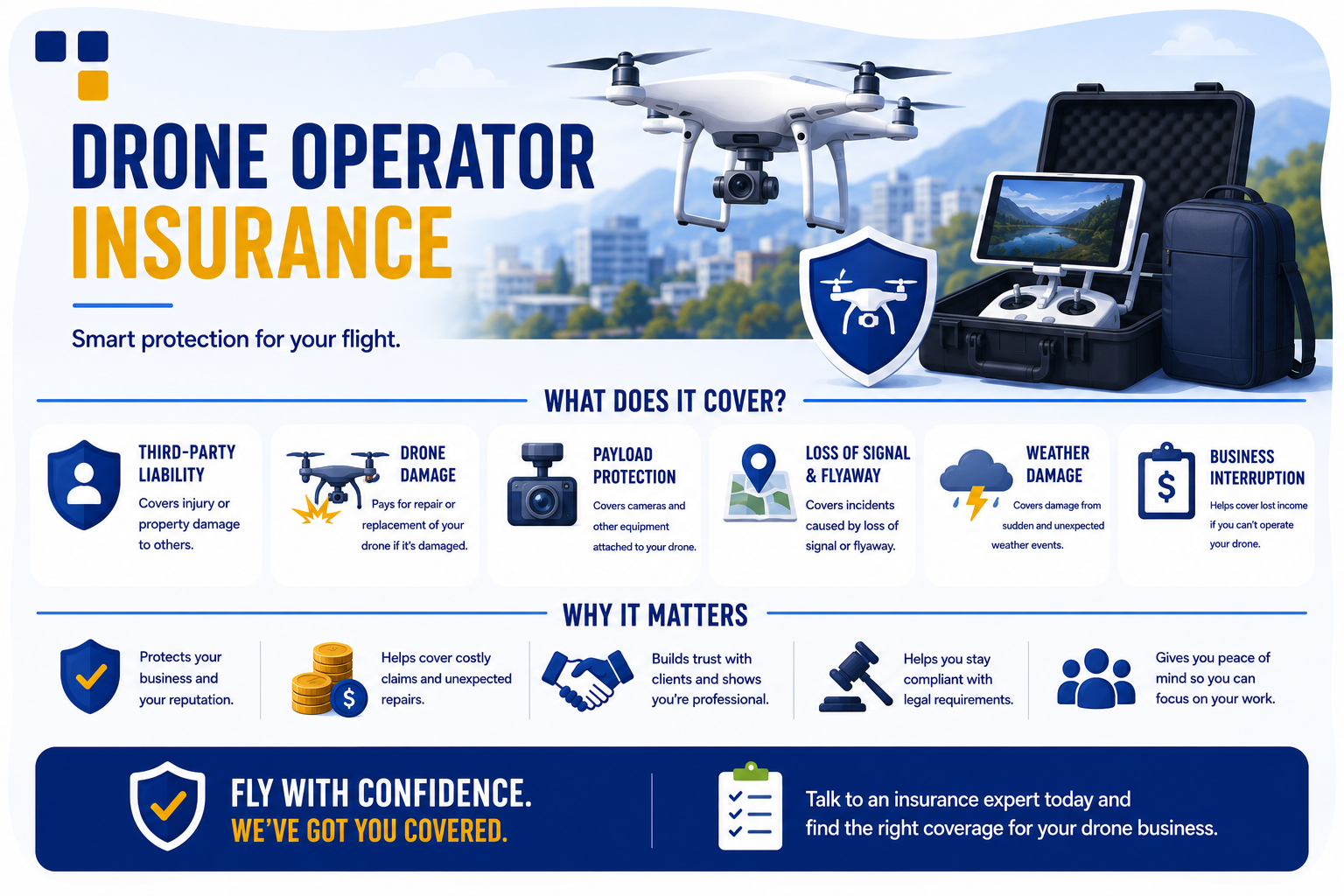
Third-Party Liability (Mandatory)
The 785/2004-compliant third-party liability that satisfies the legal requirement. The statutory minimum for drones below 500kg MTOM is 750,000 SDR — roughly £750,000–£800,000 — but practical limits are higher: £1m is the usual floor, £5m is increasingly the working baseline, and £10m applies for higher-risk operations, usually because the client contract requires it rather than the regulation. The policy must:
- Specifically cover aviation third-party liability
- Be written on aviation policy wording (not standard commercial wording)
- Name the registered Operator as policyholder
- Cover all jurisdictions where you operate
- Include war, terrorism, hijack and sabotage cover as required by 785/2004
Hull and Equipment Cover
Covers physical loss or damage to your drone, payloads (cameras, sensors, gimbals), ground stations, and accessories. Drone hull values can be substantial — professional inspection drones with thermal imaging payloads can cost £20,000+ per aircraft, and survey-grade LiDAR or photogrammetry systems frequently exceed £40,000. Hull cover typically includes:
- Accidental damage during flight, take-off, landing
- Damage in transit and storage
- Theft from premises and vehicles
- Fly-away (drone lost in flight beyond recovery)
- Some policies include weather event damage (lightning, hail, water ingress)
Professional Indemnity (PI)
Essential for any operator providing professional services where the deliverable matters — surveyors, mappers, photographers delivering specific outputs, inspection contractors, agricultural surveyors. PI insurance covers claims arising from errors or omissions in the work product — inaccurate mapping data, missed defects in inspection, image quality issues, deliverables that don't meet contractual specifications. Limits typically £500k–£2m for smaller operators; £5m+ for larger survey firms or operators working with high-value infrastructure clients.
Public Liability (Non-Aviation Activities)
Standard public liability cover for non-aviation aspects of your business — visitors to your premises, equipment used on the ground, in-person client meetings. Aviation third-party liability covers the flight; standard PL covers everything else. Don't confuse them — they're different policies addressing different risks.
Cyber Insurance
Drone operations involve substantial data — flight logs, captured imagery and video, customer information, ground station systems. Cyber insurance covers data breach response, ransomware, business interruption from system outage, and increasingly the operational technology exposures specific to connected drones (firmware tampering, ground station compromise, communication link interference).
Employers' Liability
Statutory requirement under the Employers' Liability (Compulsory Insurance) Act 1969 if you employ anyone — including a co-pilot, visual observer, or ground crew. The statutory minimum is £5m, though most policies are issued at £10m as standard. Penalties for trading without it can reach £2,500 per day. Many drone operators use subcontractor pilots; the employer / subcontractor question affects EL responsibility and should be clearly documented.
Personal Accident
Often overlooked but valuable for drone operators — many of whom are sole traders or owner-operators where personal injury halts the business immediately. Covers loss of income from injury sustained during operations, with options for one-off lump sum payments for serious injury.
Goods in Transit
Drones and equipment moving between sites, particularly for survey and inspection contractors with multiple daily locations. Standard policies often have low transit sub-limits; declared transit cover is more robust for high-value equipment.
Legal Expenses
Covers legal costs in disputes — contract disputes with clients, CAA enforcement matters, employment matters. The CAA enforcement extension specifically can be valuable: drone law is complex and well-meaning operators can find themselves on the wrong side of a regulatory inquiry without warning.
5. Business Type Cover Checker
Select your drone operation type below for a general checklist of the cover commonly arranged for that profile.
Commercial Drone Operator Cover Checker
Select your operation type to see the cover typically arranged
Aerial Photography / Video / Cinematography
- CRITICAL Assimilated Regulation (EU) No 785/2004 compliant third-party liability — typically £1m–£5m for Open Category photography work
- ESSENTIAL Hull and equipment cover — cameras, gimbals, lenses add substantially to drone hull value; declare all payloads
- ESSENTIAL Night operations endorsement if working after sunset (requires green anti-collision light from January 2026)
- ESSENTIAL Public liability for non-flight activities — client meetings, location scouting, equipment handling on ground
- ESSENTIAL Goods in transit cover — equipment moving between locations daily
- RECOMMENDED Professional indemnity — particularly where deliverables include edited footage with specific contractual specifications
- RECOMMENDED Personal accident — sole-trader photographers face immediate business stop if injured
- RECOMMENDED Cyber insurance — client footage and personal data on storage systems
- CONSIDER Crowded location endorsement for event photography, sporting events, festivals
Land Surveying / Mapping / Photogrammetry
- CRITICAL Professional Indemnity at substantial limits — survey errors generate the largest claims in drone services; £1m–£5m typical
- ESSENTIAL 785/2004-compliant third-party liability at £5m minimum (clients in construction routinely require this)
- ESSENTIAL Hull and equipment cover including survey-grade payloads (LiDAR sensors, multispectral cameras, RTK ground stations can each exceed £20,000)
- ESSENTIAL PI retroactive date — survey errors often only surface when construction or planning issues arise months later
- ESSENTIAL Cyber insurance — geospatial data is increasingly considered protected information; client confidentiality obligations
- ESSENTIAL Goods in transit — high-value survey equipment in vehicles daily
- RECOMMENDED Legal expenses with contract dispute cover — survey contracts often dispute scope and accuracy
- RECOMMENDED Specific Category Operational Authorisation cover if you operate in built-up areas
Infrastructure / Building / Roof Inspection
- CRITICAL Third-party liability £5m–£10m typical — inspection work frequently near valuable infrastructure (power lines, telecoms, occupied buildings)
- ESSENTIAL Professional Indemnity covering missed defects, inspection negligence, reporting errors
- ESSENTIAL Hull cover for thermal imaging, zoom payloads, and inspection-specific equipment
- ESSENTIAL Public liability for site work — ground crew, working at height adjacent operations, scaffolding interactions
- ESSENTIAL Specific Category cover if working in built-up areas or near assemblies of people
- ESSENTIAL Employers' Liability for any ground crew or co-pilot
- RECOMMENDED Working at height contractor cover for any roof-access ground operations
- RECOMMENDED Contractors combined structure if combining drone with ground inspection services
Agricultural / Crop Spraying / Precision Farming
- CRITICAL Specialist agricultural drone insurance — heavier drones (often 25kg+) and chemical payload exposure place this outside standard drone cover
- ESSENTIAL Third-party liability at substantial limits (£5m–£10m+) reflecting chemical contamination, neighbouring crop damage, water source proximity
- ESSENTIAL Specific Category Operational Authorisation — most agricultural spraying operations exceed Open Category limits
- ESSENTIAL Environmental liability cover — chemical spillage, off-target drift, water contamination
- ESSENTIAL Hull cover at agricultural drone values (£15,000–£40,000+ per aircraft)
- ESSENTIAL Professional Indemnity for crop monitoring and yield prediction services
- RECOMMENDED Chemical handling protocols documented and trained — typically a policy condition
- CONSIDER Aviation-specific market placement — many UK insurers decline agricultural drone risks
Multi-Pilot Fleet / Drone Services Firm
- ESSENTIAL Fleet-rated third-party liability covering all drones and all pilots on a single policy
- ESSENTIAL Multi-aircraft hull cover with aggregate limits and per-aircraft sub-limits
- ESSENTIAL Employers' Liability — statutory minimum £5m, typically issued at £10m
- ESSENTIAL Professional Indemnity at firm-level limits reflecting aggregate engagement values
- ESSENTIAL Cyber insurance with multi-site and multi-user scope
- ESSENTIAL Business interruption — operational stoppage from incident, equipment loss, or pilot unavailability
- ESSENTIAL Directors' & Officers' liability if operating as a limited company
- RECOMMENDED Subcontractor pilot vetting protocols and indemnification clauses (a policy condition for many insurers)
- CONSIDER Broader business liability programme rather than pure drone cover
Specific Category / BVLOS / Specialist Operations
- CRITICAL Specialist market placement typically required — mainstream drone insurance markets often decline Specific Category and BVLOS risks
- ESSENTIAL Third-party liability at substantial limits (£5m–£25m+) reflecting elevated operational risk
- ESSENTIAL Operational Authorisation, Operations Manual, and pilot qualification evidence as policy conditions
- ESSENTIAL Hull cover at significant payload values — specialist drones, ground stations, communication infrastructure
- ESSENTIAL Professional Indemnity matching the typical client contract size in your sector
- ESSENTIAL Cyber insurance with OT (operational technology) coverage for ground station and communications systems
- ESSENTIAL Maintenance records as policy condition — Specific Category typically requires documented airworthiness
- RECOMMENDED D&O liability for limited company directors
- RECOMMENDED Contact Miller & Partner directly — this profile needs specialist aviation market placement
General information about cover commonly arranged for each operation type. It is not a personal recommendation and doesn't take account of your circumstances.
6. Operation Risk Assessor
Two factors determine drone insurance risk and cost more than anything else: where you fly and what category you operate in. Use the tool below to identify your general risk profile.
Drone Operation Risk Assessor
Select your typical operating environment and category to see your general risk profile
Please select both your operational category and typical environment.
General guidance based on the two answers given. It is not a personal recommendation, a quotation, or an assessment of your actual operation.
7. Professional Indemnity for Surveying, Mapping and Inspection
The growth area for UK drone insurance claims hasn't been third-party liability — it's been professional indemnity. Drone operators have moved from being primarily photographers to being data providers: the deliverable is a survey, a model, an inspection report, a digital twin, an orthomosaic, a thermal map. When that deliverable is wrong, the resulting financial loss can be very substantial — and far exceeds the cost of any drone hardware or the typical third-party liability event.
What Professional Indemnity Claims Look Like in Drone Services
Typical drone PI claims include:
- Survey accuracy disputes — measurements that prove inaccurate, ground control point errors, photogrammetry quality issues
- Missed defects in inspection reports — undetected damage to a building, missed corrosion on infrastructure, overlooked safety issues
- Photogrammetry and 3D model errors — geometric inaccuracies in models used for engineering or planning decisions
- LiDAR point cloud errors — calibration issues, registration errors, datum confusion
- Thermal imaging interpretation errors — missed thermal anomalies in industrial inspection
- Deliverables that don't meet contractual specification — resolution, accuracy, completeness
- Late delivery that creates downstream client losses
- Data security failures creating client confidentiality breaches
The financial consequences of these errors flow through to your client's downstream decisions. A horizontal accuracy error in topographical mapping can translate into tens of thousands of pounds of rework on a construction site. An inspection that missed a defect which subsequently caused failure can trigger claims of multiple times that. The PI limit needs to reflect these downstream consequences, not just your fee for the original work.
What to Confirm In Your PI Wording
- Surveying, mapping, photogrammetry, and inspection services explicitly within scope
- Datum / coordinate system errors within cover
- Cover for errors in software-generated deliverables (photogrammetry software, LiDAR processing)
- Full retroactive date — claims often surface months or years after delivery
- Run-off provisions if you sell, close, or restructure the business
- Loss of documents and electronic data cover for original captured data
- Defence costs structure — inside vs outside the limit
The Surveyor / Engineer / Professional Body Question
Many UK drone surveyors hold RICS membership, work alongside chartered engineers, or sit within engineering consultancies regulated by professional bodies. Where this is the case, the PI policy must align with the requirements of the relevant professional body — RICS, ICE, IStructE, or others — which often impose minimum PI limits and specific wording requirements as a condition of membership. Failing to maintain compliant PI puts both your insurance position and your professional membership at risk.
8. BVLOS, Night, and Specific Category Operations
The most rapidly growing area of UK commercial drone work is Specific Category operations — including BVLOS (Beyond Visual Line of Sight), operations at night, operations in built-up areas, and operations with heavier or more complex aircraft. Each of these creates specific insurance considerations.
BVLOS Operations
BVLOS removes the operational constraint that the remote pilot must maintain visual line of sight with the drone at all times. It enables longer-range inspection work, larger-area surveys, delivery operations, and more efficient infrastructure monitoring. The CAA permits BVLOS only under specific Operational Authorisations, typically requiring:
- Detect-and-avoid capability or operational mitigations (e.g. operating in segregated airspace)
- Specific aircraft and ground station systems
- Trained and qualified remote pilots — RPC-L1 Part B covers BVLOS visual mitigation, with RPC-L2 and L3 above it
- Comprehensive Operations Manual and UK SORA risk assessment
- Specific airspace coordination
For insurance, BVLOS creates significantly elevated third-party liability exposure because the operator cannot directly observe the aircraft and avoid emerging hazards. Premium loadings are material; some mainstream insurers decline BVLOS risks entirely; specialist aviation market placement is the standard route. Confirm explicitly:
- BVLOS operations are within the policy scope
- The specific Operational Authorisation reference is noted on the policy
- Aircraft system requirements (Remote ID, communications, detect-and-avoid) are documented as policy conditions
- Maintenance and airworthiness records meet the policy's specified standards
Night Operations
Night flying is widely used for cinematography, inspection of illuminated infrastructure, and event photography. The January 2026 requirement for a flashing green anti-collision light adds a specific compliance step. From an insurance perspective:
- Night operations must be declared to your insurer — some policies exclude night flying entirely
- The anti-collision light requirement is a policy condition for compliant night operations from January 2026
- The light counts toward drone MTOM and may shift which operational rules apply
- Reduced visibility increases the risk of strikes against unexpected obstacles, raising premium
Built-Up Area Operations
Drone operations in built-up areas (typically meaning urban environments with residential, commercial, or industrial congregation) sit in the Specific Category and require Operational Authorisation. Insurance considerations:
- Higher third-party liability limits typically required (£5m–£10m+ depending on density)
- Specific risk assessment for each operation site
- Documented evidence of pilot competence at A2 CofC, GVC or RPC-L1 level
- Some policies require notification of each built-up area operation in advance
- Particular sensitivity around critical national infrastructure (rail, power, telecoms)
Heavy-Lift and Industrial Operations
Drones exceeding 25kg MTOM, agricultural spraying drones, heavy-lift survey aircraft, and industrial inspection drones in hazardous environments are increasingly common. These typically operate in the Specific Category and require specialist insurance placement. The third-party liability minimums under 785/2004 scale with MTOM: 750,000 SDR below 500kg, 1,500,000 SDR from 500kg to under 1,000kg, and higher again above that. Almost all UK commercial drones sit in the lowest band, but operators using heavier aircraft must verify compliant limit selection.
9. What Drives the Cost
| Rating Factor | Impact on Premium | What You Can Do |
|---|---|---|
| Operational category | Open Category lowest; Specific Category significantly higher; BVLOS / Certified specialist placement only | Match category to actual operations; don't carry Specific Category cover if you only operate in Open |
| Drone MTOM and value | Both third-party liability minimums and hull premium scale with weight and value | Declare accurate MTOM and replacement value; over-declaration is expensive, under-declaration risks coverage |
| Operating environment | Rural lower; urban higher; events and crowds materially higher | Declare typical operating environment honestly — environment-specific exclusions can leave you uninsured |
| Service type | Photography lower; survey/mapping/inspection higher because of PI exposure | Match PI limit to client contract values; survey work needs structurally different cover from photography |
| Number of drones and pilots | Fleet rating typically more efficient than per-drone individual policies | Single fleet policy usually outperforms multiple individual policies for 3+ drones |
| Pilot qualifications | A2 CofC, GVC and RPC rate better than Flyer ID only; documented training reduces premium | Maintain documented pilot qualifications and currency; insurers often require evidence at renewal |
| Claims history | Material multi-year impact (3-5 years); a single significant claim can move premium sharply | Comprehensive risk management documentation reduces claims; address root causes quickly |
| Limit selection | £1m, £5m, £10m all rate differently; PI sub-limits separately rated | Match limits to genuine exposure; over-buying liability cover is expensive |
| Night and BVLOS operations | Specific premium loadings; some markets decline entirely | Declare these operations specifically; document compliance with the January 2026 anti-collision light requirement |
| Territorial scope | UK-only lowest; EU adds modest loading; worldwide significantly higher | Match scope to actual operating territory; international work without territorial extension is uninsured |
10. Illustrative Claims Scenarios and How to Manage Them
Scenario — Property Damage from Drone Strike, Aerial Photography Operator
A commercial aerial photographer operating at A2 CofC level is contracted to photograph a new-build property on a private estate for marketing purposes. During the shoot, the drone — a sub-2kg professional model — experiences a sudden GPS lock loss and initiates its return-to-home function, but in doing so collides with a glass conservatory at the rear of the property. The structural glass panel cracks across its full length, and the drone hull is destroyed in the impact.
Property damage at the conservatory: around £6,800 for replacement glass, frame inspection and installation. The drone hull and gimbal: around £3,200 to replace. The operator notifies the insurer within 24 hours.
The 785/2004-compliant third-party liability section responds to the property damage. The hull section responds to the drone replacement, less the policy excess. A claim of this size would typically be expected to affect the following renewal.
A post-incident investigation of this kind commonly identifies that the operator hadn't checked for GPS interference sources at the location — a frequent contributing factor to GPS lock loss near modern buildings with extensive glazing. The practical response is a pre-flight site survey protocol including a GPS signal check before every operation.
The lesson: drone claims usually have identifiable contributing factors that insurers examine after the event. Documented pre-flight protocols both reduce the frequency of claims and improve the settlement outcome when claims do occur. Up-to-date Flyer ID and A2 CofC records support the insurer's defence position.
Scenario — Topographical Survey Accuracy Dispute, Drone Survey Firm
A drone survey firm operating under a Specific Category PDRA delivers a topographical survey of a brownfield site being developed for residential housing, to a stated engineering accuracy specification. Months later, during construction, the contractor identifies discrepancies between the survey ground levels and actual site conditions in two localised areas. Independent verification by ground-based total station confirms a vertical discrepancy, traced to a ground control point that had subsided between survey and verification.
The contractor claims against the survey firm for the cost of redesign and rework — revised drainage engineering, retaining wall modifications, slab thickness adjustments. The firm's PI policy responds, and the insurer engages an independent surveying expert to assess the methodology.
Where the original ground control points were verified at the time of survey using independent observation, and the subsidence occurred after delivery, an expert may well conclude the cause was partly unforeseeable — which typically produces a settlement below the full claimed sum, plus defence costs, against the PI limit. Without contemporaneous records, the same claim tends to settle at a materially higher figure.
The lesson: drone survey PI claims turn heavily on methodology documentation. Contemporaneous records of GCP placement, GPS observation, and accuracy reporting are what allow an insurer to argue a partial defence at all. PI for drone surveyors isn't optional — and the underlying documentation discipline matters as much as the cover itself.
Scenario — Fly-Away Loss During BVLOS Inspection, Specialist Operator
A Specific Category operator conducting a BVLOS power line inspection under an Operational Authorisation loses communications entirely with a specialist inspection drone. The aircraft — equipped with autonomous return-to-home logic — is last reported on a heading that should have returned it within minutes. It never returns and is never recovered. CAA notification, search efforts, and remote tracking attempts return no result.
The hull claim covers full replacement of the drone, ground station components damaged in the incident, and the lost payload (thermal camera and zoom optics) — a five-figure sum on this class of equipment. The operator notifies both the insurer and the CAA within hours, as required under the policy and the Operational Authorisation conditions.
Fly-away — the drone being lost in flight beyond recovery — is covered explicitly under a properly structured hull section, and settlement follows less the policy excess. The operator would be asked to provide all flight log data, maintenance records, communication system records, and pre-flight checks to support the claim. The third-party liability section is not engaged where no third party reports damage. A claim of this size and specialism would be expected to have a significant effect at renewal.
The lesson: fly-away cover is an essential hull component for any commercial drone operator, particularly for BVLOS and high-value specialist operations. Without it, the loss of the drone falls entirely on the operator. The discipline of maintaining proper Operations Manual records, flight logs, and Operational Authorisation compliance evidence is what makes a claim like this payable without challenge.
Claims Management Steps
- For any incident causing injury, property damage, or near-miss: ensure all persons are safe first; preserve the drone, ground station, and all flight data; gather witness contact details; photograph the incident scene before anything is moved.
- Notify your insurer immediately. Most drone policies require notification within 24-48 hours of any incident. Late notification can prejudice cover even where the underlying claim is genuine.
- Notify the CAA where the incident meets the threshold for occurrence reporting — typically any incident causing injury, significant property damage, or near-collision with manned aviation.
- Preserve all evidence. Flight logs (drone and ground station), maintenance records, pilot logs, weather data, pre-flight checklists, communications records, payload data, and the physical drone itself. Don't attempt repairs before the insurer has assessed.
- Do not admit liability. Provide factual information; leave assessment to the insurer's appointed loss adjuster and solicitor. Apologies in the immediate aftermath can prejudice the defence position.
- For property damage claims: document the damage thoroughly with photographs and measurements; do not authorise repairs until the insurer's adjuster has inspected.
- For PI claims (survey/inspection accuracy disputes): retrieve the original captured data, processing records, GCP documentation, and delivered output; engage with the client through your insurer's defence team, not directly.
- For fly-away or hull losses: conduct a search effort; report to the CAA; submit the insurance claim with full operational records; preserve any recovered components.
- Document everything in writing. Phone calls and verbal undertakings count for little in disputed claims. Email summaries of every conversation; preserve files time-stamped.

Frequently Asked Questions
Yes. The Civil Aviation (Insurance) Regulations 2005, supported by Assimilated Regulation (EU) No 785/2004, make third-party liability insurance a statutory requirement for every commercial drone flight in the UK. Commercial means any flight conducted for valuable consideration — paid photography, paid surveys, paid inspection, paid coaching, even paid educational use. The minimum cover level is set by the Maximum Take-Off Mass (MTOM) of the drone. Recreational drone flying does not legally require insurance, but you remain personally liable for any damage caused — and most home insurance policies exclude liability for flying devices. For any commercial work, third-party liability written on aviation policy wording is non-negotiable.
785/2004 — the retained UK version of what was EC 785/2004 — sets the minimum standards for aviation third-party liability insurance, including drones used commercially. To be compliant, a policy must: meet minimum cover levels determined by drone MTOM (750,000 SDR below 500kg, 1,500,000 SDR from 500kg to under 1,000kg); include war, terrorism, hijack and sabotage cover; provide territorial scope matching your operations; be written on aviation policy wording rather than standard commercial wording; and name the registered Operator as policyholder. Generic SME public liability policies do not meet this standard. When obtaining drone insurance, ask the insurer to confirm 785/2004 compliance in writing.
Several significant changes took effect on 1 January 2026:
- Flyer ID required from 100g (previously 250g), with Operator ID required from 100g for drones with a camera — significantly expanding who must register
- UK class marks UK0–UK6 apply to new drone models placed on the UK market, with EU C-class marks recognised as equivalents to 31 December 2027
- Remote ID became mandatory for UK1, UK2, UK3, UK5 and UK6 class-marked drones, extending to legacy and UK0 camera drones of 100g+ from 1 January 2028
- Mandatory green flashing anti-collision light for night operations
Each of these affects insurance: declared night operations now require the anti-collision light; class mark affects which operational rules apply and therefore premium; the 100g threshold brings more operators into the compliance ambit.
The Operator ID is held by the legal person (individual or company) responsible for the drone — typically the owner. It carries an annual fee and must be displayed on every drone. The Flyer ID is held by the person actually flying the drone, obtained free by passing the CAA's online theory test, and valid for five years. For insurance, the policyholder name must match the Operator ID — not the Flyer ID, not a related entity, not the trading name. Mismatch between policyholder and Operator ID is one of the most common drone insurance failures and can be raised against you at claim stage.
It depends on operational category. Open Category A1 requires Flyer ID only. Open Category A2 requires Flyer ID plus A2 Certificate of Competency (A2 CofC). Open Category A3 requires Flyer ID. Specific Category requires Flyer ID plus a higher qualification — GVC or RPC-L1 Part A — and an Operational Authorisation from the CAA tying together the qualification, drone, Operations Manual, and risk assessment. Note that the CAA will stop issuing the GVC on 31 December 2027; existing GVCs remain valid until they expire where the Operational Authorisation accepts them, and bridging courses exist for holders converting to RPC-L1. Insurers typically require evidence of pilot qualifications matching the operational category as a policy condition. Operating outside your qualification level can invalidate cover even where the operation is otherwise compliant.
Only if you have hull and equipment cover. Third-party liability — the legally required cover — protects against claims from others; it does not cover damage to your own drone. Hull and equipment cover is a separate policy section covering physical loss or damage to your drone, payloads, ground stations, and accessories. Typical hull cover includes accidental damage during flight, take-off and landing; damage in transit and storage; theft; fly-away (drone lost in flight beyond recovery); and sometimes weather event damage. Hull values can be significant for professional drones — survey-grade LiDAR or inspection-grade thermal payloads can each exceed £20,000.
If your deliverable matters — survey data, mapping, inspection reports, photogrammetric models, thermal images for engineering use — yes. Professional indemnity covers claims arising from errors or omissions in your work product. Survey accuracy disputes, missed defects in inspection, model errors, and deliverables that don't meet specification all create PI claims that can substantially exceed third-party liability events. Photography and cinematography work has lower PI exposure; survey, mapping, and inspection work has high PI exposure and limits should reflect the downstream financial consequences of error, often multiples of your original fee.
Night operations must be declared to your insurer. Some policies exclude night flying entirely; others include it but require the operator to comply with operational requirements — including, from 1 January 2026, the mandatory flashing green anti-collision light. The light itself counts toward drone MTOM and may shift which operational rules apply. Insurers typically charge a modest loading for declared night operations. Flying at night under a policy that excludes it leaves you uninsured for both regulatory and claim purposes — confirm in writing whether night operations are included before flying after sunset.
Only with specific cover, and typically through specialist aviation market placement. BVLOS (Beyond Visual Line of Sight) operations sit in the Specific Category and require both a CAA Operational Authorisation and specific insurer agreement. Mainstream UK drone insurance markets often decline BVLOS entirely. Where cover is available, the policy will typically reference the specific Operational Authorisation, require evidence of Operations Manual compliance, and impose conditions on aircraft systems (Remote ID, communications, detect-and-avoid). Premium for BVLOS operations is materially higher than for Open Category. Contact a specialist drone broker for BVLOS placement.
Pricing varies widely by operation type and risk profile. Broad market ranges for illustration only — these are not quotations:
- Single drone, Open Category, occasional commercial use: £180–£500 per year
- Single drone, Open Category, regular commercial use: £400–£1,200 per year
- Survey or inspection operator with PI: £900–£3,500 per year
- Multi-drone fleet (3-10 aircraft): £2,500–£8,000 per year
- Specific Category BVLOS specialist: £4,000–£15,000+ per year (specialist placement)
- Agricultural / heavy-lift / hazardous operations: specialist market only, typically £6,000+ per year
Drivers: operational category, drone weight and value, environment (urban and events significantly higher), service type (survey and inspection cost more than photography because of PI), claims history, and limits selected.
Critical first steps: ensure all persons are safe; preserve the drone and any ground station components; gather witness details; photograph the scene before anything is moved. Then: notify your insurer within 24-48 hours (most policies require this), notify the CAA if the incident meets occurrence reporting thresholds (typically injury, significant property damage, or near-collision with manned aviation), preserve all flight logs and maintenance records, and do not admit liability. Your insurer can advise on whether your incident requires CAA notification. Late insurer notification can prejudice cover even where the underlying claim is genuine.
You need cover that explicitly recognises and covers your Operational Authorisation. The OA reference should appear on the policy schedule or in the policy wording. The policy must respond to operations within the OA scope; operations outside the OA are typically excluded. If you obtain a new OA, you must update your insurance. If your OA conditions require specific aircraft systems, training, or maintenance, those become policy conditions too. Specific Category operators should confirm at every renewal that the policy continues to align with the current OA — operational and insurance documentation should be reviewed together as a single compliance pack.
Important information
Miller & Partner Ltd is an Appointed Representative of Gauntlet Risk Management Ltd, which is authorised and regulated by the Financial Conduct Authority (FRN 308081). Miller & Partner Ltd is entered on the FCA Register under reference 1029698. Registered in England and Wales, company number 16206282. Registered office: Vivian House, Roman Bridge Close, Mumbles, Swansea, SA3 5BG.
This guide is general information about commercial drone insurance and the regulatory framework around it. It is not a personal recommendation, a quotation, or an offer of cover, and it doesn't take account of your circumstances. Cover, limits, terms and exclusions vary by insurer and are subject to underwriting. Premium figures are illustrative market ranges, not quotations.
Regulatory content reviewed 20 August 2026. CAA rules and dates change — always check caa.co.uk/drones for the current position before relying on anything here.





Instagram
LinkedIn