


Game Development Studio Insurance UK | Specialist Cover
Why does UK game development need specialist insurance treatment in 2026?
UK game development has spent the last decade quietly becoming one of Europe's most valuable creative industries — a £12 billion sector employing roughly 27,000 developers across 800-plus studios, generating £2.2 billion in annual Treasury receipts, and exporting world-class titles to every major platform. It has also, in the last 18 months, become one of the most heavily regulated, with a risk profile that bears almost no resemblance to the contractor-package mindset that historically served small studios.
The triggers stack. The Online Safety Act 2023 moved from statute to active enforcement through 2025, with Ofcom publishing dedicated guidance for the video games industry in October 2025 confirming that any studio operating a service with user-to-user features — chat, voice, lobbies, matchmaking, UGC, mod tools — is in scope. Ofcom issued its largest single OSA fine of over £1 million in late 2025 and has signalled wider enforcement action through 2026. PEGI's June 2026 classification reform automatically rates any game containing loot boxes at PEGI 16 minimum and any game with unrestricted communication at PEGI 18, fundamentally changing the commercial economics of monetisation features. The Data (Use and Access) Act 2025 tightened UK GDPR breach reporting and clarified player data handling obligations. The Video Games Expenditure Credit (VGEC) replaced VGTR from April 2025, restructuring how studios must evidence qualifying UK expenditure. And the TIGA "Making Games in the UK" report published in March 2026 documented the first UK industry employment decline since 2011 — a 4.5% workforce contraction — with rising insurance and compliance burden cited among contributors.
Against that backdrop, an off-the-shelf contractor or office package policy is now a meaningfully bad fit for a working studio. The actual UK 2026 claim drivers — IP infringement disputes, player data breaches, technical professional indemnity claims on platform submissions, publisher contract disputes, equipment and source code loss, employment practices claims in a contracting workforce — sit largely outside the cover scope of generic policies, or are written with exclusions that bite at exactly the point the studio needs the policy to respond. Generic cyber sub-limits are a particular trap, as is the standard exclusion of intellectual property and media liability under non-specialist PI wordings.
This guide is the definitive UK game development business insurance article for 2026 — built around the regulatory landscape that's reshaped the risk profile, the claim-driving exposures, the cover architecture that responds, and the underwriting evidence that gets specialist terms placed. It sits inside our wider AI and tech insights cluster and complements our deeper guides on cyber insurance, SaaS business insurance, esports team insurance, and insurance for IT contractors.
Key facts at a glance
- The UK video games industry is worth £12 billion in GVA, employing approximately 27,000 developers across roughly 800 studios. 78% of UK studios employ four or fewer staff, making this overwhelmingly a small-business sector — and one where specialist insurance placement is hardest to access generically.
- Ofcom Online Safety Act guidance for games took effect October 2025, with enforcement intensifying through 2026. Any UK studio operating user-to-user chat, voice, matchmaking, UGC, or community features is in scope. Maximum OSA fines are £18 million or 10% of global turnover — uninsurable as fines but defence costs are insurable.
- PEGI's June 2026 reform automatically rates loot box games PEGI 16 minimum and unrestricted-communication games PEGI 18. UK physical-format PEGI ratings are legally enforceable under the Video Recordings Act 1984, materially affecting commercial release strategy and monetisation design.
- Intellectual property infringement is the dominant catastrophic claim category for UK game studios. Defence costs alone routinely reach £80,000–£250,000 in serious cases; settlements £100,000–£800,000+. Specialist Media Liability cover sits outside generic PI and is essential for any studio releasing original IP.
- ICO fines for UK GDPR breaches reached record levels in 2025 — the largest single fine was £14 million (Capita, October 2025). Player data breaches in multiplayer titles are an active claim category given the volume of email, payment, and behavioural data game studios now process.
- UK game development insurance typically runs £750–£3,000 for sole indie developers and £4,000–£40,000+ for small-to-mid studios with comprehensive PI, media liability, cyber, and EL programmes. AAA-scale operations with £25m+ turnover may invest £80,000–£500,000+ annually across a structured insurance programme.
- Insurance non-disclosure under the Insurance Act 2015 is the most preventable catastrophe in game development insurance — operating live multiplayer, UGC features, or international distribution under a generic office package without specific declaration creates uninsured loss exposure that can dwarf the studio's entire valuation.
1. The 8 biggest game development risks: summary table
The risks below are ranked by combined frequency, severity, and regulatory consequence under the 2026 framework. Some — technical PI claims, equipment loss — are everyday operational realities. Others — IP litigation from major publishers, Online Safety Act enforcement — are infrequent but business-ending when they occur. A mature programme manages all eight rather than addressing them in priority order.
| Risk | Frequency | Severity | Primary Cover |
|---|---|---|---|
| IP / copyright / trademark infringement | Occasional but rising | Catastrophic (£100k–£800k+ defence + settlement) | Media Liability / IP infringement defence |
| Player data breach (cyber) | Rising sharply | High (£50k–£500k+; ICO fines uninsurable) | Cyber and Data Liability |
| Professional indemnity — technical errors | Routine for work-for-hire studios | Medium-High (£20k–£200k typical) | Professional Indemnity / Tech E&O |
| Publisher / platform contract breach | Occasional | High (£40k–£500k typical) | PI with contract scope; Legal Expenses |
| Online Safety Act / PEGI regulatory action | Rare but rising | Catastrophic (fines uninsurable; defence £50k–£500k) | Legal Expenses; D&O |
| Employment practices / contractor disputes | Rising in contracting industry | Medium (£15k–£75k typical) | EL + EPLI / Management Liability |
| Equipment, source code, and asset loss | Routine | Low-Medium (£2k–£60k typical) | Office contents / portable equipment / BI |
| Insurance non-disclosure | Common (often unnoticed) | Catastrophic (entire claim uninsured) | No insurance response — proposal discipline |
2. How does the Online Safety Act change game studio insurance in 2026?
The Online Safety Act applies to any "user-to-user service" — and Ofcom's October 2025 guidance for the video games industry confirms that this captures the vast majority of modern multiplayer, live-service, and online-component games. The Act doesn't care whether the studio is large or small; it applies if a "significant number" of UK users can access the service, or if UK users are part of the target market. The compliance bar is the same.
The duties cascade through three operational layers. Studios must complete illegal content risk assessments covering 17 specified categories of illegal content (terrorism, child sexual exploitation, hate-based offences, fraud, and so on). They must complete children's access assessments, and where children can access the service, complete children's risk assessments covering 12 categories of harmful content. They must put in place safety measures — content moderation, reporting tools, complaint procedures, and where children are users, age-appropriate design. And they must keep records of all of the above, available for Ofcom inspection.
The insurance implications are sharp:
Implication 1: Defence costs for Ofcom investigation are insurable; fines are not
The Online Safety Act maximum penalty is £18 million or 10% of global turnover, whichever is higher. Under UK public policy, regulatory fines are uninsurable. But the defence costs of an Ofcom investigation — preparation, legal representation, evidence gathering, response submissions — are routinely £50,000–£500,000 for a contested matter, and they are insurable under properly-scoped Legal Expenses cover. Studios without that cover face the regulator's investigation on their own balance sheet.
Implication 2: Risk assessment documentation as cover defence
The studio's OSA risk assessments, content moderation policies, age-assurance evidence, and complaints handling logs are not just regulatory deliverables — they're the documentary file insurers and Legal Expenses providers will rely on to defend an investigation. Studios with thin or generic documentation will struggle to access specialist terms at renewal.
Implication 3: D&O exposure for senior managers
The OSA contains senior manager liability provisions. While these are most likely to bite for the largest categorised services, smaller studios with named senior managers face potential personal exposure where serious systemic failures are attributable to their action or neglect. Directors and Officers cover responds to defence costs for personal regulatory exposure.
Implication 4: Content moderation operational cost ripple
OSA-driven moderation, complaint-handling, age-assurance, and risk-assessment work is now a recurring operating cost rather than a one-off. The cost ripples into insurance because studios with mature moderation and documented child-safety controls present materially better to underwriters than those who haven't engaged with the Act. The premium differential is meaningful.
3. Risk 1: Intellectual property infringement — the AAA litigation threat
IP Infringement — The Catastrophic Claim
Intellectual property infringement is the single most expensive routine claim category for game development studios — and the Nintendo v. Pocketpair litigation over Palworld (filed September 2024 in the Tokyo District Court, ongoing through 2026) has put the issue back at the top of every games legal team's agenda. The dispute is being prosecuted on patent rather than copyright grounds, which is itself instructive: where major publishers can't easily establish copyright infringement on creature design, they pivot to patented gameplay mechanics, where the prior art defence is harder to construct and the discovery process more favourable to the claimant.
UK studios face this exposure from three directions. They can be sued by competitors alleging that their original work copies an established title (character design, gameplay mechanics, asset libraries, sound, music, lore). They can be sued by content owners where third-party assets were used without proper licence — typeface, music, sound effects, stock art, motion capture libraries, voice talent likeness. And they can be sued by individuals where employee or contractor-created work turns out to derive from another protected work the studio didn't know about. Each route generates separate defence costs and separate exposure. The Palworld litigation is generating reported defence costs in seven figures — a useful reference point for what serious IP disputes look like at the upper end.
Documented IP clearance process for all third-party assets used in development (music, art, fonts, code libraries); written assignment of IP from all freelancers, contractors, and employees; IP register tracking ownership of every asset in the game; legal review of character design and gameplay mechanics where any resemblance to existing IP could be alleged; due diligence on music and voice talent licensing including platform-specific rights (some music licences exclude streaming or video monetisation); NDAs and confidentiality protocols across the whole supply chain; review of EULA and Terms of Service by competent IP counsel before launch.
Specialist Media Liability cover — sometimes called IP Infringement Defence — is the primary response, and it sits outside generic PI in most market wordings. The cover should address copyright, trademark, design right, passing off, and content-related claims. Defensive scope (responding to claims against the studio) is the standard form; offensive scope (pursuing claims against infringers of the studio's IP) is a separate product. Defence costs cover is critical: even where the studio successfully defends, costs alone routinely run £80,000–£250,000 for a meaningful dispute. Settlements £100,000–£800,000+. The cover is materially more expensive than generic PI but the exposure differential makes it essential for any studio releasing original IP.
4. Risk 2: Player data breach and cyber attack exposure
Player Data Breach — The Rising Claim Category
Modern game development studios — even small indie operations — process player data at a scale that would have been unthinkable a decade ago. Multiplayer titles, mobile games, and live-service products routinely process email addresses, usernames, IP addresses, payment tokens, device identifiers, behavioural telemetry, voice and chat logs, and in some cases biometric data through age-assurance flows. Each of these is personal data under UK GDPR, with attendant breach notification, lawful basis, retention, and security obligations.
The ICO's 2025 enforcement record has been a wake-up call across UK tech. The Capita £14 million fine in October 2025 (originally proposed at £45 million before settlement discount) was the largest single fine of the year, but the broader pattern shows the ICO concentrating on fewer, larger penalties focused on security failures rather than procedural infringements. The 2025 trend is significantly larger average fines for systematic security failures — inadequate MFA, slow incident response, poor patch management, missing audit logs. Game studios fit this risk profile uncomfortably well: lean operations, fast iteration cycles, third-party dependencies, and complex multiplayer infrastructure all create attack surface that mature controls have to keep pace with.
Documented data protection impact assessment for any new game feature processing personal data; UK GDPR-compliant privacy notices, lawful basis records, and consent flows; MFA enforced on all administrative access to player data systems; documented patch management with defined timescales by severity; backup and recovery testing on a defined schedule; incident response runbook with named owners and 72-hour ICO notification flow; staff data protection training; third-party processor contracts (Article 28) with all cloud providers, anti-cheat vendors, analytics partners, and outsourced QA; periodic penetration testing for live-service titles.
Specialist Cyber and Data Liability cover is the primary response. The cover should address: first-party costs (incident response, forensic investigation, customer notification, credit monitoring, public relations, system restoration); third-party liability (player and partner claims arising from the breach); regulatory defence costs (ICO investigation legal costs — fines themselves uninsurable); business interruption from system outage. Limits typically £500k–£5m depending on player base size; studios with 100k+ player accounts increasingly need £2m+. Generic office package cyber sub-limits (often £25k–£100k) are functionally inadequate for any studio operating a live multiplayer or live-service title. See our small business cyber insurance guide for cover principles, and our main cyber insurance page.
5. Risk 3: Professional indemnity — technical errors and software defects
Technical PI — The Work-For-Hire Studio Exposure
The largest claim category for work-for-hire and contracted game development studios is technical professional indemnity — claims arising from software defects, missed milestones, platform certification failures, performance shortfalls, or technical advice that proves to be wrong. The pattern is well-established: the studio delivers a build, the publisher or platform identifies a defect or shortfall, contractual remedies are invoked, and where the studio's response is inadequate the matter escalates to a formal claim.
Platform certification failures are a particularly UK-specific pain point. Sony, Microsoft, and Nintendo each maintain their own certification (TRC, XR, Lotcheck) standards, and a failed cert can mean missed launch windows, refunded pre-orders, and contractual penalties. Where a publisher contracts a studio to deliver a "platform-ready" build and the build then fails cert, the financial damage flows back through the work-for-hire contract — and into the studio's PI. Mobile platform compliance (Apple App Store, Google Play) creates a parallel exposure.
Written milestone definitions in every work-for-hire contract; QA process documented with traceable test plans; platform compliance checklist completed and signed off per submission; contract acceptance terms reviewed before signing (avoiding open-ended warranty obligations); change order discipline (any scope change documented and re-priced before work proceeds); explicit limitation of liability and exclusion of consequential loss in client contracts where possible; documented version control and build provenance for any submitted build.
Professional Indemnity with Tech E&O scope is the primary response. Limits typically £500k for solo developers and small indie studios; £1m–£2m for mid-sized work-for-hire studios; £5m+ for AAA tier work or studios with large publisher contracts. Run-off cover is important — PI claims can surface 2–3 years after the work was performed, especially where a published title later experiences issues attributed back to the original code. Generic IT contractor PI may not contemplate game-specific exposures like platform certification, in-game performance, or mod tool security; specialist game studio PI does. For broader principles see our professional indemnity guide.
6. Risk 4: Publisher and platform contract breach
Publisher Contract Breach — The Money-At-Stake Claim
Publisher contracts in the games industry are structured for the publisher's benefit. Standard terms include milestone-based payments tied to acceptance, claw-back provisions for failed milestones, broad warranty and indemnity obligations on the developer, intellectual property assignment, audit rights, and termination for cause provisions that can be triggered by relatively minor breaches. US publisher contracts in particular are often onerous, with US jurisdiction clauses, additional insured requirements that smaller studios struggle to meet, and confidentiality obligations that survive termination.
Where a project goes wrong — milestone slippage, scope disagreement, build quality dispute, market underperformance with claim-back, or termination for convenience — the contractual claim profile is sharp. The publisher has the money, the leverage, and typically the legal budget. The developer has the IP arguments, the development records, and a PI policy that may or may not respond depending on how the claim is framed. Where the dispute is framed as professional negligence or breach of warranty, PI typically responds; where framed as breach of contract pure, PI scope is narrower and Legal Expenses becomes critical.
Contract review by competent games-experienced legal counsel before signing — never sign a publisher contract on the day it arrives; documented milestone definitions with specific acceptance criteria; weekly written status updates to publisher (which both deliver transparency and create a contemporaneous record); milestone acceptance recorded in writing — never proceed past a milestone until acceptance is documented; change orders in writing for any scope variance; escrow arrangements for source code where appropriate; warranty period defined and limited; territorial limit clauses to manage US exposure where possible.
Professional Indemnity with contract dispute scope is the primary response for claims framed as professional negligence. Legal Expenses cover is essential for claims framed as pure contractual disputes — defence costs alone for a publisher dispute run £40,000–£300,000+. US jurisdiction exposure typically requires specific endorsement and incurs significant rating uplift; some markets exclude US-domiciled claims entirely without a specific extension. Specialist game studio brokers can negotiate publisher contract review service as part of the insurance package — a meaningful value-add for smaller studios without in-house legal.
7. Risk 5: PEGI 2026 reform, loot boxes, and monetisation compliance
PEGI June 2026 Reform — The Monetisation Compliance Risk
PEGI's June 2026 classification reform — announced 12 March 2026 — is the most significant change to European game age ratings in over a decade. Four new "interactive risk categories" join traditional content descriptors: in-game purchases (PEGI 7 or 12 depending on parental controls), loot boxes and paid random items (automatic PEGI 16 minimum), unrestricted communication features (PEGI 18), and NFT/blockchain mechanics (automatic PEGI 18). The reform applies to all newly submitted titles from June 2026 onwards.
In the UK, PEGI ratings on physical-format games are legally enforceable under the Video Recordings Act 1984. Selling a PEGI 18 game to a person under 18 is a criminal offence carrying fines up to £5,000 per offence. The commercial consequence of automatic age uplift is meaningful: a free-to-play casual mobile title with loot boxes that previously sat at PEGI 7 will, from June 2026, sit at PEGI 16 — a fundamentally different commercial proposition with different audience access, different platform store positioning, and different advertising and marketing constraints. Studios with live-service titles relying on loot box monetisation face a genuine commercial design problem; studios about to launch with such features face a more urgent one.
Audit current and planned titles against new PEGI categories before June 2026; consider redesign of loot box mechanics where commercial viability depends on lower age rating (e.g. replacement with direct purchase, transparent pricing, or removal); review communication features against PEGI 18 trigger — providing default-on chat restrictions and proper moderation tools may avoid automatic PEGI 18 classification; document age-assurance approach to satisfy parallel OSA requirements; review advertising and marketing strategy for age-appropriate channel restrictions; ASA compliance for loot box disclosure in app store listings and advertising.
PEGI compliance itself isn't an insurable event — it's a commercial design decision. The insurance exposure flows downstream: misclassification disputes (Legal Expenses); third-party harm claims arising from features that should have been age-gated (Media Liability, PL); regulatory action by ASA, CMA, or trading standards (Legal Expenses); and where loot box mechanics drift close to gambling, potential UK Gambling Commission interest (Legal Expenses + D&O). Specialist game studio insurance recognises these adjacent exposures; generic placement typically doesn't.
8. Game development insurance cover checker
Select your studio profile below to see the cover matched to your specific risk profile. For background on how cover scope differs across digital businesses see our AI and tech insurance page and the broader cyber insurance product page.
Game Development Insurance Cover Checker
Select your studio profile to see the recommended insurance programme matched to the 8 main game development risks
Solo Indie Developer
- ESSENTIAL Professional Indemnity £250k–£500k with specific games industry scope
- ESSENTIAL Media Liability scope for IP infringement defence (often within PI; verify in writing)
- ESSENTIAL Cyber and Data Liability £250k–£500k if any player data processed
- ESSENTIAL Public Liability £1m–£2m for events, expos, client meetings
- ESSENTIAL Tools and equipment cover (PC, monitors, dev kits, peripherals)
- RECOMMENDED Legal Expenses with regulatory and contract dispute scope
- RECOMMENDED Personal Accident — primary income protection given health is the business
- CONSIDER Employers' Liability immediately if any freelancer or contractor engaged on a labour-only basis
Small Indie Studio (2-10 Staff)
- LEGAL Employers' Liability £10m — statutory requirement under the Employers' Liability (Compulsory Insurance) Act 1969
- ESSENTIAL Professional Indemnity £500k–£1m with Tech E&O scope
- ESSENTIAL Media Liability with IP infringement defence — separate cover or PI extension
- ESSENTIAL Cyber and Data Liability £500k–£1m
- ESSENTIAL Public Liability £2m–£5m
- ESSENTIAL Office contents, equipment, and portable equipment cover
- ESSENTIAL Business Interruption — particularly important for live-service titles
- ESSENTIAL Legal Expenses with OSA / regulatory scope
- RECOMMENDED Employment Practices Liability cover
Work-For-Hire Studio
- CRITICAL Publisher contracts elevate PI exposure substantially — specialist placement essential
- LEGAL Employers' Liability £10m
- ESSENTIAL Professional Indemnity £1m–£2m with Tech E&O, contract scope, and platform certification scope
- ESSENTIAL Run-off PI cover — publisher claims surface 1-3 years post-engagement
- ESSENTIAL Media Liability with IP infringement defence
- ESSENTIAL US jurisdiction extension where US publisher contracts active — significant rating impact
- ESSENTIAL Cyber and Data Liability scaled to client data sensitivity
- ESSENTIAL Legal Expenses comprehensive scope
- ESSENTIAL Public Liability £5m typical contract requirement
Live-Service / Multiplayer Studio
- CRITICAL Online Safety Act exposure makes documentation and cover both essential
- LEGAL Employers' Liability £10m
- ESSENTIAL Professional Indemnity £1m–£2m with Tech E&O scope
- ESSENTIAL Media Liability £1m+ with user-generated content scope
- ESSENTIAL Cyber and Data Liability £1m–£5m — player data volume drives this
- ESSENTIAL Business Interruption — live-service downtime is direct revenue loss
- ESSENTIAL Legal Expenses with Ofcom OSA investigation scope
- ESSENTIAL Directors and Officers (D&O) — senior manager OSA exposure
- ESSENTIAL Public Liability £5m
- ESSENTIAL Documented OSA risk assessment pack maintained — see red flag check below
Indie Publisher / Self-Publishing
- CRITICAL Publishing role concentrates IP and contract risk — specialist Media Liability essential
- LEGAL Employers' Liability £10m
- ESSENTIAL Professional Indemnity £1m+
- ESSENTIAL Media Liability £2m+ — primary cover for publishing exposure
- ESSENTIAL Cyber and Data Liability £1m+
- ESSENTIAL Legal Expenses comprehensive — contract disputes are routine
- ESSENTIAL Directors and Officers (D&O)
- ESSENTIAL Public Liability £5m
- RECOMMENDED Trade Credit cover where significant developer advances paid
Mid-Sized Studio (25+ Staff)
- LEGAL Employers' Liability £10m comprehensive scope
- ESSENTIAL Public Liability £10m
- ESSENTIAL Professional Indemnity £2m–£5m with Tech E&O and contract scope
- ESSENTIAL Media Liability £2m–£5m with IP infringement defence
- ESSENTIAL Cyber and Data Liability £2m–£10m
- ESSENTIAL Business Interruption with adequate indemnity period
- ESSENTIAL Office property, contents, equipment — full schedule
- ESSENTIAL Directors and Officers (D&O) liability
- ESSENTIAL Employment Practices Liability
- ESSENTIAL Legal Expenses comprehensive regulatory scope
- ESSENTIAL Key Person cover for technical leadership
- RECOMMENDED Crime / fidelity cover
9. Game studio cover red flag self-check
The 12 items below are the most common reasons UK game studio insurance fails to respond when it's needed. Tick each one that's already addressed in your current programme. Anything left unchecked is a priority gap to close at the next renewal — and most can be addressed without significant premium impact if raised at proposal.
Game Studio Cover Red Flag Self-Check
Click each item your current insurance and operational programme addresses. The unchecked items are your priority gaps.
-
Game development specifically declared at proposal — not "IT consultancy" or "software" but specifically video game development, with the game types and platforms listed
-
Media Liability / IP infringement defence specifically scoped — written confirmation that the policy responds to copyright, trademark, and content-related claims, not just professional negligence
-
US jurisdiction position confirmed in writing — whether US-domiciled claims are covered, excluded, or covered with an extension; matters for any studio with US publisher contracts
-
Cyber sub-limit appropriate to player data volume — generic office package sub-limits of £25k–£100k are typically inadequate for any live-service or multiplayer title
-
Online Safety Act risk assessments completed and on file — illegal content RA and (where applicable) children's RA, with documented mitigation measures
-
Legal Expenses scope includes Ofcom OSA investigation — defence costs for regulatory investigation under the OSA are insurable but only if specifically scoped
-
IP clearance documented for all third-party assets — music, fonts, sound effects, stock art, motion capture, voice talent, code libraries each with documented licence trail
-
IP assignment in place from all freelancers and contractors — written assignment of any IP created during the engagement, not just hourly billing terms
-
Source code escrow or backup arrangement — at minimum offsite encrypted backup with documented restore testing; ideally escrow for any title with publisher money attached
-
MFA enforced on all admin access to player data systems — basic cyber hygiene that ICO and underwriters both treat as table-stakes
-
Incident response plan with named owners and 72-hour ICO notification flow — Data (Use and Access) Act 2025 maintains 72-hour breach notification with significant fines for delay
-
Publisher / platform contracts reviewed before signing — by competent games-experienced legal counsel; never sign on the day the contract arrives
10. Game development operation risk assessor
Two factors drive game studio insurance risk above all others: the complexity of work mix (multiplayer / live-service / UGC raise exposure substantially) and the maturity of documentation and operational controls. Use the tool below for your specific risk profile.
Game Development Operation Risk Assessor
Select your studio profile and your documentation maturity to see your specific risk profile and indicative insurance package
11. Risk 6: Employment practices and remote contractor exposure
Employment Practices — The Industry-Contraction Claim
The TIGA "Making Games in the UK" report published in March 2026 documented the first UK games industry employment contraction since 2011 — a 4.5% workforce decline in the year to September 2025, equivalent to 1,537 jobs lost. Studios consolidating, restructuring, or closing has driven a parallel rise in employment-related disputes: unfair dismissal claims, redundancy procedural challenges, discrimination claims from international remote contractors treated differently from UK staff, and disputes over IP assignment and post-termination restrictions.
Game studios face employment claims from two distinct workforce populations. Direct employees bring claims under the Employment Rights Act 1996, the Equality Act 2010, and the Working Time Regulations 1998 — the standard UK employment claim universe, with Employment Tribunal awards typically £15,000–£75,000 for unfair dismissal and discrimination cases. Freelancers and contractors — a substantial part of the games workforce, with TIGA reporting 4,245+ freelance contractors in UK games by September 2025 — bring different claims, often around IR35 status, IP ownership disputes, payment disputes, and disguised employment allegations. The latter category has been growing as remote and distributed working has normalised.
Documented employment contracts with up-to-date statutory clauses; written contractor agreements with clear IP assignment, IR35 status assessment, and payment terms; documented performance management process; equal opportunities policy and training; disciplinary and grievance procedure compliant with ACAS code; redundancy procedure compliant with statutory consultation requirements; documented offboarding process; mental health and crunch-culture policy (industry-specific issue with significant employment law tail).
Employers' Liability addresses physical injury and occupational disease claims from employees. Employment Practices Liability Insurance (EPLI) — sometimes bundled with Management Liability — addresses non-injury employment claims: unfair dismissal, discrimination, harassment, wrongful termination. Limits typically £100k–£500k for small studios; £500k–£2m for mid-sized. Generic office package EPLI sub-limits are often inadequate for a studio that does redundancies in a contracting market. Defence costs alone for a contested Employment Tribunal claim run £15,000–£60,000.
12. Risk 7: Equipment, source code, and asset loss
Equipment and Asset Loss — The Routine Operational Claim
Game development is equipment-heavy and asset-heavy. A small studio of 6 staff might have £30,000–£60,000 of dev kits, high-spec PCs, monitors, motion capture equipment, audio equipment, VR headsets, and peripherals — plus source code, build assets, and creative work product worth substantially more again. The routine claim profile is theft (office break-in, laptop stolen from a vehicle), accidental damage (drinks spilled on a £4,000 workstation), and fire or water damage. Less common but higher-severity: data loss without backup, where development time is genuinely lost and a milestone delivery date is missed.
The asset risk that's specifically under-insured across the industry is development time and IP value. A 12-month development project lost to a fire isn't just £40,000 of replacement equipment — it's potentially £400,000 of irrecoverable development cost. Business Interruption cover with an adequate indemnity period (12 months minimum for development studios; 24 months for projects with publisher milestones) is the cover that addresses this exposure, and it's frequently set too low or excluded entirely in generic office packages.
Asset register maintained at replacement value (not historic cost); offsite encrypted backup with documented restore testing on a defined schedule; cloud-based version control (Git, Perforce) for code; cloud asset management for art and audio; physical security at premises including alarm and good locks; vehicle security where dev kits travel; insurance valuation reviewed annually as the studio grows; data classification and retention policy.
Office contents and portable equipment cover for hardware; Business Interruption with adequate indemnity period for development time loss; Cyber cover responds to data loss events involving compromise rather than physical destruction. Limits should match actual asset values — common gap is studios outgrowing initial cover and not updating the schedule at renewal. Source code loss without compromise (e.g. accidental deletion, server failure, ransomware) sits in a grey area between Cyber and Contents cover; specialist placement clarifies this. Claim values £2,000–£60,000 typical for equipment; £20,000–£200,000+ for significant BI events.
13. Risk 8: Insurance non-disclosure under the Insurance Act 2015
Insurance Non-Disclosure — The Most Preventable Catastrophe
The single most common reason UK game studio insurance claims are reduced or declined isn't underwriting fraud — it's non-disclosure at the proposal or renewal stage. Studios routinely buy generic IT contractor or software developer packages without specifically declaring video game development, multiplayer / live-service features, user-generated content systems, US distribution, child-accessible features, loot box mechanics, or NFT/blockchain integration. The Insurance Act 2015 requires businesses to make a "fair presentation of the risk" — proactively disclosing every material fact the insurer would want to know. Failure to do so allows the insurer to: avoid the policy (treating it as never having existed); reduce the claim proportionally; impose terms that would have applied with proper disclosure.
Annual review of declared activities against actual operations; written confirmation from broker that all current activities are within scope; specific declaration of each work type at proposal (game type, platforms, multiplayer/single-player, UGC features, monetisation model, age rating, geographic distribution, child accessibility, publisher relationships); mid-term notifications to broker when new game types or features go live (UGC launches, multiplayer modes, NFT integrations, US distribution agreements); documented response to broker enquiries at renewal; retention of policy documents and broker correspondence as evidence.
There is no insurance response to insurance non-disclosure — that's the whole point. The cover that should have responded doesn't. The only mitigation is at the proposal stage: detailed declaration, broker discipline, and renewal review. Specialist game studio broker placement makes a material difference here — generic brokers often miss the specific declarations that games industry work requires, while specialist brokers know exactly what each insurer expects to see at proposal. The premium difference between generic and specialist placement is often modest; the claim-defensibility difference is dramatic.
14. What drives the cost of game development insurance in 2026?
Game development insurance pricing in 2026 reflects the regulatory transformation under the Online Safety Act, the rising IP litigation profile, and the player data exposure on multiplayer titles. Indicative annual premium ranges:
| Studio Profile | Indicative Annual Premium 2026 |
|---|---|
| Solo indie developer — single-player offline titles, no employees, £20k–£60k turnover | £750–£2,000 |
| Small indie studio (2–10 staff) — single-player or simple online, £100k–£500k turnover | £3,000–£9,000 |
| Work-for-hire studio — publisher contracts, no own IP, £200k–£1m turnover | £5,500–£14,000 |
| Live-service / multiplayer studio — substantial player data, £500k–£3m turnover | £8,500–£25,000 |
| Indie publisher / self-publishing studio — broader IP exposure, £1m–£5m turnover | £12,000–£40,000 |
| Mid-sized regional studio (25+ staff) — full multi-discipline, £2m–£10m turnover | £25,000–£80,000+ |
| Large studio / AAA scale — £10m+ turnover, complex international operations | £80,000–£500,000+ |
The factors below drive both insurance premium and overall risk management investment. The rating impact within each profile band is typically larger than the differential between profile bands — meaning a small indie studio with poor documentation can pay more than a mid-sized studio with excellent documentation.
| Rating Factor | Impact on Premium | What You Can Do |
|---|---|---|
| Game type and complexity | Single-player offline lowest; multiplayer / UGC / publisher highest | Declare every game type specifically; misdeclaration is the #1 claim dispute driver |
| Player data volume | Primary driver of cyber premium — 100k+ players step-change | Declare accurately; minimise data collection where commercially possible |
| US jurisdiction exposure | 20%–60% rating uplift for US-domiciled claim exposure | Manage territorial scope of contracts where possible; specialist placement |
| IP clearance documentation maturity | Mature IP register reduces Media Liability premium 10%–20% | Asset register, written assignments, music licensing documentation |
| Online Safety Act documentation | OSA risk assessments and moderation evidence reduce premium 5%–15% | Implement, document, evidence at every renewal |
| Cyber controls (MFA, patch management, IR plan) | Documented controls reduce cyber premium 15%–30% | Treat as table-stakes; underwriters increasingly verify rather than just ask |
| Limits selected | £500k vs £1m vs £2m PI rate materially differently | Match to contract requirements; some publisher panels require £1m+ minimum |
| Loot box and gambling-adjacent mechanics | Material uplift for monetisation mechanics on UK Gambling Commission watch | Specific declaration; consider design changes ahead of PEGI June 2026 reform |
| Claims history | 5+ year impact; IP claims particularly material | Root cause analysis and remedial documentation after any claim |
| Publisher mix and contract values | Higher-value publisher contracts drive PI limit requirements | Declare typical contract values accurately; review annually |
| Broker placement | Specialist game studio brokers access better terms than generic placement | Use a broker with specialist games industry underwriting experience |
| Continuity with insurer | 3+ years with same insurer typically reduces renewal premium 5%–10% | Strategic continuity decision; don't chase £200 savings |
15. Real claims and how to manage them
Claim — IP Infringement Media Liability, £185,000 Settlement
A small UK indie studio (4 staff) released a stylised action-adventure title featuring a creature companion system as a central gameplay mechanic. Three months post-launch, the studio received a cease-and-desist letter from a major Japanese publisher alleging that several creature designs in the game infringed copyright on established IP, and that the companion-battling system infringed a patented gameplay mechanic. The publisher's letter demanded immediate removal of the affected content from all distribution platforms, an accounting of revenue derived from the title, and damages.
The studio's documentation review identified gaps: while character designs had been internally reviewed for similarity to obvious references, there was no formal IP register and no documented design clearance process. Some creature designs had been adapted by a freelance artist from "inspiration board" assets that the studio could not source-verify. The studio's PI did not contemplate IP infringement; the cover wording explicitly excluded "intellectual property, copyright, trademark, and content-related claims" under a standard IT contractor PI wording. Without Media Liability cover, the matter would have been entirely uninsured.
The studio engaged specialist IP counsel and entered into negotiations. Defence costs accumulated to £62,000 over 9 months. Negotiated settlement: £125,000 including a content modification commitment, payment in lieu of damages, and a confidentiality agreement. Total claim cost: £187,000. The studio retrospectively placed specialist Media Liability cover at the next renewal, attracting a 35% rating loading reflecting the historic claim.
The lesson: IP infringement is the dominant catastrophic claim category for game studios releasing original IP. Generic IT contractor PI typically excludes IP and content claims explicitly. The premium uplift for proper Media Liability scope is modest (£400–£1,500 typically); the exposure differential without it is the entire claim. The documentation that defends these claims — IP register, design clearance log, freelancer assignment records — is also the documentation that prevents them.
Claim — Player Data Breach Cyber, £312,000 Settlement
A UK mobile game studio (12 staff) operating a free-to-play casual title with approximately 180,000 active UK players experienced a credential stuffing attack against its account management portal, followed by a successful database extraction. The breach exposed email addresses, hashed passwords, payment tokens (not full card numbers but sufficient for some payment service identification), in-game purchase histories, and behavioural telemetry for the player base. The breach was detected when leaked records appeared on a known credential-trading forum.
The studio engaged forensic incident response within 36 hours of detection. ICO notification was made at the 50-hour mark, within the 72-hour window. Affected players were notified at the 72-hour mark by email. Public disclosure followed at week one. The studio's documentation review identified that MFA had not been enforced on admin access to the player database (the studio relied on IP whitelisting alone) and patch management on the legacy account portal had a documented backlog of 4 months. The ICO's subsequent investigation found these were material security failures.
The studio's £1m Cyber and Data Liability policy responded. Forensic and incident response costs: £85,000. Customer notification and credit monitoring: £42,000. PR and crisis management: £28,000. Legal costs for ICO investigation: £56,000. Third-party claims from affected players (mostly small individual settlements): £71,000. ICO fine: £30,000 (significantly reduced from initial proposal reflecting cooperation and early notification — the fine itself uninsurable). Total insurable claim cost: £282,000 with £30,000 uninsurable fine on top, for a £312,000 total cost.
Post-claim renewal: Cyber premium increased 55%. Insurer required: MFA on all admin access; documented patch management with SLA by severity; quarterly penetration testing for any live-service title; documented incident response runbook with tested 72-hour notification flow; data protection officer (DPO) appointed. The studio implemented these and at the following renewal premium returned to a 22% loading over baseline.
The lesson: cyber claims in 2026 are largely about security control maturity, not headline incident severity. The £30,000 fine reflects the ICO's recognition that the studio responded properly; without the early notification and cooperation, the proposed fine of £180,000 would have been on the table. Generic office package cyber sub-limits would not have come close to addressing the actual claim cost. Specialist cover, mature controls, and tested incident response are the trio that keeps these events survivable.
Claim — Publisher Contract Dispute PI, £148,000 Settlement
A UK work-for-hire studio (8 staff) entered into a development agreement with a mid-sized US publisher to deliver a console title under a 14-month milestone schedule with £680,000 total contract value. Milestone 3 (vertical slice) was delivered 11 days late. Milestone 4 (alpha) was delivered to deadline but the publisher's QA process identified 47 critical defects, of which the studio disputed 21 as outside the agreed scope. The publisher invoked the contract's "material breach" provision, terminated the agreement, withheld the milestone payment of £170,000, and signalled an intent to claim back amounts paid against earlier milestones plus consequential damages including a missed launch window.
The studio engaged its PI insurer immediately. The claim was framed by the publisher as professional negligence (negligent technical delivery, negligent scope management, breach of warranty) which fell within the PI scope. Defence and negotiated resolution took 11 months. Key documentation gaps identified in defence: scope was inadequately defined in the original contract, particularly around what constituted "critical defects" versus "polish issues"; weekly status reports had been informal and did not flag the milestone 3 risk in writing until 4 days before the deadline; change orders for emergent scope had been agreed verbally but never documented in writing.
Negotiated settlement: studio retained £80,000 of milestone 4 payment, returned £90,000 of earlier milestone payments, and accepted termination on without-fault terms with mutual release. Studio's defence costs: £58,000. Publisher's consequential damages claim ultimately not pursued. Total claim against PI: £148,000. The publisher engaged a different studio to complete the project.
Post-claim renewal: PI premium increased 45% and the insurer required new operational controls including written milestone definitions in every future contract, weekly written status reports template, change order discipline with written client sign-off, and access to specialist contract review service for any new publisher engagement over £200k contract value. The studio implemented these and reduced the loading to 18% at the following renewal.
The lesson: work-for-hire studios are exposed in proportion to their contract values and inversely to their documentation maturity. The same eight-person studio with documented contract review, written milestone definitions, and weekly status discipline would likely have either avoided the dispute or had a much stronger defence. PI cover responded because the claim was framed as professional negligence; pure breach-of-contract claims sit more in Legal Expenses territory. Specialist game studio PI is built for these scenarios; generic IT contractor PI may not contemplate the milestone, certification, and acceptance dynamics that drive publisher disputes.
Claims Management Steps
How to respond to a game development incident or regulatory engagement — the steps below are critical given the multi-policy and multi-regulator exposure typical of 2026 game studio work:
- Make the situation safe and protect data/IP first. If a cyber incident is in progress, contain it (disconnect affected systems, change credentials, engage forensic IR). If an IP letter has arrived, preserve evidence (do not delete development assets, code branches, or communications) but do not respond substantively until counsel is engaged. If equipment is damaged, photograph and preserve.
- Notify your insurer immediately for any potential claim. Game studio incidents often engage multiple policies (PI, Media Liability, Cyber, EL, Legal Expenses, D&O). Single notification triggers coordinated response. Threshold is "may give rise to a claim" — much lower than "formal claim received". For Ofcom or ICO regulatory engagement, notify immediately — these are time-sensitive.
- Preserve all documentation rigorously. Development files, version control history, communications, contracts, milestone acceptance records, IP clearance records, OSA risk assessments, incident response logs, security logs, employment records as relevant to the matter. The documentation pack is the defence across all coverage layers.
- Do not admit liability or fault. Provide factual information about what happened and what was done. Do not accept fault, apologise in writing in terms that admit liability, or commit to remedial work or compensation that could be interpreted as admission. This applies equally to publisher disputes, IP letters, and regulatory enquiries.
- Manage regulatory engagement carefully. If Ofcom, ICO, or Trading Standards engage, treat as a regulated investigation immediately. Engage your Legal Expenses insurer at the first contact. Cooperate factually with regulators but do not provide written statements without legal representation. Regulatory investigation can become formal enforcement action quickly.
- Engage with Online Safety Act-specific complaints procedurally. If complaint relates to OSA compliance, understand the Ofcom complaints route. Ofcom super-complaints regime (expected operational from early 2026) creates additional escalation paths. Document factual response in detail; engage specialist counsel.
- Conduct root cause analysis and document remedial action. Identify the underlying cause and implement remedial action. Insurers reviewing renewal will ask what's changed since the claim; regulators will require evidence of remedial action; publisher relationships will require evidence of process improvement.
- Update operational documentation to address gap. Where the claim identified a documentation gap (no IP register, no incident response runbook, no OSA risk assessment, no contract review process), update the standard operating procedure to close the gap going forward. This is both insurance and regulatory defence — and the primary mechanism for keeping renewal premium proportionate after a claim.

Glossary of game development insurance terms
- Online Safety Act 2023 (OSA)
- UK statute regulating online services with user-to-user features. Ofcom guidance for the games industry published October 2025. Imposes duties around illegal content risk assessment, children's risk assessment (where applicable), content moderation, complaints handling, and record-keeping. Maximum fines £18m or 10% of global turnover.
- Media Liability / IP Infringement Defence
- Specialist insurance cover responding to claims arising from intellectual property infringement (copyright, trademark, design right, passing off), defamation, and content-related claims. Sits outside generic PI in most market wordings. Defensive scope responds to claims against the studio; offensive scope (pursuing infringers) is a separate product.
- PEGI (Pan European Game Information)
- European video game age rating framework used across 38 countries including the UK. In the UK, PEGI ratings on physical-format games are legally enforceable under the Video Recordings Act 1984. June 2026 reform introduces "interactive risk categories" affecting age ratings for loot boxes (auto PEGI 16), unrestricted communication (PEGI 18), and NFT/blockchain mechanics (PEGI 18).
- VGEC (Video Games Expenditure Credit)
- UK tax credit for qualifying video game development, replacing the previous Video Games Tax Relief (VGTR) from April 2025. Headline rate 34% on 80% of core qualifying UK costs; effective rate approximately 20.4% after corporation tax. Requires BFI cultural test certification and minimum 10% of core costs "used or consumed" in the UK.
- TIGA
- The Independent Game Developers' Association — UK trade association for the games industry. Provides industry research, policy advocacy, and the TIGA accreditation for studios. The TIGA "Making Games in the UK" annual report is the authoritative UK industry data source.
- Ukie
- UK Interactive Entertainment — the UK trade body for the games and interactive entertainment sector. Member organisations span developers, publishers, and platforms. Active in policy advocacy on VGEC reform, OSA implementation, and PEGI updates.
- Technology E&O
- Technology Errors and Omissions — specialist PI scope for technology businesses covering claims arising from software defects, technical errors, missed deliverables, or technical advice. The form of PI most relevant to work-for-hire game studios with publisher contracts.
- UK GDPR
- The UK General Data Protection Regulation — the UK domestic regime governing personal data processing post-Brexit, sitting alongside the Data Protection Act 2018 and the Data (Use and Access) Act 2025. Requires lawful basis for processing, data subject rights, breach notification within 72 hours, and security measures.
- Loot Box
- In-game purchase mechanism delivering randomised items or content. Subject to ongoing UK regulatory and ASA disclosure scrutiny. From June 2026 automatically rated PEGI 16 under reformed PEGI classification. Not currently classified as gambling under the UK Gambling Act 2005 but the boundary is actively contested.
- Platform Certification
- The submission and approval process imposed by platform holders (Sony TRC, Microsoft XR, Nintendo Lotcheck, Apple App Store, Google Play) before a title can be released on their platform. Failed certification is a common PI claim trigger for work-for-hire studios with milestone-tied contracts.
- UGC (User Generated Content)
- Content created by players within the game — mods, levels, characters, chat, voice, video clips. UGC creates separate IP exposure (infringement claims against the studio for hosting infringing UGC) and OSA exposure (the studio's obligation to moderate). Specialist cover scope is required.
- Insurance Act 2015
- UK statute imposing on commercial policyholders a duty to make a "fair presentation of the risk" at proposal and renewal — proactively disclosing every material fact the insurer would want to know. Failure allows the insurer to avoid the policy, reduce claims proportionally, or impose retrospective terms.
- EPLI (Employment Practices Liability Insurance)
- Specialist insurance cover responding to employment-related claims including unfair dismissal, discrimination, harassment, and wrongful termination. Separate from Employers' Liability which addresses physical injury and occupational disease. Often bundled with Management Liability or D&O for smaller studios.
- D&O (Directors and Officers Liability)
- Insurance covering personal liability of company directors and officers for management decisions and regulatory exposure. Material for game studios given senior manager liability provisions under the Online Safety Act and the broader fiduciary exposure on directors in growing creative businesses.
- Run-off Cover
- Professional Indemnity and Media Liability cover that continues to respond to claims notified after the policy has ended (provided the work was performed during the original policy period). Essential for any work-for-hire or publishing engagement where claims can surface 2–5 years after the original work.
- ASA (Advertising Standards Authority)
- UK independent advertising regulator. Active on loot box disclosure in app store listings and in-game advertising. Has signalled enforcement action against game advertising that fails to disclose loot box mechanics or in-game purchases adequately.
- Ofcom
- The UK's independent regulator for communications and online safety. Regulator under the Online Safety Act with powers to issue codes of practice, conduct investigations, and impose fines up to £18 million or 10% of global turnover for systemic non-compliance.
Frequently asked questions
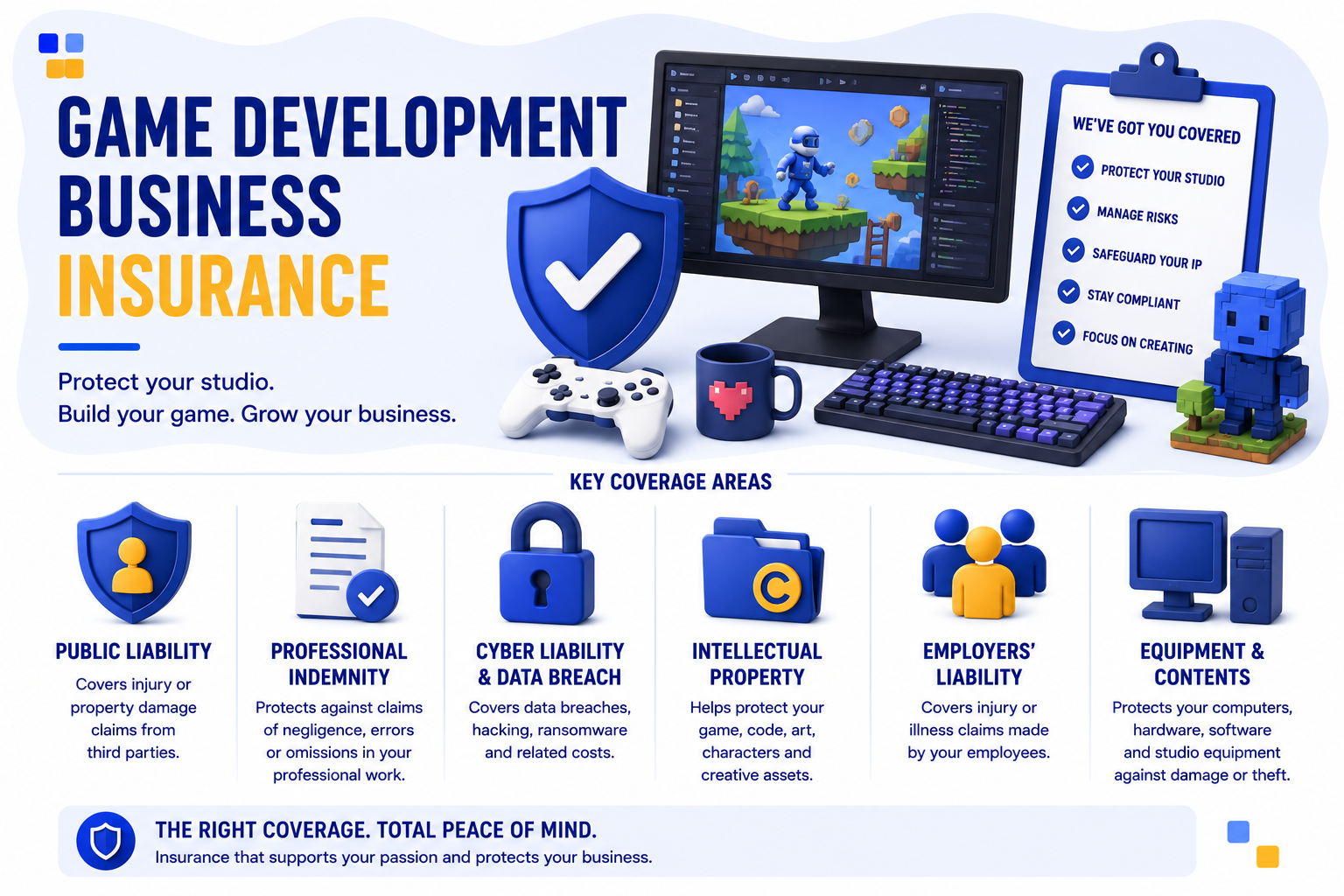
Game development business insurance is specialist commercial insurance designed for video game studios, indie developers, publishers, and interactive entertainment businesses. The core covers in 2026 are: Professional Indemnity with Tech E&O scope; Media Liability with IP infringement defence; Cyber and Data Liability with player data scope; Public Liability; Employers' Liability; office contents and portable equipment; Business Interruption; Legal Expenses with Ofcom OSA scope; and (for larger studios) D&O, EPLI, and Crime cover. The cover differs fundamentally from generic IT contractor or office package policies — those typically exclude intellectual property, media liability, and content-related claims, and don't contemplate the player data volumes that modern multiplayer titles process.
Ofcom's guidance for the video games industry published in October 2025 confirmed that any studio operating user-to-user features (chat, voice, lobbies, matchmaking, UGC, mod tools) is in scope of the Online Safety Act. Studios must complete illegal content risk assessments, children's access assessments (and where applicable children's risk assessments), implement content moderation, complaints handling, and reporting tools, and keep records of all of the above. Maximum fines are £18 million or 10% of global turnover. Fines themselves are uninsurable but defence costs of Ofcom investigation are insurable under properly-scoped Legal Expenses cover.
Indicative 2026 annual premiums: solo indie developers £750–£2,000; small indie studios (2–10 staff) £3,000–£9,000; work-for-hire studios £5,500–£14,000; live-service / multiplayer studios £8,500–£25,000; indie publishers £12,000–£40,000; mid-sized studios (25+ staff) £25,000–£80,000+; AAA-scale operations £80,000–£500,000+. Pricing depends on game type, player data volume, US jurisdiction exposure, IP clearance documentation maturity, claims history, limits selected, and broker placement type. For broader cyber-specific pricing dynamics see our small business cyber insurance quote guide.
Employers' Liability is legally required if you have staff under the Employers' Liability (Compulsory Insurance) Act 1969 — fines of £2,500 per day for non-compliance. Public Liability is not legally required but is contractually required by virtually all publishers, platform holders, and commercial partners. Where you operate a commercial vehicle, motor insurance is required under the Road Traffic Act 1988. Other covers (PI, Media Liability, Cyber, Legal Expenses, D&O, EPLI) are commercially essential but not legally required.
Only if specifically scoped. Generic IT contractor or software developer PI typically excludes "intellectual property, copyright, trademark, and content-related claims" by explicit wording — the cover responds to negligent professional advice but not to IP infringement. Specialist Media Liability cover (sometimes called IP Infringement Defence) is the cover that responds, and it's either an extension of specialist game studio PI or a standalone policy. Get written broker confirmation that IP infringement is within scope. This is the dominant catastrophic claim category for game studios releasing original IP and the most common cover gap.
Multiplayer and live-service titles materially elevate insurance requirements above single-player exposure. The core programme typically includes: Cyber and Data Liability £1m–£5m scaled to player base; Media Liability £1m+ with user-generated content scope; PI £1m–£2m with Tech E&O scope; Legal Expenses with Ofcom OSA scope; Business Interruption with adequate indemnity period (downtime is direct revenue loss); D&O with senior manager OSA exposure scope; EL £10m; PL £5m. Documentation requirements parallel the cover: OSA risk assessments, incident response runbook, MFA on player data systems, third-party processor contracts, and ongoing security testing.
Yes — and the limit needs to match the contract values. PI is the cover that responds to claims framed as professional negligence: failed milestones, technical defects, platform certification failures, scope disputes, warranty breaches. Work-for-hire studios with publisher contracts typically need PI £1m–£2m minimum; studios working on AAA-tier contracts may need £5m+. Run-off cover is essential — PI claims can surface 1–3 years after the work was performed, especially where the published title later experiences issues attributed back to the original code. See our professional indemnity insurance guide for cover principles and our insurance for IT contractors guide for adjacent exposures.
Insurance non-disclosure under the Insurance Act 2015. The pattern: studio buys an office package or IT contractor policy in year one declaring "small UK software studio", then transitions into multiplayer, UGC, US distribution, or loot box monetisation without specifically declaring the new exposures. At claim stage, the insurer points to the proposal documentation showing the declared activity was generic software, and a claim involving Media Liability, player data, or international jurisdiction becomes uninsured. This isn't fraud; it's the normal operation of UK insurance law requiring "fair presentation of the risk". The fix at proposal stage is minimal cost; the retrospective cost is potentially every uninsured claim across multiple policy years.
PEGI's June 2026 reform doesn't directly create insurance exposure — it creates commercial design and compliance pressure. Games with loot boxes are automatically PEGI 16 minimum; games with unrestricted communication are PEGI 18; games with NFT/blockchain mechanics are PEGI 18. UK physical-format PEGI ratings are legally enforceable under the Video Recordings Act 1984. The downstream insurance implications are: misclassification disputes (Legal Expenses); ASA enforcement on loot box disclosure (Legal Expenses); CMA / Trading Standards action where age-gated features were not properly age-gated (Legal Expenses, D&O); and where loot box mechanics drift close to gambling, potential UK Gambling Commission interest. Studios with live-service titles relying on loot box monetisation face commercial redesign pressure ahead of June 2026.
The single biggest premium reduction lever is documented IP clearance and security control maturity. IP register, design clearance log, freelancer assignment records, music licensing documentation, third-party asset trail — all of this reduces Media Liability premium 10%–20%. MFA, documented patch management, incident response runbook, quarterly penetration testing (for live-service titles) — reduces cyber premium 15%–30%. OSA risk assessments and moderation evidence — reduces premium 5%–15% across the programme. Other levers: accurate work mix declaration; limits matched to actual contract requirements; 3+ years continuity with same insurer; specialist game studio broker placement. Stack the levers; don't choose between them. Avoid the trap of buying the cheapest generic IT contractor package — the saving is dwarfed by uninsured claim exposure.
Publisher contract insurance requirements have tightened materially through 2025–2026, particularly from US publishers. Typical specifications: Employers' Liability £10m; Public Liability £5m–£10m; Professional Indemnity £1m–£5m with Tech E&O and platform certification scope; Media Liability £1m–£5m with IP infringement defence; Cyber and Data Liability £1m+; publisher named as additional insured on relevant policies; waiver of subrogation against publisher; certificates of insurance provided ahead of project commencement; ongoing notification of material policy changes. US publisher contracts in particular often require specific endorsements for US jurisdiction that smaller UK studios can't access without specialist placement. Review the insurance clauses before signing — they often dictate the studio's insurance buying for years.
Look for brokers with specific experience in games, tech, and creative industries evidenced by: specialist articles or guides on game studio risk (IP, OSA, cyber, publisher contracts); willingness to discuss specific exposures (Media Liability scope, US jurisdiction, loot box compliance, OSA documentation) in detail; access to Lloyd's market and specialist MGAs rather than just mainstream commercial markets; FCA authorisation and documented track record. Avoid brokers offering generic IT contractor packages without discussing games specifics; brokers who can only quote one or two markets; brokers who don't ask about Media Liability scope, US exposure, or OSA documentation in detail at proposal. Miller & Partner specialise in this sector — see our AI and tech product page, the cyber insurance page, and the broader AI and tech insights hub.






Instagram
LinkedIn