


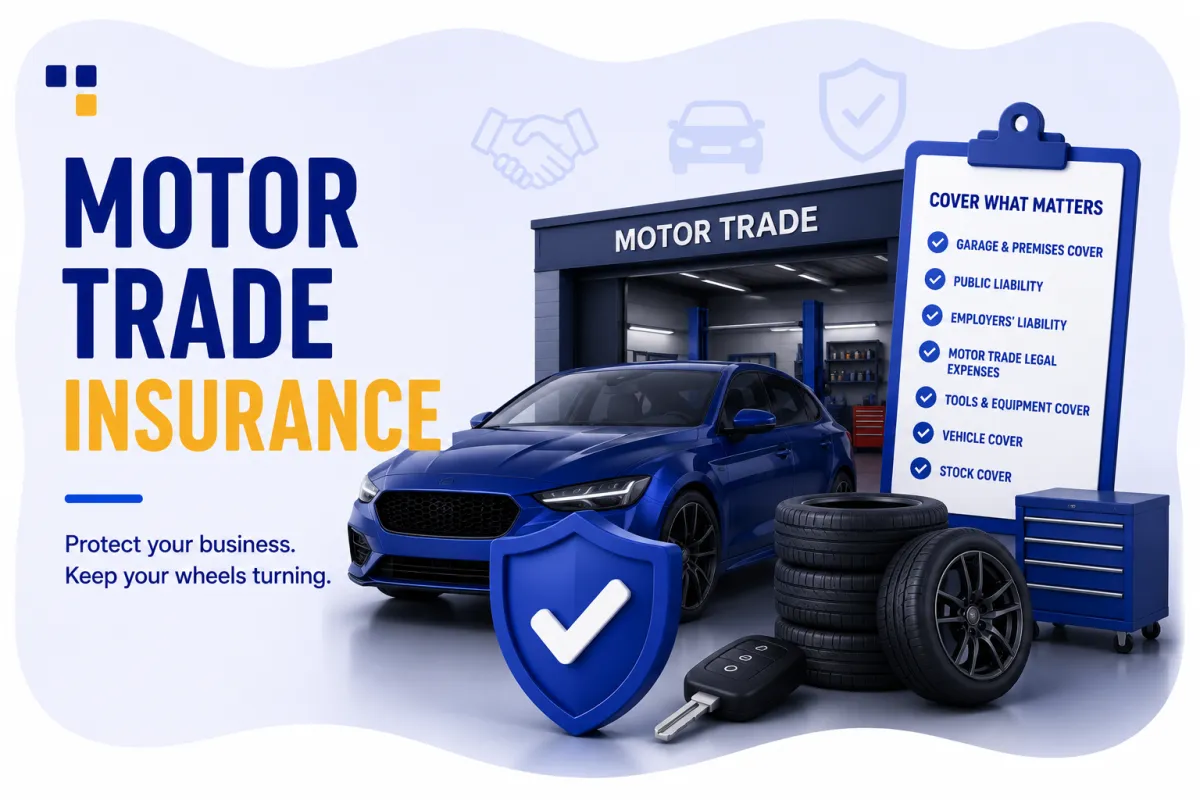
Motor Trade Insurance Brokers: Expert Guide 2026
Why has motor trade broking changed completely in 2026?
For most of the last two decades, choosing a motor trade insurance broker was a straightforward exercise. You needed a "Road Risks" policy if you drove customer vehicles, or a "Traders Combined" policy if you operated from premises with stock, tools, and staff — and most brokers could place one or the other through a handful of standard markets. The market was settled. The product was settled. The risks were settled.
That settlement has now collapsed. Four things have happened simultaneously, and any motor trade broker who hasn't adjusted to them is selling you the cover that suited 2019, not 2026.
First, the EV transition has arrived in workshops and on forecourts at scale. According to Thatcham Research, claims for electric vehicles are approximately 25% costlier than petrol or diesel equivalents and take around 14% longer to repair — driven by high-voltage battery exposure, advanced driver assistance system (ADAS) calibration requirements, and a recognised national shortage of IMI TechSafe-qualified technicians. For a dealer, that means battery exposure on forecourt stock. For a repair workshop, it means ADAS calibration as a professional indemnity exposure most workshops don't even know they have.
Second, on 9 January 2026 the Driver and Vehicle Standards Agency (DVSA) implemented sweeping enforcement reforms removing loopholes for MOT testers and Authorised Examiner Principals (AEPs) subject to 2-year or 5-year cessations, with new equipment standards for heavier EVs taking effect from 1 April 2026. The DVSA is now also rolling out photographic evidence trials following a successful pilot covering over 13,000 images — designed to crack down on "ghost MOTs", which the DVSA estimates account for 80% of all MOT frauds. Garages running MOT bays now face a fundamentally different enforcement risk profile that flows directly into their insurance.
Third, ghost broking — fraudsters selling fake insurance policies via social media — has surged 22% over the past two years according to Aviva, with the average victim losing more than £2,000. Motor traders are increasingly targeted, both as victims (buying fake road risks cover) and as collateral damage (when employees using personal vehicles for business activity unknowingly hold fraudulent policies).
Fourth, the FCA Consumer Duty moved firmly from implementation to active supervision in 2026. Insurance brokers must now evidence — not just assert — that they deliver good customer outcomes. For motor traders, that should mean better disclosure, fairer commission structures, and clearer policy explanations. In practice it has separated the brokers actually doing the work from those still trading on inertia.
This guide is the definitive 2026 framework for selecting and working with a motor trade insurance broker — built around the exposures that actually drive claims today rather than the generic feature lists most "motor trade broker" articles rehash. It complements our motor trade insurance product page, and sits alongside our broader commercial motor cluster including the commercial car insurance cost guide, business car insurance guide, and the commercial insurance hub.
Key facts at a glance
- Motor trade insurance is a regulated specialist product — Road Risks cover is a legal requirement under the Road Traffic Act 1988 if your business drives customer or stock vehicles on public roads; private motor policies do not respond to motor trade activity.
- FCA-authorised brokers must be on the Financial Services Register — verifiable at register.fca.org.uk. If a broker can't give you a Firm Reference Number that matches their company name on the FCA Register, they are not legitimately FCA-authorised and you cannot legally buy insurance through them.
- DVSA Phase 1 enforcement reforms commenced 9 January 2026 — closing cessation loopholes for testers and AEPs; from 1 April 2026 jacking equipment standards must accommodate heavier EVs at all new and significantly altered MOT test centres.
- EV repair claims average 25% costlier and 14% longer than ICE equivalents (Thatcham Research) — driven by high-voltage battery exposure, ADAS recalibration requirements, and the national shortage of IMI TechSafe-qualified technicians.
- Ghost broking surged 22% over the past two years (Aviva) with the average victim losing over £2,000. Motor traders are increasingly targeted through social media and messaging app promotions of "cheap" road risks cover.
- Indicative 2026 annual premiums range from £900–£2,200 for part-time sole traders, £2,800–£6,500 for small workshops, and £8,500–£25,000+ for established multi-bay dealerships and MOT-equipped garages.
- Insurance non-disclosure under the Insurance Act 2015 remains the single most preventable claim dispute for motor traders — accurate declaration of trade type, vehicle limits, premises, named drivers, and EV handling at proposal stage is essential.
1. What does a specialist motor trade insurance broker actually do?
The generic motor trade broker article will tell you a broker "compares quotes" and "finds you the right policy". That description was incomplete in 2010 and is actively misleading in 2026. A modern specialist motor trade insurance broker does eight distinct jobs that direct platforms and generalist intermediaries cannot replicate.
First, a specialist broker translates your operation into the underwriter's language. Motor trade underwriters categorise risk by trade type (dealer, mechanic, valeter, mobile mechanic, recovery operator, MOT centre, body shop, vehicle dismantler) and within each trade type by specific activities (Class 4 MOT only vs Class 4–7, accident repair vs servicing, EV-handling vs ICE-only, demonstration drives vs static sales). A misdescription at proposal — even an innocent one — creates Insurance Act 2015 non-disclosure exposure. The broker who knows the underwriter's expectations is the broker who keeps your claims defensible.
Second, a specialist broker matches your operation to the right markets. Motor trade capacity in the UK is concentrated across a small number of specialist insurers (Tradex, Markerstudy, KGM, NIG, Aviva, Allianz, plus Lloyd's syndicates accessed through specialist MGAs). Each has different appetite by trade type, postcode, age of principal, and EV exposure. A generic motor broker calling three of these isn't doing market access; a specialist motor broker with appointed-representative relationships across all of them is.
Third, a specialist broker structures the road risks layer correctly. The choice between third-party only (TPO), third-party fire and theft (TPFT), and comprehensive on road risks isn't just a price decision — it determines whether you're covered for vehicle damage during a test drive, accident damage to stock, theft cover gaps between road movement and static storage, and demonstration vs goods-in-transit exposure. Generic brokers default to TPFT; specialist brokers explain the comprehensive uplift in terms of the specific claim scenarios your business will face.
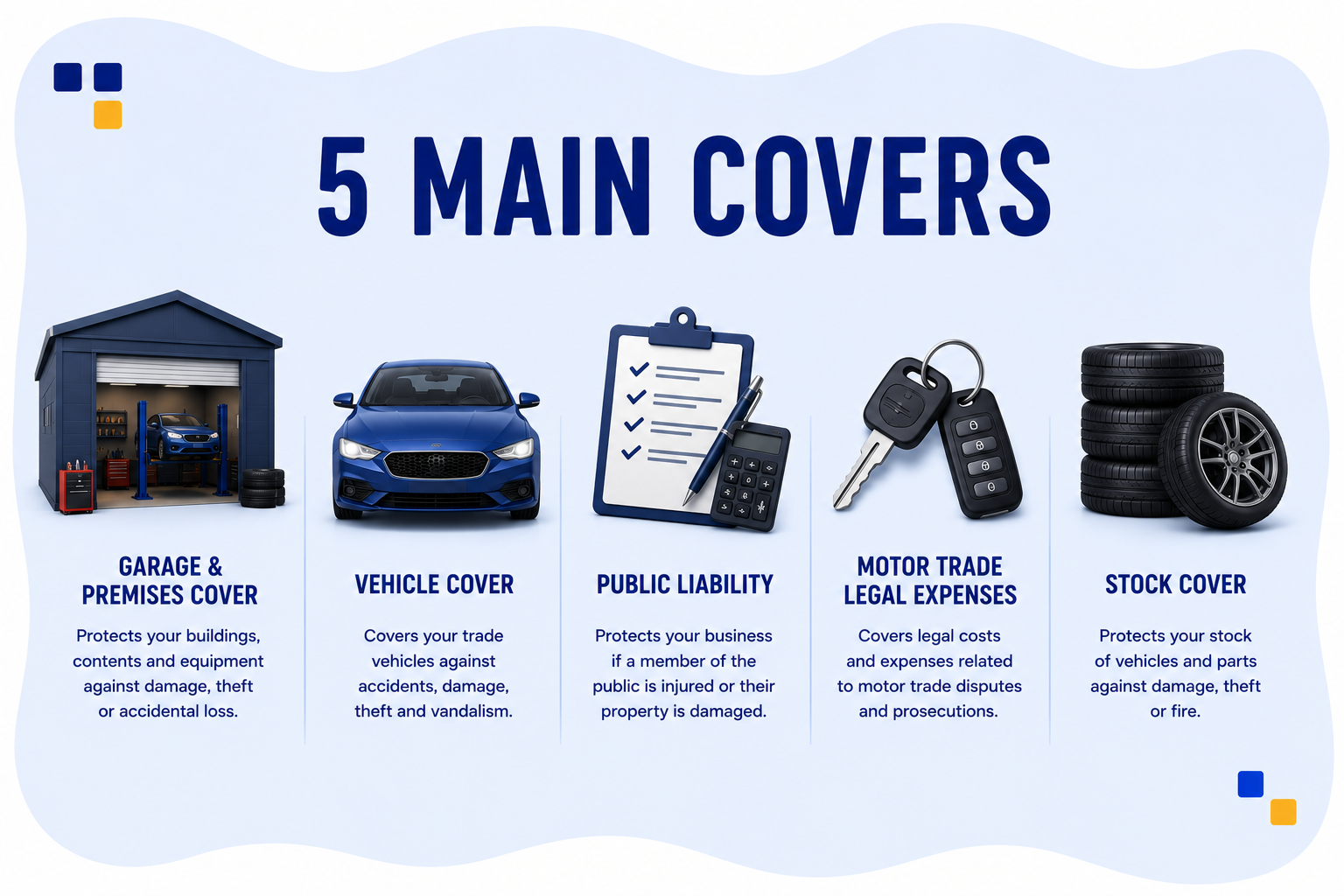
Fourth, a specialist broker understands when you need traders combined cover. Combined cover layers premises, stock, tools, employers' liability, public liability, product liability, and business interruption on top of road risks. Many traders operate under road risks only when they should be on combined; some traders pay for combined cover they don't need. The right answer depends on premises, staff, stock value, tool value, and forecourt exposure — and shifts as the business grows. A broker who reviews this at every renewal is a broker who's earning their commission.
Fifth, a specialist broker navigates the EV and ADAS exposure properly. We'll cover this in detail later in this guide, but in summary: most motor trade policies do not specifically declare high-voltage work; most repair workshops doing ADAS recalibration don't have professional indemnity cover that contemplates calibration error claims; most dealers with EV stock on the forecourt haven't separately considered thermal runaway exposure on premises cover. A generic broker quotes the policy that suited 2019 and hopes the claim doesn't surface; a specialist broker scopes the cover that responds to a 2026 EV claim.
Sixth, a specialist broker defends you in claims. Motor trade claims are administratively complex — multiple potential responding policies (road risks, public liability, professional indemnity, premises cover), Motor Insurance Database (MID) records to coordinate, vehicle valuation disputes (trade price vs retail value), and increasingly Insurance Fraud Bureau (IFB) and Insurance Fraud Enforcement Department (IFED) scrutiny on suspicious claims. The broker who knows the claim handler and can argue position on your behalf is doing work the cheapest direct platform cannot.
Seventh, a specialist broker delivers ongoing FCA Consumer Duty evidence. Since the Consumer Duty took effect, brokers are required not just to deliver good outcomes but to evidence how they do so. That means renewal reviews, fair-value commission assessments, clear product disclosures, and documented advice. A broker who can show you that evidence at every renewal is a broker passing the FCA test; a broker who cannot is exposed — and so are you.
Eighth, a specialist broker protects you from ghost brokers. We'll come back to this. The short version: a real FCA-authorised broker has a Firm Reference Number on the FCA Register, a verifiable BIBA membership, a UK office and phone number, and a paper trail you can audit. A ghost broker has none of these — but a slick social media presence often disguises that gap. Motor traders are increasingly the targets.
2. The 8 things a great motor trade broker delivers: summary table
The table below is the working framework you should use to evaluate any motor trade broker — incumbent or new. A specialist will deliver all eight; a generic motor intermediary will deliver three or four; a ghost broker will deliver none.
| What the Broker Should Deliver | How You Verify It |
|---|---|
| FCA authorisation evidence | Firm Reference Number visible on website; matches FCA Register; BIBA membership; UK office and phone |
| Trade-specific underwriting expertise | Can name the underwriters they place with; explains differences between Tradex, Markerstudy, KGM, Lloyd's; understands your specific trade type |
| Road risks vs combined cover analysis | Reviews staff, premises, stock value, tool value, forecourt exposure at every renewal — not just at first placement |
| EV and ADAS exposure scoping | Asks about high-voltage work, IMI TechSafe certification, ADAS calibration activity, EV stock on forecourt |
| MID and IFB compliance support | Confirms vehicles are registered on the Motor Insurance Database within statutory timeframes; explains MIAFTR implications |
| Claims advocacy | Direct contact with claims handlers; can negotiate trade vs retail valuation disputes; explains IFED process if claim becomes contested |
| Consumer Duty evidence pack | Renewal review document; fair-value commission disclosure; product disclosure summary; documented advice |
| Specialist market access | Access to Lloyd's syndicates and specialist MGAs for non-standard risks (young principals, claims-affected, EV-heavy, prestige stock) |
3. How does the EV transition change what your broker must understand?
The EV transition is the single most significant change in motor trade insurance underwriting since the introduction of mandatory third-party cover under the Road Traffic Act 1930. EVs are not just "different cars" — they create three categorically different claim exposures that conventional motor trade policies were never designed to address.
Exposure 1: High-voltage battery handling on premises
EV batteries typically operate at 400V to 800V, well above the UK Electricity at Work Regulations 1989 50V AC threshold for "live working" precautions. A workshop handling EVs without IMI TechSafe-qualified technicians is exposing operatives to potential fatal shock and exposing the business to Health and Safety Executive prosecution risk. The insurance implications are layered: employers' liability for operative injury; public liability if a customer or visitor is exposed; premises cover if a thermal runaway event damages the workshop; product liability if work performed contributes to subsequent battery failure.
Most generic motor trade policies don't carry a specific high-voltage exclusion — they simply weren't drafted with EVs in mind. When a claim arises, the response can range from "fully responding" to "claim disputed pending technical investigation" depending on the underwriter and the specific facts. A specialist broker scopes this exposure proactively at proposal and gets written confirmation that high-voltage work is within cover scope.
Exposure 2: ADAS calibration as a PI exposure
Modern vehicles with advanced driver assistance systems (lane keep assist, automatic emergency braking, adaptive cruise control, blind spot monitoring) require sensor recalibration after seemingly routine work — windscreen replacement, bumper repair, suspension adjustment, wheel alignment. If recalibration is not performed correctly, the safety systems may fail in real-world driving — and the workshop that performed the original work faces a professional indemnity claim where bodily injury results. This is a new claim category that didn't exist before 2018 and is only now beginning to surface in motor trade PI claims.
Most motor trade policies do not specifically include professional indemnity scope for ADAS calibration. Some include limited PI for "defective workmanship" as a product liability extension; few contemplate the consequential injury exposure that calibration errors create. A specialist broker either scopes specific ADAS PI cover or carries a separate professional indemnity policy for workshops doing this work.
Exposure 3: EV stock on the forecourt
EV stock on a dealer forecourt creates two distinct exposures conventional cover may not contemplate. First, charging exposure: if vehicles are charged overnight on premises and a charging fault causes a fire, the policy response depends on whether charging infrastructure was specifically declared. Second, thermal runaway: lithium-ion battery fires can re-ignite hours or days after an initial incident, posing a unique fire-spread risk that fire suppression systems designed for petroleum fuels may not adequately address. The London Fire Brigade has issued specific guidance on EV charging fires; underwriters increasingly require evidence of charging point compliance with BS 7671 and risk-assessed charging procedures.
4. What does the DVSA enforcement reset from January 2026 mean for your cover?
The Driver and Vehicle Standards Agency implemented major reforms on 9 January 2026 affecting MOT testers and Authorised Examiner Principals (AEPs). The headline change closed a long-standing loophole: testers and AEPs subject to a 2-year or 5-year cessation period are now completely barred from any MOT-related role for the full duration of the ban, including indirect involvement through associated businesses. From 1 April 2026, MOT test centres must meet updated jacking equipment standards to accommodate heavier EVs at new and significantly altered sites. The DVSA is also expanding photographic evidence requirements to combat "ghost MOTs" — fraudulent certificates issued without the vehicle being physically tested.
The insurance implications for motor trade businesses running MOT bays are significant. The combination of stricter disciplinary enforcement, expanded photographic monitoring, and digital oversight of testing patterns means:
- Site authorisation withdrawal is now a more realistic exposure. If your AEP or testers face cessation, you cannot route MOTs through associated businesses to continue operating. The business interruption exposure is substantial.
- Photographic evidence creates an audit trail. Where photo evidence is required, any test conducted without proper imagery is at risk of retrospective review and disciplinary action. The business defending such a review needs Legal Expenses cover with regulatory investigation scope.
- Background check obligations have tightened. Garages employing or contracting individuals subject to MOT-related disciplinary action face their own enforcement exposure. Hiring documentation needs to reflect this.
- Equipment compliance affects insurability. Garages that haven't upgraded jacking equipment for heavier EVs face restricted testing capability and potential underwriter questions about modernisation. Property underwriters increasingly ask about workshop equipment capacity at renewal.
The right specialist broker for a garage running MOT bays in 2026 understands not just the insurance but the regulatory environment that drives the insurance. A broker who hasn't mentioned the January 2026 DVSA reforms at your last renewal hasn't done their job.
5. How does ghost broking specifically target motor traders?
Ghost Broking — The Motor Trade Variant
Ghost broking — fraudsters posing as legitimate insurance brokers and selling fake or invalid policies — is most associated with young drivers and private car insurance. But the motor trade is now an active target, with three distinct attack patterns:
Pattern 1: Fake motor trade road risks cover. A "broker" with a slick Instagram presence offers part-time road risks cover at 30–50% below market rate. The motor trader receives convincing-looking policy documents, an apparent insurer name, and what looks like an MID confirmation. In reality, no policy exists. The first sign of trouble is usually a stopped vehicle, an arrest for IN10 (using vehicle uninsured), or a claim that the insurer denies ever underwriting.
Pattern 2: Doctored real policies. The ghost broker takes out a real policy in the trader's name but falsifies key information — overstating experience, understating vehicle limits, omitting claims history, lying about the trade type. The policy is technically real on day one but voidable from inception because of the misrepresentation. When a claim arises, the insurer voids the cover and the trader is uninsured retroactively.
Pattern 3: Cancellation harvest. The ghost broker arranges a genuine policy, takes the first premium payment, then cancels the policy within the cooling-off period and pockets the customer's money. The trader keeps the policy documents and may operate for weeks or months believing they have cover. The cancellation only surfaces when a vehicle is stopped or a claim is attempted.
Social media-first marketing (Instagram, TikTok, WhatsApp); price 30%+ below market; payment by bank transfer to a personal-sounding account; no traceable office address; no verifiable FCA Firm Reference Number; pressure to pay quickly; policy documents only as screenshots or unverified PDFs; no broker terms of business; no clear cancellation rights documentation. If two or more of these are present, walk away.
A real FCA-authorised motor trade broker can give you: a Firm Reference Number you can verify on the FCA Register at register.fca.org.uk; an FCA-authorised firm name that matches the trading name; a UK office address and landline; a documented complaints procedure; a written Terms of Business Agreement; BIBA membership (verifiable on the BIBA Find Insurance Service); a policy schedule from a named insurer whom you can call directly. If any of these is missing, you are not dealing with a real broker.
6. Why is the Motor Insurance Database the silent claims-killer for motor traders?
The Motor Insurance Database (MID) is the central record of insured vehicles in the UK, operated by the Motor Insurers' Bureau (MIB). Every insured vehicle must be on the MID, and the police use Automatic Number Plate Recognition (ANPR) systems that check MID status in real time. For motor traders this creates an administrative obligation that, when mishandled, causes more claim disputes than almost any other operational issue.
The motor trade MID challenge
Motor traders typically hold vehicles for short and variable periods — from a few hours (test drive returns) to weeks or months (stock vehicles). Some policies require every vehicle in custody to be added to the MID; some operate on a trade plate basis; some use a registration database approach. Mishandling MID coverage creates three claim scenarios:
- Vehicle not on the MID at the time of an incident. The trader believes the vehicle is covered under their road risks policy; the insurer points to absence from the MID as evidence the vehicle wasn't formally on cover at the moment of incident. The dispute can take months to resolve and may result in claim reduction or denial.
- Vehicle on the MID under wrong cover terms. The trader has added the vehicle but with the wrong category — for example, registered as a personal vehicle rather than trade stock. The cover terms don't match the use and a claim involving trade activity is at risk of denial.
- Vehicle on the MID but with stale data. The vehicle was acquired weeks ago, added to the MID, but specifics (current keeper, address, driver) are not updated. An ANPR check returns a stop and an investigation that creates regulatory friction even where the underlying cover is valid.
A specialist motor trade broker either operates a MID coordination service (some specialist brokers do) or specifically trains their motor trade clients on MID best practice. A generic broker leaves it to you and hopes you handle it correctly.
7. What does FCA Consumer Duty mean when choosing a motor trade broker?
The FCA Consumer Duty took effect in July 2023 and moved firmly into active supervision in 2026. It requires regulated firms — including insurance brokers — to deliver good outcomes for retail customers across four areas: products and services that meet customer needs; price and value that's fair; consumer understanding through clear communication; and consumer support throughout the customer journey. For motor traders selecting a broker, Consumer Duty creates an evidence framework you should expect to see at every renewal.
Specifically, your broker should be able to show you, at every renewal:
- A documented renewal review. Not just a quote — a review of what's changed in your business, what's changed in the market, and whether your current cover still meets your needs.
- Fair-value commission disclosure. The broker's commission as a percentage of premium, and a statement explaining why that commission represents fair value for the service delivered.
- A product disclosure summary. The key features, exclusions, limits, and conditions of the policy in plain English — not just the policy schedule and a 60-page wording.
- A target market statement. Confirmation that the policy is designed for businesses like yours and that you fit the target market.
- A documented advice trail. Where the broker made a recommendation, the reasoning behind it.
A broker who can deliver this is meeting Consumer Duty in 2026. A broker who can't is failing the FCA test — and any cover dispute that goes to the Financial Ombudsman Service will turn partly on whether the broker met their Consumer Duty obligations. Choosing a broker who clears this bar is one of the simplest ways a motor trader can de-risk their entire insurance programme.
8. Motor trade business cover checker
Select your motor trade business profile below to see the cover programme matched to your specific operation. For Miller & Partner's main motor trade product page see motor trade insurance.
Motor Trade Cover Checker
Select your business profile to see the recommended insurance programme matched to the 2026 risk landscape
Part-Time / Sole Trader (Home-Based)
- LEGAL Motor trade Road Risks cover — Road Traffic Act 1988 requirement when driving customer or stock vehicles on public roads
- ESSENTIAL Public Liability £2m–£5m — covers third-party injury or property damage from your trade activity
- ESSENTIAL Vehicles in your custody cover — protects stock/customer vehicles while in your possession
- ESSENTIAL Tools and equipment cover — diagnostic kit, hand tools, portable equipment
- RECOMMENDED Demonstration cover — third parties test-driving your stock
- RECOMMENDED Personal Accident — primary income protection given vehicle handling exposure
- CONSIDER Employers' Liability immediately if any subcontract help engaged — legal requirement
Mobile Mechanic / Valeter
- LEGAL Motor trade Road Risks — comprehensive recommended due to high vehicle handling exposure
- ESSENTIAL Public Liability £2m–£5m with operations-at-customer-premises scope
- ESSENTIAL Product Liability — covers claims arising from parts fitted or work performed
- ESSENTIAL Tools and equipment cover at full replacement value (mobile equipment theft is the dominant claim)
- ESSENTIAL Commercial vehicle / van — separate from road risks, covers your own service van
- RECOMMENDED Goods in transit if collecting/delivering vehicles
- RECOMMENDED Professional Indemnity if offering diagnostic or pre-purchase inspection services
- CONSIDER Employers' Liability if any subcontract or family help engaged
Small Workshop / Repair Garage
- LEGAL Employers' Liability £10m — EL Compulsory Insurance Act 1969
- LEGAL Motor trade Road Risks for all named drivers
- ESSENTIAL Traders Combined Public Liability £5m
- ESSENTIAL Product Liability including defective workmanship
- ESSENTIAL Premises buildings and contents — including specialist equipment (ramps, diagnostic, alignment)
- ESSENTIAL Stock cover — vehicles in custody while on premises
- ESSENTIAL Business Interruption — operational continuity if workshop fire or theft
- CRITICAL EV-specific scope if handling high-voltage vehicles — IMI TechSafe evidence required by some underwriters
- RECOMMENDED Professional Indemnity if performing ADAS recalibration
- RECOMMENDED Cyber insurance for customer data and DMS systems
MOT-Equipped Garage
- CRITICAL DVSA enforcement scope — Legal Expenses with disciplinary and AE cessation defence
- LEGAL Employers' Liability £10m comprehensive
- LEGAL Motor trade Road Risks
- ESSENTIAL Public Liability £5m–£10m with MOT activity scope
- ESSENTIAL Product Liability with defective workmanship including MOT certification
- ESSENTIAL Premises with MOT equipment cover — jacking equipment, brake testers, headlamp aligners
- ESSENTIAL Business Interruption with site authorisation suspension scope
- ESSENTIAL Stock cover for customer vehicles in custody
- CRITICAL EV-specific scope for heavier EV testing (post-1 April 2026 equipment compliance)
- RECOMMENDED Cyber insurance for customer data and MOT Testing Service access
Used Car Dealer / Forecourt
- CRITICAL Forecourt theft scope — keyless theft is a 2026 priority underwriter concern
- LEGAL Employers' Liability £10m if staff employed
- LEGAL Motor trade Road Risks for all named drivers including demonstration
- ESSENTIAL Stock cover at full retail or replacement value for entire forecourt
- ESSENTIAL Premises cover including forecourt fixtures, signage, CCTV, security infrastructure
- ESSENTIAL Public Liability £5m with customer-on-premises scope
- ESSENTIAL Product Liability for vehicles sold
- ESSENTIAL Business Interruption
- CRITICAL EV stock and charging exposure if EVs on forecourt
- ESSENTIAL Money cover — daily cash takings and customer deposits
- ESSENTIAL Cyber insurance — customer data, finance application data, DMS
Recovery / Transporter Operator
- CRITICAL Goods in Transit (GIT) — vehicles being recovered or transported
- LEGAL Employers' Liability £10m
- LEGAL Motor trade Road Risks comprehensive for recovery vehicles
- ESSENTIAL Public Liability £5m–£10m with recovery operations scope
- ESSENTIAL Specialist recovery equipment cover (winches, spectacle lifts, transporter beds)
- ESSENTIAL Premises if depot-based — storage compound and vehicle storage
- ESSENTIAL Operator licence considerations (if O-licence held) including transport manager exposure
- RECOMMENDED Professional Indemnity for recovery advice and salvage decisions
- RECOMMENDED Cyber insurance — booking systems and customer data
9. Ghost broker red-flag self-check
Ghost broking has surged 22% over the past two years (Aviva) and motor traders are now an active target. Click each red flag that applies to a broker you're being offered. The more ticked, the higher the risk this is not a legitimate FCA-authorised broker.
Ghost Broker Red-Flag Self-Check
Tick each red flag that applies to a broker offering you motor trade insurance. Two or more ticked is reason to walk away.
-
No FCA Firm Reference Number visible — or the FRN doesn't match the firm name on the FCA Register
-
Marketing predominantly via social media or messaging apps — Instagram, TikTok, WhatsApp, Telegram, Snapchat without a verifiable corporate website
-
Price 30%+ below comparable market quotes — particularly for road risks where pricing has tight underwriting bands
-
Payment requested by bank transfer to a personal-sounding account — or by cash, cryptocurrency, or untraceable payment method
-
No verifiable UK office address or landline — mobile-only contact, accommodation address, or no traceable physical premises
-
Policy documents provided only as screenshots or low-quality PDFs — with no insurer phone number to verify directly
-
Pressure to commit quickly — "this offer expires today", time-limited discount language, refusal to issue a quote in writing for review
-
No Terms of Business Agreement (TOBA) provided — FCA-authorised brokers are required to provide a TOBA before binding any business
-
Asks you to falsify proposal information — overstating experience, understating vehicles handled, omitting claims or convictions
-
No BIBA membership or other verifiable trade body affiliation — legitimate brokers usually display BIBA membership on website and correspondence
-
Insurer name unrecognised or not on the MIB member list — every legitimate UK motor insurer must be a Motor Insurers' Bureau member
-
Cannot or will not confirm vehicle is on the Motor Insurance Database — verifiable at askMID or via your insurer directly
10. Motor trade broker selection risk assessor
Two factors drive your motor trade insurance complexity above all others: the breadth of your trade activities and the modernisation of your operation (EVs, ADAS, MOT bays). Use the tool below to assess your risk profile and the matching broker approach.
Motor Trade Broker Selection Risk Assessor
Select your trade scope and your modernisation profile to see your specific risk position and the broker approach that matches it
11. How does the 2026 keyless theft and forecourt crime wave change your cover?
Forecourt and Keyless Theft — The Dominant 2026 Stock Claim
The dominant property-related claim for UK motor traders in 2026 is keyless theft from forecourts and premises. Modern keyless entry systems are vulnerable to "relay attacks" — two-person teams using signal amplifiers to clone a fob signal from inside the dealership, unlock vehicles, and drive them away in seconds. Industry data suggests 60-70% of car thefts now involve electronic methods, with luxury and high-volume models both targeted. For dealers, the exposure compounds: high-value stock concentrated in one location, often with keys held on premises overnight.
The new Crime and Policing Act 2026 makes it illegal to own or distribute car theft devices (not just use them), with penalties of up to 5 years imprisonment and unlimited fines. The legislation is a positive step but does not substitute for adequate cover and operational security — claims continue at scale and underwriters are now requiring evidence of specific anti-relay measures.
RFID signal-blocking pouches (Faraday bags) for all keyless fobs held overnight; key safe or electronic key management system separate from the office; CCTV with 24/7 monitoring and offsite cloud backup; perimeter security including bollards or vehicle barriers preventing drive-aways; alarm system with police response or monitored signal; secure compound perimeter (fencing, gates) with documented opening/closing procedures; staff training in key handling protocols; tracker devices on high-value stock.
Stock cover under traders combined should respond to forecourt theft — but underwriters increasingly attach specific warranties requiring: documented key management; CCTV operation at the time of incident; alarm activation if covered hours include outside trading; specific protections for keyless vehicles (Faraday pouches or equivalent). Breach of warranty can void cover for the specific incident. A specialist broker negotiates the warranty terms at placement and audits compliance at renewal. Without that, you have stock cover that becomes uninsurable at the worst moment.
12. Why is ADAS calibration a hidden PI exposure for repair workshops?
ADAS Calibration — The PI Claim Most Workshops Don't Know They Have
Advanced Driver Assistance Systems (ADAS) — lane keep assist, automatic emergency braking, adaptive cruise control, blind spot monitoring, traffic sign recognition — are now standard equipment on most vehicles manufactured after 2019. These systems use cameras, radar, lidar, and ultrasonic sensors that require precise calibration relative to the vehicle's mechanical and structural geometry. Recalibration is required after routine work: windscreen replacement; bumper repair; suspension work; wheel alignment; ride height adjustment; minor accident repair.
The exposure for repair workshops is that incorrect calibration can leave safety systems active but inaccurate — the vehicle reports systems are functional, but real-world response to lane departure, emergency braking, or adaptive cruise is impaired. When a subsequent accident occurs and ADAS failure is identified as a contributing factor, the workshop that performed the original work faces a professional indemnity claim. The injury severity in ADAS-failure accidents can be substantial; PI claim values £40k–£250k+ are realistic for serious injury cases.
ADAS calibration equipment appropriate to the makes worked on (Bosch, Hella Gutmann, Autel, Texa, manufacturer-specific tools); documented calibration procedure per make and model; pre-work measurement and post-work verification with diagnostic printout; ADAS recalibration certificate or sign-off provided to customer; technician training records (Bosch, Autodata, IMI ADAS qualifications); awareness of "static vs dynamic" calibration requirements per vehicle; clear contractual exclusions where customer declines recommended recalibration.
Professional Indemnity specifically scoped for ADAS calibration is the primary response. Generic traders combined PI (where it exists) typically responds to negligent advice but may not contemplate calibration specifically — and the distinction matters at claim stage. Specialist motor PI should cover: calibration negligence, diagnostic error, post-work verification failure, and customer notification failure where recalibration was declined. Limit typically £500k for small workshops; £1m+ for active ADAS workshops. Run-off cover important — accidents can occur months or years after the original calibration work.
13. What is the most common reason motor trade claims get declined?
Insurance Non-Disclosure — The Most Preventable Catastrophe
The single most common reason UK motor trade insurance claims are reduced or declined isn't underwriting fraud or bad luck — it's non-disclosure at the proposal or renewal stage. The pattern is familiar: a motor trader buys a road risks or traders combined policy, declares the operation as it was three years ago, and continues paying premium year after year while the business evolves. New trade types are taken on (the dealer adds a workshop; the workshop starts MOT work; the mobile mechanic starts handling EVs). New named drivers join. New vehicle types are handled. None of it is specifically declared.
The Insurance Act 2015 requires businesses to make a "fair presentation of the risk" — proactively disclosing every material fact the insurer would want to know. Failure to do so allows the insurer at claim stage to: avoid the policy (treating it as never having existed); reduce the claim proportionally; impose terms that would have applied with proper disclosure. For motor traders the most common missed disclosures are: change in named drivers; change in trade type or activities; addition of MOT bay; addition of EV handling; change in stock value; change in premises; new convictions among named drivers; previous claims at any associated business.
Annual review of declared activities against actual operations; written confirmation from broker that all current activities are within scope; specific declaration of each work type at proposal (road risks, demonstration, recovery, MOT, ADAS, EV); mid-term notifications to broker when new work types are taken on; documented response to broker enquiries at renewal; retention of policy documents and broker correspondence as evidence of disclosure. The Insurance Act test isn't "did I mean to mislead?" — it's "was the disclosure complete enough that the underwriter could properly price the risk?"
There is no insurance response to insurance non-disclosure — that's the whole point. The cover that should have responded doesn't. The only mitigation is at the proposal stage: detailed declaration, broker discipline, and renewal review. Specialist motor trade broker placement makes a material difference here — generic brokers often miss the specific declarations that modern motor trade requires (EV, ADAS, MOT, demonstration scope), while specialist brokers know exactly what each insurer expects to see at proposal.
14. What drives the cost of motor trade insurance in 2026?
Motor trade insurance pricing in 2026 reflects the regulatory and technological transformation across the sector. Indicative annual premium ranges:
| Business Profile | Indicative Annual Premium 2026 |
|---|---|
| Part-time / sole trader — home-based, low turnover, basic road risks | £900–£2,200 |
| Mobile mechanic / valeter — at customer premises, full road risks plus PL | £1,800–£3,500 |
| Small workshop / repair garage — premises-based, traders combined, 2–5 staff | £2,800–£6,500 |
| MOT-equipped garage — workshop + MOT bay, traders combined, DVSA scope | £4,500–£9,500 |
| Used car dealer with forecourt — stock cover, demonstration, premises | £5,500–£15,000 |
| Mid-sized operator — multi-discipline, 6–15 staff, full traders combined | £12,000–£25,000+ |
The factors below drive both insurance premium and overall risk management. The rating impact within each profile band is typically larger than the differential between profile bands — meaning a workshop with poor documentation can pay more than a small dealer with excellent documentation.
| Rating Factor | Impact on Premium | What You Can Do |
|---|---|---|
| Trade type and activity mix | Dealers and MOT centres rate higher than mobile/workshop; multi-discipline highest | Declare every activity specifically; misdeclaration is the #1 claim dispute |
| Annual turnover and staff numbers | Primary scaling factors for PL, EL, premises | Declare accurately including planned growth |
| Named driver age and experience | Drivers under 25 add 30–50% loading; over 25 with 5+ years motor trade experience material reduction | Restrict named drivers to experienced operators; document trade experience |
| Claims history (5-year) | Major impact on road risks particularly; theft claims load stock cover heavily | Root cause analysis and remedial documentation after any claim |
| Vehicle limits and stock value | Direct scaling — declare actual maximum carried, not target | Right-size limits at every renewal; over-declaring costs unnecessarily |
| Premises security and CCTV | Documented security reduces stock cover premium 10–20% | CCTV with cloud backup, alarm, bollards, Faraday key pouches |
| Postcode and operating area | Urban postcodes load stock and road risks materially | Declare operating area accurately; some specialists offer better postcode terms |
| EV and ADAS scope declaration | Adds 10–20% to relevant cover lines but essential | Don't try to save here; undeclared EV/ADAS creates uninsured claim exposure |
| MOT activity | Adds 15–25% across PL and PI lines | Specific declaration; Legal Expenses with DVSA scope |
| IMI TechSafe and trade certification | Recognised certification reduces premium 5–10% | Maintain at staff level; evidence at every renewal |
| Continuity with insurer | 3+ years with same insurer typically reduces renewal premium 5–10% | Strategic continuity decision; don't chase £100 savings |
| Specialist vs generic broker placement | Specialist brokers access better motor trade-specific terms | Use a broker with documented specialist motor trade experience |
For a broader picture of how commercial motor pricing has evolved, see our commercial car insurance cost guide which covers many of the same pricing dynamics for non-trade commercial motor.
15. Real claims and how to manage them
Claim — Forecourt Stock Theft, £180,000 Stock Cover Settlement
A used car dealer with a six-vehicle forecourt experienced an overnight relay attack theft of three high-value vehicles (two Range Rovers and an Audi RS6) with a combined stock value of £185,000. CCTV recorded the incident but the perimeter was unsecured, key fobs were stored in an unlocked office cabinet, and no Faraday pouches were in use. Vehicles were driven from the forecourt within four minutes.
The dealer's traders combined policy responded under stock cover, but the insurer applied a key-management warranty that had been included in the schedule but not specifically discussed at placement. Settlement was reduced to £150,000 (trade value rather than retail), and a £20,000 contributory underinsurance deduction was applied because the actual maximum stock value exceeded the declared limit. Defence costs and administrative deductions: £10,000. Net recovery to dealer: £140,000 against £185,000 stock value.
Post-claim renewal: stock cover premium increased 65%. Insurer required: documented key management procedure with electronic key safe; Faraday pouches for all keyless fobs; CCTV upgraded to 24/7 monitored cloud system; perimeter bollards installed; alarm system with police response. The dealer implemented these and at the following renewal premium returned to a 22% loading over baseline.
The lesson: stock cover responds to forecourt theft but increasingly carries specific warranties around key management and physical security. A broker who explains the warranties at placement, audits compliance at renewal, and ensures declared stock value matches reality is doing the work that converts a £180k claim from a 75% loss into a 90%+ recovery. The £150 saving on cheaper non-specialist placement created £45k of uninsured loss.
Claim — ADAS Calibration Failure PI, £85,000 Settlement
A mid-sized repair workshop performed a routine windscreen replacement on a 2023 SUV equipped with lane keep assist, automatic emergency braking, and adaptive cruise control. The workshop replaced the windscreen but did not perform ADAS recalibration, instead advising the customer to "have the camera recalibrated at the main dealer" — without documenting the advice. Six weeks later the vehicle was involved in a rear-end collision; investigation by the customer's insurer identified that the forward-facing camera was misaligned by 3 degrees, resulting in delayed automatic emergency braking activation.
The customer's injured passenger brought a personal injury claim against the workshop's insurance, alleging that incomplete ADAS work was a contributing factor to the accident severity. The workshop's documentation review identified: no written record of the customer being advised to seek dealer recalibration; no waiver signed; no notification to the customer's insurer about the incomplete work. The workshop's traders combined policy included Product Liability for defective workmanship but no specific ADAS PI scope.
The product liability layer responded but settlement was disputed. After 14 months: settlement £85,000 (personal injury, consequential losses, legal costs). Defence costs: £22,000. Total claim: £107,000.
Post-claim renewal: PI added specifically with ADAS scope, premium increased 35%. Workshop implemented: documented ADAS recalibration policy; customer sign-off form; written recommendations where work declined; technician ADAS training certificates.
The lesson: ADAS calibration is the rising PI exposure most workshops aren't insuring for. The documentation that defends these claims (customer sign-off, technician training, recalibration verification) is the same documentation that prevents them. Specialist motor PI with explicit ADAS scope is the working route.
Claim — Insurance Non-Disclosure, Cover Voided, £42,000 Uninsured Loss
A workshop started as ICE-only domestic servicing in 2019. By 2024 it had taken on three IMI TechSafe-certified technicians and was performing approximately 30% of its work on EVs including high-voltage battery diagnostics. The workshop continued renewing the same traders combined policy each year through a generic intermediary, with no specific declaration of EV work or high-voltage activity at any renewal.
In early 2026 a thermal runaway event during EV battery diagnostic work caused a workshop fire. Three customer vehicles in the workshop were destroyed; significant smoke damage affected the building and adjacent unit; one technician sustained burn injuries requiring 6 weeks off work. Combined exposure: £45,000 customer vehicles, £28,000 building damage, £38,000 contents and equipment, £12,000 business interruption, £18,000 EL claim from injured technician. Total estimated claim: £141,000.
The insurer investigated and identified that the policy had been renewed annually without specific declaration of EV work. Under the Insurance Act 2015 the insurer asserted the right to avoid the policy from inception, arguing they would have applied different terms (specifically excluding high-voltage work from premises cover, requiring specific containment evidence for EL cover, and applying surcharge premium) had EV work been declared.
After 9 months of dispute, partial settlement was reached: customer vehicle and EL claims responded (£63,000); building, contents, and BI claims were declined under the disclosure breach (£78,000 uninsured loss). The workshop ultimately recovered against the broker's professional indemnity for £36,000 representing the broker's failure to identify and disclose the EV activity — but the unrecovered £42,000 remained the workshop's loss.
The lesson: insurance non-disclosure is the most preventable catastrophe in motor trade insurance, and the most expensive when it happens. The annual renewal review where the broker specifically asks "what's changed in your business this year?" is the discipline that prevents this. The £300 broker fee for a proper specialist annual review is dramatically cheaper than the uninsured loss.
Claims Management Steps
How to respond to a motor trade insurance incident or regulatory engagement — the steps below are critical given the multi-policy and multi-regulator exposure typical of 2026 motor trade work:
- Make the site safe and protect persons first. Standard response. If thermal runaway, high-voltage, or chemical exposure has occurred, medical response (A&E for acute, occupational health within 24–48 hours) takes priority over administrative steps. Fire service for any EV battery event.
- Notify your insurer immediately for any potential claim. Motor trade incidents often engage multiple policies (Road Risks, EL, PL, PI, Stock, Premises). Single notification triggers coordinated response. The notification threshold is "may give rise to a claim" — much lower than "formal claim received".
- Preserve all documentation rigorously. Pre-incident state evidence; work performed including written records and customer sign-offs; CCTV footage (cloud-backup if available); witness statements; police reports; technical inspection reports; vehicle documentation and MID records. The documentation pack is the defence across all coverage layers.
- Do not admit liability or fault. Provide factual information about what happened, what work was done, methodology followed. Do not accept fault, apologise in writing, or commit to remedial work that could be interpreted as admission. Refer all liability questions to your insurer or broker.
- Manage regulatory engagement carefully. If DVSA, HSE, police, or trading standards attend or notify, engage your Legal Expenses insurer immediately. Cooperate factually with inspectors but do not provide written statements without legal representation. Regulatory investigation can become criminal prosecution.
- Engage with IFB/IFED on contested claims. If the insurer raises Insurance Fraud Bureau or Insurance Fraud Enforcement Department concerns, this is a serious escalation. Your broker should arrange specialist legal representation. Do not engage with IFED directly without legal representation.
- Conduct root cause analysis and document remedial action. Identify underlying cause and implement remedial action. Insurers reviewing renewal will ask what's changed since claim; regulators will require evidence of remedial action.
- Update operational documentation to address gap. Where the claim identified a documentation gap (no key management record, no ADAS sign-off, no EV declaration), update the standard operating procedure to close the gap going forward. This is both insurance and regulatory defence.

Glossary of motor trade insurance terms
- Road Risks Insurance
- The core motor trade cover required under the Road Traffic Act 1988 when driving customer or stock vehicles on public roads. Available at three levels: Third Party Only (TPO), Third Party Fire and Theft (TPFT), and Comprehensive. Insures the trader (named drivers) for the activities of the motor trade business, not a specific vehicle.
- Traders Combined Insurance
- Bundled cover combining Road Risks with premises insurance, stock cover, tools and equipment, public liability, employers' liability, product liability, and business interruption. Suited to motor traders with business premises, staff, or higher-value equipment.
- Motor Insurance Database (MID)
- The central record of insured vehicles in the UK, operated by the Motor Insurers' Bureau. Every insured vehicle must be on the MID; police ANPR systems check MID status in real time. Verifiable at askMID. Motor traders have specific MID compliance obligations for vehicles in custody.
- Motor Insurers' Bureau (MIB)
- The UK body responsible for compensating victims of uninsured and untraced drivers, operating the Motor Insurance Database, and providing related services. Every UK motor insurer must be an MIB member.
- MIAFTR (Motor Insurance Anti-Fraud and Theft Register)
- The central database of stolen and written-off vehicles. Motor trade businesses should check MIAFTR before purchasing stock to identify previously stolen, cloned, or written-off vehicles.
- Ghost Broking
- Fraud where individuals or unauthorised firms pose as legitimate insurance brokers and sell fake or invalid policies. Particularly targets young drivers and motor traders via social media. Verify any broker on the FCA Register before paying premium.
- FCA Authorisation
- Required for any firm advising on, arranging, or transacting insurance in the UK. Verifiable on the Financial Conduct Authority's Financial Services Register. Every authorised firm has a Firm Reference Number (FRN).
- Consumer Duty
- FCA conduct framework requiring regulated firms (including insurance brokers) to deliver good customer outcomes across product design, price and value, consumer understanding, and consumer support. In active supervision in 2026.
- ADAS (Advanced Driver Assistance Systems)
- Vehicle safety systems including lane keep assist, automatic emergency braking, adaptive cruise control, blind spot monitoring, and traffic sign recognition. Require sensor recalibration after windscreen replacement, bumper repair, suspension work, or wheel alignment. Calibration negligence creates Professional Indemnity exposure for workshops.
- IMI TechSafe
- The Institute of the Motor Industry's certification standard for technicians working on high-voltage electric and hybrid vehicles. The recognised UK competency standard for safe EV repair work. Increasingly required by underwriters as evidence of competency.
- DVSA (Driver and Vehicle Standards Agency)
- UK agency regulating MOT testing, vehicle approvals, and driving standards. From 9 January 2026 implemented enforcement reforms closing cessation loopholes for testers and Authorised Examiner Principals.
- AEP (Authorised Examiner Principal)
- The individual responsible for ensuring compliance at an MOT testing station. Subject to DVSA fit and proper person standards and disciplinary jurisdiction including 2-year and 5-year cessations.
- IFB / IFED
- The Insurance Fraud Bureau (industry intelligence) and Insurance Fraud Enforcement Department (City of London Police-led specialist unit). Both investigate suspected insurance fraud including ghost broking, application fraud, and claims fraud. IFED engagement is a serious matter requiring legal representation.
- Insurance Act 2015
- UK legislation governing commercial insurance contracts, including the duty of fair presentation of risk at proposal and renewal. Failure to disclose material facts allows insurers to avoid the policy, reduce claims, or impose retrospective terms.
- Demonstration Cover
- Specific Road Risks scope covering third parties (potential customers) test-driving stock vehicles. Often not included as standard; specifically declared and may carry additional premium.
- Trade Plates
- Temporary registration plates issued to motor traders for legitimate trade purposes (moving vehicles between premises, road testing after repair, demonstration). Use beyond trade purposes invalidates cover.
- Relay Attack
- Keyless theft methodology using paired signal-amplifier devices to clone a key fob's signal and unlock and start a vehicle without physical possession of the key. Now the dominant vehicle theft method in the UK.
- Faraday Pouch
- Signal-blocking pouch designed to prevent relay attacks by shielding the key fob's signal. Underwriter expectation for motor traders holding keyless fobs overnight.
Frequently asked questions
A specialist motor trade insurance broker advises on, arranges, and manages insurance specifically for businesses operating in the motor trade — dealers, mechanics, valeters, mobile mechanics, recovery operators, MOT-equipped garages, body shops, and vehicle dismantlers. The core jobs are: translating your operation into underwriter language at proposal; accessing the right markets (specialist motor trade insurers and Lloyd's syndicates); structuring road risks vs traders combined cover correctly; navigating EV and ADAS exposure; coordinating Motor Insurance Database compliance; defending you in claims; delivering FCA Consumer Duty evidence; and protecting you from ghost brokers. Beyond compliance, a specialist broker becomes part of your risk management — reviewing exposure at every renewal as your business evolves.
Check four things. First, the broker must be FCA-authorised — verifiable on the Financial Services Register at register.fca.org.uk. Confirm the Firm Reference Number matches the trading name. Second, check BIBA membership at the British Insurance Brokers' Association website. Third, confirm the named insurer is a Motor Insurers' Bureau member — every UK motor insurer must be. Fourth, request a Terms of Business Agreement (TOBA) before paying any premium — FCA-authorised brokers must provide one. Walk away from any broker who refuses or delays. Ghost broking has surged 22% over the past two years and motor traders are increasingly targeted.
Indicative 2026 annual premiums: part-time sole traders £900–£2,200; mobile mechanics/valeters £1,800–£3,500; small workshops £2,800–£6,500; MOT-equipped garages £4,500–£9,500; used car dealers with forecourts £5,500–£15,000; mid-sized multi-discipline operators £12,000–£25,000+. Pricing depends on trade type and activity mix, named driver age and experience, claims history, vehicle limits and stock value, premises security, postcode, EV/ADAS scope, MOT activity, and broker placement type. For comparison with non-trade commercial motor pricing see our commercial car insurance cost guide.
Road Risks cover is legally required under the Road Traffic Act 1988 when your business drives customer or stock vehicles on public roads. Employers' Liability is legally required if you have staff under the Employers' Liability (Compulsory Insurance) Act 1969 — fines of £2,500 per day for non-compliance. Other cover (Public Liability, Professional Indemnity, premises, stock, EIL, Legal Expenses) is commercially essential but not legally required. Private motor insurance does not respond to motor trade activity; you specifically need motor trade insurance.
Road Risks is the core motor trade cover insuring named drivers for vehicle handling on public roads — driving customer vehicles, test driving, collection and delivery. Available as Third Party Only (TPO — minimum legal), Third Party Fire and Theft (TPFT), or Comprehensive. Traders Combined adds layers on top of Road Risks: premises insurance, stock cover, tools and equipment, public liability, employers' liability (if staff), product liability, and business interruption. Combined suits any motor trader with business premises, staff, or higher-value equipment. Many traders start with Road Risks and grow into Combined as the business expands. A specialist broker reviews this at every renewal — see our motor trade insurance product page.
Only if specifically scoped. Most generic motor trade policies don't carry a specific high-voltage exclusion but weren't drafted with EVs in mind — meaning the response to an EV claim can range from "fully covered" to "claim disputed". Workshops handling EVs should have written broker confirmation that high-voltage work is within cover scope, technician IMI TechSafe qualifications evidenced, and (for premises) charging infrastructure declared. Dealers with EV stock on the forecourt need stock cover that contemplates thermal runaway and battery fire exposure. EV repair claims average 25% costlier than ICE equivalents (Thatcham Research); the cover that handles this needs to be specifically structured.
Increasingly yes, particularly under the 2026 framework. PI was historically optional for many motor traders; now it's essential for: workshops performing ADAS calibration (where calibration error can contribute to subsequent accidents); workshops offering diagnostic or pre-purchase inspection services; dealers offering vehicle condition warranties; recovery operators providing salvage advice. Limits typically £500k for small operators; £1m–£2m for ADAS-active workshops or panel contractors. Run-off cover important — claims can surface months or years after the original work. See our professional indemnity insurance guide for cover principles.
Insurance non-disclosure under the Insurance Act 2015. The pattern: operator buys a motor trade policy declaring the business as it was 3–5 years ago; the business evolves (adds workshop, MOT bay, EVs, new staff); no one specifically reviews whether the policy kept pace. At claim stage the insurer points to the original simpler declaration, and a claim involving a new activity becomes uninsured. This isn't fraud; it's the normal operation of UK insurance law requiring "fair presentation of the risk". The fix at proposal stage is minimal cost; the retrospective cost is potentially every uninsured claim across multiple policy years. Annual broker review with documented disclosure update is the simplest discipline.
If you run an MOT bay, the DVSA reforms that took effect 9 January 2026 materially change your enforcement exposure. Cessation loopholes for testers and Authorised Examiner Principals were closed; 2-year or 5-year bans now apply across all MOT-related roles for the full duration. Photographic evidence requirements are expanding to combat "ghost MOTs". From 1 April 2026, jacking equipment standards must accommodate heavier EVs. The insurance implications: Legal Expenses with DVSA disciplinary scope is now essential; site authorisation withdrawal is a more realistic business interruption exposure; background checks on new hires create their own compliance burden. A specialist motor trade broker who hasn't mentioned the January 2026 DVSA changes at your last renewal isn't doing their job.
The biggest levers: specialist broker placement (typically 10–20% better terms than generic intermediaries); accurate work mix and vehicle limits declaration (over-declaring costs unnecessarily); restricting named drivers to experienced operators over 25; documented premises security including CCTV, Faraday pouches for keyless fobs, alarm systems, and bollards; IMI TechSafe certification at technician level; trade association membership (BIBA-affiliated brokers, RMI for retail dealers); 3+ years continuity with the same insurer; annual payment vs monthly. Stack the levers; don't choose between them. Avoid the trap of buying the cheapest road risks policy without checking the broker is FCA-authorised — ghost broker exposure is real.
FCA Consumer Duty requires regulated brokers to deliver — and evidence — good customer outcomes across product design, price and value, consumer understanding, and consumer support. For motor traders this means your broker should be able to show at every renewal: a documented renewal review; fair-value commission disclosure (commission as percentage of premium with rationale); product disclosure summary in plain English; target market statement; documented advice trail. Consumer Duty moved firmly into active FCA supervision in 2026 — brokers who can't deliver this evidence are failing the regulator's test, and any cover dispute that reaches the Financial Ombudsman will partly turn on whether the broker met their Consumer Duty obligations.
Look for brokers with specific evidence of motor trade specialism: dedicated motor trade pages on their website; specialist articles or guides on EV exposure, ADAS calibration, DVSA enforcement, and ghost broking; willingness to discuss specific exposures in detail at first contact; access to specialist motor markets and Lloyd's syndicates rather than just mainstream commercial; FCA authorisation visibly displayed with Firm Reference Number; BIBA membership; documented track record with motor trade businesses. Avoid brokers offering "motor trade as a side activity"; brokers who can only quote one or two markets; brokers who don't ask about EV handling, ADAS work, or MOT activity at proposal. Miller & Partner specialise in this sector — see our motor trade insurance product page and broader motor insights hub.






Instagram
LinkedIn