


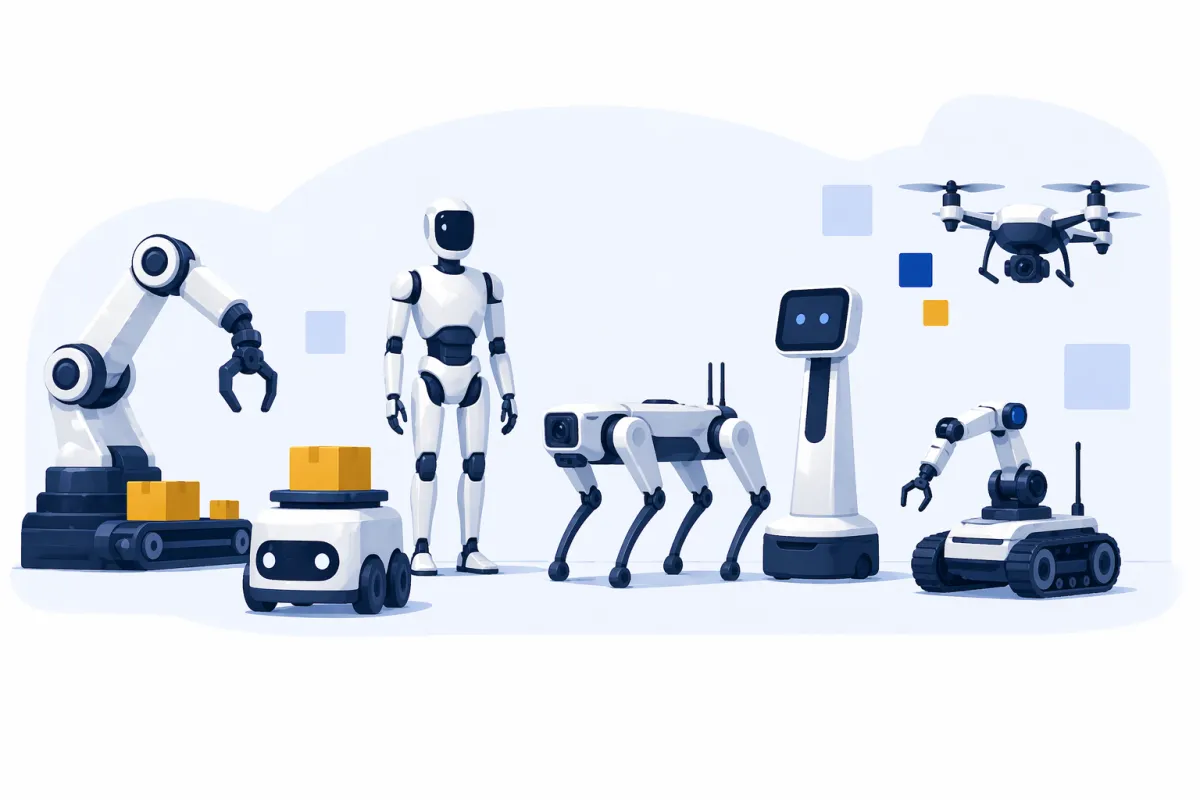
Robotics Startup Insurance UK Guide: Secure Success in 2026
Why does UK robotics startup insurance need a complete rethink in 2026?
UK robotics is in a fundamentally different shape in 2026 than it was even two years ago. Capital has poured into the sector — global VC funding into AI-robotics startups hit roughly $13.9 billion in 2025 — and London, Cambridge and Bristol have become genuine deep-tech hubs alongside Boston, Munich and Shenzhen. UK industrial robotics is forecast to reach over $1 billion in revenue by 2030 at a 6%+ CAGR. Humanoid platforms, autonomous mobile robots, surgical robotics, agricultural automation, defence systems and embodied-AI driving systems are all attracting serious British engineering talent and serious investor money.
The insurance market has not kept pace with this shift. Most robotics founders we speak to are operating on generic small-business or technology-startup policies that were designed for software companies — built around professional indemnity and cyber, with property and equipment as an afterthought, and product liability either absent, sub-limited, or excluded. That works fine until the moment a robot does something physical in the real world. The whole point of a robot is that it acts. It picks, lifts, drives, cuts, assembles, navigates, interacts with humans. The moment one of those actions causes harm or damage, the insurance question is no longer "did we have PI?" — it's "did our policy contemplate a machine making an autonomous decision that hurt someone, and if so, was it properly placed?" For most UK robotics startups in 2026, the honest answer is no.
The 2026 regulatory landscape has compounded this. The Product Regulation and Metrology Act 2025 received Royal Assent on 21 July 2025, giving UK ministers broad enabling powers to overhaul product safety rules to address AI, automation, and machinery — with software explicitly within scope. The EU Machinery Regulation comes into force on 14 January 2027 with new conformity assessment requirements for self-evolving autonomous systems. The EU AI Act's high-risk obligations engage from August 2027 for embedded AI in machinery. The UK Product Security and Telecommunications Infrastructure (PSTI) Act and the EU Cyber Resilience Act (CRA) impose lifetime cybersecurity duties on connected products from 2026–2027. UK GDPR continues to bite hard on data-handling robots. Even if a robotics startup is selling only into the UK, the EU regulatory framework reaches in through customers, supply chains and investor due diligence. One practical consequence is that recall readiness has become an underwriting question rather than a contingency — and because Products Liability excludes the cost of retrieving your own product, product recall insurance is a separate purchase that most robotics startups do not hold.
This guide is the definitive 2026 UK robotics startup insurance article — the regulatory shape, the eight risk profiles that drive claims, the cover architecture that actually responds, the cost benchmarks for sole founders through to Series A/B scale-ups, and the operational documentation that makes both compliance and claim defence possible. It complements our AI and tech insurance product page, and sits in our broader AI and Tech cluster alongside the AI consultancy insurance guide, SaaS business insurance UK guide, the smart home manufacturing insurance guide, experimental technology companies guide, electronics design business insurance guide, and 3D printing company insurance guide.
Key facts at a glance
- UK robotics startup insurance in 2026 is fundamentally a hardware-plus-software-plus-AI risk — generic tech-startup policies built around PI and cyber are typically inadequate; product liability for autonomous machines, with treatment for self-evolving behaviour, is the cover that defines the placement.
- The Product Regulation and Metrology Act 2025 brings software within product safety scope — UK ministers can now make secondary regulations covering automation, AI, and machinery; the EU Machinery Regulation 2027 imposes parallel conformity duties on UK firms selling into Europe.
- VC and corporate investor due diligence now treats insurance as a Series A gating item — boards expect documented PI with technology errors and omissions scope, cyber liability, product liability, and D&O before signing term sheets. Inadequate cover can collapse a funding round.
- Professional indemnity for robotics must include "automated decision-making" scope — many standard PI policies exclude claims arising from automated decisions, which is precisely what a robot does; specialist wording is essential.
- Cyber liability is no longer optional for connected robots — under the Product Security and Telecommunications Infrastructure Act 2022 (PSTI) and the EU Cyber Resilience Act, manufacturers carry security duties for the product's expected lifetime, including vulnerability reporting.
- UK robotics startup insurance premiums typically run £1,500–£4,500 annually for early-stage solo founders and £15,000–£60,000+ for VC-backed scale-ups operating physical hardware in customer environments — pricing depends on hardware/software mix, deployment context, contract values, and investor expectations.
- Insurance non-disclosure under the Insurance Act 2015 is the most preventable robotics startup catastrophe — operating physical robots under a "software consultancy" or "SaaS" cover description creates uninsured-loss exposure that can dwarf years of correctly priced premium.
1. The 8 biggest robotics startup risks: summary table
The risks below are ranked by combined frequency, severity, and investor/regulatory consequence under the 2026 framework. Some — software errors, IP disputes, key-person dependency — are everyday operational realities for any deep-tech business. Others — product liability for autonomous machines, cyber liability under PSTI, and insurance non-disclosure — are the categories where a single event can end a startup. The intelligent founder manages all eight simultaneously from seed stage onwards rather than waiting for Series A to discover what's missing.
| Risk | Frequency | Severity | Primary Cover |
|---|---|---|---|
| Product liability — autonomous machine injury / damage | Occasional but rising | Catastrophic (£100k–£2m+) | Product Liability with autonomous-systems scope |
| Software / algorithmic errors causing client loss | Common — dominant PI claim | High (£50k–£200k+) | Professional Indemnity / Technology E&O |
| Cyber breach, ransomware, connected-device hack | Common and rising | High (£75k–£500k+) | Cyber Liability with product-vector cover |
| IP infringement / patent litigation | Occasional but high-cost | High (£100k–£1m+) | IP Defence / specialist IP insurance |
| Prototype failure, R&D loss, lab incident | Routine in early stage | Medium (£10k–£150k) | Property, Equipment, R&D cover |
| Key-person dependency / founder D&O | Constant exposure | High (£250k–£2m+) | D&O Liability, Key-Person Life/Income |
| Supply chain failure / component shortage | Common since 2022 | Medium-High (£25k–£500k) | Business Interruption, Trade Credit |
| Insurance non-disclosure under Insurance Act 2015 | Common (often unnoticed) | Catastrophic (entire programme) | No cover — preventable at proposal stage |
2. How is UK robotics regulation transforming the risk landscape?
Robotics regulation in the UK and EU went from a slow-moving background concern to a structured framework with concrete dates and obligations during 2025–2026. For founders, this has practical implications across product development, market access, contracting, and insurance placement. The five regulatory frameworks that matter most for robotics startup insurance in 2026 are summarised below.
1. Product Regulation and Metrology Act 2025 (UK)
The PRMA 2025 received Royal Assent on 21 July 2025. It does not impose immediate substantive requirements but gives the Secretary of State broad powers to make secondary legislation covering modern safety issues including AI, automation, machinery, and 3D printing. Critically, the Act's scope explicitly includes intangible components such as software — meaning UK robotics manufacturers can no longer assume their software layers fall outside product safety regulation. Government estimates suggest the framework could expand to cover approximately 300,000 UK businesses. The first wave of secondary legislation is expected to target online marketplaces, lithium-ion battery safety, and automation/AI more broadly.
2. EU Machinery Regulation 2023/1230 (effective 14 January 2027)
The EU Machinery Regulation replaces the Machinery Directive and introduces three structural changes critical to robotics. First, enhanced conformity assessment for products with "self-evolving behaviour" — manufacturers must provide safety documentation not only for current capabilities but for reasonably foreseeable future operational states. Second, lifetime cybersecurity responsibilities for network-connected machinery. Third, expanded risk mapping covering psychological and ergonomic hazards alongside physical safety. UK firms selling robotics into the EU face full compliance regardless of UK regulatory direction.
3. EU AI Act (high-risk obligations from August 2027)
The EU AI Act establishes a tiered risk framework. Where AI is embedded in machinery already covered by other EU harmonisation legislation (such as the Machinery Regulation), high-risk obligations engage on 2 August 2027 — though the Digital Omnibus proposal may delay enforcement to August 2028 pending harmonised standards. High-risk obligations include conformity assessment, human oversight protocols, granular data governance, and post-market monitoring. The UK has chosen a more principles-based AI regulatory approach, but UK firms selling into the EU must comply with the AI Act.
4. PSTI Act 2022 and EU Cyber Resilience Act (CRA)
The UK Product Security and Telecommunications Infrastructure Act 2022 imposes baseline security requirements for connectable consumer products: unique default passwords, vulnerability reporting policies, and security update transparency. The EU CRA goes further, requiring risk assessments, security measures over the product's expected lifetime, and mandatory reporting of actively exploited vulnerabilities. CRA reporting obligations take effect in September 2026; the remaining rules apply from December 2027. Manufacturers supplying both UK and EU markets face dual compliance, though the CRA's broader scope substantially covers UK PSTI requirements.
5. UK GDPR and the Data (Use and Access) Act 2025
Robotics platforms collecting personal data — image data, voice data, behavioural data, location data — engage full UK GDPR obligations. The Data (Use and Access) Act 2025 modifies certain aspects of UK data protection but retains the core framework. ICO fines for serious breaches can reach 4% of global turnover or £17.5m, whichever is higher. For robotics startups handling enterprise customer data through robot deployments, GDPR is a primary cyber-claim driver.
3. Risk 1: Product liability — the autonomous machine claim
Product Liability for Autonomous Machines — The Defining Robotics Exposure
This is the cover category that defines whether a robotics startup is genuinely insured. When a robot causes physical injury or property damage — whether by mechanical action, navigation error, gripping failure, falling component, or unexpected behaviour — the claim flows under the Consumer Protection Act 1987 and the Supply of Machinery (Safety) Regulations 2008. Liability is strict — the claimant doesn't have to prove negligence, only that the product was defective and caused the harm. Defects can arise from design, manufacturing, or failure to warn. For autonomous and self-evolving systems, defects can also arise from training data, model behaviour in foreseeable but untested scenarios, and inadequate human-oversight design. Claim values range from £50k for minor property damage to £2m+ for serious bodily injury.
Conformity assessment aligned to current Machinery Regulations and forward to the 2027 EU framework; documented risk assessment per product covering reasonably foreseeable misuse and adverse operational states; ISO 13482 (personal care robots), ISO 10218 (industrial robots), or ISO 23482 (assistive robotics) alignment as applicable; documented training data governance for AI components; human-in-the-loop or human-over-the-loop oversight where indicated; emergency stop and safety interlock design; post-market surveillance programme; customer onboarding and training records; clear documentation of intended use vs reasonably foreseeable use.
Product Liability with explicit autonomous-systems scope is the primary cover. Generic technology-startup product liability sub-limits typically run £1m–£2m which is broadly adequate for early-stage deployments but insufficient for industrial or healthcare robotics where £5m–£10m may be required by customer contracts. US/Canada exposure (where many robotics startups have early customers) requires specific declaration and adds 30–80% to product liability premium. Specialist Lloyd's placement is the working route; mainstream commercial markets often decline robotics product liability or impose restrictive sub-limits.
4. Risk 2: Software and algorithmic errors — the dominant PI exposure
Software and Algorithmic Errors — The Embedded-PI Claim
The dominant claim category in early-stage robotics by frequency is software errors causing client financial loss. A navigation algorithm misbehaves and a customer's warehouse operation grinds to a halt. A computer-vision system misclassifies and a sorting line ships incorrect product. A surgical-assist algorithm produces an unexpected output and a hospital pauses procedures. The common feature: no physical injury, no product defect strictly defined, but real financial loss flowing from a software or algorithmic mistake. The claim engages Professional Indemnity (negligent advice / negligent service delivery) rather than Product Liability — and this is where standard tech PI policies most commonly fail robotics businesses, because many exclude "automated decision making" or "decisions made by AI without human oversight" as a class.
Written engagement letters / terms of business with clear scope, limitations, and performance expectations; documented testing protocols with pass/fail thresholds; version control and deployment audit trails; pre-deployment customer acceptance testing; clear delineation of customer responsibilities (data quality, environment, supervision); incident response procedure for software-caused customer impact; documented model behaviour expectations including known limitations and edge cases.
Professional Indemnity with explicit Technology Errors & Omissions scope and explicit cover for "automated decision making" / "AI-derived outputs". This is non-negotiable for robotics PI in 2026 — standard wordings that pre-date the AI era often have implicit or explicit exclusions for autonomous decisions. Limits typically £500k for seed-stage, £1m–£2m for Series A, £2m–£5m for Series B+ or enterprise contracts. Run-off cover important — algorithmic claims can surface 2–4 years after deployment. For broader PI cover principles see our professional indemnity insurance guide; our AI consultancy insurance guide goes deeper on algorithmic-error PI claim drivers that apply equally to embodied AI.
5. Risk 3: Cyber liability and connected-device security
Cyber Liability and PSTI/CRA Connected-Device Duties
Modern robots are connected. Fleet management, OTA updates, telemetry, cloud-based AI inference, customer dashboards — every robotics startup we place insurance for runs cloud infrastructure as a core operational dependency. That creates two distinct cyber exposures: the conventional one (your own data, customer data, and operational systems compromised by attack) and the product-vector one (your robot becomes the route through which a customer's systems are compromised, or your robot is itself attacked and modified). The product-vector exposure is the one many startups have not yet considered. Under PSTI and the incoming CRA, manufacturers are legally responsible for product security throughout the expected product lifetime, including reporting actively exploited vulnerabilities. A ransomware attack that takes a customer's robot fleet offline can drive £75k–£500k+ in business interruption and remediation claims.
PSTI-compliant security defaults (unique device passwords, no hard-coded credentials, vulnerability disclosure policy, transparent security-update timeframes); secure development lifecycle with code review and dependency scanning; over-the-air update infrastructure with cryptographic verification; network segmentation between development and production environments; multi-factor authentication on all engineering and admin systems; documented incident response plan with practiced exercises; UK GDPR data inventory and data processing impact assessments for customer-data-handling robots; cyber insurance compliance with insurer security baseline (which is now usually contractual).
Cyber Liability with explicit third-party / product-vector scope is the primary cover. Standard cyber insurance typically responds to first-party loss (your own data, your own systems) but may not contemplate scenarios where your product becomes the cyber-attack vector into a customer's environment. Robotics-specific cyber wording should include: ransomware response, customer notification costs, ICO investigation defence, business interruption (yours and customers'), and product-vector third-party liability. Limits typically £500k–£2m for seed, £2m–£5m for Series A+. See our cyber insurance for UK businesses guide for cover principles that scale directly into robotics deployments.
6. Risk 4: Intellectual property disputes and patent litigation
IP Disputes and Patent Litigation — The Investor-Visible Exposure
Robotics is a crowded patent landscape. Major incumbents (ABB, KUKA, Fanuc, Boston Dynamics, Universal Robots) and well-funded scale-ups (1X Technologies, Figure AI, Sanctuary AI, Wayve, Engineered Arts) hold thick patent portfolios across hardware mechanisms, control software, sensor fusion, and increasingly model architectures. A robotics startup operating at any meaningful scale will eventually face an IP threat — either as a defendant (a competitor or NPE alleges infringement) or claimant (someone has copied a core mechanism or trained on copyrighted training data). UK patent litigation routinely costs £500k–£2m to take through trial; defence costs alone can run £100k+ before any settlement consideration. For generative-AI-trained robotics models, the open question of copyright on training data adds another threat layer.
Freedom-to-operate searches before committing to core mechanisms or algorithms; documented invention provenance including lab notebooks, commit histories, and design records; IP assignment agreements with all employees and contractors before any work begins; clear training data governance including provenance documentation and licensing where applicable; trademark registration for product names and brand assets; defensive patent filings on novel mechanisms; clear contract terms on IP ownership with customers and partners.
IP defence insurance is a specialist line available through Lloyd's syndicates and specialist MGAs. Covers legal defence costs against third-party infringement claims and (depending on policy) pursuit costs against infringers. Limits typically £500k–£5m for robotics startups depending on portfolio and exposure. Generic professional indemnity often includes some IP infringement defence but is typically sub-limited and may exclude knowing infringement or claims involving patents. For robotics startups with significant patent exposure, standalone IP insurance is typically the better placement. Investor and customer contracts increasingly mandate evidence of IP cover.
7. Risk 5: Prototype failure and R&D loss
Prototype Failure and R&D Loss — The Founder-Stage Exposure
Early-stage robotics development is hardware-intensive and accident-prone. Prototypes catch fire (lithium battery failures are a routine cause), get dropped, get short-circuited, get pushed beyond mechanical limits, get damaged in shipping between dev and test sites, get stolen from poorly secured workshops. Lab equipment — robotic arms, motion-capture systems, GPU servers, test rigs — represents hundreds of thousands of pounds of investment that disappears in a single incident if not insured. R&D loss extends to the data and code: a fire in a workshop that destroys uncommitted code or training data sets can set development back months. Claim values £10k–£150k typical; major lab incidents can reach £500k+ where multiple bespoke prototypes are involved.
Lithium battery storage in metal containment with fire suppression; documented inventory of all hardware at replacement value; offsite backup of code and training data with version control discipline; controlled access to development premises; insurance-grade fire and intruder alarms; documented incident reporting; segregation of high-value prototypes between locations where possible; insurance schedule maintained current as hardware portfolio grows.
Property and contents at premises covers fire, flood, theft, accidental damage. Equipment cover for laptops, motion capture, sensors, test rigs. Specific R&D extensions cover prototypes and one-off bespoke equipment at agreed replacement value (not standard depreciated value). Business interruption following a major lab loss is increasingly important for venture-backed startups burning $50k–$200k+ monthly. Marine cargo cover for shipping prototypes between locations or to customers. For broader cover principles see our commercial property insurance guide.
8. Robotics startup insurance cover checker
Select your business profile below to see the cover matched to your specific risk profile. For Miller & Partner's main product page see AI and Tech insurance.
Robotics Startup Insurance Cover Checker
Select your business profile to see the recommended insurance programme matched to the 8 main robotics risks
Solo Founder / Pre-Revenue
- ESSENTIAL Public Liability £2m–£5m with treatment for prototype demonstrations and customer-site visits
- ESSENTIAL Professional Indemnity £250k–£500k with technology E&O and automated-decision-making scope
- ESSENTIAL Property and equipment cover for development hardware (motion capture, robotic arms, GPU servers, prototypes)
- ESSENTIAL Cyber liability £250k–£500k — even pre-revenue, training data and IP are valuable
- RECOMMENDED Personal Accident — primary income protection during the founder runway
- RECOMMENDED Limited Product Liability £1m for early prototype demonstrations
- CONSIDER Employers' Liability immediately if any contractor or part-time help engaged — legal requirement
Seed-Stage Robotics Startup (2–8 staff)
- LEGAL Employers' Liability £10m comprehensive scope
- ESSENTIAL Public Liability £5m for customer-site work, demonstrations, and pilot deployments
- ESSENTIAL Product Liability £1m–£2m for any deployed hardware (US/Canada loading if applicable)
- ESSENTIAL Professional Indemnity £500k–£1m with technology E&O and automated decision-making scope
- ESSENTIAL Cyber Liability £500k–£1m with product-vector and ransomware scope
- ESSENTIAL Property and contents at premises with R&D extension for prototype values
- ESSENTIAL Equipment and electronics cover at replacement value
- RECOMMENDED Marine cargo / transit cover for shipping prototypes
- RECOMMENDED Legal Expenses cover
Series A Robotics Startup (VC-Backed)
- CRITICAL Series A diligence treats insurance as a gating item — full programme review before term sheet
- LEGAL Employers' Liability £10m comprehensive
- ESSENTIAL Public Liability £5m–£10m
- ESSENTIAL Product Liability £2m–£5m with US/Canada extension if applicable
- ESSENTIAL Professional Indemnity £1m–£2m with full technology E&O scope
- ESSENTIAL Cyber Liability £1m–£2m comprehensive
- ESSENTIAL Directors and Officers (D&O) liability — VC-imposed requirement
- ESSENTIAL Key-person life and income protection on technical founders
- ESSENTIAL IP defence cover for patent litigation exposure
- RECOMMENDED Business Interruption with R&D-specific extension
- RECOMMENDED Crime / fidelity cover
Industrial / Enterprise-Deployment Robotics
- CRITICAL Industrial deployment in customer environments substantially elevates product liability exposure
- LEGAL Employers' Liability £10m
- ESSENTIAL Public Liability £10m
- ESSENTIAL Product Liability £5m–£10m with autonomous-systems wording
- ESSENTIAL Professional Indemnity £2m–£5m with full automated-decision scope
- ESSENTIAL Cyber Liability £2m+ with product-vector and customer business interruption scope
- ESSENTIAL Customer contractual indemnity review — many enterprise contracts impose specific cover requirements
- ESSENTIAL D&O liability
- ESSENTIAL Environmental Impairment Liability if hazardous materials or industrial chemicals involved
- ESSENTIAL Recall expense cover
Healthcare / Surgical / Regulated Robotics
- CRITICAL Medical robotics carries the highest claim severity in the sector — specialist placement essential
- LEGAL Employers' Liability £10m comprehensive
- ESSENTIAL Public Liability £10m
- ESSENTIAL Product Liability £10m+ with MHRA medical device alignment
- ESSENTIAL Professional Indemnity £2m–£5m with medical-device-specific extension
- ESSENTIAL Cyber Liability £5m+ with NHS / healthcare-data-specific extension
- ESSENTIAL Recall expense cover (mandatory for medical device manufacturers)
- ESSENTIAL Clinical trials liability if applicable
- ESSENTIAL D&O liability with healthcare-specific extension
- ESSENTIAL IP defence comprehensive
Scale-Up Robotics (Series B+)
- LEGAL Employers' Liability £10m comprehensive
- ESSENTIAL Public Liability £10m+
- ESSENTIAL Product Liability £10m+ with worldwide territory including US/Canada
- ESSENTIAL Professional Indemnity £2m–£5m+ comprehensive technology E&O
- ESSENTIAL Cyber Liability £5m+ with international and product-vector scope
- ESSENTIAL Directors and Officers (D&O) liability with full Side A/B/C scope
- ESSENTIAL Employment Practices Liability (EPL)
- ESSENTIAL Crime / fidelity cover comprehensive
- ESSENTIAL Business Interruption with full revenue protection
- ESSENTIAL IP defence comprehensive (litigation costs and damages)
- ESSENTIAL Fleet insurance covering manufacturing facilities and offices
- ESSENTIAL Trade Credit cover for major customer concentration risk
9. Investor and contract readiness self-check
Series A and B due diligence in 2026 routinely treats insurance as a gating item, not a post-close administrative task. Enterprise customer contracts impose specific minimum cover requirements before deployment can begin. Tick each readiness item your operation has in place. The unchecked items are your priority gaps before your next term sheet or enterprise contract.
Investor and Contract Readiness Self-Check
Click each readiness discipline you have in place. The more ticked, the smoother your Series A diligence and enterprise contract execution will be.
- Product Liability cover declared specifically for autonomous / robotic systems — not generic technology product cover with implicit autonomous-decision exclusions
- Professional Indemnity with explicit Technology E&O and automated decision-making scope — broker written confirmation that algorithmic-error claims are within cover
- Cyber Liability with product-vector / third-party scope — cover for scenarios where your robot becomes the attack route into a customer environment
- D&O liability in place at Series A / before VC term sheet — board members will require D&O before joining; without it, key hires walk away
- Insurance schedule reviewed annually and at every funding round — work changes faster than cover; renewals on autopilot create gaps
- Territory declared accurately (UK only / EU / USA-Canada / worldwide) — US/Canada exposure must be specifically disclosed and uplifted; non-disclosure of US sales is a primary claim-decline trigger
- IP assignment agreements in place with every employee, contractor, and partner — without these, your IP isn't really yours and investors will discount valuation accordingly
- PSTI / CRA compliance documented for connected products — unique device passwords, vulnerability disclosure policy, security update transparency
- UK GDPR data inventory and DPIAs completed for data-handling robots — image/voice/location data collection triggers full UK GDPR scrutiny
- Conformity assessment documented per product — UKCA / CE marking, machinery directive compliance, applicable ISO 10218 / 13482 / 23482 alignment
- Customer contracts reviewed against insurance programme — many enterprise contracts impose specific limits, indemnities, and additional-insured requirements that the policy must match
- Certificates of insurance ready for instant issue — Series A diligence and enterprise sales both routinely require certificates within 24-48 hours; delays slow deals
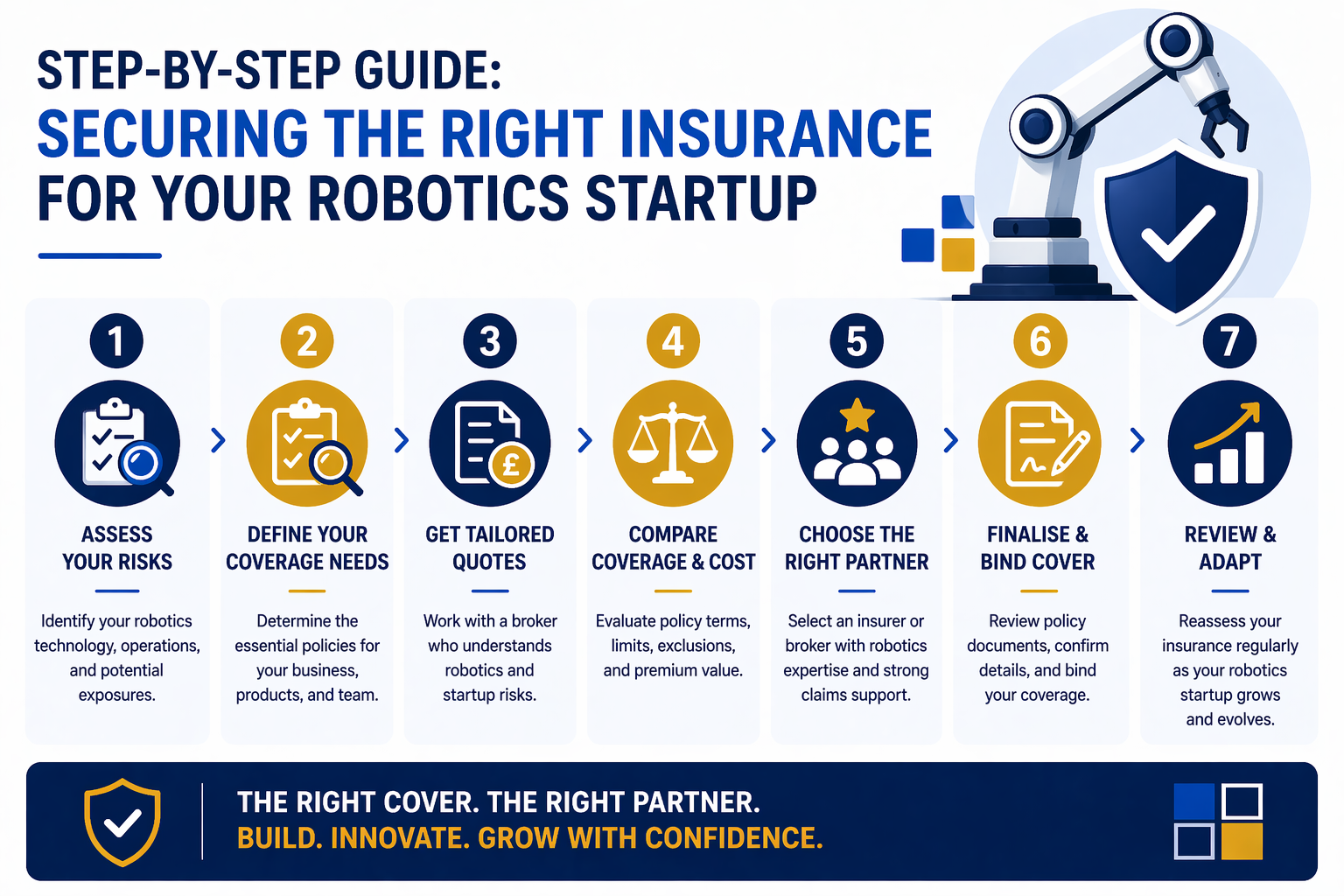
10. Robotics startup risk assessor
Two factors drive robotics startup risk above all others: the maturity stage of the business and the physicality of customer-facing deployment. Use the tool below for your specific risk profile.
Robotics Startup Risk Assessor
Select your stage and your deployment context to see your specific risk profile and indicative insurance package
11. Risk 6: Key-person dependency and D&O exposure
Key-Person Dependency and D&O — The VC-Visible Exposure
Robotics startups are unusually concentrated around small numbers of irreplaceable technical specialists — typically the founder-CTO, a lead robotics engineer, and a lead ML or perception specialist. The loss of any one of these to illness, injury, or competitor poaching can set development back 12–18 months and materially affect enterprise value. At the same time, the moment external capital enters the business, the directors carry personal liability for decisions taken — fiduciary duty to investors, employment decisions, regulatory compliance, product safety. UK directors can face personal liability under the Companies Act 2006, the Health and Safety at Work Act 1974 (Section 37 personal prosecution), the Bribery Act 2010, and various sector-specific regulations. D&O claim values £250k–£2m+ are common; major regulatory or shareholder actions can reach £5m+.
Documented board governance with minutes, decisions, and risk discussion records; clear delegation of authority schedule; documented health and safety management system; named compliance and DPO roles; clear founder agreements covering vesting, leaver provisions, IP assignment, and competitive restrictions; key-person identification and succession planning; cross-training to reduce single-point dependencies; documented offboarding processes for departing key personnel.
Directors and Officers (D&O) liability is the primary cover for personal director liability — defence costs, settlements, regulatory investigation costs. Side A/B/C structure becomes important at Series A+ to ensure individual directors are protected even if the company can't indemnify them (insolvency, indemnification refused, etc.). Limits typically £1m for early-stage, £2m–£5m at Series A, £5m–£10m+ at Series B+. Key-person life and income protection separately addresses the financial impact of losing a technical specialist — typically £500k–£2m on each key person.
12. Risk 7: Supply chain and component dependency
Supply Chain and Component Dependency — The Post-2022 Reality
Robotics depends on highly specialised supply chains — high-precision actuators, harmonic drives, specific GPU SKUs, custom PCBs, LiDAR units, force-torque sensors, robot-grade lithium battery packs. Many critical components have lead times of 12–26 weeks and concentrated supplier bases. The 2021–2024 semiconductor and component disruption period taught the sector that single-supplier dependency creates business-critical interruption risk. Post-Brexit customs and import friction has added a second layer for UK-specific firms. Component cost inflation has affected unit economics. Customer concentration is a parallel risk — many robotics startups have 60-80% of revenue concentrated in their top 2-3 customers, and the failure or contract termination of any one of them is materially damaging.
Dual-supplier strategy for safety-critical and long-lead components; component substitution engineering ahead of single-supplier exits; strategic inventory buffer for known long-lead parts; documented contingency for major component shortages; customer diversification ahead of any single customer exceeding 30% of revenue; clear customer contracts with mutual termination notice periods; financial monitoring of major customers; multi-year supply agreements where possible to lock terms.
Business Interruption with contingent BI extension (covering disruption from supplier failure, not just own-premises events) is the primary cover. Trade Credit insurance addresses customer-concentration risk — covering against customer insolvency or extended non-payment. Marine cargo / transit cover for components in shipment. Recall expense cover where component failure could trigger product recall. For broader cover principles see our contractors combined insurance guide.
13. Risk 8: Insurance non-disclosure and the hardware-software trap
Insurance Non-Disclosure — The Robotics-Specific Catastrophe
The single most common reason robotics startup insurance claims are reduced or declined isn't fraud — it's non-disclosure at proposal or renewal. The pattern is consistent and easily explained: a founder buys insurance when the company is doing software consultancy or research. The activity declared is "technology consultancy" or "software development". Then the company evolves — first into prototype development, then customer demos, then commercial deployment, then physical hardware in customer environments, then international deployment. The insurance description never updates. At renewal, the broker asks "any material changes?" and the founder, focused on engineering, says "no, broadly the same". Three years later, a robot causes injury in a US warehouse, and the insurer points to the proposal documentation showing the declared activity was "software consultancy" — and the claim becomes uninsured. Under the Insurance Act 2015, businesses must make a "fair presentation of the risk" — proactively disclosing every material fact the insurer would want to know.
Annual review of declared activities against actual operations with specialist broker; written confirmation from broker that all current activities are within scope; specific declaration of each work type at proposal (hardware design, hardware manufacture, software development, AI/ML training, customer-site deployment, customer-site operation, US/Canada exposure, healthcare/regulated context, autonomous decision-making, connected-device security responsibility); mid-term notifications to broker when new activities are taken on (new customer territory, new product line, new deployment context); documented response to broker enquiries at renewal; retention of policy documents and broker correspondence.
There is no insurance response to insurance non-disclosure — the cover that should have responded doesn't. The only mitigation is at proposal stage: detailed declaration, broker discipline, and annual review. Specialist robotics broker placement makes a material difference here — generic brokers often miss the activity-specific declarations that robotics requires (product liability scope, automated decision-making PI, product-vector cyber, US/Canada territory loading). The fix at proposal stage costs minimal extra premium; the retrospective cost is potentially every uninsured claim across multiple policy years.
14. What drives the cost of robotics startup insurance in 2026?
Robotics startup insurance pricing in 2026 reflects the hardware-software-AI risk profile and the genuine claim exposure differential vs generic tech-startup placement. Indicative annual premium ranges:
| Business Profile | Indicative Annual Premium 2026 |
|---|---|
| Solo founder / pre-revenue — R&D only, no customer deployment | £1,500–£4,500 |
| Seed-stage (2–8 staff) — pilot customer demos, early deployment | £4,500–£12,000 |
| Series A robotics — revenue-generating, commercial deployment, VC-backed | £15,000–£35,000 |
| Industrial / enterprise-deployment robotics — customer environments at scale | £25,000–£55,000 |
| Healthcare / surgical / regulated robotics — MHRA / medical device exposure | £35,000–£90,000 |
| Series B+ scale-up — multi-territory, US/Canada exposure, full board structure | £45,000–£100,000+ |
The factors below drive both insurance premium and overall risk management investment. The rating impact within each profile band is typically larger than the differential between profile bands — meaning a Series A company with poor documentation can pay more than a Series B company with excellent documentation.
| Rating Factor | Impact on Premium | What You Can Do |
|---|---|---|
| Hardware vs software mix | Hardware shifts premium materially higher; software-only operations cost least | Declare accurately; don't hide hardware exposure in a software-presented policy |
| Customer deployment context | Lab → demo → commercial → public → safety-critical pricing rises stepwise | Declare current and 12-month-planned deployment context |
| Territory (UK vs EU vs USA/Canada) | US/Canada exposure adds 30–80% to product liability and PI lines | Declare specifically; non-disclosure is the #1 claim dispute |
| Annual turnover and projected growth | Primary scaling factor across all liability lines | Declare accurately including next 12 months projection |
| Number of staff (legal & rating) | EL legally required; affects PI and product liability ratings | Update mid-term when hiring; don't wait for renewal |
| Autonomous decision-making scope in PI | Specific scope vs generic tech E&O — typically 15–25% premium uplift but essential | Don't try to save here; saving £400 creates £200k+ claim exposure |
| Cybersecurity controls maturity | MFA, SDL, vulnerability disclosure can reduce cyber premium 15–25% | Implement before applying; insurer security baseline is now contractual |
| Conformity assessment documentation | UKCA / CE marking, ISO 10218/13482/23482 alignment reduces product liability premium 10–20% | Maintain audit-ready; evidence at every renewal |
| Claims history | 5+ year impact; product liability claims particularly material | Root cause analysis and remedial documentation after any claim |
| Customer concentration | Single-customer revenue concentration above 30% raises BI and trade credit premium | Diversify customer base ahead of Series A; declare honestly |
| D&O history of board members | Prior D&O claims on any board member affect placement | Declare prior involvements; insurer will check anyway |
| Broker placement type | Specialist Lloyd's-access brokers achieve materially better terms than generic placement | Use a broker with deep technology and product-liability experience |
15. Real claims and how to manage them
Claim — Algorithmic Error PI, £148,000 Settlement
A Series A warehouse robotics startup deployed a fleet of 14 autonomous mobile robots (AMRs) to a UK 3PL customer for inventory movement. The robots used a vision-based path-planning algorithm fine-tuned on the customer's warehouse layout during a 6-week pilot. Three months after full deployment, a software update was pushed to handle a new warehouse zone configuration. The update interacted with an edge case in the customer's WMS integration, causing intermittent path-planning failures that left robots stationary in aisles for 30–90 seconds. The customer's throughput dropped 22% over a week before the issue was diagnosed and rolled back.
The customer brought a contractual claim for £180,000 covering lost throughput, expedited shipping costs to maintain customer SLAs, and labour costs for manual fallback. The robotics startup's PI policy initially raised a dispute — the policy was generic technology E&O written when the company was a software consultancy, and the wording arguably excluded "decisions made by algorithms without human oversight" which was substantially the nature of the loss. After broker intervention citing the operational context and the specific update having been reviewed by a senior engineer (i.e. human-in-the-loop in the change process), the insurer responded. Settlement: £148,000. Defence costs: £24,000. Total claim: £172,000.
Post-claim renewal: PI premium increased 65%. Insurer required: updated PI wording with explicit Technology E&O and automated-decision-making scope (which the company had been operating without and didn't know it); documented testing protocols with rollback procedures; customer change-management notification process; documented pre-deployment acceptance testing. The company implemented these and the following renewal saw premium return to a 28% loading over baseline.
The lesson: the most common PI gap for robotics startups in 2026 is generic tech E&O that doesn't contemplate algorithmic-decision-making explicitly. The fix at proposal stage is broker discipline asking the right questions. The cost differential is modest — typically 15–25% premium uplift — and the claim certainty differential is dramatic.
Claim — Product Liability Bodily Injury, $1.2m Settlement (Translation Loss £950,000)
A UK robotics startup with early product-market fit in industrial cobotics expanded into a US customer base through a regional distribution partner. A 14kg payload-rated cobot deployed at a tier-2 automotive supplier in Ohio caught the sleeve of a maintenance worker performing an unauthorised reach into the robot's working envelope. The cobot's force-limiting safety stopped within ISO 10218-2 limits but the worker fractured his wrist falling backwards. The worker filed a personal-injury lawsuit naming the cobot manufacturer (the UK startup), the distributor, and the end customer.
The startup's UK-domiciled product liability policy had been written without specific US territory declaration. Coverage analysis identified that the policy excluded "claims arising in the USA or Canada" — a standard sub-limitation that the founder had not flagged when the US distribution agreement was signed 14 months earlier. The policy declined the claim. The startup faced direct exposure. After a 9-month defence funded substantially from runway, the case settled at $1.2m (approximately £950,000), wiping out approximately 6 months of runway and forcing an emergency bridge round at a 35% valuation haircut. The distributor's contribution claim against the startup added a further £180,000 in legal costs.
Post-incident, the startup secured specialist Lloyd's-market product liability with explicit US/Canada extension at £15,000 annual premium uplift over the original policy. The cost of the US/Canada declaration that should have been made 14 months earlier: approximately £18,000 in additional premium over the period. The actual cost of not making it: approximately £1.1m in uninsured loss plus the dilution of the bridge round.
The lesson: US/Canada exposure must be specifically declared the moment any US/Canadian customer enters the pipeline — not when the first deployment ships, not at the next renewal, but immediately. Non-disclosure of territory is the single largest claim-decline driver for UK robotics startups expanding internationally. The premium for proper US/Canada cover is real but rationally tiny vs the claim exposure.
Claim — Cyber Product-Vector Breach, £325,000 PL and Cyber Settlement
A scale-up robotics company manufacturing connected cleaning robots for retail and hospitality environments suffered a coordinated cyberattack in late 2025. Attackers exploited a hardcoded default credential (in violation of PSTI Act requirements that the company's compliance pack claimed to address but which the engineering team had not fully implemented across all deployed units) to gain access to approximately 380 deployed robots across 47 customer sites. The robots became a lateral-movement vector into customer networks at three retail customers; one of those customers suffered consequential data exfiltration affecting approximately 18,000 customer records.
Two customer lawsuits resulted: a £225,000 contractual claim from one retail customer for incident response, customer notification, ICO investigation costs, and business disruption; and a £180,000 claim from a hospitality customer for similar costs at smaller scale. The company also faced direct ICO investigation under UK GDPR for failing to maintain "appropriate technical and organisational measures" and faced a parallel PSTI Act compliance review by the OPSS (Office for Product Safety and Standards).
The company's cyber liability policy responded for first-party costs (forensic investigation, customer notification on company's own data, system remediation) — £85,000. Product liability with explicit product-vector extension responded for the third-party customer claims — £325,000 across the two claims plus £42,000 in defence costs. Legal expenses cover responded for the ICO and OPSS engagement — £38,000.
Post-claim renewal: cyber premium increased 80%; product liability premium increased 45%. Insurer required: completed PSTI compliance audit by independent third party; over-the-air update infrastructure with cryptographic verification documented and operational; vulnerability disclosure policy published and tested; documented incident response plan with tabletop exercise records; SOC 2 Type II progress within 12 months.
The lesson: product-vector cyber exposure is the fastest-growing claim category for connected robotics in 2026. The combination of cyber and product liability with explicit product-vector wording is essential for any connected-device robotics business. PSTI/CRA compliance is no longer a checkbox — it's a primary insurer requirement.
Claims Management Steps
How to respond to a robotics startup incident or regulatory engagement — the steps below are critical given the multi-policy and multi-regulator exposure typical of 2026 robotics businesses:
- Make the site safe and protect persons first. Standard response. If there's been physical injury, medical response (emergency services, A&E) takes priority over administrative steps. Take the affected robot(s) out of service immediately; preserve telemetry, logs, and physical evidence.
- Notify all relevant insurers immediately. Robotics incidents often engage multiple policies simultaneously (Product Liability, PI, Cyber, EL, PL, D&O). Single notification to the specialist broker triggers coordinated multi-policy response. The threshold is "may give rise to a claim" — much lower than "formal claim received".
- Preserve all documentation rigorously. Telemetry logs, system event logs, code versions and commits, configuration files, customer communication records, training records, deployment documentation, safety assessments, maintenance records. The documentation pack is the defence across all coverage layers.
- Do not admit liability or commit to remedial action prematurely. Provide factual information about what happened, what the system did, what the design intent was. Do not accept fault, apologise in writing in legally significant ways, or commit to product modifications that could be interpreted as admission. Customer support communications need careful framing — the broker and lawyers should review before sending substantive responses.
- Manage regulatory engagement carefully. HSE (workplace injury), MHRA (medical devices), OPSS / Trading Standards (consumer products), ICO (data protection), Civil Aviation Authority (drone operations), and others may engage depending on the incident. Engage Legal Expenses insurer immediately. Cooperate factually but no written statements without legal representation.
- Conduct rigorous root cause analysis with documented findings. Identify the technical, organisational, or training cause(s) of the incident. Document the findings. Customers, regulators, and insurers will all expect a credible root cause report. Quality of analysis directly affects renewal terms.
- Implement remedial action and document it. Software fix, hardware modification, training change, policy update — whatever the root cause requires. Insurers reviewing renewal will ask what's changed since the claim; regulators will require evidence of remedial action.
- Update operational documentation, contracts, and insurance scope to address the gap. Where the claim identified a documentation gap, contract gap, or insurance scope gap, update each going forward. This is both regulatory defence and renewal premium management. A documented response to a claim materially improves the renewal outcome.

Glossary of robotics startup insurance terms
- Product Regulation and Metrology Act 2025 (PRMA)
- UK enabling legislation enacted 21 July 2025, granting government broad powers to make secondary regulations on product safety covering AI, automation, machinery, and software. Scope explicitly includes intangible components.
- EU Machinery Regulation 2023/1230
- EU regulation replacing the Machinery Directive effective 14 January 2027. Introduces conformity assessment for self-evolving autonomous systems, lifetime cybersecurity duties for connected machinery, and expanded risk mapping.
- EU AI Act
- EU regulation establishing a tiered framework for AI risk classification. High-risk obligations for AI embedded in machinery engage from 2 August 2027 (potentially delayed to August 2028 under Digital Omnibus proposal).
- PSTI Act 2022
- UK Product Security and Telecommunications Infrastructure Act 2022. Imposes baseline security requirements for connectable consumer products including unique default passwords, vulnerability disclosure policy, and security update transparency.
- EU Cyber Resilience Act (CRA)
- EU regulation imposing risk assessment, lifetime security duties, and vulnerability reporting on manufacturers of products with digital elements. Reporting obligations from September 2026; remaining rules from December 2027.
- Technology Errors and Omissions (Tech E&O)
- Specialist PI scope covering claims arising from technology service delivery — software errors, algorithmic outputs, system performance failures. Distinct from standard professional indemnity that focuses on negligent advice.
- Automated Decision-Making (ADM) Scope
- Specific PI wording confirming the policy responds to claims arising from decisions made by software, algorithms, or AI without explicit human authorisation per decision. Critical for robotics PI; often excluded in standard tech PI wordings.
- Product-Vector Cyber Cover
- Specialist cyber liability extension covering scenarios where the insured's product becomes the route through which a customer's environment is compromised. Distinct from standard cyber cover that focuses on the insured's own systems.
- Conformity Assessment
- The structured process of evaluating whether a product meets applicable regulatory requirements (Machinery Regulations, EMC, low-voltage, radio equipment, etc.) before placing it on the market. Required for UKCA and CE marking.
- ISO 10218
- International standard for industrial robot safety — covers robot design (ISO 10218-1) and robot system integration and use (ISO 10218-2). The baseline competency standard for industrial robotics safety.
- ISO 13482
- International standard for personal care robots — covers mobile servant robots, physical assistant robots, and person carrier robots. Relevant for consumer, healthcare-adjacent, and assistive robotics.
- ISO 23482
- International standard providing test methods for personal care robots aligned to ISO 13482. Increasingly referenced by insurers as evidence of safety methodology.
- Directors and Officers (D&O) Liability
- Insurance covering personal liability of company directors and officers for claims arising from management decisions. Side A (individual directors), Side B (company indemnification reimbursement), Side C (entity coverage for securities claims).
- Key-Person Insurance
- Life and/or income protection cover on irreplaceable individuals whose loss would materially affect business continuity. Common on technical founders and lead engineers in robotics startups.
- Recall Expense Cover
- Specialist insurance covering costs of product recall — communications, logistics, replacement, refunds, brand rehabilitation. Essential for any robotics business with significant fielded product population.
- Contingent Business Interruption (CBI)
- Business interruption extension covering disruption to the insured's operations from a covered event affecting a supplier or major customer rather than the insured's own premises. Material for component-dependent robotics.
- Run-off Cover
- Professional indemnity cover continuing to respond to claims notified after the policy has ended (provided the work was performed during the original policy period). Important for robotics PI where algorithmic claims surface 2–4 years after deployment.
- Insurance Act 2015 / Fair Presentation
- UK insurance law requiring policyholders to make a "fair presentation of the risk" by proactively disclosing every material fact the insurer would want to know. The dominant cause of claim disputes in robotics startup insurance.
Frequently asked questions
Robotics startup insurance is specialist commercial insurance designed for hardware-software-AI businesses developing autonomous or semi-autonomous machines. The core covers in 2026 are: Product Liability with autonomous-systems scope for physical injury or property damage caused by robots; Professional Indemnity with Technology E&O and automated decision-making scope for software and algorithmic errors; Cyber Liability with product-vector cover for connected-device security; Employers' Liability (legally required if staff employed); Public Liability for general third-party claims; Property and Equipment for development hardware and prototypes; Directors and Officers (D&O) liability for board members. The placement differs fundamentally from generic tech-startup cover which is typically built around PI and cyber without contemplating physical product liability or automated decision-making.
The PRMA 2025 received Royal Assent on 21 July 2025 as enabling legislation. It does not impose immediate substantive requirements but grants UK ministers broad powers to make secondary regulations on product safety covering AI, automation, machinery, and 3D printing. Critically, scope explicitly includes intangible components such as software — meaning UK robotics manufacturers can no longer assume software layers fall outside product safety regulation. Secondary legislation is expected to roll out from 2026 onwards. UK robotics startups should expect product safety obligations to broaden materially over the policy cycle, and the EU Machinery Regulation effective January 2027 brings parallel duties for UK firms selling into Europe. For broader regulatory context see our experimental technology companies insurance guide.
Indicative 2026 annual premiums: solo founder/pre-revenue £1,500–£4,500; seed-stage (2–8 staff) £4,500–£12,000; Series A robotics £15,000–£35,000; industrial/enterprise-deployment robotics £25,000–£55,000; healthcare/surgical/regulated robotics £35,000–£90,000; Series B+ scale-up £45,000–£100,000+. Pricing depends on hardware/software mix, customer deployment context (lab vs commercial vs safety-critical), territory (UK only vs EU vs USA/Canada — US/Canada adds 30–80%), claims history, limits, and broker placement type. Specialist Lloyd's placement is typically 1.5–2.5× generic tech-startup cover but the differential reflects genuine claim exposure differential.
Employers' Liability is legally required if you have staff under the Employers' Liability (Compulsory Insurance) Act 1969 — fines of £2,500 per day for non-compliance. Other covers (Product Liability, PI, Cyber, D&O) are not legally required but are contractually required by virtually all VC term sheets, enterprise customer contracts, and partner agreements. Effectively, an unfunded solo founder operating in stealth might run on EL alone briefly; the moment external capital, customer revenue, or third-party deployment enters the picture, the wider programme becomes commercially essential.
Only if specifically scoped. Generic technology startup product liability often contemplates "manufactured product defect" in the conventional sense but may not contemplate scenarios where the product behaves as designed yet still causes harm because the design contemplated a foreseeable scenario that a self-evolving system handled badly. Specialist robotics product liability should explicitly cover: design defects, manufacturing defects, failure to warn, foreseeable misuse, autonomous decision-making by the system, and self-evolving behaviour where applicable. Get written broker confirmation that autonomous-systems scope is within cover. The premium uplift for proper scope is typically modest; the claim exposure without it is potentially £1m+ per incident.
At pre-revenue stage, D&O is generally not necessary. The moment external capital enters the business through a Series A or earlier institutional round, D&O becomes effectively mandatory — VC term sheets typically require it, and outside board members will not join an uninsured board. D&O claims arise from fiduciary breach allegations, employment decisions, regulatory compliance failures, health and safety prosecutions of directors under Section 37 of the Health and Safety at Work Act 1974, shareholder disputes, and creditor claims in insolvency scenarios. Limits typically £1m–£2m at Series A, scaling to £5m–£10m+ at Series B+. Side A/B/C structure becomes important at scale-up to ensure individual director protection even if the company can't indemnify.
SaaS and AI consultancy businesses primarily deliver software outputs. Their insurance is built around Professional Indemnity (negligent advice/service), Cyber Liability (data/system breach), and Directors and Officers — with property and equipment as a relatively minor line. Robotics businesses additionally deliver physical hardware that acts in the real world. Their insurance must contemplate product liability for autonomous machines, machinery-conformity duties, and product-vector cyber exposure on top of the SaaS/AI baseline. The gap between SaaS-style placement and robotics-grade placement is typically where startups get caught when scaling. For SaaS-specific cover see our SaaS business insurance UK guide; for AI consultancy see our AI consultancy insurance guide.
Insurance non-disclosure under the Insurance Act 2015. The pattern: a founder buys insurance when the company is doing software consultancy; the activity declared reflects that; the policy renews each year on autopilot while the business evolves into hardware, customer deployment, international expansion. At claim stage, the insurer points to the original declaration and declines. This isn't fraud — it's the normal operation of UK insurance law requiring "fair presentation of the risk". The fix at proposal stage and at each renewal is minimal cost; the retrospective cost is potentially every uninsured claim across multiple policy years. Get a proper broker review whenever business model, customers, territory, or product context changes — not just annually.
The single biggest premium reduction lever is documented operational maturity: conformity assessment per product (UKCA/CE, ISO 10218/13482/23482 alignment), PSTI-compliant security controls, SDL with code review and dependency scanning, documented incident response, IP assignment agreements, board governance records. Mature documentation typically reduces premium 15–25% across the programme. Other levers: accurate activity declaration (don't over-declare risk you don't have); limits matched to actual contract requirements rather than aspirational; specialist Lloyd's-access broker placement; 2-3 years continuity with same insurer where claim history permits; investing in cybersecurity to reduce cyber premium. Stack the levers; don't choose between them. Avoid the trap of buying the cheapest generic tech-startup package — the saving is dwarfed by uninsured claim exposure when the business scales.
Only with specific territory declaration. UK-domiciled product liability and PI policies typically default to "UK only" or "UK and EEA" territory, with explicit exclusion for USA and Canada. US/Canada exposure must be specifically declared at proposal and adds 30–80% premium uplift due to the substantially higher litigation environment. Worldwide cover excluding US/Canada is intermediate. The moment a US/Canadian customer enters the pipeline — not when the first deployment ships, not at the next renewal, but the moment it becomes a real possibility — territory declaration must be updated. Non-disclosure of US/Canada exposure is the single largest claim-decline driver for UK robotics startups expanding internationally.
VC due diligence at Series A for robotics typically expects: Product Liability £2m–£5m with autonomous-systems scope; Professional Indemnity £1m–£2m with Technology E&O and automated decision-making scope; Cyber Liability £1m–£2m with product-vector cover; Directors and Officers (D&O) liability £1m–£2m with Side A/B/C structure; Employers' Liability £10m; Public Liability £5m–£10m; key-person life and income on technical founders; IP defence cover where significant patent exposure exists. Diligence increasingly treats the insurance pack as a gating item — proper placement before term sheet rather than after close. For broader cover principles relevant to tech contractor and consultant placements see our IT contractor insurance guide.
Look for brokers with specific experience in deep tech, AI, robotics, and product liability — evidenced by: specialist articles or guides on product liability for autonomous systems, technology E&O, and product-vector cyber; willingness to discuss specific exposures (autonomous decision-making PI, PSTI compliance, US/Canada territory, conformity assessment) in detail; access to Lloyd's market and specialist technology MGAs rather than just mainstream commercial markets; FCA authorisation and documented track record placing robotics or comparable hardware-software-AI risks. Avoid brokers offering "tech startup package" without discussing physical product and autonomous-system specifics; brokers who can only quote one or two markets; brokers who don't ask about automated decision-making scope in detail at proposal. Miller & Partner specialises in this sector — see our AI and Tech main product page, tech contractors product page, and broader AI and Tech insights hub.






Instagram
LinkedIn