


Streetwear and Urban Fashion Business Insurance UK 2026
Why do UK fashion brands need specialist business insurance in 2026?
UK fashion in 2026 is no longer a niche occupied only by big high-street names and luxury houses. It's a sprawling ecosystem of independent streetwear labels, digital-native clothing brands, designer-apparel boutiques, vintage and resale stores, small garment manufacturers, print-on-demand drop shippers, accessory makers, fashion consultants, and creator-led DTC brands selling through Shopify, TikTok Shop, Depop, Vinted, and Amazon Fashion. The UK apparel market is forecast to generate over £68 billion in revenue across 2025–2026; UK fashion e-commerce alone reached £21 billion in 2025 and is projected to grow at 15.9% CAGR through 2033. Behind those numbers sit roughly 34,000 fashion businesses and 890,000 fashion-related jobs — most of them micro, small, or owner-led.
The insurance settlement that served this sector ten years ago doesn't hold in 2026. Streetwear and urban fashion brands now face the full product-liability exposure that comes with selling clothing direct to consumers — a defective zip, an allergic reaction to dye, a drawstring on children's clothing falling foul of the General Product Safety Regulations 2005 — without the in-house compliance teams that protect the high-street incumbents. They face intellectual property risk on two sides: trademark and design claims brought against them when a logo, slogan, or print sails too close to an existing mark, and the inverse problem of policing their own brand against counterfeits and dropship copycats. They face cyber and payment-data exposure that's grown with every shift toward DTC e-commerce and social commerce. They face stock concentration risk in tightly packed studios and warehouses. They face the consequences of buying generic shop or e-commerce package insurance that was never designed for fashion's specific claim profile.
This guide is the definitive 2026 UK fashion business insurance article — designed for streetwear and urban fashion brands, but equally useful for clothing-line founders, designer-apparel retailers, fashion e-commerce operators, small garment manufacturers, vintage and resale store owners, accessory makers, and fashion consultants. It complements our shop and retail cluster including the shop insurance UK guide, vintage store insurance guide, print-on-demand business insurance guide, and sits alongside our broader e-commerce and cyber resources including the SaaS and digital business insurance guide and cyber insurance product page.
Key facts at a glance
- UK fashion is a £68bn+ market with around 34,000 businesses — and most of them are micro or small operators where a single product-liability or IP claim can be existential. UK fashion e-commerce alone is forecast to grow from $51 billion in 2026 to $143 billion by 2033.
- Product liability is the dominant hidden exposure — defective zips, fabric allergic reactions, children's drawstring non-compliance with BS EN 14682, and decorative-component choking hazards can trigger claims with no notice. Brand owners and importers are equally exposed under the Consumer Protection Act 1987.
- IP claims work in both directions — fashion brands face trademark and passing-off claims under the Trade Marks Act 1994 when a logo or design echoes an existing mark, and they need IP pursuit cover when counterfeiters target their own brand. Claims typically run through the Intellectual Property Enterprise Court (IPEC).
- The General Product Safety Regulations 2005 apply to all clothing and accessories sold in Great Britain — non-compliance can result in fines of up to £20,000 or 12 months' imprisonment for the most serious offences, alongside mandatory recall and significant reputational damage.
- Cyber and payment-data breach is the fastest-rising claim category — UK fashion e-commerce penetration is approaching 40-45% of total fashion sales, and DTC brands hold significant customer and payment-card data subject to the UK GDPR and PCI-DSS standards.
- Fashion business insurance premiums typically run £450–£1,800 for online-only micro brands, £1,200–£4,500 for small physical/hybrid retailers, and £4,500–£15,000+ for manufacturing or wholesale-led fashion operations — pricing depends on turnover, product mix, premises, claims history, and limits.
- Insurance non-disclosure under the Insurance Act 2015 is the most preventable catastrophe — operating a fashion brand under a generic "online retailer" policy without declaring product liability, own-label manufacturing, children's clothing, or import activity creates uninsured loss exposure that can dwarf the policy's lifetime premium.
1. The 8 biggest fashion business risks: summary table
The risks below are ranked by combined frequency, severity, and regulatory consequence under the 2026 UK fashion landscape. Some — product liability, stock loss — are everyday operational realities. Others — IP litigation, recall, regulatory prosecution — are infrequent but business-ending when they occur. The functional UK fashion brand manages all eight simultaneously.
| Risk | Frequency | Severity | Primary Cover |
|---|---|---|---|
| Product liability (defects, allergic reactions, choking) | Rare individually, rising with own-label volume | High (£10k–£100k+; recall costs uncapped) | Products Liability with Recall |
| IP infringement (trademark, design, passing off) | Increasingly common as brands scale | Medium-High (£20k–£250k+ legal and damages) | Intellectual Property / Brand Protection |
| Stock loss (theft, fire, water) | Common over career | Medium-High (£15k–£500k+ depending on volume) | Stock and Contents Insurance |
| Cyber attack and payment data breach | Rising sharply with DTC e-commerce | High (£25k–£200k+ including ICO fines) | Cyber Insurance |
| Public liability — pop-ups, drops, events | Occasional | Medium (£5k–£75k typical) | Public Liability |
| Product recall and supply-chain failure | Rare but rising | Catastrophic (£50k–£500k+ recall costs) | Product Recall Insurance |
| Business interruption (seasonality, platform dependency) | Occasional | Medium-High (£30k–£250k+ lost revenue) | Business Interruption |
| Insurance non-disclosure | Common (often unnoticed) | Catastrophic (entire policy avoided) | No cover responds — prevented at proposal |
2. Which fashion business models does this guide cover?
"Fashion business" is a label that covers radically different operations. The cover architecture differs accordingly. Below are the main UK fashion business models in 2026 and the dominant insurance considerations for each. Many founders run hybrids — a streetwear brand may design, produce, hold stock, sell DTC, wholesale to boutiques, and operate occasional pop-ups, picking up risk exposures from each layer.
- Streetwear and urban fashion brands — own-label DTC, often with hyped drops and limited releases. Dominant exposures: product liability on own-brand garments, IP risk both directions, drop-event public liability, cyber on payment data.
- Designer apparel and contemporary fashion labels — original design-led, often higher price points, frequently sold through wholesale and boutiques as well as DTC. Dominant exposures: IP protection (your designs being copied), high-value stock concentration, professional indemnity where styling or consultancy is offered.
- Fashion e-commerce retailers — multi-brand online stores, dropship operators, marketplace sellers (Amazon, Etsy, eBay, Vinted, Depop). Dominant exposures: product liability passing through from suppliers, cyber and payment data, business interruption from platform dependency.
- Clothing manufacturers and garment producers — cut-make-trim factories, contract manufacturers, in-house production. Dominant exposures: employers' liability, machinery and stock, product liability (where they own the design specification), business interruption.
- Vintage clothing and resale stores — second-hand fashion, depop/Vinted resellers, vintage market traders, archive-resale boutiques. Dominant exposures: stock authenticity disputes, IP issues around branded second-hand goods, stock loss, public liability for physical premises. See our dedicated vintage store insurance guide.
- Print-on-demand and dropship fashion brands — designs printed on third-party blanks, fulfilled by suppliers. Dominant exposures: design IP infringement (the artwork you upload), product liability passing through from blanks supplier, cyber, business interruption from print partner. See our print-on-demand business insurance guide.
- Accessory and footwear brands — bags, hats, jewellery, footwear adjacencies. Dominant exposures: product liability (especially for jewellery and small parts), high-value stock if leather goods/footwear, IP on distinctive designs.
- Fashion consultants and stylists — advisory work for brands, retailers, or private clients. Dominant exposures: professional indemnity for advice given, public liability when visiting client premises. Professional indemnity is essential here — see our professional indemnity insurance page.
- Designer apparel boutiques and high-street fashion shops — physical retail of fashion brands. Dominant exposures: stock loss, public liability for in-store accidents, business interruption from fire/flood, employers' liability for staff. See our shop insurance UK guide.
3. Risk 1: Product liability — the dominant hidden exposure
Product Liability — The Quietly Catastrophic Fashion Risk
Fashion looks like a low-risk product category until you read the case law. Defective metal zips that cut customers; allergic reactions to azo dyes, nickel in fasteners, formaldehyde finishes, and rubber latex; children's drawstrings that fall foul of BS EN 14682 and trap kids in playground equipment; decorative beads, sequins, and buttons on children's wear that become choking hazards; flammability failures on nightwear; metal-detector failures in production where broken needles enter the supply chain. Under the Consumer Protection Act 1987, anyone who manufactures, imports, or own-brands a product into the UK is strictly liable for defects — regardless of fault. For UK fashion brands, "own-brand" includes putting your label on a generic blank, having a manufacturer produce to your specification, or importing from outside Great Britain.
Documented product specifications and supplier QC processes; appropriate testing for children's wear and any product with specific safety standards (BS EN 14682 for drawstrings, EN 71-3 for migration of certain elements in children's items); supplier warranties and indemnities in writing; technical files for each product or product range under GPSR 2005; clear care labelling per the Textile Products (Labelling and Fibre Composition) Regulations 2012; chemical compliance under UK REACH for dyes and treatments; documented batch and traceability systems; complaint and incident tracking.
Products Liability cover (typically embedded in a combined Public & Products Liability policy) responds to third-party injury and property damage caused by defective products. Limits should match potential exposure — £2m–£5m minimum for most fashion brands, £5m–£10m where higher-risk product categories are involved (children's wear, jewellery, performance/sportswear with safety standards). Worldwide cover required if exporting. Critical exclusion to watch: the cover responds to damage caused by the product, not the cost of replacing the defective product itself, and typically does not respond to costs of recall (which requires a separate Product Recall extension). Claim values £10k–£100k+ per incident typical; major children's wear or sportswear claims can reach £250k+.
4. Risk 2: Trademark, design, and copyright infringement
Intellectual Property — The Two-Sided Fashion Risk
Fashion brands face IP risk on both sides simultaneously. Defensive risk: a logo, slogan, design element, or print sails close enough to an existing registered mark or established unregistered mark to attract a cease-and-desist or infringement claim under the Trade Marks Act 1994, plus passing-off at common law where the rights-holder has goodwill. Streetwear is particularly exposed here — the visual vocabulary is dense with logos, type-treatments, references to existing brands, and graphics that can shade into infringement quickly. Offensive risk: someone else copies your design, logo, or get-up — typically a dropship or fast-fashion operator — and you need to enforce. UK fashion IP litigation typically runs through the Intellectual Property Enterprise Court (IPEC), which has capped costs and damages (up to £500,000) and is designed for SMEs.
UK trademark registration for brand name and logo with the Intellectual Property Office; international registration through the Madrid System where exporting; clearance searches before launching a new mark, slogan, or significant design; documented design records with dated files; written IP assignments from any designer, illustrator, photographer, or agency producing work for the brand (designs they create are theirs by default unless assigned); influencer and collaboration agreements with clear IP terms; UDR (Unregistered Design Right) and Registered Design protection for distinctive product designs; monitoring services for the brand on key marketplaces and social platforms.
Standard Public & Products Liability does not cover IP claims — this is a critical and common cover gap. Intellectual Property Insurance (Brand Protection Insurance) is the specialist product, with two parts: defence cover for legal costs and damages when you're accused of infringement, and pursuit cover for the costs of enforcing your own IP rights against infringers. Specialist IP cover is available in the UK from Lloyd's underwriters and specialist MGAs; it's typically a separate policy rather than an extension of a general liability programme. Limits typically £100k–£500k for SME fashion brands; £1m+ for higher-turnover or wholesale-significant operations. Note that some Cyber and Combined Liability policies include modest IP defence sub-limits — useful as a baseline but rarely sufficient as primary cover.
5. Risk 3: Stock loss, theft, and fire damage
Stock Loss — The Concentrated Asset Risk
Fashion brands carry concentrated stock — limited drops, seasonal collections, pre-orders fulfilled in batches, designer pieces with high per-unit values. Stock loss claims for fashion brands typically fall into four categories: theft (premises break-in, shoplifting, employee theft, in-transit theft); fire (studio, warehouse, or shared-building fires — fashion's flammable inventory amplifies severity); water damage (escape of water from sprinklers, plumbing failures, flood — devastating for textiles); and transit loss (carriers losing or damaging stock between supplier, warehouse, and customer). Designer apparel shops carrying multi-thousand-pound individual pieces face the highest per-unit severity; volume brands with thousand-unit drops face the highest aggregate severity. A small studio fire taking out a full season's stock can be a £50,000–£300,000 loss before business interruption is added.
Documented stock inventory with real-time tracking; appropriate security at storage location (insurer-approved alarm, CCTV, secure access, fire detection, sprinkler maintenance where applicable); fire safety compliance per the Regulatory Reform (Fire Safety) Order 2005; insurer-approved transit carriers with documented chains of custody; segregation of high-value lines from bulk stock where practical; goods-in-transit cover for stock movements; explicit declaration of stock values at full replacement cost (not cost-of-goods); seasonal sum-insured adjustments where stock cycles dramatically.
Stock and Contents insurance is the primary response, typically as part of a combined commercial property and contents policy. Sums insured must reflect peak stock values, not annual average — under-insurance is the most common claim dispute. "Average clause" in UK property policies reduces claim payouts proportionally where the sum insured is below the actual value at the time of loss. Goods-in-transit cover sits alongside (often as a separate section). Per-event and aggregate limits matter for catastrophic loss events. Specialist fashion placement typically achieves better terms on stock cover than generic commercial property because the underwriting specifically considers stock turnover, security, fire load, and concentration patterns.
6. Risk 4: Cyber attack and payment data breach
Cyber and Payment Data — The Fastest-Rising Fashion Claim
Every UK fashion brand that sells online holds customer data — names, addresses, purchase history, marketing preferences — and typically processes payment-card information (whether directly or through Shopify, Stripe, Klarna, PayPal). That data and that transaction flow create exposure to: data breach (customer details exfiltrated by attackers); ransomware (operational systems encrypted, demanding payment); payment-card compromise (PCI-DSS forensic costs and card-scheme fines); business email compromise (impersonation fraud diverting supplier payments); and e-commerce site outages (revenue loss from downtime, particularly during product drops). The UK Information Commissioner's Office can issue fines of up to £17.5m or 4% of global turnover for serious UK GDPR breaches — and routinely imposes meaningful fines on SMEs that mishandle data subject rights or breach notification timeframes.
Multi-factor authentication on all admin platforms (Shopify, payment processors, email, CMS); regular software updates and patching; staff training on phishing and business email compromise; clear data retention policy compliant with UK GDPR principles of storage limitation; documented incident response plan with defined notification timeframes (72 hours to ICO for notifiable breaches); PCI-DSS compliance evidenced for any direct card-data handling; backup strategy with offline copies; segmentation between customer-facing and internal systems; vendor risk assessment for third-party platforms.
Cyber Insurance is the primary response, providing: first-party costs (incident response, forensic investigation, breach notification, credit monitoring for affected customers, ransom payment where covered, system restoration, business interruption from cyber events); third-party costs (defence against customer/regulatory claims, ICO investigation costs, PCI fines and assessments where covered); and cyber-specific business interruption (lost revenue during system outages). Standard limits £100k–£500k for SME fashion brands; £1m+ for higher-revenue operations. Critical exclusions to check: state-sponsored attacks, war exclusions, war-like operations exclusions (rising in importance post-2022). See our dedicated cyber insurance product page and small business cyber insurance quote guide.
7. Risk 5: Public liability — drops, pop-ups, and events
Public Liability — The Underestimated Event Risk
Streetwear brands and urban fashion labels routinely operate in scenarios where members of the public interact with the business in person: limited-release drops where hundreds queue outside a store or pop-up; brand activations at music festivals, sneaker conventions, and culture events; sample sales; warehouse-clearance pop-ups; collaboration launches with stores or galleries; in-store styling sessions and runway shows. Each of these creates public liability exposure — a customer trips over a queue barrier, gets injured in a crowd surge, suffers heatstroke in an unventilated pop-up, is hit by display equipment, or has property damaged by staff. The brand is liable if reasonable safety precautions weren't taken. Designer apparel boutiques face a different but related exposure — high-value items being knocked or damaged in fitting rooms, customers slipping on shop floors, staff causing damage to customers' belongings.
Event-specific risk assessments for drops, pop-ups, and activations; crowd management plans where significant queuing is expected; SIA-licensed security where appropriate; venue safety checks before activation; documented incident response procedures; first aid provision; clear delineation of public vs staff-only areas; insurance certificates from venue and any partner brands; explicit notification to insurer of any non-standard activation (festival, off-site event, international pop-up).
Public Liability cover responds — typically £2m–£5m for online-only brands with occasional in-person activity, £5m for fashion brands with physical premises or significant event activity, £10m for brands working with social housing landlords or larger venues that contractually require it. Standard policies cover UK activity by default; international activations need explicit declaration. Festival and event organisers will often require evidence of cover at a specified limit before agreeing to a brand activation, with named-insured wording for the venue.
8. Fashion business insurance cover checker
Select your business profile below to see the cover matched to your specific risk profile. The categories overlap — a brand running both DTC e-commerce and occasional pop-ups should consider both relevant lists. For broader UK retail fashion context see our shop insurance UK guide and vintage store insurance guide.
Fashion Business Insurance Cover Checker
Select your business profile to see the recommended insurance programme matched to the 8 main fashion business risks
Online-Only Micro Fashion Brand (under £50k turnover)
- ESSENTIAL Public & Products Liability £2m–£5m with own-label product scope explicitly declared
- ESSENTIAL Stock and Contents at peak value (not annual average)
- ESSENTIAL Cyber Insurance £100k–£250k with payment-data and e-commerce BI scope
- RECOMMENDED Intellectual Property defence cover — even modest sub-limits help with early cease-and-desist correspondence
- RECOMMENDED Goods-in-transit cover for stock movements between supplier and warehouse
- RECOMMENDED Personal Accident — primary income protection for founder-led operations
- CONSIDER Employers' Liability immediately if any subcontract or paid help engaged — legal requirement
- CONSIDER Business Interruption sub-limit if e-commerce platform outages would materially impact revenue
Streetwear / Urban Fashion Brand
- LEGAL Employers' Liability £10m where staff or paid interns engaged
- ESSENTIAL Public & Products Liability £5m with own-label, drop-event, and pop-up scope
- ESSENTIAL Stock and Contents at peak value with security-uplift terms
- ESSENTIAL Cyber Insurance £250k–£500k with payment-data and e-commerce BI scope
- ESSENTIAL Intellectual Property Insurance — both defence and pursuit cover given high IP claim frequency in streetwear
- ESSENTIAL Drop-specific public liability notifications — limited releases create crowd-management exposure
- RECOMMENDED Business Interruption tied to peak drop revenue periods
- RECOMMENDED Personal Accident for founders and key staff
- CONSIDER Product Recall as standalone or extension if children's lines or higher-risk product categories are sold
Designer Apparel Label
- LEGAL Employers' Liability £10m
- ESSENTIAL Public & Products Liability £5m–£10m with bespoke design and wholesale scope
- ESSENTIAL Intellectual Property Insurance — particularly pursuit cover (your designs are the asset to protect)
- ESSENTIAL Stock and Contents at full replacement cost including in-progress collections
- ESSENTIAL Cyber Insurance £500k+
- ESSENTIAL Goods-in-transit cover including international shipments
- ESSENTIAL Business Interruption matched to seasonal collection economics
- RECOMMENDED Professional Indemnity if styling, consultancy, or design advisory services offered separately
- CONSIDER International extensions for wholesale buyers and trade shows abroad
Designer Apparel Boutique / Fashion Shop
- LEGAL Employers' Liability £10m
- ESSENTIAL Public Liability £5m with retail premises scope
- ESSENTIAL Products Liability — most boutiques distribute branded stock but PL exposure exists for own-label and tailoring/alteration services
- ESSENTIAL Buildings (if owned) or Improvements and Betterments (if leased)
- ESSENTIAL Stock and Contents at full retail replacement value — designer pieces individually itemised where appropriate
- ESSENTIAL Business Interruption covering loss of revenue during premises reinstatement
- ESSENTIAL Glass cover for shopfront and display windows
- ESSENTIAL Money cover (cash on premises, in transit)
- ESSENTIAL Cyber Insurance — payment-card and customer-data exposure
- RECOMMENDED Theft cover with appropriate security warranties — fashion retail is a high-theft category
Clothing Manufacturer / Garment Producer
- LEGAL Employers' Liability £10m with machinery/factory scope
- ESSENTIAL Public & Products Liability £5m–£10m
- ESSENTIAL Buildings (if owned) and Plant & Machinery cover including sewing, cutting, and finishing equipment
- ESSENTIAL Stock at full replacement cost including raw fabric, work-in-progress, and finished goods
- ESSENTIAL Business Interruption covering operational continuity — typically 18–24 months indemnity period given manufacturing reinstatement timelines
- ESSENTIAL Goods-in-transit (raw materials in, finished goods out)
- ESSENTIAL Engineering breakdown cover for production equipment
- ESSENTIAL Product Recall extension — manufacturers face the highest recall exposure in the chain
- ESSENTIAL Cyber Insurance — operational technology and customer data
- CONSIDER Trade Credit Insurance for wholesale customer insolvency exposure — see our trade credit insurance page
Print-on-Demand / Dropship Fashion Brand
- CRITICAL IP risk profile is exceptional — your dropship fulfilment partner is no defence against IP claims on the designs you upload
- ESSENTIAL Public & Products Liability £2m–£5m — product liability passes through to you as the brand owner
- ESSENTIAL Intellectual Property defence cover — POD brands face the highest cease-and-desist frequency in fashion
- ESSENTIAL Cyber Insurance with payment-data and e-commerce BI scope
- ESSENTIAL Business Interruption tied to print partner outages and platform dependency (Etsy, Shopify, TikTok Shop)
- RECOMMENDED Stock cover modest unless you also hold inventory — most POD operations don't
- RECOMMENDED Personal Accident for founder operations
- CONSIDER Employers' Liability immediately if any virtual assistant or contractor engaged
- For full POD-specific cover detail see our print-on-demand business insurance guide
9. Brand-protection and IP readiness self-check
IP claims are now the second most common fashion business insurance claim category — and the gap between the brands that handle them cheaply and the brands that pay six-figure settlements is overwhelmingly down to the documentation and registration discipline in place before the dispute arises. Tick each item your operation has in place.
Brand-Protection & IP Readiness Self-Check
Click each discipline you have in place. The more ticked, the lower your IP downstream exposure and the easier any IP insurance is to place.
-
UK trademark registered for brand name with the Intellectual Property Office in the relevant Nice classes (typically Class 25 for clothing, plus 14, 18, 35 depending on activity)
-
UK trademark registered for logo separately from the wordmark where the logo carries distinct brand equity
-
International registration in key markets through the Madrid System where exporting (EU, US, Asia depending on customer base)
-
Clearance searches conducted before launch of any new mark, slogan, or significant design — documented searches reduce IP defence cost dramatically
-
Written IP assignments from every external designer, illustrator, photographer, and agency producing work — they own the IP unless assigned
-
Dated design records maintained — original sketches, files, mood-boards with creation dates evidence Unregistered Design Right and copyright
-
Influencer and collaboration agreements with clear IP terms covering usage rights, term, territory, and exclusivity
-
Registered Design protection for distinctive product designs where the design itself is core to brand equity
-
Marketplace and social media monitoring — either via service (Red Points, Corsearch) or manual checks for infringement on Amazon, eBay, Etsy, Vinted, TikTok Shop, Instagram
-
Documented cease-and-desist response protocol — first 48-hour actions defined before receiving the first letter, not improvised after
-
IP insurance with defence and pursuit cover — specialist brand-protection cover declared and active, with limits proportionate to turnover and reputation
-
Customs enforcement registration with HMRC where counterfeit goods crossing UK borders is an active risk — provides early-warning interception of fake stock
10. Fashion operation risk assessor
Two factors drive UK fashion business risk above all others: your business model (which determines the dominant claim categories) and your risk management maturity (which determines how those claims unfold). Use the tool below for your specific risk profile.
Fashion Operation Risk Assessor
Select your business model and your risk management maturity to see your specific risk profile and indicative insurance package
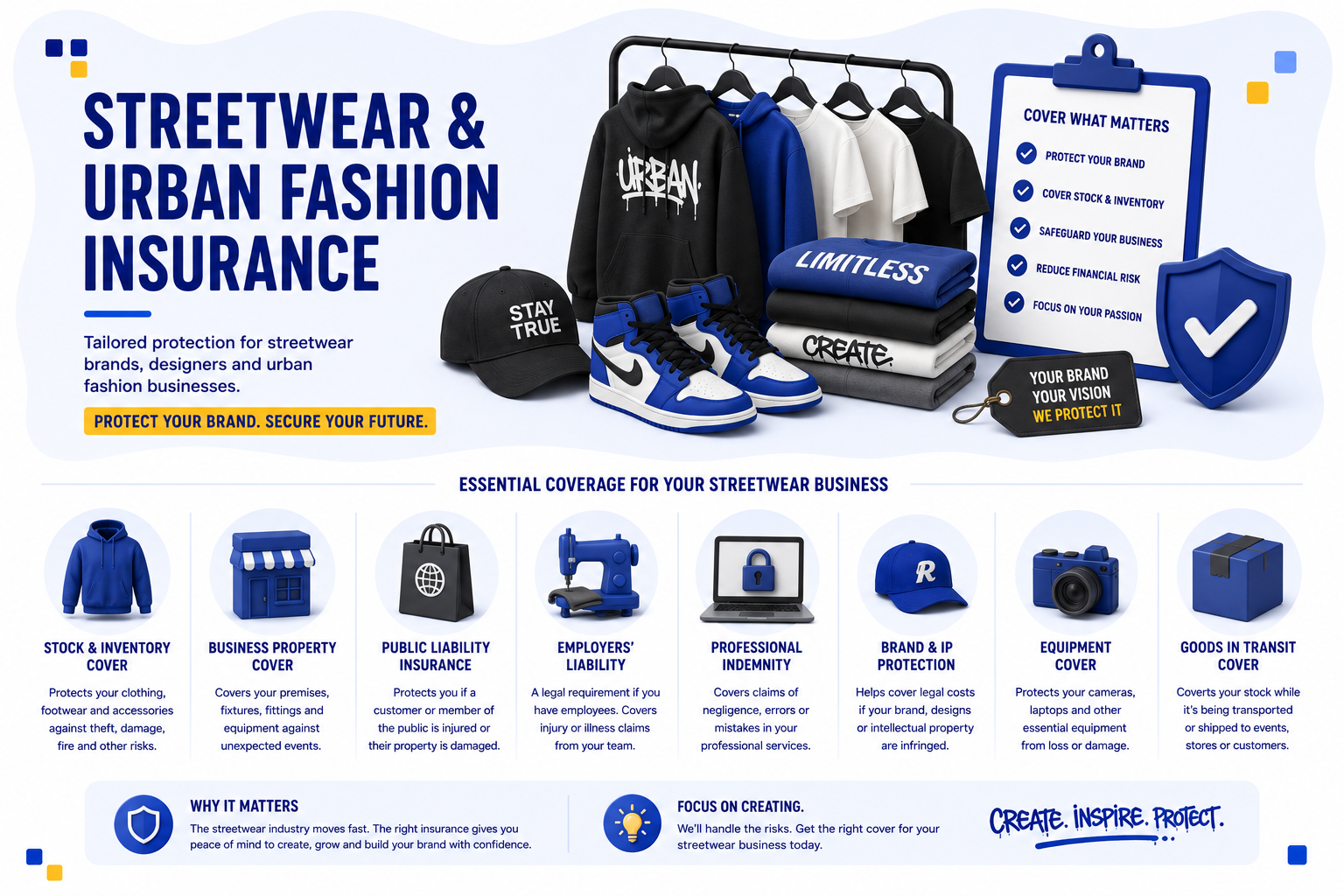
11. Risk 6: Product recall and supply-chain failure
Product Recall — The Cost That Doesn't Show in a Liability Limit
If a defective product reaches market, brand owners face the cost of recall — and it's substantial. Under the General Product Safety Regulations 2005, producers and distributors must take corrective action where a product is unsafe, and notify the relevant enforcement authority. The recall costs are not covered by standard products liability cover, which responds to the injury or damage the product caused but not the cost of getting it back. Direct recall costs include: customer notification (email campaigns, social media, paid placements, postal mailings); return logistics; warehouse handling; disposal or remediation; replacement product; customer compensation goodwill payments; and reputational management. A meaningful fashion recall — say 5,000 units of a children's wear line failing drawstring compliance — can cost £50,000–£250,000 in direct recall expenses alone, before reputational damage and BI losses are added.
Pre-production testing for any product with specific safety standards (children's wear, sportswear, swimwear, nightwear); supplier warranties and indemnities with the financial substance to back them; batch and traceability systems enabling targeted rather than mass recall; documented incident-response protocol identifying notification responsibilities; customer database hygiene enabling fast and accurate communication; relationships with disposal/remediation providers for fast scale-up if needed; pre-drafted recall communication templates approved by legal counsel.
Product Recall insurance — either as a standalone policy or as an extension to Products Liability — is the primary response. Cover typically responds to: direct recall costs (notification, logistics, disposal); replacement product costs; consultancy fees; reputational management; and in higher-end policies, lost profits during the recall period. SME fashion brands typically buy limits of £100k–£500k; children's wear and higher-risk product categories £500k–£1m+. Critical exclusions: voluntary recalls undertaken purely for commercial/reputational reasons without an underlying safety defect typically aren't covered; pre-existing defects known to the brand at policy inception aren't covered; defects in raw materials supplied by the brand to manufacturers are typically covered only if the cover is specifically scoped to do so.
12. Risk 7: Business interruption — seasonality and dependency
Business Interruption — The Compounded Fashion Loss
Fashion's seasonality and platform dependency make business interruption unusually costly. A studio fire in early November destroys the Christmas drop — the seasonal revenue isn't recoverable later. A Shopify outage during Black Friday weekend costs a multi-channel brand a disproportionate share of annual revenue. A print partner going into administration leaves a POD brand unable to fulfil at peak season. A cyber attack on e-commerce systems during a drop means crowds of customers can't transact and don't return when systems recover. The standard property/contents claim might be modest — £15,000 of damaged stock — but the BI tail can be 5–10× the direct loss. Designer apparel labels face the seasonal-collection version of the same problem: production delay or stock loss before fashion week or trade-show season can write off a season's wholesale revenue, with downstream cash-flow consequences that take 18–24 months to recover.
Documented business continuity plan covering studio/warehouse fire, key supplier failure, platform outage, and cyber incident; cloud-based backup of customer data, product files, design files, and marketing assets; multi-supplier strategy for any critical production component; multi-platform sales strategy reducing single-platform dependency (DTC site plus Shopify plus Etsy plus Amazon plus physical/wholesale); cash reserve sufficient to absorb 90–120 days of fixed costs without revenue; explicit indemnity period in BI cover matched to actual recovery timelines, not generic 12 months.
Business Interruption cover — typically as an extension of commercial property/contents — is the primary response for premises-based losses. Indemnity period is the critical variable: 12 months is the default but is often inadequate for fashion businesses where collection cycles, supplier reorder lead-times, and seasonal revenue patterns mean meaningful recovery takes longer. 18–24 months is increasingly the working standard. Cyber Business Interruption is a separate cover (within the Cyber policy) responding to e-commerce outages and ransomware-driven downtime. Denial-of-access cover and supplier-failure (contingent BI) extensions extend the cover where loss is caused by something at a different location (a fire at a key supplier, a road closure preventing access to the studio). Trade Credit Insurance addresses wholesale customer insolvency — material where a small number of large wholesale customers represent significant revenue.
13. Risk 8: Insurance non-disclosure under the Insurance Act 2015
Insurance Non-Disclosure — The Most Preventable Catastrophe
The single most common reason UK insurance claims are reduced or declined isn't underwriting fraud or bad luck — it's non-disclosure at the proposal or renewal stage. Fashion brand operators routinely buy generic "online retailer" or "shop" package policies without specifically declaring own-label products, manufacturing, children's wear, IP/brand-protection exposure, international sales, or platform dependency. The Insurance Act 2015 requires businesses to make a "fair presentation of the risk" — proactively disclosing every material fact the insurer would want to know. Failure to do so allows the insurer to: avoid the policy (treating it as never having existed); reduce the claim proportionally; or impose terms that would have applied with proper disclosure.
Annual review of declared activities against actual operations; written confirmation from broker that all current activities are within scope; specific declaration at proposal of each material exposure — own-label, manufacturing, children's clothing, sportswear/performance wear, drops and events, international sales, wholesale, marketplace selling, dropship/POD, in-house design vs commissioned design; mid-term notifications to broker when new work types are taken on (a new product category, a new sales channel, a new export market); documented response to broker enquiries at renewal; retention of policy documents and broker correspondence as evidence.
There is no insurance response to insurance non-disclosure — that's the whole point. The cover that should have responded doesn't. The only mitigation is at the proposal stage: detailed declaration, broker discipline, and renewal review. Specialist fashion broker placement makes a material difference — generic brokers often miss the specific declarations that fashion work requires (own-label vs distribution, children's wear sub-category, international territory, IP exposure), while specialist brokers know exactly what each insurer expects to see at proposal.
14. What drives the cost of fashion business insurance in 2026?
Fashion business insurance pricing in 2026 reflects the genuine claim exposure differential between business models, plus the documentation and risk management maturity within each model. Indicative annual premium ranges below. For broader cost-driver context across UK commercial insurance see our business insurance quote guide.
| Business Profile | Indicative Annual Premium 2026 |
|---|---|
| Online-only micro brand — under £50k turnover, no staff, single channel | £450–£1,200 |
| Established streetwear brand — DTC plus occasional drops, 1–3 staff, £100k–£400k | £1,200–£3,800 |
| Designer apparel label — DTC + wholesale, 2–5 staff, £200k–£800k | £2,400–£6,500 |
| Designer apparel boutique — physical retail premises, £300k–£1m turnover | £2,800–£7,500 |
| Print-on-demand / dropship fashion brand — £100k–£500k turnover, IP-elevated | £1,500–£4,200 |
| Small clothing manufacturer — under £1m turnover, factory-based | £4,500–£12,000 |
| Mid-sized fashion operation — £1m–£3m turnover, multi-channel, larger inventory | £6,500–£15,000+ |
The factors below drive both insurance premium and overall risk management investment. The rating impact within each profile band is often larger than the differential between profile bands — a streetwear brand with mature documentation can pay less than a micro brand with poor documentation.
| Rating Factor | Impact on Premium | What You Can Do |
|---|---|---|
| Business model and work mix | Micro online lowest; manufacturer and boutique highest | Declare every work type specifically — own-label, drops, manufacturing, exports |
| Annual turnover and stock value | Primary scaling factors for products liability, stock, and BI lines | Declare accurately including planned growth and seasonal peaks |
| Product mix — children's wear, sportswear, nightwear | Children's wear adds 15–35% to products liability line | Justify with documented testing and supplier QC; don't try to omit |
| Trademark and IP documentation | Registered marks reduce IP cover premium 10–20% | UK trademark in core classes; IP assignments with creative collaborators |
| Premises type and security | Boutique with insurer-approved security vs unattended studio — material differential | Insurer-approved alarm, CCTV, fire detection; document maintenance |
| Cyber controls (MFA, backups, training) | Mature controls reduce Cyber premium 15–25% | MFA on all admin systems; backups; documented incident response |
| Sales channel mix | Single-platform dependency increases BI exposure | Multi-channel reduces premium and improves resilience |
| International sales / exports | Adds 10–25% to products liability line | Worldwide cover where exporting; US territory typically excluded by default |
| Claims history | 5+ year impact; products liability and IP claims particularly material | Documentation pack and remedial action after any claim |
| Limits selected | £2m vs £5m PL material; £100k vs £500k Cyber material | Match to actual exposure and contract requirements |
| Broker placement type | Specialist fashion brokers access better terms than generic placement | Use a broker with specific fashion brand experience |
| Continuity with insurer | 3+ years with same insurer typically reduces renewal premium 5–10% | Strategic continuity decision; don't chase £100 savings |
15. Real claims and how to manage them
Claim — Trademark Infringement Defence, £58,000 Settlement
A growing streetwear brand with around £350,000 annual turnover launched a new graphic tee featuring a stylised wordmark that drew design inspiration from a popular 1990s skate brand. The brand was unregistered as a trademark; the founder hadn't conducted clearance searches. Within 8 weeks of release, the brand received a cease-and-desist from solicitors acting for the established skate brand's owner — alleging trademark infringement, passing off, and unfair advantage of an established reputation. The letter demanded immediate cessation, delivery up of remaining stock, an account of profits, and contribution to legal costs.
The brand's standard combined liability policy did not cover IP defence costs. The founder engaged solicitors privately at £350/hour. After three months of correspondence and a pre-action protocol exchange, the dispute settled: cessation of the design, delivery up of remaining stock (1,400 units written off at £18,000), a £15,000 contribution to claimant's costs, and a confidentiality undertaking. The brand's own legal costs reached £24,000. Total economic impact: £58,000 plus diverted founder time across four months.
Post-claim insurance response: the brand placed specialist IP insurance with £250k defence cover at the next renewal — premium uplift £680 per annum. UK trademark registration completed for the core wordmark and logo at £450 across two classes. The brand instituted clearance searches before all subsequent design releases.
The lesson: IP claims are not covered by standard combined liability policies. The cost of defending a single trademark or passing-off claim out of pocket dwarfs the premium for specialist IP defence cover across many policy years. For streetwear brands particularly, where visual references are dense and rights-holders are vigilant, IP defence cover is functionally essential — not optional.
Claim — Children's Wear Product Recall, £142,000 Settlement
A small-but-growing fashion brand selling womenswear and a small children's accessory line discovered that a batch of children's beanie hats featuring decorative pom-poms had a structural defect — the pom-poms could detach with moderate force, creating a choking hazard for under-3s. The defect was identified after a customer complaint, escalated through Amazon's marketplace safety review, and the brand was required to notify the Office for Product Safety and Standards under GPSR 2005 mandatory notification requirements.
The recall covered 3,200 units sold across multiple channels — DTC, Amazon, eBay, two boutique stockists. Direct recall costs: customer notification (email and postal mailing where addresses available), return logistics for marketplace channels, disposal at compliant facility, refund processing across multiple payment platforms, replacement product for customers who wanted continued supply, and OPSS engagement. The brand's Product Recall extension (£100k limit on £5m Products Liability policy) responded to direct recall costs. Total recall and remediation: £142,000 across direct costs and consequential losses (BI on the children's line, lost wholesale relationship with one stockist who declined to continue stocking).
Post-claim renewal: Products Liability premium increased 30%, with insurer requiring documented pre-production testing for any future children's wear product (independent lab testing to BS EN 14682 and EN 71-3 equivalents for decorative elements). Recall extension limit increased to £250k. The brand discontinued children's wear pending dedicated supplier QC discipline.
The lesson: children's wear materially elevates product liability risk and recall exposure. The Recall cover sub-limit on the original Products Liability policy was inadequate — the brand was exposed for approximately £42,000 above the recall limit, paid out of cash flow. Children's wear specifically requires recall extension limits proportionate to volume sold, plus documented pre-production testing as a condition of cover.
Claim — E-commerce Cyber Attack, £96,000 Settlement
A designer apparel label with around £700,000 annual turnover, operating through Shopify Plus and several wholesale relationships, suffered a credential-compromise attack where an attacker gained access to the brand's Shopify admin via a phishing email targeting the head of marketing. Over a 6-day window before discovery, the attacker: added a malicious "checkout" payment skim that captured card details from approximately 1,400 customer transactions; modified the order workflow to divert ~80 high-value orders to a fraudulent address; and downloaded the customer database (approximately 28,000 records).
On discovery, the brand engaged its Cyber Insurance incident response panel within 24 hours. Forensic investigation, remediation, customer notification, credit monitoring for affected customers, and the ICO breach notification (within the 72-hour UK GDPR window) cost approximately £42,000. Card-scheme PCI forensic investigation and assessment cost £18,000. Direct losses from the diverted orders: £19,000. Business interruption during the 4-day operational pause for remediation: £17,000.
Settlement total: £96,000. Cyber Insurance policy (£250k limit) responded across all categories. The brand subsequently implemented MFA across all admin platforms, mandatory security training, principle-of-least-privilege access controls, and a quarterly access review.
Post-claim renewal: Cyber premium increased 35% with insurer requiring documented MFA on all admin platforms (Shopify, email, payment processors, CMS) as policy warranty. Following implementation, premium returned to a 12% loading over baseline. The brand reports the post-claim controls have prevented two subsequent phishing attempts that would otherwise likely have succeeded.
The lesson: cyber attacks on fashion brands are no longer rare. The DTC e-commerce stack — Shopify admin, email marketing platforms, payment processor dashboards — concentrates significant access privilege in a small number of credentials, typically held by non-technical staff. The single most impactful control is MFA on all admin platforms; the second is staff phishing training. Cyber Insurance with appropriate limits is the financial backstop, but the operational controls are what prevent the claim in the first place.
Claims Management Steps
How to respond to a fashion business insurance incident or regulatory engagement — the steps below are critical given the multi-policy exposure typical of 2026 fashion brand operations:
- Stop the immediate harm. For a product defect, suspend further sales of the affected line. For a cyber incident, isolate the affected systems before doing anything else. For an IP cease-and-desist, do not continue using the disputed material while assessing the claim. Acting before the fact-finding stops the problem getting bigger.
- Notify your insurer immediately for any potential claim. Fashion incidents often engage multiple policies (Products Liability, Cyber, IP, BI). Single notification triggers coordinated response. Threshold is "may give rise to a claim" — much lower than "formal claim received".
- Preserve all documentation rigorously. Product specifications and supplier records; customer communications; design files with creation dates; correspondence with claimant; technical evidence (cyber: log files, forensic image; product: defect samples, batch records). The documentation pack is the defence across all coverage layers.
- Do not admit liability or fault. Provide factual information about what happened, what work was done, methodology followed. Do not accept fault, apologise in writing, or commit to remedial work that could be interpreted as admission. Particularly critical for IP claims — early admissions are binding.
- Manage regulatory engagement carefully. If OPSS, Trading Standards, or the ICO attend or notify, engage your Legal Expenses insurer immediately. Cooperate factually with inspectors but do not provide written statements without legal representation. For UK GDPR breaches, the 72-hour notification window is mandatory and missing it is itself a separate offence.
- Engage with customer communications procedurally. Public communication about a product recall, cyber breach, or IP dispute should be drafted with legal and insurer input. Honest, prompt communication generally reduces claim severity; defensive or evasive communication makes things worse. Pre-drafted templates approved by counsel before any incident make this faster.
- Conduct root cause analysis and document remedial action. Identify underlying cause and implement remedial action. Insurers reviewing renewal will ask what's changed since claim; regulators will require evidence of remedial action. Document the steps taken.
- Update operational documentation to address gap. Where the claim identified a documentation gap (no IP assignment, no clearance search, no MFA, no supplier QC record), update the standard operating procedure to close the gap going forward. This is both insurance and regulatory defence at the next renewal.

Glossary of fashion business insurance terms
- Products Liability
- Insurance cover responding to third-party injury and property damage caused by defective products. For fashion brands this includes defective zips, fabric reactions, choking hazards on children's wear, and footwear/sportswear defects. Typically embedded in combined Public & Products Liability policies.
- Product Recall
- Specialist insurance covering the cost of removing defective products from market — notification, logistics, disposal, replacement, consultancy, and (in higher policies) lost profits. Sold either as a standalone product or as an extension to Products Liability. Distinct from products liability cover, which responds to injury caused but not to recall costs.
- Consumer Protection Act 1987
- UK statute imposing strict liability for defective products. Anyone who manufactures, imports, or own-brands a product into the UK is liable for defects regardless of fault. Fundamentally important for fashion brand owners who put their label on third-party-manufactured goods.
- GPSR 2005 (General Product Safety Regulations 2005)
- UK regulations requiring all consumer products to be "safe" before being placed on the market. Applies to all clothing and accessories. Penalties for non-compliance up to £20,000 or 12 months' imprisonment for the most serious offences. Mandatory notification of unsafe products to OPSS.
- Intellectual Property Enterprise Court (IPEC)
- UK specialist court within the Business and Property Courts handling IP disputes up to £500,000. Streamlined procedure with capped costs, making it the standard forum for SME fashion brand IP claims. Faster and cheaper than High Court.
- Trade Marks Act 1994
- UK statute governing trademark registration and infringement. Fashion brands typically register in Class 25 (clothing, footwear, headgear) plus adjacent classes (14 jewellery, 18 leather goods, 35 retail services) depending on activity.
- Passing Off
- Common-law action protecting unregistered brand goodwill. To succeed, the rights-holder must prove (1) goodwill in the mark/get-up, (2) misrepresentation causing confusion, and (3) damage. More expensive to prove than registered trademark infringement — which is why UK trademark registration is the foundational fashion brand IP investment.
- Unregistered Design Right (UDR)
- UK statutory right under the Copyright, Designs and Patents Act 1988 protecting original design of the shape or configuration of articles. Lasts 10 years from first marketing or 15 years from creation, whichever is shorter. Provides automatic protection for original fashion designs without registration.
- Registered Design
- UK formal design registration providing stronger and longer protection (up to 25 years) than UDR. Particularly useful for distinctive product silhouettes, surface decoration, or accessory designs where the design itself is core to brand equity.
- BS EN 14682
- British Standard governing cords and drawstrings on children's clothing — specifying maximum lengths, attachment requirements, and prohibited configurations. Referenced under GPSR 2005 as a designated standard giving presumption of conformity.
- UK REACH
- UK Registration, Evaluation, Authorisation and Restriction of Chemicals regulation governing chemical substances in products. Applies to dyes, fabric treatments, finishes, and any chemical components in fashion products. Material restrictions apply to azo dyes, phthalates, nonylphenol ethoxylates, and other substances.
- Textile Products (Labelling and Fibre Composition) Regulations 2012
- UK regulations requiring clothing and textile products to carry labels showing accurate fibre composition using official fibre names. Labels must be in English; non-compliance can trigger enforcement and create reputational damage.
- UK GDPR
- UK General Data Protection Regulation governing personal data processing. Fashion brands holding customer data must comply with data subject rights, breach notification within 72 hours, and security obligations. ICO can impose fines up to £17.5m or 4% of global turnover.
- PCI-DSS
- Payment Card Industry Data Security Standard governing card-payment data handling. Fashion brands processing card payments must comply, with compliance level varying by transaction volume. Non-compliance can result in card-scheme fines and post-incident forensic costs.
- Combined Public & Products Liability
- Single policy covering both public liability (third-party injury/damage on premises or by operations) and products liability (injury/damage caused by products). Standard for fashion brands; ensure both elements are at appropriate limits and that own-label products are specifically declared.
- Business Interruption (BI)
- Insurance cover responding to loss of revenue and additional costs following an insured event (typically fire, flood, or cyber attack). Indemnity period is the critical variable — 12 months is default but 18–24 months is increasingly the working standard for fashion businesses given seasonal collection cycles.
- Goods-in-Transit
- Insurance cover for stock and finished goods while in transit between supplier, warehouse, and customer. Fashion brands have significant transit exposure given international supply chains and DTC fulfilment.
- Run-off Cover
- Cover that continues to respond to claims notified after the policy has ended (provided the activity occurred during the policy period). Important for Professional Indemnity where advisory work creates long-tail exposure. Relevant for fashion consultants and stylists offering paid advice.
Frequently asked questions
Fashion business insurance is specialist commercial insurance designed for clothing brands, designer apparel labels, streetwear and urban fashion businesses, fashion e-commerce retailers, garment manufacturers, vintage stores, and creative fashion SMEs. The core covers in 2026 are: Public & Products Liability with own-label scope; Employers' Liability if you have staff; Stock and Contents at peak replacement value; Cyber Insurance with payment-data and e-commerce BI scope; Intellectual Property (Brand Protection) Insurance with defence and pursuit cover; Business Interruption; and Goods-in-Transit. The cover differs fundamentally from generic shop or online retailer policies — those typically don't contemplate own-label products liability or IP risk specifically.
Yes — and the marketplace doesn't change the answer. Under the Consumer Protection Act 1987, whoever brings the product to market is strictly liable for defects. If you put your brand on a garment and sell it on Etsy, Amazon, Vinted, or Depop, you're the producer for liability purposes. The marketplace's terms typically pass through liability to the seller and require evidence of insurance for higher-volume sellers. Don't assume marketplace selling reduces your exposure — it doesn't. Standard Public & Products Liability £2m–£5m is the working level for most marketplace fashion sellers, with own-label scope explicitly declared.
Indicative 2026 annual premiums: online-only micro brands (under £50k turnover) £450–£1,200; established streetwear brands (£100k–£400k) £1,200–£3,800; designer apparel labels (£200k–£800k) £2,400–£6,500; designer apparel boutiques (£300k–£1m) £2,800–£7,500; print-on-demand fashion brands £1,500–£4,200; small clothing manufacturers (under £1m) £4,500–£12,000; mid-sized fashion operations (£1m–£3m) £6,500–£15,000+. Pricing depends on business model, product mix (children's wear elevates premium), claims history, limits, and broker placement. Specialist placement is typically modestly more expensive than generic shop or e-commerce package cover but the differential reflects genuine claim exposure differential.
Employers' Liability is legally required if you have staff under the Employers' Liability (Compulsory Insurance) Act 1969 — fines of £2,500 per day for non-compliance. Public Liability is not legally required but is contractually required by virtually all venues hosting brand activations, drops, pop-ups, fashion weeks, and trade shows. Cyber Insurance is not legally required but ICO breach notification obligations under UK GDPR create operational exposures it covers. Product Liability is not legally required but operating without it where you sell own-label products is a substantial uninsured exposure. Other covers (IP, BI, Recall) are commercially essential but not legally required.
Standard Public & Products Liability does NOT cover IP claims — this is a critical and common cover gap. Intellectual Property (Brand Protection) Insurance is the specialist product, with two parts: defence cover for legal costs and damages when you're accused of infringement, and pursuit cover for the costs of enforcing your own IP rights against infringers. UK specialist IP cover is available from Lloyd's underwriters and specialist MGAs; it's typically a separate policy rather than an extension of general liability. Limits typically £100k–£500k for SME fashion brands; £1m+ for higher-turnover operations. Some Cyber and Combined Liability policies include modest IP defence sub-limits — useful as a baseline but rarely sufficient as primary cover.
The dominant differences are IP exposure profile and event exposure. Streetwear and urban fashion brands operate in a visual vocabulary dense with logos, references, and graphics that can shade into IP infringement quickly — making IP defence cover materially more important than for, say, a contemporary minimalist clothing brand. Streetwear also routinely operates with limited-release drops and queue events that create concentrated public liability exposure. Both factors mean specialist streetwear placement typically prices 15–25% higher than equivalent contemporary fashion brand cover, but with cover scope specifically matched to streetwear's claim profile. See our wider print-on-demand business insurance guide for adjacent fashion-brand cover considerations.
If you give advice for a fee — fashion consultancy, brand strategy, design advisory, styling for paid clients, trend forecasting — Professional Indemnity is essential. Standard Public Liability doesn't cover the financial loss flowing from negligent advice (a forecast that proves wrong, a brand direction that fails commercially, a styling decision that causes reputational damage). For fashion designers running their own labels, Professional Indemnity is less commonly bought but becomes relevant where you offer paid design services to other brands. Run-off cover important — advisory claims can surface 2–5 years after engagement. See our professional indemnity insurance page for cover principles.
Insurance non-disclosure under the Insurance Act 2015. The pattern: brand owner buys a "shop" or "online retailer" package with generic "clothing retail" declared, operates with substantial own-label, children's wear, or international sales not specifically declared. At claim stage, the insurer points to the proposal showing the declared activity was generic, and a claim involving own-label product liability, children's wear recall, or export-territory exposure becomes uninsured. This isn't fraud; it's the normal operation of UK insurance law requiring "fair presentation of the risk". The fix at proposal stage is minimal cost; the retrospective cost is potentially every uninsured claim across multiple policy years. Get written confirmation from your broker that own-label, your specific product categories, and your specific sales channels are within scope.
The biggest premium reduction levers are: documented IP discipline (registered trademarks, written IP assignments with creative collaborators, monitoring) — reduces IP cover premium 10–20%; mature cyber controls (MFA, backups, training, documented incident response) — reduces Cyber premium 15–25%; appropriate stock security with insurer-approved alarm/CCTV/fire detection — material on Stock cover; multi-channel sales strategy reducing platform dependency — reduces BI premium; accurate work mix declaration avoiding insurer surprises; 3+ years continuity with same insurer; annual payment vs monthly; specialist broker placement. Stack the levers; don't choose between them. Avoid the trap of buying the cheapest generic shop or online retailer package — the saving is dwarfed by uninsured claim exposure.
Standard Products Liability covers the harm caused by a defective product (injury, property damage) — but typically does NOT cover the cost of recalling the product. Product Recall insurance is a separate cover, either as a standalone policy or as an extension to Products Liability, responding to direct recall costs (notification, logistics, disposal, replacement) and in higher policies to lost profits during the recall period. SME fashion brands typically buy limits of £100k–£500k; children's wear and higher-risk product categories £500k–£1m+. Critical to check: voluntary recalls undertaken purely for commercial/reputational reasons without an underlying safety defect typically aren't covered.
UK insurance policies cover UK activity by default. To sell internationally you need explicit declaration of territorial scope, with the US typically excluded by default given the higher claim severity in US jurisdictions. Cover needed: worldwide Public & Products Liability with US/Canada included where exporting there (typically with a separate premium); worldwide Goods-in-Transit for shipments; international Stock cover for trade-show samples; territory-specific Cyber cover where local data protection regimes (EU GDPR, US state laws, others) apply. Material exposure: US product liability claim values are routinely 5–10× UK equivalents; sportswear, children's wear, and accessories with safety standards face particular scrutiny. Get specialist advice before declaring US/Canada sales — the additional premium is usually meaningful.
Look for brokers with specific experience in fashion brand, e-commerce retail, and SME creative-sector risk evidenced by: specialist articles or guides on fashion-specific cover; willingness to discuss specific exposures (own-label products liability, IP defence and pursuit, cyber on DTC e-commerce, BI on seasonal collections) in detail; access to Lloyd's market and specialist MGAs rather than just mainstream commercial markets; FCA authorisation and documented track record. Avoid brokers offering "shop package" or "e-commerce package" without discussing fashion specifics; brokers who can only quote one or two markets; brokers who don't ask about own-label, IP, or platform dependency at proposal. Miller & Partner specialise in this sector — see our shop insurance UK guide and broader shops and retail insights hub.





Instagram
LinkedIn