Vegan Café Insurance UK

Vegan Cafe Insurance UK: Full Cover, Zero Confusion — 2026 Guide

May 08, 202610 min read

Miller & Partner are specialist commercial insurance brokers with 15 years' experience placing hospitality risks across the UK

Custom HTML/CSS/JAVASCRIPT

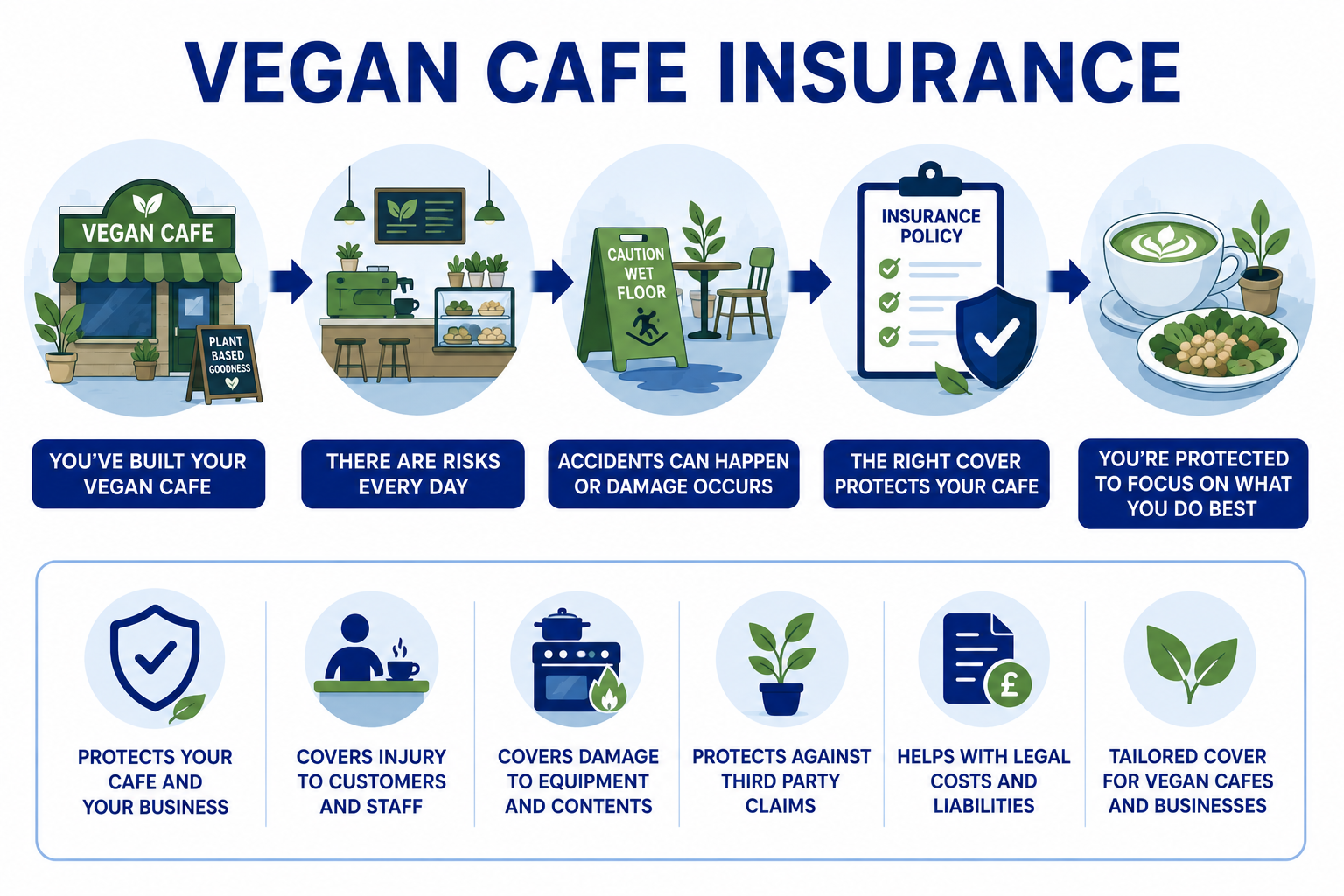
Running a vegan cafe in the UK is genuinely exciting — plant-based dining is one of the fastest-growing segments on the British high street. But as your menu scales up, so does your exposure to risk. Whether you're worried about an allergic reaction claim, a refrigeration breakdown spoiling a week's worth of cashew cheese, or a customer slipping on a wet floor, the right insurance keeps your restaurant and food business standing.

This guide covers everything UK vegan cafe owners need to know: what cover is legally required, what's strongly recommended, what specialist risks plant-based businesses face, and how to keep premiums manageable.


What Insurance Does a Vegan Cafe in the UK Actually Need?

There's a difference between what the law requires and what a sensible business needs. Here's a clear breakdown.

Legally Mandatory: Employers' Liability Insurance

If you employ anyone — even a single part-time member of staff — employers' liability insurance is a legal requirement under the Employers' Liability (Compulsory Insurance) Act 1969. You must hold a minimum of £5 million in cover.

The penalty for non-compliance is up to £2,500 per day. In a busy café kitchen where staff handle hot equipment, sharp knives, and slippery surfaces, the risk of a workplace injury claim is real — and an uninsured claim could be catastrophic.

Effectively Essential: Public Liability Insurance

Public liability isn't a legal requirement, but in practice it's non-negotiable. Most commercial landlords, suppliers, and event organisers will ask for proof of it before working with you. It covers:

  • Customers slipping on wet floors

  • Allergic reactions to food served in your café

  • Damage to a third party's property caused by your business

Standard limits for UK hospitality businesses run from £1 million to £5 million. For a café with reasonable footfall, £2 million is a common starting point.

Critical for Food Businesses: Product Liability Insurance

Product liability is where vegan cafés face a genuinely elevated risk compared to many other food businesses. Your customers often choose plant-based dining because of allergies or intolerances — to dairy, eggs, or other animal products. A mislabelled ingredient or a trace of cross-contamination can trigger a severe allergic reaction and a substantial claim.

Product liability covers harm caused by food or drink you've prepared, even after it leaves your premises. This includes:

  • Take-away orders

  • Packaged goods sold for retail

  • Catering at external events

If you produce any packaged goods for retail sale, product recall insurance is also worth considering — it covers the cost of notifying customers, recalling stock, and disposing of contaminated products.


Specialist Insurance Considerations for Plant-Based Cafes

Vegan cafes face some risks that are either unique or significantly more pronounced than in conventional food businesses. These deserve specific attention when structuring your policy.

Stock and Ingredient Protection

The ingredients at the heart of a vegan menu — premium nut milks, organic produce, imported superfoods, specialist cheeses — are often more expensive and more perishable than conventional equivalents. A single refrigeration failure in your commercial kitchen can wipe out hundreds of pounds of stock overnight.

Stock deterioration cover (sometimes called spoilage insurance) protects you against financial losses when refrigeration fails, power goes out, or a supplier delivers contaminated produce. It's one of the most overlooked — and most valuable — covers for plant-based cafés.

Business Interruption Insurance

If a fire, flood, or serious equipment failure forces you to close temporarily, business interruption insurance compensates for the income you lose during that period. For vegan cafés that have built a loyal local following, even a two-week closure can be damaging — not just financially, but in terms of customer retention.

When comparing policies, check:

  • What triggers a claim (fire, flood, equipment failure, utility failure?)

  • The indemnity period (how many months of lost income are covered?)

  • Whether increased cost of working is included (e.g. renting a temporary space)

Equipment Breakdown Cover

Modern vegan cafes invest heavily in specialist equipment: high-powered blenders, cold-press juicers, alternative milk steaming systems, advanced refrigeration. When these fail, the costs aren't just repair bills — they're lost trading days.

Equipment breakdown insurance covers repair or replacement costs and the associated business losses. It's particularly worthwhile if you rely on equipment that would take days to source and replace.

Cyber Insurance

If you take card payments, run an online ordering platform, or store customer data, you're exposed to cyber risk. A data breach or ransomware attack can result in regulatory fines, customer compensation claims, and significant recovery costs.

Cyber insurance covers incident response costs, legal fees, data recovery, and business interruption caused by a cyber event. It's increasingly relevant as more cafés move to digital ordering and loyalty systems.


vegan cafe insurance uk

Allergen Management: The Highest-Stakes Risk for Vegan Cafés

Allergen compliance sits at the intersection of legal obligation and significant liability exposure. Under Natasha's Law, which came into force in October 2021, any food business in England, Wales, and Northern Ireland that prepares and packs food on-site for direct sale must display full ingredient and allergen information on the label.

For vegan cafés, the practical implications are serious:

  • Cross-contamination protocols must be documented and followed consistently — particularly if your kitchen also handles anything that isn't strictly vegan

  • Supplier verification is essential: an ingredient declared as dairy-free must actually be dairy-free, and you need to be able to demonstrate that

  • Staff training in allergen awareness isn't just good practice — it's a key factor in both preventing incidents and demonstrating due diligence if a claim arises

Thorough allergen management doesn't just protect your customers — it's one of the most effective ways to reduce your product liability premium.


What Does Vegan Cafe Insurance Cost in the UK?

Premiums vary considerably depending on your specific circumstances, but here are realistic ballpark figures:

Custom HTML/CSS/JAVASCRIPT

Want to know what your vegan cafe would cost? Call us on 01792 001350, email [email protected] or get a quick quote now.

These figures assume a standard package including public liability, employers' liability, product liability, and contents cover.

What Drives Your Premium Up or Down?

Factors that increase premiums:

  • High-footfall urban locations

  • Extended trading hours

  • Alcohol sales (wine, craft beer)

  • Delivery or outside catering operations

  • High-value specialist equipment

  • Previous claims history

Factors that can reduce premiums:

  • CCTV and intruder alarm systems installed

  • Documented staff training records (food safety, allergen awareness)

  • Regular equipment maintenance schedules

  • Paying annually rather than monthly (typically saves 5–10%)

  • Higher voluntary excess (if you can comfortably afford it)


Recommended Additional Covers

Beyond the core package, several additional covers are worth considering depending on your operation:

Food hygiene liability — covers claims arising specifically from food poisoning or contamination incidents, which may have sub-limits under a standard public liability policy.

Loss of licence cover — protects your income if a regulatory issue results in a temporary closure or suspension of your food hygiene rating.

Glass insurance — covers your shopfront windows and internal glass partitions, which can be expensive to replace.

Money insurance — protects cash held on-premises and during banking trips.

Legal expenses insurance — covers defence costs for employment disputes, HMRC investigations, or regulatory challenges.

Key person insurance — if your café's reputation is tied closely to a founder's personal brand or expertise, this cover protects against the financial impact of losing that person through illness or injury.

Crisis management cover — provides access to professional PR support following a serious incident, such as a food safety scare or a viral negative review. For vegan cafés where reputation and ethics are central to the brand, this is increasingly relevant.

Custom HTML/CSS/JAVASCRIPT

How to Structure a Comprehensive Policy Package

The most cost-effective approach for most vegan cafés is a combined hospitality policy that bundles multiple covers under a single document. This avoids gaps between separate policies and often delivers better value than purchasing covers individually.

A typical combined package includes:

Core bundle:

  • Buildings insurance (if you own the premises)

  • Contents and stock insurance

  • Public liability

  • Employers' liability

  • Product liability

Common additions:

  • Business interruption

  • Equipment breakdown

  • Stock deterioration

  • Cyber liability

When reviewing policy limits, note that £5 million public liability is the industry standard for hospitality businesses, though £10 million is available for minimal additional premium and may be required by some commercial landlords or event organisers.

On excesses: a £250–£500 voluntary excess is common for established cafés. Start-ups with tighter cash flow may prefer a lower excess despite the slightly higher premium — a large excess you can't afford to pay defeats the purpose of having insurance.


vegan cafe insurance
Reducing risk for your vegan cafe business

Reducing Risk (and Premiums) Through Good Operations

Insurers price risk. Businesses that demonstrate strong operational practices — and can evidence them — are rewarded with more competitive premiums at renewal.

Physical measures:

  • CCTV, intruder alarms, and quality locks

  • Fire suppression systems and regular electrical testing

  • Annual gas safety certificates

  • Documented servicing records for refrigeration and kitchen equipment

Operational practices:

  • Food Safety Management System (based on HACCP principles)

  • Documented allergen training for all staff

  • Slip-prevention protocols and regular floor inspections

  • Written health and safety policy with annual review

Keep records of all of the above. At renewal, being able to demonstrate a year of clean, documented risk management is one of the most effective negotiating tools you have.


Managing Claims When They Happen

If an incident occurs, how you respond in the first hours matters.

Do:

  • Notify your insurer promptly (most policies require notification within 30 days for standard claims, and immediately for serious incidents)

  • Photograph damage and preserve evidence before clearing up

  • Collect contact details and written statements from witnesses

  • Keep receipts for any emergency repairs or replacement purchases

  • Record all business losses caused by the incident

Don't:

  • Admit liability or make settlement offers without consulting your insurer first

  • Dispose of anything that could be relevant to a claim

  • Delay notification — late reporting can complicate or invalidate a claim


Annual Policy Reviews: Don't Just Auto-Renew

Your business changes. Your insurance should keep pace. At each renewal, take time to:

  • Reassess coverage limits against current equipment and stock values

  • Add or remove covers to reflect operational changes (new delivery service? New equipment? Staff changes?)

  • Update your declared turnover — under-declaration can leave you underinsured

  • Compare quotes from multiple insurers via a specialist hospitality broker

Any significant business change mid-year — adding alcohol sales, launching outside catering, taking on new premises — should be reported to your insurer promptly, not saved for renewal. Failing to disclose material changes can invalidate your cover.


Emerging Trends Worth Watching

Ghost kitchens and delivery-only models — vegan food businesses operating exclusively through delivery platforms face coverage gaps in standard café policies. If you're operating a shared kitchen space or virtual brand, get specialist advice on whether your policy actually covers your operational model.

Green infrastructure — solar panels, heat pumps, EV charging points, and other sustainability investments are increasingly common in ethically-driven vegan businesses. These need to be specifically noted on your buildings or contents policy to be covered.

Climate-related supply chain disruption — crop failures, extreme weather events, and logistics disruption are growing risks for businesses that rely on specialist or imported plant-based ingredients. Business interruption and supplier failure cover becomes more relevant in this context.


Frequently Asked Questions

Custom HTML/CSS/JAVASCRIPT

This guide is intended for general information purposes. Insurance requirements and policy terms vary between providers. Always seek advice from a qualified commercial insurance broker for guidance specific to your business.

Ready to protect your business?
Get expert advice and a tailored commercial insurance quote today.

✔ Independent broker
✔ Access to leading UK insurers
✔ Fast turnaround

[[email protected]]
[Call 01792 001350]

Custom HTML/CSS/JAVASCRIPT
vegan cafe insuranceplant based cafe insurancecaferestaurant
Working in the insurance industry for 15 years, I finally decided to go it alone and set up my own brokerage.

John Miller

Working in the insurance industry for 15 years, I finally decided to go it alone and set up my own brokerage.

LinkedIn logo icon
Back to Blog


We’re authorised and regulated by the FCA. You can check our registration on the FCA Register.

Office: Vivian House, Roman Bridge Close, Mumbles, Swansea, SA3 5BG

Miller & Partner is an Authorised Representative of Gauntlet Risk Management Ltd and are authorised and regulated by the Financial Conduct Authority (FCA) under firm reference number 1029698. You may check this on the Financial Services Register by visiting the FCA website, https://www.fca.org.uk/register/ or by contacting the FCA on 0800 111 6768 Privacy Policy