



Bootcamp Business Insurance Specialist: Secure Your Venture in 2026
Why does a UK bootcamp need different insurance from a personal trainer or a gym?
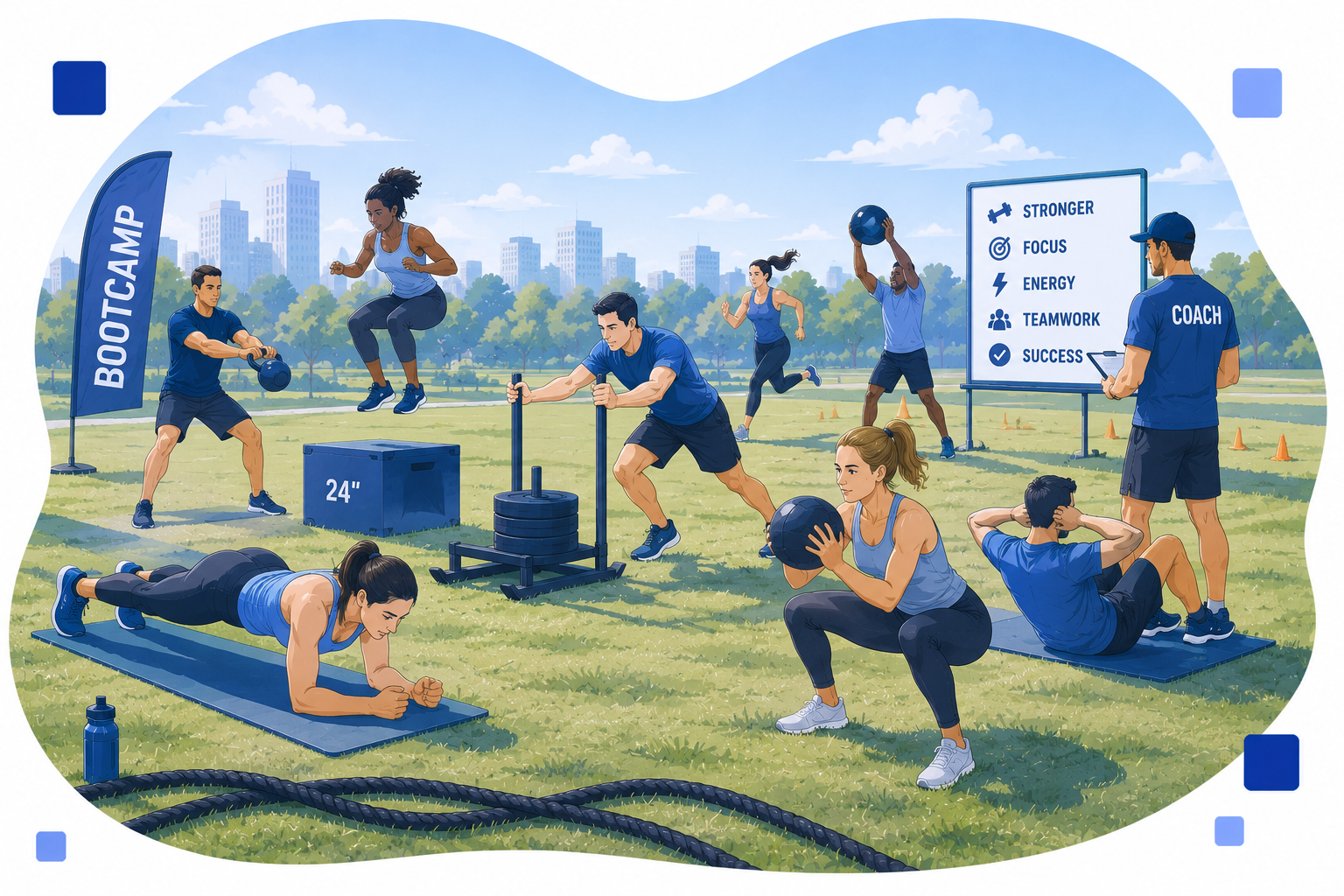
Bootcamp businesses occupy a unique position in the UK fitness sector. They aren't quite personal training (which is typically 1:1, indoor, and lower-throughput), they aren't quite a gym (which sits inside controlled premises with the operator owning the floor), and they aren't quite a sports club (which usually has formal membership and governing body affiliation). A bootcamp is a high-intensity group fitness format, frequently held outdoors in public parks, often involving 8–25 participants per session, with a strong emphasis on functional movements — burpees, sprints, kettlebells, plyometrics, military-style drills — under a single instructor. That combination creates a risk profile that doesn't fit neatly into any standard fitness insurance template.
Three structural factors make bootcamp insurance genuinely different. First, the group throughput multiplier: a personal trainer working with one client at a time can carry a £1m–£2m liability programme comfortably; a bootcamp instructor running 20 people through plyometric circuits has 20 simultaneous injury exposures per session, multiplied by the number of sessions per week. Second, the outdoor venue dimension: most UK bootcamps operate in parks, on beaches, in car parks, and at borrowed sites — each of which carries licensing requirements, terrain risk, weather exposure, and uncontrolled public access. Third, the format intensity: bootcamp by design pushes participants beyond their comfort zone, which is part of the value proposition but is also the underlying cause of overexertion injuries, including rhabdomyolysis — a serious muscle-breakdown condition increasingly seen in court-reported claims against group fitness operators.
The legal and insurance landscape has also shifted. The 2024 update to the Judicial College Guidelines (17th Edition) lifted moderate injury payout brackets by roughly 22% to account for inflation, meaning even a routine back or ligament claim from a bootcamp session can now settle well above £10,000 before legal fees. Personal injury awareness has risen; "no win, no fee" routes are well-established; and councils across England, Scotland, and Wales have tightened park licensing regimes — often requiring proof of Public Liability cover at £5m or £10m, evidence of CIMSPA registration, and current first aid qualification before a permit will issue. The bootcamp operator who built a programme on a £2m PL policy bought from a price comparison site five years ago is now operating with cover that doesn't meet venue requirements and doesn't reflect the claim environment.
This guide is the definitive 2026 UK bootcamp business insurance article. It covers the regulatory and licensing position, the eight claim-driving risks ranked by combined frequency and severity, the cover architecture that responds, indicative 2026 premium ranges, and three real claim case studies showing how things actually go wrong. It complements our personal trainers and fitness coach insurance product page, and sits alongside related guides including esports team insurance, fitness nutrition products insurance, and broader business liability insurance principles.
Key facts at a glance
- UK bootcamp operators face a group-fitness claim profile, not a personal training one — with 8–25 participants per session, a single bootcamp instructor's per-session injury exposure is roughly 10–25× that of a 1:1 personal trainer working the same hours.
- Public Liability at £5m is now the working minimum for venue access — most UK councils and park authorities require £5m as standard, with £10m increasingly required for higher-traffic sites and beach licensing.
- Park and outdoor venue licensing varies by council, parish, and landowner — there is no UK-wide bootcamp licensing scheme. Royal Parks (London), seaside resorts, and major city parks operate distinct permit regimes, with annual licence fees typically £200–£2,500 depending on location, session frequency, and class size.
- Professional Indemnity is no longer optional for bootcamp operators — claims arising from instructional negligence, programming errors, or nutritional advice given alongside training have become routine. The 2024 Judicial College Guidelines 17th Edition raised moderate injury payouts by ~22%, lifting typical PI claim values materially.
- Overexertion injuries — including rhabdomyolysis — are a recognised bootcamp PI exposure — group HIIT and bootcamp-format classes are specifically flagged in industry claims data as carrying elevated risk of muscle-breakdown injuries that can require hospitalisation and produce six-figure settlements.
- Employers' Liability is legally required if any staff are engaged under the Employers' Liability (Compulsory Insurance) Act 1969 — including unpaid helpers, substitute instructors, and casual session cover. £2,500-per-day fines for non-compliance.
- UK bootcamp business insurance premiums typically run £180–£600 for sole instructors and £1,200–£6,000+ for multi-instructor or multi-location operators — pricing depends on session volume, participant numbers, qualifications, venues, and limits selected.
1. The 8 biggest bootcamp business risks: summary table
The risks below are ranked by combined frequency, severity, and downstream insurance consequence. Some — participant injury, equipment incidents — are everyday operational realities. Others — overexertion-driven rhabdomyolysis, cardiac events, insurance non-disclosure — are rarer but high-severity and capable of ending a bootcamp business. The well-run operator manages all eight simultaneously rather than addressing them in priority order.
| Risk | Frequency | Severity | Primary Cover |
|---|---|---|---|
| Participant injury during group exercise | Routine — the dominant claim category | Medium (£3k–£40k typical) | Public Liability |
| Overexertion / rhabdomyolysis / cardiac event | Rare per business | High-Critical (£25k–£300k+) | PL + Professional Indemnity |
| Programming / instructional negligence (PI) | Rising | Medium (£8k–£60k typical) | Professional Indemnity |
| Equipment failure / weather incident | Occasional | Medium (£5k–£35k typical) | PL + equipment cover |
| Property damage at venue or to participants | Routine — low value mostly | Low (£200–£8k typical) | Public Liability |
| Vulnerable participant / undisclosed condition | Occasional | High (£15k–£150k+) | PL with participant screening defence |
| Online / corporate / hybrid programme exposure | Rising — sector shift | Medium (£8k–£75k typical) | PI with online delivery scope, Cyber |
| Insurance non-disclosure (Insurance Act 2015) | Common, often unnoticed | Catastrophic (potentially uninsured claim) | None — preventable at proposal only |
2. How does park and outdoor venue licensing affect UK bootcamp operators?
The single most under-prepared area of UK bootcamp operations is park and outdoor venue licensing. Most operators understand instinctively that you can't run a commercial fitness business on private land without permission. Far fewer realise that public parks are also regulated — and that running an unlicensed bootcamp in a public park can void your insurance, attract enforcement action from the council, and prejudice future licence applications across multiple local authorities.
There is no UK-wide bootcamp licensing scheme. Instead, each local authority, parish council, and landowner sets its own rules. Royal Parks (covering Hyde Park, Richmond Park, St James's Park, Green Park, and other major London sites) operates a strict licensing regime requiring documented insurance, instructor qualifications, and adherence to specific terms protecting land and public access. Major seaside councils such as Bournemouth, Christchurch and Poole (BCP) Council license fitness activities on beaches with seasonal restrictions — typically excluding peak summer windows of 10am to 5pm from 1 April to 30 September. Most district councils require an application showing proof of qualification (Level 2 Group Exercise or Level 3 Personal Trainer minimum), proof of Public Liability insurance (typically £5m–£10m), and a session-specific risk assessment.
The structural insurance implication: park licences typically require a minimum PL cover level that the operator must maintain throughout the licence period. If cover lapses or is reduced below the required level mid-licence, the operator is technically in breach — which can void both the licence and the insurance simultaneously when a claim arises.
Typical park licence requirements in 2026
- Proof of accepted fitness qualification — Level 2 Certificate in Group Training or Level 3 Personal Trainer minimum, increasingly verified against the CIMSPA directory.
- Proof of Public Liability insurance — typically £5m, £10m for higher-value sites.
- Current First Aid at Work or Emergency First Aid certificate — most councils require certification held by the instructor on session.
- Session-specific risk assessment — covering terrain, weather, equipment, participant numbers, and emergency response.
- Code of conduct compliance — including no exclusive use of park space, no large fixed equipment, no rubbish left, right of way for other park users.
- DBS clearance — where bootcamps include or are likely to include under-18 participants.
- Licence fee — typically £200–£2,500 annually depending on site, session count, and class size.
3. Risk 1: Participant injury during group exercise
Participant Injury — The Dominant Claim Category
The single largest claim category for bootcamp operators is participant injury during the session itself. The typical claim profile: a participant trips during a sprint drill on uneven ground; pulls a hamstring during plyometric work after inadequate warm-up; rolls an ankle on a kettlebell left in a transition zone; falls during a partner-carry exercise; or sustains a minor head injury from a medicine ball or resistance band. These claims are usually £3,000–£40,000 in settlement value, but the volume is high. A single bootcamp instructor running 8–10 sessions per week with 12–20 participants per session creates exposure to roughly 500–800 individual participant-sessions per month — and only one of those needs to go wrong to generate a claim.
The legal route is straightforward. The bootcamp operator owes a duty of care to participants under both common law negligence principles and (where the operator controls the space, however temporarily) the Occupiers' Liability Act 1957. The 2024 Judicial College Guidelines 17th Edition raised moderate injury payout brackets by approximately 22% to reflect inflation, meaning typical bootcamp injury claims have moved structurally upward in value over the past three years.
Pre-session site walk-through documented per session (terrain, hazards, weather); structured warm-up and mobility protocols; participant ability screening and modification offers per exercise; equipment placement protocols to remove trip hazards; participant signed waivers and Physical Activity Readiness Questionnaire (PAR-Q) per participant; current first aid certification carried on session; emergency response plan including phone signal verification and nearest A&E knowledge; incident reporting system with photographic evidence retention; clear bad-weather cancellation protocol.
Public Liability is the primary response. £5m is the working minimum for venue access and council licensing; £10m is increasingly required for high-traffic sites and is sensible across all multi-instructor operations. Generic gym or personal trainer PL may not contemplate group format and outdoor venue scope specifically — declared activity must explicitly include "outdoor group fitness / bootcamp". Most participant injury claims settle at £3,000–£40,000; complex injuries (knee ligament, shoulder, lower back disc) can reach £75,000+; long-tail or permanent disability claims can exceed £150,000.
4. Risk 2: Overexertion, rhabdomyolysis, and cardiac events
Overexertion and Catastrophic Acute Injury — The High-Severity Bootcamp Exposure
Bootcamp and HIIT-format classes are specifically flagged in fitness industry claims data as carrying elevated risk of overexertion injuries. The two highest-severity outcomes are exertional rhabdomyolysis (a serious muscle-breakdown condition that releases myoglobin into the bloodstream and can cause kidney failure, requiring hospitalisation and sometimes intensive care) and cardiac events (typically affecting middle-aged participants with undiagnosed underlying conditions pushed beyond safe intensity). Both are rare per-business but catastrophic per-event, and both produce claim values well into six figures when negligent programming or inadequate screening can be demonstrated.
The PI exposure here is specific. Rhabdomyolysis claims typically allege that the instructor designed a programme with excessive repetitions of eccentric muscle loading (downhill running, deep squats, plyometric depth drops) without progressive scaling for beginner-level participants; that intensity was pushed via verbal motivation beyond what reasonable scaling required; and that warning signs (dark urine, persistent muscle pain, swelling) were not appropriately escalated. Cardiac events typically allege inadequate pre-participation health screening, no PAR-Q completion, or known risk factors being ignored.
Mandatory PAR-Q (Physical Activity Readiness Questionnaire) for all new participants with annual refresh; specific cardiovascular risk screening for participants over 35 or with declared risk factors; documented progressive intensity protocols with explicit beginner pathways; intensity scaling options shown for every exercise; explicit verbal recognition that participants self-determine intensity (no shame-based intensity pressure); recognition training for instructors on rhabdomyolysis early warning signs; emergency response plan including AED location knowledge where available; post-session check-in protocol for new and returning participants; documented intensity-progression methodology aligned to recognised standards.
Coordinated Public Liability and Professional Indemnity response. PL covers the immediate injury; PI covers the alleged programming negligence and inadequate screening. Generic fitness insurance often doesn't contemplate this specific exposure — specialist placement with explicit bootcamp scope is materially better. Settlement values for rhabdomyolysis with hospitalisation typically £30,000–£100,000; cardiac event claims with permanent injury or death can exceed £250,000. Defence costs alone routinely £15,000–£40,000.
5. Risk 3: Professional indemnity — instructional, nutritional, and programming advice
Professional Indemnity — The Rising Bootcamp Claim Category
Modern bootcamp operations rarely stop at the session itself. Participants pay for a programme, not just a class — and the programme typically includes nutritional guidance, weight loss targets, body composition goals, recovery advice, supplementation suggestions, and ongoing accountability check-ins. Every one of those touchpoints is potentially a Professional Indemnity exposure. The claim drivers: a participant follows nutritional advice that triggers a health complication; a programme designed for fat loss causes injury through inappropriate exercise selection; body composition targets pushed too aggressively produce disordered eating; supplementation suggestions interact badly with declared medication; or pregnancy modifications are missed and an injury results.
The qualification framework matters here. UK fitness insurance PI typically covers advice given within the instructor's accepted qualification scope. A Level 3 Personal Trainer can offer general healthy eating principles aligned to government guidelines; they cannot prescribe individualised macronutrient programmes unless they also hold a recognised nutrition qualification. A Level 2 Group Exercise instructor can lead a class within their qualification scope but cannot design individualised progressive programmes for clients with medical conditions. Claims arising from advice given outside scope are often excluded.
Operate strictly within qualification scope — and document where additional qualifications justify additional advice; clear participant onboarding materials specifying what is and isn't included; written disclaimers for general nutritional information vs individualised programmes; signposting to qualified dietitians, GPs, or sports nutritionists where individualised dietary work is needed; structured pre-natal modifications training and protocols for relevant participants; documented programming methodology aligned to recognised industry standards; written participant communications retained for claim defence; ongoing CPD documented per CIMSPA Practitioner expectations.
Professional Indemnity is the primary response. £500k–£2m is the typical limit range for bootcamp operators depending on programme value and participant numbers. Generic fitness PI typically covers within-qualification advice including general nutritional principles; specialist scope confirms coverage for programme design negligence, online delivery advice, and recovery/supplementation guidance where given. Claim values £8,000–£60,000 typical; serious programming negligence cases producing chronic injury can reach £100,000+.
6. Risk 4: Equipment failure and weather-related incidents
Equipment and Weather — The Operational Exposure
Bootcamp operations involve constant deployment, use, and recovery of equipment in environments not built for it. The typical exposure: a TRX strap fails mid-suspension exercise causing a fall; a kettlebell handle fractures during a swing; a resistance band snaps and recoils into a participant's face; a battle rope anchor pulls free; a sandbag bursts spilling content across the session area. Weather adds a parallel exposure layer: wet grass becoming hazardous during sprint drills; sudden hail during outdoor circuits; UV/heat-related issues in summer; cold-related issues in winter; lightning risk requiring immediate cancellation. Each individual incident is typically £5,000–£35,000 in claim value, but the operational protocols required to manage them are extensive.
Equipment inspection log per session before use; structured replacement schedule based on manufacturer guidance; visible damage triggers immediate retirement; clear no-go criteria for weather (lightning, ice, extreme heat, very high winds); accessible weather-monitoring tool used pre-session; participant clothing and footwear guidance issued in advance; cold-weather warm-up protocols; hot-weather hydration and intensity scaling protocols; documented session cancellation policy with participant communication template.
Public Liability covers third-party injury caused by equipment failure; equipment cover (Goods in Transit and All Risks) covers the equipment itself against loss, damage, and theft. Bootcamp operators typically carry £3,000–£15,000 of equipment cover reflecting realistic kit value (kettlebells, ropes, sleds, plyo boxes, sound system, branding). Weather-related cancellation is typically not an insured risk unless specific weather event cover is purchased (rare for bootcamps).
7. Risk 5: Property damage at venues and to participants
Property Damage — The Routine Low-Value Claim
Bootcamp operations carry routine property damage exposure of two types. First, damage to the venue itself: turf wear and tear in heavily-used park locations; rubber matting damaging artificial grass surfaces; equipment leaving marks on paving or seafront promenades; battle rope use damaging ground surfaces or wall fixings. Second, damage to participants' property during sessions: phones dropped during sprint drills; keys lost during partner exercises; bags rifled while participants are mid-session; running shoes damaged by mud or beach conditions. Claim values are typically £200–£8,000 — the volume is moderate, severity is low.
Participant property storage protocol (consolidated and visible during session); equipment placement avoiding venue damage; venue-specific operational restrictions documented (e.g. no equipment on heritage paving); structured session warm-up that doesn't degrade turf; agreement with venue on remedial works if any damage occurs; clear written participant guidance on what to bring and leave.
Public Liability covers both third-party property damage at venues and damage to participant property during sessions, subject to standard exclusions. Pre-session venue condition documentation is the primary defence on disputed damage claims. Most participant property claims settle below the policy excess and are handled commercially; venue damage claims are insurance-eligible above excess. Property damage claims are routine and not premium-impacting on a per-claim basis unless frequency becomes elevated.
8. Bootcamp insurance cover checker
Select your business profile below to see the cover matched to your specific operating model. For Miller & Partner's main fitness product page see personal trainers and fitness coach insurance.
Bootcamp Insurance Cover Checker
Select your operating model to see the recommended insurance programme matched to bootcamp-specific risks
Sole Bootcamp Instructor — Single Venue
- ESSENTIAL Public Liability £5m minimum — required by virtually all UK park and venue licensing
- ESSENTIAL Professional Indemnity £500k — covers instructional, programming, and within-qualification nutritional advice claims
- ESSENTIAL Personal Accident — primary income protection given physical exposure
- ESSENTIAL Tools and equipment cover £3k–£10k — kettlebells, ropes, sound system, branding
- ESSENTIAL CIMSPA registration and current first aid certification documented
- RECOMMENDED Public Liability £10m — if operating in higher-traffic venues or considering corporate work
- CONSIDER Employers' Liability immediately if any substitute or helper used — legal requirement
Sole Instructor — Multiple Venues
- ESSENTIAL Public Liability £5m–£10m — declared scope must include all venue types (park, beach, car park, private hire)
- ESSENTIAL Professional Indemnity £500k–£1m
- ESSENTIAL Personal Accident comprehensive
- ESSENTIAL Tools and equipment cover with portable scope across venues
- ESSENTIAL Commercial vehicle insurance — kit transport between sites
- RECOMMENDED All park licences current and copies retained as evidence at renewal
- RECOMMENDED Legal Expenses with employment, contract dispute, and tax investigation scope
Multi-Instructor Bootcamp Firm
- LEGAL Employers' Liability £10m — required by EL Compulsory Insurance Act 1969
- ESSENTIAL Public Liability £5m–£10m with all-instructor scope and substitute cover
- ESSENTIAL Professional Indemnity £1m — programming and advice scope per instructor
- ESSENTIAL Tools and equipment cover at full replacement value
- ESSENTIAL Commercial vehicle cover for any pool vehicles
- ESSENTIAL Documented instructor qualification matrix audited annually
- ESSENTIAL Documented incident reporting protocol with shared platform
- RECOMMENDED Cyber insurance for participant data and online booking systems
- RECOMMENDED Legal Expenses comprehensive scope
Online + In-Person Hybrid
- CRITICAL Online delivery scope must be specifically declared — generic in-person PI may exclude online
- ESSENTIAL Public Liability £5m for in-person component
- ESSENTIAL Professional Indemnity £500k–£1m with explicit online delivery scope
- ESSENTIAL Cyber insurance — participant data, payment processing, video platform
- ESSENTIAL Online participant waiver, PAR-Q, and acknowledgment process documented
- ESSENTIAL Personal Accident
- ESSENTIAL Equipment cover including video and streaming kit
- RECOMMENDED Multi-jurisdiction PI scope if accepting non-UK participants
Corporate Bootcamp Contractor
- CRITICAL Corporate clients typically specify minimum cover requirements — £10m PL, £1m+ PI standard
- ESSENTIAL Public Liability £10m — corporate contract baseline
- ESSENTIAL Professional Indemnity £1m–£2m — programme design and wellness advice scope
- ESSENTIAL Employers' Liability £10m if any staff or substitutes used
- ESSENTIAL Contract review process — corporate contracts often include indemnity clauses requiring matched insurance
- ESSENTIAL Tools and equipment cover at full value
- ESSENTIAL Cyber insurance — corporate participant data sensitivity
- ESSENTIAL Documented health and safety methodology aligned to corporate wellness standards
- ESSENTIAL Legal Expenses with contract dispute scope
Franchise / Multi-Location Operator
- LEGAL Employers' Liability £10m comprehensive scope
- ESSENTIAL Public Liability £10m with full multi-location and multi-instructor scope
- ESSENTIAL Professional Indemnity £1m–£2m
- ESSENTIAL Franchisor / franchisee insurance architecture — clarity on who insures what
- ESSENTIAL Commercial property if any owned/leased premises
- ESSENTIAL Business Interruption — operational continuity at this scale
- ESSENTIAL Cyber insurance comprehensive scope including multi-location data
- ESSENTIAL Directors and Officers (D&O) liability
- ESSENTIAL Legal Expenses comprehensive scope
- ESSENTIAL Fleet insurance if multiple vehicles
9. Bootcamp risk red flag self-check
Bootcamp operators rarely fail because of a single dramatic incident — they fail because of accumulated documentation gaps, screening shortcuts, and licensing assumptions that become claim defence problems when something does go wrong. Tick each operational discipline your bootcamp has in place. The unticked items are your priority risk and compliance gaps.
Bootcamp Operational Risk Red Flag Self-Check
Click each discipline you have in place. The more ticked, the lower your operational and claim defence risk.
-
Park / venue licences current for every site you operate at — copies retained as evidence and renewal dates tracked
-
PAR-Q (Physical Activity Readiness Questionnaire) completed by every participant before first session, with annual refresh
-
Participant waiver / informed consent signed covering acknowledged exercise risk, modification offers, and emergency protocols
-
Pre-session site walk-through documented — terrain, hazards, weather, equipment placement plan, emergency exit routes
-
Current First Aid at Work or Emergency First Aid certification held by instructor delivering every session
-
CIMSPA membership current and qualification matrix documented including Level 2 Group Training or Level 3 Personal Trainer minimum
-
Modification options demonstrated and verbalised for every exercise — explicit recognition that participants self-determine intensity
-
Equipment inspection log maintained with retirement triggers and replacement schedule per manufacturer guidance
-
Bad weather cancellation policy documented with participant communication template and no-go criteria (lightning, ice, extreme heat, high wind)
-
Incident reporting protocol active with structured form, photographic evidence retention, and immediate insurer notification process
-
Insurance specifically declares bootcamp / outdoor group fitness — written broker confirmation that all activity types are within cover scope
-
DBS clearance held where bootcamps include or are likely to include under-18 participants or vulnerable adults
10. Bootcamp operation risk assessor
Two factors drive bootcamp operational risk above all others: the format intensity and breadth of operations, and the maturity of operational documentation. Use the tool below for your specific risk profile.
Bootcamp Operation Risk Assessor
Select your operating format and your documentation maturity to see your specific risk profile and indicative insurance package
11. Risk 6: Vulnerable participants and pre-existing conditions
Vulnerable Participants — The Hidden Severity Multiplier
The single biggest severity multiplier in bootcamp claims is undeclared or undiagnosed pre-existing conditions. The pattern is consistent: a participant signs up, attends, suffers an event during a session that would have been minor in a healthy participant but is severe due to an underlying condition — and the claim alleges that the operator failed to screen adequately or to modify appropriately. The conditions most commonly involved are cardiovascular (undiagnosed hypertension, arrhythmia), musculoskeletal (previous joint surgery, disc problems, hernia), pregnancy (especially early or unconfirmed), and metabolic (uncontrolled diabetes, recent surgery).
The legal exposure is twofold. First, negligence — failure to screen, failure to modify, failure to act on disclosed information. Second, the Equality Act 2010 — failure to make reasonable adjustments for disabled participants. Claims can therefore run on multiple grounds simultaneously, increasing both severity and defence complexity. Settlement values for permanent injury or significant medical consequence routinely reach £75,000–£150,000+, with cases involving young participants or breadwinners exceeding £250,000.
Mandatory PAR-Q completion with structured questions covering cardiovascular, musculoskeletal, metabolic, and pregnancy categories; clear written acknowledgment that participants must disclose conditions; structured response protocol when conditions are disclosed (modification offer, GP confirmation request, programme decline if outside competence); pregnancy-specific protocols including pre-natal modifications training; clear participant communication that intensity is self-determined; documented modification offers per exercise; recognition that "managed within bootcamp" vs "decline and signpost" is a competence-based decision.
Public Liability is the primary response, with screening documentation as the defence file. The PAR-Q and waiver pack become the central claim defence evidence — if the participant disclosed a condition that the operator failed to modify for, the claim is difficult to defend. If the participant failed to disclose, the documented PAR-Q evidence shifts the contributory negligence dynamic substantially. Specialist fitness PL with vulnerable participant scope is materially better than generic cover. Claim values £15k–£150k+ depending on injury permanence and consequential loss.
12. Risk 7: Online and corporate bootcamp specific exposures
Online and Corporate Delivery — The Modern Bootcamp Exposure
The bootcamp model has expanded materially since 2020. Online delivery (live-streamed group classes and asynchronous programmed content), corporate contracts (wellbeing programmes delivered at employer premises or for employee groups), and hybrid models combining the two are now mainstream rather than fringe. Each carries distinct insurance considerations that generic fitness insurance often doesn't address.
Online delivery creates three specific exposures: programming advice given to participants the instructor cannot physically observe (modification decisions made without visual feedback); equipment safety where the participant uses their own kit at home; and jurisdictional scope where participants may be outside the UK. Generic UK fitness PI typically covers in-person delivery with the instructor physically present; online scope often needs to be specifically declared. Corporate contracts typically include contractual indemnity clauses requiring the bootcamp operator to indemnify the corporate client for participant claims — meaning a corporate claim flows through the operator's insurance rather than the employer's. Most corporate contracts also specify minimum insurance levels (£10m PL, £1m+ PI standard) and require evidence at contract signing. UK GDPR applies to participant data including health information collected via PAR-Q — a significant data breach can attract Information Commissioner fines and trigger Cyber insurance response.
Online delivery: documented online PAR-Q and waiver workflow; explicit acknowledgment of self-determined intensity in online sessions; equipment safety guidance issued in writing; jurisdictional scope clarity (UK-only vs international); video platform with adequate security. Corporate contracts: structured contract review before signing; written confirmation of insurance scope match; cyber and data protection documentation matching corporate expectations; understanding of indemnity clause implications. GDPR: registered with ICO if processing personal data; clear privacy notice for participants; structured response to subject access requests; documented breach notification procedure.
PI with explicit online delivery scope as primary response to online programming claims. PL £10m typically required by corporate contracts. Cyber insurance covers participant data breach, ransomware, business email compromise, and Information Commissioner investigation defence. Contractual liability cover may be needed for specific corporate indemnity clauses. Generic fitness insurance often excludes or sub-limits all three of these areas; specialist placement explicitly includes them. See our cyber insurance guide for the cyber risk dimension and our professional indemnity guide for PI principles.
13. Risk 8: Insurance non-disclosure under the Insurance Act 2015
Insurance Non-Disclosure — The Most Preventable Catastrophe
The single most common reason UK fitness insurance claims are reduced or declined isn't underwriting fraud or bad luck — it's non-disclosure at the proposal or renewal stage. Bootcamp operators routinely buy generic personal trainer or fitness instructor cover without specifically declaring bootcamp format, outdoor delivery, multiple venues, online streaming, corporate contracts, or any of the activity-specific exposures that distinguish bootcamp from general fitness work. The Insurance Act 2015 requires businesses to make a "fair presentation of the risk" — proactively disclosing every material fact the insurer would want to know. Failure to do so allows the insurer to: avoid the policy (treating it as never having existed); reduce the claim proportionally; or impose terms that would have applied with proper disclosure.
Annual review of declared activities against actual operations; written confirmation from broker that all current activities are within scope; specific declaration of each work type at proposal (bootcamp, outdoor delivery, multiple venues, online streaming, corporate contracts, HIIT/high-intensity formats, under-18 participants); mid-term notifications to broker when new work types are added; documented response to broker enquiries at renewal; retention of policy documents and broker correspondence as evidence.
There is no insurance response to insurance non-disclosure — that's the whole point. The cover that should have responded doesn't. The only mitigation is at the proposal stage: detailed declaration, broker discipline, and renewal review. Specialist bootcamp broker placement makes a material difference here — generic brokers often miss the specific declarations that bootcamp work requires, while specialist brokers know exactly what each insurer expects to see at proposal.
14. What drives the cost of bootcamp business insurance in 2026?
Bootcamp insurance pricing in 2026 reflects the elevated participant-throughput exposure relative to 1:1 personal training, the genuine claim severity differential vs gym-based fitness, and the regulatory documentation expectations across park licensing and qualification standards. Indicative annual premium ranges:
| Business Profile | Indicative Annual Premium 2026 |
|---|---|
| Sole instructor, single venue, low session count — under 10 sessions/week, 8–12 participants | £180–£400 |
| Sole instructor, single venue, full session schedule — 10–20 sessions/week, 12–20 participants | £280–£600 |
| Sole instructor, multiple venues — parks, beach, corporate one-offs | £400–£900 |
| Multi-instructor bootcamp firm (2–5 staff) — EL required, expanded scope | £1,200–£3,000 |
| Online + in-person hybrid operator — streaming + venue, expanded PI scope | £1,400–£3,500 |
| Corporate bootcamp contractor — £10m PL minimum, contract indemnity exposure | £2,500–£5,000 |
| Multi-location franchise or regional operator — 6–15 staff, multi-discipline | £3,500–£8,000+ |
The factors below drive both insurance premium and overall risk management investment. The rating impact within each profile band is typically larger than the differential between profile bands — meaning a sole instructor with poor documentation can pay more than a small firm with excellent documentation.
| Rating Factor | Impact on Premium | What You Can Do |
|---|---|---|
| Number of sessions per week and average participants per session | Primary scaling factor — direct participant-session exposure | Declare accurately including seasonal variance |
| Format intensity (standard vs HIIT vs military-style) | Higher-intensity formats carry 15–30% premium uplift | Declare format honestly; intensity scaling documentation reduces uplift |
| Venue mix (single venue vs multi-venue vs outdoor variety) | Multi-venue and outdoor scope adds 10–20% | Declare all venue types; maintain current park licences as evidence |
| Instructor qualifications (Level 2/3, CIMSPA, specialty) | Recognised qualifications reduce premium 5–15% | Maintain CIMSPA membership; document specialty certifications |
| Documentation maturity (PAR-Q, waivers, site assessments) | Mature documentation reduces premium 10–20% | Implement PAR-Q, waiver, site assessment, equipment inspection logs |
| Number of staff or substitute instructors | EL premium scales with payroll; PI exposure scales with instructor count | Declare all helpers including unpaid; substitute scope clarity at proposal |
| Online delivery / corporate / hybrid scope | Adds 15–25% to PI line; Cyber premium added separately | Specific declaration; run-off cover at policy end where claims can surface late |
| Public Liability limit (£2m vs £5m vs £10m) | £5m to £10m typically 25–40% premium uplift | Match to highest contract or venue requirement, not lowest |
| Professional Indemnity scope and limit | £500k to £1m typically 30–50% PI premium uplift | Match to programme value and participant numbers |
| Claims history | 5+ year impact; participant injury claims particularly material | Root cause analysis and operational documentation update after any claim |
| First aid certification currency | Current First Aid at Work or Emergency First Aid reduces premium 3–8% | Maintain current certification; evidence at every renewal |
| Broker placement | Specialist fitness/group fitness brokers access better terms than generic | Use a broker with specific group fitness underwriting experience |
| Continuity with insurer | 3+ years with same insurer typically reduces renewal premium 5–10% | Strategic continuity decision; don't chase £50 savings |
15. Real claims and how to manage them
Claim — Participant Injury PL, £28,500 Settlement
A sole bootcamp instructor ran a Saturday morning session in a local council park — 18 participants, standard 60-minute circuit format including sprint drills, burpees, and partner-carry exercises. A participant in her late 30s tripped during a sprint drill on uneven ground in a section of the park where the council had been undertaking drainage works. She fell heavily, sustaining a fractured radius requiring surgical fixation, six weeks off work as a self-employed graphic designer, and ongoing physiotherapy.
The participant brought a PL claim alleging the operator failed to conduct an adequate pre-session site assessment that would have identified the uneven ground in the works area. The operator's documentation review found: no documented pre-session walk-through; no risk assessment specific to the venue; the instructor had relied on familiarity with the park rather than a structured inspection process. The participant had completed a basic waiver but no PAR-Q, and no record existed of modification offers made during the session.
The operator's £5m PL responded. Settlement: £28,500 (medical costs, lost earnings, physiotherapy, general damages). Defence costs: £6,200. Total claim: £34,700.
Post-claim renewal: PL premium increased 35%. Insurer required: documented pre-session site walk-through per session per venue; PAR-Q and waiver pack rolled out across all participants; equipment inspection log; structured incident reporting protocol; current first aid certification evidenced. The operator implemented these and at the following renewal premium returned to a 12% loading over baseline.
The lesson: participant injury PL claims live or die on documentation. The pre-session walk-through that would have taken three minutes was the missing piece between a defensible claim and a paid one. The documentation pack that defends these claims is the same pack that prevents them — site assessment forces hazard recognition before participants arrive.
Claim — Rhabdomyolysis PI and PL Coordinated, £87,000 Settlement
A multi-instructor bootcamp firm ran a "transformation challenge" promotional programme — six-week intensive course, three sessions per week, marketed at participants new to group fitness. A participant in her mid-40s, previously sedentary, attended the second session — a high-volume eccentric muscle loading workout involving 200 walking lunges, 150 step-down drops, and 100 deep squats over 45 minutes. She felt extreme muscle pain over the following 48 hours and noticed dark cola-coloured urine. She was admitted to A&E with exertional rhabdomyolysis and acute kidney injury, requiring 6 days of inpatient treatment including renal monitoring and IV fluids.
The participant brought a coordinated PI and PL claim alleging: programming negligence (the intensity and volume were inappropriate for new participants without progressive scaling); inadequate screening (the PAR-Q was completed but no follow-up screening for sedentary baseline); failure to recognise early warning signs (she had complained of muscle pain at the third session and was encouraged to "push through"); inadequate information about rhabdomyolysis risk and warning signs. The operator's documentation review identified that programme design materials existed but did not show progressive scaling; instructor training on rhabdomyolysis recognition was not documented; and no recovery protocol or warning signs information was issued to participants.
The operator's £5m PL and £500k PI responded in coordination. Settlement: £87,000 (medical costs, lost earnings for 4 months, ongoing kidney function monitoring, general damages for pain and suffering, future medical surveillance). Defence costs: £21,500. Total claim: £108,500.
Post-claim renewal: PI premium increased 55%, PL premium increased 25%. Insurer required: documented progressive scaling protocols for any "transformation" or "intensive" programme; mandatory pre-programme cardiovascular screening for new participants; instructor training on rhabdomyolysis recognition documented; participant information packs covering recovery and warning signs; structured post-session check-in protocol. The operator implemented these; the following renewal saw premiums return to a 18% loading over baseline.
The lesson: bootcamp PI exposure is real and rising. Programming negligence is the dominant claim category and is difficult to defend without documented methodology. Rhabdomyolysis specifically is a recognised group fitness exposure flagged by insurers — operators running "transformation challenges" or "intensive" programmes for new participants need to evidence progressive scaling and recovery protocols as standard.
Claim — Corporate Bootcamp Cardiac Event, £215,000 Settlement
A bootcamp firm with two instructors ran a corporate wellbeing contract — weekly lunchtime bootcamp sessions at a London financial services firm's London office plaza. A participant in his early 50s, a senior manager at the corporate client, collapsed during a 5-minute high-intensity finisher of the third session he had attended. The cause was cardiac arrest from a previously undiagnosed cardiomyopathy. CPR was administered by the instructor (current First Aid at Work qualified) and the office's first responder team; an AED located in the building was used; the participant was hospitalised and survived with reduced cardiac function and permanent restrictions on physical activity.
The participant brought a PL and PI claim against the bootcamp firm alleging: failure to screen adequately at programme onboarding (PAR-Q was provided but the question set didn't probe cardiovascular risk factors specific to over-50 participants); programming inappropriate for a self-selecting corporate audience including older participants without progressive familiarisation; intensity pressure created by group dynamic and instructor verbal motivation; inadequate information about cardiac warning signs to participants. The corporate client made a parallel claim against the bootcamp firm under the contractual indemnity clause in the contract.
The firm's £10m PL and £1m PI responded; the corporate indemnity claim was managed through Legal Expenses cover. Settlement to the participant: £215,000 (medical costs, permanent reduction in earning capacity, general damages, future care). Corporate indemnity settlement: £18,000. Defence costs across both: £42,000. Total claim: £275,000.
Post-claim renewal: PL premium increased 50%, PI premium increased 65%, EL premium increased 30%. Insurer required: enhanced PAR-Q including specific cardiovascular risk factors for over-35 participants; documented protocol for declining or modifying participation where risk factors indicated; AED location verification at every corporate venue; structured information pack on cardiac warning signs issued to all participants; documented programming methodology with explicit recognition that intensity pressure is the instructor's responsibility to manage. The firm implemented these and at the following renewal saw premiums return to a 28% loading over baseline.
The lesson: corporate bootcamp work carries the highest individual claim severity because the participant demographic includes older, sedentary, time-poor professionals with elevated undiagnosed risk factors. Screening must be more rigorous than for self-selecting bootcamp clients; programming must accommodate the demographic; and contractual indemnity clauses in corporate contracts can pull operator insurance into claims that would otherwise sit with the employer. The £10m PL minimum that corporate clients typically require is not a paper figure — it reflects the genuine claim envelope.
Claims Management Steps
How to respond to a bootcamp incident or potential claim — the steps below are critical given the multi-policy and multi-stakeholder exposure typical of 2026 bootcamp operations:
- Make the participant safe and arrange medical response first. Standard response. For any potential cardiac, head injury, suspected fracture, or rhabdomyolysis presentation, call 999 immediately. Administer first aid within your qualification scope. Do not delay medical response for administrative steps.
- Notify your insurer immediately for any potential claim. Bootcamp incidents often engage multiple policies (PL, PI, EL where staff involved). Single notification triggers coordinated response. Threshold is "may give rise to a claim" — much lower than "formal claim received".
- Preserve all documentation rigorously. PAR-Q and waiver completed by the participant; pre-session site walk-through record; equipment inspection log; methodology / programme design; weather conditions; photographs of the venue, the relevant exercise area, and the equipment used; first aid administered and by whom; other participant witnesses (with consent). The documentation pack is the defence across all coverage layers.
- Do not admit liability or fault. Provide factual information about what happened, what exercise was being performed, what modifications were offered. Do not accept fault, apologise in writing, or commit to refunds or remedial action that could be interpreted as admission. Express concern for the participant without admission.
- Engage with the venue / council / corporate client carefully. If the incident occurred at a council park, the council may engage as venue authority — engage your Legal Expenses insurer immediately. If the incident occurred under a corporate contract, the corporate client will engage their own legal team; communicate factually and refer commercial questions to the corporate liaison rather than answering directly.
- Manage social media and reputation carefully. Do not post about the incident; ask staff not to post; manage participant communications carefully. The pattern of incidents going viral on local social media is a recognised escalator of claim costs and brand damage. Insurer communications guidance applies.
- Conduct root cause analysis and document remedial action. Identify underlying cause and implement remedial action. Insurers reviewing renewal will ask what's changed since the claim; this is also the moment to identify documentation gaps that the claim exposed.
- Update operational documentation to address gap. Where the claim identified a gap (no PAR-Q, no site walk-through, no equipment inspection log, no modification documentation), update the standard operating procedure to close the gap going forward. This is both insurance defence and reputation defence for future participants and venue licensing.

Glossary of bootcamp insurance terms
- PAR-Q (Physical Activity Readiness Questionnaire)
- Standard pre-participation health screening questionnaire covering cardiovascular, musculoskeletal, metabolic, and pregnancy risk factors. Industry baseline for fitness participant onboarding. Documented PAR-Q completion is essential claim defence evidence.
- CIMSPA (Chartered Institute for the Management of Sport and Physical Activity)
- UK chartered professional body for the sport and physical activity sector. Operates the professional standards framework for fitness instructors and the membership directory recognised by insurers, employers, and venue licensing authorities.
- Rhabdomyolysis
- Serious medical condition involving rapid breakdown of skeletal muscle tissue releasing myoglobin into the bloodstream. Can cause acute kidney injury and may require hospitalisation. Specifically flagged in industry claims data as an elevated risk in HIIT and bootcamp-format classes, particularly for sedentary participants undertaking intensive programmes without progressive scaling.
- Level 2 Certificate in Group Training
- Foundation industry qualification for group exercise instruction in the UK. CIMSPA-endorsed pathway for entry into group fitness instructing including bootcamp-format work. Most park licensing schemes accept Level 2 Group Training as the qualification baseline.
- Level 3 Personal Trainer
- Industry standard qualification for individualised programme design and personal training. Required for advice falling outside the scope of Level 2 group exercise — including individualised programming, working with referred populations, and offering nutritional guidance.
- Public Liability (PL)
- Insurance covering third-party injury and property damage arising from your business activities. The dominant cover for bootcamp operators given participant injury exposure. Minimum £5m typically required by UK council park licensing; £10m increasingly standard for high-traffic venues and corporate contracts.
- Professional Indemnity (PI)
- Insurance covering claims arising from professional advice, instruction, or programming. Now functionally essential for bootcamp operators given the rise in programming negligence, nutritional advice, and online delivery claim exposure.
- Employers' Liability (EL)
- Legally required insurance for businesses employing staff under the Employers' Liability (Compulsory Insurance) Act 1969. Required for substitute instructors, casual session cover, and unpaid helpers. £2,500 per day fines for non-compliance.
- Occupiers' Liability Act 1957
- UK legislation imposing a duty of care on those who control premises (which can include the temporary control a bootcamp operator has during a session) to ensure visitors are reasonably safe.
- Equality Act 2010
- UK legislation requiring service providers to make reasonable adjustments for disabled participants. Material for bootcamp operators given pre-existing condition and accessibility considerations.
- Royal Parks
- UK government agency managing eight major London parks including Hyde Park, Richmond Park, St James's Park, and Green Park. Operates a strict fitness operator licensing regime requiring documented insurance, qualifications, and adherence to land protection terms.
- First Aid at Work / Emergency First Aid at Work
- HSE-regulated workplace first aid qualifications. Most UK park licensing schemes require the instructor delivering each session to hold a current qualification. Three-year currency typical.
- Judicial College Guidelines 17th Edition
- The 2024 update to the standard reference used by UK personal injury solicitors and courts for calculating general damages awards. Lifted moderate injury payout brackets by approximately 22% to account for inflation, raising typical bootcamp participant injury claim values.
- UK GDPR
- UK General Data Protection Regulation. Applies to bootcamp operators processing personal data including health information collected via PAR-Q. Information Commissioner can impose fines for serious breaches. Specifically relevant for online/hybrid operators and corporate contract holders.
- Cyber Insurance
- Insurance covering data breach, ransomware, business email compromise, and Information Commissioner investigation defence. Material for bootcamp operators processing participant health data, payment information, and corporate client data. Increasingly required by corporate contracts.
- Contractual Indemnity Clause
- Provision in corporate contracts requiring the bootcamp operator to indemnify the corporate client for participant claims. Pulls operator insurance into claims that would otherwise sit with the employer. Requires matched insurance scope to be effective.
Frequently asked questions
Bootcamp business insurance is specialist commercial insurance designed for group fitness operators running outdoor or indoor high-intensity training sessions. The core covers in 2026 are: Public Liability with group format and outdoor scope (£5m minimum, £10m for corporate or higher-traffic work); Professional Indemnity for programming and instructional advice (£500k–£2m); Employers' Liability if any staff are engaged; Personal Accident for the instructor; equipment cover. The cover differs from generic personal trainer insurance because it must contemplate group throughput, outdoor venue exposure, and the specific overexertion and programming PI risks that bootcamp format generates.
Employers' Liability is legally required if you have staff (including substitute instructors and unpaid helpers) under the Employers' Liability (Compulsory Insurance) Act 1969 — fines of £2,500 per day for non-compliance. Public Liability is not legally required but is contractually required by virtually all UK council park licensing schemes, corporate contracts, and private venue agreements. Professional Indemnity is commercially essential but not legally required. Operating commercial bootcamps in public parks without licensing is a council enforcement matter and can void insurance simultaneously.
Indicative 2026 annual premiums: sole instructor at single venue £180–£600; sole instructor at multiple venues £400–£900; multi-instructor bootcamp firm £1,200–£3,000; online + in-person hybrid £1,400–£3,500; corporate bootcamp contractor £2,500–£5,000; multi-location franchise £3,500–£8,000+. Pricing depends on session volume, participants per session, format intensity, venue mix, instructor qualifications, documentation maturity, limits selected, and broker placement type. Specialist placement is typically modest premium uplift over generic fitness cover but the cover differential is material at claim stage.
Yes — almost always. Public parks are managed by local authorities, parish councils, or specific bodies like Royal Parks (London) or Friends of Group community trusts. Commercial fitness activity in public parks requires permission, typically through an annual or seasonal licence. Requirements vary by council but commonly include: proof of fitness qualification (Level 2 Group Training or Level 3 PT minimum); proof of Public Liability insurance (typically £5m); current first aid certification; session-specific risk assessment; agreement to a code of conduct covering land protection and public access. Licence fees typically £200–£2,500 annually depending on location. Operating without a licence can attract enforcement and can void insurance.
£5m is the working UK minimum for bootcamp operators in 2026 — required by virtually all council park licensing schemes. £10m is increasingly standard for higher-traffic venues, beach licensing, and corporate contracts. Below £5m, you'll find venue access being declined and corporate clients refusing to sign. The premium uplift from £5m to £10m is typically modest (25–40% on the PL line) while the claim envelope it covers is doubled. Sole instructors operating only at lower-key venues may operate at £5m comfortably; multi-instructor firms, corporate contractors, and franchise operators should typically default to £10m.
Yes, where the cover is appropriately scoped. Public Liability responds to the physical injury itself; Professional Indemnity responds to the alleged programming and screening negligence that produced the injury. Generic fitness PL/PI often doesn't contemplate this specific bootcamp exposure; specialist placement explicitly includes it. The cover responds where the operator's documentation defence is solid — PAR-Q completed, progressive scaling documented, instructor training on warning signs evidenced, modification options demonstrated. Without that defence file, claims become harder to defend even where cover scope is correct. Settlement values £30k–£100k+ for rhabdomyolysis with hospitalisation; £250k+ for cardiac events with permanent injury.
Yes — increasingly essential in 2026. PI was historically optional for fitness operators; under the current claim environment it has become functionally essential. The claim drivers are: programming negligence (intensity inappropriate for participant); modification failure (exercise not appropriately scaled for participant condition); nutritional advice given alongside training producing health complication; online delivery advice where the instructor cannot physically observe; pregnancy or pre-existing condition modifications missed. Typical limits £500k for sole instructors; £1m–£2m for multi-instructor firms or corporate contractors. The premium uplift is modest; the claim exposure without it is potentially £30k–£100k+ per claim. See our professional indemnity insurance guide.
Only if specifically declared and scoped. Generic in-person fitness PI may not contemplate online delivery — claims arising from programming or modification advice given to participants the instructor cannot physically observe may be outside cover scope. Specialist policies explicitly include online delivery where declared. The additional considerations are: jurisdictional scope (UK-only vs international participants); equipment safety where the participant uses their own kit; data protection compliance under UK GDPR for participant data; and Cyber insurance for the video platform, payment processing, and participant data exposure. Get written confirmation from your broker that online delivery is within scope before delivering it.
Corporate contracts typically specify minimum cover requirements aligned to the corporate client's risk management framework. Typical specifications: Public Liability £10m; Professional Indemnity £1m–£2m; Employers' Liability £10m; current first aid certification; documented health and safety methodology; Cyber insurance for participant data; DBS clearance where any vulnerable adults or under-18s involved. Corporate contracts also commonly include indemnity clauses requiring the bootcamp operator to indemnify the corporate client for participant claims — meaning operator insurance is pulled into claims that would otherwise sit with the employer. Contract review before signing is essential — Legal Expenses cover with contract dispute scope is recommended. See our business liability insurance guide for the broader contractual liability framework.
The single biggest premium reduction lever is documented operational discipline: PAR-Q and waivers for every participant; site walk-throughs documented per venue; equipment inspection logs; incident reporting protocol; instructor qualification matrix with CIMSPA membership current; current first aid certification. Mature documentation typically reduces premium 10–20%. Other levers: accurate activity declaration at proposal (avoids retrospective premium adjustments and claim disputes); limits matched to actual contract and venue requirements rather than excess; 3+ years continuity with the same insurer; annual rather than monthly payment; specialist broker placement. Stack the levers; don't choose between them. Avoid the trap of buying the cheapest generic fitness package — the saving is dwarfed by claim exposure and venue access risk.
Insurance non-disclosure under the Insurance Act 2015. The pattern: operator buys a generic "personal trainer" or "fitness instructor" policy, undertakes bootcamp format work as a substantial part of operations, doesn't specifically declare it. At claim stage, the insurer points to the proposal documentation showing the declared activity was generic personal training, and a claim involving group format, outdoor venue, online delivery, or corporate contract becomes uninsured. This isn't fraud; it's the normal operation of UK insurance law requiring "fair presentation of the risk". The fix at proposal stage is a five-minute conversation; the retrospective cost is potentially every uninsured claim. Get written confirmation from your broker that bootcamp, outdoor delivery, multiple venues, online streaming, and corporate contracts are all within scope.
Look for brokers with specific experience in group fitness and bootcamp operations evidenced by: specialist articles or guides on group fitness, outdoor delivery, and bootcamp risks; willingness to discuss specific exposures (overexertion, rhabdomyolysis, programming PI, park licensing, corporate indemnity clauses) in detail; access to Lloyd's market and specialist MGAs rather than just mainstream commercial markets; FCA authorisation and documented track record. Avoid brokers offering "fitness instructor cover" without discussing bootcamp specifics; brokers who can only quote one or two markets; brokers who don't ask about venue licensing or programme intensity at proposal. Miller & Partner specialise in this sector — see our personal trainers and fitness coach insurance product page.






Instagram
LinkedIn