

Business Insurance UK: Types of Cover & What You Need 2026
What is business insurance?
Business insurance is the umbrella term for the range of policies that protect a company from the financial consequences of the things that can go wrong in trade — an injured customer or employee, a fire or flood, a faulty product, a cyber-attack, a negligent piece of advice, or the loss of income while you recover. It is not a single product but a programme of covers, assembled to match what a particular business does and the risks it actually carries.
The difficulty for most owners is that "business insurance" is talked about as if it were one thing, when in reality it is a dozen distinct covers — some legally required, some demanded by contracts, some simply sensible. Buy too little and a single event can end the business; buy the wrong mix and you pay for cover you don't need while leaving your real exposure open. This guide is the complete overview: every main type of commercial insurance, what each protects, which are required by law, what they cost, and how to put the right combination together.
Miller & Partner approaches every placement through The Insurability Framework™ — a structured method covering underwriter intelligence, difficult-risk expertise, risk assessment and claims advocacy — so that the programme a business ends up with reflects its real risk, not a tick-box. Throughout this guide we link to deeper specialist guides for each cover, so you can go as deep as you need.
Key facts about business insurance at a glance
- "Business insurance" is an umbrella for many covers — liability, property, business interruption, cyber and more — not one policy.
- Only Employers' Liability is required by law for most employers — minimum £5 million, with fines of up to £2,500 for each day uninsured.
- Public Liability is not compulsory but is demanded by most clients, landlords and contracts, usually at £1m–£5m.
- Professional Indemnity is essential — and often mandatory — for any business that advises, designs or provides a professional service.
- Covers can be bought separately or bundled into a commercial combined or package policy, which is usually simpler and better value.
- Most business insurance carries Insurance Premium Tax at 12%, included in the price and not reclaimable like VAT.
- Commercial cover is governed by the duty of fair presentation (Insurance Act 2015) — disclose everything material or risk a reduced payout.
What types of business insurance are there?
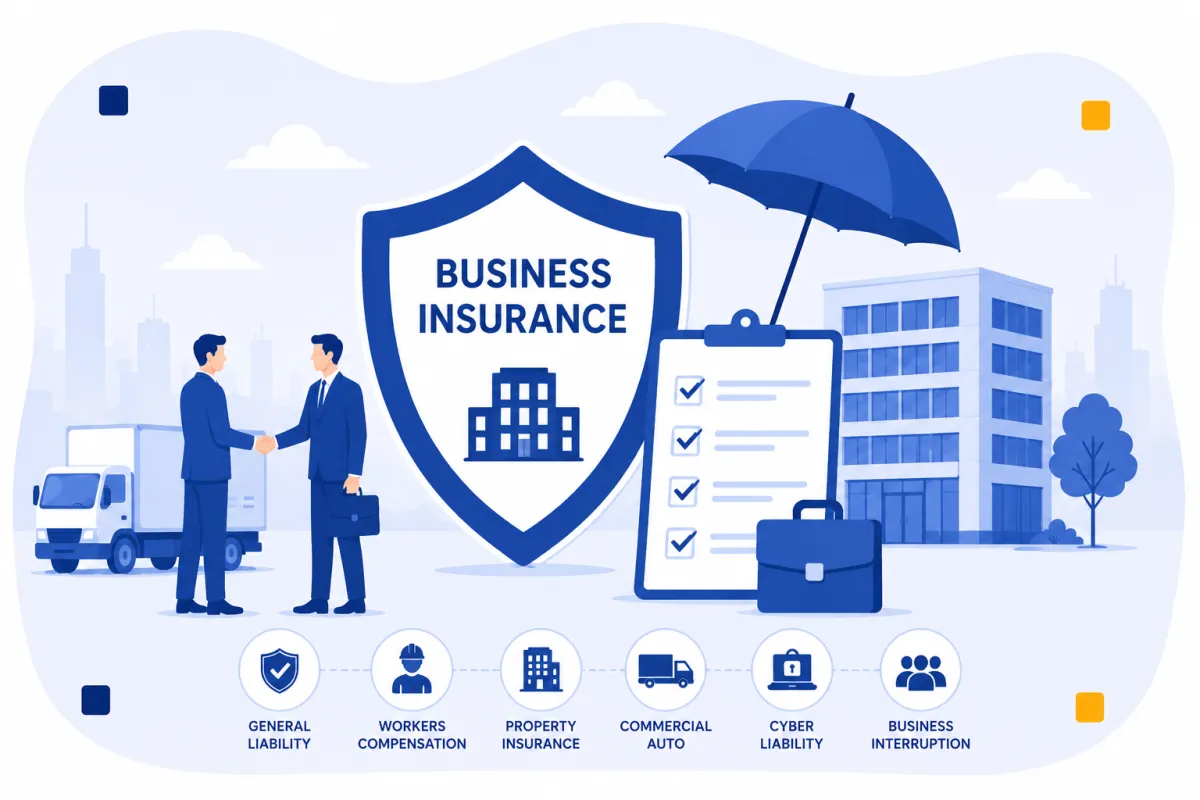
Business insurance breaks down into a handful of families. Most businesses need a combination drawn from these, packaged together. The main covers are:
- Liability covers — Public Liability, Employers' Liability, Product Liability and Professional Indemnity, protecting you against claims from third parties, staff and clients.
- Property & assets — buildings, contents, stock, plant and equipment against fire, flood, theft and damage.
- Income protection — Business Interruption cover for lost income while you recover from an insured event.
- Cyber & data — breach, ransomware, data loss and the regulatory fallout.
- Vehicles — commercial motor for vans, fleets and business use.
- Specialist & optional — tools, goods in transit, legal expenses, directors' & officers', key person and more.
The art is in the combination. A consultant and a manufacturer share almost no risk profile, so their programmes look completely different. The deeper guide to business liability insurance covers the liability family in full, and the sections below explain each main cover in turn.
Which business insurance is legally required?
This is the first question every business should answer, because the legal position is clear-cut and the penalties for getting it wrong are real.
| Cover | Legally required? | In practice |
|---|---|---|
| Employers' Liability | Yes — by law | Compulsory for most employers; £5m minimum; fines up to £2,500/day uninsured. |
| Commercial motor | Yes — by law | Compulsory for any vehicle used on the road for business. |
| Public Liability | No | Not legally required, but demanded by most contracts, clients and landlords. |
| Professional Indemnity | No* | *Mandatory for many regulated professions; essential for any advisor. |
| Product Liability | No | Not required, but strict liability under the Consumer Protection Act 1987 makes it essential for anyone supplying goods. |
| Property, BI, cyber, etc. | No | Commercial choices — but often the difference between surviving a loss and not. |
So only two covers are strictly compulsory by statute — Employers' Liability and commercial motor — but treating the rest as "optional" is how businesses end up uninsured for the event that matters most. The regulatory detail is in Part 2 of this guide.
The most common mistake I see isn't buying too little insurance — it's buying a random assortment of it. A business will have three overlapping liability policies bought at different times, no business interruption cover at all, and a building insured for a figure from 2019. "Business insurance" had been treated as a series of one-off purchases rather than one coherent programme. When we map the actual risks against the actual covers, the gaps and the duplication jump out together. The value isn't in having lots of policies — it's in having the right ones, sized correctly, with nothing missing and nothing doubled up.
What is public liability insurance?
Public Liability (PL) covers your legal liability for injury to a member of the public or damage to their property caused by your business — a customer slipping in your premises, or your work damaging a client's property. It pays compensation and legal defence costs. It is not compulsory by law, but most contracts, clients and landlords demand it, typically at £1m, £2m or £5m. For trades, no certificate often means no work. See our guides to the best public liability insurers and high-risk trades cover.
What is employers' liability insurance?
Employers' Liability (EL) covers claims from your own staff who are injured or made ill through their work. It is the one business insurance that is compulsory by law for most employers — including those with casual, part-time and many labour-only sub-contract staff — under the Employers' Liability (Compulsory Insurance) Act 1969, at a minimum of £5 million. Trading without it can mean a penalty of up to £2,500 for each day uninsured. If you employ anyone, this is your non-negotiable baseline.
What is professional indemnity insurance?
Professional Indemnity (PI) covers claims that your advice, design or professional service was negligent and caused a client a financial loss. If your business sells knowledge or expertise — consultants, designers, architects, surveyors, accountants, IT and tech firms, agencies — PI is usually your single largest exposure, because the damages claimed can far exceed the fee you earned. It is mandatory for many regulated professions and is almost always written on a claims-made basis, so continuity matters. See our dedicated professional indemnity page.
What is product liability insurance?
Product Liability covers you when a product you have made, supplied, repaired or sold causes injury or damage once it is in someone else's hands. Crucially, liability is strict under the Consumer Protection Act 1987 — a claimant need only show the product was defective and caused harm, not that you were negligent. That makes it essential even for businesses that only resell or import. It is often bundled with public liability in a combined policy — see our guide to commercial general liability policies.
What is commercial property & contents insurance?
Commercial property insurance protects your physical assets — buildings, contents, stock, plant and equipment — against fire, flood, storm, escape of water, theft and malicious damage. Buildings should be insured on a professional reinstatement (rebuild) basis, not market value, and contents and stock at replacement cost; getting these sums insured right is critical, because underinsurance lets the average clause cut your payout. For depth, see our guide to commercial property insurance.
What is business interruption insurance?
Business interruption (BI) cover replaces the income you lose while you recover from an insured event — for example, the trading you cannot do while premises are rebuilt after a fire. It is one of the most valuable and most misunderstood covers: the indemnity period (the maximum time it pays for) is routinely set too short, often at 12 months when real recovery takes far longer. A realistic indemnity period — frequently 24–36 months — is what makes BI cover actually work.
What is cyber insurance?
Cyber insurance covers the financial and operational fallout of a cyber-attack or data breach — ransomware, business interruption from systems being down, data recovery, breach-response costs, and liabilities to customers whose data was exposed. As businesses of every size digitise, it has moved from a niche to a near-essential cover, and most general policies specifically exclude cyber risk. See our dedicated cyber insurance page.
What other business insurance might you need?
Beyond the core covers, a complete programme often includes one or more of:
- Commercial motor — vans, fleets and vehicles in business use; legally compulsory for road use.
- Tools & equipment — theft and damage to trade tools, in the van and on site.
- Goods in transit — stock and goods while being transported.
- Legal expenses — the cost of pursuing or defending business legal disputes.
- Directors' & officers' (D&O) — personal liability of directors for decisions made running the business.
- Trade credit — protection against customers failing to pay. See trade credit insurance.
- Key person — the financial impact of losing a critical individual.
Which of these apply depends entirely on what your business does — the next tool maps the essentials to common business types.
Interactive · Business Cover Checker
What business insurance does your business type need?
Pick a business type to see the covers a complete programme should include, and how each is prioritised. Tags show what is legally required, essential, recommended or worth considering. A general guide to spot gaps, not advice on your own placement.
Tradesperson / contractor
Shop / retailer
Office / consultancy
Café / hospitality
Manufacturer
Tech / online business
How much does business insurance cost?
There is no flat price for business insurance, because the premium is built from your specific risk — your trade, turnover, wage roll, claims history, the covers and limits you choose, and your location. A low-risk sole trader might pay a modest annual figure for public liability alone, while a manufacturer needing the full programme at high limits pays substantially more. The honest answer to "how much?" is "it depends on what you do and what you need to protect."
The useful answer is that the price reflects how the insurer sees your risk, so a well-presented, well-managed business earns a lower premium without cutting cover. For typical ranges and the levers that move them, see our guides to small business insurance prices and how a commercial insurance quote is priced. Remember the standard 12% Insurance Premium Tax is included and, unlike VAT, cannot be reclaimed. The full cost driver table is in Part 2.
Interactive · Business Insurance Essentials Check
Have you covered the essentials?
Tick each item once you have confirmed it. A red box is an open gap; a green tick means you have it covered. Work through all eight to see whether your programme has holes.
- Employers' Liability in place if you have any staff. Legally compulsory; £5m minimum.
- Public Liability limit meets your contracts. Check what each client and landlord demands.
- Professional Indemnity if you advise or design. The most commonly missed cover.
- Property & stock insured at correct values. Reinstatement basis, reviewed each year.
- Business interruption with a realistic indemnity period. 12 months is rarely enough.
- Cyber cover if you hold data or take payments. Usually excluded from other policies.
- No overlap or duplication between policies. Paying twice for the same cover.
- All material facts disclosed across every policy. Claims, CCJs, side activities, refusals.
Interactive · Cover Needs Snapshot
How much cover does your business need?
Choose your situation for a quick indication of how broad your business insurance programme needs to be.
What does the law require of your business insurance?
Most business insurance is a commercial choice, but a few corners of it are fixed by statute, and a duty of disclosure runs through all of it. Getting the legal foundations right is the first job of any programme.
Compulsory covers: Employers' Liability and motor
Two business insurances are required by law. The Employers' Liability (Compulsory Insurance) Act 1969 requires most employers to hold EL cover of at least £5 million, enforced by the HSE with penalties of up to £2,500 for each day uninsured. Separately, any vehicle used on the road for business must be insured for at least third-party liability under road traffic law. Everything else — public liability, property, business interruption, cyber and so on — is a commercial decision, however essential in practice.
Product liability and strict liability
If you supply goods, the Consumer Protection Act 1987 imposes strict liability for defective products — a claimant need not prove negligence, only that the product was defective and caused harm — and it can attach to manufacturers, own-branders, importers and suppliers. This is why product cover matters even to a business that only resells.
The duty of fair presentation
Across every commercial policy you hold, the Insurance Act 2015 imposes a duty of fair presentation — to disclose every material circumstance you know or ought to know, clearly, when you take out or vary cover. A careless failure gives the insurer a proportionate remedy that can reduce a claim; a deliberate one can void the policy. And because UK insurers are regulated by the FCA, the firms you deal with are accountable for fair value and conduct — one reason to use an FCA-authorised broker.
What drives the cost of business insurance?
These are the factors that build your premium across the programme. The third column matters most — almost every one can be influenced, which is how a well-presented business pays less without cutting cover.
| Factor | Why it moves the premium | How to mitigate it |
|---|---|---|
| Trade / activity | Sets the base hazard across liability and property. | Describe accurately and fully; never narrow it. |
| Annual turnover | Proxy for exposure and claim volume. | Declare honestly; split distinct activities. |
| Wage roll & staff | Drives employers' liability exposure. | Keep accurate records, including sub-contractors. |
| Claims history | Past losses predict future ones. | Provide context and evidence of remedial action. |
| Sums insured | Higher values raise payouts; undervaluing triggers average. | Use reinstatement valuations; review every renewal. |
| Cover limits & extensions | Higher limits and added sections raise exposure. | Match limits to contracts — adequate, not excessive. |
| Premises & construction | Affects fire, escape-of-water and theft risk. | Document upgrades; maintain the building. |
| Security & protections | Reduces theft and damage frequency. | Install to insurer standards; keep certificates. |
| Location | Reflects crime, flood and subsidence risk. | Provide flood-mitigation and loss-history evidence. |
| Business interruption indemnity period | Longer recovery windows mean more potential loss. | Set a realistic period — don't shorten to save premium. |
| Excess level | A higher voluntary excess lowers the premium. | Set an excess you can fund on each claim. |
| Risk management evidence | Reduces the underwriter's uncertainty. | Supply risk assessments, training and maintenance records. |
What do real claims teach us about getting business insurance right?
Three anonymised but representative claims show how different covers respond — and what happens when one is missing.
Tâf Valley Bakery — the fire that tested two covers
An electrical fault caused a serious fire at an independent bakery. Property cover rebuilt the premises and replaced equipment — but the real test was business interruption. The rebuild and refit took 16 months, and because the owner had set a realistic 24-month indemnity period, lost gross profit was covered throughout the closure.
Gwent Logistics — the compulsory cover that paid
A warehouse worker was seriously injured by falling stock that had been poorly stacked. The employee claimed against the firm. Because Employers' Liability is compulsory and was correctly in place, the claim and the substantial legal defence costs were met in full by the policy rather than the business.
Riverside Studio — the gap that wasn't insured
A design agency held public liability and contents cover but, to keep costs down, had never bought cyber insurance or professional indemnity. A ransomware attack locked its systems and exposed client data, and one client then claimed for losses caused by a delayed, error-strewn project. Neither the public liability nor the contents policy responded — the exposures sat in the two covers the agency had skipped.
How do you buy business insurance the right way, step by step?
Buying business insurance well is less about chasing the lowest price and more about building the right programme. Follow these eight steps.
-
Map what your business actually does
List every activity, including side lines and seasonal work. The covers you need flow from what you do, so an accurate picture comes first.
-
Identify your legal obligations
Confirm Employers' Liability if you have staff, and motor cover for any business vehicles — these are not optional.
-
Identify your real exposures
Work out where a claim could come from: the public, employees, clients relying on your advice, products, property, data, lost income.
-
Check what your contracts require
Clients, landlords and regulators often demand specific covers and limits — your programme must meet the highest of these.
-
Get your sums insured and limits right
Value buildings on a reinstatement basis, stock and plant at replacement cost, and set liability limits and indemnity periods realistically.
-
Decide on separate policies or a combined package
Bundling covers into a commercial combined policy is usually simpler and better value than buying each separately.
-
Make a full, fair presentation
Disclose everything material — claims, CCJs, prior declinatures, unusual activities — to satisfy the Insurance Act 2015 and protect future claims.
-
Use a broker to build and review the programme
A broker matches cover to your risk, removes gaps and duplication, reaches the right markets, and reviews it as the business changes.

John Miller
Director & Principal Broker — Miller & Partner
John has spent 13+ years building business insurance programmes for UK firms of every size, with direct access to the Lloyd's Market and specialist MGA schemes. A former #1 Account Executive at Brown & Brown and #1 Salesperson at AXA, he spends much of his week doing exactly what this guide describes — mapping a business's real risks against the covers available, closing the gaps and the duplication, and turning a pile of one-off policies into one coherent programme.
Business insurance glossary
- Business insurance
- The umbrella term for the range of policies protecting a business from the financial consequences of things going wrong.
- Public Liability (PL)
- Cover for injury to the public or damage to their property caused by your business.
- Employers' Liability (EL)
- Compulsory cover for claims by your own staff injured or made ill through work; £5m minimum.
- Professional Indemnity (PI)
- Cover for claims that your advice, design or service was negligent and caused a client financial loss.
- Product Liability
- Cover for harm caused by a defective product you supplied; strict liability applies.
- Commercial property insurance
- Cover for buildings, contents, stock and equipment against fire, flood, theft and damage.
- Business interruption (BI)
- Cover for lost income while you recover from an insured event; limited by the indemnity period.
- Cyber insurance
- Cover for the financial and operational fallout of a cyber-attack or data breach.
- Commercial combined
- A package policy bundling several covers — liability, property, BI and more — under one schedule.
- Sum insured
- The maximum an insurer will pay for an item or section; if too low, average reduces claims.
- Reinstatement value
- The full cost to rebuild or replace as new — the correct basis for buildings, not market value.
- Indemnity period
- The maximum time business interruption cover pays for lost income after a loss.
- Excess
- The first part of any claim you pay yourself; a higher excess lowers the premium.
- Insurance Premium Tax (IPT)
- Government tax on most general insurance, standard rate 12%, included in the price and not reclaimable.
- Duty of fair presentation
- The legal duty under the Insurance Act 2015 to disclose all material circumstances when arranging cover.
- Average clause
- A policy term letting the insurer cut a claim in proportion to how much the property was underinsured.
Business insurance — frequently asked questions
What is business insurance?
Business insurance is the umbrella term for the range of policies that protect a company from the financial consequences of things going wrong — injury to people, damage to property, faulty products, cyber-attacks, negligent advice or lost income. It is a programme of covers, not a single product.
What types of business insurance are there?
The main types are the liability covers (public, employers', product and professional), property and contents, business interruption, cyber, and commercial motor, plus specialist covers like tools, goods in transit, legal expenses and directors' & officers'. Most businesses need a combination drawn from these.
What business insurance is legally required in the UK?
Two covers are compulsory by law: Employers' Liability (for most businesses with staff, minimum £5 million under the 1969 Act) and motor insurance for any vehicle used on the road for business. Everything else is a commercial choice, although many covers are required by contracts, clients or regulators.
Do I need business insurance if I'm a sole trader?
Often yes. Even without employees you may need public liability for client or public contact, professional indemnity if you advise, and cover for tools, stock or equipment. Employers' Liability only applies once you take on staff. See our sole proprietorship guide for the detail.
How much does business insurance cost?
There is no flat price — the premium is built from your trade, turnover, wage roll, claims history, the covers and limits you choose, and your location. A low-risk sole trader pays modestly; a manufacturer needing the full programme at high limits pays more. The standard 12% IPT is included and cannot be reclaimed.
Should I buy separate policies or one combined policy?
Most businesses are better served by a commercial combined or package policy that bundles the covers they need under one schedule — it is simpler to manage and usually better value than buying each cover separately. The key is making sure every cover you need is present at an adequate limit.
What is the difference between public and employers' liability?
Public Liability covers injury or damage to third parties such as customers and the public. Employers' Liability covers claims from your own staff injured through work and is compulsory by law. Most businesses with staff and public contact need both.
Do I need professional indemnity insurance?
If your business gives advice, designs, or provides a professional service, almost certainly yes — and for many regulated professions it is mandatory. It covers claims that your work was negligent and caused a client financial loss, which is usually a service business's single largest exposure.
Is business interruption insurance worth it?
For any business with premises, stock or staff, it is often the most valuable cover of all — it replaces lost income while you recover from an insured event. The key is a realistic indemnity period; 12 months is frequently too short, as real recovery from a major loss can take far longer.
Does my business need cyber insurance?
If you hold customer data, take payments, or rely on systems to trade — which is almost every modern business — then yes. Cyber cover handles breach response, ransomware, downtime and data liabilities, and these risks are specifically excluded from most other policies.
What happens if I don't disclose something when buying cover?
For commercial insurance you owe a duty of fair presentation under the Insurance Act 2015 — to disclose every material circumstance clearly. A careless failure can give the insurer a proportionate remedy that reduces a claim; a deliberate one can void the policy. Full, accurate disclosure is what keeps your cover safe.
Can I get business insurance if I've been refused or have claims?
Yes. A previous refusal or claims history makes a risk non-standard, not uninsurable. Miller & Partner approaches every placement through The Insurability Framework — covering underwriter intelligence, difficult-risk expertise, risk assessment and claims advocacy — and uses specialist Lloyd's and MGA markets to place risks the standard engines decline.





Instagram
LinkedIn