


Commercial Insurance Agencies UK 2026: Broker Guide
Why does choosing a commercial insurance agency matter more in 2026?
UK commercial insurance buying changed permanently in 2023 when the FCA Consumer Duty came into force, and the regulatory pressure has only sharpened since. In 2026, the Financial Conduct Authority moved Consumer Duty firmly from implementation into active supervision — testing whether brokers and agencies are actually delivering good customer outcomes, not just documenting that they intend to. At the same time, an ABI study published January 2026 found significant SME underinsurance gaps, while separate Charterfields research showed 88% of commercial sites surveyed in 2025 were underinsured on building values. The cost of choosing the wrong commercial insurance agency has never been higher.
The market is also more crowded and less differentiated on the surface than it has ever been. There are roughly 1,770 insurance agents and brokers in the UK, operating in a £21.7bn industry, with brokers writing 83.5% of all commercial insurance premium. Howden has overtaken Marsh as the largest broker by revenue. Aon launched an AI-powered placement platform in 2025. Consolidation is accelerating. Yet for the average UK business owner trying to compare commercial insurance agencies, the differences between them are increasingly hidden behind similar-sounding marketing language. "Bespoke advice", "tailored cover", "specialist expertise" — every agency claims all three. So how do you actually tell them apart, and how do you choose the one that will defend a claim rather than just sell you a policy?
This guide is the definitive 2026 commercial insurance agencies article — built around the broker selection framework that actually matters under Consumer Duty, the real differences between broker types, the warning signs that separate competent brokers from order-takers, and the structured process for switching agencies without breaking cover. It complements our commercial insurance hub, our business insurance quote guide, and our specialist broker guide. The article is written by a broker (FS Register FRN 1029698) with 13+ years' specialist commercial experience and direct Lloyd's Market access — not by a content team, and not paid for by any of the agencies discussed.
Key facts at a glance
- Brokers write 83.5% of UK commercial insurance premium (2024 estimate, Insurance Distribution Report 2025) — the dominant channel because complex commercial risks require advice, not just price comparison.
- The UK has approximately 1,770 insurance agents and brokers with combined industry revenue of £21.7bn (IBISWorld, January 2026), grown at a 1.6% CAGR since 2021.
- 88% of UK commercial sites were underinsured on building values in 2025 (Charterfields research) — a 2026 problem that competent brokers identify and fix at quote stage rather than at claim stage.
- FCA Consumer Duty supervision intensified in 2026 — the regulator now actively tests whether brokers evidence good customer outcomes, including for SME commercial clients defined as "retail" under the rules.
- Direct channel commercial insurance held just 8.5% market share in 2024e — meaning more than nine out of ten UK businesses choose advised purchase through a broker or agency.
- UK insurers paid £197 million in cyber claims in 2024 — a 230% increase on 2023 (PolicyBee, 2025) — illustrating why the gap between generic and specialist commercial agency placement matters in fast-moving classes.
- Only 50% of UK SMEs reviewed their insurance cover in the past 12 months (Public First / ABI, January 2026) — meaning the choice of commercial insurance agency is also a choice about who keeps your cover current.
1. What's the difference between a broker, an agency, a PCW and direct insurance?
Most UK business owners use "broker", "agency", "intermediary" and "insurer" interchangeably. The distinctions matter — particularly when a claim is disputed and you need to know who actually represents whose interests. The four channels below are the only ones writing meaningful UK commercial premium volume in 2026.
| Channel | Who they represent | Best for | Weakness |
|---|---|---|---|
| Independent broker | The client — duty to obtain best terms across the market | Complex risks, specialist sectors, mid-market commercial, claims advocacy | Costs more than direct for very simple risks |
| Insurance agency / tied agent | One or a small panel of insurers under agency agreement | Standard package risks where the panel covers your sector well | Cannot access the wider market or specialist MGAs |
| Direct insurer | The insurer (themselves) | Very simple risks (sole traders, single-office consultants) on price-led decisions | No advice; non-disclosure exposure is entirely on you |
| Price Comparison Website (PCW) | The aggregator — paid per click and per conversion | Quick price benchmarking on very standardised products | Filters out specialist markets; cover scope often diluted to fit comparison fields |
In 2024, brokers wrote 83.5% of UK commercial insurance premium — up from 83.2% in 2023, confirming the dominant role of advised purchase in commercial classes. The direct channel held 8.5%, mostly sole traders and very small SMEs on basic packages. PCWs remain a minority commercial channel, primarily for commercial motor and very small package policies. The remaining premium is split across affinity schemes, banks, and tied agency arrangements. The point isn't that one channel is universally better — it's that the channel choice should be deliberate, based on your risk complexity, not defaulted to whatever Google served first.
2. How does FCA Consumer Duty change commercial insurance buying in 2026?
The FCA Consumer Duty applies to insurance contracts sold to UK customers where the customer falls within the regulator's "retail" definition — which includes individuals and SMEs that are not buying "contracts of large risk". For commercial buying, this means the vast majority of UK businesses are now Consumer Duty customers in regulatory terms, even though they are buying commercial insurance. The implications for choosing a commercial insurance agency are substantial.
The Duty requires firms — including brokers and agencies — to deliver good outcomes across four pillars: products and services, price and value, consumer understanding, and consumer support. In 2026 the FCA moved firmly from "implementation supervision" (asking firms how they are embedding the Duty) to "outcomes supervision" (testing whether good outcomes are actually being delivered in practice). PwC's 2026 FCA insurance priorities summary notes the regulator is examining how sales processes affect outcomes, with particular focus on claims handling and consumer understanding.
For SMEs buying commercial insurance, the practical implications are:
- Brokers must demonstrate they recommended cover that meets your needs — not just that they sold you something within their panel.
- Price and value testing applies — including transparency on commissions, fees, and any premium finance arrangements (the FCA is intensifying scrutiny here, particularly following the Consumer Duty market study on premium finance).
- Consumer understanding obligations require plain language — policy summaries, exclusions, limits, and warranties must be communicated in ways that allow you to actually understand what you're buying.
- Claims handling oversight has tightened — including third-party administrators and delegated authority arrangements. The FCA has signalled this will be a continued focus area through 2026.
None of this means every commercial insurance agency now meets the standard. It means that where they don't, the regulatory consequences for the agency are real — and your evidential position at claim stage is materially stronger. When evaluating a commercial insurance agency, asking how they evidence Consumer Duty compliance is a legitimate, expected question in 2026 and a competent broker will answer it confidently.
3. What are the main types of commercial insurance agency in the UK?
"Commercial insurance agency" is a loose term covering several genuinely different business models. The differences matter — they determine which insurers you can access, how the agency is remunerated, and what conflicts of interest may exist.
Type 1: Independent commercial brokers
The largest category — independent commercial brokers acting under FCA authorisation as the client's agent. They have agency agreements with multiple insurers and MGAs and place each risk in the market that fits best. The broker is paid commission by the insurer (the standard model) and sometimes a fee by the client (rarer for SME risks). Independent brokers range from one-person specialist firms through to global consolidators. Examples include Miller & Partner (UK specialist independent), regional brokers, and the boutique end of the market.
Type 2: Network and consolidator brokers
Brokers that are members of buying groups (Cobra, Bravo, Willis Towers Watson Networks, etc) or have been acquired by consolidators (Howden, PIB, Global, Markerstudy, Aston Lark, AssuredPartners). The broker retains their high-street brand and client relationships but benefits from the consolidator's negotiated terms with insurers. Howden overtaking Marsh as the largest UK broker by revenue in 2024 reflects the scale of this consolidation. Quality is variable — some retain genuine independence, others become routing channels for the parent's preferred insurer panel.
Type 3: Specialist sector brokers and MGAs
Firms that focus on specific sectors or risk types — biohazard cleaning, drone operators, construction, professional indemnity, cyber. Often have schemes or delegated authority arrangements with insurers giving them specialist underwriting capacity. The depth of sector knowledge is genuinely valuable for complex risks. Miller & Partner sits in this category for specialist cleaning, mould remediation, biohazard, construction, and tech contractor placement.
Type 4: National brand brokers
Marsh Commercial, Gallagher UK, Aon, Howden, WTW. The largest brokers in the UK, with global resources, specialist teams, and capacity to handle multinational and complex corporate placements. For mid-market and corporate clients, these firms offer scale advantages — analytics, risk management consulting, multinational coordination. For smaller SMEs, the service model is often less personal and more transactional than specialist independent brokers.
Type 5: Digital-first SME brokers
Simply Business, Superscript, Coverwallet, PolicyBee, etc. Technology-led intermediaries focused on the SME and sole trader market with online quote-and-bind. Fast and convenient for simple risks where the cover is standardised. Less suitable where the risk profile doesn't fit the standard models the platform supports. Sit in the "broker" classification but the service model is closer to advised direct.
Type 6: Tied agents and affinity schemes
Insurance offered through trade associations, banks, accountancy firms, or other affinity partners. May be a tied agent of a single insurer or a panel broker. Convenience-led — often bundled with other services. Quality varies enormously; some affinity schemes are excellent value, others are simply distribution channels for the partner insurer.
4. What 8 criteria should you use to evaluate a commercial insurance agency?
These are the genuinely material criteria — not marketing language. Apply them when speaking to any commercial insurance agency, and the answers will rapidly differentiate competent specialist brokers from order-takers.
Criterion 1: FCA Authorisation status
Every UK insurance broker, agency, or intermediary must be authorised and regulated by the FCA — either directly authorised or as an Appointed Representative of an authorised principal firm. Check the firm reference number on the FCA Register at register.fca.org.uk. The register shows the firm's status, permissions, and any disciplinary history. Miller & Partner is an Appointed Representative of Gauntlet Risk Management Ltd, which is authorised and regulated by the Financial Conduct Authority (FS Register FRN 1029698). Anyone selling commercial insurance in the UK without proper FCA authorisation is operating illegally; the register is the only way to verify.
Criterion 2: Market access — how many insurers can they place with?
Ask directly: "Which insurers do you have agency agreements with, and do you have access to Lloyd's Market or specialist MGAs?" A broker placing exclusively with three or four mainstream insurers will struggle on any specialist or non-standard risk. A broker with Lloyd's access and MGA relationships can place biohazard cleaners, mould remediation contractors, vape manufacturers, drone operators, escape rooms, alternative therapy clinics — risks the mainstream markets won't quote. For ordinary SME risks (offices, retail, basic trades) wide market access is less critical; for anything specialist, it is determinative.
Criterion 3: Sector expertise — do they actually understand your risk?
Ask sector-specific questions and listen to the answers. A competent broker for a mould remediation contractor will know about Awaab's Law downstream contractor liability. A competent broker for an Airbnb landlord will know about the short-let endorsement gaps in standard landlord policies. A competent broker for a 3D printing company will know the IP and product liability exposures. If the broker can't engage at this level, they will quote you generic cover and miss the specific gaps. Test sector knowledge before the quote, not after the claim.
Criterion 4: Claims handling and advocacy
The single most important question to ask: "Tell me about a recent claim where your client's claim was initially declined or reduced, and how you got it paid." Listen for specifics — broker advocacy, evidence gathering, escalation routes, ombudsman knowledge. A broker who has never overturned an insurer's initial decision either has very few claims or doesn't fight them. The Financial Ombudsman Service handled tens of thousands of insurance complaints in 2024-25; competent brokers know how to use this route when appropriate and when to settle constructively before it gets there.
Criterion 5: Continuity of relationship
Will you deal with the same person at renewal, mid-term change, or claim — or will you cycle through call-centre operatives? Continuity is a genuine differentiator. An advisor who knows your business, your previous claims, your renewal cycle, and your sector can spot changes that matter (new equipment, new staff, expansion into new postcodes, new services). A call-centre model can't. Larger brokers vary on this; smaller specialist independent brokers almost always offer named-broker continuity by default.
Criterion 6: Consumer Duty evidence
Ask the broker how they evidence Consumer Duty compliance — particularly around price and value, consumer understanding, and ongoing support. A competent broker will discuss it openly. A broker who looks blank or deflects is either not engaging with the regulatory framework or doesn't understand it. With the FCA now in active outcomes supervision through 2026, this matters because the broker's regulatory exposure is also your evidential position at claim or dispute.
Criterion 7: Transparency on commission and remuneration
UK brokers are paid commission by insurers (typically 7.5%–25% of net premium depending on class and scheme) and sometimes fees by clients. The FCA requires disclosure of remuneration arrangements; competent brokers will discuss this transparently. If asked, they should be able to confirm how they are paid, whether they receive volume-related bonuses from any insurer (which could create a placement bias), and whether any conflicts of interest are managed. None of this is dirty — it's how the industry works — but transparency about it is a reliable indicator of regulatory hygiene.
Criterion 8: References, reviews, and visible track record
Look for Google reviews, Trustpilot, Feefo, and LinkedIn endorsements — particularly from named individuals in your sector. Generic "great service" reviews are worth less than specific reviews discussing how a claim was handled or how a tricky renewal was placed. Ask the broker for two or three current client references in similar sectors. A confident broker will provide them; one who can't or won't may not have the satisfied client base they're claiming.
5. What are the 6 biggest mistakes UK businesses make choosing an insurance agency?
These are the patterns we see most often when reviewing existing commercial insurance arrangements at quote stage. Each one is preventable; together they account for the majority of declined or reduced claims.
Mistake 1: Treating commercial insurance as a price-comparison exercise
Commercial insurance is an advice purchase, not a price purchase. The cheapest quote on a generic comparison site is usually built on generic assumptions — your declared activities, turnover, premises, and risk controls. If those assumptions miss your actual operations, you have a policy that may not respond at claim. Brokers exist to identify those gaps before the policy is bound, not after the claim is declined. Saving £200 a year on premium and losing £80,000 at claim is a poor trade.
Mistake 2: Not declaring all activities at proposal
The Insurance Act 2015 requires "fair presentation of the risk" — every material fact the insurer would want to know must be disclosed proactively at proposal and renewal. Operators routinely buy generic cover with one activity declared while actually performing several. At claim stage, the insurer cites the proposal documentation and reduces or declines the claim. Specialist broker placement materially reduces this risk because the broker probes for all activities; generic placement does not.
Mistake 3: Buying the limits the broker suggests without challenge
The 88% underinsurance rate on commercial sites surveyed by Charterfields in 2025 is largely about sums insured on buildings — set at original construction cost or last renewal value rather than current reinstatement cost. Insurers apply average clauses meaning a claim is reduced proportionally where the sum insured is inadequate. A building insured at £400,000 when reinstatement cost is £800,000 means a £100,000 claim becomes a £50,000 payout. A competent broker pushes you on sums insured at every renewal; a transactional broker just rolls the previous year's figure forward.
Mistake 4: Not updating cover when the business changes
Only 50% of UK SMEs reviewed their insurance cover in the past 12 months — meaning the other 50% may be insured against last year's business rather than this year's. New staff, new premises, new equipment, new services, new geographic reach — each one may need disclosure. The Insurance Act 2015 duty of fair presentation applies at every variation. A broker on a continuity model checks in periodically; a broker on a transactional model only hears from you at renewal. Twelve months is a long time in a growing business.
Mistake 5: Ignoring policy wording in favour of "headline cover"
"£5m Public Liability" sounds the same on every quote. The actual cover scope — what's excluded, what's sub-limited, what conditions and warranties apply — varies enormously. Pollution, contamination, treatment risk, cyber, employer's vehicle use, work away, work at height, working depth, sub-contractor scope. A broker who walks you through actual policy wordings is doing the work; a broker who just quotes headline limits and price is not. Ask specifically about the top three exclusions or sub-limits that apply to your sector and listen to the answer.
Mistake 6: Chasing £50 of premium savings at renewal
Insurers value continuity. Three or more years with the same insurer typically reduces premium 5–10%; bouncing between insurers every year for marginal savings sacrifices that loyalty discount and creates non-disclosure exposure (each new insurer requires fresh fair presentation). Specialist sector schemes often reward continuity even more. The right time to switch insurer is when the broker identifies a genuine cover or pricing improvement — not annually for the sake of "shopping around".
6. Commercial insurance agency type matcher
Different business profiles fit different agency models. Use the matcher below to see which commercial insurance agency type is best matched to your business profile and risk complexity.
Commercial Insurance Agency Type Matcher
Select your business profile to see which type of commercial insurance agency typically fits best
Sole Trader / Freelancer
- BEST FIT Independent broker (small, named-broker model) or digital-first SME broker
- GOOD FIT Specialist sector broker if you operate in a non-standard sector
- ACCEPTABLE Direct insurer for very simple, single-activity profiles (basic PI, basic PL)
- CONSIDER Trade association affinity scheme if your trade body has a competitive arrangement
- AVOID Large national broker — service model rarely fits at this scale; you'll get junior broker time
Micro Business (1–5 staff)
- BEST FIT Independent broker with sector knowledge — named-broker continuity model
- GOOD FIT Specialist sector broker if your activity is non-standard
- ACCEPTABLE Digital-first SME broker for standard package risks
- CONSIDER Direct insurer only for very simple risks where you understand the cover scope fully
- AVOID Tied agent arrangements that limit you to a single insurer's panel without market comparison
SME (6–50 staff)
- BEST FIT Independent broker with strong market access — Lloyd's MGA relationships matter
- BEST FIT Specialist sector broker if you operate in cleaning, construction, tech, or other complex sectors
- GOOD FIT Regional broker member of buying network (Cobra, Bravo) with named-broker model
- CONSIDER Network/consolidator broker — verify they retain genuine independence at placement
- AVOID Online-only quote-and-bind models where complexity exceeds the platform's risk profile
- AVOID Direct insurer at this scale — non-disclosure exposure becomes material
Specialist / Non-Standard Sector
- CRITICAL Specialist sector knowledge is non-negotiable — generic placement risks claim disputes
- BEST FIT Specialist sector broker with Lloyd's Market and MGA access (Miller & Partner fits here for cleaning, mould, biohazard, construction, tech)
- GOOD FIT Independent broker with specific track record in your sector — ask for references in your industry
- CONSIDER Specialist MGA scheme arrangements via specialist broker
- AVOID Mainstream brokers without specific sector experience — they'll quote what their panel will write, not what your risk actually needs
- AVOID Price comparison websites — most specialist risks aren't accessible through this channel
Mid-Market (50–250 staff)
- BEST FIT Independent broker with mid-market team or specialist national broker
- BEST FIT Specialist sector broker for sectors with material technical complexity
- GOOD FIT National brand broker (Marsh, Gallagher, Aon, Howden, WTW) for analytics and risk management support alongside placement
- CONSIDER Hybrid model — large broker for the corporate programme, specialist broker for the technical risks (some clients use both)
- AVOID Single-person broker arrangements at this scale — succession risk and capacity risk are real
Corporate / Multinational
- BEST FIT National brand broker (Marsh, Gallagher, Aon, Howden, WTW) — global capacity, multinational programmes, captive expertise
- GOOD FIT Specialist broker engagement alongside corporate programme for specific technical lines (cyber, D&O, environmental)
- CONSIDER Captive insurance arrangements where loss experience and risk appetite support self-insurance
- NOT RECOMMENDED Smaller broker firms — capacity, resource depth, and multinational scope generally inadequate at this level
7. Broker red-flag self-check
Tick each red flag that applies to your current commercial insurance agency or any agency you are considering. The unticked items are reasons to stay; the ticked items are reasons to investigate further or switch.
Commercial Insurance Broker Red-Flag Checker
Click each warning sign that applies to your current or prospective commercial insurance agency. The more ticked, the stronger the case for switching.
-
Can't tell you their FCA firm reference number — or it doesn't match the FCA Register when you check
-
Won't tell you which insurers they have agency agreements with — or claims to have "whole of market access" without specifying
-
You speak to a different person every time you call — call centre model rather than named-broker continuity
-
Can't engage with sector-specific questions — gives generic answers when you ask about specific risks in your industry
-
Doesn't push you on sums insured or activities at renewal — just rolls last year's figures forward
-
Has never recommended a cover change — your needs haven't evolved in five years according to your broker
-
Slow or evasive on policy wording questions — directs you to read the policy yourself rather than explaining what's covered and excluded
-
Won't discuss commission or remuneration — FCA disclosure obligations require this to be available on request
-
Doesn't ask about a previous claim or near-miss — proposal process skips the risk management conversation entirely
-
Premium has increased every year without a meaningful claims explanation — and the broker can't show alternative market comparison
-
Can't articulate Consumer Duty compliance approach — looks blank when asked or gives a generic compliance line without substance
-
No visible track record online — no Google reviews, no Trustpilot, no LinkedIn presence, no written content evidencing expertise
8. Business profile to broker fit assessor
The right commercial insurance agency depends on two factors above all others: your business size and your risk complexity. Use the tool below to identify the broker model best matched to your specific profile.
Business Profile to Broker Fit Assessor
Select your business size and risk complexity to see the broker model most likely to deliver good outcomes for your profile

9. How do you switch commercial insurance agency without breaking cover?
Many UK businesses stay with underperforming commercial insurance agencies because they think switching is complicated or risky. In practice, switching brokers mid-policy is straightforward, and switching at renewal is even easier. The only genuine risk is breaking cover continuity — which is fully avoidable with the steps below.
The process below is the standard approach used when a new broker is brought in. None of it requires any disclosure to your current broker until you choose to make it; the broker market operates on professional courtesy but client confidentiality is the default.
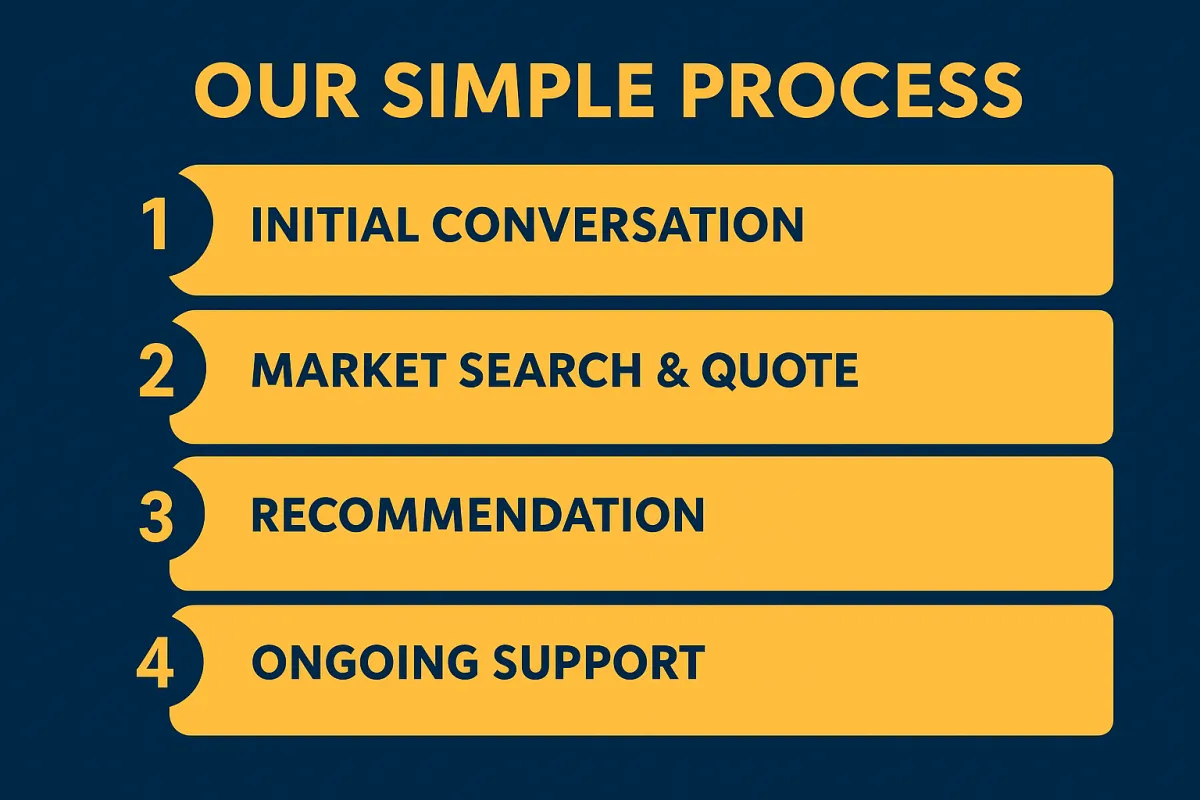
- Have an exploratory conversation with one or more new brokers. Discuss your business, current cover, claims history, and what's prompting the review. A competent specialist broker will tell you within 20 minutes whether they think they can add value or whether your current arrangement is already competitive.
- Provide your current policy documents and proposal information to the new broker. They need to understand exactly what you're currently covered for to identify gaps, overlaps, or pricing improvements. This is the broker's diagnostic input — without it they can't provide meaningful comparison.
- Allow the new broker to obtain quotes from their market. Depending on complexity this takes 1–3 weeks. The broker will produce a market summary showing terms, exclusions, sums insured, and premium. They should explain the differences — not just present the cheapest.
- Compare like-for-like, not headline price. The competent broker presentation shows where new terms improve cover, where they reduce cover, and where they sit equivalent. A £200 premium saving with a key exclusion added is not a saving. A £200 premium uplift with treatment risk and contamination scope added is usually excellent value.
- Choose to proceed (or not) — your existing broker has no right to your renewal. If proceeding, the new broker arranges new cover to incept on the day your current policy ends. There is no overlap and no gap. If not proceeding, no obligation to either party.
- Notify your existing broker professionally. Simple email confirming the renewal won't proceed. No reasons required. The departing broker has FCA duties around fair treatment at departure — including providing claims history, copies of documentation, and a smooth handover of any in-flight matters.
- Confirm mid-term changes if switching at renewal isn't possible. If you need to switch mid-policy (broker becoming unresponsive, service standards collapsing) it is possible to cancel and re-broker. There will typically be a short-rate refund from the existing insurer; the new broker handles the practical mechanics.
10. What does using a commercial insurance broker actually cost?
The cost of using a commercial insurance broker is almost entirely hidden in the premium — UK brokers are paid commission by insurers, typically expressed as a percentage of net premium. Some brokers also charge client fees on certain placements, particularly mid-market and corporate. The table below sets out the typical 2026 cost structure.
| Cost Element | How It Works | Typical 2026 Range |
|---|---|---|
| Commission from insurer | Percentage of net premium, paid by the insurer to the broker — included within the premium you pay; you don't pay this separately | 7.5%–25% depending on class and scheme; typically 12.5%–17.5% for standard commercial |
| Broker fee | Flat fee charged by some brokers in addition to commission, particularly for complex placements or mid-market work | £0–£250 for SME placements; £500–£5,000+ for mid-market |
| Mid-term adjustment fee | Some brokers charge an admin fee for policy changes mid-term (added activities, additional premises, etc.) | £0–£35 typically; varies by broker |
| Premium finance arrangements | Where you pay monthly via finance, an interest rate applies; FCA Consumer Duty focuses on transparency here | 7%–14% APR typical 2026; specialist broker financing arrangements sometimes more competitive |
| Cancellation fee | If you cancel mid-policy, the insurer applies short-rate calculation; broker may retain some commission | Specified in policy documents; varies |
The economic reality: the broker model is largely "free at point of use" for the SME client, with the broker's economic interest aligned to placement volume and continuity (the same insurer relationships that need to deliver good outcomes for you, deliver commission for the broker). The model works well where the broker provides genuine advice and market access; it works less well where the broker is purely transactional. The FCA's Consumer Duty focus on "price and value" supervision in 2026 is specifically about ensuring the commission economics deliver value to the client, not just income to the broker.
What does cheaper-than-direct mean in practice?
A common misconception: that going direct to an insurer cuts out the broker's commission and saves you money. The reality is more nuanced. Direct insurers price their products with the same overall cost loading as the broker channel — the "commission" is replaced by direct marketing, sales, and acquisition costs. Brokers can often access wholesale pricing, MGA schemes, and Lloyd's terms that direct channels can't reach. Net of all factors, broker placement is often equivalent or cheaper than direct for the same risk profile, with the added benefit of advice and advocacy. The "cut out the middleman" argument works for very simple commodity products, not for nuanced commercial risks.
11. How do commercial insurance agencies handle claims in 2026?
The single biggest test of a commercial insurance agency is what happens at claim stage. The FCA has made claims handling a continued supervisory priority through 2026 — particularly around prompt and fair claims responses, oversight of delegated authority arrangements, and outsourced claims handling by third-party administrators. The broker's role in this is significant.
At claim notification, the broker should:
- Take the initial notification — capturing the incident, parties involved, potential exposures, and witnesses. Some brokers operate 24/7 claims lines for material claims; smaller specialist brokers operate next-business-day commitments.
- Liaise with the insurer's claims handler — providing factual context, policy documentation, and broker assessment of cover scope. The broker is the client's advocate at this stage, not a neutral intermediary.
- Manage evidence gathering — particularly for technical claims (treatment failure, professional indemnity, product liability) where documentary evidence determines defensibility.
- Provide claim management advice — including whether to engage solicitors, when to admit or contest liability, how to manage reservation of rights communications, and when to escalate within the insurer.
- Manage disputes constructively — initial coverage queries can usually be resolved through broker advocacy without recourse to formal complaint. Where they can't, the broker should know when ombudsman referral is appropriate.
The quality of claims handling varies enormously between brokers. The 2026 FCA focus on claims oversight reflects the regulator's view that the quality differential is too wide. Generic brokers often default to passing the claim to the insurer and waiting for a decision; specialist brokers actively manage the claim outcome.
12. Real-world broker outcomes: three placement case studies
The case studies below are drawn from typical UK SME commercial broker engagements. They illustrate the genuine differential between competent specialist broker placement and generic placement at claim or cover dispute stage.
Case Study 1 — Underinsurance Discovery, £180,000 Claim Differential
A specialist food manufacturer with three premises had been with a mainstream broker for 6 years. Renewals were largely automated — last year's sums insured rolled forward with a CPI adjustment. The buildings sum insured at £2.2m had been set 6 years earlier when the previous broker was appointed. In 2024, a new specialist broker was engaged for a parallel review of the placement and identified that current reinstatement cost (per RICS Building Cost Information Service) was £4.8m — meaning the building was insured at 46% of reinstatement cost.
The new broker insisted on a professional reinstatement valuation before renewal. The valuation confirmed the £4.8m figure. The sum insured was reset, premium increased by approximately £2,800 a year. Eight months later, a fire damaged one of the premises with a partial loss of £700,000. Under the original 46% under-insurance, the average clause would have reduced the claim payout to approximately £322,000 — a £378,000 shortfall. With the corrected sums insured, the claim paid in full.
The lesson: under-insurance is the single most common preventable claim dispute driver in UK commercial insurance. Brokers who push you on sums insured at every renewal — even when uncomfortable — earn their commission many times over. Brokers who roll forward last year's figures don't.
Case Study 2 — Specialist Placement vs Generic Quote, £85,000 Claim Outcome
A small mould remediation contractor (2 directors, 3 operatives) had been with a generic commercial broker since starting up. The "cleaning contractor" package included PL £5m, EL £10m, basic PI £250k. Premium was approximately £2,200 annual — competitive on price for a generic cleaning contractor. A specialist mould remediation broker review identified that the policy didn't contemplate treatment risk specifically — the PI scope was for negligent advice rather than treatment failure or warranty breach.
The broker re-placed the cover with a specialist mould cleaning programme: PL £5m with explicit treatment risk and contamination spread scope, EL £10m with respiratory occupational disease scope, PI £500k with treatment failure and warranty scope, plus EIL. Premium increased to £3,400 — about £1,200 a year more. Twelve months later, a treatment failure claim emerged after mould reappeared in a property within 8 months of remediation. Settlement: £85,000. Under the original generic placement, the insurer's initial position was that treatment failure wasn't within the PI scope — defending the claim through dispute would have been protracted with significant uninsured risk. Under the specialist placement, treatment failure was explicitly covered and the claim paid promptly.
The lesson: specialist sector knowledge at placement stage is worth multiples of the premium differential at claim stage. The £1,200 annual uplift bought £85,000 of claim certainty. Generic brokers writing specialist risks routinely create this exposure without flagging it to the client.
Case Study 3 — Claims Advocacy, Initial Decline Overturned, £42,000 Recovery
A small construction contractor (CIS, 8 staff, civil engineering scope) suffered a tools and plant theft from a secured site overnight. The claim was £42,000 for stolen equipment. The insurer's initial response: declined on the basis of a warranty in the policy requiring "site security adequate to prevent unauthorised access" — citing that perimeter fencing showed evidence of being cut, indicating the security wasn't adequate. The contractor's existing broker (a generic regional broker) accepted the decline at face value and advised the client the claim was not recoverable.
The contractor sought a second opinion from a specialist construction broker. The specialist broker reviewed the policy wording, the site risk assessment, and the security records. They identified: (a) the warranty wording was ambiguous and case law supported a "reasonable security" reading rather than absolute prevention; (b) the contractor had complied with all defined security protocols including CCTV, perimeter lighting, fence height; (c) the burglary involved professional tools and methodology indicating predetermined targeting that wouldn't have been deterred by standard site security. The broker prepared a structured evidence pack and escalated to the insurer's senior claims handler.
Within 6 weeks the insurer reversed the initial decision and paid the claim in full. The contractor switched all his cover to the specialist broker at the next renewal.
The lesson: the difference between brokers at claim stage is often the difference between an accepted decline and an overturned decline. The same claim, with the same facts, under the same policy — handled by a specialist broker willing to challenge and escalate — produced a £42,000 payment instead of a £0 decline.
How to choose and engage a UK commercial insurance agency in 2026
The structured selection process below provides a defensible, repeatable framework for choosing a commercial insurance agency that will actually deliver value across the policy year and at claim stage. The steps reflect Consumer Duty best practice and the FCA's expectations on outcome-focused broker selection.
- Define your placement requirements in writing. List your activities, premises, staff numbers, turnover, specialist exposures, and any known risk factors. The proposal-stage clarity reduces non-disclosure risk and provides each broker the same brief to quote against.
- Verify FCA Authorisation for every broker contacted. Check firm reference numbers on the FCA Register. Confirm authorisation status, scope of permissions, and any disciplinary history. Takes 30 seconds per broker.
- Apply the 8 evaluation criteria. Market access, sector expertise, claims handling, continuity of relationship, Consumer Duty evidence, commission transparency, references, FCA status. Score brokers explicitly on each.
- Request structured market summaries — not just quotes. A competent broker presentation shows where new terms improve cover, where they reduce cover, where they sit equivalent. Compare on coverage scope and policy wording, not just headline premium.
- Test claims handling before placement, not after the claim. Ask for specific examples of claims advocacy, disputed claim outcomes, and how the broker handles insurer challenges. Listen for specifics versus generic answers.
- Confirm Consumer Duty compliance approach. Ask how the broker evidences good outcomes for clients in your sector; ask about their price and value testing; ask about their consumer understanding processes. Competent brokers welcome the conversation.
- Confirm placement terms in writing before binding. Terms of business agreement, fee disclosure (if applicable), broker complaints procedure, claims notification process. Standard documents but read them.
- Review annually and stress-test at renewal. A good broker proactively reviews; you should still do your own annual review of activities declared, sums insured, claims history, and broker performance. Don't autopilot a broker relationship for more than 3 years without explicit market testing.

Glossary of commercial insurance agency terms
- Appointed Representative (AR)
- A firm or individual conducting regulated business under the authorisation of an FCA-authorised principal firm. ARs are listed on the FCA Register but operate under their principal's authorisation. Miller & Partner is an AR of Gauntlet Risk Management Ltd.
- Broker
- An insurance intermediary acting as the agent of the client. Has a duty to obtain best terms across the market for the client and to advise on cover suitability. Paid by commission from insurers and sometimes fees from clients.
- Commission
- Percentage of net premium paid by the insurer to the broker as remuneration for placing the business. Typically 7.5%–25% depending on class. Included within the premium the client pays — not a separate cost on top.
- Consumer Duty
- The FCA's regulatory standard requiring firms to deliver good customer outcomes across four pillars: products and services, price and value, consumer understanding, and consumer support. In force since 2023; in active supervision through 2026. Applies to SME commercial customers as "retail" customers.
- Contracts of Large Risk
- The category of insurance contracts that fall outside FCA Consumer Duty consumer protection rules. Generally large corporate and complex commercial. For most UK SMEs, Consumer Duty does apply.
- Delegated Authority
- An arrangement under which an insurer or MGA delegates underwriting authority to a third party (often a specialist broker or scheme operator). FCA increasing scrutiny on delegated authority oversight through 2026.
- Direct Insurer
- An insurer that sells policies directly to customers without a broker intermediary. The client has no broker advocate; non-disclosure exposure rests entirely on the client.
- FCA Register
- The Financial Conduct Authority's public register of authorised firms and individuals. Accessible at register.fca.org.uk. The only definitive source for verifying broker authorisation status.
- Fair Presentation of the Risk
- The duty under the Insurance Act 2015 to disclose every material fact the insurer would want to know at proposal and renewal. Failure to make a fair presentation enables the insurer to avoid the policy, reduce the claim, or impose retrospective terms.
- Financial Ombudsman Service (FOS)
- The independent body resolving disputes between consumers (including most SMEs) and financial services firms. Free for the customer; binding on the firm if the customer accepts the decision. Many disputed broker or claim outcomes are resolved here.
- Lloyd's Market
- The Lloyd's of London insurance market — a syndicate-based specialist market providing underwriting capacity for complex, specialist, and adverse risks. Access requires accredited broker placement; not all UK brokers have Lloyd's market access.
- MGA (Managing General Agent)
- A specialist insurance intermediary with delegated underwriting authority from an insurer for a defined class. MGAs often provide scheme arrangements for specialist sectors and are accessible through specialist brokers rather than direct or mainstream broker channels.
- Premium Finance
- Arrangement under which the client pays the insurance premium monthly via a finance facility rather than annually upfront. APR typically 7%–14% in 2026. FCA increasing scrutiny on fair value and transparency.
- Price Comparison Website (PCW)
- Aggregator websites comparing insurance prices across multiple providers. Operate primarily in personal and very small SME commercial; remunerated by the insurer per click and per conversion. Limited utility for specialist or complex commercial risks.
- Retail Customer
- FCA terminology for customers protected by Consumer Duty rules. Includes individuals and SMEs not buying contracts of large risk. Most UK commercial insurance buyers are "retail" customers in regulatory terms.
- Short-Rate Cancellation
- The premium calculation applied when a policy is cancelled mid-term. The insurer retains a proportionate premium with a penalty for early cancellation; the balance is refunded to the client.
- Tied Agent
- An intermediary appointed by a single insurer (or small panel) to sell that insurer's products. Cannot access the wider market. Less common than independent broker arrangements in UK commercial.
- Treating Customers Fairly (TCF)
- Earlier FCA principles framework largely now subsumed within Consumer Duty. Still referenced in older policy documentation and broker terms of business.
Frequently asked questions
There is no single "best" commercial insurance agency for all UK businesses — the right choice depends on your business size, risk complexity, and sector. For specialist or non-standard risks, specialist sector brokers with Lloyd's Market and MGA access (such as Miller & Partner) deliver materially better outcomes than mainstream placement. For corporate and multinational clients, national brand brokers (Marsh, Gallagher, Aon, Howden, WTW) offer scale advantages. For very simple SME risks, digital-first brokers or trade association schemes may serve well. The right approach is to apply the 8 evaluation criteria above to brokers in the category that matches your profile.
Visit the FCA Register at register.fca.org.uk, enter the firm name or firm reference number, and confirm the authorisation status. The register shows whether the firm is directly authorised, an Appointed Representative, the scope of permissions (which insurance classes they can advise on), and any disciplinary history. Miller & Partner's firm reference is 1029698. Verification takes 30 seconds and should be done for every broker you consider engaging.
Strictly speaking, a broker acts as agent of the client with market-wide access, while an agency may be tied to a single insurer or a defined panel. In UK common usage the terms are often used interchangeably — "agency" sometimes means "broker" and sometimes means a tied or panel arrangement. The substantive question isn't the label but who the firm represents and how many insurers they can access. Always ask directly: "Are you an independent broker with access to the whole market, or are you tied to a specific insurer or panel?"
UK commercial insurance brokers are typically paid 7.5%–25% commission on net premium by the insurer, with most standard commercial classes sitting in the 12.5%–17.5% range. Specialist classes and scheme arrangements vary. Some brokers also charge client fees, particularly on mid-market and corporate placements. The commission is included within the premium the client pays — not a separate cost. FCA rules require disclosure of remuneration arrangements on request, and Consumer Duty is intensifying scrutiny on price and value transparency through 2026.
Usually not, and often the opposite. Direct insurers price their products with the same overall cost loading as the broker channel — the "commission" is replaced by direct marketing and acquisition costs. Brokers can access wholesale pricing, MGA schemes, and Lloyd's terms that direct channels can't reach. Net of all factors, broker placement is often equivalent or cheaper than direct for the same risk profile, with the added benefit of advice and claims advocacy. The "cut out the middleman" argument works for very simple commodity products, not nuanced commercial risks.
Yes, though it is usually easier and cheaper to switch at renewal. Mid-policy switching is possible — particularly if the existing broker becomes unresponsive or service standards collapse. The new broker handles the mechanics: cancellation of existing cover, re-broking with the same or new insurer, ensuring no cover break. The existing insurer applies a short-rate refund. Switching is a straightforward administrative process; no broker has an inherent right to your renewal. See the step-by-step switching process in section 9 above.
The FCA Consumer Duty is a regulatory standard requiring insurance firms (including brokers) to deliver good customer outcomes. It applies to UK SMEs as "retail" customers. In practice it means brokers must demonstrate they recommended cover that meets your needs; that the price and value of the cover is fair; that you understood what you were buying; and that ongoing support meets reasonable standards. In 2026 the FCA moved from implementation supervision to active outcomes testing — meaning brokers are being audited on whether they deliver in practice. When evaluating a broker, asking how they evidence Consumer Duty compliance is a legitimate question they should answer confidently.
For specialist or non-standard sector risks — biohazard cleaning, mould remediation, drone operations, 3D printing, alternative therapies, vape manufacturing, escape rooms, adverse risks generally — specialist brokers deliver materially better outcomes. They have Lloyd's Market and MGA relationships that mainstream brokers don't, and they understand the sector-specific exposures that generic placement misses. For mainstream SME risks (basic retail, office consulting, simple trades) mainstream broker placement is often adequate, though specialist sector knowledge always adds value where it exists. The combined cost of a specialist broker is rarely material; the cover scope and claim defence differential often is. See our specialist adverse risk broker guide for more on specialist placement specifically.
The 8 evaluation questions covered in section 4 above are the framework: FCA authorisation status, market access, sector expertise, claims handling, continuity model, Consumer Duty approach, commission transparency, references. The single most useful single question is: "Tell me about a recent claim where the insurer's initial position was wrong, and how you got it changed." Listen for specifics. Generic answers indicate generic broker; specifics indicate competent advocacy. A broker who can't give a specific example either has no disputed claims experience or isn't comfortable describing it — both are concerning.
For very simple SME risks (basic public liability, single-activity sole traders, simple commercial motor) price comparison websites can be useful for benchmarking price. For anything more complex, the cover scope is typically diluted to fit comparison filters, specialist markets are filtered out, and the non-disclosure protection of broker placement is lost. UK direct channel and PCW combined hold around 8.5% of commercial insurance premium share — the dominance of broker placement reflects the genuine value differential for the majority of commercial risks. PCWs work where the risk fits the standard product; not where it doesn't.
If your broker ceases trading, your insurance policy with the underlying insurer remains in force — the policy is between you and the insurer, not the broker. The insurer typically writes to you directly explaining the situation and giving you options to re-broke. Where the broker was holding client money (premium collected from you but not yet paid to the insurer), the FCA's Client Asset Sourcebook (CASS) rules and the Financial Services Compensation Scheme provide protection in most circumstances. Practically, the new broker takes over the relationship and the transition is administratively straightforward.
Start by raising the complaint formally with the broker in writing. They are required by FCA rules to acknowledge within 5 working days and provide a final response (or progress update) within 8 weeks. If you remain dissatisfied — and you qualify as an eligible complainant (most SMEs do under FOS rules) — you can refer the matter to the Financial Ombudsman Service free of charge. FOS decisions are binding on the broker if you accept them. The Financial Ombudsman Service handles tens of thousands of insurance complaints annually; commercial broker complaints are a small but recognised category.





Instagram
LinkedIn