



Construction Insurance Claims Examples (UK Case Studies)
Why Construction Claims Are Different — And More Expensive
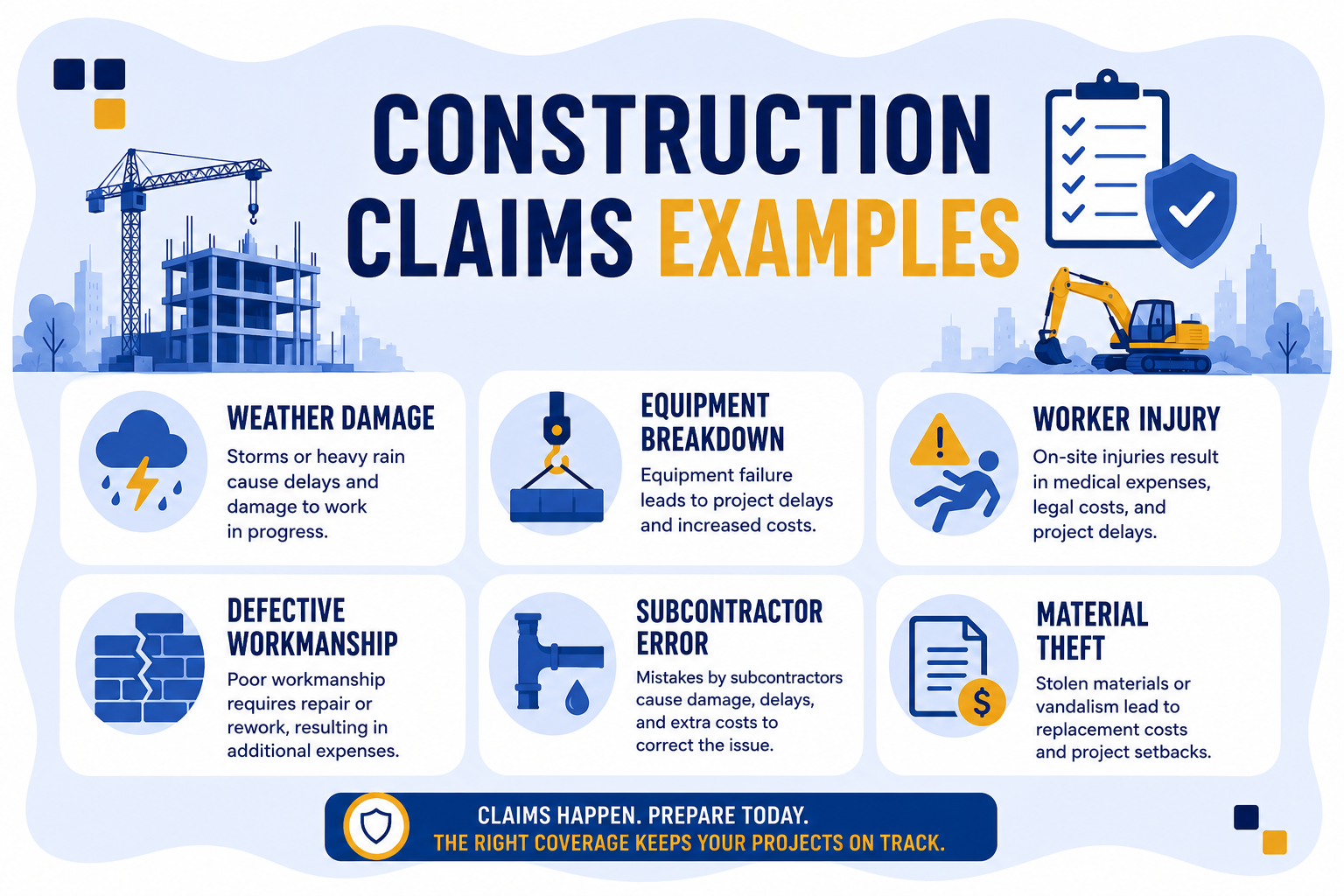
Construction is one of the highest-risk commercial environments in the UK economy. Projects involve large sums insured, multiple parties working in close coordination, exposure to weather and theft, technical design decisions with long-tail liability, and tight contractual deadlines where every day of delay carries financial consequences. When something goes wrong on a construction project, it rarely affects just one policy — a single incident typically triggers multiple sections of cover simultaneously, and the way those policies interact often decides whether the contractor or developer absorbs the loss or recovers it.
This guide presents ten real-world construction insurance claim scenarios drawn from typical UK projects in 2025 and 2026 — covering fire, storm, theft, design error, subcontractor insolvency, escape of water, employee injury, third-party damage, contractual disputes, and cyber incidents. For each scenario we show how the policies responded, where coverage worked, and where gaps in the insurance programme increased the contractor's or developer's exposure. The aim is not just to illustrate what insurance covers, but to show what experienced contractors and developers can do — before a claim — to make sure their programme actually responds when it matters.
If you want a broader overview of how construction insurance works as a programme, see our main construction insurance page. If you are evaluating specific products, our guides to Contractors All Risks insurance, Delay in Start-Up insurance, groundworks insurance, demolition insurance, and Contractors Combined insurance cover each policy in detail.
1. The Anatomy of a Construction Insurance Claim
Construction claims have a structure that is materially different from claims in most other commercial sectors. Understanding that structure is the difference between a recoverable loss and a financial disaster.
Multiple Policies in One Event
A typical commercial claim involves one policy: a fire at a shop triggers the property and business interruption sections of a combined policy. A construction claim involving the same fire might trigger Contractors All Risks (for the physical damage), Delay in Start-Up (for the delayed revenue), public liability (for any damage to neighbouring property), employers' liability (if any workers were injured), and professional indemnity (if the fire is later traced to a design or specification fault). Each policy may have a different insurer, different sums insured, different excess levels, and different definitions of the same loss. Getting them to respond cohesively is the single most important task in managing the claim.
The Joint Names Question
Most construction contracts require the CAR policy to be in joint names — the employer, the main contractor, and sometimes named subcontractors are all named insureds on the same policy. This is not a formality. It affects who can claim, who has subrogation rights against whom, and how a loss is allocated. Where joint names cover has been incorrectly arranged — or where a subcontractor has been omitted from the policy — disputes about who is liable for what can persist long after the physical damage has been repaired.
The Contract Determines the Insurance
Whether you use a JCT standard form, NEC4, FIDIC, or a bespoke contract, the contract sets the insurance requirements — what policies must be in place, what limits, what indemnity period for DSU, who is named, and who bears responsibility for what loss. Insurance that does not match the contract creates exposure at claim stage. A contractor who does not check the contract's insurance schedule against the actual policy wording before construction begins is taking on risk that is invisible until the claim arises.
Long-Tail Liability
Physical damage on a construction site is immediate and visible. Design and workmanship liability is not. A defective design that contributes to structural failure may not surface for five, seven, or ten years after practical completion. By the time the claim arises, the original PI policy may have lapsed, the original architect may have changed firms, and the original main contractor may have dissolved. This is why professional indemnity insurance is claims-made, requires careful retroactive date management, and must remain in force long after the project completes.
2. The Core Policies — How They Respond to Loss
| Policy | What It Responds To | Typical Trigger |
|---|---|---|
| Contractors All Risks (CAR) | Physical damage to the works in progress, materials on site, temporary works, and hired-in plant | Fire, storm, flood, theft, vandalism, impact, accidental damage during construction |
| Delay in Start-Up (DSU) | Lost revenue or financing costs caused by a delay arising from insured physical damage | Project completion delayed beyond contractual handover date due to an insured CAR event |
| Public Liability | Third-party injury or property damage arising from the works | Falling materials, neighbouring property damage, member of the public injured near site |
| Employers' Liability | Injury or illness to employees arising from their work | Site accident, manual handling injury, exposure to hazardous substances, work-related illness |
| Professional Indemnity (PI) | Claims arising from errors or omissions in design, specification, or professional services | Design defect causing damage, incorrect specification, inadequate supervision, drawing errors |
| Contractors Combined | Combined package — typically PL, EL, tools, plant, and small works for trade contractors | Day-to-day trade activity rather than project-specific construction |
| Cyber Insurance | System breach, ransomware, business interruption from cyber events, data loss | Ransomware attack on construction management systems, BIM data loss, project email compromise |
| Trade Credit Insurance | Bad debt from insolvent customers or subcontractors | Customer or counterparty becomes insolvent owing money for completed work or supplied materials |
3. Claim Scenario Explorer
Select the type of incident below to see which policies typically respond, the order in which they engage, and the key questions you need to be able to answer to maximise your recovery.
Construction Claim Scenario Explorer
Select an incident type to see the typical insurance response
🔥 Fire on Site
Primary policy: Contractors All Risks — for the physical damage to the works, materials, and temporary works on site.
Secondary policies likely to engage:
- Delay in Start-Up — if the fire pushes completion beyond the contractual handover date
- Public liability — if the fire spreads to neighbouring property or harms third parties
- Employers' liability — if any workers are injured
- Professional indemnity — if the fire is later traced to a design, specification, or supervision failure
Key questions to answer fast: What was the cause? Was the site properly secured? Were hot works permits in place? Were combustible materials stored compliantly? Were fire watch protocols followed? Each of these can affect whether the claim is paid in full, paid with deductions, or disputed.
🌧️ Storm or Flood Damage
Primary policy: Contractors All Risks — for damage to the works in progress.
Secondary policies likely to engage:
- Delay in Start-Up — particularly important where flood damage requires dehumidification and structural drying before work can resume
- Plant and equipment cover — for any owned or hired plant damaged or rendered unusable
Key questions to answer fast: Was the site protected to the standard expected by the policy? Were weather warnings acted on? Were excavations and openings covered? Was equipment moved to higher ground where warnings allowed time? Some CAR policies contain conditions or warranties around storm preparation — breach can affect the claim.
🚧 Theft of Plant or Materials
Primary policy: Contractors All Risks (for materials on site) and either the CAR plant section or a standalone contractors combined tools and plant section (for plant).
Secondary policies likely to engage:
- Hired-in plant cover — typically a separate inner limit; check whether your CAR policy includes hired plant or whether it is excluded
- Public liability — if the theft involves third-party damage during the incident
Key questions to answer fast: What security was in place — fencing, CCTV, lighting, alarmed compounds, immobilisers on plant? Were the items immobilised when not in use? Was the theft reported to police promptly with a crime reference? Many CAR policies impose security warranties that must be complied with for full recovery.
📐 Design or Specification Error
Primary policy: Professional indemnity — for the design liability of the designer (architect, engineer, design-and-build contractor).
Secondary policies likely to engage:
- Contractors All Risks — for any resulting physical damage to the works during construction (though "defective design" exclusions vary widely between policies)
- Public liability — for any third-party injury or property damage caused by the defect
Key questions to answer fast: Who designed the relevant element? Is their PI policy still in force? When was the design issued? Is the claim within the limitation period? Is the design failure the direct cause of the damage or a contributing factor among several? These questions determine which insurer pays and how the loss is allocated.
🦺 Employee or Public Injury
Primary policy: Employers' liability (for employees) or public liability (for members of the public, visitors, or self-employed subcontractors who do not qualify as employees for EL purposes).
Secondary policies likely to engage:
- Contractors All Risks — if the incident involves damage to the works as well as injury
- Professional indemnity — if the injury is traced to a design, supervision, or method statement failure
- Legal expenses — for HSE investigation and prosecution defence
Key questions to answer fast: Has the incident been RIDDOR-reported? Have witness statements been taken? Has the scene been preserved? Have the HSE been notified where required? Were the relevant risk assessments, method statements, and training records in place? These determine the strength of the defence and the cost of the claim.
🏘️ Damage to Neighbouring Property
Primary policy: Public liability — for the damage caused to the third party's property.
Secondary policies likely to engage:
- Contractors All Risks — if the same event also damages the works
- Professional indemnity — if the cause is traced to a design or method statement failure (for example, inadequate party wall protection, underpinning failure, vibration assessment error)
- Specialist non-negligence cover (JCT 6.5.1) — sometimes required by contract to cover damage to adjoining property regardless of negligence
Key questions to answer fast: Was a party wall award in place? Were pre-construction condition surveys carried out? Were vibration monitors installed? Is the damage related to known existing defects or genuinely caused by the works? Condition surveys are the single most useful piece of evidence in defending or apportioning these claims.
📉 Subcontractor Insolvency
Primary policy: Standard CAR and liability policies generally do not cover pure financial loss from subcontractor insolvency. Coverage usually depends on whether the insolvency is linked to an insured physical event.
Policies that may help:
- Trade credit insurance — for unpaid invoices owed to you by an insolvent counterparty
- Contractor insolvency cover — a specialist product covering specific delay and additional cost from a contractor failing mid-project; see our guide on contractor insolvency insurance
- Performance bonds and parent company guarantees — contractual rather than insurance protection
Key questions to answer fast: What stage was the subcontractor at? What has been paid for and not delivered? Is there a retention bond, advance payment bond, or performance bond in place? What are your contractual rights to step in and complete with another contractor? The first 72 hours after an insolvency notice often determine how much you recover.
💻 Cyber Incident or Data Loss
Primary policy: Cyber insurance — for incident response, system restoration, data loss, ransomware, and business interruption from cyber events.
Secondary policies likely to engage:
- Professional indemnity — if the loss of design data, BIM files, or specifications causes downstream project loss
- Public liability — generally does not respond to pure cyber events, but may respond if the cyber event causes physical harm (for example, building management system failure)
Key questions to answer fast: When was the attack detected? Are backups isolated and intact? Have you preserved logs and forensic evidence? Has the ICO been notified within 72 hours if personal data is involved? Have you notified affected clients and counterparties? Cyber claims move fast and require immediate specialist response — your cyber insurer's incident response team should be engaged before any internal IT decisions are made.
4. Claim Severity Estimator
Select your project value and the type of incident to see the typical severity profile, the policies likely to engage, and the key insurance considerations for your specific position.
Construction Claim Severity Estimator
Estimate the likely severity profile of a construction claim against your project
5. Claim Example 1 — Fire on a Residential Development
Claim — Electrical Fire, £6m Residential Development, South West England 2025
A main contractor was 60% through a £6 million residential development of 24 units when an electrical fault in a temporary lighting installation caused a fire that started overnight in one block. The fire spread through partially completed timber-frame structures before site security alerted the fire service. Three units were severely damaged, two were affected by smoke and water from firefighting, and the entire site was inaccessible for 11 days while the investigation completed.
How the policies responded: The CAR policy covered the rebuild of the damaged works (£890,000), replacement of materials and components destroyed in the fire (£140,000), debris removal and site clearance (£35,000), and additional architect and engineer fees for the rework specification (£28,000). The DSU policy compensated the developer for delayed handover under the forward funding agreement — the lender had been due to drawdown completion proceeds against the contractual handover date, and the 3.5-month delay triggered DSU indemnity of approximately £180,000 in finance costs and lost rental income.
Where the claim got difficult: The temporary lighting installation had been carried out by a subcontracted electrical firm that was not specifically named on the joint CAR policy. The CAR insurer initially indicated they would pursue subrogation against the electrical subcontractor. The main contractor had to evidence that the subcontractor was working as part of the contract works and that joint names was intended to extend to all contractors on site. The dispute extended the claim resolution by approximately four months and required legal involvement.
The lesson: Joint names should explicitly include all subcontractors performing work on the project, not just those named in the principal contract. Confirm with your broker before construction begins that the policy schedule reflects every contractor whose work could conceivably contribute to a loss. See our guide to Contractors All Risks insurance for more on joint names structuring.
6. Claim Example 2 — Storm Damage and Delayed Completion
Claim — Storm Damage, Commercial Development, North West England 2026
A commercial development site reached structural completion of two of four planned blocks before a named winter storm caused exceptional wind and rain damage across the partially completed works. Roofing membranes on Block A were torn free, allowing significant water ingress to the floors below. Block B's curtain walling, partially installed but not yet sealed, was damaged by flying debris from neighbouring trees. Site material storage areas flooded, ruining stocked plasterboard, insulation, and electrical components.
How the policies responded: The CAR policy covered the repair of the storm damage including reinstatement of the roof, replacement of the curtain walling sections, and full structural drying of the affected floors (combined £1.2 million). Damaged stored materials were replaced under the materials section of the CAR policy (£190,000). The DSU policy responded to the four-month delay in completion, compensating the developer for lost rental income from the pre-let portion of Block A and additional finance costs through the extended construction period (approximately £610,000).
Where the claim got difficult: The CAR policy contained a condition requiring "reasonable precautions" to protect the works against foreseeable weather. The Met Office had issued an amber warning 36 hours in advance. The insurer's investigators identified that some additional roof securing should have been carried out following the warning, and the policy contained an inner limit on materials stored in open air. Initial settlement offers were 18% below the claimed amount on those grounds.
After commercial negotiation and detailed evidence of the precautions actually taken — including site records, photographs, and method statements — the insurer settled at 94% of the claimed amount. The 6% reduction reflected agreed deductions for the partially exposed materials storage.
The lesson: Document every storm preparation action. Site supervisors should photograph and log securing measures whenever a weather warning is issued. This documentation is the difference between full settlement and a contested claim. For more on DSU mechanics, see our guide to Delay in Start-Up insurance.
7. Claim Example 3 — Theft of Plant and Materials
Claim — Organised Plant Theft, Infrastructure Project, Midlands 2025
A civil engineering contractor was working on a road infrastructure project in a semi-rural location. Over a weekend, organised thieves cut perimeter fencing, disabled site lighting, and removed a tracked excavator (hired), a wheeled loader (owned), two diesel generators, and approximately £40,000 of copper cabling and steel reinforcement. The site CCTV captured the incident but the response was too late to intervene.
How the policies responded: The CAR policy's plant section responded for the owned wheeled loader (£75,000) and the diesel generators (£18,000). The hired-in plant section responded for the excavator (£110,000 — based on the hire company's replacement value). The materials section of CAR responded for the cabling and reinforcement (£40,000). Hire continuation costs while replacements were arranged added £8,000. Additional site security costs imposed by the insurer as a condition of continued cover added £17,000 to the project budget.
Where the claim got difficult: The CAR policy contained a security warranty requiring that all plant be immobilised when not in use, that the site be secured by fencing of a specified height, and that any plant valued over £50,000 be either locked in a compound or fitted with tracking devices when left on site overnight. The wheeled loader did not have a tracking device fitted. The insurer initially declined that portion of the claim on warranty breach grounds.
The contractor was able to negotiate partial settlement on the wheeled loader by demonstrating that the policy wording was ambiguous about whether the tracking requirement applied to all owned plant or only to plant remaining on site for extended periods. Settlement was reached at 70% of the claimed amount for the loader. All other elements of the claim were paid in full.
The lesson: Security warranties on CAR policies are not best-practice suggestions — they are conditions precedent. Read the warranties before policy inception, implement them on day one, and document compliance. The cost of a tracking device on a piece of plant is a fraction of the loss caused by a warranty breach. Our Contractors Combined insurance guide covers plant and tool cover in more detail.
8. Claim Example 4 — Design Error and Structural Damage
Claim — Design Defect, Commercial Office Conversion, London 2025
A commercial office building was being converted to residential use under a design-and-build contract. The structural engineer's calculations for the modified floor loadings, prepared during the design phase, contained an error in the assumed live loads for the residential conversion. The error was not identified during peer review. During construction — specifically during the installation of new partition walls and bathroom fitments on the third floor — visible deflection appeared in the floor slab. Investigation confirmed the slab was inadequately reinforced for the actual residential loading.
How the policies responded: The structural engineer's PI policy responded to the design liability — covering the cost of the remedial structural works (£640,000), the temporary propping required while the remediation was designed and constructed (£85,000), and the consequential costs to the main contractor for delay and rework (£195,000). The CAR policy was engaged for the physical damage element but the "defective design" exclusion meant the policy paid only for the consequential damage to non-defective parts of the works, not for the cost of correcting the underlying design defect itself.
Where the claim got difficult: The structural engineer's PI policy was a claims-made policy with a £2 million limit per claim. The claim was within limit, but the PI insurer engaged its own technical experts to assess causation. They argued that the main contractor's installation methodology contributed to the failure — specifically that loading was applied to the slab faster than the design assumed. This shifted some liability to the main contractor's PI cover (held under its design-and-build PI policy). The two PI insurers eventually agreed apportionment at 75/25 between the structural engineer and the main contractor.
The lesson: Design liability is rarely clean. The boundary between design fault and construction fault is contested in most significant claims. Every party providing design input — including design-and-build contractors — needs PI cover at appropriate limits. PI run-off cover, maintained for at least six years after practical completion, is essential because design defects often surface years after construction. See our professional indemnity insurance page for full PI structuring.
9. Claim Example 5 — Subcontractor Insolvency Mid-Project
Claim — Mechanical and Electrical Subcontractor Insolvency, £15m Mixed-Use Scheme, 2025
The mechanical and electrical subcontractor on a £15 million mixed-use development entered administration with the M&E installation approximately 70% complete. The administrators confirmed they would not continue performance of the contract. The main contractor had paid £1.4 million on account, of which approximately £400,000 represented work not yet delivered. Critical equipment had been ordered and partially paid for through the subcontractor — title was unclear and the equipment was in the subcontractor's warehouse.
How the policies responded: This is the scenario where standard construction insurance has the least to offer. The CAR policy responds to physical damage, not pure financial loss from a counterparty default. Public and employers' liability are not relevant. PI does not respond unless there is a design or specification element to the failure.
The losses were partially mitigated by:
- The performance bond: A 10% performance bond had been required at contract signing — providing £180,000 against an actual loss of approximately £400,000 for paid-but-undelivered work
- Retention monies: 5% retention against certified payments — providing approximately £70,000 of held funds
- Trade credit insurance: The main contractor held trade credit insurance on supplier and subcontractor exposures, which responded to approximately £290,000 of confirmed bad debt
- Specialist contractor insolvency cover: The developer (not the main contractor) held a standalone contractor insolvency policy that responded to the developer's additional costs of completing the works — see our specialist guide to contractor insolvency insurance for more on this product
Where the claim got difficult: The equipment held in the insolvent subcontractor's warehouse was the largest single point of dispute. Title was contested between the administrators, the main contractor (who had paid for it), and the equipment manufacturer (who had not been fully paid by the subcontractor). Resolution took eight weeks of legal negotiation and ultimately involved settling at approximately 60% of the original payment value.
The lesson: Subcontractor insolvency is the most underinsured risk in UK construction. Standard CAR does not cover it. The protection has to be built in through contractual mechanisms (bonds, retention, parent company guarantees), supplemented where appropriate by trade credit and specialist insolvency cover. Project teams should review subcontractor financial position at procurement, not just at default.
10. Claim Example 6 — Escape of Water on a Refurbishment Project
Claim — Failed Cold Water Pressure Test, Listed Building Refurbishment, 2026
A refurbishment contractor was working on a Grade II listed building converting to boutique hotel use. During a Friday afternoon pressure test of the newly installed cold water mains, a compression fitting on the third floor failed. The water supply had been left active over the weekend in anticipation of testing resuming Monday morning. Approximately 16,000 litres of water discharged through three floors of the building before being discovered Monday morning. Heritage plaster ceilings on two floors were destroyed. Original timber flooring on the ground floor was saturated. Recently installed M&E equipment in the lower ground service area was submerged.
How the policies responded: The CAR policy responded to the damage to the works in progress including the M&E installation, the partially completed decorative finishes, and the heritage materials damaged. Specialist heritage restoration costs were significantly higher than standard rebuild — heritage plasterers were engaged to recreate the original ceiling designs at a cost of £180,000. Total CAR claim: £420,000. The DSU policy responded to the six-week delay with £60,000 of additional finance and consequential cost.
Where the claim got difficult: The CAR policy's heritage and listed buildings element required specific declaration at inception. The contractor had declared the building as Grade II listed but had not specifically requested a heritage restoration extension. The standard policy rebuild basis would have valued the ceiling reinstatement at modern equivalent cost (£40,000) rather than heritage replacement cost. After negotiation, the insurer agreed to apply heritage replacement on the basis that the original declaration had identified the building's listed status and the policy had not excluded heritage works. Settlement was reached at full claim value but the dispute extended the recovery by two months.
The lesson: Heritage and listed building projects require specifically scoped CAR policies. The reinstatement basis must reflect heritage restoration costs, not modern rebuild equivalents. Confirm this in writing with your broker before construction begins. For broader heritage property insurance considerations, our high value property insurance guide covers some adjacent considerations.
11. Claim Example 7 — Employee Injury and Employers' Liability
Claim — Scaffolding Collapse, Mid-Sized Residential Project, 2025
A section of independent tied scaffolding collapsed during high winds on a residential development. Two workers were on the scaffold at the time. One sustained serious lower-limb injuries requiring multiple surgeries and an extended recovery period; he was unable to return to construction work. The second sustained less serious injuries and returned to work after six months.
How the policies responded: The employers' liability policy responded to both injuries. The more seriously injured worker's claim settled at £620,000 covering loss of future earnings, care costs, general damages, and rehabilitation. The second worker's claim settled at £85,000 covering loss of earnings during recovery and general damages. The scaffolding contractor (a subcontractor) had separate PL/EL cover, and its insurer contributed approximately 60% of the total settlement under a contribution claim — leaving the main contractor's EL insurer with net exposure of approximately £280,000.
Where the claim got difficult: The HSE investigated and issued a Notice of Contravention against both the scaffolding contractor and the main contractor. The scaffolding contractor was prosecuted for inadequate inspection. The main contractor faced HSE enforcement for failing to ensure that scaffolding inspection records were maintained as required by CDM regulations. Defence costs and the HSE prosecution combined cost a further £75,000, partially covered by legal expenses insurance.
The lesson: Statutory minimum EL cover is £5 million per incident. For a construction site that figure looks adequate until you consider that a single serious injury claim with loss of future earnings for a young worker can readily exceed £1 million, and that a single incident can injure multiple workers simultaneously. Standard market practice for construction EL is £10 million minimum. Confirm your limit reflects the actual exposure, not the statutory floor. The HSE prosecution defence cost is a separate consideration that is best addressed with adequate legal expenses cover.
12. Claim Example 8 — Damage to Third-Party Property
Claim — Underpinning Failure, Urban Extension Project, 2025
A residential extension project required underpinning works to the boundary wall between the property and the neighbouring house. The underpinning contractor's method statement had been approved by the building control inspector and the party wall surveyor. During the second phase of excavation, ground conditions encountered were different from those assumed in the geotechnical report. Movement occurred in the neighbouring property — visible cracking appeared in the party wall and the neighbouring kitchen extension, and one window frame became distorted.
How the policies responded: The main contractor's public liability policy responded to the damage to the neighbouring property — covering repair costs of £210,000, the neighbour's alternative accommodation during repairs (£28,000), and the neighbour's professional fees (£18,000). Pre-construction condition surveys carried out before work began were critical in defending against additional claims for pre-existing defects that the neighbour attempted to attribute to the works. Approximately £35,000 of claimed damage was successfully excluded on this evidence.
Where the claim got difficult: The geotechnical consultant who had prepared the ground conditions report was also pursued under their PI policy. Their insurer engaged with the main contractor's PL insurer on apportionment. Eventually the geotechnical consultant's PI policy contributed approximately 30% of the total claim cost on the basis that the ground conditions report had not adequately identified the soil variability encountered. The main contractor's underpinning method statement, although approved, was identified as not having included contingency for variable conditions — this contributed to the apportionment.
The lesson: Pre-construction condition surveys of all neighbouring property are essential where any below-ground or vibration-generating work is involved. They are the single most useful piece of evidence in defending or apportioning damage claims. The cost of professional condition surveys is a fraction of the claim cost in any subsequent dispute. For complex projects with significant adjacent property exposure, consider non-negligence cover (JCT clause 6.5.1) as an additional layer.
13. Claim Example 9 — JCT Contract Dispute and Liquidated Damages
Claim — Liquidated Damages Following Insured Delay, 2026
A main contractor on a JCT Design and Build 2024 contract experienced a roof structural failure during construction caused by a defective steel beam supplied by the steel fabricator. The CAR policy responded to the damage and the works were reinstated. However, the project was delayed by 10 weeks beyond the contractual completion date. The employer levied liquidated damages at £15,000 per week — totalling £150,000 — and additionally claimed consequential losses of £570,000 representing lost rental income from a pre-let portion of the development.
How the policies responded: The CAR policy paid for the physical damage to the works (£280,000). The DSU policy responded only to the developer's losses if the developer was the policyholder — in this case the policy was held by the main contractor as a single policyholder, not in joint names, and the DSU benefit flowed to the contractor not the employer. The employer's losses against the contractor were a contractual claim, not directly insurable under the CAR/DSU programme.
The main contractor's PI policy responded to the consequential losses claim because the contractor was operating under a Design and Build contract — the contractor carried design liability for the failed element, and the steel fabricator had been engaged as a domestic subcontractor. The fabricator's PI policy ultimately bore the largest share of liability, but apportionment took 14 months to resolve.
Where the claim got difficult: Liquidated damages are not automatically insurable. Whether they are covered depends on policy wording and on whether they qualify as a genuine pre-estimate of loss or a penalty. The court enforces genuine pre-estimates; penalties are unenforceable. The £15,000 per week figure was within market range and was upheld as enforceable. Whether the contractor's CAR/DSU policy covered liquidated damages as a head of loss depended on specific policy wording — in this case partial cover was available but with sub-limits that meant the contractor absorbed approximately £40,000 net.
The lesson: JCT and NEC4 contracts require the insurance schedule to align with the contractual liability structure. Liquidated damages clauses, completion date definitions, extension of time mechanisms, and insurance schedules all interact. A contractor signing a JCT contract without aligning the policy programme to the contractual liabilities is taking on uninsured exposure that only becomes visible at claim stage. Review every contract's insurance clauses with your broker before signing.
14. Claim Example 10 — Cyber Incident on a Live Project
Claim — Ransomware Attack on Contractor's Project Management System, 2025
A mid-sized main contractor running multiple live projects experienced a ransomware attack on its project management infrastructure. The attack encrypted BIM model files, project schedules, RFI logs, drawings repositories, and email systems. Site operations continued in a reduced capacity using paper records and locally-stored files, but coordination with consultants and subcontractors was severely impaired. On the £22 million project specifically, the loss of access to the live BIM model and the latest revision drawings caused approximately five weeks of delay across coordination-critical activities.
How the policies responded: The contractor's cyber insurance policy responded to the incident, covering: incident response and forensic investigation (£68,000), ransom payment negotiation (the ransom was not paid but the negotiation service was retained — £12,000), data restoration from backups (£45,000), additional IT consultancy to harden systems post-incident (£36,000), notification costs to clients and subcontractors (£8,000), and business interruption for the period of system unavailability (£185,000).
Where the claim got difficult: The downstream impact on construction projects was the largest single element of loss but the most difficult to quantify. The cyber policy's business interruption section responded to the contractor's own lost revenue, but did not extend to liquidated damages claimed by clients on the affected projects. One client levied LADs of £60,000 against the contractor for the project delay — and the contractor argued unsuccessfully that the cyber event was a Force Majeure event under the JCT contract. The cyber policy contributed to the resulting commercial settlement but did not cover it in full.
The lesson: Cyber insurance for construction businesses needs to address project consequences, not just IT recovery. BIM data loss, drawing repository compromise, and project email system failure all have downstream consequences that standard cyber policies may not fully cover. The interaction between cyber events and JCT/NEC4 contract delay mechanisms is poorly understood in the market — but increasingly significant as construction businesses digitise. For more on cyber risk for construction businesses, see our cyber insurance for UK businesses guide.
15. The Top 7 Coverage Gaps That Wreck Construction Claims
Across the claims above and dozens like them, the same coverage gaps appear repeatedly. These are not exotic edge cases — they are everyday omissions that turn a recoverable loss into a partial recovery or worse.
| Coverage Gap | Consequence at Claim | How to Fix It |
|---|---|---|
| CAR sum insured below full project value | Underinsurance — average clause applied; claim reduced proportionately | Declare full project value including materials, temporary works, and contingency; review at each milestone |
| DSU indemnity period too short | Delay continues beyond the indemnity period; uncovered loss falls on developer or contractor | Set DSU indemnity period at minimum 12 months, longer for complex or specialist projects |
| Joint names omitting key subcontractors | Subrogation by insurer against the omitted subcontractor — disputes and delayed settlement | Confirm joint names schedule explicitly includes all subcontractors performing on the project |
| Security warranties breached on plant and materials | Claim declined or reduced for plant theft and material loss | Read the warranties at inception; implement and document compliance from day one |
| PI policy not maintained in run-off | Design defect claim post-completion finds no PI cover available | Maintain PI run-off for minimum 6 years (12+ years for dwellings); make this contractual |
| Heritage/listed building reinstatement not specified | Settlement at modern equivalent value rather than heritage restoration cost | Declare heritage status and obtain specific heritage restoration extension on CAR |
| EL limit at statutory minimum of £5m | Serious injury claim exceeds limit; uninsured liability falls on the company | Set EL at £10m minimum for construction; consider higher limits for specialist or hazardous work |
16. How to Manage a Claim from Day One
How a claim is managed in the first 48 hours often determines its outcome. The steps below are the framework that experienced construction businesses follow regardless of incident type.
- Secure the site and preserve evidence. Stop work in affected areas. Photograph everything. Preserve damaged components for inspection. Do not move debris before insurer's loss adjuster has attended unless safety requires it. If there has been an injury, preserve the scene exactly as it is and contact emergency services.
- Notify your broker immediately. Not your insurer directly — your broker. Your broker manages multi-policy claims, coordinates between insurers, and is the right party to handle initial notification across all policies that may engage.
- Pull and preserve documentation. Pre-construction condition surveys, daily site records, weather records, hot works permits, scaffolding inspection records, method statements, risk assessments, training records, and toolbox talk records. All become evidence at claim stage. Lock them down before anyone has the chance to lose them.
- Notify all other affected parties. Employer, principal designer, neighbouring property owners if relevant, HSE if required, and Building Control. Keep records of every notification.
- Engage your own claim preparer if the claim is significant. For losses above approximately £250,000, a chartered loss adjuster acting for you (not the insurer) typically pays for themselves multiple times over in claim outcome.
- Document the delay. Every day. Daily site records showing what work would have been done, what work was actually possible, and what additional costs were incurred. The DSU and consequential loss claim depends on this documentation.
- Coordinate across policies. Make sure CAR, DSU, PI, PL, and EL claims are being handled in a coordinated way. Conflicting statements between policies can be used by an insurer to limit liability. A specialist construction broker manages this coordination.
- Maintain HSE and regulatory compliance. Any criminal or regulatory investigation runs parallel to the insurance claim. Statements made in one process can affect the other. Take legal advice before responding to HSE under caution.
- Don't repair before agreement. Emergency stabilisation and safety work proceed regardless. Permanent reinstatement should be agreed with the insurer before work begins to avoid disputes about scope and cost.
- Review and revise your insurance programme post-claim. Every significant claim reveals a gap or weakness in the existing programme. Address it before the next project begins.

Frequently Asked Questions
Contractors All Risks (CAR) insurance covers physical loss or damage to the works in progress on a construction project — including the permanent works, temporary works, materials on site, and typically plant and equipment used in construction. It responds to insured events such as fire, storm, flood, theft, vandalism, impact, and most forms of accidental damage during the construction period. CAR is the core property cover for any construction project and is required by most JCT and NEC4 standard form contracts. For a detailed product breakdown see our Contractors All Risks insurance guide.
Delay in Start-Up (DSU) insurance — sometimes called Advanced Loss of Profits or ALOP — covers the financial consequences of a delay in project completion arising from an insured CAR event. It typically compensates for lost rental or trading income, additional finance costs, and other consequential losses that the developer or owner would have avoided had the project completed on time. DSU is almost always required by funders on commercial development projects and is critical wherever there is a pre-let or pre-sale commitment. The indemnity period must reflect the realistic worst-case delay for the project type — typically 12 months minimum, longer for specialist or complex projects. See our full Delay in Start-Up insurance guide.
They cover different things, are rated differently, and are often placed with different insurers. CAR is property-focused — physical damage to the works. DSU is consequential loss following CAR damage. PI is liability for design and professional services. While they can be packaged together for smaller projects under a contractors combined policy, for any significant development they are typically placed as separate policies — sometimes with the same insurer for alignment, sometimes with different insurers where market capacity requires it. The critical point is that the wordings must be compatible so that a single event triggers the right response across all three.
Only if they are named as joint insureds on the policy. Most JCT and NEC4 standard form contracts require CAR to be in joint names of the employer, main contractor, and subcontractors. The schedule of insureds on the policy must reflect this. Where a subcontractor is omitted, the CAR insurer may pursue subrogation against that subcontractor following payment of a claim — leading to disputes about liability allocation. Confirm with your broker that the joint names schedule includes every subcontractor whose work could conceivably contribute to a loss.
CAR policies typically exclude the cost of correcting defective design or workmanship itself, but cover the consequential damage to non-defective parts of the works caused by the defect. For example, if a defective weld causes a structural collapse, CAR generally does not pay to redo the weld — but does pay for the damage caused to the surrounding works. The cost of correcting the underlying design defect falls on the professional indemnity policy of the responsible designer. The interaction between CAR and PI on defective design claims is one of the most disputed areas of construction insurance and is best addressed by aligning the policies through a specialist broker.
You must notify your insurer and increase the sum insured. CAR policies almost universally include an average clause — if the sum insured is less than the actual reinstatement value at the time of loss, the claim is reduced proportionately. A project insured at £5m that has grown to £6m in actual value through variations and inflation will recover only 83% of any loss. Review the sum insured at every variation, every milestone, and at any material change in scope or specification. Most insurers will adjust at modest cost mid-term — far less than the cost of underinsurance at claim stage.
Generally no. Standard CAR and liability policies do not cover pure financial loss from a subcontractor failing. Protection against subcontractor insolvency typically requires a combination of contractual mechanisms (performance bonds, retention, parent company guarantees) and specialist insurance products including trade credit insurance for unpaid invoices and standalone contractor insolvency insurance for direct project consequences. This is one of the most underinsured risks in UK construction — particularly relevant in a market where contractor insolvencies have been at elevated levels in recent years.
It depends on complexity. A simple theft or weather damage claim on a small project might settle in 6–12 weeks. A fire claim with multiple policy sections engaged typically takes 4–9 months. A complex claim involving design defects, multiple insurers, and consequential loss can take 18 months or longer — particularly where apportionment between PI and CAR insurers is contested. Settlement timelines are extended significantly by poor documentation, late notification, and disputes over policy interpretation. Engaging a specialist broker from the start and maintaining thorough site records throughout the project both shorten the eventual claim timeline.
Most UK construction contractors carry public liability of £5 million as a baseline, with £10 million being standard for any project involving urban work, work adjacent to occupied property, or any heightened third-party risk. For larger or more complex projects, £10m–£25m limits are common. The right limit reflects the maximum credible loss — the highest realistic claim that could arise from your work. Underpinning, excavation, demolition, and any work near rail, road, or utility infrastructure all warrant higher limits. Review the contract — many JCT and NEC4 contracts specify minimum PL limits that must be carried.
As a specialist construction insurance broker we structure programmes designed to respond cleanly when claims arise, manage notifications and coordination across multiple policies, advocate with insurers on technical disputes, and engage specialist loss adjusters or claims preparers where the claim value justifies it. The work that determines whether a claim is paid in full happens before the policy is bought — in the way the cover is scoped, the warranties are documented, and the schedule is aligned to the contract. We focus on getting that right from inception. Call 01792 001350 or email enquiries@millerandpartner.co.uk to discuss your project.






Instagram
LinkedIn