


Contractors All Risks Insurance UK (CAR Insurance Explained)
Why Contractors All Risks Insurance Matters in 2026
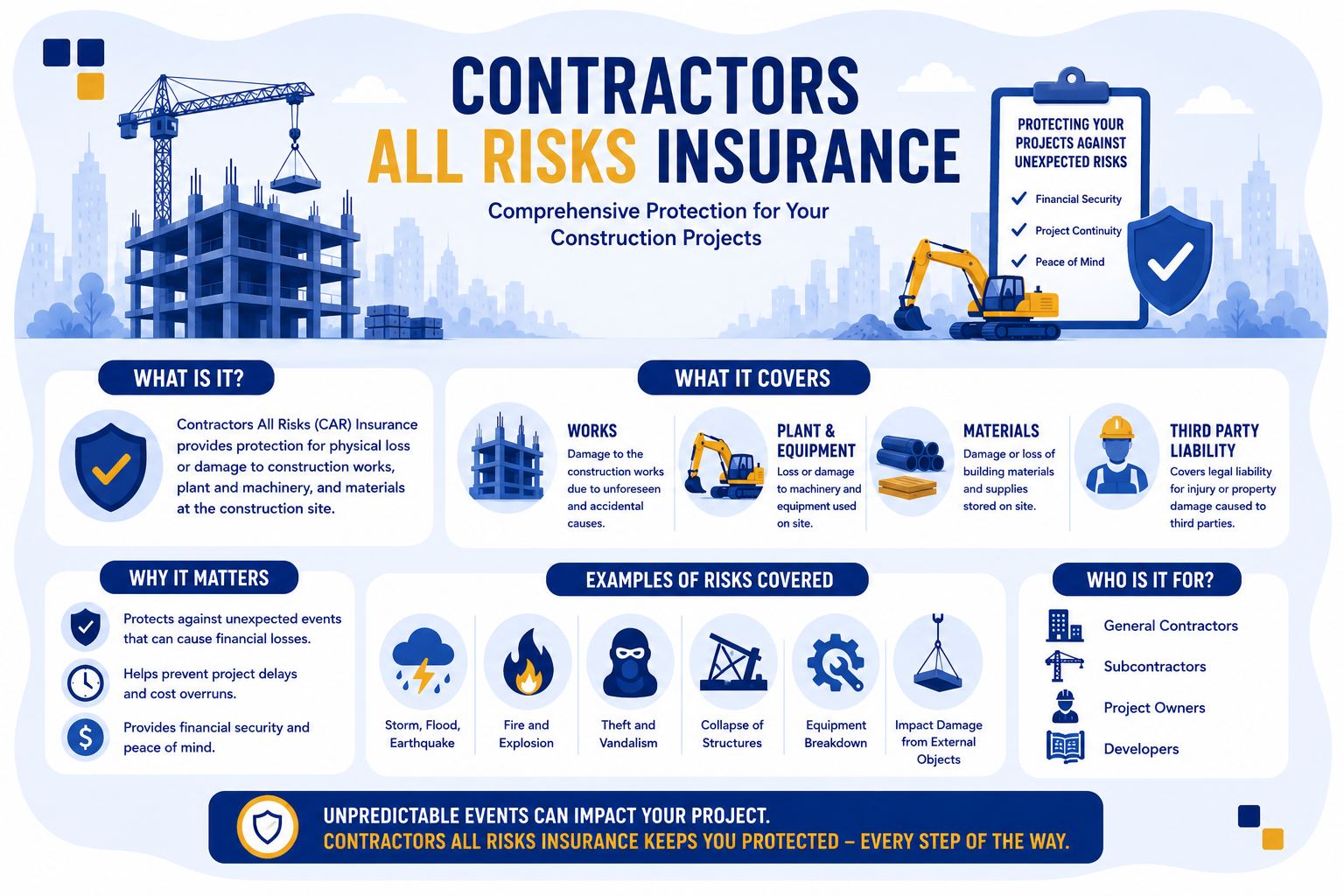
Contractors All Risks (CAR) insurance is the single most important policy on most UK construction projects, and the one most likely to leave a gap when something goes wrong. It is the cover that pays for the physical works themselves — the half-built structure, the materials on site, the temporary works, the plant and equipment that delivers the project — against the wide range of unexpected events that can damage them during a build. When a fire, a flood, a storm, a theft, or a contractor error damages the works, CAR is the policy that responds.
But despite being routinely required by JCT and NEC contracts, by funders, by main contractors, and by local authorities, CAR insurance is also one of the most poorly understood policies in the market. There is no standard CAR wording. Two policies sold under the same name can have materially different scope. The exclusions — particularly around defective design, materials, and workmanship — vary significantly between insurers and the difference between an LEG 1, LEG 2, or LEG 3 clause can be the difference between a fully paid claim and a fully denied one. The interface with professional indemnity, property owners' insurance, and contract-required cover is where most disputes arise.
This guide unpacks the policy in detail — what CAR covers, what it doesn't, how JCT and NEC contracts shape your obligations, how defects exclusions actually work in practice, and how to structure a programme that meets your contract requirements without leaving the gaps insurers and claimants will inevitably find.
1. What CAR Insurance Actually Covers — and What It Doesn't
The Insuring Clause
At its core, a Contractors All Risks policy covers "all risks of physical loss or damage" to the insured property during the period of insurance. "All risks" is a defined insurance term — it doesn't mean every conceivable loss; it means the policy responds to any cause of physical loss or damage that is not specifically excluded. This makes the exclusions, conditions, and definitions in the wording the operative parts of the cover, not just the headline insuring clause.
A CAR policy typically responds to events including:
- Fire, lightning, explosion, and impact damage
- Storm, flood, escape of water, and weather-related loss
- Theft, including theft following forcible entry to the site
- Vandalism and malicious damage
- Subsidence, landslip, and heave affecting the works
- Accidental damage to the works during construction operations
- Damage to temporary works, formwork, and falsework
- Damage to plant, equipment, and materials on site
What CAR Does Not Cover
Equally important is what falls outside the scope. Standard CAR wordings exclude:
- Defective design — the cost of remedying a defect in design itself; this is the domain of professional indemnity insurance, not CAR
- Defective workmanship and materials — the cost of rectifying the defective work itself (though resulting damage may be covered, depending on the LEG or DE clause in place)
- Wear and tear, gradual deterioration, and inherent vice — CAR is not a maintenance or warranty policy
- Consequential financial loss — unless extended via Delay in Start-Up (DSU) or Advanced Loss of Profits (ALOP) cover
- Employers' liability — covered separately under employers' and public liability insurance
- Professional services errors — design, specification, and consultancy errors are PI territory
- Pure financial loss without physical damage — such as contractor insolvency, which requires contractor insolvency cover
How CAR Differs From Adjacent Policies
Construction insurance overlaps in places where each policy stops and the next begins, and confusion is common. The table below clarifies the distinction.
| Policy | What It Covers | Where It Stops |
|---|---|---|
| Contractors All Risks (CAR) | Physical damage to the works, materials, plant during construction | Stops at design errors, consequential financial loss, and the cost of remedying defective work itself |
| Public Liability | Third-party injury or property damage caused by your operations | Stops at damage to your own works — that's CAR territory |
| Employers' Liability | Injury to your employees in the course of their employment | Statutory cover; does not extend to subcontractors who are not your employees |
| Professional Indemnity | Claims for negligent design, specification, or professional advice | Stops at physical damage during construction not caused by design error |
| JCT 6.5.1 / Non-Negligence | Damage to existing structures and surrounding property caused by the works, without negligence | Specialist standalone or extension; doesn't replace public liability for negligent damage |
| Latent Defects (Structural Warranty) | Post-completion structural defects, typically 10-12 years | Stops at non-structural items and pre-handover damage (CAR territory) |
2. Core Sections of a CAR Policy
A typical CAR policy is structured as a series of sections, each covering a different aspect of the project. The exact section structure varies by insurer, but the standard components are as follows.
Section 1 — Contract Works (Material Damage)
The primary section. Covers the permanent and temporary works, materials on site, and items incorporated or to be incorporated into the works. The sum insured should reflect the full contract value plus an allowance — typically 15% in line with FIDIC convention — for demolition costs, professional fees, and inflation during the rebuild period. Underinsurance here triggers the average clause, where insurers reduce claim payments proportionally. We see this routinely on projects where the original contract sum has been revised upwards but the insurance has not been updated to match.
Section 2 — Construction Plant and Equipment
Covers owned plant, equipment, tools, site huts, scaffolding, and temporary works on a "specified" or "unspecified" basis. Hired-in plant is typically a separate section or extension — and one where contractors most often fall short of the hire company's contractual indemnity requirements. The hire company's standard terms (CPA conditions) impose a continuing liability for plant in the hirer's possession; your CAR plant section must respond to that liability for both physical damage and, importantly, continuing hire charges following damage.
Section 3 — Public Liability
Many CAR policies bundle public liability as a section, covering third-party bodily injury or property damage arising from the works. The limit should reflect the scale of the project and any contractual requirement — £5m is a common minimum for most commercial projects, with £10m+ required on larger or higher-risk works. Public liability cover on a project basis interacts with any annual public liability cover you may also hold; both insurers will need to coordinate at claim stage.
Section 4 — Employees' Tools and Personal Effects
A relatively modest sub-section but important on sites where employees bring high-value personal tools. Limits are typically capped at £500–£1,000 per employee.
Section 5 — Off-Site and In-Transit Cover
Where materials and components are stored off-site (at suppliers' premises, in marshalling yards, in dedicated storage facilities) or moved in transit to and between sites. Critical for any project with significant pre-fabrication, modular construction, or supplier-stored stockpiles. Standard wordings often attach when materials arrive on site — leaving everything before that point uninsured under the project policy unless this extension is specifically negotiated.
Section 6 — Delay in Start-Up / Advanced Loss of Profits (Optional)
Optional extension that covers the financial consequences of an insured damage event delaying project completion: lost rent, lost sales revenue, additional financing costs, and increased professional fees during the delay. DSU is rated separately, can significantly add to the premium, and requires a robust delay analysis at underwriting stage — but for any project where revenue or sale depends on a fixed completion date, it is often more important than the material damage section itself.
3. Project Role Cover Checker
Select your role in the project for a tailored cover checklist showing exactly what CAR scope, extensions, and adjacent policies you need.
Contractors All Risks Cover Checker
Select your role in the project to see the recommended insurance programme
Main Contractor — Annual CAR Policy
- LEGAL Employers' Liability — minimum £5m; statutory requirement for any business with employees
- ESSENTIAL Annual Contract Works at contract value plus 15% — covering all projects under the policy; declare turnover and largest project values accurately
- ESSENTIAL Public Liability at minimum £5m on a combined basis; £10m+ for higher-risk works or where contractually required
- ESSENTIAL Plant cover — owned and hired-in, with continuing hire charges extension to match CPA contractual liability
- ESSENTIAL LEG 2 (or LEG 3) defects clause negotiated into the wording rather than the default LEG 1 — material difference at claim stage
- RECOMMENDED Off-site and in-transit extension covering pre-fabrication storage, supplier sites, and goods in movement to site
- RECOMMENDED JCT 6.5.1 non-negligence cover — frequently a JCT contract requirement; some annual policies include, others require a project bolt-on
- RECOMMENDED Professional Indemnity — if you provide any design, design coordination, or design-and-build services
- CONSIDER Cyber insurance — increasingly relevant for digital site management, BIM coordination, and supply chain payment exposure
Sub-Contractor — Relying on Main Contractor's CAR
- LEGAL Employers' Liability — minimum £5m if you have employees, including self-employed labour-only sub-subbies in some cases
- CRITICAL Confirm in writing the scope of cover under the main contractor's joint names CAR — sub-contractor cover is typically limited to specific perils, not the full main contractor wording
- ESSENTIAL Own Public Liability at the level required by your sub-contract — typically £2m–£5m; often required even where you benefit from the main CAR
- ESSENTIAL Own plant and tools cover — the main contractor's policy is unlikely to cover your equipment
- ESSENTIAL Review the sub-contract carefully — back-to-back indemnification provisions may make you liable for matters the main CAR doesn't cover
- RECOMMENDED Professional Indemnity if you provide any specialist design input (M&E coordination, structural elements, design-and-build packages)
- RECOMMENDED Contract works on works you have completed but not yet handed over — particularly relevant for staged sub-contracts
- CONSIDER Small builders insurance package if you operate at this scale and want an annual policy that combines the above
Developer / Employer — Funding the Build
- ESSENTIAL Project-specific CAR in joint names of employer and contractor — particularly where contract value is significant or the project is complex; gives the developer control over the cover
- ESSENTIAL Existing Structures cover — if the development is a refurbishment, extension, or fit-out within an existing building, JCT 6.5.1 type cover for the existing structure is critical
- ESSENTIAL Delay in Start-Up (DSU) — lost rent, sales, or revenue from a delayed completion is typically the developer's largest uninsured exposure
- ESSENTIAL Latent Defects / Structural Warranty — separate post-completion cover typically required by funders, future purchasers, and tenants
- RECOMMENDED Review contractor's PI cover and sum insured before contract — design responsibility on design-and-build means contractor PI is your protection against design failures
- RECOMMENDED Contractor insolvency cover — performance bond or specialist insurance against contractor failure mid-project
- RECOMMENDED Commercial property insurance in place for handover and post-completion exposure
- CONSIDER Funder requirements — funding agreements typically specify minimum insurance terms that override standard market wordings
Self-Builder — Single Domestic Project
- ESSENTIAL Self-build CAR policy — specifically designed for non-trade clients on a single domestic project; standard contractor CAR is unlikely to be available
- ESSENTIAL Public Liability — minimum £2m; £5m if you have any contractor traffic on site
- ESSENTIAL Employers' Liability — if you directly employ anyone, including casual labour
- ESSENTIAL Existing structures cover — if you're extending or refurbishing rather than building from scratch
- RECOMMENDED Plant and tools cover — for the equipment, scaffolding, and materials accumulated during the build
- RECOMMENDED Structural warranty (10-year defects insurance) — typically a mortgage condition and important for future resale
- RECOMMENDED Check contractor insurance — confirm any contractors you engage carry their own PL and EL; their cover does not replace yours but it should layer in
- CONSIDER Buildings insurance arrangements for the period between completion and full occupation
Specialist Contractor — M&E, Demolition, Civils
- LEGAL Employers' Liability — minimum £5m; specialist trades typically have elevated injury risk
- ESSENTIAL Public Liability at minimum £5m, often £10m for demolition, ground works, or works near third-party property
- ESSENTIAL Specialist plant cover — high-value specialist equipment (cranes, piling rigs, demolition plant) often requires bespoke wording beyond standard CAR plant sections
- ESSENTIAL Professional Indemnity — for M&E design coordination, demolition method statements, temporary works design; minimum £1m, £5m+ for larger commercial work
- ESSENTIAL Non-negligence cover (JCT 6.5.1 type) — critical for demolition and ground works where subsidence and vibration damage can occur without provable negligence
- RECOMMENDED Environmental liability — for contamination, escape of substances, and pollution; standard PL has limited environmental cover
- RECOMMENDED Asbestos extension — for any work in older buildings; absolute exclusions are common and require specific endorsement
- CONSIDER Complex construction insurance programme — for projects beyond the scale of a standard CAR policy
Fit-Out / Refurbishment Contractor
- LEGAL Employers' Liability — minimum £5m for all on-site staff
- ESSENTIAL CAR with explicit fit-out scope — many CAR wordings are written for new build and have inadequate wording for fit-out within an occupied or partially occupied building
- ESSENTIAL Existing structures cover at adequate sum insured — the existing building you are working within is at risk from your operations; quantum depends on building value, not contract value
- ESSENTIAL Hot works extension — fit-out frequently involves welding, soldering, and brazing; many policies impose strict hot work permit conditions or limit cover
- ESSENTIAL Public Liability at minimum £5m — particularly important where the building remains in operation during the works
- RECOMMENDED Damage to surrounding property — adjacent units, common parts, services running through the fit-out area
- RECOMMENDED Professional Indemnity if you provide design coordination, specification advice, or interior design services
- CONSIDER Tenant rights and lease obligations — landlord-required insurance specifications may exceed what your standard CAR provides
4. CAR Adequacy Assessor
Most CAR policies we review have at least one significant gap. Select your contract type and project value below to identify the most likely areas of underinsurance or coverage failure for your specific situation.
CAR Adequacy Assessor
Select your contract type and project value to identify your priority coverage gaps
5. JCT, NEC, and FIDIC — Contractual Insurance Requirements
Around 70% of UK construction projects operate under the Joint Contracts Tribunal (JCT) framework, with the balance largely under NEC3/NEC4 forms and a smaller proportion of international or bespoke contracts. Each form imposes specific insurance obligations, and a CAR policy that doesn't meet those obligations puts the contract — and your right to be paid — at risk.
JCT Contracts — Clause 6.7 and Insurance Options
Under the JCT suite, Clause 6.7 (in earlier editions referenced as Clause 22) governs the works insurance arrangement and offers three primary options:
- Option A — the contractor takes out and maintains a joint names policy for new building works in the joint names of contractor and employer. This is the most common option for new build by experienced contractors.
- Option B — the employer takes out the joint names policy for new building works. More common where the employer is a developer with its own insurance arrangements or where multiple contractors are working on a large scheme.
- Option C — the employer takes out joint names insurance for both existing structures and the new works. This option applies to refurbishment, extension, and fit-out projects within existing buildings.
Each option carries its own pitfalls. Under Option A, contractors frequently rely on their annual CAR policy without verifying that it specifically meets JCT joint names requirements and includes the contract-mandated extensions. Under Option B, contractors often assume they are fully protected without checking the wording or sum insured — the joint names policy may be inadequate for their specific exposure. Under Option C, the existing structures sum insured is often based on outdated valuations or market value rather than reinstatement cost.
NEC3 and NEC4 Contracts
NEC contracts take a different approach — Clause 8 (Risks and insurance) sets out a schedule of insurance requirements that the contractor must meet, including minimum limits and specific covers. Unless the contract is amended, the contractor is responsible for taking out CAR in joint names. NEC's specificity is double-edged: it provides clarity about what's required, but failure to meet the schedule can constitute a fundamental breach. NEC project insurance schedules typically specify:
- Minimum sum insured for works (usually contract value + 15%)
- Minimum third-party liability limit
- Minimum employers' liability limit
- Specific extensions required (often including 12-month maintenance period)
- Defects exclusion wording (some NEC schedules specify LEG 2 or LEG 3 minimum)
FIDIC Contracts
FIDIC 2017 forms (Red, Yellow, Silver Books) typically require contractor-arranged joint names CAR at replacement value plus 15%. FIDIC's international footprint means that policies often need to address overseas operations, multi-jurisdiction claims, and currency considerations that domestic UK wordings don't routinely include.
6. Defects Exclusions — LEG and DE Clauses Explained
The defects exclusion is the single most important wording detail in any CAR policy. Two policies with identical premiums, identical limits, and identical insurers can differ enormously in how they respond when defective work causes physical damage. The difference between an LEG 1 and an LEG 3 clause can be the difference between full payment and full denial.
The LEG Clauses (London Engineering Group)
The LEG defects clauses were developed by the London Engineering Group as a market-standard set of exclusions for damage arising from defects. There are three tiers, each progressively more favourable to the insured:
| Clause | What's Excluded | What's Covered |
|---|---|---|
| LEG 1 | All loss or damage arising from any defect in design, materials, or workmanship — absolute exclusion | Nothing related to defects; the most restrictive available |
| LEG 2 | The cost that would have been incurred to remedy the defect immediately before any damage occurred — a "time-bar" exclusion | Resulting physical damage to non-defective property, beyond the cost of original rectification |
| LEG 3 | Only the cost of improvements to the original design, plan, specification, workmanship, or materials | The widest cover: physical damage caused by defects, including resultant damage and rectification (except improvements) |
The DE Clauses (Defects Exclusion)
An alternative framework, with five tiers (DE 1 through DE 5), works similarly. DE 1 is the most restrictive (absolute exclusion); DE 5 is the broadest. Most UK construction policies use DE 3 or LEG 2 as the default, but better terms can be negotiated, particularly for experienced contractors with strong claims records.
How This Plays Out at Claim Stage
Consider this scenario: a sub-contractor installs a heating system incorrectly. Six weeks later, a fitting fails. Water escapes overnight and damages two floors of newly-installed parquet flooring. With each defects clause, the policy responds differently:
- Under LEG 1 — the entire claim is excluded because the loss arose from defective workmanship; nothing is paid
- Under LEG 2 — the cost of correcting the original installation (what should have been done in the first place) is excluded; the water damage to the parquet is covered
- Under LEG 3 — almost everything is covered except any element of cost that represents an improvement on what was originally specified
7. Critical Extensions — Off-Site, Transit, Existing Structures
The standard CAR policy is written to attach at site delivery and respond to events on the construction site. Modern construction routinely involves activity beyond that scope — pre-fabrication, off-site storage, modular components, supplier-held stockpiles, in-transit movements, and works to existing structures. Each of these requires a specific extension to bring it within cover.
Off-Site Materials and Components
Materials at a supplier's premises, in a marshalling yard, or in dedicated off-site storage are not covered under the basic CAR wording. The extension is typically rated on the maximum value held off-site at any one time, with conditions on the security and segregation of the stored materials. For modular construction projects, this extension is fundamental — the majority of project value can sit in the manufacturer's factory before any site delivery, and a fire there is a project-ending event unless covered.
Goods in Transit
Materials and components moving between supplier, off-site storage, and site need transit cover. The extension typically covers loading, transit, and unloading; specific multi-stage transit (rail + road, or marine + road) may require bespoke wording. For abnormal loads — large pre-fabricated components, specialist plant — additional engineering survey and routing requirements often apply.
Existing Structures (JCT 6.5.1 Non-Negligence Cover)
The JCT 6.5.1 clause (in older numbering 21.2.1) requires the contractor to maintain insurance against damage to existing structures and surrounding property caused by collapse, subsidence, vibration, weakening or removal of support, or lowering of ground water — even where this damage occurs without contractor negligence. Public liability insurance only responds to negligent acts; the 6.5.1 cover bridges the gap for non-negligent damage that PL would exclude.
This is particularly critical for:
- Demolition contractors and ground works specialists
- Basement and substructure works in dense urban areas
- Fit-out work where the existing building is occupied
- Refurbishment projects involving party walls and adjoining structures
- Piling, underpinning, and any operations near third-party property
Hired-In Plant — Continuing Hire Charges
Plant hired in under CPA (Construction Plant-hire Association) terms typically imposes continuing liability for hire charges following damage — even when the plant is unusable or off-hire pending repair. Standard CAR plant cover responds to the cost of the damaged plant but not to the continuing hire liability. The extension must be specifically negotiated, with limits matching your maximum daily hire spend.
Free Issue Materials
Materials supplied by the employer for incorporation into the works — common in M&E projects and where the employer holds long-lead-time procurement — require a specific extension covering loss or damage while in the contractor's custody. The sum insured here is often overlooked, and free issue items can be high-value (specialist plant, owner-furnished equipment, statutory utilities components).
8. Joint Names, Subrogation Waivers, and the Subcontractor Question
Joint Names Insurance — What It Really Means
A joint names policy is one where two or more parties are named as insured, each with their own independent right of recovery under the policy. The legal effect is significant: insurers cannot exercise subrogation rights against any party who is jointly insured. If the employer and contractor are joint insureds and a loss is caused by the contractor's negligence, the policy will pay the loss without the insurer turning around to recover from the contractor.
This is fundamentally different from a policy in one party's name with another party's interest "noted" — which provides no protection against subrogation. JCT, NEC, and FIDIC all require true joint names cover, not just a noted interest. The wording must be checked explicitly.
Subcontractor Cover Under the Main Policy
JCT contracts typically extend the joint names cover to sub-contractors, but only in respect of a limited set of "specified perils" (fire, explosion, lightning, storm, flood, escape of water, earthquake, aircraft impact, riot, civil commotion). Outside those perils, sub-contractors must carry their own cover. Where a sub-contractor's negligence causes a loss outside the specified perils, the joint names CAR may pay the loss but then pursue the sub-contractor for recovery — meaning sub-contractors must ensure their own liability cover responds to that exposure.
Cross-Liability Cover
Where multiple parties are joint insureds, a cross-liability clause makes the policy operate as if each insured party had a separate policy. Without this, a loss caused by one insured party affecting another insured party can fall into a coverage gap (the policy doesn't pay the perpetrator's loss; the other party can't claim against their own insurance). Cross-liability is standard in well-drafted CAR wordings but should be specifically verified.
9. What Drives the Cost
| Rating Factor | Impact on Premium | What You Can Do |
|---|---|---|
| Contract value and turnover | Primary rating basis; rated on annual contract value (annual policy) or single project sum insured (project policy) | Declare accurately including the 15% professional fees/demolition allowance; never under-declare to reduce premium |
| Project type and complexity | New build is typically cheapest; refurbishment, fit-out, and works in existing buildings attract higher rates; demolition and ground works highest | Provide method statements and engineering details at underwriting; insurers price uncertainty more than risk |
| Defects clause negotiated | LEG 1 cheapest; LEG 2 mid-tier; LEG 3 highest cost but widest cover | Cost-benefit the upgrade — typically 15-25% additional premium for materially wider cover |
| Sum insured and limits | Material damage sum insured; PL limit; DSU indemnity period and limit; plant value all rate independently | Avoid both underinsurance and over-specification; right-size each section to actual exposure |
| Site location and security | High-risk locations (urban, flood risk, low security) attract premium loadings; demonstrable security reduces cost | Document fencing, lighting, CCTV, alarm systems, and out-of-hours protocols |
| Claims history | Significant historic CAR claims affect rating for 5+ years; claims-free contractors get preferential terms | Invest in risk management; document near-misses and lessons learned |
| Contractor experience and accreditations | Experienced contractors with relevant accreditations (CHAS, SafeContractor, Constructionline) attract better rates | Maintain and present accreditations at renewal; insurers actively price for evidenced competence |
| Hot work and high-risk operations | Welding, soldering, brazing, and other ignition-source operations significantly affect fire-related rating | Document hot work permit systems; restrict to specified hours with fire watch protocols |
10. Real Claims and How to Manage Them
Claim — Site Fire During Hot Works, Mixed-Use Development
A main contractor on a £6 million mixed-use residential and commercial scheme experienced a significant fire during the second-fix stage. The cause was determined to be inadequate hot work controls during pipework brazing in a service riser — the fire watch had been withdrawn before the contractually-required 60-minute post-work observation period had elapsed. Fire spread to combustible insulation in the riser and damaged three floors of nearly-completed apartments.
Total loss including reinstatement, professional fees, delay-related losses, and consequential damage to adjoining units: £1.3 million. The CAR policy responded with the full material damage section, professional fees extension, and partial public liability for damage to adjoining tenant units. However, two issues affected the settlement: the policy contained an LEG 1 defects clause, which insurers initially argued excluded the brazing defect cost; and the contractor's hot work permit records were incomplete, weakening their position on causation.
Settlement was reached after extended negotiation at £1.1 million, leaving a £200k uninsured shortfall borne by the contractor. The contractor's renewal premium increased by 35%, and the insurer required formal hot work permit documentation as a renewal condition.
The lesson: hot work conditions in CAR policies are strictly enforced. A permit system that exists on paper but isn't followed in practice provides little defence at claim stage. The LEG 1 defects clause turned a manageable claim into a partially uninsured one — LEG 2 or LEG 3 would have substantially closed the gap. Both points should be addressed proactively at policy inception, not at the point of claim.
Claim — Storm Damage to Partially Completed Roof Structure
A regional contractor was building a £2.4m school extension when an unseasonal storm with winds gusting to 70mph damaged a partially-completed roof structure. The roof had been left unsheeted overnight with the timber frame exposed; storm-driven rain damaged the structure and the recently-installed floor finishes beneath.
The claim was notified to the CAR insurer, who accepted it under the storm peril. However, the policy contained a "reasonable precautions" condition that required works to be protected from foreseeable weather. The Met Office had issued an amber wind warning 36 hours before the storm; the site had not implemented additional protection. The insurer initially declined the claim on this basis.
After negotiation, the insurer agreed to settle but applied a 25% uninsured contribution to reflect the reasonable precautions failure. Settlement was £180,000 (against a gross claim of £240,000). Renewal premium increased; renewal also required documented adverse weather procedures including monitoring forecasts and implementing temporary protection.
The lesson: CAR is not unconditional. Reasonable precautions, weather monitoring, security, and protection of the works are policy conditions, not just good practice. When weather warnings are issued, document the protective steps taken — even if those steps prove insufficient, the documentation supports the claim. Insurers settling on a partial basis are increasingly common where policyholders cannot evidence reasonable precautions.
Claim — Hired Plant Theft, Continuing Hire Charges Gap
A specialist piling contractor had a hired-in CFA piling rig stolen overnight from a secured site. The rig's hire value was £180,000 with a daily hire charge of £1,250 under CPA terms. The hire company invoked their contractual right to continuing hire charges for the rig until it was either recovered or paid out, plus the replacement cost.
The CAR policy plant section responded with the £180,000 replacement value. However, the continuing hire charges extension had been overlooked at policy inception. Over the 11 weeks it took to source a replacement and finalise the hire company settlement, continuing hire charges totalled £96,250 — all uninsured.
The contractor paid the continuing hire charges directly. Total uninsured loss: £96,250 plus £15,000 in additional costs for site downtime. The contractor's PI insurer was asked to consider a claim against their broker for failing to advise on the continuing hire extension; this was settled commercially between brokers.
The lesson: hired-in plant continuing hire is a routine extension that is frequently overlooked. The CPA terms imposed by all major plant hire companies create continuing liability that standard CAR plant sections do not address. Confirm in writing that your continuing hire extension matches your maximum daily hire spend across all projects. A £1,000 annual premium increase can save £100,000+ at claim stage.
Claims Management Steps
- Immediately after a loss: secure the site, prevent further damage, contact emergency services if needed, and notify your CAR insurer as a precaution even before you know the scale. Most policies require "immediate" notification of any potential claim.
- Preserve evidence: photograph everything; retain damaged materials and components where possible; secure all site records — hot work permits, weather logs, security records, sub-contract files. The strength of your claim position rests on evidence available in the first 48 hours.
- For larger losses: the insurer will appoint a loss adjuster. Cooperate fully but consider engaging your own loss assessor for losses above £100k — the adjuster represents the insurer, not you. The cost of an assessor is typically recoverable as a professional fee in the settlement.
- For defects-related claims: the LEG or DE clause in your wording will be the focal point. Engage your broker and legal advisors early; the question of "what was the defect, what was the resulting damage, and what is excluded vs covered" rarely has an obvious answer.
- For multi-party losses: where a loss involves the employer, contractor, sub-contractors, and possibly third parties, the joint names structure and cross-liability provisions become central. Each party's insurers may need to coordinate; broker management of this process is critical.
- Document everything in writing: phone calls and verbal undertakings count for little in a contested claim. Email summaries of every conversation, every site visit, every assessor meeting.

Frequently Asked Questions
No, CAR insurance is not a statutory legal requirement in the UK. The only mandatory construction-related cover is employers' liability for any contractor with employees. However, CAR is almost universally a contractual requirement under JCT, NEC, and FIDIC contracts, and is required by most professional developers, local authorities, lenders, and main contractors as a condition of award. Operating without CAR on a contract that requires it puts you in breach of contract and exposes you to the full cost of works damage personally. For most contractors and developers, CAR is a commercial necessity even though it isn't a legal one.
The terms are often used interchangeably but they aren't identical. Contract Works typically refers narrowly to the material damage section — the cover for the works themselves and the materials on site. Contractors All Risks usually refers to the broader package that bundles Contract Works together with public liability, plant cover, and sometimes employers' liability and professional indemnity. Think of Contract Works as one component of the wider CAR package. When reviewing a policy or quote, focus less on the marketing label and more on the specific sections, sums insured, and extensions in the actual wording.
This depends entirely on the contract. Under JCT Options A, the contractor takes out the cover; under Options B and C, the employer takes out the cover. NEC and FIDIC typically default to the contractor. Bespoke developer contracts vary. Whichever party arranges the cover must put it in joint names and confirm to the other party that the cover is in place before works commence. For larger projects (typically £5m+), employer-arranged project-specific cover often gives the developer better control and clearer aggregation of all parties' interests. For smaller works, contractor-arranged annual cover is usually more practical.
The cost of putting right the defective work itself is not covered — that would make CAR a workmanship guarantee policy. However, resulting damage caused by the defect may be covered, depending on the defects clause in your wording. Under an LEG 1 clause, all defect-related damage is excluded. Under LEG 2, the cost of original rectification is excluded but resulting damage to non-defective property is covered. Under LEG 3 (the widest), only the cost of improvements to the original design or specification is excluded; resulting damage and most rectification costs are covered. The defects clause is the most important wording detail to confirm when buying CAR.
JCT Clause 6.5.1 (in older numbering 21.2.1) requires the contractor to maintain insurance against non-negligent damage to existing structures and surrounding property — damage caused by collapse, subsidence, vibration, weakening or removal of support, or lowering of ground water, even where there is no negligence on the contractor's part. Public liability insurance responds only to negligent damage; 6.5.1 cover bridges the non-negligent gap. It's particularly important for demolition, ground works, basement construction, piling, and any work in close proximity to existing structures or third-party property. If your contract names a 6.5.1 cover, you must have it before works start.
The material damage sum insured should be the full reinstatement value of the works plus an allowance for demolition, professional fees, and inflation — standard practice is contract value plus 15%, in line with FIDIC convention. The public liability limit should reflect the scale of the project and contract requirements — £5m is a typical minimum for commercial work, with £10m+ for larger or higher-risk projects. Plant cover should match the maximum value of plant on site at any one time. DSU/ALOP should reflect the revenue or rent at risk during a potential delay period. Avoid both under-declaration (which triggers the average clause and reduces claim payments) and over-specification (which adds unnecessary premium).
Most CAR policies include a section or extension for hired-in plant, but the cover often falls short of contractual liability under CPA hire terms. CPA terms typically impose continuing hire charges for damaged or stolen plant until either recovery or full settlement — this can accumulate quickly. Standard CAR plant cover responds to the replacement cost but not to continuing hire. Continuing hire charges is a separate extension that must be specifically negotiated, with limits matching your maximum daily hire spend across all sites. This is one of the most frequently overlooked extensions and a common source of significant uninsured loss.
Under standard JCT terms, the joint names CAR extends to sub-contractors but only in respect of "specified perils" — primarily fire, explosion, lightning, storm, flood, escape of water, earthquake, aircraft impact, riot, and civil commotion. Outside those perils, sub-contractors must carry their own cover. Sub-contractors should never assume they are fully covered under the main CAR; they should confirm the scope in writing and arrange their own insurance to cover the gaps. For sub-contractors providing their own design (M&E coordination, specialist packages, temporary works design), separate professional indemnity insurance is essential because the main CAR will not respond to design-related claims.
A small builder or jobbing contractor with £200k–£500k annual turnover might pay £800–£2,000 per year for an annual CAR policy with standard limits. A mid-sized contractor (£1m–£5m turnover) typically pays £2,500–£8,000 depending on work type and claims history. Larger contractors (£10m–£50m turnover) might pay £10,000–£40,000+ on an annual basis. Project-specific CAR for a £10m project might cost £15,000–£40,000 depending on duration, complexity, and limits. The biggest cost drivers beyond turnover are work type (demolition and refurbishment cost more than new build), defects clause (LEG 1 cheapest, LEG 3 most expensive), site security, claims history, and the geographic and seasonal risk profile of the works.







Instagram
LinkedIn