


Supplement & Sports Nutrition Business Insurance UK
Why Fitness Nutrition Businesses Need Specialist Insurance
The UK sports and fitness nutrition market has grown into a £700 million+ annual sector, with protein supplements, pre-workouts, creatine, amino acids, and functional foods now sold through tens of thousands of retail and online channels. That growth has brought more competition, more product innovation, and more regulatory scrutiny — and with it, more insurance risk than many business owners in the sector have properly accounted for.
Fitness nutrition products are ingestible. When an ingestible product causes harm — or is alleged to cause harm — the liability picture is more complex, the claim values are higher, and the regulatory consequences more serious than for most consumer product categories. A single contamination event, a mislabelled allergen, or a product found to contain a prohibited substance can trigger simultaneously: a product recall, a Trading Standards investigation, FSA enforcement action, civil claims from affected customers, and in the sports nutrition sector, potential claims from athletes whose careers have been affected by a positive doping test.
This guide addresses all of those exposures specifically — alongside the interactive tools to help you identify exactly what your business needs.
1. The Specific Risk Profile of Supplement Businesses
Product Liability — Ingestible Products Are Different
Standard commercial product liability is designed for products that can malfunction, break, or cause physical harm through defective manufacture. Ingestible products create an additional and more complex liability picture: they can cause harm through contamination, through incorrect formulation, through allergen mislabelling, or through interaction with medication or pre-existing health conditions. And unlike a broken household appliance, proving or disproving causation in a health claim from a supplement is technically complex, expensive to investigate, and often contested — meaning legal costs accumulate regardless of the outcome.
Product liability for fitness nutrition businesses must specifically cover:
- Claims from consumers alleging personal injury from consuming your products
- Allergen reaction claims where labelling was incorrect or insufficient
- Contamination events — whether from manufacturing, storage, or supply chain failure
- Product recall costs — the logistics of withdrawing a product from market, consumer notifications, and laboratory testing
- Regulatory investigation costs from the Food Standards Agency or Trading Standards
Your Position in the Supply Chain Determines Your Liability
Where you sit in the supply chain significantly affects your product liability exposure. Under the Consumer Protection Act 1987, liability for a defective product can attach to the producer, the importer into the UK, or — if neither can be identified — the supplier. This means:
- Manufacturers bear primary product liability for products they make
- Importers of supplements from non-UK manufacturers bear liability as if they were the producer
- Retailers can face liability if the manufacturer or importer cannot be identified or is outside the UK
- White-label businesses that put their own brand on a third-party manufactured product take on full manufacturer liability
2. Core Covers Every Fitness Nutrition Business Needs
Product Liability Insurance
The most important cover for any fitness nutrition business. Product liability must be explicitly scoped to cover ingestible supplement products — some standard retail or manufacturing policies exclude food products or ingestibles. Confirm with your broker in writing that your specific product categories are within scope. The limit should reflect your worst-case exposure: for a supplement sold to thousands of consumers, a contamination event affecting multiple people simultaneously can generate multiple individual claims that collectively exceed a low product liability limit.
Professional Indemnity
Required if your business provides any form of nutritional advice, supplement recommendations, personalised programme design, or diet planning alongside product sales. Professional indemnity insurance covers claims arising from errors or omissions in that advice — including where the advice is given by employed staff rather than the business owner personally. If you employ registered nutritionists, dietitians, or sports nutritionists, PI is non-negotiable. It is also required if you make specific health outcome claims in consultations with clients.
Public Liability
Covers third-party injury or property damage from your business operations — relevant for any business with a physical premises, at events and trade shows, or where staff visit client locations. For supplement businesses, public liability is particularly relevant for in-store sampling events (allergic reaction risk) and for fitness expo or show attendance.
Product Recall Insurance
A separate and often overlooked cover that specifically addresses the costs of withdrawing a product from the market. Standard product liability covers third-party claims arising from a defective product. Product recall insurance covers your own costs of conducting the recall: laboratory testing, consumer notification, logistics of returning stock, public relations management, and business interruption during the recall period. For a supplement business selling through multiple retail channels, a recall can be an extremely expensive operational event — even before any third-party claims are resolved.
Employers' Liability
Legally required under the Employers' Liability (Compulsory Insurance) Act 1969 if you employ anyone. Minimum £5 million. Manufacturing and warehouse environments carry specific risks: repetitive handling, machinery use, chemical exposure (particularly relevant for supplement manufacturing), and forklift or pallet operations.
Cyber Insurance
E-commerce supplement businesses hold customer payment data, personal health information provided during consultation or personalisation, and subscription customer data. A data breach triggers GDPR notification obligations. Platform downtime halts online revenue immediately. Cyber insurance covers both the breach response costs and the business interruption during system outage.
3. Business Type Cover Checker
Select your primary business model for a tailored cover checklist.
Fitness Nutrition Business Cover Checker
Select your business type to see the recommended insurance programme
Supplement Manufacturer — Own Formulation
- LEGAL Employers' Liability — minimum £5m; manufacturing environments have elevated injury risk; include all production, QC, and warehouse staff
- ESSENTIAL Product Liability — primary exposure; as the manufacturer you bear full liability; confirm ingestible supplement products are explicitly within scope; minimum £2m, £5m+ recommended
- ESSENTIAL Product Recall Insurance — manufacturing contamination events requiring market withdrawal are the most severe operational risk; recall costs are separate from third-party claims
- ESSENTIAL Public Liability — minimum £5m; for visitor access, trade show attendance, and any direct customer interaction
- ESSENTIAL Property and Contents — manufacturing equipment, raw materials, packaging, and finished goods at replacement cost; include equipment breakdown for production-critical machinery
- RECOMMENDED Business Interruption — manufacturing stoppage has supply chain consequences; minimum 18-month indemnity period to cover equipment replacement lead times
- RECOMMENDED US/Canada product liability extension — if you sell to North American consumers or supply North American distributors; standard UK policies exclude this territory
- RECOMMENDED Professional Indemnity — if you provide formulation advice or nutritional guidance alongside your products
- CONSIDER Environmental liability — supplement manufacturing may involve chemical handling; confirm your property insurer understands the materials on site
Online Retailer — Third-Party Brands
- LEGAL Employers' Liability — if you employ anyone including warehouse or customer service staff; minimum £5m
- ESSENTIAL Product Liability — as an online retailer you can face product liability claims even for brands you did not manufacture; the Consumer Protection Act 1987 places liability on the last identifiable UK party in the supply chain
- ESSENTIAL Cyber Insurance — e-commerce operations hold payment data, customer health data (if personalisation is offered), and subscription information; GDPR breach liability and platform downtime are both real risks
- ESSENTIAL Stock and goods in transit — stock in warehouse and in transit to customers; confirm perishable and temperature-sensitive products are covered
- RECOMMENDED Business Interruption — for online businesses, platform downtime is the primary BI trigger; confirm cover includes cyber-caused revenue loss, not just physical damage
- RECOMMENDED US/Canada product liability — if you ship supplements to North American customers; standard UK policies exclude this territory
- RECOMMENDED Product Recall contribution — where you stock products recalled by the manufacturer; confirm whether your policy covers your recall-related costs even where you didn't manufacture the product
- CONSIDER Advertising and marketing liability — online health claims for supplements are heavily regulated; claims that breach the CAP Code or food labelling legislation can generate regulatory and civil liability
High-Street Nutrition Store
- LEGAL Employers' Liability — minimum £5m; include all retail and stockroom staff
- ESSENTIAL Public Liability — minimum £2–5m; in-store sampling events create specific allergen reaction risk; slip and trip from customer footfall is ongoing
- ESSENTIAL Product Liability — for all products sold, including own-label; allergen labelling and ingestible product claims are the primary exposures
- ESSENTIAL Stock and Contents — at replacement cost; include EPOS systems, display equipment, and chilled/frozen stock if applicable
- ESSENTIAL Business Interruption — fire, flood, or break-in halting a nutrition retail business during peak seasonal demand can be financially serious; minimum 12 months indemnity
- RECOMMENDED Professional Indemnity — if staff give supplement recommendations or nutritional advice to customers; even informal advice creates PI exposure
- RECOMMENDED Glass cover — shopfront glazing; often tenant's responsibility under the lease
- CONSIDER Legal expenses — for Trading Standards investigations, landlord disputes, and employment issues
Wholesale Distributor
- LEGAL Employers' Liability — minimum £5m; include warehouse, logistics, and sales staff
- ESSENTIAL Product Liability — as a distributor you can face liability as the last identifiable UK party in the supply chain; confirm ingestible products are explicitly within scope
- ESSENTIAL Goods in transit — significant stock values moving between suppliers, your warehouse, and retail customers; include international transit if you import directly
- ESSENTIAL Stock and warehouse contents — at full replacement value; temperature-controlled stock if applicable
- RECOMMENDED Product Recall costs — if a product you have distributed is recalled; the cost of tracing and notifying all retail customers and managing stock return can be significant
- RECOMMENDED Trade credit insurance — if you supply retail accounts on credit; bad debt in the retail sector is a real risk, particularly for smaller independent gyms and health stores
- RECOMMENDED US/Canada product liability — if any products are distributed to North American retailers or end consumers
- CONSIDER Import compliance documentation — insurers may require evidence that imported supplement products meet UK food safety and labelling standards; obtain and retain supplier compliance certificates
Nutrition Consultant / Personalised Supplement Service
- LEGAL Employers' Liability — if you employ any consultants or support staff; minimum £5m
- ESSENTIAL Professional Indemnity — your primary exposure; personalised supplement recommendations, diet planning, and health outcome claims all create PI liability; minimum £1m; higher if you work with clinical populations or athletes
- ESSENTIAL Public Liability — minimum £2m; for client consultations, home visits, and any premises used for sessions
- ESSENTIAL Product Liability — if you supply, recommend specific brands, or curate supplement packs for clients; your advice creates a direct link between the product and the client
- RECOMMENDED PI retroactive date — covers the full history of your consultancy work; do not switch insurers without maintaining retroactive continuity
- RECOMMENDED Cyber insurance — client health data is sensitive personal data under GDPR; a breach triggers mandatory notification obligations
- CONSIDER Registration body requirements — if you hold BANT, ANutr, or RNutr registration; check whether your professional body specifies minimum PI limits as a membership condition
White-Label / Own-Brand Supplement Business
- LEGAL Employers' Liability — minimum £5m if you have any staff
- CRITICAL Manufacturer-level product liability — by putting your brand on a third-party manufactured product you take on full manufacturer liability; your insurer must understand this; retailer-level PL is inadequate
- ESSENTIAL Product Recall Insurance — as the brand owner you are responsible for conducting the recall, regardless of whether the manufacturing defect originated with your contract manufacturer
- ESSENTIAL Contract manufacturer indemnification — obtain back-to-back indemnification from your contract manufacturer; confirm this is enforceable and that your own insurer is aware of the arrangement
- ESSENTIAL Supply chain documentation — batch records, certificates of analysis, and allergen statements from every production run; your ability to pass liability up the supply chain depends on this documentation
- RECOMMENDED US/Canada product liability — if you sell to North American consumers; as the brand owner you are the named party in any US product liability claim
- RECOMMENDED Professional Indemnity — if your brand makes performance claims or you provide nutritional guidance alongside products
- CONSIDER WADA compliance testing — if your products are sold to athletes or sport-specific markets; third-party tested and certified products significantly reduce prohibited substance liability exposure
4. Product Risk Assessor
Select your product category and your position in the supply chain to get a specific risk rating and the insurance implications for your business.
Product Risk Assessor
Select your product type and supply chain position to see your specific risk profile
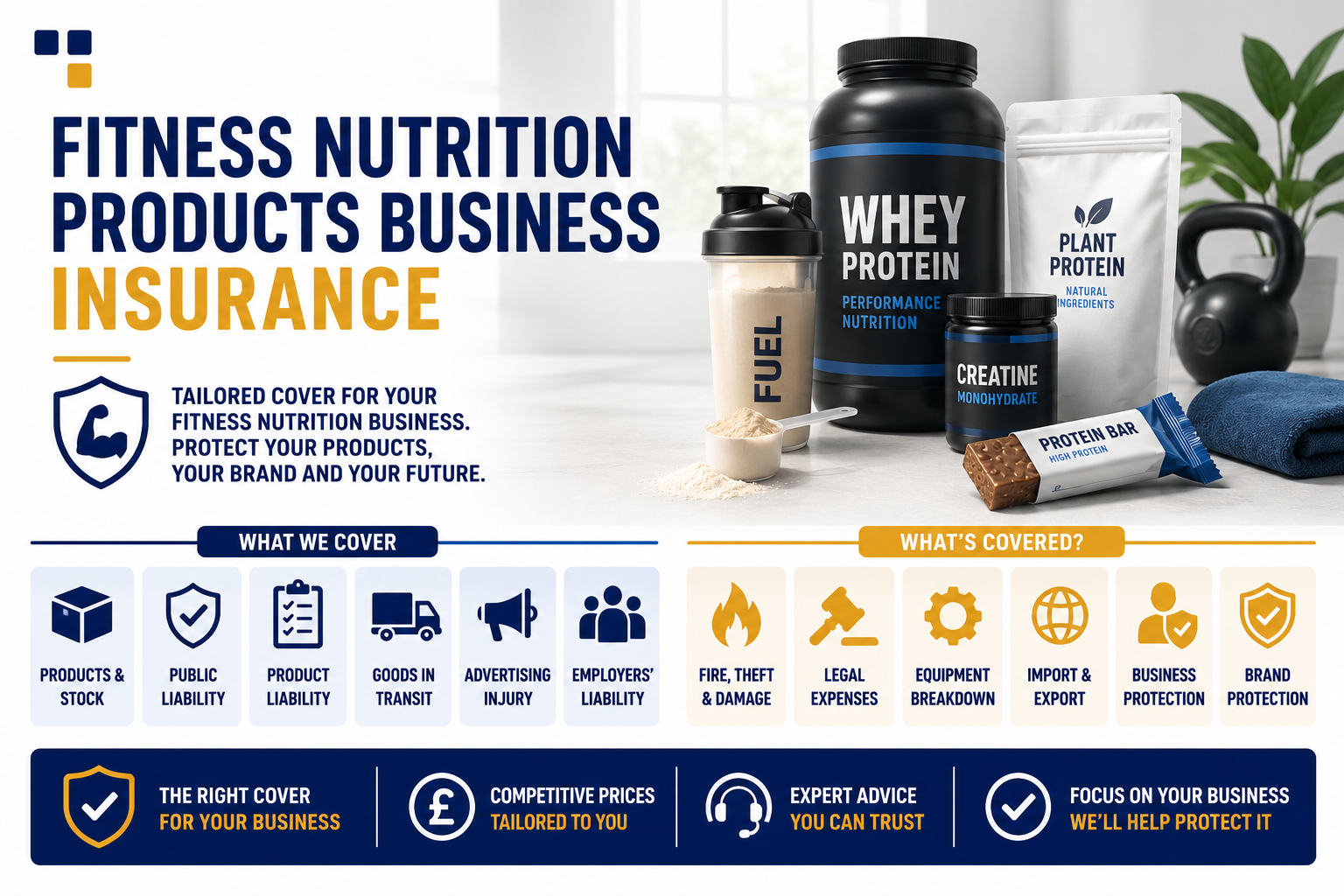
5. The WADA / Prohibited Substances Risk
For any supplement business selling into the sports nutrition market — and many that do not specifically target it — the risk of a product containing a substance prohibited under the World Anti-Doping Agency (WADA) Prohibited List is one of the most serious and least understood insurance exposures in the sector.
How Contamination Happens
Prohibited substances appear in supplement products through three routes. Deliberate adulteration — adding undeclared stimulants or anabolic agents to enhance perceived product effect — is rare but does occur, particularly in weight management and pre-workout products imported from unvetted manufacturers. Cross-contamination at manufacturing facilities — where supplement production lines share equipment with pharmaceutical or other supplement manufacture — is more common. And ingredient contamination — where a raw material contains trace amounts of prohibited compounds not identified in the supplier's certificate of analysis — is the most frequent route and the most difficult to control.
The Liability Chain
When an athlete tests positive for a substance found in a supplement they were using, the claim trajectory is:
- The athlete faces a ban and potentially significant career and commercial losses
- Independent testing of the supplement batch identifies the prohibited substance
- The athlete's legal team identifies the manufacturer, importer, or brand owner of the supplement
- A product liability claim is brought — typically for loss of earnings during the ban, loss of endorsement contracts, and reputational damage
For a professional athlete, these losses can be very substantial. A contaminated batch of protein powder reaching a professional rugby or cycling team could generate simultaneous claims from multiple athletes, each with significant earnings and contract exposure. The product liability claim in that scenario can run to millions of pounds — far exceeding standard retail product liability limits.
Third-Party Testing — How It Affects Your Insurance Position
Several independent certification schemes test supplements for prohibited substances and provide certified-clean status to products that pass: Informed Sport, Informed Protein, NSF Certified for Sport, and Cologne List are the most widely recognised. Holding certification from one of these schemes does not eliminate product liability exposure, but it:
- Significantly reduces the likelihood of a prohibited substance contamination event
- Demonstrates due diligence that supports your defence in any claim
- Is increasingly required by elite sports nutrition buyers as a condition of supply
- Is viewed favourably by specialist insurers when assessing risk and setting premiums
6. Allergen Labelling — Natasha's Law and Insurance Implications
Natasha's Law — the Food Information (Amendment) England Regulations 2019, which came into full force in October 2021 — requires all pre-packed for direct sale (PPDS) food and drink products to carry a full ingredients list with allergens emphasised in bold. For fitness nutrition businesses, this applies to protein bars, protein balls, baked goods, and any other food products prepared and packaged on the premises for sale.
The 14 Allergens
UK food law requires the following allergens to be declared in the ingredients list, emphasised to stand out from the surrounding text:
| Allergen | Relevance to Fitness Nutrition |
|---|---|
| Milk / Dairy | Present in whey protein, casein, milk protein concentrates — most protein powders |
| Eggs | Present in some protein powders, protein bars, and baked products |
| Gluten (wheat, rye, barley, oats) | Present in many protein bars, oat-based products; cross-contamination risk in mixed facilities |
| Peanuts | Peanut butter protein bars; cross-contamination risk in manufacturing |
| Tree nuts | Almond, cashew, walnut variants common in premium protein bars and snacks |
| Soya | Soy protein isolate widely used in plant-based protein products |
| Sesame | Increasingly common in protein snacks and bars |
| Celery, Mustard, Lupin, Sulphites, Fish, Crustaceans, Molluscs | Less common but must be declared if present at any level |
Insurance Implications of Allergen Failures
An allergen mislabelling failure generates liability on two fronts: civil liability to anyone who suffers an allergic reaction as a result, and regulatory liability from Trading Standards or the Food Standards Agency. In severe cases involving anaphylaxis, the civil liability alone can be very significant. The FSA can require product withdrawal and recall — at your cost — and may impose notices that affect your ability to trade. Your product liability policy must explicitly cover allergen-related claims, and your product recall policy must cover an allergen-driven recall. Neither should be assumed — both must be confirmed.
7. Regulatory Framework — FSA, Novel Foods, and HFSS
Food Standards Agency Compliance
The Food Standards Agency (FSA) regulates food supplements in England, Scotland, and Wales under the Food Supplements (England) Regulations 2003 and successor legislation. Key compliance requirements include:
- Maximum permitted levels for vitamins and minerals in supplements
- Prohibition of certain substances from food supplements
- Restrictions on health claims — only approved health claims from the GB NHC Register may be made
- General food safety obligations under the Food Safety Act 1990
Non-compliance with FSA regulations can result in enforcement notices, mandatory recall, and criminal prosecution in serious cases. From an insurance perspective, regulatory investigation costs and the costs of defending enforcement action are covered under legal expenses insurance — making this a valuable addition to the programme for any supplement business operating in a heavily regulated product category.
Novel Foods Regulations
Novel foods — ingredients that were not consumed to a significant degree in the EU before 15 May 1997 — require authorisation from the FSA before they can be sold in the UK. The novel foods list is periodically updated and includes a number of ingredients that have appeared in sports nutrition products: certain algae, specific plant extracts, some amino acid derivatives, and CBD products (which have their own complex regulatory status).
Selling a product containing a non-authorised novel food ingredient is a regulatory breach that creates both enforcement and product liability exposure. If the novel food ingredient causes harm, the insurer will investigate whether the product was compliant at the time of sale — a non-compliant product may be excluded from coverage. Maintain awareness of the FSA novel foods list and check any new ingredient against it before inclusion in formulations or stocked products.
HFSS Advertising Restrictions
The High Fat, Sugar, and Salt (HFSS) advertising restrictions that expanded in October 2025 limit where HFSS products can be advertised — including significant restrictions on paid online advertising. Many fitness nutrition products — protein bars, mass gainers, flavoured protein shakes — technically fall within the HFSS classification depending on their nutritional profile. Breaching HFSS advertising rules can result in ASA enforcement, financial penalties, and reputational damage. Ensure your marketing team and any external agencies you use are aware of the HFSS status of your product range.
8. US and Canada Market Exclusions
As with most manufactured consumer product categories, standard UK product liability policies exclude the United States and Canada from their territorial scope. For the fitness nutrition sector, this exclusion is particularly significant because:
- Many UK supplement brands sell to North American consumers directly through their websites or via Amazon
- US product liability litigation for supplement products — particularly where health claims have been made — can generate very large claims
- The US Federal Trade Commission and FDA both regulate supplement marketing and labelling independently from UK requirements — compliance in the UK does not ensure compliance in the US
- US class action litigation allows many claimants to join a single claim — a contaminated batch affecting multiple consumers can generate a class action with aggregate damages far exceeding UK equivalents
If you sell to North American consumers — whether directly or through a third-party platform — you need a specific US/Canada territorial extension on your product liability policy. This must be arranged at inception, not retrospectively when a claim arises. The extension is priced on your North American revenue as a proportion of total sales, and the cost is typically modest relative to the exposure it covers.
9. What Drives the Cost
| Rating Factor | Impact on Premium | What You Can Do |
|---|---|---|
| Annual turnover and product range | Primary product liability rating basis; higher turnover = more products in consumers' hands = more exposure | Declare accurately including all product categories; never omit higher-risk product lines |
| Supply chain position | Manufacturers and white-label brand owners pay significantly more than retailers; importers are between the two | Obtain back-to-back indemnification from contract manufacturers; document your supply chain for claims defence |
| Product category | Stimulant pre-workouts and weight management products attract higher rates than vitamins; clinical nutrition attracts the highest rates | Declare all product categories; obtain WADA testing certification for sports market products |
| US/Canada sales | North American territorial extension adds premium; rated on export value as percentage of total sales | Declare all North American sales accurately; do not omit platform sales (Amazon, Etsy) that reach US/Canada consumers |
| Quality management systems | GMP-compliant manufacturing, batch testing, CoA records, and HACCP systems all reduce premium | Document and maintain QMS procedures; present evidence at renewal |
| Claims history | A product recall or allergen incident claim will affect premiums for 5+ years; PI claims from nutritional advice also impact renewal | Invest in allergen management, batch testing, and staff training; address root causes of any incidents |
| Professional advice services | PI adds to the overall premium but is relatively modest for standard nutritional consultation | Ensure all staff who give product recommendations have appropriate qualifications and training records |
10. Real Claims and How to Manage Them
Claim — Protein Powder Contamination Recall, UK Manufacturer 2025
A UK protein powder manufacturer was notified by a customer that an independent laboratory test had identified elevated levels of heavy metals — specifically lead — in a batch of their whey concentrate product. The batch had been produced from a new supplier's raw material following a cost reduction initiative. 2,200 units had been sold through direct website sales and four wholesale accounts supplying independent gyms.
The manufacturer immediately ceased sales of the affected batch and notified their insurer. Their product recall policy funded: laboratory testing of retained batch samples (£8,400), consumer notification campaign including direct email and social media recall notice (£3,200), logistics of recovering and destroying unsold stock from wholesale accounts (£4,600), and PR management support (£5,800). Total recall direct cost: £22,000.
Three consumers made product liability claims alleging health impacts. Two were settled through the insurer at a combined £44,600. The third claim was still under investigation at the time of this guide's publication. The manufacturer's product liability limit was £5 million — adequate in this case. Their product recall policy was capped at £100,000 — also adequate. The manufacturer had retained certificates of analysis from the previous raw material supplier but not from the new one — a gap that complicated the investigation and made passing liability up the supply chain more difficult.
The lesson: CoAs must be obtained from every supplier, for every batch, before production. Switching suppliers without obtaining and reviewing compliance documentation creates both a safety risk and an insurance defence gap that can make a manageable claim significantly more expensive.
Claim — In-Store Allergen Reaction, High Street Nutrition Store
A customer at a high-street nutrition store sampled a protein bar during an in-store promotional event. The bar contained tree nuts. The customer had a tree nut allergy and had not been informed before sampling. She experienced anaphylaxis requiring emergency hospital treatment. The allergen was present in the product's ingredient list, but staff conducting the sampling had not been briefed to check and declare allergens before offering samples.
The claim was brought against the store for public liability. The insurer confirmed coverage and the claim was settled at £45,000. A post-claim review identified that the store had no allergen awareness protocol for in-store sampling events and staff had not received allergen awareness training. The insurer required both to be implemented as a condition of renewal. The store's premium increased by 22% at the next renewal.
The lesson: allergen awareness training for all customer-facing staff, and a documented sampling protocol that includes allergen declaration before any sample is offered, are both an insurance condition and a legal obligation under Natasha's Law. Implement both and document them — not just to reduce claims, but to evidence compliance at renewal and in any subsequent investigation.
Claim — Professional Advice, Kidney Complication
A nutrition consultant employed by a supplement retailer recommended a high-protein diet combined with a specific creatine and branched-chain amino acid stack to a customer. The customer had not disclosed a pre-existing reduced kidney function condition. The customer subsequently experienced a deterioration in kidney function that his GP attributed in part to the high protein intake. A professional indemnity claim was brought against the consultant's employer — the supplement retailer — alleging negligent advice.
The PI insurer defended the claim, engaging a nephrologist to assess causation. The assessment was inconclusive on direct causation but identified that the consultant had not taken an adequate health history before making the recommendation — specifically had not asked about kidney function or history of kidney disease, which is a standard question in sports nutrition consultations. The claim settled at £38,000 plus defence costs of £17,000.
The lesson: any business providing nutritional advice alongside supplement sales needs both PI insurance and a structured consultation protocol. Health history must be taken before making specific product or nutrition recommendations. The protocol should be documented, staff should be trained against it, and records of consultations should be retained.
Claims Management Steps
- For a product liability complaint or illness report: notify your insurer immediately. Do not admit liability. Retain the specific batch or product involved. Pull all batch records, CoAs, and supplier documentation for that production run before anything is discarded.
- For a potential product recall: notify your recall insurer before initiating the recall — their team will manage the process alongside you. A self-managed recall without insurer involvement is expensive and may not be reimbursed.
- For a Trading Standards or FSA investigation: contact your legal expenses insurer immediately. Do not make statements to investigators without legal advice. Cooperate fully once you have legal representation in place.
- For a PI claim from a nutrition consultation: notify your PI insurer promptly. PI is claims-made — the policy in force when you receive the claim (or become aware of a circumstance) is the relevant policy. Do not wait for formal proceedings.
- For an allergen incident: attend to the affected person first — call emergency services if required. Then complete a full incident record, preserve the specific product sampled or sold, and notify your insurer. Do not modify your allergen labelling or sampling protocol before discussing with your insurer — any changes could be interpreted as an admission.

Frequently Asked Questions
Employers' liability insurance is the only statutory legal requirement — mandatory if you employ anyone, minimum £5 million, with fines of £2,500 per day for non-compliance. Product liability, professional indemnity, and public liability are not legally mandated but are commercially essential for any supplement business. Many retailers, gyms, and online platforms require evidence of product liability as a condition of supply. For businesses providing nutritional advice, PI is a condition of registration with BANT, ANutr, and similar professional bodies.
Potentially yes. Under the Consumer Protection Act 1987, liability for a defective product can attach to the supplier where the producer or importer cannot be identified or is outside the UK. If you stock imported supplements from a manufacturer with no UK presence, you may be treated as the liable party if a consumer claim arises. As a retailer of UK-distributed branded products, you are lower risk — you can direct the claim to the importer or UK distributor. But you should still carry product liability insurance that covers ingestible supplement products, because claims can arise from your own actions (storage, sampling, advice) as well as from product defects.
White-labelling means putting your own brand name on a product manufactured by a third party. Under the Consumer Protection Act 1987, this means you are treated as the manufacturer for product liability purposes — you take on full liability for defects in the product, even if the defect originated with your contract manufacturer. Standard retailer-level product liability insurance is inadequate for a white-label business. You need manufacturer-level product liability, product recall cover, and back-to-back indemnification from your contract manufacturer. Disclose white-label activity to your insurer at inception and at each renewal.
If a supplement you manufactured, branded, or supplied is found to contain a WADA-prohibited substance — through contamination, adulteration, or raw material impurity — an athlete who tests positive after using it can bring a product liability claim for career losses, including lost earnings, endorsements, and prize money. For professional athletes, these losses can be very significant, and a single contaminated batch reaching a professional sports team could generate multiple simultaneous claims. Specialist third-party testing certification (Informed Sport, NSF Certified for Sport) reduces the risk and supports your defence, but does not eliminate liability. Ensure your PL limit reflects this worst-case scenario if your products reach the sports market.
It should, but you must confirm this specifically. Standard product liability for ingestible products should cover claims arising from allergen reactions — whether from incorrect labelling, undeclared allergens, or cross-contamination. However, some policies include conditions or exclusions around regulatory compliance — a product that was non-compliant with Natasha's Law at the time of the allergen incident may be excluded. Maintain allergen labelling compliance and staff allergen awareness training as both a legal requirement and an insurance condition.
If you genuinely provide no advice — customers select their own products and you make no recommendations — then the PI exposure is lower. In practice, most supplement retailers provide at least informal guidance: staff recommend products, in-store signage makes performance or health claims, and product descriptions on websites include outcome statements. Each of these can create PI exposure. If you employ nutritionists, run a consultation service, or your business model includes any element of personalised product recommendation, PI is essential. The boundary between retail advice and professional advice is not always clear — if in doubt, carry PI. The premium for a small supplement retailer PI policy is modest.
No — standard UK product liability policies exclude the United States and Canada. If you sell supplements to North American consumers through your website, Amazon, or any other channel, you need a specific US/Canada territorial extension. This is not automatically included and must be arranged at inception. US supplement product liability litigation — particularly where health claims are involved — can generate very large claims, and the US class action mechanism allows multiple claimants to join a single proceeding. The extension cost is typically modest relative to the exposure for most UK brands. Do not assume platform sales to North American addresses are covered without confirming the territorial extension.
A small online retailer selling established brands with £150,000 turnover might pay £1,200–£2,500 per year for a combined policy. A high-street nutrition store with staff might pay £2,000–£4,000. A white-label supplement brand with £500,000 turnover could pay £4,000–£8,000 depending on product categories. A manufacturer with its own formulations could pay £6,000–£15,000 or more depending on product range and North American export value. The biggest cost drivers beyond turnover are: supply chain position (manufacturer vs retailer), product categories (stimulants and weight management cost more), US/Canada export value, and whether professional indemnity and product recall are included.







Instagram
LinkedIn