


Sharps Removal Insurance UK | Needle Cleanup Cover
Why does UK sharps removal need specialist insurance treatment in 2026?
Sharps removal is a specialist service category that sits at the intersection of clinical waste management, biohazard cleaning, public health response, and emergency facilities work. UK operators perform needle sweeps in parks, public toilets, transport hubs, car parks, festival sites, and void properties; clear drug paraphernalia from squats, abandoned buildings, and antisocial behaviour hotspots; and provide routine sharps bin collection for healthcare, beauty, tattoo, acupuncture, veterinary, and laboratory clients. The work is statutorily regulated under multiple overlapping frameworks — most importantly the Health and Safety (Sharp Instruments in Healthcare) Regulations 2013, the Hazardous Waste (England and Wales) Regulations 2005, the Environmental Protection Act 1990, COSHH 2002, and the Carriage of Dangerous Goods Regulations 2009.
Yet the insurance market that serves UK sharps removal operators is overwhelmingly generic. Most operators buy "cleaner's package" policies — sometimes with a biohazard extension, often without — from brokers who treat the work as a sub-category of commercial cleaning. The result is a chronic mismatch between the actual risk profile (clinical waste exposure, BBV transmission, public injury liability from missed sharps, Environment Agency Duty of Care, CDG transport regulation, Section 37 director liability) and the insurance that is supposed to respond when something goes wrong. When a claim does arise — and across the UK sharps removal sector, claims arise regularly — the policy is often found to be either inadequately scoped or in breach of disclosure obligations.
This guide is a complete operator and contractor reference for UK sharps removal insurance in 2026. It complements our main biohazard cleaning insurance product page and the sister deep-dives — the biohazard cleaning insurance cost guide, the trauma cleaning insurance guide, the crime scene cleaning insurance guide, and the risks of biohazard cleaning businesses guide. Where biohazard cleaning is dominated by indoor scenes and known site briefings, sharps removal is dominated by outdoor and public-facing work where missed-needle public injury is the defining commercial risk. The cover programme should reflect that.
Key facts at a glance for UK sharps removal operators
- UK sharps removal is governed by at least six overlapping regulatory frameworks — Health and Safety (Sharp Instruments in Healthcare) Regulations 2013, Hazardous Waste Regulations 2005, Environmental Protection Act 1990, COSHH 2002, CDG 2009, and the Controlled Waste Regulations 2012. Generic cleaner's insurance rarely contemplates all six.
- Public injury from missed sharps is the defining commercial risk — distinct from trauma or crime scene work, sharps removal claims are predominantly Public Liability driven, with claim values reaching £40,000–£250,000+ for confirmed BBV transmission to a member of the public.
- An Environment Agency upper-tier waste carrier licence is mandatory — operating without it (or with an expired one) is a strict-liability offence under the Environmental Protection Act 1990 with fines up to £50,000 in magistrates' court and unlimited in Crown Court.
- One published UK study identified over 7,000 discarded needles in a single year in Southampton alone — illustrating the scale of public-space sharps litter that local authorities, transport operators, housing associations, and FM contractors need to manage.
- Royal College of Nursing data indicates roughly 32% of sharps injuries are disposal-related — meaning the disposal and removal stages, not the original use, account for a third of all UK occupational sharps injuries.
- Hepatitis B vaccination is increasingly an insurance underwriting condition for UK sharps removal operators — insurers require documented programmes with immunity testing rather than a vaccination list alone.
- Insurance non-disclosure is the single most common claim dispute pattern — operators buying "cleaner's package" cover without explicitly declaring sharps removal, needle sweeps, void clearance, or drug paraphernalia removal create a non-disclosure exposure under the Insurance Act 2015 that can void cover entirely.
1. What is sharps removal and which businesses provide it?
"Sharps removal" in the UK commercial context covers several distinct service models, and the insurance requirements vary materially between them. Understanding which service model an operator runs is the first step to building a cover programme that actually responds when needed.
The five primary UK sharps removal service models are:
- Needle sweep contractors — typically attending public spaces (parks, alleyways, car parks, underpasses, public toilets, transport hubs) under contract to local authorities, housing associations, transport operators, or facilities management companies. Work is often unscheduled and reactive, sometimes lone-worker.
- Void property clearance contractors — clearing former residential, commercial, or industrial properties prior to re-letting, sale, or demolition. Sharps and drug paraphernalia are commonly encountered in voids, often without prior warning. SIA-trained void specialists often combine sharps removal with security and access control.
- Drug den and squat decontamination specialists — clearing properties used for habitual injecting drug use, sometimes alongside police operations or post-eviction. Higher sharps density, contamination spread, and chemical residue (Spice, methamphetamine, fentanyl traces) than routine void work.
- Routine clinical sharps bin collection services — scheduled collection of sharps containers from healthcare practices (GPs, dentists, vets), beauty salons, tattoo parlours, acupuncturists, laboratories, and home-care patients. Higher transport mileage, multi-stop routes, smaller per-stop sharps volumes.
- Festival, event and emergency sharps response — providing sharps response at music festivals, sporting events, large gatherings, and emergency call-outs (e.g. found needles reported to councils). Short-burst high-intensity work, often outdoor, often in crowds.
Most UK operators run a mix of these models. The insurance implication is that every service type must be specifically declared at proposal — a cover programme designed for routine clinical bin collection will not respond properly to a needle sweep public injury claim, and vice versa.
2. How does sharps removal insurance differ from generic cleaner's cover?
Sharps removal sits a long way from general commercial cleaning in risk terms. The table below summarises the differences that drive cover scoping decisions:
| Risk Factor | Generic Commercial Cleaner | UK Sharps Removal Operator |
|---|---|---|
| Primary Public Liability driver | Slip and trip claims; property damage | Missed-sharps injury to public; BBV transmission liability |
| BBV exposure (HIV, HBV, HCV) | Negligible — not contemplated in cover | Routine — must be explicitly declared and scoped |
| Hazardous waste handling | Minimal — non-hazardous mixed waste | Hazardous waste consignment notes, EWC codes, EA upper-tier waste carrier licence |
| Environment Agency Duty of Care exposure | Low | High — EPA 1990 Section 34 strict liability |
| Transport regulation | Standard commercial vehicle | CDG 2009, ADR dangerous goods, hazardous goods declaration on insurance |
| Lone working exposure | Moderate — typically scheduled premises work | High — unscheduled public-space attendance, voids, out-of-hours |
| HSE prosecution exposure | Standard HSAW 1974 scope | HSAW 1974 + Sharps Regs 2013 + COSHH Hazard Group 3 specific scope |
| Public Liability limits typically required | £2m–£5m | £5m–£10m+ for council and panel contracts |
| PI cover requirement | Generally not required | Required for sign-off, methodology, panel contract work |
| Environmental Impairment Liability | Rarely required | Strongly recommended — chemical residue, waste spillage, contamination spread |
| Legal Expenses scope | Standard commercial | HSE investigation + Environment Agency enforcement + CDG defence scope |
| Specialist broker placement | Generally not material | Material — generic placement typically misses sharps-specific declarations |
The implication is straightforward: a cover programme designed for a domestic or commercial cleaning operator will not respond properly to the risks a sharps removal operator carries. The two are different commercial insurance products that happen to share the word "cleaning". Treat them differently.
3. What are the core insurance covers a UK sharps removal operator needs?
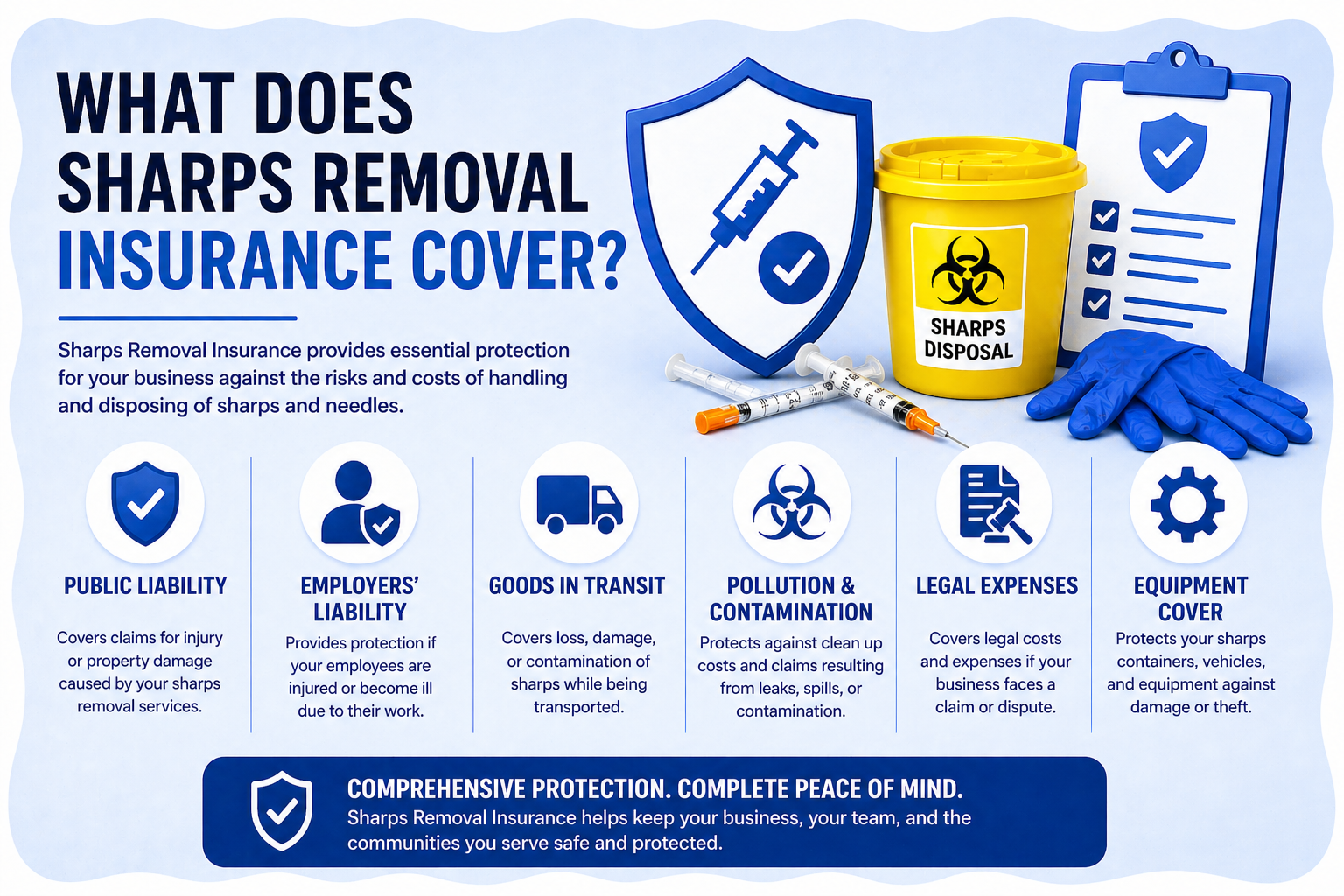
The core insurance programme for a UK sharps removal operator typically comprises ten cover layers, scoped specifically to the activities declared. Each cover layer has a distinct purpose; under-buying or over-buying any layer creates either uninsured exposure or wasted premium.
Public Liability (the primary cover)
Public Liability is the dominant insurance product for sharps removal because the defining commercial risk — public injury from a missed sharps in a swept area — flows through PL. Limits typically run £5m–£10m for routine work; council and panel contracts often require £10m. Our broader business liability insurance guide covers limit selection in more detail. Sharps-specific scoping items at proposal include: needle sweep work explicitly declared; void property clearance explicitly declared; drug paraphernalia removal explicitly declared; BBV exposure scope confirmed; contamination spread scope confirmed.
Employers' Liability (legally required where staff engaged)
EL is a legal requirement under the Employers' Liability (Compulsory Insurance) Act 1969 wherever any staff are engaged. £10m is the practical UK market standard. For sharps removal specifically, the EL must cover: BBV occupational disease; needlestick injury; chemical exposure (drug residues, cleaning agents); lone working scenarios; manual handling injury during void clearance; and psychological injury from disturbing scenes.
Professional Indemnity
PI cover is increasingly required for sharps removal work where the operator provides any form of sign-off, certification, or methodology advice. Council panel contracts, housing association frameworks, and insurance work all typically require PI £500k–£2m. See our complete Professional Indemnity guide for the technical detail. The cover responds where a methodology error (e.g. failed sweep leaving sharps in a swept area; incorrect waste classification; chain-of-custody dispute) causes loss to a client or third party.
Environmental Impairment Liability (EIL)
EIL is the appropriate cover for environmental release, contamination spread, and pollution incidents arising from the work. Chemical residues in drug dens, sharps in waterways from improper containment, and spillage during transport all sit in EIL scope rather than general PL.
Commercial Vehicle / Fleet with Hazardous Goods
Every sharps removal vehicle must be insured commercially with hazardous goods explicitly declared. Standard "carriage of own goods" cover does not contemplate clinical waste transport. CDG 2009 compliance — ADR signage, driver training, transport documentation — is both a regulatory obligation and an insurance precondition. Goods in transit cover should be scoped to clinical waste values.
Tools, Plant, and PPE Cover
Sharps removal kit is expensive (specialist grabbers, HEPA vacuums, sharps containers, decontamination spray equipment, FFP3 respirators, splash-protective suits). A small operator's kit can be £15,000–£40,000; replacement at full retail after theft or damage exposes the operator to significant out-of-pocket cost. Schedule cover at replacement value.
Legal Expenses with HSE and EA scope
Legal Expenses cover — specifically with HSE investigation, Environment Agency enforcement, and CDG defence scope — is essential. UK Sentencing Guidelines for HSE breaches mean defence costs alone can reach £50,000–£250,000 in a contested case. The fine itself is uninsurable under UK public policy; defence costs are insurable and should be covered.
Cyber Insurance
Sharps removal operators handle client data — council contracts, healthcare practice information, void property addresses, panel paperwork. A cyber incident leaking this data triggers ICO notification obligations under UK GDPR with fines up to £17.5 million or 4% of worldwide turnover. Our cyber insurance guide covers the cover scope in detail.
Directors' and Officers' Liability (D&O)
For limited company operators, D&O cover protects directors personally against the Section 37 HSAW 1974 prosecution exposure. Director imprisonment of up to 2 years is available for serious health and safety breaches; defence costs are insurable through D&O.
Personal Accident
For sole traders and owner-operators, Personal Accident provides primary income protection following injury (BBV exposure, needlestick injury, vehicle incident). For limited companies, PA is often arranged for owner-directors as an additional layer above the EL cover that protects employees.
4. Which UK regulations govern sharps removal and waste handling?
The UK regulatory framework for sharps removal is one of the most complex in any service sector. Operators are simultaneously subject to multiple overlapping regimes, each with its own compliance obligations and enforcement bodies. Understanding the framework is the foundation of both operational compliance and insurance disclosure.
Health and Safety (Sharp Instruments in Healthcare) Regulations 2013
The Sharps Regulations 2013 apply to all organisations providing healthcare, including in patients' own homes. They build on COSHH Regulation 7(6)(c) by requiring clearly marked, secure sharps containers at the point of use and instructions for their use. While the regulations are healthcare-focused, they form the regulatory baseline that sharps removal contractors working with healthcare clients must align to.
Hazardous Waste (England and Wales) Regulations 2005
The Hazardous Waste Regulations 2005 classify clinical waste — including sharps contaminated with medication or bodily fluids — as hazardous waste. Producers of more than 500kg of hazardous waste per year must register with the Environment Agency. Consignment notes are required for every transfer. EWC codes (European Waste Catalogue) must be assigned correctly: 18 01 03* for healthcare sharps contaminated with infectious agents, 18 01 06* for chemical waste, 20 01 31* for cytotoxic medicines, and so on.
Environmental Protection Act 1990 — Section 33 and Section 34
Section 33 of the EPA 1990 prohibits the deposit, treatment, or disposal of controlled waste without a permit. Section 34 imposes a Duty of Care on waste producers requiring them to ensure waste is transferred only to authorised persons and accompanied by adequate documentation. The Duty of Care persists even after waste has been transferred to a third party — a critical insurance implication where subcontracted waste carriers later fail or fly-tip the waste.
Control of Substances Hazardous to Health (COSHH) Regulations 2002
COSHH 2002 imposes duties for risk assessment, exposure control, health surveillance, and information/training where hazardous substances are present. Bloodborne viruses (HIV, HBV, HCV) are classified by HSE in COSHH Hazard Group 3 — biological agents capable of causing severe human disease, transmissible to the community, but with usually-available effective prophylaxis. Sharps removal involves routine COSHH Hazard Group 3 exposure.
Carriage of Dangerous Goods Regulations 2009
The Carriage of Dangerous Goods and Use of Transportable Pressure Equipment Regulations 2009 apply ADR (the European Agreement on the International Carriage of Dangerous Goods by Road) to UK transport. Clinical waste sharps are typically transported under UN 3291 (clinical waste, unspecified) with corresponding ADR documentation, packaging, signage, and driver training requirements.
Controlled Waste Regulations 2012
The Controlled Waste (England and Wales) Regulations 2012 categorise waste types for the purposes of disposal regulation and charging. They confirm that clinical waste must be handled separately from general waste.
Health and Safety at Work Act 1974 — and Section 37 director liability
The umbrella statute. HSAW 1974 imposes general duties on employers (Section 2) and persons conducting an undertaking (Section 3). Section 37 enables personal prosecution of directors where the offence was committed with their consent, connivance, or attributable to their neglect — with imprisonment up to 2 years available.
5. What is the BBV exposure profile and how does insurance respond?
Bloodborne Virus Exposure — The Defining Occupational Risk
The dominant occupational risk for sharps removal staff is needlestick injury and bodily fluid splash exposure to HIV, Hepatitis B (HBV), and Hepatitis C (HCV). All three are classified by HSE in COSHH Hazard Group 3. HBV is the most transmissible (transmission risk approximately 30% per needlestick from an infected source); HCV is less transmissible (approximately 3%); HIV is least transmissible (approximately 0.3%) but with no effective vaccine.
For sharps removal operators specifically, the BBV exposure pathway is most commonly: (1) hidden sharps not visible in the swept area; (2) puncture through inadequate or worn PPE; (3) splash exposure during decontamination of contaminated surfaces; (4) handling of overfilled or improperly sealed sharps containers; (5) sharps in unexpected locations during void clearance (sofas, mattresses, clothing piles).
Hepatitis B vaccination programme with documented immunity testing; documented sharps handling protocol (never recap, never reach blindly, always use grabbers); puncture-resistant gloves (Kevlar-lined, double-glove protocol); FFP3 respirators with documented fit testing; eye and splash protection; documented post-exposure prophylaxis arrangements through occupational health; RIDDOR Regulation 7 reporting discipline for every dangerous occurrence.
Employers' Liability with explicit BBV occupational disease cover. UK case law on BBV transmission claims has evolved significantly; a confirmed HCV transmission case can reach £100,000–£250,000+ including medical costs, lost earnings, career change impact, and psychological injury. Generic cleaner's EL often doesn't contemplate BBV; specialist sharps removal placement does. The Hepatitis B vaccination programme documentation is both the operational mitigation and the primary claim defence — claims fail more often on contributory negligence (e.g. operative not vaccinated) than on direct cover disputes.
6. What is the public injury exposure from missed sharps?
Public Injury from Missed Sharps — The Defining Commercial Risk
This is the risk that defines sharps removal insurance and distinguishes it from biohazard, trauma, or crime scene cleaning. After a needle sweep is completed and the contractor signs off the area, a missed needle that subsequently causes injury to a member of the public — a child in a park, a council worker, a transport passenger, a parkrun participant — creates a Public Liability claim that flows directly back to the operator.
The claim quantum depends on the injury and infection outcome. A negative blood-test outcome typically settles £8,000–£25,000 for the puncture injury, psychological impact during the seroconversion window (3-6 months of uncertainty), prophylaxis cost, and general damages. A confirmed HBV transmission (where the source needle is identifiable and vaccination protection failed) can reach £40,000–£100,000. A confirmed HCV or HIV transmission can reach £150,000–£250,000+ including lifetime medical management, antiviral therapy costs, and life-impact damages.
The legal test for liability in missed-sharps claims is whether the contractor exercised reasonable skill and care in the sweep. The defence depends entirely on documentation: site-specific risk assessment; methodology used (grid search, sectioning, lighting conditions, sweep density); time taken; operative numbers; equipment used; sign-off documentation; photographic record. Where this documentation is absent or thin, the claim typically settles in the claimant's favour.
Documented sweep methodology per site type (open park, enclosed space, void property); minimum operative numbers per area type; time-of-day restrictions (no sweeps in inadequate light); photographic before/after records; documented sign-off process; client communication discipline ("sweep complete but not a guarantee of complete clearance" caveat where appropriate); follow-up sweep protocols for high-density sites.
Public Liability £5m–£10m primary. Some specialist policies offer specific extensions for missed-sharps liability; ensure this is explicitly within scope. Professional Indemnity may respond where the claim alleges methodology failure or sign-off error. Critically, the cover responds only where the activity is declared correctly — a missed-sharps PL claim under a generic "commercial cleaning" PL policy is the highest-risk non-disclosure exposure in the sector.
7. Which insurance cover matches my sharps removal business profile?
Select your business profile below to see the cover programme matched to your specific risk profile. For an overview of how Miller & Partner arrange specialist biohazard cleaning and sharps removal insurance, see our main product page. For indicative pricing across similar specialist cleaning operators, see the biohazard cleaning insurance cost guide.
Sharps Removal Risk-Matched Cover Checker
Select your business profile to see the recommended insurance programme matched to your sharps removal operation
Sole Needle-Sweep Operator
- ESSENTIAL Public Liability £5m with sharps removal, needle sweep, BBV exposure, and missed-sharps scope explicitly declared
- ESSENTIAL Personal Accident — primary income protection given BBV, needlestick, lone working, and vehicle exposure
- ESSENTIAL Tools, plant, and PPE cover at full replacement value (grabbers, HEPA vacuum, sharps containers, FFP3 respirators)
- ESSENTIAL Commercial vehicle / van with hazardous goods explicitly declared (clinical waste UN 3291)
- ESSENTIAL Environment Agency upper-tier waste carrier licence — operational requirement, insurance precondition
- RECOMMENDED Environmental Impairment Liability — chemical residue and contamination spread exposure
- RECOMMENDED Legal Expenses with HSE investigation and Environment Agency scope
- RECOMMENDED Hepatitis B vaccination evidence — insurance underwriting condition for most specialist markets
- CONSIDER Employers' Liability immediately if any subcontract help engaged — legally required from day one
Void Property Clearance Specialist
- LEGAL Employers' Liability £10m with BBV, lone working, manual handling, and chemical exposure scope
- ESSENTIAL Public Liability £5m–£10m with void clearance, sharps removal, hidden hazards, and drug paraphernalia scope
- ESSENTIAL Property owner / landlord clarity in scope (operating in someone else's vacant property — confirm cover responds)
- ESSENTIAL Hepatitis B vaccination programme documented and operational across all staff
- ESSENTIAL Tools, plant, and PPE cover comprehensive
- ESSENTIAL Commercial vehicle with hazardous goods declared; multi-vehicle if applicable
- ESSENTIAL Environmental Impairment Liability — chemical residue from drug dens, decomposition where extended voids encountered
- ESSENTIAL Legal Expenses comprehensive scope
- RECOMMENDED Professional Indemnity £500k for sign-off and methodology exposure
- RECOMMENDED Goods in transit cover for clearance contents
Council / Housing Association Panel Contractor
- CRITICAL Cover must meet specific panel requirements — review the panel agreement and confirm with broker before commencing
- LEGAL Employers' Liability £10m comprehensive scope
- ESSENTIAL Public Liability £10m typically required (some panels require £5m, some £10m)
- ESSENTIAL Professional Indemnity £1m–£2m with sweep methodology and sign-off cover
- ESSENTIAL Documented COSHH compliance package presented at proposal and renewal
- ESSENTIAL DBS clearance for all staff (basic minimum, enhanced for any safeguarding scenarios)
- ESSENTIAL Environmental Impairment Liability — panel will require evidence
- ESSENTIAL Cyber insurance — panel data handling exposure under UK GDPR
- ESSENTIAL Confidentiality cover for sensitive locations (e.g. social housing addresses)
- RECOMMENDED Specialist panel-aware broker placement essential
Routine Clinical Sharps Bin Collection
- LEGAL Employers' Liability £10m with BBV scope
- ESSENTIAL Public Liability £5m with clinical waste handling, transport, and customer premises work scope
- ESSENTIAL Fleet insurance with hazardous goods declaration; ADR-compliant where applicable
- ESSENTIAL Goods in transit cover — clinical waste loads have meaningful liability exposure even at low monetary value
- ESSENTIAL Environmental Impairment Liability — spillage and contamination during transport
- ESSENTIAL Legal Expenses with regulatory scope
- ESSENTIAL Cyber insurance — handling client healthcare practice data
- RECOMMENDED Professional Indemnity £500k for service-level and methodology exposure
- RECOMMENDED Business Interruption — fleet downtime impacts service continuity
- RECOMMENDED Property/contents cover at depot and storage
Festival / Event Sharps Response
- CRITICAL Event-specific cover declarations — generic PL will not respond to large-event crowd exposure
- LEGAL Employers' Liability £10m
- ESSENTIAL Public Liability £10m+ — large-event crowd exposure scales the limit requirement
- ESSENTIAL Event organiser indemnity arrangements reviewed before each event
- ESSENTIAL Out-of-hours and night work explicitly declared
- ESSENTIAL Lone working protocols at scale — festival sweeps often involve multiple lone operatives across large sites
- ESSENTIAL Hepatitis B vaccination across all event staff including casuals
- ESSENTIAL Hazardous goods vehicle insurance for waste removal
- ESSENTIAL Goods in transit cover for event load values
- ESSENTIAL Legal Expenses comprehensive scope
- RECOMMENDED Specialist event-aware broker placement
National Multi-Vehicle Operator
- CRITICAL Specialist coordinated programme essential at this scale — see contractors combined approach
- LEGAL Employers' Liability £10m comprehensive scope
- ESSENTIAL Public Liability £10m–£25m for major contract work
- ESSENTIAL Professional Indemnity £2m–£5m
- ESSENTIAL Comprehensive Environmental Impairment Liability programme
- ESSENTIAL Fleet insurance comprehensive — multi-depot multi-vehicle
- ESSENTIAL Property and Business Interruption at all premises
- ESSENTIAL Directors' and Officers' (D&O) at substantial limits
- ESSENTIAL Cyber insurance comprehensive scope
- ESSENTIAL Reputational, confidentiality, and PR crisis cover
- RECOMMENDED Specialist Lloyd's market placement — contact Miller & Partner directly
8. What compliance red flags expose me to HSE prosecution?
HSE and Environment Agency prosecutions of sharps removal operators are rare on a per-business basis but consequential when they occur. The Sentencing Guidelines mean even a micro-company can face six-figure fines and director imprisonment for serious breaches. Tick each warning sign that applies to your operation — the more checked, the higher your exposure if a regulatory investigation occurs:
Sharps Removal Compliance Red-Flag Self-Check
Click each warning sign that applies. The more red flags, the higher the priority for remediation.
-
Environment Agency upper-tier waste carrier licence is missing or expired — strict liability offence under EPA 1990 Section 33; check the public register at gov.uk now
-
Sweep methodology is undocumented or "in the operative's head" — no written procedure for grid search, sectioning, lighting conditions, sweep density per site type
-
Sign-off documentation is absent or thin — sweep completed but no written confirmation, no photographic record, no time-stamped evidence of completion
-
Hepatitis B vaccination is informal or undocumented — staff vaccinated at some point but no immunity testing records, no booster schedule, no records for refusing staff
-
RIDDOR reporting is inconsistent — needlestick incidents have occurred but Regulation 7 (dangerous occurrences) reporting is patchy or post-rationalised
-
Waste consignment notes are incomplete — EWC codes not always documented; transfer paperwork sometimes missing or assigned retrospectively
-
Waste carrier verification for subcontracted disposal is informal — relying on documentation provided rather than checking the Environment Agency public register at engagement
-
CDG 2009 / ADR transport compliance is informal — clinical waste transported without ADR signage, without driver dangerous goods awareness training, without UN 3291 documentation
-
FFP3 respirator fit testing is missing — respirators issued but no documented face-fit testing per individual operative
-
Lone working risk assessment is generic or missing — no documented protocol, no check-in procedure, no lone worker safety device, no two-operative rule for higher-risk sites
-
Insurance has not been specifically declared with sharps removal scope — operating on a "cleaner's package" without explicit needle sweep, void clearance, or drug paraphernalia removal declarations
-
Near-miss reporting culture is absent — near misses (operative almost punctured, sharps found post-sweep, container near-overfill) not formally logged or investigated
9. What is my sharps removal operational risk score?
Two factors drive sharps removal operational risk above all others: the type of work undertaken and the maturity of compliance infrastructure. Use the tool below for your specific risk profile.
Sharps Removal Operation Risk Assessor
Select your primary work type and your compliance infrastructure maturity to see your specific risk profile
10. Panel and tender requirements for sharps removal contractors
Sharps removal contracts are predominantly let through local authority procurement, housing association frameworks, NHS trust tenders, transport operator (TfL, Network Rail) frameworks, festival and event organiser procurement, and large facilities management primes (Mitie, ISS, Sodexo, OCS) acting as principal contractors with sharps clearance subcontracted out. Every panel and tender has its own insurance requirements but the working baseline for 2026 sharps removal procurement is converging:
| Buyer type | Typical PL | Typical EL | Other |
|---|---|---|---|
| Local authority (council parks, streets, voids) | £5m minimum, £10m increasingly required | £10m (statutory) | EIL, EA upper-tier waste carrier licence, DBS for void clearance staff |
| Housing association / RSL voids | £5m | £10m | EIL, safeguarding, DBS, Hep B vaccination evidence |
| NHS trust / clinical site | £10m | £10m | PI with chain-of-custody scope, clinical waste transfer competence, NHS-aligned governance |
| Transport (TfL, Network Rail, station operators) | £10m, sometimes £25m | £10m | Track safety competence (PTS where applicable), Sentinel cards, lone working tech |
| Festival / event organiser | £5m–£10m | £10m | Crowd safety briefing, drug welfare integration, EIL for site contamination |
| National FM primes (Mitie, ISS, Sodexo, OCS as subcontract route) | £10m | £10m | PI £1m+, cyber, audit-ready compliance documentation, supply chain assurance evidence |
Where sharps work is embedded in a wider biohazard cleaning programme, the panel requirements typically harmonise upward — i.e. if the contract covers both routine cleaning and sharps response, the higher sharps requirements apply across the contract. Specialist broker placement matters because the insurance schedule needs to evidence specifically that sharps clearance and BBV exposure are within scope, not bundled under generic "cleaning operations" wording.
11. Vehicle, CDG and duty of care liability
Vehicle and Waste Transfer — Compounding Regulatory Exposure
Sharps removal operatives transport infectious clinical waste (EWC code 18 01 03* — sharps from infectious clinical waste) under the Carriage of Dangerous Goods and Use of Transportable Pressure Equipment Regulations 2009. UN3291 packaging (clinical waste, unspecified) is the standard classification for sharps containers; ADR (European Agreement concerning the International Carriage of Dangerous Goods by Road) applies to consignments above small load thresholds. A road traffic accident involving a vehicle carrying sharps waste creates cascading regulatory exposure: Environment Agency spillage notification; potential public health authority involvement if container integrity is compromised; load recovery costs; police engagement; and HSE notification under RIDDOR if any operative injury occurs. The most dangerous compounding exposure is EPA 1990 Section 34 Duty of Care — sharps waste producers retain Duty of Care responsibility even when waste is transferred to a third party. Where sharps end up improperly disposed of by a downstream actor (including a subcontracted carrier with expired licence), the original collecting contractor can face Environment Agency enforcement up to £50,000 in magistrates' court (unlimited in Crown Court) and personal director liability.
Environment Agency upper-tier waste carrier licence current and verified annually; UN-approved sharps containers and outer packaging; ADR driver training where required by load thresholds; consignment notes with EWC codes for every transfer; approved disposal facility list maintained and audited; downstream carrier licence verified at engagement via Environment Agency public register; vehicle security (overnight depot, immobilisers, tracking); spill response kits with sharps-specific protocols.
Commercial vehicle insurance with hazardous goods declaration. Goods in transit cover for clinical waste loads. Environmental Impairment Liability for spillage and contamination. Legal Expenses with Environment Agency enforcement scope (essential — the fine itself remains uninsurable but defence costs are insurable). The Section 34 Duty of Care exposure can persist for years after the immediate transfer; documentation is the only effective long-term defence.
12. Operative vetting and misconduct exposure
Operative Misconduct — Reputational and Civil Exposure
Sharps removal operatives access sensitive environments — voids previously occupied by drug users; public spaces during quiet hours; clinical sites with patient data exposure; festival sites with vulnerable young attendees. Misconduct cases are rare but disproportionately consequential: theft from voids; inappropriate behaviour at festival drug welfare points; data breach from clinical site access; sub-standard work concealed through certificate falsification creating downstream BBV exposure to public users of public spaces. The employer carries vicarious liability under UK common law for operative acts in the course of employment, regardless of the rigour of vetting.
DBS clearance at appropriate level (enhanced for clinical-site, void clearance involving vulnerable adults, festival drug welfare work); basic DBS as minimum for all sharps operatives; employment reference checks; documented confidentiality undertaking signed annually; social media policy with disciplinary consequences; supervision arrangements particularly for new recruits; clear escalation paths for concerns; periodic competence audits; incident reporting culture.
Fidelity guarantee insurance for theft losses; Professional Indemnity for sign-off failures or methodology disputes; Public Liability for third-party injury from operative conduct; Reputational management cover for high-profile misconduct cases; Legal Expenses for employment tribunal defence. Documented vetting and management response remain critical to claim defence even though vicarious liability persists.
13. Insurance non-disclosure — the silent killer
Insurance Non-Disclosure — The Most Preventable Catastrophe
The single most common reason UK insurance claims are reduced or declined isn't fraud or bad luck — it's non-disclosure at the proposal or renewal stage. Sharps removal operators routinely buy generic cleaner's or contractor package policies without specifically declaring sharps work, public-space clearance, void clearance, clinical-site work, drug-related environments, or festival response. The Insurance Act 2015 requires businesses to make a "fair presentation of the risk" — proactively disclosing every material fact the insurer would want to know. Failure to do so allows the insurer to: avoid the policy (treating it as never having existed); reduce the claim proportionally; impose terms that would have applied if proper disclosure had been made. This isn't fraud; it's the normal operation of UK insurance law. The cost is potentially every claim made on the policy across multiple years.
Annual review of declared activities against actual operations; written confirmation from broker that all current activities are within scope; specific declaration of each work type at proposal (sharps removal, needle sweeps, void clearance, clinical sharps, festival response, drug paraphernalia, vehicle sharps cleaning, etc); mid-term notifications when new work types are taken on; documented response to broker enquiries at renewal; retention of policy documents and broker correspondence as evidence.
There is no insurance response to insurance non-disclosure — that's the whole point. The cover that should have responded doesn't. The only mitigation is at the proposal stage: detailed declaration, broker discipline, and renewal review. Specialist sharps and biohazard cleaning broker placement makes a material difference here — generic brokers often miss the specific declarations sharps work requires.
14. What drives the cost of sharps removal insurance?
The factors below drive both insurance premium and overall risk management investment. For broader pricing benchmarks across the wider biohazard cleaning sector, see our dedicated biohazard cleaning insurance cost guide, which provides monthly cost benchmarks across sole traders, small teams, and larger operations.
| Rating Factor | Impact on Premium and Total Cost | What You Can Do |
|---|---|---|
| Work mix and venue type | Public-space sweeps lowest; clinical sharps and drug residue highest | Declare every work type and venue type specifically; misdeclaration is the #1 claim dispute |
| Annual turnover and staff numbers | Primary scaling factors for PL, EL, and most other covers | Declare accurately including planned growth |
| Risk management maturity | Documented system materially reduces premium across all cover types | Site-specific RA, training matrix, occupational health, audit trail |
| Hepatitis B vaccination programme | Documented programme materially reduces EL premium | Implement, document immunity confirmation, schedule boosters, evidence at every renewal |
| Two-pass sweep / missed-sharps protocol | Documented protocol materially reduces PL premium | Document two-pass methodology; photo evidence per sweep; debrief records |
| Lone working protections | Lone worker safety devices and check-in protocols reduce EL premium | Documented protocol, devices issued, periodic audit of compliance |
| Limits selected | PL £2m/£5m/£10m all rate differently; EL £5m vs £10m material | Match to panel and contract requirements; oversized limits are insurance waste |
| Claims history | 5+ year impact for sharps work; BBV and missed-sharps claims particularly material | Root cause analysis and documented remedial action after any claim |
| NASC / NACSC / panel certification | Recognised professional certification reduces premium | Maintain at staff level; evidence at every renewal |
| Geographic operating area | Postcode-based loadings for vehicle theft and operational risk | Declare typical operating area accurately |
| Broker placement | Specialist sharps/biohazard brokers access better terms than generic placement | Use a broker with sharps and biohazard underwriting experience |
| Audit-ready documentation pack | Materially affects underwriting at proposal and renewal | Maintain compliance pack as operational discipline rather than annual scramble |
15. Real claims and how to manage them
Claim — Missed Sharps Public Injury, £67,500 PL Settlement
A small sharps removal firm (4 operatives) was contracted by a south coast local authority for routine park sweeps following an organised needle exchange relocation that had increased local discarded-sharps incidence. The team completed a Saturday sweep of a designated park area, removed 23 sharps, issued a clearance certificate, and the park reopened to public use Sunday morning. A child age 8 sustained a needle-stick injury Sunday afternoon — the sharp was lodged vertically in soil adjacent to a play area path. The child was treated at A&E with full BBV post-exposure prophylaxis (PEP), HIV and HCV testing at 6 weeks, 3 months, and 6 months. All tests returned negative; the child suffered no transmission. The parents brought a Public Liability claim against the local authority, who in turn brought a claim against the sharps contractor under indemnity provisions in the service contract.
Investigation identified: sweep methodology had been single-pass visual inspection only, no probe used in soil-adjacent areas; no photographic evidence of pre-sweep state of vertical-axis ground; clearance certificate was issued on operative sign-off without supervisory countersign; debrief had not specifically identified the play-area-adjacent zone as elevated risk.
The firm's £5m PL responded. Settlement: £52,000 (PEP medical costs, psychological trauma claim for child and parents, ongoing monitoring through age 16, general damages for "near-miss" trauma). Defence costs: £15,500. Total: £67,500.
Post-claim renewal: PL premium increased 42%. Insurer required: documented two-pass sweep methodology (visual + probe); photographic evidence of pre-sweep and post-sweep state per zone; supervisory countersign on clearance certificates; specific elevated-risk zone identification protocol including play-area-adjacent areas. The firm implemented these and at the following renewal premium returned to a 14% loading over baseline.
The lesson: missed-sharps incidents are the signature PL exposure for public-facing sharps work. The two-pass methodology that defends the claim is the same methodology that prevents it. Single-pass visual sweeps were industry-standard 10 years ago; in 2026 they're an insurance liability. Generic business liability cover doesn't usually have specific sharps exclusions but cover terms get worse fast after the first significant claim.
Claim — Operative BBV Exposure, £92,000 EL Settlement
A two-operative team attended a void clearance at a former drug-user-occupied housing association property. Pre-attendance briefing had identified BBV risk but had not specifically identified the high concentration of sharps concealed within upholstery — over 60 sharps were ultimately recovered from sofa cushions, mattress interiors, and clothing piles. An operative sustained a needle-stick injury through standard nitrile gloves while compressing a mattress for disposal; the sharp pierced both glove layers and entered the index finger. The operative attended A&E within 90 minutes, commenced HIV PEP, had hepatitis B booster (operative was already vaccinated with documented immunity), and was tested for HCV at 6 weeks, 3 months, and 6 months. At the 6-month test the operative was found to be HCV-positive. Subsequent treatment was successful (HCV is now curable in 12-week regimens) but the operative developed significant anxiety and depression around continued work in sharps environments, ultimately leaving the role and changing industry.
EL claim. Investigation identified: pre-attendance briefing had not specified hidden-sharps concentration risk; standard nitrile gloves were issued rather than puncture-resistant; no mechanical aids were available for mattress compression; the team had not been trained specifically in concealed-sharps protocol for drug-user voids.
EL settled at £92,000 (PEP and treatment costs, lost earnings during treatment and transition period, future earnings differential from career change, psychological injury, general damages). Defence costs: £18,500. Total: £110,500.
Post-claim review: insurer required puncture-resistant gloves as standard PPE for void clearance; mechanical compression aids for mattresses and upholstery; specific drug-user-void briefing protocol; pre-attendance two-operative attendance minimum with safeguarding/risk briefing per site; documented Hepatitis B vaccination programme (already in place) supplemented by occupational health surveillance.
The lesson: BBV occupational disease claims are severe, slow-developing, and frequently involve career-change consequences alongside the medical cost. Cure-rate progress for HCV has been remarkable but the psychological injury from BBV exposure persists regardless of medical outcome. Documented PPE escalation for elevated-risk venues (drug-user voids specifically) is both prevention and claim defence.
Claim — Environment Agency Section 34 Prosecution, £35,000 Defence + £40,000 Fine
A mid-sized sharps removal firm completed several council void clearances and used a subcontracted carrier for the bulk waste streams (non-hazardous mixed waste from voids alongside the segregated sharps stream). The subcontracted carrier was engaged on the basis of an apparently valid waste carrier licence and standard transfer note paperwork. Approximately 8 months after the engagement period, the Environment Agency notified the firm that waste traceable to one of their original clearances had been identified in an illegally dumped tip on agricultural land 45 miles from the operating area — including sharps containers that should have gone through the specialist clinical waste stream but had been bundled with mixed waste by the subcontracted carrier. The subcontracted carrier had ceased trading 5 months earlier; investigation revealed the carrier had been operating with an expired licence at the time of engagement.
The Environment Agency brought charges against the firm under Section 34 of the Environmental Protection Act 1990 (Duty of Care). The firm's defence relied on having obtained licence documentation from the carrier at engagement — but the licence documentation had been outdated. The firm had not checked the carrier's licence status on the Environment Agency public register at engagement.
Magistrates' court fine: £40,000. Defence costs: £35,000. Total exposure: £75,000. Legal Expenses cover with Environment Agency enforcement scope responded to defence costs; the fine itself was uninsurable.
Post-claim review: firm implemented documented waste carrier verification protocol — Environment Agency public register check at engagement, annual re-verification, documented transfer note compliance including separate verification of clinical waste stream. Premium impact: EIL +22%; Legal Expenses +18%.
The lesson: the Section 34 Duty of Care persists regardless of intermediary failures. Verifying waste carrier licence status takes minutes (the Environment Agency public register is online and free); the consequence of not doing so can be five-figure fines and uninsurable financial loss. Sharps work specifically attracts EA scrutiny because the misclassification of clinical waste into mixed waste streams is a regulatory red flag.
Claims Management Steps
How to respond to a sharps removal incident or regulatory engagement — the steps below are critical given the multi-policy and multi-regulator exposure typical of this sector:
- Make the site safe and protect persons first. Standard biohazard response. If BBV exposure has occurred, medical response (A&E for needle-stick within 90 minutes for PEP eligibility, occupational health within 24-48 hours) takes priority over all administrative steps.
- Notify your insurer immediately for any potential claim. Sharps incidents often engage multiple policies (EL, PL, PI, EIL, Legal Expenses, Cyber). Single notification triggers coordinated response. Threshold is "may give rise to a claim" — much lower than "formal claim received".
- Preserve all documentation rigorously. Site-specific risk assessment; sweep methodology applied; sharps inventory and disposal certificate; operatives present; photographs before/during/after; waste consignment notes with EWC codes; communications with client, regulators; PPE and training records. The documentation pack is the defence across all coverage layers.
- Do not admit liability or fault. Provide factual information about what happened, what work was done, methodology followed. Do not accept fault, apologise in writing, or commit to remedial work that could be interpreted as admission.
- Manage HSE / Environment Agency / ICO engagement carefully. If regulators attend or notify, engage your Legal Expenses insurer immediately. Cooperate factually with inspectors but do not provide written statements without legal representation. Regulatory investigation can become criminal prosecution.
- Complete RIDDOR reporting where applicable. Regulation 7 (dangerous occurrences) for BBV exposure with potential transmission of Hazard Group 3 agent; over-7-day injury reporting where applicable. Late reporting is itself an offence; complete within required timeframes.
- Document the response and remediation comprehensively. Every decision, communication, site visit, training intervention, policy change after the incident. Post-incident response file supports settlement and future insurance terms.
- Conduct root cause analysis and address. Identify underlying cause and implement remedial action. Insurers reviewing renewal will ask what's changed since claim; regulators will require evidence of remedial action.

Glossary of sharps removal risk terms
- Sharps
- Needles, syringes, lancets, broken ampoules, scalpel blades, and any object capable of penetrating skin and transmitting infection. In UK regulatory usage, includes both clinical sharps (from healthcare settings) and discarded sharps (community-generated, drug paraphernalia, etc).
- BBV (Bloodborne Virus)
- Viruses transmitted through blood and bodily fluids — primarily HIV, Hepatitis B (HBV), and Hepatitis C (HCV). Classified by HSE in COSHH Hazard Group 3.
- PEP (Post-Exposure Prophylaxis)
- Medical treatment commenced after suspected BBV exposure to reduce transmission risk. HIV PEP is most effective if commenced within 1-2 hours and must commence within 72 hours. Hepatitis B booster and HCV monitoring complete the standard occupational PEP regime.
- Hazard Group 3
- COSHH classification for biological agents capable of causing severe human disease, may transmit to community, but with usually-available effective prophylaxis or treatment. Includes BBVs, TB, anthrax.
- COSHH (Control of Substances Hazardous to Health Regulations 2002)
- Cornerstone UK regulation governing exposure to hazardous substances including biological agents. Imposes duties for risk assessment, exposure control, health surveillance, and information/training.
- Sharp Instruments Regulations 2013
- Health and Safety (Sharp Instruments in Healthcare) Regulations 2013 — UK regulations implementing EU Directive 2010/32/EU specifically on sharps in healthcare settings, also relevant where sharps removal contractors operate at clinical venues.
- RIDDOR (Reporting of Injuries, Diseases and Dangerous Occurrences Regulations 2013)
- UK regulations requiring reporting of certain workplace injuries, diseases, and dangerous occurrences to HSE. For sharps work, Regulation 7 (dangerous occurrence) reporting applies to BBV exposure incidents.
- CDG 2009 (Carriage of Dangerous Goods Regulations 2009)
- Carriage of Dangerous Goods and Use of Transportable Pressure Equipment Regulations 2009 — governing transport of clinical waste including sharps. UN3291 is the standard classification for clinical waste sharps containers.
- EWC Code (European Waste Catalogue)
- Six-digit codes classifying waste types for regulatory tracking. EWC 18 01 03* is sharps from infectious clinical waste. Misclassification is a regulatory offence.
- Section 34 EPA 1990 (Duty of Care)
- Section 34 of the Environmental Protection Act 1990 imposes Duty of Care on waste producers, requiring them to ensure waste is transferred only to licensed carriers and to maintain transfer documentation. Duty persists after waste has been transferred.
- UN3291
- UN classification for "Clinical Waste, Unspecified, N.O.S." — applicable to most sharps containers in transport under CDG 2009 and ADR.
- Two-Pass Sweep Methodology
- Industry-evolved best practice for public-space sharps sweeps: first pass visual inspection, second pass with probe in soil-adjacent and concealed areas. Documented two-pass methodology is now an insurance underwriting expectation for public-facing sharps work.
- Sharps Clearance Certificate
- Document signed by sharps removal operator certifying that a defined area has been swept and sharps removed to specified methodology. In 2026 best practice, requires supervisory countersign and photographic evidence.
- Hepatitis B Vaccination Programme
- HSE-recommended employer-provided vaccination programme for staff exposed to BBV. Includes vaccination, immunity testing post-vaccination, boosters, and documented refusers. Increasingly an insurance underwriting condition for sharps work specifically.
- Insurance Act 2015 / Fair Presentation of Risk
- UK legislation governing insurance disclosure. Requires businesses to make a "fair presentation of the risk" — proactively disclosing material facts. Failure allows insurer to avoid policy or reduce claims proportionally. Critical at proposal stage for sharps removal placement.
- Sentinel Card / PTS (Personal Track Safety)
- Network Rail / industry-recognised competence schemes required for any contractor operating in railway environments. Sharps removal contractors working on railway land or stations typically require Sentinel-sponsored access.
Frequently asked questions
The minimum package is Employers' Liability £10m (statutory if you employ anyone), Public Liability £5m–£10m with sharps work specifically declared, commercial vehicle insurance with hazardous goods/clinical waste declared, and Environment Agency upper-tier waste carrier licence (regulatory rather than insurance but a precondition for cover). Strongly recommended additions: Environmental Impairment Liability for chemical and contamination spread; Legal Expenses with HSE and Environment Agency scope; Professional Indemnity for any clearance certificate sign-off; cyber for client and case data; Personal Accident for sole traders. The single biggest mistake is operating under a generic cleaner's package without specifically declaring sharps removal — that's non-disclosure and the policy can be voided at claim stage.
Three reasons. First, BBV exposure (HIV, HBV, HCV) is a Hazard Group 3 occupational disease — claim values reach £100k–£250k+ including PEP costs, lost earnings, career change, and psychological injury. Second, missed sharps in public spaces create third-party injury exposure to vulnerable users (children, elderly, drug users) which attracts higher general damages than industrial settings. Third, the regulatory overlay is heavier — HSE prosecution under HSAW 1974, Environment Agency prosecution under EPA 1990 Section 34 for waste transfer failures, ICO investigation for any data breach in clinical settings. The compounding multi-regulator exposure means a single sharps incident can engage four or five separate insurance policies and three or four regulatory frameworks simultaneously.
Two-pass sweep methodology is the industry-evolved best practice for public-space sharps sweeps: first pass visual inspection of the defined area; second pass with probe in soil-adjacent, vegetation-adjacent, and concealed areas. It matters for insurance because single-pass visual inspection — which was industry-standard 10 years ago — is now considered inadequate given the frequency of missed-sharps public injury claims. Documented two-pass methodology is increasingly an insurance underwriting expectation; insurers rate higher and impose worse terms where only single-pass methodology is evidenced. The methodology also serves as the primary claim defence when missed-sharps incidents do occur: photographic evidence of two-pass execution, supervisory countersign on clearance certificates, and zone-specific risk assessment combine to support claim defensibility.
Severely. The Insurance Act 2015 requires businesses to make a "fair presentation of the risk" — proactively disclosing every material fact the insurer would want to know. For sharps removal operators this means specifically declaring each work type: needle sweeps, void clearance, clinical sharps, festival response, drug paraphernalia removal, vehicle decontamination. Operating sharps work under a generic cleaner's package without specific declaration is non-disclosure — and at claim stage, the insurer can avoid the policy entirely, reduce the claim proportionally, or impose terms that would have applied if proper disclosure had been made. This isn't fraud; it's the normal operation of UK insurance law. The fix at proposal stage costs little; the retrospective cost can be every uninsured claim across multiple years. Get written confirmation from your broker that all your work types are within scope.
Not necessarily different policies but specific declaration of sharps removal as a distinct work type within whatever programme is placed. A well-structured biohazard cleaning insurance programme can accommodate sharps removal through extensions, sub-limits, and policy schedules — but sharps must be specifically declared and the scope confirmed in writing. For a sharps-only operator, a focused sharps-specific placement may be more cost-effective; for a multi-discipline operator covering trauma, crime scene, biohazard, and sharps, a coordinated programme makes more sense. The key is that whatever programme is placed must specifically address: BBV exposure occupational disease; missed-sharps public injury; CDG / clinical waste transport; Section 34 Duty of Care; and missed-sharps clearance certificate exposure. Generic cleaner's policies typically cannot accommodate this mix.
Time-critical response. First, wash the wound with soap and water immediately (do not scrub), encourage bleeding, and cover with waterproof dressing. Second, attend A&E within 90 minutes — this is the window for maximum HIV PEP effectiveness, and PEP must commence within 72 hours regardless. The A&E will assess source-patient information (where available), prescribe HIV PEP if indicated, provide Hepatitis B booster or vaccination as needed, and arrange HCV monitoring. Third, attend occupational health within 24-48 hours for ongoing monitoring and HCV/HIV testing at 6 weeks, 3 months, and 6 months. Fourth, the incident is RIDDOR-reportable as a Regulation 7 dangerous occurrence — the employer must report within 10 days. Fifth, notify your insurer immediately (this is a potential EL claim from day one, regardless of whether transmission occurs). Sixth, document everything — when, where, source-patient information if any, PPE used, methodology applied. The documentation pack is essential whether the claim is for transmission or for psychological injury from the exposure itself.
The biggest premium reduction lever is documented compliance: site-specific COSHH risk assessments per job; Hepatitis B vaccination programme with immunity testing; two-pass sweep methodology with photographic evidence; structured training matrix with renewal dates; lone working protocols with safety devices; Environment Agency waste carrier verification protocol; mental health and welfare programme. Specialist sharps/biohazard certification at staff level also reduces premium. Beyond compliance: limits matched to actual panel and contract requirements (not over-bought); accurate work mix declaration; specialist broker placement (generic brokers typically miss the sharps-specific declarations that affect rating). The total package can reduce premium materially while improving cover certainty.
Material. UK Sentencing Guidelines mean a micro-company (under £2m turnover) facing "harm category 1 / very high culpability" health and safety prosecution can be fined £150,000–£450,000 even without injury actually occurring. Larger companies face proportionally higher fines (up to several million pounds). Section 37 of the Health and Safety at Work Act 1974 enables director prosecution personally with imprisonment of up to 2 years; corporate manslaughter prosecution with unlimited fines is also available. HSE enforcement attention to sharps work has increased given the public-injury exposure profile. Legal Expenses insurance with HSE investigation scope covers defence costs (£50k–£250k typical for contested prosecution) but cannot insure the fine itself.
Yes but requires specific declaration. Festival sharps response sits at the intersection of public-event risk, drug paraphernalia handling, vulnerable young attendee safeguarding, and tight operational windows. Standard sharps cover typically accommodates it but only when specifically declared with details: venues, attendance scale, duration, drug welfare integration (whether you're co-located with drug-checking services such as The Loop), out-of-hours working. Festival work also creates Public Liability exposure that's distinct from public-space sweeps — closely-packed attendees, fatigue-related operative error risk, and concentrated incident exposure. Specialist broker placement is essential because festival work declarations vary materially between insurers; some prefer to exclude entirely, others rate it competitively if the operator can demonstrate documented festival-specific risk management.
Section 34 of the Environmental Protection Act 1990 imposes Duty of Care on waste producers, requiring them to ensure waste is transferred only to licensed carriers and to maintain transfer documentation. Critically, the duty persists after waste has been transferred — meaning if downstream actors (subcontracted carriers, disposal facilities) handle the waste improperly, the original producer can still face prosecution. For sharps operators, this creates specific exposure: misclassification of sharps into mixed waste streams attracts Environment Agency scrutiny; subcontracted carrier licence verification is essential (check the EA public register at engagement and annually); transfer notes must include accurate EWC codes (18 01 03* for sharps from infectious clinical waste). Fines reach £50,000 in magistrates' court and are unlimited in Crown Court. The fine itself is uninsurable but defence costs (£20k–£50k+ for contested prosecution) are covered by Legal Expenses with EA enforcement scope.
The minimum viable package for a UK sharps removal startup is: Public Liability £2m–£5m with sharps work explicitly declared (essential — no sharps work without this); Employers' Liability £5m if any staff (legally required); commercial vehicle insurance with hazardous goods/clinical waste declared (essential); Environment Agency upper-tier waste carrier licence (regulatory requirement, insurance precondition). Strongly recommended additions: Personal Accident for sole-trader income protection; tools and equipment cover; Legal Expenses with HSE scope; basic cyber for client data. Critically, the operational compliance package (Hepatitis B vaccination, COSHH risk assessments, two-pass sweep methodology, training records, PPE, mental health programme) is more important than higher insurance limits in the early stages — the limits can be increased as turnover grows, but the documented compliance is the basis of cover certainty from day one. See our sole proprietorship insurance guide for the broader startup insurance framework.
Look for brokers with specific sharps, biohazard, or specialist cleaning sector experience evidenced by: specialist articles or guides on sharps and biohazard cleaning insurance (not generic cleaner's package material); willingness to discuss specific exposures (BBV, missed-sharps PL, CDG transport, Section 34 Duty of Care, festival response) in detail; access to Lloyd's market and specialist MGAs rather than just mainstream commercial markets; FCA authorisation and a documented track record. Avoid: brokers who offer "cleaner's package" without discussing sharps specifics; brokers who can only quote one or two markets; brokers who don't ask about your specific work types and venue types in detail at proposal; brokers who don't request documentation evidence at renewal. Miller & Partner specialise in this sector — see our biohazard cleaning insurance product page and broader biohazard cleaning insights hub.







Instagram
LinkedIn