


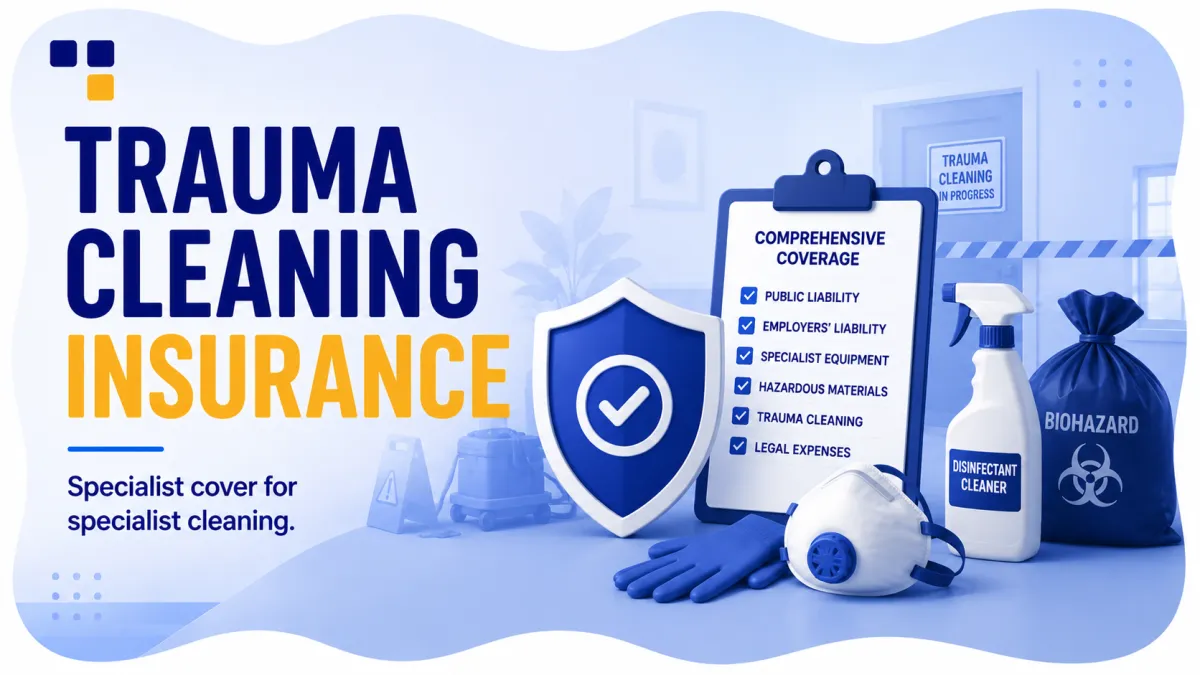
Trauma Cleaning Insurance UK | Specialist Biohazard Cover
Why does trauma cleaning need specialist insurance?
Trauma cleaning — also known as biohazard remediation, crime scene cleaning, after-death cleaning, or specialist forensic cleaning — sits at the intersection of professional cleaning, regulated waste management, healthcare-grade infection control, and emergency response. It is one of the most heavily regulated cleaning sectors in the UK and one of the most poorly understood by mainstream insurance markets. The result is a routine pattern of trauma cleaning operators carrying standard "cleaner's package" policies that contain almost none of the cover the business actually needs.
Three things make trauma cleaning genuinely different from general cleaning insurance. First, the biohazard exposure profile — blood, bodily fluids, decomposition products, sharps, drug residues, sewage backflow, and chemical contamination from clandestine drug labs all sit in COSHH 2002 Hazard Group 3 territory alongside HIV, Hepatitis B and Hepatitis C. Standard cleaners' PL doesn't price for this; specialist underwriting does. Second, the regulated waste carrier exposure — trauma cleaners hold Environment Agency upper-tier waste carrier licences, transport Hazardous Waste (England and Wales) Regulations 2005 Category B (UN3291) infectious waste, and operate under strict consignment documentation. Misclassification or non-compliant transport is a regulatory offence carrying both Environment Agency enforcement and insurance consequences. Third, the professional sign-off exposure — when a trauma cleaner certifies that a property has been safely decontaminated and the certificate is later challenged, the resulting claim is professional indemnity territory, not public liability.
Add to that the operational realities — 24/7 emergency response, lone working in distressing environments, mental health and secondary trauma exposure for staff, insurance-broker-channel relationships where the cleaner is paid via building insurance claims, and the rapid expansion of the UK biohazard cleaning sector — and you have a niche where the wrong insurance creates regulatory exposure, blocks insurance-channel work, and leaves the operator personally exposed to claims that mainstream cleaners' insurance simply doesn't address. Two adjacent exposures come up often enough on this work to be worth flagging: void and hoarding properties frequently turn up licensed material, which is covered on our asbestos removal insurance page, and severe infestation alongside decomposition brings pest control insurance into scope where treatment is carried out rather than subcontracted.
Key facts at a glance
- Employers' Liability is the only statutory requirement for UK trauma cleaning businesses with staff — minimum £5m, with £10m as market standard given BBV exposure profile.
- Public Liability with explicit biohazard cover is functionally mandatory — £5m typical minimum; £10m for police, insurer, and council panel work.
- BBV (bloodborne virus) exposure is COSHH Hazard Group 3 — HIV, Hepatitis B and Hepatitis C; risk assessment and Hepatitis B vaccination provision are HSE-mandated.
- Hazardous waste must be transported by Environment Agency upper-tier licensed carrier — Category B infectious waste under UN3291 labelling with packaging instruction P650.
- Standard PL "pollution sudden and accidental" wording is often inadequate — biohazard contamination, gradual release, and chemical residue claims may need a specific environmental impairment liability extension.
- Professional Indemnity is needed where you sign off decontamination — certifying a property as safe creates direct PI exposure if subsequent contamination is found.
- Illustrative 2026 UK trauma cleaning insurance cost: £900–£2,200 sole trader; £2,400–£6,000 small firm with staff; £6,500–£18,000+ multi-vehicle commercial operator with PI. Figures are illustrative only and are not quotations.
1. What insurance is legally required for UK trauma cleaning?
Statutory Requirement: Employers' Liability
Under the Employers' Liability (Compulsory Insurance) Act 1969, any UK business with employees must hold Employers' Liability insurance with a minimum limit of £5 million. The market standard is £10 million. Penalties reach £2,500 per day. For trauma cleaning specifically, EL must respond to the actual occupational exposure profile — which includes:
- BBV exposure (HIV, Hepatitis B, Hepatitis C)
- Other infectious agent exposure
- Chemical exposure from cleaning agents and contamination sources
- Psychological injury including secondary trauma and PTSD
- Sharps injuries
- Lone working incidents
- Night/shift working injuries and incidents
Contractual Requirement: Public Liability
Public liability is not legally compulsory in the UK, but it is functionally mandatory for trauma cleaning because:
- Insurance company panels (Aviva, AXA, Allianz, RSA, Zurich and major loss adjusters) require £5m–£10m PL as a condition of supplier registration
- Police force contracts (Metropolitan Police and others) require specific PL limits and biohazard scope
- Local authority contracts require £5m or £10m PL with explicit biohazard cover
- Coroners' offices and funeral director referral relationships expect insurance evidence
- Without PL, a single contamination spread event, subsequent infection claim, or property damage claim can end the business
Regulatory Compliance Requirements
Beyond strict insurance compliance, trauma cleaning operates under a regulatory framework that creates secondary insurance implications:
- Health and Safety at Work etc. Act 1974 — primary occupational health and safety legislation; Hepatitis B vaccination provision obligation where BBV exposure identified
- COSHH Regulations 2002 — biological agents in Hazard Groups 1-4; BBVs at Hazard Group 3; risk assessment, health surveillance, exposure control required
- RIDDOR — BBV exposure incidents reportable under Regulation 7 (dangerous occurrence) where could potentially transmit a hazard group 3 agent
- Hazardous Waste (England and Wales) Regulations 2005 — classification, segregation, tracking, transport, disposal
- Special Waste Regulations 1996 — Scotland equivalent
- Environmental Protection Act 1990 — Duty of Care, waste transfer notes
- PPE at Work Regulations 2022 — PPE suitability, maintenance, training
- Carriage of Dangerous Goods regulations — UN3291 Category B infectious waste transport requirements
- Environment Agency upper-tier waste carrier licence — required for transporting hazardous waste; renewal every 3 years
2. Trauma cleaning insurance comparison: which policy responds to which claim?
| Claim / Exposure | Public Liability | Employers' Liability | Professional Indemnity | Environmental |
|---|---|---|---|---|
| Customer property damage during cleaning | Yes — primary | No | No | No |
| Spread of contamination to other parts of property | Yes (subject to biohazard conditions) | No | Sometimes (if methodology fault) | Sometimes |
| BBV / infection exposure to your staff | No | Yes — primary | No | No |
| BBV / infection exposure to third parties | Yes (subject to conditions) | No | Sometimes | No |
| Incomplete decontamination later discovered | Partial (subsequent damage) | No | Yes — primary if you signed off | Sometimes |
| Chemical spillage during cleaning | Yes | If staff injured | No | Sometimes (if reaches environment) |
| Hazardous waste transport incident | Limited | If staff injured | No | Yes — primary |
| Staff PTSD / secondary trauma claim | No | Yes — primary | No | No |
| Sharps injury to staff | No | Yes — primary | No | No |
| Odour residue dispute with property owner | Sometimes | No | Yes (if certified clean) | No |
3. Which insurance does a UK trauma cleaning business actually need?
Public Liability with Explicit Biohazard Cover
The foundation cover. Standard cleaner's PL is inadequate; you need PL specifically scoped for biohazard, crime scene, trauma, and infectious waste work. Minimum £2m for purely domestic / smaller-scale work; £5m for insurance-funded and most commercial work; £10m for police-panel work, large insurer panels, and any work involving institutional clients. Confirm specifically:
- Biohazard work explicitly within scope — blood, bodily fluids, decomposition, sharps, drug residues
- Spread of contamination cover — claims for contamination reaching other parts of the property during cleaning
- Subsequent infection / illness claims from third parties
- Pollution cover — sudden and accidental at minimum; ideally extended for gradual incidents
- Out-of-hours / 24/7 working explicitly covered
- Hot works if you do any thermal disinfection
- Use of biocides and high-strength disinfectants — proper hazard classification
Employers' Liability with BBV-Aware Scope
Legally required if you have staff. Minimum £5m; market standard £10m. Confirm specifically:
- BBV exposure cover — needle-stick injuries, blood splash, mucous membrane exposure
- Secondary trauma / PTSD cover — increasingly relevant given recent case law on psychological injury at work
- Hepatitis B vaccination programme evidenced as a precondition of cover for some insurers
- Lone working incidents — including night working, attendance at remote scenes
- Sharps injury cover with specific protocol expectations
Professional Indemnity
Required if your business signs off decontamination certificates, provides risk assessments, or makes "safe to occupy" declarations. PI insurance for trauma cleaning typically £250k–£1m; the premium is modest relative to the exposure. PI is particularly important for businesses working insurance-channel where a "decontamination complete" sign-off is the trigger for insurance settlement to the homeowner.
Tools, Equipment and Specialist Plant
Trauma cleaning equipment carries substantial value: HEPA-filtered vacuum systems, ozone generators, hydroxyl generators, fogging machines, thermal disinfection equipment, advanced PPE. Insure at full replacement cost; confirm overnight vehicle storage conditions and any specific security warranties.
Environmental Impairment Liability (EIL)
Specialist cover for pollution events beyond standard PL. Particularly relevant for trauma cleaners whose work routinely involves hazardous chemicals, infectious waste transport, and contamination risks. EIL covers gradual contamination, statutory clean-up costs under the Environmental Damage Regulations 2015, regulatory defence, and third-party clean-up costs.
Waste Carrier Liability
Some insurers offer specific waste carrier extensions covering: incidents during transport of hazardous waste; waste misclassification; carrier licence breaches; consignment note disputes. For trauma cleaning businesses holding Environment Agency upper-tier carrier licences, this is increasingly purchased as a dedicated layer rather than relying on general PL extensions.
Commercial Vehicle / Fleet
Vans carrying hazardous waste need appropriate cover. Commercial vehicle insurance at Class 3 business use; confirm carriage of hazardous goods is declared and covered. Fleet cover for 3+ vehicles is typically more efficient.
Personal Accident
Sole-trader trauma cleaners face high physical and psychological risk. PA provides lump sum or weekly income on injury or illness. Particularly valuable given the lone working, night working, and BBV exposure profile.
Legal Expenses
HSE investigations, Environment Agency enforcement actions, COSHH disputes, employment matters, and insurance-channel payment disputes all create legal cost exposure. Legal expenses with regulatory cover is genuinely valuable.
Cyber Insurance
Trauma cleaning businesses handle sensitive client data — bereavement situations, crime scene addresses, police case references, insurance claim details, medical information about deceased persons. GDPR breach exposure is real. Cyber cover addresses breach response, ICO investigation, and business interruption.
4. Trauma cleaning business type checker
Select your business model below for a tailored cover checklist. The tool gives general guidance from a small number of answers — it cannot see your business, and its output is not a personal recommendation or a quotation.
Trauma Cleaning Business Cover Checker
Select your business type to see the recommended insurance programme
Sole Trader / Owner-Operator
- ESSENTIAL Public Liability £2m–£5m with explicit biohazard, trauma, and crime scene scope declared
- ESSENTIAL Tools and equipment cover at replacement value — HEPA vacs, foggers, ozone generators, PPE
- ESSENTIAL Commercial vehicle / van insurance with Class 3 business use and carriage of hazardous goods declared
- RECOMMENDED Personal Accident — sole-trader income protection against BBV exposure or injury
- RECOMMENDED Environmental Impairment Liability — pollution exposure beyond standard PL
- RECOMMENDED Legal Expenses with HSE investigation cover
- CONSIDER Sole proprietorship package bundling these covers
- CONSIDER Employers' Liability immediately when you take on any labour, even informal subcontract help
Small Biohazard Firm (2-5 staff)
- LEGAL Employers' Liability £10m with BBV exposure, lone working, and night working explicitly within scope
- ESSENTIAL Public Liability £5m with biohazard, trauma, contamination spread, and out-of-hours work explicitly declared
- ESSENTIAL Tools, plant, and PPE cover at full schedule of values
- ESSENTIAL Commercial vehicle / multi-driver fleet for installation teams
- ESSENTIAL Hepatitis B vaccination programme documented for all front-line staff
- ESSENTIAL Environmental Impairment Liability — exposure beyond standard PL pollution sub-limit
- RECOMMENDED Professional Indemnity if you sign decontamination certificates
- RECOMMENDED Legal Expenses with HSE / Environment Agency / employment cover
- RECOMMENDED Cyber insurance — sensitive customer data, insurance-channel relationships
Insurance Panel / Loss Adjuster Supplier
- CRITICAL Cover must meet specific panel requirements — major insurers and loss adjusters require £5m–£10m PL with biohazard cover; check supplier agreement carefully
- ESSENTIAL Public Liability £10m with full biohazard scope, contamination spread, and subsequent damage explicitly covered
- ESSENTIAL Employers' Liability £10m
- ESSENTIAL Professional Indemnity £500k–£1m — your decontamination sign-off triggers insurance settlement and creates direct PI exposure
- ESSENTIAL Environmental Impairment Liability — gradual pollution, statutory remediation cover
- ESSENTIAL Documented COSHH compliance package — risk assessments, training records, equipment maintenance
- ESSENTIAL Hazardous waste carrier liability extension
- ESSENTIAL Cyber insurance — handling claim-related personal data and insurer system access
- RECOMMENDED Specialist trauma cleaning broker placement — generic cleaner's brokers often miss panel-specific requirements
Police / Public Sector Contractor
- CRITICAL Public Liability £10m minimum — police force contracts and major public sector frameworks typically require this
- ESSENTIAL Employers' Liability £10m with full BBV, lone working, night working, and psychological injury cover
- ESSENTIAL Professional Indemnity £1m+ for evidence-handling and forensic-sensitive work
- ESSENTIAL Environmental Impairment Liability essential — public sector clients require evidence
- ESSENTIAL Disclosure and Barring Service (DBS) compliance for staff — typically required by police contracts
- ESSENTIAL Hazardous waste carrier liability with chain-of-custody documentation
- ESSENTIAL Cyber insurance with public sector / sensitive data scope
- RECOMMENDED Legal Expenses with comprehensive regulatory cover
- RECOMMENDED Confidentiality / data protection cover — crime scene work handles forensically sensitive information
Hoarding / Extreme Cleaning Specialist
- ESSENTIAL Public Liability £5m–£10m with hoarding, extreme cleaning, and pest infestation cover explicitly declared
- ESSENTIAL Employers' Liability £10m with rodent/insect bite, asthma/respiratory exposure, and physical handling cover
- ESSENTIAL Property damage cover — hoarding properties often need significant structural remediation that interacts with insurance claims
- ESSENTIAL Vehicle and load cover for waste removal in volume
- ESSENTIAL Pest control product liability if you treat infestations
- ESSENTIAL Environmental Impairment Liability for any pollution risk from cleared waste
- RECOMMENDED Professional Indemnity if you assess properties or provide treatment plans
- RECOMMENDED Mental capacity / safeguarding training records — many hoarding clients are vulnerable adults
- RECOMMENDED Legal Expenses with safeguarding / vulnerable adult dispute cover
National Multi-Vehicle Biohazard Firm
- CRITICAL Specialist trauma cleaning programme essential — single-policy approaches inadequate at this scale
- LEGAL Employers' Liability £10m with comprehensive BBV, secondary trauma, and shift-work cover
- ESSENTIAL Public Liability £10m minimum, often £25m+ for major insurer panel work
- ESSENTIAL Professional Indemnity £2m–£5m
- ESSENTIAL Comprehensive Environmental Impairment Liability programme
- ESSENTIAL Fleet insurance with hazardous goods declaration on every vehicle
- ESSENTIAL Property and contents at premises across operating depots
- ESSENTIAL Business interruption — your fleet IS the revenue stream
- ESSENTIAL D&O liability — regulatory and contractual exposure at scale
- ESSENTIAL Cyber insurance with comprehensive scope
- RECOMMENDED Specialist Lloyd's market placement — contact Miller & Partner directly
5. COSHH and biohazard regulatory readiness checker
The single most common cause of trauma cleaning insurance claims being declined or reduced is missing COSHH and biohazard regulatory documentation. Tick each item you have in place before every job:
Trauma Cleaning Regulatory Readiness Checker
Click each item you have in place. The more you tick, the stronger your insurance position and audit defence.
-
Site-specific COSHH risk assessment completed before work begins — identifying biological agents (Hazard Group), chemicals, PPE, exposure controls
-
Hepatitis B vaccination programme documented for all front-line staff, with records of immunisation status and boosters
-
Staff training records — BBV awareness, sharps handling, COSHH compliance, NASC/equivalent certification with renewal dates
-
PPE schedule and inspection records — appropriate respirators (FFP3 minimum), suits, gloves, eye protection per PPE at Work Regulations 2022
-
Environment Agency upper-tier waste carrier licence current and renewal scheduled — required for transporting hazardous waste
-
UN3291 / P650 packaging compliance — Category B infectious waste correctly packaged, labelled, and stored before transport
-
Waste consignment / transfer notes retained for every load — Environmental Protection Act 1990 Duty of Care evidence, 5-year retention
-
Approved disposal facility identified for each waste stream — clinical waste incinerator or appropriate treatment facility
-
Health surveillance records for staff exposed to biological agents — required under COSHH Regulation 11(3)
-
Sharps incident protocol — written procedure for needle-stick injury response including immediate first aid, occupational health referral, and RIDDOR reporting where applicable
-
Photographic evidence pack — before, during, and after photographs for every job; standard insurer requirement and audit defence
-
Decontamination verification — ATP testing or other verification methodology before sign-off, with results documented
6. Trauma cleaning exposure risk assessor
Two factors drive trauma cleaning insurance risk more than any others: the work types you handle and your operational scale. Use the tool below for a general indication of your risk profile — it is not an assessment of your actual risk or a quotation.
Trauma Cleaning Operation Risk Assessor
Select your primary work type and operational scale to see your specific risk profile
7. What is BBV exposure liability and how does it affect cover?
Bloodborne virus (BBV) exposure is the single most distinctive occupational hazard in UK trauma cleaning, and it sits at the heart of how specialist trauma cleaning insurance is underwritten. HIV, Hepatitis B virus (HBV), and Hepatitis C virus (HCV) are classified by the HSE in COSHH Hazard Group 3 — high-risk biological agents requiring specific risk assessment, exposure control, and health surveillance.
The BBV Risk Pathway
Trauma cleaners face BBV exposure through several pathways routinely:
- Sharps injuries — discarded needles in drug residue scenes; contaminated glass; surgical/medical equipment in unattended death scenes
- Mucous membrane exposure — blood or bodily fluid splash to eyes, nose, mouth during decontamination
- Broken skin contact — fluid contact with cuts, abrasions, or dermatitis on hands or arms
- Aerosol generation — high-pressure cleaning, certain disinfection processes; particularly significant for tuberculosis and respiratory pathogens
- Decomposition products — both biological agents and chemical compounds released during decomposition
HSE Mandatory Employer Obligations
Where BBV exposure is identified as a workplace hazard — and for trauma cleaning, this is always the case — HSE guidance requires the employer to:
- Conduct a specific COSHH risk assessment for BBV exposure
- Implement appropriate control measures (PPE, safer sharps procedures, decontamination protocols)
- Maintain health records for staff exposed to biological agents (COSHH Regulation 11(3))
- Provide Hepatitis B vaccination where exposure risk is identified — employer-funded under the Health and Safety at Work Act 1974
- Offer post-exposure prophylaxis arrangements through occupational health
- Investigate and record exposure incidents
- Report BBV exposure incidents under RIDDOR Regulation 7 (dangerous occurrence) where exposure could potentially transmit a Hazard Group 3 agent
The Insurance Implications
BBV exposure creates three distinct insurance dimensions:
- Employers' Liability — primary cover for staff who contract BBV through occupational exposure. EL must explicitly cover BBV exposure as a recognised occupational disease; some standard cleaner's EL excludes or sub-limits this. Confirm cover scope specifically.
- Public Liability — third-party BBV transmission claims (rare but possible) where the cleaning methodology resulted in cross-contamination or where occupants subsequently became infected through residual contamination. Subject to COSHH compliance evidence.
- Professional Indemnity — claims arising from sign-off that a property is BBV-safe when subsequent testing identifies residual contamination. Increasingly relevant where ATP testing or other verification is part of the service.
The Vaccination Programme as Underwriting Condition
An increasing number of specialist trauma cleaning insurers require evidence of a documented Hepatitis B vaccination programme as an underwriting condition. The programme typically requires: vaccination offered to all front-line staff before BBV-exposure work; immunity testing post-vaccination; boosters scheduled; refusing employees documented and risk-assessed; medical records maintained. The cost of provision is modest (typically £150-£250 per employee for the full course plus immunity check) and the insurance benefit is meaningful — both in premium and in claim defensibility.
8. How do hazardous waste regulations affect your insurance?
Trauma cleaning operates within one of the strictest UK waste regulatory frameworks. The combination of biohazard content, infectious agents, and the trauma context means waste from this sector cannot be handled the way standard commercial waste is handled — and the regulatory non-compliance consequences are both criminal and insurance-relevant.
Waste Classification
Most trauma cleaning waste falls into one of these regulated categories under the Hazardous Waste (England and Wales) Regulations 2005 (and Special Waste Regulations 1996 in Scotland):
- Category B Infectious Waste (UN3291) — most blood, bodily fluid, and contaminated material; packaging instruction P650 applies
- Sharps Waste — needles, glass, contaminated sharps; requires UN-approved sharps containers
- Pharmaceutical Waste — sometimes encountered in drug residue or unattended death scenes
- Hazardous Chemical Waste — particularly significant for clandestine drug lab decontamination
- Anatomical / Body Tissue Waste — incineration-only disposal required
Carrier Licence Requirements
Transporting hazardous waste requires an Environment Agency upper-tier waste carrier licence (in England; SEPA equivalent in Scotland; NRW in Wales; NIEA in Northern Ireland). Key points:
- Upper-tier licence required (not lower-tier registration alone)
- 3-year renewal cycle
- Public register of licensed carriers
- Operating without a licence is a criminal offence under the Environmental Protection Act 1990
- Insurance policies may exclude cover for waste-related claims where the operator didn't hold the required licence at the time of the incident
Consignment Note Discipline
Every load of hazardous waste must be accompanied by a consignment note documenting: waste classification (EWC code); quantity; producer; carrier; consignee; disposal facility; declaration of compliant transport. The note must be retained for at least 3 years (5 years recommended), and the chain of custody is the insurance and regulatory evidence pack. Misclassified, missing, or fraudulent consignment notes create both Environment Agency enforcement exposure and direct insurance consequences.
Hazardous Waste Insurance Implications
- Transport incidents — accidents involving hazardous waste loads trigger Environment Agency reporting and potentially clean-up notices; standard motor insurance often inadequate
- Spillage during loading/unloading — pollution exposure that may fall outside standard PL sudden-and-accidental pollution sub-limit
- Storage at depot — overnight or interim storage of hazardous waste creates property pollution exposure
- Disposal facility refusal — incorrectly classified or contaminated loads can be refused at the disposal facility, generating storage and re-handling costs
- Regulatory investigation — Environment Agency investigations carry defence costs that legal expenses insurance should specifically address
9. When does a trauma cleaning business need professional indemnity?
Professional indemnity is often dismissed as a "consultancy" cover and overlooked for trauma cleaning businesses. This is a meaningful coverage gap because — unlike most physical service businesses — trauma cleaning routinely involves a professional sign-off element that creates direct PI exposure.
The PI Trigger Points
You need PI in trauma cleaning when your business:
- Signs decontamination certificates — declaring a property safe to reoccupy after biohazard work
- Provides risk assessments — written assessments for landlords, employers, councils, or other parties
- Issues clean-down reports — documenting work scope, methodology, and outcome for insurance claims
- Provides ATP testing or verification — surface bioluminescence testing to verify clean-down
- Offers consultative advice — recommending containment, demolition, or further intervention
- Trains other operators — provides training that others rely on for their own COSHH compliance
- Acts as expert witness — provides reports in litigation involving biohazard or contamination disputes
The Insurance-Channel Sign-Off Risk
The most distinctive PI exposure for trauma cleaning sits at the interface with insurance-funded work. Where a building insurer engages your business to clean a property following an insured event (escape of water with sewage contamination, fire with smoke contamination, trauma incident), your decontamination sign-off is typically the trigger for the insurer to settle with the policyholder and release the property to be reoccupied. If subsequent contamination is found, three claim streams flow:
- The policyholder claims against you for incomplete decontamination
- The building insurer subrogates against you for the additional settlement cost
- The occupier (if different) may claim for any illness or property impact
Each of these is PI territory rather than PL territory. The "subsequent damage" extension on PL covers physical property impact; the "professional sign-off" exposure is squarely PI. For any trauma cleaning business operating in the insurance-channel space, PI at £500k–£1m+ is essential.
Common PI Claim Patterns
- Residual odour following an unattended death cleaning despite "complete" sign-off
- Visible blood staining discovered during subsequent refurbishment despite decontamination certificate
- BBV detection in residual contamination after sign-off
- Chemical residues from drug lab decontamination identified during occupier health investigation
- Hoarding clean-out where structural damage was missed in assessment
10. Why does mental health cover matter for trauma cleaning staff?
Trauma cleaning is one of the few civilian occupations routinely involving exposure to scenes that emergency services attend in trained, briefed, and supported teams. Operatives encounter unattended deaths, suicide aftermaths, violent crime scenes, severe self-neglect, and significant decomposition. The mental health consequences are real, well-documented, and increasingly the subject of UK employment liability claims.
Secondary Trauma and Compassion Fatigue
Two distinct but related conditions affect trauma cleaning operatives:
- Secondary traumatic stress — symptoms of PTSD arising not from direct trauma to the operative, but from repeated exposure to the trauma of others. Symptoms include intrusive thoughts, hypervigilance, avoidance behaviours, and emotional numbing.
- Compassion fatigue — emotional and physical exhaustion reducing the operative's ability to feel empathy or engage with future trauma situations. Often progressive; significant predictor of operative attrition.
The Legal Position
UK case law on psychological injury at work has evolved significantly. Employers carrying staff into routine trauma exposure have a duty of care under both common law and the Management of Health and Safety at Work Regulations 1999. The duty includes:
- Risk-assessing psychological injury exposure
- Providing reasonable supervision and support
- Implementing debriefing or counselling arrangements where indicated
- Acting on warning signs of psychological injury
- Providing access to occupational mental health support
The Insurance Response
Modern specialist trauma cleaning EL increasingly covers psychological injury claims, but with specific conditions and expectations:
- Occupational health arrangements required — typically including access to mental health support
- Debriefing protocols for difficult jobs, documented and applied
- Training records evidencing mental health awareness training
- Supervision arrangements reducing lone working at extreme scenes where practical
- Exit procedures when operatives display warning signs
Specialist insurers will increasingly ask about these arrangements at proposal stage. Their presence improves underwriting; their absence raises premium and may result in declined cover at upper limits.
11. What drives the cost of trauma cleaning insurance?
| Rating Factor | Impact on Premium | What You Can Do |
|---|---|---|
| Work type mix | Generic cleaning lowest; trauma/crime scene middle; drug lab and clandestine decon highest | Declare accurate split of activities; misdeclaration is a fundamental cover dispute |
| Annual turnover | Primary scaling factor for PL premium | Declare accurately including projected growth from new contracts |
| Insurance-channel exposure | Insurer panel work demands higher PL limits and PI; rated accordingly | Confirm specific panel insurance requirements at proposal |
| Number and competence of staff | EL rated on payroll; PL also factors operative numbers; NASC certification reduces rating | Document training records and certifications at every renewal |
| Hepatitis B vaccination programme | Documented programme materially reduces EL premium | Implement, document, evidence at every renewal |
| COSHH compliance documentation | Risk assessment templates, training records, equipment maintenance logs all reduce premium | Maintain audit-ready pack; present at renewal as evidence package |
| Limits selected | PL £2m / £5m / £10m all rate differently | Match to contract requirements; insurance panel work needs £5m or £10m |
| Geographic operating area | Postcode-based loadings for vehicle theft and operational risk | Declare typical operating area accurately |
| Vehicle and equipment values | Tools, plant, fleet all scale with declared values | Realistic replacement values; security arrangements documented |
| Claims history | 5+ year impact for trauma cleaning; BBV claims particularly material | Address root causes; document remedial action and training response |
| Mental health arrangements | Documented occupational health support reduces psychological injury claim exposure | Implement EAP, debriefing protocols, mental health awareness training |
| Broker placement | Specialist trauma cleaning brokers access better terms than generic cleaning placement | Use a broker familiar with biohazard underwriting; generic cleaner brokers often miss critical scope |
12. Real claims and how to manage them
The claim examples below are illustrative composites written to show how a policy section responds. They do not describe an identifiable client, claim, or settlement, and the figures are not quotations.
Claim — BBV Exposure to Operative, £142,000 Settlement
A small trauma cleaning firm with 4 operatives was engaged for an unattended death cleaning at a residential property. The deceased was identified during routine police inquiries to have been Hepatitis C positive. The trauma cleaning firm had not been informed of this — the information had not been passed through the referral chain.
An operative sustained a needle-stick injury from a discarded syringe (the deceased had been a drug user) during initial clearance. The operative was a relatively recent hire; his Hepatitis B vaccination was current but no documented immunity check had been completed; he had not received specific BBV awareness training beyond a general induction. Post-exposure prophylaxis was initiated within 4 hours through A&E and continued under occupational health supervision.
The operative tested positive for Hepatitis C approximately 11 weeks later. Treatment was successful but the operative was unable to work for 9 months and developed secondary PTSD related to the incident. He brought an Employers' Liability claim alleging: failure to provide adequate BBV awareness training; failure to ensure Hepatitis B vaccination immunity verification; failure to provide adequate PPE; failure to follow safe handling procedures for sharps.
The firm's £10m EL responded. The insurer's investigation identified that: BBV risk assessment was generic rather than site-specific; sharps handling protocol was verbal rather than documented; PPE training records were incomplete; the operative's induction had been abbreviated due to operational pressure. The claim settled at £142,000 (HCV-related medical and care costs, lost earnings during 9-month absence, future earnings impact from career change, psychological injury). Defence costs added £32,400.
Post-claim renewal: the EL insurer required documented overhaul of BBV training, structured Hepatitis B vaccination programme with immunity confirmation, formal sharps handling protocol, and quarterly compliance audits. Premium increased by 65%. The firm subsequently restructured its training and compliance, and at the following renewal premium returned to a 10% loading over baseline.
The lesson: BBV exposure claims are the most material EL exposure in trauma cleaning. The case settled cleanly because the EL responded — but the firm's training, vaccination, and procedural gaps materially affected both settlement value and renewal terms. Treating BBV compliance as the insurance proposition rather than as a regulatory burden produces better outcomes on both sides.
Claim — Insurance-Channel Sign-Off Dispute, £58,400 PI Settlement
A trauma cleaning firm completed unattended death cleaning at a residential property for a major UK home insurer. The deceased had been in the property for approximately 3 weeks before discovery; decomposition was significant. The firm conducted clean-down, treated affected surfaces, replaced affected soft furnishings, and conducted ATP testing on representative surfaces before issuing a decontamination certificate confirming the property safe to reoccupy.
The insurer settled the policyholder claim and released the property. The policyholder began moving back in approximately 11 days post sign-off. Within 3 days, the policyholder reported persistent odour and visible staining emerging through redecoration. Specialist investigation identified that decomposition fluid had penetrated through to the subfloor beneath affected carpet sections; visual surface ATP testing had not identified the subfloor contamination.
The policyholder claimed against the trauma cleaning firm. The home insurer subrogated to recover the additional settlement cost (£18,400 for renewed decontamination, alternative accommodation during further works, lost time). The policyholder claim added £25,000 for general distress and inconvenience. Total claim: £43,400 plus the firm's defence costs.
The firm's £1m PI responded. The insurer's investigation determined the firm's testing methodology had been industry-standard but had not extended to subfloor inspection where the carpet had not been lifted in non-pooling areas. The methodology was defensible but the sign-off scope was not consistent with the contamination spread.
Total settlement: £58,400 (£43,400 claim + £15,000 cost of remedial works the firm completed at its own cost to retain the relationship). The firm's PI premium increased by 28% at next renewal, and the insurer required documented sign-off methodology updates including mandatory subfloor inspection in decomposition cases.
The lesson: PI claims arising from decontamination sign-off are the distinctive trauma cleaning PI exposure. The amount is rarely catastrophic, but the frequency in insurance-channel work is meaningful. The right wording, retroactive date, and methodology documentation make the difference between defended settlement and disputed coverage.
Claim — Contamination Spread During Hoarding Clearance, £67,800 PL Settlement
A trauma cleaning firm specialising in hoarding and extreme cleaning was clearing a severely hoarded property. The property had been condemned by environmental health and was scheduled for full clearance. During clearance, an undisclosed previous rodent infestation was identified — the firm had been told of fly/insect infestation but not of rats. Significant rodent waste contamination had spread throughout the property fabric, including into wall voids.
The firm continued clearance but did not arrest the spread of contamination during their work — disturbed materials including rodent droppings became airborne and dispersed across multiple rooms during the clearance process. After completion, an environmental health officer attending the property noted that contamination had spread beyond what the firm had remediated.
The property owner (a landlord) claimed against the firm for: cost of additional decontamination at adjacent flats in the same converted house (£28,000 — Aspergillus and Leptospira spore concerns required treatment of two adjacent flats); cost of full decontamination of the original property beyond the firm's original scope (£24,800); loss of rental income (£15,000); and the cost of EHO oversight (£3,000 actual fees, though disputed).
The firm's £10m PL responded with biohazard cover. The insurer's investigation identified that: the firm had not conducted a containment risk assessment before clearance; air filtration during work had been inadequate for the actual contamination level (HEPA filtration had been intermittent rather than continuous); operatives had not bagged contaminated materials at source; the changing room / decontamination procedures between cross-contamination zones had been inadequate.
Total settlement: £67,800. Defence costs: £14,200. The PL premium increased 38% at next renewal, with explicit conditions requiring documented containment risk assessment, continuous HEPA air filtration during clearance work, and source-bagging protocols for all contaminated materials.
The lesson: contamination spread is one of the most distinctive trauma cleaning PL claims and the wording of "spread of contamination" cover matters significantly. Standard cleaners' PL often doesn't address it explicitly; specialist trauma cleaning PL should. Equally important, the operational procedures (containment, filtration, source-bagging) that prevent spread are themselves the insurance claim defence.
Claims Management Steps
How to respond to a trauma cleaning insurance claim — the steps below are critical given the speed at which contamination, exposure, and regulatory investigations can develop:
- Make the site safe and protect persons first. If anyone has been exposed to BBV or other biological agent, attend to medical needs immediately — A&E for needle-stick or significant exposure, occupational health within 24-48 hours. Site decontamination and follow-up cleaning can wait; medical response cannot.
- Notify your insurer promptly. Most PL, EL, and PI policies require prompt notification of any claim or circumstance that may give rise to a claim. The threshold is "may give rise" — much lower than "formal claim received". For trauma cleaning, the threshold should be even lower given long-tail nature of BBV claims.
- Preserve all evidence comprehensively. Before/during/after photographs from the job; COSHH risk assessment; training records for operatives present; equipment maintenance records; PPE issue records; waste consignment notes; chemical product data sheets; client communications. The documentation pack is the defence.
- Do not admit liability. Provide factual information about what happened, what work was done, and what methodology was followed. Do not accept fault, apologise in writing, or commit to remedial work that could be interpreted as admission.
- Manage HSE / Environment Agency engagement carefully. If regulators attend, engage your legal expenses insurer immediately. Cooperate factually with inspectors but do not provide written statements without legal representation. Regulatory investigation can become criminal prosecution.
- For BBV exposure incidents, complete RIDDOR reporting. Where BBV exposure has occurred, RIDDOR Regulation 7 (dangerous occurrence) reporting may apply. Late reporting itself is an offence; complete within the required timeframe.
- Document the response. Every decision, every communication, every site visit, every operative debrief logged with timestamps. The claim file you create supports both this settlement and any regulatory or industry body proceedings.
- Conduct root cause analysis and address. Beyond responding to this specific incident, identify the underlying cause and address it. Insurers reviewing renewal terms will ask what's changed since the claim; regulators will require evidence of remedial action.

Glossary of trauma cleaning insurance terms
- Biohazard Remediation
- Industry term for trauma cleaning. The professional process of returning a hazardous environment (blood, bodily fluids, infectious agents, decomposition products) to a verified safe state. Distinguished from "cleaning" by the requirement for scientifically verifiable decontamination.
- COSHH (Control of Substances Hazardous to Health Regulations 2002)
- The cornerstone UK regulation governing exposure to hazardous substances including biological agents. Imposes duties on employers for risk assessment, exposure control, health surveillance, and information/training.
- BBV (Bloodborne Virus)
- Viruses transmitted through blood and bodily fluids — primarily HIV, Hepatitis B virus (HBV), and Hepatitis C virus (HCV). Classified by HSE in COSHH Hazard Group 3 (high risk).
- Hazard Group 3
- COSHH classification for biological agents that can cause severe human disease, may present a serious hazard to employees, may be transmissible to the community, but where effective prophylaxis or treatment is usually available. Includes BBVs, TB, anthrax.
- UN3291 / Category B Infectious Waste
- UN classification for most waste from trauma cleaning. Packaging instruction P650 applies. Distinguished from Category A waste (very high consequence pathogens, much rarer in trauma cleaning).
- P650 Packaging
- UN-specified packaging instruction for Category B infectious waste — primary, secondary, and outer packaging with absorbent material and labelling requirements.
- Upper-Tier Waste Carrier Licence
- Environment Agency licence required to transport hazardous waste in England. Distinguished from lower-tier registration. Renewed every 3 years. SEPA equivalent in Scotland; NRW in Wales; NIEA in Northern Ireland.
- Consignment Note
- Documentation accompanying every load of hazardous waste, recording waste classification (EWC code), quantity, producer, carrier, consignee, and disposal facility. Required under Hazardous Waste (England and Wales) Regulations 2005. Retain minimum 3 years.
- EWC Code (European Waste Catalogue)
- Six-digit codes classifying waste types for regulatory tracking. Hazardous wastes marked with asterisk. Misclassification is a regulatory offence and an insurance issue.
- RIDDOR (Reporting of Injuries, Diseases and Dangerous Occurrences Regulations 2013)
- UK regulations requiring reporting of certain workplace injuries, diseases, and dangerous occurrences to HSE. For trauma cleaning, Regulation 7 (dangerous occurrence) reporting applies to BBV exposure incidents that could potentially transmit a Hazard Group 3 agent.
- ATP Testing (Adenosine Triphosphate)
- Bioluminescence testing methodology used to verify surface cleanliness in biohazard remediation. Detects biological residue (not specifically pathogens). Industry-standard verification methodology.
- NASC / NACSC
- National Academy of Specialist Cleaners / National Academy of Specialist Cleaning and Restoration Contractors. UK industry bodies providing training and certification for specialist cleaning operators. Recognised by insurers as professional certification.
- Decontamination Certificate
- Document issued by trauma cleaning operator confirming a property has been decontaminated to a defined standard. Triggers reoccupation, insurance settlement, or property release. Creates direct professional indemnity exposure for the issuing operator.
- Hepatitis B Vaccination Programme
- HSE-recommended employer-provided vaccination programme for staff exposed to BBV. Includes immunity testing post-vaccination, boosters, and refusing employees documented. Increasingly an insurance underwriting condition for trauma cleaning EL.
- Secondary Traumatic Stress
- Psychological condition arising from repeated exposure to the trauma of others. Symptoms resemble PTSD. Recognised UK occupational health condition; insurable employer liability under Management of Health and Safety at Work Regulations 1999.
- Environmental Impairment Liability (EIL)
- Specialist insurance covering pollution and contamination claims beyond standard PL "sudden and accidental" cover. Includes gradual pollution, statutory clean-up under Environmental Damage Regulations 2015, regulatory defence, third-party clean-up.
Frequently asked questions
The core programme is: Employers' Liability £10m with explicit BBV exposure and psychological injury cover (legally required with any staff); Public Liability £5m–£10m with biohazard, contamination spread, and out-of-hours work explicitly declared; Tools, plant and PPE cover; commercial vehicle / fleet with hazardous goods declared; Professional Indemnity £500k–£1m if you sign off decontamination; Environmental Impairment Liability for pollution exposure beyond standard PL sub-limits; Legal Expenses with HSE/EA regulatory cover; and Cyber insurance for client data. Standard cleaner's package policies are generally inadequate; specialist trauma cleaning placement is the working route.
Almost never. Standard cleaner's PL is priced and underwritten for office, commercial, retail, and domestic cleaning. Biohazard work — bodily fluids, decomposition, sharps, drug residues, infectious waste — typically requires either: (a) explicit declaration to your insurer that you do this work, with a specific biohazard extension; or (b) a specialist trauma cleaning PL policy with biohazard work declared as a primary activity. Doing biohazard work under generic cleaner's PL without disclosure puts the cover in dispute at claim stage. Confirm with your broker in writing that biohazard work is within scope of your declared activities.
BBV (bloodborne virus) exposure is occupational contact with blood or bodily fluids potentially containing HIV, Hepatitis B, or Hepatitis C — classified by HSE in COSHH Hazard Group 3. For trauma cleaners, exposure routes include sharps injuries, mucous membrane splash, broken skin contact, and aerosol inhalation. The insurance implications are threefold: Employers' Liability must explicitly cover BBV as an occupational disease; Public Liability may cover third-party BBV transmission claims (subject to procedural compliance); Hepatitis B vaccination provision is HSE-required for exposed staff and increasingly an EL underwriting condition. BBV-related EL claims can run to six figures including occupational disease, loss of earnings, future earnings impact, and psychological injury.
Yes — if you transport waste from job sites to disposal facilities (which is essentially universal in trauma cleaning), you need an Environment Agency upper-tier waste carrier licence in England (SEPA equivalent in Scotland; NRW in Wales; NIEA in Northern Ireland). Lower-tier registration is not adequate for hazardous waste. The licence is renewed every 3 years and your business appears on a public register of licensed carriers. Operating without a licence is a criminal offence under the Environmental Protection Act 1990 and can invalidate insurance cover for waste-related claims. Cost of upper-tier licence is approximately £165 for 3 years — trivial relative to the regulatory and insurance consequences of operating without it.
If you sign decontamination certificates, provide risk assessments, issue clean-down reports, conduct ATP testing or verification, offer consultative advice, train other operators, or act as expert witness in contamination disputes — yes, you need PI. The most common trigger in trauma cleaning is the insurance-channel sign-off: when a building insurer engages you to clean a property after an insured event, your decontamination certificate is the trigger for insurance settlement and property release. If subsequent contamination is found, both the policyholder and the building insurer (via subrogation) can claim against you. Standard PL covers physical property impact but not the professional sign-off exposure. Typical limits £500k–£1m. If in doubt, carry PI — the premium is modest relative to the exposure.
It covers claims where contamination from a job site spreads to other areas during your work — common in trauma cleaning where decontamination work itself can disperse biological agents if containment is inadequate. Examples: rodent waste becoming airborne during hoarding clearance and contaminating adjacent flats; blood splash during cleaning reaching previously unaffected surfaces; aerosolised infectious agents during high-pressure cleaning. Standard PL often excludes or sub-limits "damage to the work itself" but should cover damage to other property — confirm specifically that spread of contamination is within scope. The wording matters; operational containment procedures (air filtration, source-bagging, decontamination corridors) are both the procedural protection and the insurance claim defence.
Only if specifically scoped. Public sector and insurance panel work imposes specific requirements: PL £5m or £10m minimum; PI £500k or £1m minimum; specific biohazard scope; DBS compliance for staff (police work); documented COSHH compliance; chain-of-custody for waste (police forensic work); occupational health arrangements for staff; sometimes specific named insurer requirements. Review the supplier agreement carefully before tendering or accepting work — operating outside the contract insurance requirements creates contract liability and may not be within your existing policy scope. Specialist trauma cleaning brokers regularly handle these requirements; generic cleaner's brokers often miss them.
Modern specialist trauma cleaning EL increasingly covers psychological injury — but with specific conditions. The cover responds where the employer can evidence: documented occupational health support arrangements; debriefing protocols for difficult jobs; mental health awareness training for staff; reasonable supervision and lone working procedures; action on identified warning signs. EL claims for PTSD or secondary trauma are reaching UK employment tribunals with increasing frequency, with awards in the £20k-£100k+ range. The insurance position requires both appropriate policy scope and operational practices that evidence reasonable employer duty of care. Generic cleaner's EL often doesn't explicitly contemplate this exposure; specialist trauma cleaning EL placement does.
DBS is not a statutory requirement for general trauma cleaning, but it is increasingly required by: police force contracts (always); local authority contracts working with vulnerable adults (often); hospital and care home contracts (often); some insurance panel arrangements where staff access vulnerable customer properties. Enhanced DBS at the staff level is the baseline expectation for any public-sector-facing trauma cleaning business. From an insurance perspective, while not directly an underwriting requirement, having DBS documentation supports your contract eligibility and reduces your professional indemnity exposure on safeguarding-adjacent matters.
Illustrative 2026 pricing for compliant trauma cleaning cover. These figures are illustrative only, are not quotations, and no cover is provided or implied on the basis of them:
- Sole trader / owner-operator: £900–£2,200 per year (PL £2m–£5m, basic biohazard scope)
- Small biohazard firm (2-5 staff): £2,400–£6,000 per year
- Insurance panel / loss adjuster supplier: £5,000–£12,000 per year
- Police / public sector contractor: £6,500–£16,000 per year
- Hoarding / extreme cleaning specialist: £4,500–£11,000 per year
- National multi-vehicle biohazard firm: £15,000–£60,000+ per year
Largest cost drivers: work type mix (drug lab and clandestine decontamination highest), turnover, insurance-channel exposure, staff numbers and competence evidence, Hepatitis B vaccination programme documentation, COSHH compliance documentation, limits selected, and claims history. Specialist trauma cleaning broker placement typically produces better terms than generic cleaner placement.
Standard PL pollution cover responds only where the pollution event was both sudden (occurring at a discrete moment) and accidental (unintended) — typical sub-limits £500k–£1m within the headline PL limit, with notification time limits of 7-14 days. Environmental Impairment Liability (EIL) is a specialist standalone or extension policy covering: gradual pollution and contamination; statutory clean-up under Environmental Damage Regulations 2015; bodily injury and property damage from pollution; natural resource damage; third-party clean-up cost claims; regulatory defence costs; business interruption from environmental incidents. For trauma cleaning businesses routinely handling hazardous chemicals and infectious waste, EIL fills the gaps that standard PL pollution cover misses. Annual premium typically £600–£2,500 for small-to-mid operators.
This is a customer-side question rather than a contractor-side one, but operators routinely encounter it. Buildings insurance may cover trauma cleaning where the cleaning is consequential to an insured event — burst pipe causing sewage backflow; fire with smoke contamination; trauma incident at the property. Cover varies by policy: some explicitly include "specialist cleaning services" within damage cover; others sub-limit at £1,000–£3,000; others exclude entirely. Customers should always: contact the insurer immediately; obtain a Crime Reference Number where police involvement applies; document the scene before any cleaning; check the policy's definitions and exclusions sections carefully. As contractors, we routinely help customers navigate the insurance claim alongside delivering the service.





Instagram
LinkedIn