


CBD Shop Insurance UK | Product Liability for CBD Retailers | Miller & Partner
CBD Shop Insurance
CBD is a legitimate retail sector — but a nightmare to insure through the mainstream market. Most standard insurers and comparison sites decline or exclude CBD outright over the regulatory position. We place CBD retailers properly, including product liability, through specialist and Lloyd's markets.
Selling CBD in the UK is perfectly legal — but insuring the business is a different story. Because CBD sits in an evolving regulatory framework, most mainstream insurers either decline CBD retailers, exclude the product entirely, or quote a generic shop policy that quietly leaves out the one cover that matters most: product liability. The result is that legitimate CBD shop owners run their business exposed, often without realising the standard policy they bought won't respond to a product claim. Below is why CBD is hard to insure, what your cover actually needs, and how we place it.
Why CBD Shops Are Hard to Insure
The difficulty isn't that CBD is illegal — it's that the regulatory position makes mainstream insurers cautious, and automated systems decline rather than assess. The common sticking points are:
- Product liability on an ingestible product — selling something consumed by the public is a serious liability exposure, and many insurers won't write it for CBD.
- An evolving regulatory framework — ingestible CBD is treated as a novel food requiring a valid FSA application, and the rules continue to develop, which makes risk-averse insurers step back.
- Comparison sites exclude it — most online shop quote engines simply don't have CBD as an acceptable trade and decline automatically.
- Compliance risk — stock that falls outside the FSA's public list or exceeds the permitted THC threshold creates a recall and liability exposure insurers worry about.
- Marketing and health-claim risk — claims made about products can create advertising and liability exposures a standard policy ignores.
- Mixed product ranges — shops combining CBD with vaping or other regulated lines confuse generic underwriting further.
What CBD Retail Cover Should Include
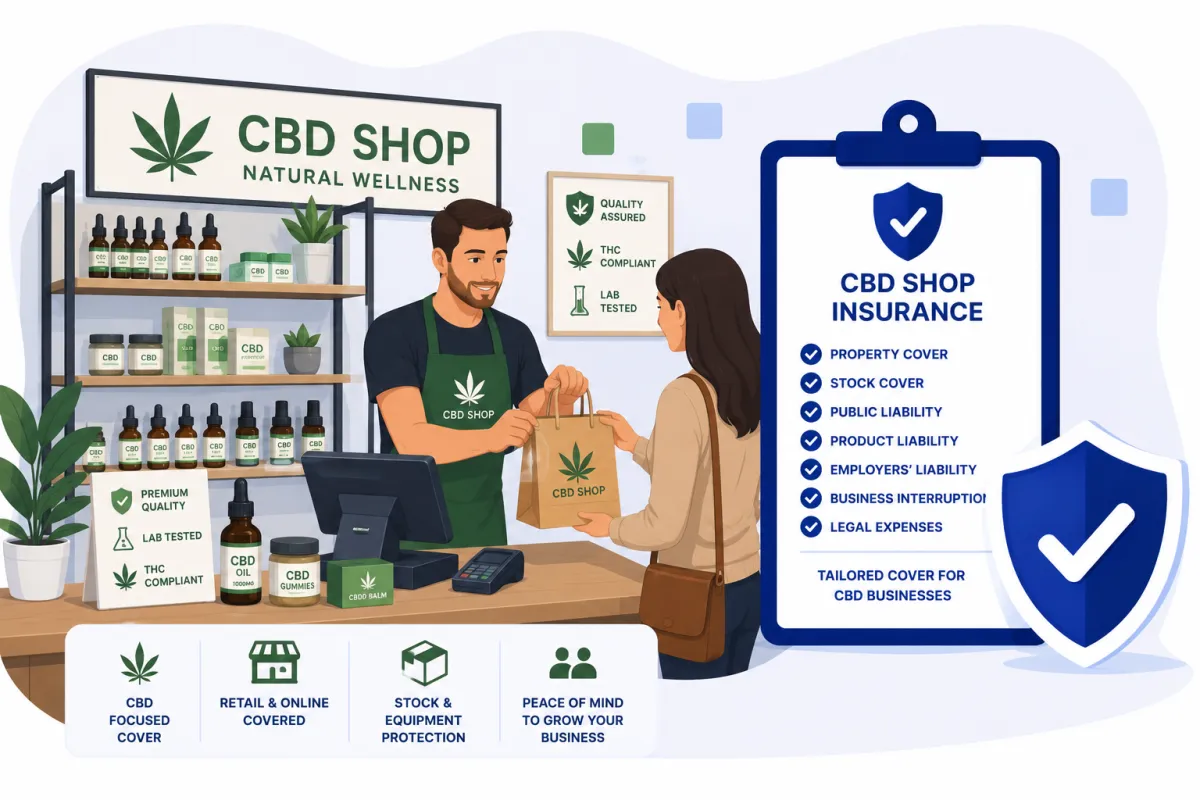
Placed through the right market, a CBD shop can be properly insured. The cover should include:
- Product liability — the critical cover for any business selling consumable products to the public; this is the section mainstream policies most often exclude.
- Public liability — for customer injury or property damage on your premises.
- Stock and contents — your CBD products, fixtures, and equipment at proper replacement value.
- Employers' liability — a legal requirement if you employ staff.
- Buildings cover — if you own the premises or your lease requires it.
- Business interruption — lost income if you can't trade after an insured event.
- Money & glass — takings and shopfront glazing.
CBD Businesses We Cover
However you sell CBD, we can build cover around it:
| Business type | Key exposure we address |
|---|---|
| Dedicated CBD shops | Product liability, stock, premises, regulatory exposure |
| CBD & vape combined stores | Mixed regulated product lines under one policy |
| Wellness / health-food shops stocking CBD | CBD product liability added to general retail cover |
| Online & physical CBD retailers | Combined e-commerce and shop exposure |
| CBD wholesalers & distributors | Higher-limit product liability down the supply chain |
| Market stall / kiosk CBD sellers | Non-standard premises and product cover |
How It Works
Tell us about the shop
What CBD products you sell, whether they're FSA-listed and lab-tested, your turnover, premises, and any other lines you stock.
We go to the right market
We approach specialist and Lloyd's insurers who actively write CBD — including the product liability mainstream insurers exclude.
You get a real quote
We come back with terms you can buy, explain exactly what's covered, and handle the placement end to end.
Why a Broker Beats a Generic Shop Quote for CBD
A comparison site or direct insurer will either refuse a CBD shop outright or sell a standard retail policy with CBD quietly excluded. Either way the owner ends up uninsured for the product they actually sell — and won't discover it until a product claim is rejected. The automated route simply isn't built to assess CBD risk.
A specialist broker changes that. We know which insurers genuinely write CBD, present your compliance position to them properly, and make sure product liability — the cover that matters most — is included rather than excluded. For a CBD retailer shut out of the mainstream market, that's the difference between being properly protected and being exposed on every sale. If you also sell vaping products, see our vape shop insurance page.
Frequently Asked Questions
Yes — but usually only through a specialist broker, not a comparison site. Most mainstream insurers and online quote engines decline CBD or exclude it from a standard shop policy, because of the product's regulatory position and the product-liability exposure of selling something consumed by the public. Specialist and Lloyd's market insurers do write CBD retail, including product liability. We place it for you with the markets that have appetite for the risk.
It's caution rather than illegality. Ingestible CBD is treated as a novel food under an evolving regulatory framework, and selling a consumable product carries a real product-liability exposure. Risk-averse mainstream insurers respond by declining the trade altogether or excluding CBD from the policy. Automated systems decline rather than assess. Specialist insurers, by contrast, understand the sector and will write it on proper terms.
It should — and it's the single most important cover for a CBD retailer, because it responds if a product you sold is alleged to have caused harm. The problem is that a generic shop policy often excludes product liability for CBD specifically, leaving the owner exposed on exactly the cover they most need. We make sure product liability is included and placed with an insurer that genuinely covers CBD.
In practice, yes. To be both legal and insurable, ingestible CBD products should be on the FSA's public list with a valid novel food application, within the permitted THC threshold, and backed by a Certificate of Analysis from an accredited laboratory. Selling non-compliant stock can invalidate a product liability claim and creates a regulatory exposure insurers will not accept. Keeping your range compliant is the basis of cover.
Yes. Combined CBD-and-vape stores are common, and we can arrange a single policy covering both regulated product lines rather than leaving one of them out. Both sit outside mainstream appetite, so both need the specialist market — which is exactly where we place them. If you mainly sell vaping products, our vape shop insurance page covers that side in more detail.
The CBD products you sell and whether they're FSA-listed and lab-tested, your annual turnover, your premises details, how many staff you employ, any other product lines you stock, and whether you sell online as well as in-store. With that we can approach the right specialist market and come back with terms.








Instagram
LinkedIn