


Phone & Device Repair Shop Insurance UK | Customer Goods & Battery Cover | Miller & Partner
Phone & Device Repair Shop Insurance
A standard shop policy leaves a repair business dangerously exposed — it rarely covers the customers' devices in your care, and insurers are tightening hard on lithium-battery risk. We arrange proper cover for repair shops, including the gaps the comparison sites miss, through specialist and Lloyd's markets.
Phone and device repair shops carry a risk profile that ordinary retail policies were never designed for. At any moment you're holding dozens of customers' phones, tablets, and laptops — items you don't own but are fully responsible for — alongside a stockroom of lithium batteries that insurers now treat as a serious fire hazard. A cheap online shop policy will quote you in minutes, but it typically excludes the two exposures most likely to sink your business. Below is what your cover actually needs to include, where standard policies fall short, and how we close the gaps.
Where a Standard Shop Policy Leaves You Exposed
These are the exposures unique to a repair business that a generic retail policy commonly excludes or caps far too low:
- Customers' devices in your care — if a fire, flood, or burglary destroys the phones and laptops awaiting repair, a standard policy covers your stock, not customers' goods. You're liable for every one of them.
- Lithium-battery fire risk — storing and charging batteries is now a flagged hazard. Many standard policies add a lithium exclusion or decline outright; getting this covered needs the right market.
- Faulty-repair liability — if a repair you carry out later causes damage (a battery fire, a device failure), that's a product/workmanship exposure a basic policy may not address.
- Data liability — you handle customers' personal data on every device; a breach or loss creates a liability standard shop cover ignores.
- High-value, portable stock — parts, refurbished handsets, and accessories are a prime theft target, often under-insured on a generic policy.
What Repair Shop Cover Should Include
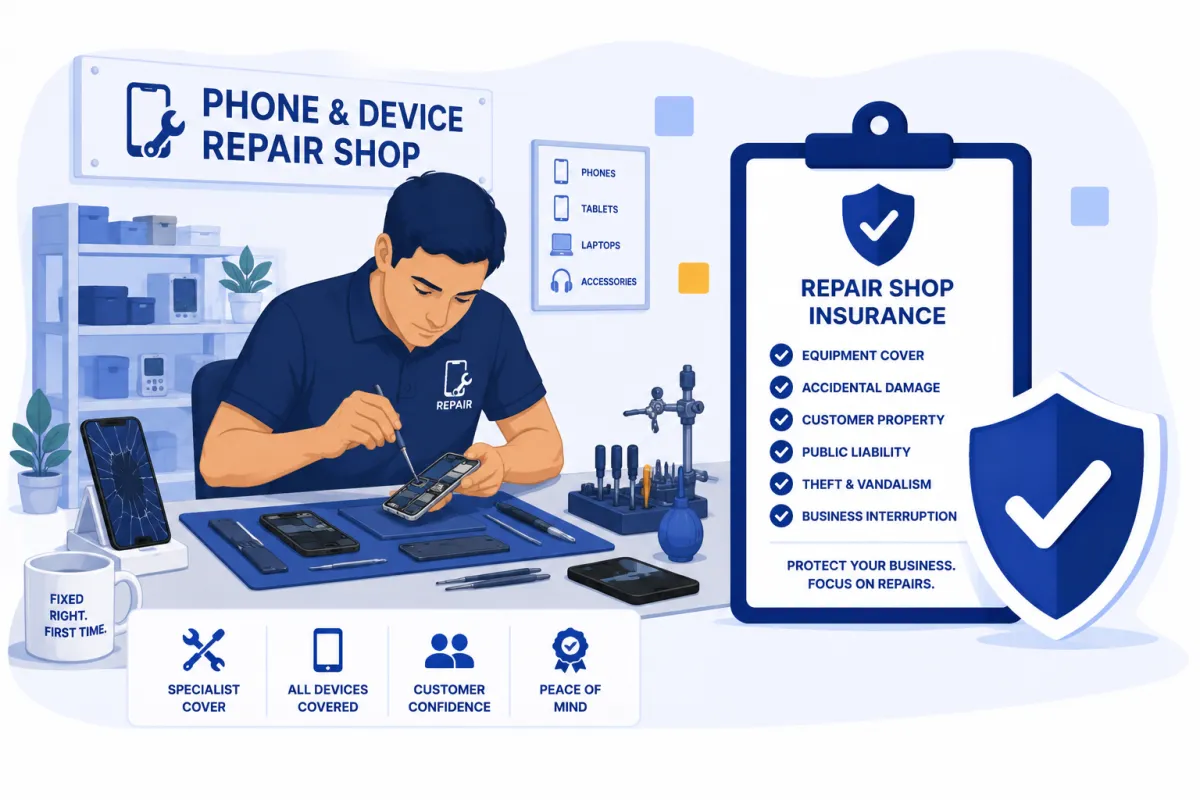
A policy built for a repair business — rather than bolted on from a generic shop template — should cover:
- Customer goods / bailee cover — the single most important section: protection for customers' devices in your custody and control.
- Stock and contents — parts, tools, refurbished devices, and equipment, insured at proper replacement value.
- Lithium-battery storage cover — placed with insurers who will write the battery risk rather than exclude it.
- Public & products liability — for customer injury and for faulty-repair or product claims.
- Employers' liability — a legal requirement if you employ staff.
- Business interruption — lost income if a fire or flood closes the shop.
- Money & glass cover — takings and shopfront glazing.
Repair Businesses We Cover
Whatever you repair and however you trade, we can build cover around it:
| Business type | Key exposure we address |
|---|---|
| Phone & tablet repair shops | Customer devices in care, lithium batteries, theft |
| Computer & laptop repair | Customer goods, data liability, high-value kit |
| Repair & unlocking / accessory shops | Stock, refurbished handsets, product liability |
| Mobile / call-out repair | Tools and goods away from the premises |
| Market stall / kiosk repairers | Non-standard premises and stock cover |
| Repair shop with stock resale | Combined retail and repair exposure |
How It Works
Tell us about the shop
What you repair, your stock and battery storage, roughly how much customer property you hold, and your premises and staff.
We build the right cover
We go to specialist and Lloyd's markets that write repair-shop risk properly — including the battery and customer-goods exposures.
You get a real quote
We come back with terms you can buy, explain exactly what's covered, and handle the placement end to end.
Why a Broker Beats a Generic Online Shop Quote
A comparison site will sell a repair shop a standard retail policy in minutes — and that's the problem. The automated quote doesn't ask the questions that matter for a repair business: how much customer property is on the premises, how lithium batteries are stored, whether faulty-repair liability is needed. It produces a cheap-looking policy with the two biggest exposures quietly excluded.
A specialist broker builds the cover around the actual business. We make sure customer goods are insured, place the lithium-battery risk with a market that will write it, and get the liability sections right — so the policy responds when something goes wrong, rather than revealing a gap at the worst possible moment.
Frequently Asked Questions
Usually not under a standard policy. A generic shop policy covers your own stock and contents, but customers' devices awaiting repair are goods you don't own — and they need a specific "customer goods" or bailee cover section. This is the single biggest gap for repair shops: if a fire or burglary destroys the devices on your workbench, without this cover you're personally liable to replace every one. We make sure it's included and the limit fits how much customer property you hold.
Yes, but it needs the right market. Insurers have tightened significantly on lithium-ion battery risk because of the fire hazard, and many standard shop policies now add a lithium exclusion or decline the risk. Specialist insurers will write it, usually subject to sensible storage and charging conditions. We place repair shops with markets that cover the battery exposure rather than excluding it.
That's a faulty-workmanship or product liability exposure — for example, if a battery or part you fitted later fails or causes a fire. A basic shop policy may not respond to it. Repair shop cover should include the liability sections that deal with the work you carry out, not just injury to customers on the premises. We make sure that's built into the policy.
Yes, combined retail-and-repair businesses are common and we cover them as one. Selling refurbished handsets and accessories adds a stock and product-liability element on top of the repair exposure, and the policy should reflect both. We build cover that handles the resale and the repair side together rather than leaving one of them out.
It depends on your turnover, stock and battery levels, how much customer property you hold, your premises, and your location. A repair-specific policy can look slightly higher than a bare online shop quote, but that's because it actually covers the customer goods and battery risks the cheap quote leaves out — which is the difference between a policy that pays and one that doesn't. We'll explain exactly what drives your premium and what each section covers.
What you repair and sell, your annual turnover, roughly the value of customers' devices you hold at any time, how you store and charge batteries, your premises details, and how many staff you employ. With that we can approach the right specialist market and come back with terms.








Instagram
LinkedIn