



Cyber Insurance Declined or Refused? UK Guide to Getting Covered
Why is cyber insurance so hard to get in 2026?
If your cyber insurance application has been declined, your renewal refused, or your quote loaded with exclusions and sub-limits, you are far from alone — and it usually isn't because your business is uninsurable. It's because the cyber market has fundamentally changed. After paying out enormous ransomware and business-interruption losses from 2022 onwards, insurers moved from trust-based underwriting to verification-based underwriting. The short questionnaire became a technical audit, and a set of security controls that were once "nice to have" became hard conditions of cover.
The result is that businesses get declined not because they're bad risks, but because they can't yet evidence the controls insurers now demand — or because their application was presented poorly. A decline is a problem to be solved, not a verdict. This is exactly the kind of difficult, declined or non-standard risk we specialise in placing at Miller & Partner. If you're new to the topic, our general guide to cyber insurance covers the basics — this guide is for when you've already been turned down and need a route back to cover. Where the decline is driven by something other than your security posture, two adjacent routes apply: business insurance after insolvency, where a formal procedure or a director-level search is what triggered it, and business insurance with a CCJ, where adverse credit stopped the quote before any underwriter looked at your controls.
Key facts: getting cyber insurance after a decline
- A decline is usually fixable — most refusals come down to a small list of missing controls or a poorly presented application, not an uninsurable business.
- MFA is now non-negotiable — insurers expect multi-factor authentication on email, remote access, VPN and all admin accounts. Partial MFA is specifically flagged.
- The "attestation trap" can void a valid claim — ticking "yes" to a control you don't fully enforce can be treated as misrepresentation and used to deny a claim.
- Always get the declination reason in writing — insurers usually cite a short, specific list ("no MFA on email", "no EDR", "no tested backups"). That list is your roadmap back.
- Compensating controls can unlock cover — where you can't meet a requirement perfectly, documented alternatives often satisfy an underwriter.
- UK GDPR adds a regulatory layer — the ICO must be notified of qualifying breaches within 72 hours, and some fines may be uninsurable, which shapes how policies are built.
How does The Insurability Framework™ help a declined business?
A declined or refused cyber risk is the definition of difficult-to-place — and placing exactly these risks is what the Insurability Framework was built for, through four pillars.
Underwriter Intelligence
We know precisely what cyber underwriters look for in 2026 — MFA everywhere, EDR, tested backups, an incident-response plan — and how to present your controls and remediation so an insurer can say yes rather than decline.
Difficult Risk Expertise
Specialist placement for risks standard markets have refused. We access Lloyd's syndicates and specialist cyber MGAs that will consider businesses other insurers turned away — including after a claim or a prior decline.
Risk Assessment
We identify why you were declined and what's actually blocking cover — the missing control, the attestation risk, the gap between what you stated and what you can evidence — then map a realistic path to placement.
Claims Advocacy
Real support from real people if you do suffer an incident — including defending against a denial based on alleged misrepresentation — not a call centre. We argue your corner.
Why is the attestation trap so dangerous?
This is the single most important point in this guide — and the one that catches the most businesses out. Modern cyber applications ask detailed yes/no questions about your security controls. Your answers don't just inform the quote; they typically become warranties — binding statements the insurer relies on. And here's the trap: an optimistic or careless answer can quietly turn a policy you paid for into one that won't pay out.
The classic example: you're asked "Is MFA enabled?" and you tick yes — because it's on email. But your VPN, remote desktop and cloud admin accounts have no MFA enforced. From a claims perspective, that answer may be treated as a misrepresentation. If a breach later exploits one of those unprotected routes, the insurer can use the discrepancy to deny the claim or void the policy — and in a widely reported case, an organisation was refused a multi-million-dollar ransomware payout precisely because MFA had not been fully implemented across affected systems.
"MFA is enabled" and "MFA is enforced everywhere it needs to be" are not the same statement — but on an application they can read identically. The gap between what you attested and what you can actually evidence is one of the most common routes to a denied claim. Getting the answers right, with evidence behind them, is as important as buying the policy.
"The hardest conversations I have are with businesses who were declined and assume they're simply uninsurable — or worse, businesses who got a policy by ticking boxes they couldn't back up, and only find out at claim time. Nine times out of ten a decline comes down to a fixable list: MFA not enforced everywhere, no EDR, backups never tested. Getting the declination reasons in writing and presenting the fix properly is the most valuable thing a specialist broker does here."
What are the common reasons cyber cover is refused?
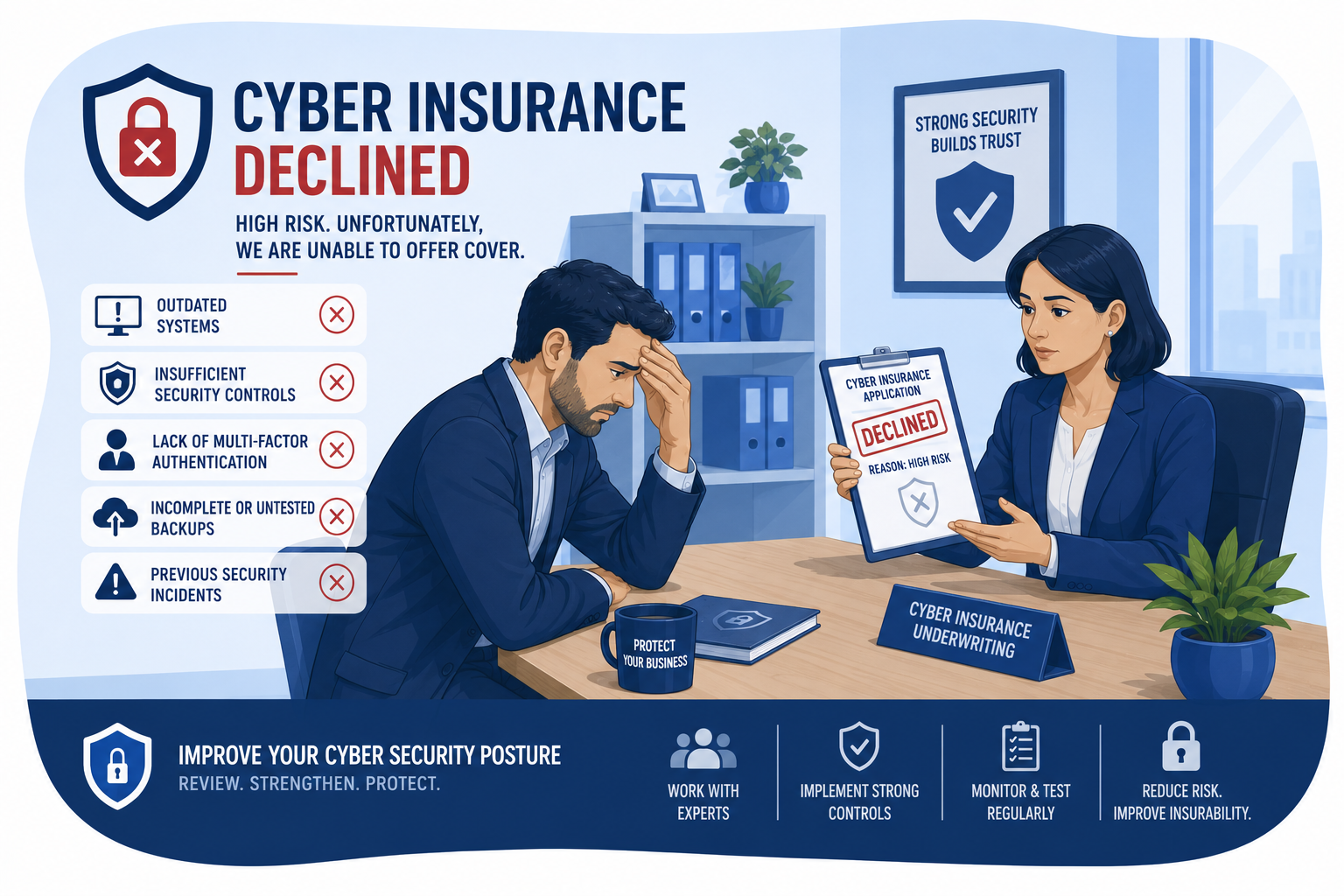
When an application is declined or a renewal refused, the cause is usually one of a short, recurring list. Insurers will normally state it explicitly — and you should always ask for it in writing. The most common blockers are below.
| Blocker | What insurers want to see |
|---|---|
| No / partial MFA | MFA enforced on email, remote access, VPN and all admin accounts |
| No EDR | Endpoint Detection & Response on all devices, centrally monitored — antivirus alone is no longer enough |
| Untested backups | Offline or immutable backups, with a restore tested in the last 12 months |
| Poor patching | A documented process to apply critical patches quickly (often within 14 days) |
| No incident-response plan | A written, owned, usable plan for intrusions and ransomware |
| Unsupported systems | End-of-life software removed or isolated with compensating controls |
| Prior claim / weak history | Evidence of remediation since any previous incident |
Declined vs placeable: what actually changes the outcome?
The difference between a flat decline and a workable quote is often less about the business itself and more about the controls in place and how the risk is presented. This is where a specialist broker changes the result.
| Factor | Likely declined | Placeable with a specialist |
|---|---|---|
| MFA coverage | Partial / email only | Enforced across all access |
| Endpoint protection | Basic antivirus | EDR, centrally monitored |
| Backups | Untested / online only | Immutable + tested restore |
| Application quality | Vague, unevidenced | Evidenced proof pack |
| Compensating controls | Not documented | Documented & presented |
| Market access | One declining insurer | Lloyd's & specialist MGAs |
Which security controls do insurers now require?
For 2026, a recurring set of controls has moved firmly into the "non-negotiable" category for most cyber underwriters. You don't always need every one perfectly in place — but you need to address them, evidence them, or offer documented compensating controls. The core expectations:
Multi-factor authentication (MFA)
Enforced on email, remote access, VPN and all administrative and cloud accounts — not just email. Phishing-resistant MFA is increasingly expected for higher limits.
Non-negotiableEndpoint Detection & Response (EDR)
Behaviour-based detection on every device, centrally managed and reporting. Traditional antivirus alone is now widely treated as uninsurable.
Non-negotiableTested, immutable backups
Offline or immutable copies that ransomware can't encrypt — with a successful restore tested in the last 12 months, not just assumed.
Non-negotiablePatch management
A documented process to apply critical security patches promptly, often within 14 days, with evidence available.
EssentialIncident-response plan
A written, owned and usable plan for intrusions and ransomware — increasingly asked about directly on applications.
EssentialEmail security
SPF, DKIM and DMARC configured, plus advanced phishing protection — phishing remains the dominant attack route.
RecommendedSecurity awareness training
Regular staff training and phishing simulations, with completion records you can show an underwriter.
RecommendedCyber Essentials / ISO 27001
Recognised certifications signal cyber hygiene to insurers and can support both eligibility and better terms.
RecommendedHow do you get covered after a decline?
A decline feels final, but it rarely is. The route back to cover is usually methodical rather than dramatic. First, get the declination reasons in writing — insurers typically give a short, specific list. Second, close the gaps you can quickly (enforcing MFA universally is often the single biggest lever) and document compensating controls where a perfect fix isn't immediate. Third, build an evidence pack: screenshots of MFA enforcement, EDR deployment reports, backup-restore test logs, your incident-response plan, and patching reports. Fourth, work with a broker who can take that evidenced risk to markets beyond the one that declined you — including Lloyd's syndicates and specialist cyber MGAs that consider non-standard and previously-declined risks. We walk through how this feeds into pricing and terms in the pricing section below.
Can you get cyber cover after a ransomware attack?
Yes — but it's harder, and how you present the aftermath matters enormously. Insurers will want to see what happened, what you've changed, and that the vulnerability that was exploited has been closed. A business that suffered ransomware, then demonstrably hardened its controls — universal MFA, EDR, immutable tested backups, a tested incident-response plan — can often still be placed, sometimes with a higher excess, a sub-limit on ransomware, or a co-insurance share initially. The worst thing you can do is hide the incident; the best thing is to evidence a credible remediation story. This is precisely the kind of post-incident, "previously declined" risk where specialist placement makes the difference between no cover and a workable policy.
How do UK GDPR fines affect your cover?
Cyber incidents that expose personal data trigger obligations under the UK GDPR and Data Protection Act 2018. You must notify the Information Commissioner's Office (ICO) of a qualifying personal data breach within 72 hours of becoming aware of it, and inform affected individuals where the risk to them is high. ICO fines can reach up to £17.5m or 4% of global annual turnover, whichever is higher.
For insurance, two points matter. First, many cyber policies include regulatory defence cover for the legal costs of responding to ICO action — but the limits are often well below the maximum possible fine, so check them. Second, the fines themselves may be uninsurable under English public-policy principles, depending on whether the breach was merely negligent or reckless. Your policy wording should be read carefully on this point — and it's a key reason why robust controls (which reduce both the breach risk and the regulatory exposure) sit at the heart of a defensible cyber position.
This guide is general information, not legal, regulatory or cybersecurity advice. UK GDPR obligations and the insurability of fines are complex and fact-specific. Confirm your data-protection duties with the ICO and a qualified adviser — then let us build cover around a well-presented, well-controlled risk.
🛡️ Readiness Checker: how placeable are you?
Answer three quick questions for an instant, indicative read on how an underwriter might view you. Guidance only — not a quote or advice.
✅ Controls checklist: are your answers defensible?
Tick what you can evidence — not just what's "in place". A self-check prompt, not advice.
📊 Risk Assessor: why were you likely declined?
A rough indicator of the most likely blocker. Indicative only.
Keep reading ↓ for how cover is priced after a decline, real-world claim-denial scenarios, how to manage a claim, a full glossary, and detailed FAQs.
How is cover priced after a decline in 2026?
There's no flat rate for cyber insurance after a decline — pricing reflects the controls you can evidence, your claims history, your sector and data exposure, and how well the risk is presented to the market. A previously-declined business isn't automatically expensive; once the blocking issues are addressed and evidenced, terms often improve sharply. Because this is a hardened, technical market, the spread between a flat "no" and a workable quote is wide — which is where specialist placement earns its keep. The main factors underwriters weigh:
Security controls
MFA coverage, EDR, tested backups and patching — the single biggest driver of both eligibility and price.
Evidence quality
Whether your "yes" answers are backed by screenshots and reports, or just attestations.
Claims & incident history
Prior ransomware or breaches raise scrutiny — but a documented remediation story can offset them.
Data & sector
The volume and sensitivity of personal data you hold, and whether your sector is heavily targeted.
Limits & retentions
The cover limit, the excess, and any ransomware sub-limit or co-insurance share you accept.
Presentation & market
A well-built proof pack taken to the right specialist markets, not just resubmitted to the insurer that declined.
To show how the variables stack up rather than quote a figure, here are illustrative risk tiers. These are indicative bands to explain the drivers — not quotes.
| Profile | Typical characteristics | Likely outcome |
|---|---|---|
| Stronger | All core controls enforced and evidenced, clean history | Competitive terms |
| Workable | Most controls in place, minor gaps with compensating controls | Quote with conditions |
| Harder | Multiple missing controls or recent unremediated incident | Specialist markets, higher excess/sub-limits |
The costliest mistake we see is resubmitting the same unevidenced application to the same hardening market and getting the same "no" — or, worse, ticking boxes you can't back up and buying a policy that won't pay. Getting the declination reasons in writing, fixing the highest-impact control first, building a proof pack, and taking it to the right specialist markets is what turns a decline into cover that actually responds.
What do real cyber claim denials look like?
These illustrative scenarios show how the gaps in this guide play out. They are composite examples for explanation, not specific clients.
The MFA attestation
A firm ticked "yes, MFA is enabled" on its application — true for email, but not for the remote-desktop gateway. Attackers got in through that unprotected gateway and deployed ransomware.
The late notification
A business spotted suspicious activity but waited until it had "full clarity" before reporting — well beyond the policy's 72-hour notification window — and separately missed the ICO's 72-hour deadline.
The previously-declined firm that got covered
An SME was declined after a near-miss phishing incident. Rather than give up, it enforced universal MFA, deployed EDR, tested its backups and documented an incident-response plan — then re-approached the market through a broker with a full evidence pack.
How should you manage a claim if an incident happens?
How you handle the first hours of a cyber incident shapes both your recovery and whether your claim is paid. These are the steps we guide clients through.
Trigger your incident-response plan
Activate the plan, isolate affected systems where safe, and preserve evidence — don't wipe or rebuild before the insurer's response team has engaged.
Notify your insurer immediately
Cyber policies require fast notification — often within 48–72 hours of awareness. Use the policy's breach hotline; the clock starts when you become aware, not when you're certain.
Don't pay or admit anything prematurely
Don't pay a ransom or admit liability before the insurer and its specialists are involved — ransom payment must also respect UK sanctions law.
Assess your ICO obligations
If personal data is affected, assess whether the 72-hour ICO notification duty is triggered, and document your decision either way.
Use the insurer's response panel
Most policies provide forensic, legal and PR specialists. Using the approved panel keeps costs covered and the response coordinated.
Let us advocate for you
We manage the insurer relationship, push back on any unfair denial — including misrepresentation challenges — and keep the claim moving.
Glossary of key terms
- Declination
- An insurer's refusal to offer cover. Usually comes with a specific reason, which should be obtained in writing as the basis for fixing the issue.
- Attestation / warranty
- A statement made on an insurance application that the insurer relies on. If it turns out to be inaccurate, it can be grounds to deny a claim or void the policy.
- Misrepresentation
- An incorrect or misleading statement on an application — for example overstating MFA coverage — which insurers can use to challenge a claim.
- MFA (multi-factor authentication)
- Requiring more than a password to log in. Insurers expect it enforced across email, remote access, VPN and admin accounts; phishing-resistant MFA is increasingly preferred.
- EDR (Endpoint Detection & Response)
- Security software that monitors device behaviour and responds to threats in real time — now expected in place of basic antivirus.
- Immutable backup
- A backup that cannot be altered or encrypted once written, protecting it from ransomware. Insurers want a tested restore within the last 12 months.
- Compensating control
- An alternative measure that reduces a risk where the standard control isn't fully in place — often enough to satisfy an underwriter if documented.
- Incident-response (IR) plan
- A written, owned plan setting out how the business responds to a cyber intrusion or ransomware attack.
- Regulatory defence cover
- Cover for the legal costs of responding to regulator action (e.g. the ICO) after a breach — often limited well below the maximum possible fine.
- UK GDPR / ICO
- The UK's data-protection regime, overseen by the Information Commissioner's Office, requiring notification of qualifying personal data breaches within 72 hours.
- Sub-limit
- A cap within a policy that's lower than the overall limit — commonly applied to ransomware or business interruption after a decline or claim.
Declined cyber insurance FAQs
Why was my cyber insurance application declined?
Usually because of a short list of missing or unevidenced security controls — most often partial MFA, no EDR, or untested backups — or because the application was presented poorly. Always ask the insurer for the declination reason in writing; it's the roadmap to getting covered.
Can I get cyber insurance after being refused at renewal?
Very often, yes. A refusal at renewal usually reflects tightened requirements rather than an uninsurable business. Closing the highest-impact control gap, documenting compensating controls and taking an evidenced application to specialist markets frequently turns a refusal into a quote.
What is the MFA attestation trap?
It's where you answer "yes, MFA is enabled" on an application when it isn't enforced everywhere it needs to be. That answer can become a binding warranty, and if a breach exploits an unprotected route, the insurer may treat it as misrepresentation and deny the claim. Accurate, evidence-backed answers are essential.
Can I get cover after a ransomware attack?
It's harder, but often possible. Insurers will want to see what happened, what you've changed, and that the exploited vulnerability is closed. A documented remediation story — universal MFA, EDR, tested immutable backups, an IR plan — can place the risk, sometimes with a higher excess or a ransomware sub-limit initially.
What security controls do insurers require in 2026?
The non-negotiable core is MFA enforced across all access, EDR on every endpoint, and immutable backups with a tested restore. Prompt patching, a written incident-response plan, email security (SPF/DKIM/DMARC) and staff training are also expected. Certifications like Cyber Essentials or ISO 27001 help.
Are UK GDPR fines covered by cyber insurance?
Not necessarily. Many policies cover the legal costs of regulatory defence, but the fines themselves may be uninsurable under English public-policy principles, depending on whether the breach was negligent or reckless. Check your wording carefully and confirm the position with a qualified adviser.
How long do I have to report a breach?
Two separate clocks. Your policy typically requires notification within 48–72 hours of becoming aware of an incident. Separately, UK GDPR requires notifying the ICO of a qualifying personal data breach within 72 hours of awareness. Both start at awareness, not certainty.
How can a specialist broker help if I've been declined?
We approach every placement through The Insurability Framework — identifying exactly why you were declined, helping you evidence the fix, and taking a well-presented risk to Lloyd's syndicates and specialist cyber markets beyond the insurer that said no. The fastest start is to request a quote and tell us what happened.








Instagram
LinkedIn