


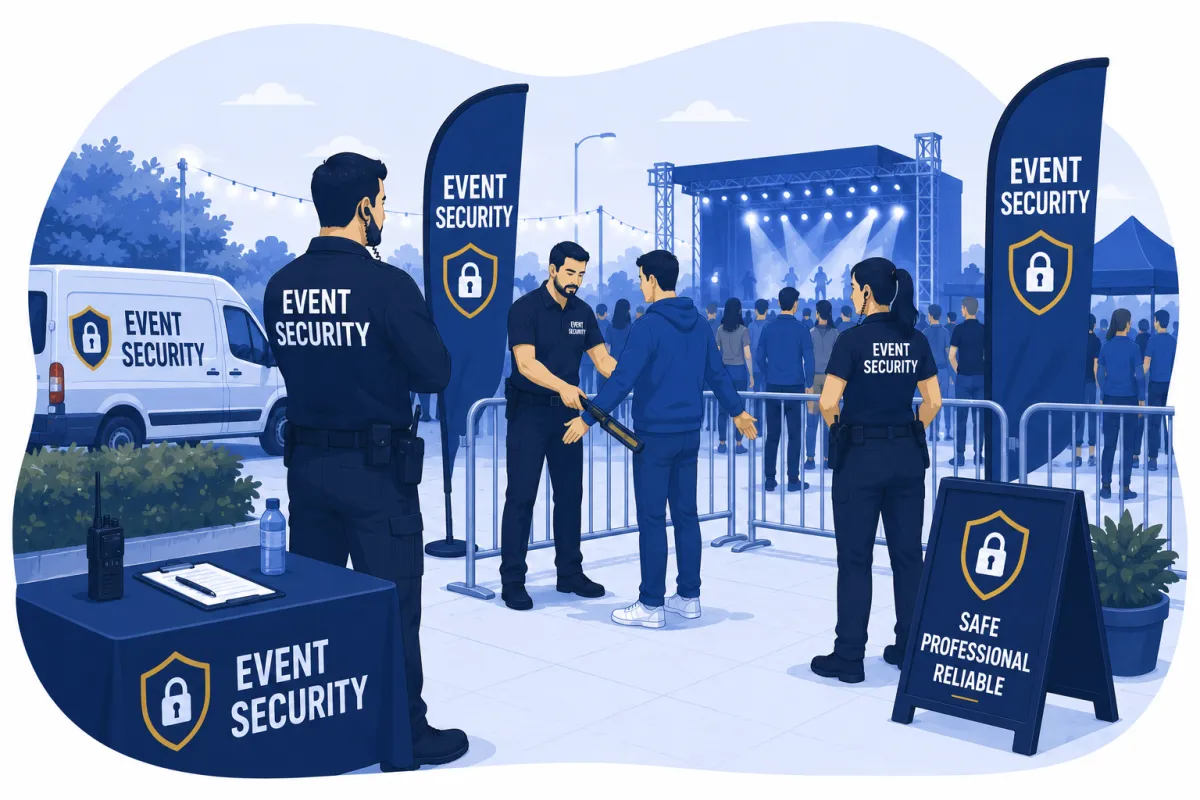
Event Security & Crowd Management Insurance UK | Specialist Guide
Why do event security and crowd management firms need specialist insurance?
Event security is one of the highest-liability service trades in the UK. Your operatives make split-second decisions — refusing entry, ejecting a guest, restraining someone, managing a surging crowd — in environments full of alcohol, adrenaline and hundreds or thousands of members of the public. Every one of those decisions can become a claim: an allegation of excessive force, a wrongful-arrest complaint, an injury during an ejection, or a crowd-crush incident with catastrophic consequences.
Here is the problem that catches so many security firms out: standard public liability policies frequently exclude assault, battery and deliberate physical acts — the very things your business does every shift. A generic "business insurance" policy bought online can look like cover and then fail at exactly the moment you need it. Event security demands a security-specific wording that explicitly covers the reasonable use of force, wrongful arrest and the realities of crowd management. This is precisely the kind of difficult, high-liability risk we place at Miller & Partner — and with Martyn's Law reshaping event-safety duties in 2026, getting it right has never mattered more.
Key facts: event security & crowd management insurance
- Standard liability policies often exclude assault & battery — security firms need a wording that explicitly covers the reasonable use of force, or a claim from an ejection can be refused.
- SIA licensing is mandatory for door supervision and security guarding under the Private Security Industry Act 2001 — and holding valid licences is usually a condition of your insurance.
- Wrongful arrest / false imprisonment cover is a critical extension — allegations of unlawful detention are common in this trade.
- Employers' liability is legally compulsory if you employ operatives — minimum £5m, and most event contracts demand far more public liability (£5m–£10m).
- Martyn's Law (Terrorism (Protection of Premises) Act 2025) received Royal Assent on 3 April 2025, with statutory guidance published in 2026 and enforcement expected around 2027 — raising the bar for event-security planning.
- Client contracts set your cover levels — venues and organisers routinely require proof of specified PL limits before you can work the door.
How does The Insurability Framework™ apply to event security?
An event security firm is a textbook difficult risk — high-liability, intervention-based, and routinely declined or poorly covered by standard markets. That is exactly what the Insurability Framework was built to handle, through four pillars.
Underwriter Intelligence
We know what makes an underwriter wary of a security firm — use-of-force exposure, crowd sizes, the venues you work — and how to present your SIA compliance, training and incident-reporting so insurers price you fairly rather than declining outright.
Difficult Risk Expertise
Specialist placement for a trade standard markets avoid or under-cover. We access Lloyd's syndicates and specialist MGAs whose wordings explicitly include assault & battery, wrongful arrest and reasonable force — not generic liability that excludes them.
Risk Assessment
We identify the hidden exposures — the assault exclusion, under-set PL limits that fail contract requirements, gaps around sub-contracted operatives — that quietly leave a security firm unprotected until a claim exposes them.
Claims Advocacy
Real support from real people when an incident becomes a claim — an alleged excessive-force complaint, an injury, a crowd incident — not a call centre. We argue your corner and manage the insurer relationship.
Why is the assault & battery exclusion the biggest trap?
This is the single most important point in this guide. Public liability insurance is built around accidental injury and damage — a guest slipping, a dropped barrier. But security work involves deliberate physical contact: restraining an aggressive patron, removing someone who won't leave, breaking up a fight. Many standard PL wordings carry an assault and battery exclusion that strips out cover for exactly these deliberate acts.
The result is a dangerous illusion of cover. A security firm buys an off-the-shelf policy, works the door for a year, then faces a claim after an ejection turns physical — and discovers the assault exclusion means the insurer won't respond. A proper event-security policy does the opposite: it explicitly includes the reasonable use of force in the course of licensed duties, together with wrongful arrest and false imprisonment cover. When we place security risks, confirming this wording is the first thing we check.
"Public liability insurance" and "public liability insurance that covers reasonable force" are not the same product. If your wording carries an assault & battery exclusion, an ejection-related claim can be declined — leaving your firm to fund the defence and any damages itself.
"The conversations that worry me most are with security firms who proudly tell me they're 'fully insured' — and then I read their wording and find a blanket assault & battery exclusion. They've been working doors for two years one claim away from disaster, and they had no idea. Checking that single clause is the most valuable thing a specialist broker does for this trade."
What does specialist cover include vs standard liability?
The gap between a generic liability policy and a properly built event-security policy is wide — and it's usually invisible until a claim. Here's where standard cover typically falls short.
| Cover area | Standard liability policy | Specialist security policy |
|---|---|---|
| Accidental third-party injury | Included | Included |
| Reasonable use of force | Often excluded | Explicitly covered |
| Assault & battery allegations | Commonly excluded | Specialist cover |
| Wrongful arrest / false imprisonment | Rarely included | Key extension |
| Crowd-management incidents | Unclear | Underwritten for it |
| Sub-contracted operatives | Often gaps | Addressed in wording |
| Contract PL limits (£5m–£10m) | Low defaults | Set to contracts |
Which covers does an event security company need?
A properly built programme for an event security or crowd-management firm is usually assembled from these components — placed together so there are no gaps between sections.
Public liability (force-inclusive)
The core cover — but it must explicitly include the reasonable use of force and not carry an assault & battery exclusion. Typically £5m–£10m to meet contracts.
EssentialWrongful arrest cover
Protects against allegations of unlawful detention or false imprisonment arising from refusals, ejections and restraint.
EssentialEmployers' liability
Legally required if you employ operatives. Minimum £5m — and security work carries real injury exposure for your own staff.
Legally requiredProfessional indemnity
Covers claims that your security advice, risk assessment or planning was negligent — increasingly relevant under Martyn's Law duties.
RecommendedLegal expenses
Funds defence costs for the disputes this trade attracts — complaints, allegations, employment issues and contract disputes.
RecommendedEquipment & tools
Radios, body-worn cameras, barriers, hi-vis and other kit against theft and damage on site and in transit.
RecommendedPersonal accident
Cover for your operatives if they're injured at work — a real risk in physical, confrontational environments.
RecommendedCyber cover
If you hold staff vetting data, incident logs or client contracts digitally, cyber cover protects against breaches and system failure.
RecommendedHow does SIA licensing affect your insurance?
The Security Industry Authority (SIA) regulates the private security industry under the Private Security Industry Act 2001. Front-line roles such as door supervision and security guarding require a valid SIA licence, and businesses supplying these services should understand both front-line and non-front-line licence requirements. Even a director in a purely administrative role at a licensable business may need a non-front-line licence.
For insurance, the link is direct and unforgiving: valid SIA licensing is typically a condition of your security liability policy. If an operative was working unlicensed when an incident occurred, the insurer may treat the policy as breached and decline the claim. Maintaining current licences across your whole team — and being able to evidence it — is therefore not just a legal duty but a condition of your cover responding. Becoming an SIA Approved Contractor can also strengthen how underwriters view your firm.
What does Martyn's Law mean for event security?
The Terrorism (Protection of Premises) Act 2025 — known as Martyn's Law, after Martyn Hett, killed in the 2017 Manchester Arena attack — received Royal Assent on 3 April 2025. It introduces a statutory duty on those responsible for qualifying public premises and events to take proportionate measures to reduce vulnerability to, and the impact of, terrorist attacks. The Home Office published statutory guidance in 2026, with enforcement expected after an implementation period of at least 24 months (around 2027).
The Act works in two tiers: a standard tier for premises with capacity of 200–799, and an enhanced tier for premises and qualifying events of 800 or more. For event security firms, this is both a responsibility and an opportunity: organisers and venues increasingly look to professional security providers to help deliver their Martyn's Law obligations — planning, procedures and trained personnel. That raises the bar on your own competence and documentation, and makes professional indemnity cover (for the advice and planning you provide) more relevant than ever. You can read the Act on legislation.gov.uk.
This guide is general information, not legal or regulatory advice. Martyn's Law obligations fall primarily on those responsible for premises and events — but security contractors are central to delivering them. Confirm your specific duties with official guidance on GOV.UK and a qualified adviser, then let us build cover around a compliant operation.
What are the crowd-management liability risks?
Crowd management carries some of the most severe potential exposures in the events world. Crowd crushes, surges at barriers, bottlenecks at entries and exits, and failures in evacuation can cause mass-casualty incidents — and the security and crowd-management provider is squarely in the frame for liability. The values at stake dwarf a typical door-work claim, which is why event-security firms working large-capacity events need PL limits set realistically (often £10m) and underwriters who understand the exposure. Good planning, trained staff, clear communication and documented procedures are both your operational defence and the evidence that helps secure cover on sensible terms.
🛡️ Cover Checker: which covers does your firm need?
Answer three quick questions for an instant, indicative starting point. Guidance only — not a quote or advice.
✅ Compliance checklist: are you contract-ready?
Tick what applies. A self-check prompt, not legal advice — confirm specifics with the SIA and your broker.
📊 Risk Assessor: how exposed is your firm?
A rough exposure indicator based on the work you do. Indicative only.
Keep reading ↓ for how event security insurance is priced in 2026, real-world claim scenarios, how to manage a claim, a full glossary, and detailed FAQs.
How is event security insurance priced in 2026?
There's no flat rate for event security insurance — pricing reflects how much intervention your work involves, the size of events you cover, and how well you evidence your competence and compliance. Because the assault-and-battery exposure makes this a trade standard markets handle cautiously, quotes vary widely, which is exactly where specialist placement earns its keep. The main factors underwriters weigh:
Type of work
Door supervision, event security, crowd management and static guarding each carry a different intervention and liability profile.
Event capacity
The size of crowds you manage — large-capacity events carry far greater potential exposure.
Use-of-force frequency
How often operatives physically intervene, and the environments (high-risk venues raise premiums).
SIA compliance & training
Valid licences across the team, Approved Contractor status and documented training all improve terms.
Claims history
Previous assault, injury or wrongful-arrest claims weigh heavily on pricing.
PL limit required
The £5m, £10m or higher limit your contracts demand directly affects premium.
To show how the variables stack up rather than quote a figure, here are illustrative risk tiers. These are indicative bands to explain the drivers — not quotes.
| Risk profile | Typical characteristics | Premium pressure |
|---|---|---|
| Lower | Mostly access control, smaller venues, clean claims history, full SIA compliance | Most competitive |
| Moderate | Busy licensed venues, regular intervention, mid-size events | Mid-range |
| Higher | Large-capacity crowd management, frequent force, prior claims | Hardest to place |
The costliest mistake we see is a firm buying cheap "public liability" online that carries an assault & battery exclusion — saving a little upfront and risking the entire business at claim time. Presenting your SIA compliance, training records and incident-reporting properly to a specialist underwriter is often the difference between a decline and a competitive quote with the right wording.
What do real event security claims look like?
These illustrative scenarios show how the cover gaps in this guide play out. They are composite examples for explanation, not specific clients.
The ejection that turned physical
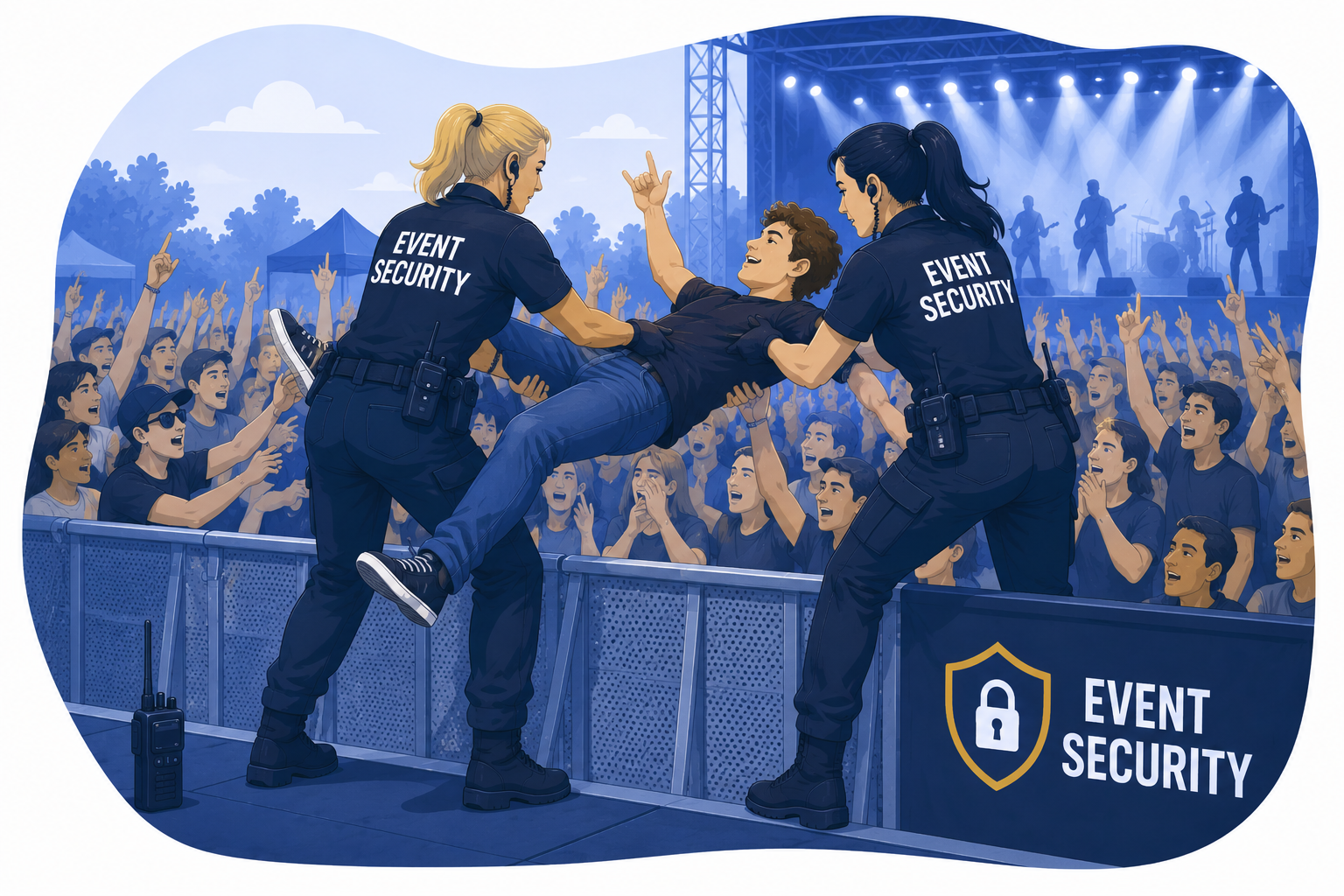
A door team removes an aggressive patron who later alleges he was assaulted during the ejection and pursues a personal-injury claim. The firm had bought a standard online liability policy — which carried an assault & battery exclusion.
The wrongful-arrest allegation
An operative detains a guest suspected of theft who is later found to have done nothing wrong. The guest alleges false imprisonment and threatens legal action.
The unlicensed operative
During the investigation of an injury claim, it emerged that the operative on duty had let his SIA licence lapse. The insurer raised the licensing condition in the policy.
How should you manage a claim if an incident happens?
Incidents are part of this trade — how you handle them determines whether they become manageable claims or business-threatening ones. These are the steps we guide clients through.
Secure the scene and get medical help
If anyone is injured, prioritise their welfare and call emergency services. Preserve the area where you safely can.
Record the incident immediately
Complete your incident report while memories are fresh — times, witnesses, actions taken, and any body-worn camera or CCTV footage.
Notify your broker promptly
Tell us as soon as possible. Early notification protects your position and lets us manage the insurer from the outset.
Preserve all evidence
Secure footage, logs, rosters and SIA licence records before they're overwritten or lost — they're central to defending a claim.
Don't admit liability
Be factual and cooperative, but avoid admissions. Let the claim be assessed properly through the insurer.
Let us advocate for you
We present the claim, handle the loss adjuster and argue your corner — so you can keep your contracts running.
Glossary of key terms
- SIA (Security Industry Authority)
- The regulator of the UK private security industry under the Private Security Industry Act 2001. Issues front-line and non-front-line licences.
- Assault & battery exclusion
- A clause in many standard liability policies that removes cover for deliberate physical acts — the exact exposure security work creates. Specialist wordings remove or reverse it.
- Reasonable use of force
- The lawful, proportionate physical intervention security operatives may use in their duties. Specialist policies explicitly cover claims arising from it.
- Wrongful arrest / false imprisonment
- Allegations that a person was unlawfully detained. A key insurance extension for security firms given the nature of the work.
- Martyn's Law
- The Terrorism (Protection of Premises) Act 2025, requiring qualifying premises and events to take proportionate measures against terrorist attacks. Royal Assent 3 April 2025; enforcement expected around 2027.
- Standard tier / Enhanced tier
- Martyn's Law categories: standard tier for premises of 200–799 capacity; enhanced tier for premises and qualifying events of 800 or more.
- SIA Approved Contractor
- A voluntary, independently audited standard for security businesses that signals higher operational standards — and can support better insurance terms.
- Crowd management
- Planning and controlling the movement and density of crowds at events to prevent crushes, surges and other mass-safety incidents.
- Public liability (PL)
- Cover for third-party injury or property damage. For security firms it must be written to include intervention-based exposures, with limits set to contract requirements.
Event security insurance FAQs
Does standard public liability insurance cover door staff?
Often not adequately. Many standard PL policies carry an assault & battery exclusion that removes cover for the deliberate physical acts security work involves. Security firms need a specialist wording that explicitly includes the reasonable use of force, otherwise an ejection-related claim can be declined.
Is event security insurance a legal requirement?
Employers' liability is legally compulsory if you employ operatives. Public liability is not legally required but is practically essential — and client contracts almost always demand proof of a specified PL limit (commonly £5m–£10m) before you can work. SIA licensing is a separate legal requirement for the individuals doing the work.
What public liability limit do event security firms need?
It depends on your contracts. Many venues and event organisers require £5m as standard, with £10m common for larger events and crowd-management work. Always check the specific limit each contract demands — too low and you won't be able to take the work.
Does my insurance cover wrongful arrest claims?
Only if it includes a wrongful arrest / false imprisonment extension. Given how often security operatives detain or eject people, this is one of the most important extensions for the trade — and one a generic policy typically omits.
How does SIA licensing affect my cover?
Valid SIA licensing is usually a condition of a security liability policy. If an operative was working unlicensed when an incident occurred, the insurer may treat the policy as breached and decline the claim. Keeping every operative's licence current and evidenced is essential.
What does Martyn's Law mean for my security business?
The Terrorism (Protection of Premises) Act 2025 places duties on those responsible for qualifying premises and events to prepare for terrorist threats. Security firms are central to delivering those duties through planning and trained personnel, which raises the importance of professional indemnity cover for the advice you provide. Confirm specifics with official GOV.UK guidance.
Are sub-contracted operatives covered?
Not automatically — this is a common gap. If you sub-contract security staff, your wording needs to address their liability explicitly, or you could face uninsured exposure. We check this carefully when placing cover.
How quickly can you arrange event security cover?
Timescales vary with the complexity of the risk, but as a specialist broker with Lloyd's and MGA access we can often move quickly once we understand your work, capacities and SIA compliance. The fastest route is to start a quote and tell us about your firm.








Instagram
LinkedIn