

Tattoo & Piercing Studio Insurance UK | Treatment Risk Cover
Why does a tattoo studio need specialist insurance?
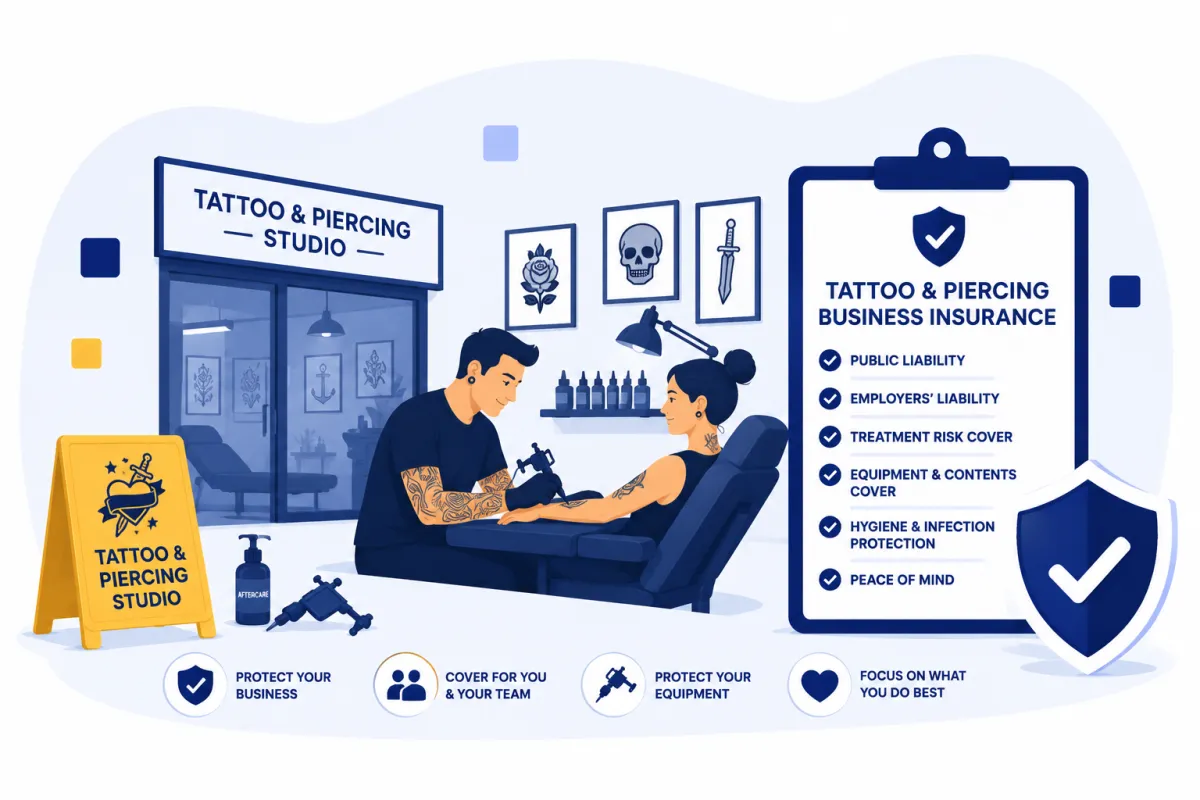
Tattooing and piercing are unusual businesses to insure, because the thing that makes you money is also the thing that carries the risk: penetrating skin with needles, permanently. A slip on the studio floor is an ordinary shop risk. An allergic reaction to red ink, an infection traced to a piercing, or scarring from a treatment gone wrong is something else entirely — and it is exactly the kind of claim that a standard, off-the-shelf policy quietly leaves you exposed to.
The single most important thing to understand is this: public liability insurance does not cover the treatment itself. Public liability handles injuries and damage around your work — the client who trips, the property you damage — but the act of tattooing or piercing, and the medical complications that flow from it, need a separate cover called treatment risk (also known as medical malpractice). Buy public liability alone, as many studios unknowingly do, and the gap sits precisely where your biggest exposure lives.
That gap — plus mandatory local-authority registration, blood-borne virus risk, the employers' liability rules, and the covers that beauty policies routinely miss — is why body art belongs with a specialist. At Miller & Partner we place proper tattoo-shop programmes with the handful of insurers who write this niche correctly, so the cover matches what you actually do.
Tattoo and piercing is a specialist niche only a handful of insurers write properly. Here is how each pillar applies to getting your studio covered correctly.
Key facts on tattoo studio cover, at a glance
- Standard public liability does NOT cover the treatment itself — you need separate treatment risk (medical malpractice) cover, and the gap sits exactly where the risk is.
- Local-authority registration is legally required for tattooing, cosmetic and body piercing, semi-permanent skin-colouring (microblading), electrolysis and acupuncture.
- Councils require proof of public liability (sometimes treatment risk) to register, so insurance is effectively a precondition of trading.
- Blood-borne viruses — hepatitis B, hepatitis C and HIV — plus allergic reactions, infections and scarring are the core client-injury risks.
- Employers' liability is compulsory even for part-time, freelance or self-employed staff — a common and costly misconception.
- Off-the-shelf beauty policies frequently exclude procedures, mobile equipment and business interruption, leaving dangerous gaps.
- Tattooing anyone under 18 is a criminal offence under the Tattooing of Minors Act 1969.
Why won't public liability cover the tattoo itself?
This is the misunderstanding that costs tattoo studios the most, so it is worth being crystal clear. Public liability is designed to cover injury or damage caused by your business in a general sense — a client who slips on a wet floor, a bystander hurt by falling equipment, damage to someone's property. What it typically does not cover is a claim arising from the treatment you deliberately performed: the tattoo, the piercing, the procedure. As specialist brokers put it plainly, public liability and treatment risk are two different types of cover, and treatment risk must be requested and shown separately.
Treatment risk — or medical malpractice — is the cover that responds when a client claims the procedure itself caused harm: an infection, an allergic reaction to ink or numbing cream, scarring, or a botched result. For a tattooist or piercer, this is not an optional extra; it is arguably the most important cover you hold, because the procedure is the whole business. A studio running on public liability alone has insured everything except the thing it actually does.
Public liability vs treatment risk — what each covers
The cleanest way to see the gap is side by side. This is the single most important table in this guide — check your own policy against it.
| Scenario | Public liability | Treatment risk |
|---|---|---|
| Client slips on the studio floor | ✓ Covered | ✗ Not its job |
| Allergic reaction to ink or numbing cream | ✗ Excluded | ✓ Covered |
| Infection traced to a procedure | ✗ Excluded | ✓ Covered |
| You damage a client's belongings | ✓ Covered | ✗ Not its job |
| Scarring from a treatment | ✗ Excluded | ✓ Covered |
| Design error or misspelling | ✗ Excluded | ✓ Covered (malpractice/PI) |
| Visitor hurt by falling equipment | ✓ Covered | ✗ Not its job |
The pattern is simple: public liability covers what happens around the chair; treatment risk covers what happens in the chair. A properly built tattoo-shop policy carries both, so there is no scenario that falls between them.
What insurance does a tattoo & piercing studio need?
Body art is rarely a single-cover business. Even a one-artist studio combines a treatment risk, a public space, valuable equipment, and income that stops if you have to close. Here is the core programme most studios need.
| Cover | What it protects | Priority |
|---|---|---|
| Treatment risk / malpractice | Claims from the procedure — infection, reaction, scarring | Essential |
| Public liability | Injury and damage around your work | Essential |
| Employers' liability | Staff and freelance artists — required by law | Compulsory |
| Products liability | Inks, jewellery and aftercare products supplied | Recommended |
| Contents & equipment | Machines, sterilisers, furniture, stock | Essential |
| Business interruption | Lost income if you close for decontamination or damage | Recommended |
| Portable / mobile kit | Equipment taken to conventions or guest spots | Consider |
| Cyber | Booking systems and client records | Consider |
Cover checker: what fits your setup?
Select the setup that fits. Each shows the priorities — and a specialist broker tailors the detail.
- CRITICAL Treatment risk cover for every procedure the studio offers.
- ESSENTIAL Public liability for the premises and visitors.
- LEGAL Employers' liability for all staff and freelance artists.
- ESSENTIAL Contents, equipment and business interruption on a shop package.
- CONSIDER Products liability for inks, jewellery and aftercare.
- CRITICAL Your own treatment risk cover — don't assume the studio's policy extends to you.
- ESSENTIAL Public liability for your work and clients.
- RECOMMENDED Confirm in writing whether you're covered as an individual or must arrange your own.
- CONSIDER Portable equipment cover for your kit.
- LEGAL Employers' liability if you take on any assistant.
- CRITICAL Treatment risk and public liability that follow you to conventions and guest spots.
- ESSENTIAL Portable equipment cover — a locked-vehicle theft is a real claim.
- RECOMMENDED Check the policy covers work away from your registered premises.
- LEGAL A personal registration may be needed for piercing away from a studio.
- CONSIDER Event-specific requirements at conventions.
- CRITICAL Treatment risk covering piercing and any microdermal or SPMU work you list.
- LEGAL Local-authority registration for piercing and semi-permanent skin-colouring.
- ESSENTIAL Confirm every specific procedure is named on the policy.
- RECOMMENDED Consent and patch-test records for reaction claims.
- CONSIDER Products liability for jewellery and pigments.
- CRITICAL Laser tattoo removal must be specifically covered — it carries its own burn and pigment risks.
- ESSENTIAL Treatment risk extended to laser procedures.
- RECOMMENDED Skin-type assessment and training evidence for underwriters.
- LEGAL Check local registration requirements for laser work.
- CONSIDER Equipment cover for the laser device.
- LEGAL You must register with your local authority before trading — and proof of public liability is usually required.
- CRITICAL Arrange cover first so you can evidence it for registration.
- ESSENTIAL Include treatment risk from day one, not just public liability.
- RECOMMENDED Prepare premises for the council's inspection.
- CONSIDER A specialist broker who understands the registration process.
Why are blood-borne viruses the core risk?
Every time skin is penetrated, there is a route for infection — and the most serious is the transmission of blood-borne viruses such as hepatitis B, hepatitis C and HIV. Poor sterilisation, needlestick incidents, cross-contamination between clients, or contaminated inks and equipment can all transmit these, and ordinary anti-bacterial cleaners are not enough to deal with them. This is why professional studios rely on autoclaves, single-use disposables and rigorous infection-control protocols — and why insurers look closely at your hygiene practices when they price your cover.
Beyond blood-borne viruses, the everyday risks are localised skin infections (staphylococcus, pseudomonas and others), allergic reactions ranging from mild irritation to severe anaphylaxis, fainting during a session, and scarring. Strong risk management — documented sterilisation, single-use needles, patch testing where appropriate, thorough consent and aftercare records — does two things: it protects clients, and it makes your studio far easier and cheaper to insure. Good hygiene is a commercial asset, not just a compliance box.
The thing that surprises tattooists most, in my experience, is discovering that the cheap policy they bought online covers the shop but not the ink going into skin. They insured the sofa in the waiting room and the till — and left the actual tattoo uninsured. The one thing their whole business is built on was the one thing the policy quietly carved out. When we rebuild these, the treatment risk is the first line on the schedule, not the last, because it's the cover that turns a frightening claim into a survivable one.
Red-flag check: is your studio exposed?
Tick each item that is true. Each is a sign your cover may not match how your studio actually operates.
Cover-fit assessor: how well protected is your studio?
Choose two factors for an indicative read on how well your cover fits. Guidance, not advice.
Do you need local-authority registration?
Yes — and it is a legal requirement, not a formality. Under the Local Government (Miscellaneous Provisions) Act 1982 (and, in the capital, the London Local Authorities Act 1991), anyone carrying out tattooing, cosmetic and body piercing, semi-permanent skin-colouring such as microblading, electrolysis or acupuncture must register both the premises and the practitioner with the local council. These are treated as invasive treatments that carry a genuine public-health risk, so councils inspect premises for hygiene and sterilisation before granting registration. Operating a skin-piercing premises without being registered can lead to a fine of up to £1,000.
Insurance and registration are linked in a way that catches people out. To register, councils generally require proof of adequate public liability insurance — and some ask for treatment risk too — which means your cover is effectively a precondition of being allowed to trade. The practical order of events is: arrange the right insurance first, then use the certificate to complete registration, then prepare your premises for inspection. A specialist broker who understands this sequence keeps it smooth rather than leaving you unable to open because the paperwork is out of order.
Is employers' liability needed for part-time staff?
This is one of the most expensive myths in the industry. Employers' liability insurance is a legal requirement if you employ anyone — and that includes part-time staff, apprentices, and in many cases freelance or self-employed artists working under your control. The common belief that it is "only for full-time employees" is simply wrong, and it leads studios to trade uninsured against staff-injury claims they are legally required to cover, exposing them to both the claim and a potential penalty.
The grey area worth clarifying is the status of chair-renting or freelance artists: a genuinely independent artist should carry their own treatment risk and public liability, but where they work under the studio's direction the employers' liability line can still apply. Rather than guess, it is worth having a broker map exactly who needs to be insured by whom, so no one falls through the gap — and so a part-time piercer injured setting up doesn't become an uninsured claim.
How are mobile artists and guest spots covered?
Plenty of tattooists work beyond their home studio — guest spots at other shops, conventions, pop-ups. Two things matter here. First, your treatment risk and public liability need to follow you to those locations rather than being tied solely to your registered premises; a policy that only covers work at one address leaves you exposed everywhere else. Second, your equipment needs portable cover: a full kit left in a locked vehicle overnight and stolen is a classic uninsured loss, because the owner assumed "business insurance" automatically covered tools away from the premises.
There can also be a registration angle: if you pierce away from your studio, some councils require a personal registration in addition to the premises one. A specialist broker will structure a policy that travels with you, covers your kit wherever it is, and flags the registration points — so a convention weekend or a guest spot doesn't quietly leave you working without cover.
What drives a tattoo studio's premium?
Tattoo and piercing cover is a specialist but perfectly insurable risk, and premiums are driven by a clear set of factors — most of which good practice and an accurate presentation can improve.
| Factor | Why it matters | How to manage it |
|---|---|---|
| Procedures offered | Laser, SPMU and piercing add exposure | List every procedure accurately |
| Treatment risk limit | The core cover for procedure claims | Set a limit that reflects your work |
| Number of artists | More practitioners, more exposure | Cover all staff and freelancers |
| Hygiene & sterilisation | Reduces infection and BBV claims | Autoclaves, disposables, documented protocols |
| Consent & records | Defends reaction and dispute claims | Signed waivers, patch tests, aftercare notes |
| Registration status | An underwriting and legal precondition | Register premises and practitioners |
| Equipment value | Machines and lasers are costly | Accurate contents sums insured |
| Mobile / convention work | Adds off-site and transit exposure | Portable kit and away-from-premises cover |
| Claims history | Past claims affect pricing | Strong risk management and record-keeping |
| Turnover | Reflects the scale of exposure | Declare accurately at each renewal |
| Business interruption limit | Income at risk if you close | Realistic income figure and indemnity period |
| Quality of presentation | A clear risk picture earns better terms | Full submission via a specialist broker |
Three real-world tattoo studio claim case studies
These composites reflect the situations we and other specialist brokers see most often. Figures are illustrative, but the dynamics — and the gaps — are real.
Ink & Iron Studio — the treatment-risk gap
A well-run studio bought a budget policy online that included public liability. A client later developed a significant allergic reaction to red ink and brought a claim of around £7,000. Because the reaction arose from the procedure itself — not a general accident on the premises — it fell outside public liability, and the studio had no treatment risk cover to meet it. The owner paid the claim personally. The lesson: treatment risk is the single most important cover a tattooist can hold, and public liability alone leaves the whole business exposed. We re-placed the studio on a shop package with treatment risk as the first line.
Nomad Tattoo — the stolen kit
A mobile tattooist travelling between guest spots left a full kit — machines, power supplies and sterilising equipment — in a locked vehicle overnight, and it was stolen. Replacing it cost several thousand pounds, and the artist assumed "business insurance" would cover it. It didn't: there was no portable or tool cover in place, and the loss fell entirely on the artist. The lesson: mobile and convention work needs specific portable equipment cover; a general policy tied to a premises won't follow your kit to a car park. The replacement policy included away-from-premises equipment cover as standard.
Steel & Skin Piercing — the part-time EL claim
A piercing studio took on a part-time piercer to cover weekends, believing employers' liability was "only for full-time staff." While setting up one morning the piercer was injured and brought a claim covering medical costs and lost earnings. With no employers' liability in force — despite it being legally required — the studio met the claim directly and faced questions over the missing compulsory cover. The lesson: employers' liability is compulsory even for part-time and freelance staff. We arranged the correct cover and clarified the status of every artist working at the studio.
How to insure a tattoo studio properly
Whether you are opening your first studio or reviewing existing cover, these eight steps will help you build a programme that matches what you actually do.
- Put treatment risk first. Make sure medical malpractice / treatment risk cover is on the schedule for every procedure you offer — it is the core cover, not an add-on.
- Add public liability. Cover injury and damage around your work, so nothing falls between the two.
- Arrange compulsory employers' liability. Include part-time, apprentice and freelance staff, and clarify each artist's status.
- List every procedure. Name piercing, microblading, SPMU, laser removal and anything else — unlisted procedures may not be covered.
- Insure your equipment and stock. Cover machines, sterilisers, furniture and inks, and add portable cover if you travel.
- Add business interruption. Protect your income if you must close for decontamination, an outbreak or damage.
- Register with your local authority. Use your insurance certificate to complete premises and practitioner registration before trading.
- Use a specialist broker. Body art is written by only a handful of insurers; a specialist places it correctly and reviews it as you grow.
Tattoo insurance glossary
- Treatment risk / medical malpractice
- Cover for claims arising from the procedure itself — infection, allergic reaction, scarring — separate from public liability and essential for body art.
- Public liability
- Cover for injury or property damage caused around your work — a slip, a fall, damaged belongings — but not the treatment itself.
- Products liability
- Cover for harm caused by products you supply, such as inks, jewellery or aftercare items.
- Employers' liability
- Legally required cover for injury or illness to staff — including part-time, apprentice and many freelance artists.
- Business interruption
- Cover for lost income while you are closed after insured damage, an infection outbreak or a decontamination order.
- Local-authority registration
- The legal requirement to register premises and practitioners with the council before offering skin-piercing treatments.
- Blood-borne virus (BBV)
- A virus carried in blood — hepatitis B, hepatitis C, HIV — transmissible through poor sterilisation or needlestick incidents.
- Autoclave
- A sterilising machine using steam and pressure to destroy pathogens on reusable equipment.
- Cross-contamination
- The transfer of pathogens between clients via equipment, surfaces, hands or inks — a key infection-control risk.
- Semi-permanent make-up (SPMU) / microblading
- Cosmetic tattooing of the skin, such as brows or lips — a registrable skin-colouring treatment needing treatment risk cover.
- Patch test
- A small trial application to check for allergic reaction before a full procedure — a defence against reaction claims.
- Consent / waiver
- A signed record that the client understood the risks and aftercare — essential evidence if a dispute arises.
- Portable / mobile equipment cover
- Cover for tools and kit away from your premises — at conventions, guest spots or in transit.
- Retroactive date
- On claims-made treatment risk cover, the date from which past work is covered — important to maintain continuously.
- Sharps
- Needles and other sharp instruments — handled and disposed of under strict protocols to control injury and infection.
Frequently asked questions
Does public liability cover the tattoo itself?
What is treatment risk insurance?
Do I need to register with my local council?
Is insurance a legal requirement for a tattoo studio?
Do I need employers' liability for part-time or freelance staff?
Is my equipment covered when I work at conventions or guest spots?
Can I tattoo someone under 18?
Does a generic beauty policy cover a tattoo studio?
Do I need business interruption cover?
How much does tattoo studio insurance cost?
I'm a self-employed artist renting a chair — am I covered by the studio?
Do you arrange insurance for tattoo and piercing studios?
Related specialist guides
- Aesthetics Insurance After a Claim
- High-Risk Public Liability Insurance
- Business Interruption Insurance
- Underinsurance & the Condition of Average
- Specialist Broker for Adverse-Risk Insurance
- Business Insurance After a Fire Claim
- Insurance for Businesses Refused Cover
- Business Insurance With a Claims History
- Directors & Officers Insurance
- Aesthetics & Beauty Insurance
- Professional Indemnity Insurance
- Commercial Insurance
- Lifestyle & Beauty Insights Hub
- Hair & Beauty Quote Form
- About John Miller
This guide is general information, not advice for your specific circumstances, and does not constitute legal or financial advice. Registration requirements and insurance needs vary by local authority, procedures offered and how you operate. Always confirm your requirements with your council and a qualified broker. Miller & Partner Limited is authorised and regulated by the Financial Conduct Authority, Firm Reference 1029698.





Instagram
LinkedIn