



Business Insurance After a Fire Claim: Getting Cover Again
Why is getting business insurance after a fire claim so hard?
A fire is the loss every commercial insurer fears most — it is sudden, severe, and frequently total. So when your business has already had one, the next insurer approaches you with a very different mindset. Where a clean risk is quoted in minutes, a fire-hit business is treated as an open question: why did it burn, could it happen again, and what has actually changed? Until those questions are answered to an underwriter's satisfaction, you will see declines, steep loadings, restricted terms, or silence at renewal.
This is adverse-risk territory, and it behaves like the rest of it. A business carrying a fire loss sits alongside one that has been refused cover elsewhere or carries a wider claims history — the standard market's automated models simply decline. But "declined by the computer" is not the same as "uninsurable." The fire-hit risk is placeable; it just has to be presented to the right markets, with the right evidence, by a broker who knows what an underwriter needs to see before they will write it again.
At Miller & Partner we place businesses back into cover after a fire — across manufacturing, hospitality, warehousing, waste, retail and property. This guide explains the single most dangerous trap (your legal duty to disclose the fire under the Insurance Act 2015), why the cause of the fire matters more than its size, how a recent court decision shows what happens when a fire goes undisclosed, and exactly how to rebuild your insurability.
Re-placing a business after a fire is precisely what the Insurability Framework was built for — a viable business that the standard market declines on a single, visible loss. Here is how each pillar applies to getting you covered again.
Key facts after a fire claim, at a glance
- Under the Insurance Act 2015 duty of fair presentation, a previous fire claim is a material circumstance you are legally obliged to disclose when you renew or move insurer.
- If non-disclosure is deliberate or reckless, the insurer can avoid the policy, refuse all claims and keep the premium you paid.
- In Mode Management v AXA (2025), an insurer avoided a property policy after a fire on the basis of non-disclosures discovered during the fire investigation.
- A claim arising from a fire generally must be brought within 6 years of the date of the fire under the Limitation Act 1980.
- Insurers investigate the cause of every significant fire — accidental, electrical, or suspicious — and the cause is what decides whether you can be re-insured.
- The ABI has reported around £1.3 billion paid in fire-damage claims in a single year, making fire among the costliest property perils.
- After a fire, rebuilding to current building and fire-safety standards routinely costs more than the old sum insured — underinsurance is the most common post-fire shortfall.
Do you have to tell a new insurer about a previous fire?
Yes — unambiguously. For business insurance, the Insurance Act 2015 imposes a duty of fair presentation: before the contract is entered into, you must disclose every material circumstance you know or ought to know. A prior fire claim is the textbook example of a material circumstance, because it would plainly influence the judgment of a prudent insurer in deciding whether to take the risk and on what terms. This duty applies at every new placement and every renewal, and it covers what your senior management and the people responsible for your insurance know — including what a reasonable search of your own records would reveal.
The danger is what happens if you get it wrong. Where the non-disclosure is a qualifying breach, the insurer has remedies that scale with your conduct. If the breach was deliberate or reckless, the insurer can avoid the policy entirely, decline every claim and keep your premium. If it was innocent, the remedy is proportionate — the insurer applies the terms it would have set, or reduces the claim payment in proportion to the higher premium it would have charged. Either way, the moment a fire goes undisclosed, your next claim is exposed. This is why the disclosure has to be made — and made well.
The most painful calls I take are from business owners who were quietly advised — or simply assumed — that they could "start fresh" with a new insurer and leave the old fire off the form. That advice is a time-bomb. A fire generates a fire-brigade report, a loss-adjuster file and often press coverage; insurers find it. When they do, the policy can be avoided and the business is left with a six-figure loss and no cover. Disclosed properly, with the cause and the fixes alongside it, the very same fire is just a fact an underwriter prices. Hidden, it is the reason a future claim is refused.
How does commercial cover differ before and after a fire claim?
The shift after a fire is not a small premium bump — it is a change in how the entire risk is treated. This is the practical difference:
| Feature | Before a fire (clean risk) | After a fire claim |
|---|---|---|
| Market appetite | Broad — most insurers quote | Narrow — specialist & Lloyd's markets |
| Underwriting basis | Largely automated | Manually referred and individually assessed |
| Evidence required | Standard proposal | Fire cause report, remediation, upgraded controls |
| Disclosure scrutiny | Routine | Intense — the fire is the headline material fact |
| Premium | Standard rating | Loaded until a clean period is re-established |
| Excess | Standard | Often increased, sometimes peril-specific |
| Sum insured | Indexed | Must be revalued to current-standards rebuild |
| Placement time | Same day | Days to weeks — needs a built submission |
If your renewal has been declined or loaded beyond recognition, the real question is whether your broker can reach the markets in the right-hand column. A specialist adverse-risk broker with Lloyd's access can.
Why does the cause of the fire decide your insurability?
To an underwriter, the size of your fire matters far less than its cause. A £500,000 fire caused by a one-off lightning strike is a very different risk from a £50,000 fire caused by an unmaintained electrical board, an unattended fryer or poor hot-works controls — because the first will not recur and the second very well might. This is the concept of moral hazard and repeat-cause risk, and it sits at the centre of every post-fire decision.
It is also why insurers investigate the cause before they will write you again. Where the cause was accidental and has been demonstrably remediated — the wiring replaced and certified, the extraction system cleaned to standard, a suppression system installed — you can present a risk that has genuinely improved. Where the cause is undetermined, or worse, where arson or fraud is suspected, the market closes hard. A specialist broker's job is to put the cause and the remediation in front of the right underwriter so the story is one of a risk that has been fixed, not a risk waiting to repeat.
What if you have already been refused or non-renewed after a fire?
A decline or non-renewal after a fire feels final, but it rarely is. Standard insurers decline fire-hit risks as a matter of automated policy, not individual judgment — their systems are not built to weigh a remediated cause against an improved control environment. That assessment happens in the specialist market, where underwriters read the evidence and price the actual risk.
The practical path back is the same one we use for any high-risk placement: assemble the cause findings, the remediation proof and the revised risk-management picture, then present them to markets that retain appetite. A prior decline is itself a material fact that must be disclosed at the next placement — so the submission has to address it head-on rather than hope it goes unnoticed. Handled properly, a business declined in the standard market in the morning can hold specialist terms by the end of the week.
Cover checker: what does your business need after a fire?
Select your business type. The cover that needs rebuilding after a fire differs by sector — and where you see "specialist placement needed," that is exactly the work a specialist adverse-risk broker does for you.
- LEGAL Employers' liability — compulsory the moment you employ staff.
- CRITICAL Buildings & machinery reinstated to current fire-compartmentation standards — specialist placement needed after a fire.
- ESSENTIAL Business interruption with an indemnity period long enough to rebuild and re-tool.
- RECOMMENDED Hot-works and electrical-inspection warranties evidenced to the insurer.
- CONSIDER Engineering inspection for plant and pressure systems.
- LEGAL Employers' and public liability for staff and customers.
- CRITICAL Fire cover with documented extraction-duct cleaning (TR19) and suppression — specialist placement needed after a kitchen fire.
- ESSENTIAL Business interruption covering closure while you refit.
- RECOMMENDED Stock and deterioration cover for chilled goods.
- CONSIDER Loss of licence and alternative-premises cover.
- LEGAL Employers' liability for warehouse staff.
- CRITICAL Buildings & stock to accurate values with sprinkler/alarm warranties — specialist placement needed post-fire.
- ESSENTIAL Business interruption reflecting supply-chain recovery time.
- RECOMMENDED Goods-in-transit and customers' goods cover.
- CONSIDER Racking, segregation and ignition-source controls evidenced.
- CRITICAL Fire cover is the hardest part of waste placement — specialist market essential after any fire.
- LEGAL Employers', public and environmental liability.
- ESSENTIAL Stockpile limits and fire-prevention-plan compliance evidenced to insurers.
- RECOMMENDED Business interruption and clean-up/pollution cover.
- CONSIDER Thermal-imaging and hot-load segregation controls.
- LEGAL Buildings insurance to full reinstatement under the lease.
- CRITICAL Sum insured revalued to compliant rebuild — specialist placement needed where a fire has occurred. See property cover after a claim.
- ESSENTIAL Property owners' liability and loss of rent.
- RECOMMENDED Alternative accommodation for displaced tenants.
- CONSIDER Updated fire risk assessment acted upon in full.
- LEGAL Employers' and public liability.
- CRITICAL Buildings/contents reinstated to current standards — specialist placement needed after a fire.
- ESSENTIAL Stock and business interruption while the unit is rebuilt.
- RECOMMENDED Electrical-installation certification evidenced.
- CONSIDER Alternative-premises and goodwill cover.
What evidence re-opens the market after a fire?
Re-placement is an evidence exercise. The single most valuable thing you can do before approaching the market is assemble the documents that answer an underwriter's three questions — what caused it, what you have done about it, and why it will not recur. In practice that means the fire investigation or fire-brigade report establishing cause, proof of remediation (electrical certification, structural repair, duct cleaning), evidence of upgraded controls (alarms, suppression, hot-works permits), a current fire risk assessment with recommendations actioned, and a revalued sum insured reflecting compliant reinstatement.
A submission built around that evidence changes the conversation entirely. Instead of a bare "we had a fire," the underwriter sees a managed risk that has measurably improved — which is exactly the narrative that turns a decline into a quote. This is the craft of specialist commercial placement, and it is what we do on every fire-hit risk we handle.
Red-flag check: is your re-placement at risk?
Tick each item that is true. Each one is a flag an underwriter will weigh — and several together mean you need a specialist submission rather than a retail panel.
Insurability assessor: how do you rate after the fire?
Choose two factors for an indicative read on how the specialist market will view your business now. Guidance, not a quote.
What does the Insurance Act 2015 actually require after a fire?
The Insurance Act 2015 governs how businesses must present risk to insurers, and it is the legal backdrop to every post-fire placement. Its central obligation, the duty of fair presentation, requires you to disclose every material circumstance you know or ought to know, in a manner that is clear and accessible to a prudent insurer. A prior fire — its cause, cost, and what followed — is squarely within that duty.
Crucially, your knowledge is not limited to what sits on your own desk. The Act deems a business to know what is held by its senior management and the people responsible for its insurance, plus anything a reasonable search of available information would reveal. You cannot escape the duty by turning a blind eye. And the remedies are calibrated to conduct: an honest mistake leads to a proportionate remedy — the insurer applies the terms or premium it would have set — while a deliberate or reckless breach allows the insurer to avoid the policy, refuse all claims and retain the premium. The lesson is simple: disclose fully, disclose well, and let a broker frame the disclosure so it informs the underwriter without sinking the risk.
What did Mode Management v AXA decide about undisclosed fires?
The 2025 Commercial Court decision in Mode Management Ltd v AXA Insurance UK plc is a sharp illustration of how badly post-fire non-disclosure can end. The case arose from a fire that damaged industrial units insured under a property policy. During its investigation of the fire, AXA identified matters it said amounted to misrepresentation and non-disclosure before the policy began, and purported to avoid the policy from inception. On top of that, the policyholder issued proceedings more than six years after the date of the fire, and the court granted AXA summary judgment on the basis that the claim was time-barred under the Limitation Act 1980.
Two practical warnings come out of it. First, the fire investigation is exactly when insurers scrutinise your original presentation — so anything material that was not disclosed at inception can resurface and unravel cover at the worst possible moment. Second, the clock on a fire claim is real and unforgiving. Both risks are managed the same way: a complete, well-documented presentation at placement, and prompt, properly handled notification when a loss occurs.
How long do you have to bring a fire insurance claim?
Under the Limitation Act 1980, a claim on an indemnity policy for fire damage generally must be brought within six years, and — as Mode v AXA confirmed — that period typically runs from the date of the fire, not from some later point such as the insurer's refusal to pay. Disputes over cause, scope and value can drag on for months or years, so it is dangerously easy to let the limitation period slip while negotiations continue. If your claim is contested, take advice early and protect the deadline; never assume an ongoing conversation with the insurer pauses the clock.
Why is underinsurance worse after a fire?
Underinsurance is the quiet killer of fire claims. After a serious fire, reinstatement must usually meet current building and fire-safety standards — better compartmentation, modern wiring, compliant materials — which frequently costs more than the figure on an old schedule of values. If your declared sum insured falls short of the true reinstatement cost, the condition of average lets the insurer scale the payout down in proportion to the shortfall.
Two further traps compound it. Betterment arguments arise where the rebuild improves on the original, and insurers may resist paying for the upgrade — even when regulations require it. And the business-interruption indemnity period set before the fire is often too short: if you chose 12 months but a compliant rebuild takes 18, your income cover runs out before you reopen. The fixes are a current reinstatement-cost assessment, consideration of day-one reinstatement cover, and a realistic business-interruption indemnity period. Setting these correctly at re-placement is one of the most valuable things a specialist broker does. The same indemnity-period trap applies after a flood claim, where drying time and loss of access extend the rebuild.
What drives the cost of insurance after a fire claim?
Post-fire premiums are built from a stack of factors — and many can be improved before you approach the market. The table sets out what underwriters weigh and the mitigation that moves each one in your favour.
| Rating factor | Why it matters | Mitigation that lowers premium |
|---|---|---|
| Fire cause | Recurring causes signal ongoing risk | Evidence the cause and prove it has been removed |
| Remediation quality | Half-finished repairs keep the risk live | Certified electrical, structural and system repairs |
| Time since the fire | Recent losses rate hardest | Bank clean claims years; premiums ease over time |
| Disclosure quality | Poor disclosure risks avoidance | Full, broker-framed fair presentation |
| Fire controls | Alarms, suppression, hot-works permits reduce loss | Install and evidence upgraded controls |
| Sum insured accuracy | Under-declaration triggers average | Current reinstatement-cost assessment |
| Prior declines | A decline is itself a material fact | Address it directly in the submission |
| Sector fire load | Waste, food, timber rate higher | Sector-specific controls evidenced |
| Business interruption | Short indemnity periods leave gaps | Set a realistic 18–36 month indemnity period |
| Fire risk assessment | An out-of-date FRA signals weak management | Keep the FRA current and act on findings |
| Claims management | Messy prior claims worry underwriters | Clean documentation and a clear loss narrative |
| Excess level | Higher voluntary excess trims premium | Take a considered excess the business can absorb |
Three real post-fire claim case studies
These fictionalised but realistic cases reflect the patterns we see when businesses seek cover again after a fire — and the difference correct handling makes.
How do you get your business insured again after a fire?
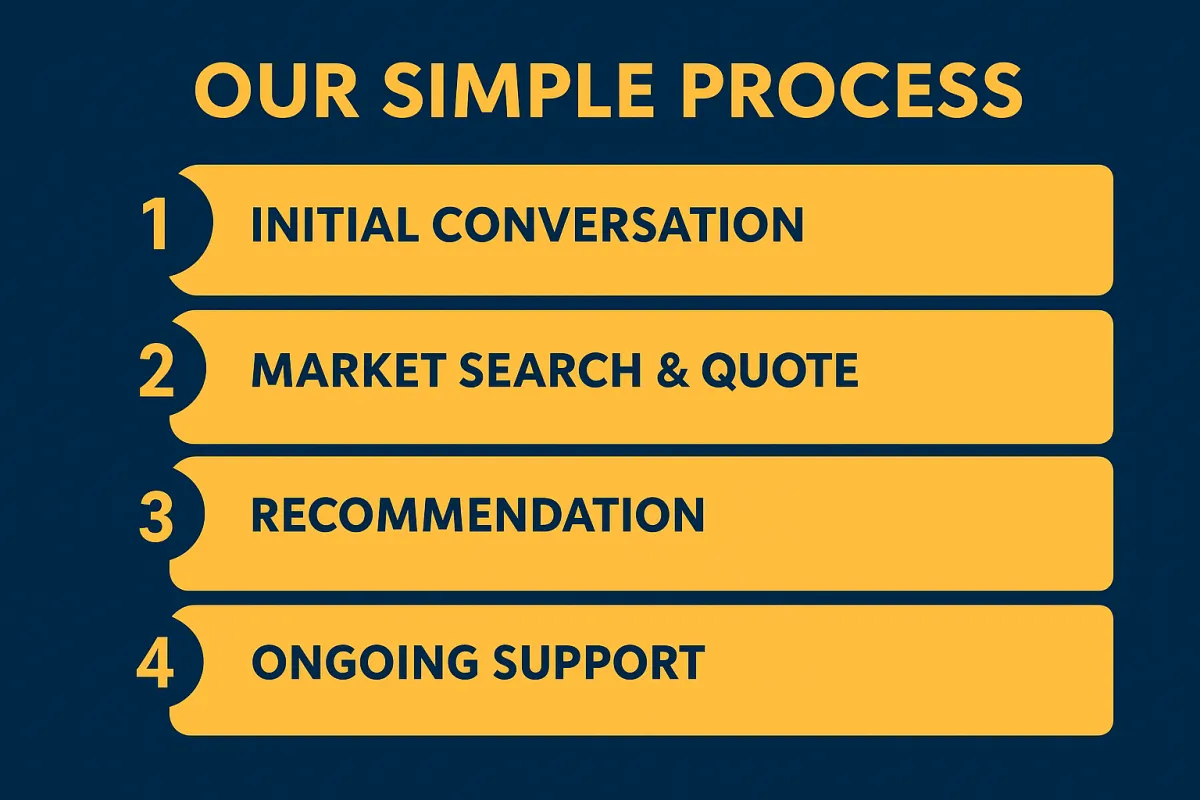
Re-placing cover after a fire is a structured process. Follow these steps to give yourself the strongest possible position in the specialist market.
- Obtain the fire cause evidence. Secure the fire-brigade report and any fire-investigation findings establishing how the fire started — this is the foundation of the whole submission.
- Complete and certify remediation. Repair and certify the cause — rewiring, structural works, duct cleaning — and keep all certificates and invoices.
- Upgrade and document fire controls. Install or improve alarms, suppression and hot-works procedures, and record them so the risk demonstrably improved.
- Revalue the sum insured. Commission a current reinstatement-cost assessment reflecting rebuilding to today's fire-safety standards.
- Refresh the fire risk assessment. Update the FRA and action every recommendation before approaching insurers.
- Build a full fair presentation. Assemble the disclosure — the fire, the cause, the remediation, any prior decline — clearly and accessibly, as the Insurance Act 2015 requires.
- Approach the specialist market through a broker. Let a specialist broker present the risk to Lloyd's and MGA markets that retain appetite, rather than retail panels that will decline.
- Review terms and set the indemnity period. Check excesses, warranties and a realistic business-interruption indemnity period before binding cover.

John has 13+ years' specialist commercial insurance experience and direct access to the Lloyd's market and specialist MGA schemes. He re-places businesses into cover after a fire — across manufacturing, hospitality, warehousing, waste and property — handling disclosure, fire-cause evidence and underinsurance so a single loss does not become a permanent barrier to insurability. More about John →
Fire claim insurance glossary
- Ab initio
- "From the beginning." A policy avoided ab initio is treated as never having existed, so no claims are payable under it.
- Avoidance
- An insurer's right to cancel a policy from inception for a qualifying breach of the duty of fair presentation, refusing claims under it.
- Betterment
- An improvement on the original property during reinstatement; insurers may resist paying for an upgrade beyond like-for-like.
- Business interruption
- Cover for lost gross profit and increased costs while the business cannot trade normally after a loss such as a fire.
- Cause investigation
- The process by which an insurer or fire investigator establishes how a fire started — central to whether the risk can be re-insured.
- Condition of average
- A clause reducing a claim payment in proportion to any underinsurance of the sum insured.
- Duty of fair presentation
- The Insurance Act 2015 obligation to disclose every material circumstance — including a prior fire — clearly to a prudent insurer.
- Indemnity period
- The maximum period for which business-interruption cover pays out — too short a period leaves a gap if the rebuild overruns.
- Loss adjuster
- A professional appointed by the insurer to investigate a claim and recommend settlement — they act for the insurer, not you.
- Loss assessor
- A professional you appoint to manage your claim on your behalf, often improving the settlement on complex fire losses.
- Material circumstance
- Any fact that would influence a prudent insurer's decision to take a risk or set its terms — a prior fire is a clear example.
- Moral hazard
- The risk that an insured's conduct or circumstances increase the likelihood of loss — heightened where a fire cause is suspicious.
- Proportionate remedy
- The Insurance Act 2015 remedy for innocent non-disclosure — the insurer applies the terms or reduced payment it would have set.
- Qualifying breach
- A breach of the duty of fair presentation that, but for it, would have changed the insurer's decision — unlocking its remedies.
- Reinstatement
- Rebuilding or repairing damaged property to its pre-loss condition — after a fire, usually to current building standards.
- Subrogation
- The insurer's right, after paying a claim, to pursue a third party responsible for the fire to recover its outlay.





Instagram
LinkedIn