


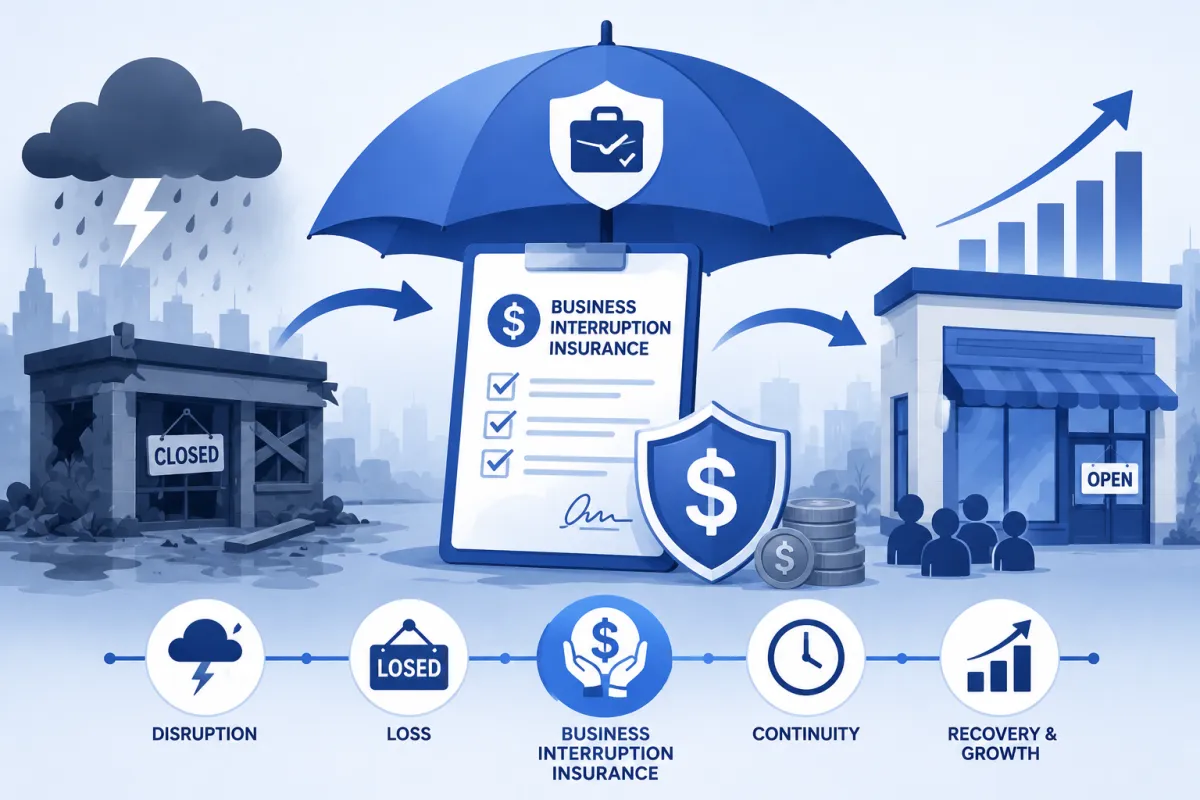
Business Interruption Insurance: Sum Insured & Indemnity
Why does business interruption insurance go wrong so often?
Business interruption (BI) insurance pays for the income you lose, and the extra costs you face, when insured damage such as a fire or flood stops your business trading. It is the cover that decides whether a business survives a major incident — and it is the cover UK firms get wrong more than any other. The reason is simple: the two numbers that drive the entire policy, the sum insured and the indemnity period, are routinely set on a misunderstanding. Owners plug in the wrong definition of profit, pick a 12-month recovery window that bears no relation to how long they'd actually take to rebuild, and never revisit either figure as the business grows.
None of this surfaces until you claim. By then the loss adjuster is applying the average clause to a sum insured that was 40% too low, the indemnity period has expired while the factory was still half-built, and the settlement falls catastrophically short of what the business needed to recover. This guide is the broker's-eye view of how to set both numbers correctly — and how the commercial property cover BI sits alongside fits together.
It is a close companion to our guide on underinsurance and the condition of average, and to the wider problem of commercial property underinsurance: the same average clause that cuts a building claim cuts a BI claim, but BI adds a second trap of its own — time. At Miller & Partner we approach every placement through The Insurability Framework™ — a structured method covering underwriter intelligence, difficult-risk expertise, risk assessment and claims advocacy — and BI is where that risk-assessment discipline earns its keep.
Business interruption: key facts at a glance
- Aviva research found only 21% of SMEs held a 24-month indemnity period, while 28% held just 12 months.
- In 2024, 43% of SMEs hit by a fire or flood needed between 12 and 24 months to fully recover — yet many hold only a 12-month indemnity period.
- The single biggest cause of BI underinsurance is confusing the insurance definition of gross profit with the accountant's — they are not the same figure.
- Insurance gross profit is turnover minus uninsured (variable) working expenses — not net profit, and not the accounting gross profit line.
- Indemnity periods are set in six-month steps; specialists usually recommend 24 or 36 months over the default 12.
- A declaration-linked basis applies an automatic uplift at claim (typically 133%) and deletes the average clause — the strongest single protection against BI underinsurance.
- Insure on a net profit basis by mistake and you might recover only around 20p in the £ of lost sales.
What is business interruption insurance and what does it actually cover?
Business interruption insurance — also called loss of profit or consequential loss cover — pays for the financial consequences of an insured event that physically damages your premises or property. Where your property policy pays to rebuild the building and replace the contents, BI pays for the income you lose while you can't trade, plus the extra costs of keeping the business going.
Critically, almost every standard BI policy is a material damage proviso cover: it only triggers if there has been physical damage that is itself covered under the property section (fire, flood, escape of water, impact, and so on). If the property claim is rejected — often because the building was underinsured or a condition was breached — the BI claim usually falls with it. The two covers are joined at the hip.
A correctly structured BI policy typically pays for three things during the indemnity period:
- Loss of gross profit — the reduction in turnover, converted to lost profit using your rate of gross profit, so the business can still meet fixed overheads (rent, salaries, loan repayments).
- Increased cost of working — the reasonable extra expense of maintaining trade (temporary premises, overtime, outsourcing, hired equipment).
- Additional expenses — including, uniquely to BI, the cost of the accountant or auditor needed to prepare and substantiate the claim itself.
Insurance gross profit vs accounting gross profit — what's the difference?
This is the heart of BI underinsurance, and the distinction that costs businesses the most. When you ask your accountant for "gross profit," they give you the accounting figure — turnover minus cost of sales. When an insurer says "gross profit," they mean something different and almost always larger: turnover minus only the uninsured working expenses — the genuinely variable costs that stop when the business stops, such as raw materials, stock purchases and carriage.
The difference matters because most overheads do not stop when you stop trading. Rent, salaries, business rates and loan repayments all continue while the factory is shut. Insurance gross profit is designed to keep paying those standing costs — so it deliberately excludes only the costs that genuinely fall away. Hand the insurer your accountant's gross profit (or worse, your net profit) and you under-declare massively.
| Basis used | What it means | Effect on your claim |
|---|---|---|
| Insurance gross profit (correct) | Turnover minus uninsured (variable) working expenses. Keeps paying standing overheads through the shutdown. | Full recovery of lost profit and fixed costs across the indemnity period. |
| Accounting gross profit (common error) | Turnover minus cost of sales as defined for the statutory accounts — often deducts wages and other costs an insurer treats as standing. | Sum insured set too low; average clause cuts the claim proportionally. |
| Net profit (severe error) | Profit after all overheads. Ignores that fixed costs continue during the interruption. | Catastrophic shortfall — recovery can fall to roughly 20p per £1 of lost sales. |
| Gross revenue / turnover basis | Insures total income rather than profit. Suited to businesses with few variable costs (e.g. professional services). | Appropriate for low-variable-cost firms; broader, usually higher premium. |
Some insurers now use the terms "insurance profit," "insurable profit" or "insurance gross profit" on the schedule precisely to stop the accountant's definition creeping in. If your schedule just says "gross profit," confirm in writing which definition the wording uses before you rely on a figure from your accounts.
From recent placement conversations
"The most avoidable shortfalls I see come from one line on a proposal form. A manufacturer copies the gross profit figure straight off their accounts, the broker doesn't query it, and three years later a fire claim settles at a fraction of the real loss because the accountant's gross profit had wages netted out of it."
"My rule with clients is simple: never declare a BI figure your accountant hasn't seen the insurance definition for. The BIBA declaration form exists for exactly this reason — it walks the accountant through the insurer's calculation, line by line, so the number that goes on the schedule is the number that pays out."
How do you calculate your business interruption sum insured?
The principle is to imagine the worst happens on the last day of your policy year, then project your insurance gross profit forward across the entire indemnity period — allowing for growth and inflation. Get the projection wrong and even a "correct" definition leaves you short.
- Start with insurance gross profit for the coming year, calculated on the insurer's definition (turnover minus uninsured working expenses).
- Scale it to the indemnity period. A 24-month indemnity period needs roughly two years of insurance gross profit as the sum insured, not one.
- Add for trends and inflation. If a loss strikes on the final day of the policy year and runs for a 24-month indemnity period, your claim may not conclude until almost three years after you set the figure. A worked industry example showed a 17% gap purely from failing to allow for growth across that window.
- Consider a declaration-linked basis (below), which builds an automatic uplift in and removes the average clause altogether.
What is the indemnity period, and why is 12 months usually too short?
The maximum indemnity period is the longest time your BI policy will keep paying after an insured loss — measured from the date of the damage, not the date of the policy renewal. It is an estimate of how long your business would take to get fully back to the trading position it would have reached had the loss never happened. When it expires, payments stop, even if you have not yet recovered and even if you have not used your full sum insured.
The default offered on most package policies is 12 months — and for most businesses that is dangerously short. Recovery is not the same as rebuilding. Even if the premises are repaired in six months, you then have to re-fit, re-stock, re-hire, win back lost customers and rebuild turnover to where it would otherwise have been. Aviva's 2024 claims data showed 43% of SMEs hit by a fire or flood needed between 12 and 24 months to recover, which is why it moved to a minimum 24-month indemnity period on its FastTrade SME policies.
| Indemnity period | Typically suitable for | Watch-outs |
|---|---|---|
| 12 months | Simple service businesses with no specialist premises, easily relocated. | Too short for anyone reliant on a specific building, plant or planning consent. |
| 24 months | Most SMEs — shops, offices, light industrial, hospitality. | The sensible modern default; sum insured must cover the full two years. |
| 36 months | Manufacturers, listed/heritage premises, bespoke plant, regulated sites. | Long lead times on rebuild, plant replacement or re-licensing justify the longer window. |
| 48+ months | Highly specialised facilities, complex supply chains, slow-recovery sectors. | Requires careful projection and specialist placement. |
Ask the practical question: if your main premises were destroyed tonight, how long — realistically — before turnover is back to where it would have been? Factor in demolition, planning, rebuild, fit-out, re-stocking, re-hiring and customer recovery. For a manufacturer with bespoke machinery on long lead times, 12 months barely covers the demolition and planning stage. Manufacturers in particular are routinely under-set on indemnity period; our manufacturing insurance page covers how BI fits alongside machinery breakdown and engineering inspection.
What is the declaration-linked basis, and why does it remove the average clause?
A declaration-linked policy is the broker's preferred way to write gross-profit BI cover, because it largely engineers underinsurance out of the policy. Instead of fixing a hard sum insured, you declare your estimated insurance gross profit for the year ahead. The insurer then:
- Applies an automatic uplift — typically 133% (a one-third increase) — to that declared figure, building in headroom for unexpected growth; and
- Deletes the average clause entirely, so a partial under-declaration does not trigger a proportional cut to the claim.
At the end of each year you declare your actual gross profit and the premium is adjusted up or down. The combination of built-in uplift and no average clause is the single strongest structural defence against BI underinsurance — and it is why, on a declaration-linked basis, an honest under-estimate is forgiven in a way it never is on a fixed sum-insured "loss limit" policy.
What does business interruption insurance not cover?
Standard BI cover is tied to physical damage, which leaves several gaps that catch businesses out. Understanding these is half the battle:
- Non-damage interruption. If there's no physical damage trigger, standard BI doesn't respond. The 2021 Supreme Court ruling in the FCA's COVID-19 test case turned entirely on whether specific non-damage wordings (denial of access, notifiable disease) were engaged — most standard policies were not.
- Pandemics and communicable disease are now widely excluded in new wordings following COVID-19.
- Cyber-driven interruption. A ransomware attack that halts trading is a non-damage event — it belongs under cyber insurance, not property BI.
- Supplier or customer failure unless you have specifically added contingent business interruption extensions (below).
- Loss beyond the indemnity period, however far short of full recovery you are when it expires.
Which businesses need the longest indemnity periods?
Select a business type to see the BI structure we'd typically recommend — basis of cover, indemnity period and key extensions. A starting point only; correct figures come from a proper review against your commercial insurance programme.
Manufacturer
Retailer / shop
Restaurant / hospitality
Office / professional services
Landlord (loss of rent)
Wholesaler / distributor
Is your BI cover set up correctly?
Tick each statement that's true of your current policy. The more you can tick, the better protected you are. Unticked items are where shortfalls hide.
How exposed is your business to a BI shortfall?
A quick two-factor gauge of your indemnity-period exposure. Indicative only.
How does the Insurance Act 2015 affect business interruption claims?
The Insurance Act 2015 reshaped how commercial cover responds when the figures or facts presented to insurers turn out to be wrong. It replaced the old "all-or-nothing" remedy with a duty of fair presentation and a set of proportionate remedies, and both bear directly on BI.
Under the duty, you must disclose every material circumstance you know or ought to know, in a reasonably clear and accessible way. For BI, the most material circumstances are your gross profit figures, your indemnity period and the dependencies your income relies on. If you under-declare gross profit — even innocently — and the insurer can show it would have charged more or imposed different terms, the Act allows a proportionate reduction of the claim. In practice that produces an average-style cut even where the policy carries no traditional average clause, which is exactly why a declaration-linked basis (with average deleted) is so valuable.
The Act cuts both ways, though. It rewards businesses that present their risk carefully and gives insurers far less room to walk away from a claim over a trivial, non-prejudicial error. The lesson for BI is the same one that runs through every adverse or non-standard placement: present the risk fully and accurately, document the basis of every figure, and the policy does what it should. Miller & Partner's role through the Insurability Framework is to make that presentation watertight.
What are increased and additional increased cost of working?
Two extensions are routinely confused, and the difference can decide whether you can afford to keep trading after a loss.
Increased Cost of Working (ICW)
ICW covers the reasonable extra costs of maintaining turnover after a loss — temporary premises, overtime, hired plant, outsourced production — but only up to the amount it saves in gross profit. This is the "economic limit": the insurer will fund extra spend only so far as it reduces the BI claim. For most businesses that is sufficient and it is built into standard gross-profit cover.
Additional Increased Cost of Working (AICW)
AICW removes the economic limit. It funds extra costs that are commercially essential even where they exceed the gross profit saved — for example, keeping a flagship contract or a critical customer that the business cannot afford to lose, regardless of the short-term maths. Manufacturers, contract suppliers and businesses with concentrated customer bases should treat AICW as close to essential.
Which BI extensions should you consider?
The base policy covers damage at your own premises. The extensions below close the gaps that catch real businesses out — add the ones your income genuinely depends on:
- Suppliers & customers (contingent BI) — responds when damage at a key supplier's or customer's premises interrupts your income, even though your own premises are untouched. Our contingent business interruption guide explains how to set it up.
- Denial of access / prevention of access — covers loss when you can't reach or use your premises because of damage nearby (a fire next door, a police cordon).
- Loss of attraction — protects businesses whose footfall depends on a nearby draw (an anchor store, a tourist site) that is itself damaged.
- Public utilities — failure of electricity, gas, water or telecoms supply, usually subject to specified causes and time excesses.
- Notifiable disease / vermin / defective sanitation — narrow, defined-peril extensions for hospitality and food businesses (post-COVID, scrutinise the disease wording closely).
- Book debts — covers irrecoverable receivables where your records are destroyed.
For income loss that has no physical trigger — a cyber attack, a data breach — standard BI won't respond at all. That exposure belongs under a cyber insurance policy with its own business-interruption section, and supplier insolvency belongs under trade credit insurance.
What drives the cost of business interruption insurance?
BI premium is rated alongside your property cover and reflects how much income is at risk, for how long, and how easily the business could recover. The factors below move the price — and most can be influenced.
| Rating factor | Why it affects premium | How to improve it |
|---|---|---|
| Insurance gross profit sum insured | The headline figure being insured; higher gross profit means more income at risk. | Declare accurately on the insurance definition; don't pad, don't under-state. |
| Indemnity period | Longer periods mean the insurer is on risk for more potential loss. | Match to realistic recovery time — neither inflate nor cut to save premium. |
| Trade / sector | Manufacturing, food and chemical risks recover slowly and carry higher BI exposure. | Evidence resilience measures specific to your sector. |
| Premises construction | Combustible or single-site construction lengthens likely interruption. | Fire-resistant construction, compartmentation, sprinklers. |
| Single vs multiple sites | A single site means a total loss halts all trading; multiple sites spread risk. | Document ability to shift production/trade to another location. |
| Supply-chain concentration | Reliance on one key supplier or customer raises contingent BI exposure. | Diversify suppliers; document alternative sourcing plans. |
| Business continuity plan | A tested plan shortens recovery and reassures underwriters. | Maintain and test a written continuity/disaster-recovery plan. |
| Claims history | Prior BI or property losses signal recurring exposure. | Show remediation since past losses; see cover after a claims history. |
| Fire and security protections | Better protection reduces both the chance and severity of interruption. | Alarms, sprinklers, regular maintenance, certified contractors. |
| Stock and seasonality | Peak-period losses hurt more; seasonal businesses need tailored wording. | Use a seasonality clause; align stock and BI declarations. |
| Extensions selected | Suppliers, denial of access and AICW each add exposure and premium. | Buy what you depend on; drop extensions that don't apply to you. |
| Basis of cover | Declaration-linked carries an uplift; loss-limit basis can be cheaper but riskier. | Declaration-linked usually offers the best protection-per-pound. |
| Excess / time excess | A waiting period before BI pays reduces premium. | Accept a modest time excess if cash flow allows. |
| Quality of presentation | A clear, well-evidenced submission earns better terms under the Insurance Act 2015. | Use a specialist broker to present the risk fully and accurately. |
What do real business interruption claims look like, and how do you handle one?
Three anonymised but representative claims show how the sum insured and indemnity period decide the outcome.
How do you handle a business interruption claim?
If the worst happens, the process below gives the best chance of a full settlement:
- Notify immediately. Tell your broker and insurer the moment the incident occurs — BI runs from the date of damage, so the clock starts straight away.
- Mitigate the loss. Take reasonable steps to limit the interruption: secure the premises, arrange temporary trading, protect stock. You have a duty to mitigate.
- Confirm the material damage claim. BI usually depends on a valid property claim; make sure the property element is accepted, because the BI claim normally falls with it.
- Engage your accountant early. BI uniquely covers the cost of preparing the claim — bring in your accountant or a forensic accountant to quantify lost gross profit.
- Document the trading position. Gather management accounts, prior-year figures and forward projections to evidence what turnover would have been but for the loss.
- Track increased costs of working. Keep every receipt for temporary premises, overtime, outsourcing and hire — these are recoverable, subject to the policy basis.
- Manage the indemnity period actively. Monitor recovery against the period; if it's running slow, flag it early, because payments stop when the period ends.
- Review cover at renewal. After settlement, reassess the sum insured and indemnity period against what the claim revealed about real recovery time.

John has 13+ years' specialist commercial insurance experience, including structuring business interruption and commercial combined cover for manufacturers, retailers and property owners. A former #1 Account Executive at Brown & Brown and #1 Salesperson at AXA, he has direct access to the Lloyd's market and specialist MGA schemes, and reviews BI sums insured and indemnity periods so claims pay out in full. More about John.
Business interruption glossary
- Business interruption (BI)
- Cover for loss of income and extra costs following an insured event that physically damages your premises or property.
- Insurance gross profit
- Turnover minus uninsured (variable) working expenses. The correct basis for most BI sums insured — not the accountant's gross profit.
- Uninsured working expenses
- Genuinely variable costs (e.g. raw materials, purchases) that stop when trading stops, and so are deducted to reach insurance gross profit.
- Indemnity period
- The maximum time BI cover pays after a loss, measured from the date of damage; an estimate of full recovery time.
- Maximum indemnity period
- The ceiling on the indemnity period stated in the policy; payments stop at this point even if recovery is incomplete.
- Declaration-linked basis
- A gross-profit basis where you declare an estimate, the insurer adds an automatic uplift (typically 133%) and the average clause is deleted.
- Average clause
- A condition allowing the insurer to reduce a claim in proportion to underinsurance. Deleted under a declaration-linked basis.
- Increased cost of working (ICW)
- Extra costs of maintaining turnover after a loss, recoverable up to the gross profit they save (the economic limit).
- Additional increased cost of working (AICW)
- Extra costs that are commercially essential even beyond the economic limit; removes the ICW cap.
- Material damage proviso
- The condition that a BI claim depends on a valid, paid property damage claim under the same or a linked policy.
- Contingent business interruption
- Cover (via suppliers/customers extensions) for income lost when damage occurs at a third party's premises, not your own.
- Denial of access
- An extension covering loss when you can't reach or use your premises due to damage nearby.
- Loss of attraction
- An extension protecting businesses whose footfall depends on a nearby draw that is itself damaged.
- Rate of gross profit
- Gross profit expressed as a percentage of turnover, used to convert lost sales into a loss of profit at claim.
- Duty of fair presentation
- The Insurance Act 2015 obligation to disclose material circumstances clearly; breach can lead to proportionate remedies.
- Proportionate remedy
- Under the Insurance Act 2015, an insurer's right to reduce a claim in proportion to a non-deliberate misrepresentation or non-disclosure.
- Loss limit basis
- A BI basis insuring a capped maximum loss rather than full annual gross profit; can be cheaper but riskier than declaration-linked.
Business interruption insurance: frequently asked questions
Is business interruption insurance a legal requirement in the UK?
No. Unlike employers' liability, BI is not legally required. But it is one of the most important commercial covers, because it determines whether a business can survive the loss of income that follows a fire, flood or major incident.
What is the difference between insurance gross profit and accounting gross profit?
Accounting gross profit is turnover minus cost of sales as defined for your statutory accounts, and often deducts wages. Insurance gross profit is turnover minus only the uninsured (variable) working expenses that stop when trading stops, so it keeps paying standing overheads. The insurance figure is usually larger — using the accounting one under-insures you.
How long should my indemnity period be?
As long as it would realistically take to get turnover back to where it would have been — not just to reopen. For most SMEs that is 24 months; for manufacturers, heritage or specialist premises it is often 36 months or more. Twelve months is rarely enough for any business reliant on a specific building or plant.
What is a declaration-linked policy and should I have one?
You declare your estimated insurance gross profit, the insurer applies an automatic uplift (typically 133%) and the average clause is deleted. It is the strongest structural protection against BI underinsurance, so for most gross-profit risks the answer is yes.
Does business interruption cover a pandemic or COVID-style closure?
Almost never under standard wordings. The 2021 Supreme Court FCA test case showed cover depended entirely on specific non-damage clauses, and most new policies now exclude communicable disease and pandemics outright.
Does it cover a cyber attack that stops me trading?
No — a ransomware shutdown is a non-damage event, so standard property-based BI won't respond. That exposure sits under a cyber insurance policy with its own business-interruption section.
What happens if my supplier or customer has a fire, not me?
Standard BI only responds to damage at your own premises. To be covered when a key supplier or customer is hit, you need a suppliers & customers (contingent BI) extension added to the policy.
Can my BI claim be reduced even without an average clause?
Yes. Under the Insurance Act 2015, if you under-declare gross profit and the insurer would have charged more or set different terms, it can apply a proportionate remedy — producing an average-style cut. A declaration-linked basis is the cleanest defence.
Does business interruption pay my accountant's fees for the claim?
Yes — uniquely among insurance classes, BI allows the reasonable cost of the accountant or auditor needed to prepare and substantiate the claim to form part of the claim itself. Engage them early.
What does business interruption insurance cost?
It's rated alongside your property cover and depends on your gross profit, indemnity period, sector, premises and protections. There is no flat figure — the right question is not "what's the cheapest" but "is the sum insured and indemnity period correct," because an under-set policy is the expensive one when you claim.
How often should I review my BI figures?
At least annually, and whenever the business changes materially — growth, new premises, new product lines or a longer rebuild profile. Inflation and growth quietly erode an adequate sum insured between renewals.
Why use a specialist broker for business interruption cover?
Because BI is where the most expensive mistakes hide, and they only surface at claim. A specialist sets the sum insured on the correct basis, matches the indemnity period to real recovery time and presents the risk to satisfy the Insurance Act 2015. Miller & Partner approaches every placement through The Insurability Framework — underwriter intelligence, difficult-risk expertise, risk assessment and claims advocacy. See our commercial insurance page.







Instagram
LinkedIn