



Directors & Officers (D&O) Insurance UK: SME Guide
Why does "limited liability" not protect directors personally?
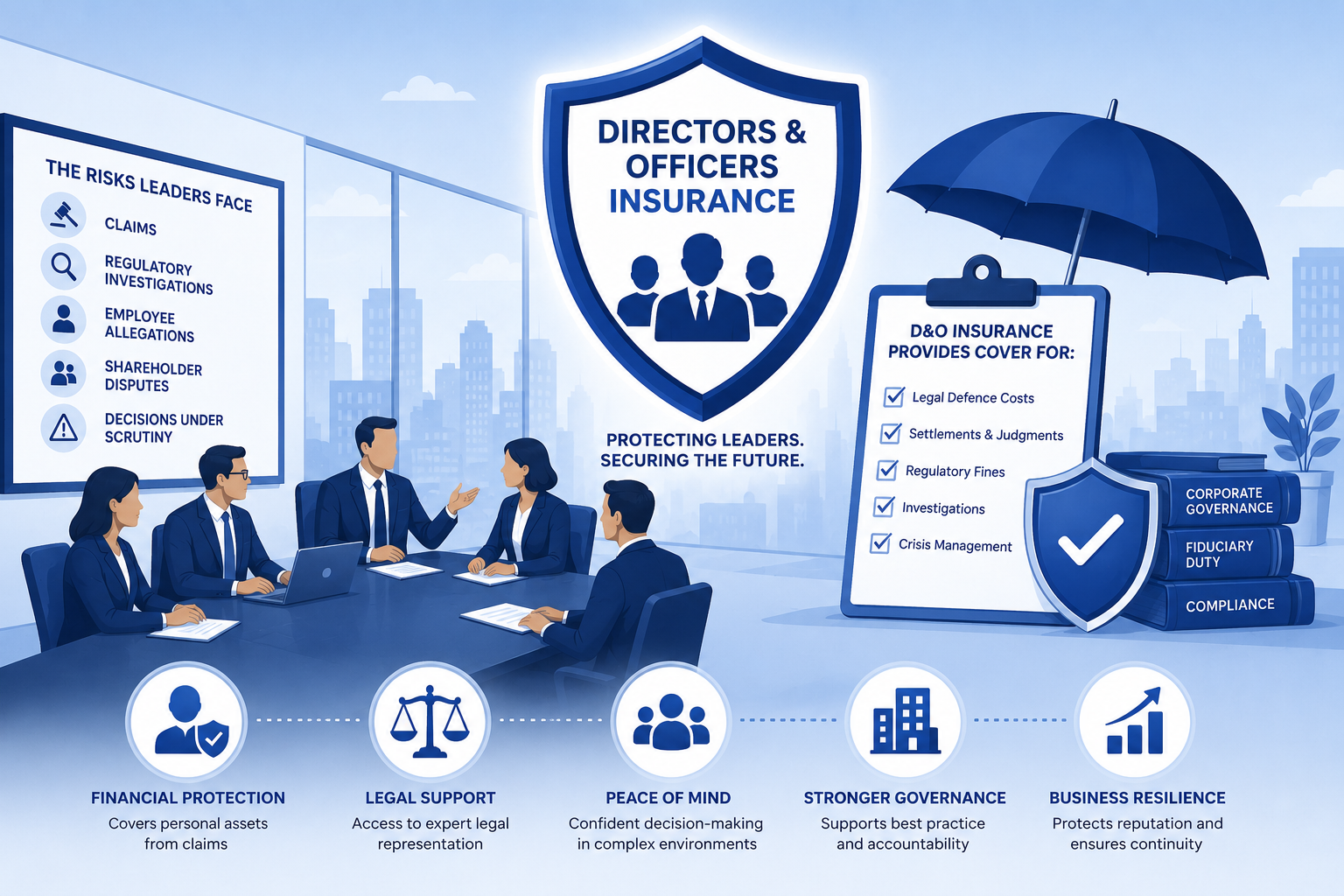
Most directors believe that incorporating as a limited company draws a clean line between the business and themselves. For ordinary trade debts, that is broadly true. But it is one of the most dangerous half-truths in business, because a long list of claims can be brought against directors personally — putting their home, savings and other assets directly at risk, regardless of the "Ltd" after the company name.
As a director you can carry unlimited personal liability, and claims can be made directly against you by regulators, shareholders, creditors, employees, liquidators and other directors. The legal costs of defending those claims are substantial even when the allegation is baseless, and an undefended allegation can result in judgment by default. Directors & officers (D&O) insurance — usually bought as part of a wider management liability policy — is the cover that funds the defence and protects personal assets.
This is not a big-company concern. The exposure exists from the day you incorporate, and SME directors are arguably more at risk because they rarely have in-house legal teams or the personal reserves to absorb a six-figure defence. At Miller & Partner we structure this cover through The Insurability Framework™ — a method covering underwriter intelligence, difficult-risk expertise, risk assessment and claims advocacy — because the wording detail here decides whether a director is genuinely protected or merely feels protected.
Directors & officers cover: key facts at a glance
- As a director you can carry unlimited personal liability — claims can be made directly against you, putting personal assets at risk.
- D&O becomes relevant the day you register a limited company or LLP, not just for listed or large firms.
- "Limited" liability does not protect directors personally for breach of duty, wrongful trading or regulatory offences.
- Management liability usually bundles three covers: D&O, Employment Practices Liability (EPL) and Corporate Legal Liability (CLL).
- The Companies Act 2006 codifies seven statutory duties every director owes — breach can trigger a personal claim.
- Continuing to trade while insolvent can lead to personal liability for wrongful trading under the Insolvency Act 1986.
- SME take-up of D&O remains low despite rising regulatory and litigation exposure — a classic protection gap.
What is D&O insurance and what does it cover?
Directors & officers (D&O) insurance is designed principally to cover the personal liability of directors and officers for alleged wrongful acts committed in their capacity as managers of the company. "Officers" extends beyond the board to those with managerial responsibility — a company secretary, a general counsel, a risk manager, a data protection officer and senior employees acting in a management role.
The policy pays two things in particular: the cost of defending a claim or investigation, and any damages or settlement the director becomes liable to pay. Because defence costs are typically the largest and most immediate exposure — racking up long before any liability is established — a policy that funds defence from the outset is the practical heart of the cover. It typically responds to:
- Claims by shareholders and investors (breach of duty, misrepresentation in a pitch deck or accounts);
- Claims by creditors and liquidators following insolvency (wrongful trading, misfeasance);
- Regulatory investigations and prosecutions (HSE, FCA, HMRC, the Information Commissioner);
- Employment-related allegations against individual managers (via the EPL section);
- Allegations of health & safety breaches, including corporate manslaughter investigations.
D&O vs professional indemnity — what's the difference?
This is the confusion that leaves the biggest gap. People assume their professional indemnity (PI) policy covers personal liability claims against directors. It almost never does. The two policies protect against entirely different things:
| Professional indemnity (PI) | Directors & officers (D&O) | |
|---|---|---|
| Who it protects | The business / professional providing services. | Individual directors and officers personally. |
| What it covers | Claims arising from professional work — negligent advice, errors, omissions. | Claims arising from managing the company — breach of duty, mismanagement, regulatory acts. |
| Who brings the claim | Clients / customers of the professional service. | Shareholders, creditors, regulators, employees, liquidators, co-directors. |
| Typical trigger | "Your advice cost me money." | "As a director, you breached your duties / broke the law." |
| Personal asset protection | No — protects the business, not the individual director. | Yes — designed to protect the director's personal assets. |
In short: PI answers "did your work harm a client?"; D&O answers "did you, as a director, breach a duty or fall foul of a regulator?". A consultancy can need both, and many do. If your firm provides professional advice, see our professional indemnity guide alongside this one.
What is management liability, and how do the three covers fit together?
For most SMEs, D&O is sold inside a packaged management liability policy that bundles three related covers. Buying them together is usually cheaper and avoids the gaps that appear when covers are arranged piecemeal:
- Directors & officers (D&O) — protects individual directors and officers personally for management wrongful acts.
- Employment practices liability (EPL) — covers claims of unfair dismissal, discrimination, harassment and other employment wrongs, brought against the company or its managers.
- Corporate / company legal liability (CLL) — covers the company entity itself for certain claims and the cost of responding to investigations against the business.
Some policies extend further to pension trustee liability, crime/fidelity and tax investigation cover. The right combination depends on your headcount, sector and ownership structure — which is exactly what a review against your wider commercial insurance programme is for.
What are a director's statutory duties under the Companies Act 2006?
The Companies Act 2006 codifies seven general duties that every director owes the company. They are legal obligations, not best-practice guidance, and they apply to executive, non-executive, shadow and de facto directors alike:
- Act within powers — exercise powers for their proper purpose and in line with the constitution.
- Promote the success of the company — for the benefit of members as a whole (and, in the zone of insolvency, creditors).
- Exercise independent judgment.
- Exercise reasonable care, skill and diligence — judged by both an objective standard and the director's actual knowledge.
- Avoid conflicts of interest.
- Not accept benefits from third parties.
- Declare interests in proposed transactions or arrangements.
Breach of any of these can give rise to a personal claim against the director — and the modern reality is a steadily more litigious, more regulated environment in which those claims are brought more often. D&O exists to fund the defence and any liability that follows.
From recent placement conversations
"The sentence I hear most often is 'but we're a small limited company, surely we don't need that.' It's exactly backwards. A FTSE board has lawyers on retainer and the reserves to ride out an investigation. A three-director SME has the founder's house on the line and no buffer at all."
"The trigger that catches directors out is almost never the thing they worried about. It's an HSE investigation after an accident, a discrimination claim from a departing employee, or a liquidator's letter eighteen months after the company folded. By then it's far too late to arrange cover."
Who needs D&O insurance — and who doesn't?
As a rule, D&O is relevant to any organisation with a formal management structure where individuals make decisions on behalf of others:
- Limited companies and LLPs — relevant from incorporation, whatever the size.
- Startups raising investment — investors and shareholders are a common source of claims, and many investors require D&O as a condition of funding.
- Charities and non-profits — trustees carry personal duties and exposure too.
- Family businesses — internal shareholder disputes are a frequent and overlooked trigger.
The clearest exception is the sole trader. With no legal separation between the person and the business, there is no "director" to protect — the relevant covers are usually business liability and, where advice is given, professional indemnity. See our sole proprietorship insurance guide for that structure.
What kinds of claims actually trigger a D&O policy?
The exposures that lead to real claims are rarely the dramatic ones. The common triggers are:
- Insolvency-related claims — liquidators pursuing directors for wrongful trading, misfeasance or breach of the creditor duty.
- Regulatory investigations — the HSE, FCA, HMRC or Information Commissioner examining the conduct of the company and its directors.
- Employment claims — discrimination, harassment or unfair dismissal allegations naming managers personally.
- Health & safety prosecutions — directors personally prosecuted after a workplace injury or, in the gravest cases, corporate manslaughter.
- Shareholder and investor disputes — allegations of misrepresentation, breach of duty or mismanagement.
- Creditor and supplier actions where a director is alleged to have acted improperly.
What does D&O insurance not cover?
D&O is broad but not unlimited. Typical exclusions and gaps include:
- Fraud and dishonesty — deliberate dishonest or fraudulent acts are excluded, though defence costs are often advanced until guilt is finally established.
- Bodily injury and property damage — these belong under public and employers' liability, not D&O.
- Professional services claims — covered by PI, not D&O.
- Prior known claims — circumstances you were already aware of before inception.
- The "major shareholder exclusion" — many policies exclude claims brought by a shareholder owning a large stake (commonly 15% or more); check this carefully in owner-managed businesses.
- Fines and penalties that are uninsurable as a matter of law (though associated defence costs are usually covered).
Which organisations need management liability cover?
Select an organisation type to see the management liability structure we'd typically recommend. A starting point only — the right limits and extensions come from a proper review.
Limited company (SME)
LLP / partnership
Startup with investors
Charity / non-profit
Family business
Sole trader
Is your D&O cover fit for purpose?
Tick each statement that's true of your current policy. The unticked items are where the gaps usually hide.
How exposed are your directors right now?
A quick two-factor gauge of management-liability exposure. Indicative only.
How does insolvency expose directors personally?
Insolvency is where the "limited liability" myth collapses most dramatically, and it is one of the leading sources of D&O claims. When a company is solvent, directors' duties point towards the shareholders. But the Insolvency Act 1986 and the Companies Act 2006 together shift that focus the moment the company enters the "zone of insolvency" — and the personal exposures multiply.
Wrongful trading
If a company goes into insolvent liquidation or administration and a director knew, or ought to have concluded, that there was no reasonable prospect of avoiding it — yet kept trading and running up debts — a court can order that director to contribute personally to the company's assets. The defence is to show you took every step you ought to have taken to minimise loss to creditors. In practice this is a genuine, regularly litigated risk, not a theoretical one.
Misfeasance and the creditor duty
Liquidators can also bring misfeasance proceedings for breach of duty, and the Supreme Court has confirmed that once a company is bordering insolvency, directors must weigh creditors' interests — not just shareholders'. High-profile rulings have seen directors ordered to pay very large sums for continuing to trade a distressed company in breach of duty.
Fraudulent trading and disqualification
Fraudulent trading — carrying on business with intent to defraud creditors — carries both personal liability and criminal penalties. And directors whose conduct falls below the expected standard can be disqualified from acting as a director. A well-structured D&O policy funds the defence of these allegations (subject to the fraud exclusion, where defence costs are typically advanced until dishonesty is finally proven).
What are Side A, B and C cover?
D&O policies are built from three "sides," and understanding them explains who is actually protected:
- Side A — directors personally. Pays the directors and officers directly when the company cannot or will not indemnify them — for example because it is insolvent or legally barred from doing so. This is the cover that protects personal assets when it matters most.
- Side B — company reimbursement. Reimburses the company when it has indemnified its directors for a covered claim. In practice this is how most claims are paid while the company is solvent.
- Side C — entity cover. Covers the company itself when it is named in certain claims (typically securities claims). More relevant to larger or listed companies, but worth understanding.
The critical point for SME directors is Side A: it is the layer that responds precisely when the company has failed and can no longer protect them — the very moment, after insolvency, when directors are most likely to be pursued personally.
What drives the cost of D&O insurance?
D&O premiums reflect how likely and how expensive a claim against the directors might be. The factors below move the price — and several can be actively managed through good governance.
| Rating factor | Why it affects premium | How to improve it |
|---|---|---|
| Turnover and balance sheet | Larger and more complex businesses present bigger potential claims. | Accurate figures; demonstrate financial stability. |
| Financial health | Distress or insolvency risk sharply increases the chance of a claim. | Strong management accounts, healthy cash flow, clean filings. |
| Sector | Regulated, financial and high-risk sectors carry more exposure. | Evidence sector-specific compliance and controls. |
| Number of employees | More staff means more employment-practices claim potential. | Robust HR policies, documented procedures, training. |
| Ownership / shareholders | External investors and disputes raise claim likelihood. | Clear shareholder agreements; manage the shareholder exclusion. |
| Claims and investigation history | Prior claims or regulatory action signal recurring risk. | Show remediation; see cover with a claims history. |
| Limit of indemnity | Higher limits cost more but match real defence-cost exposure. | Set the limit to a realistic worst-case defence, not the minimum. |
| Corporate governance | Strong board processes reduce both the chance and severity of claims. | Minuted decisions, conflict registers, documented duties. |
| International exposure | Overseas operations (especially US) add litigation risk. | Disclose and ring-fence overseas activity. |
| Funding / transaction activity | Raises, M&A and IPOs heighten investor-claim exposure. | Align cover to transaction timing and scale. |
| Run-off requirement | Closing or selling triggers run-off cover needs. | Arrange run-off proactively at exit, not after. |
| Quality of presentation | A clear, well-evidenced submission earns better terms. | Use a specialist broker to present the risk fully and accurately. |
What do real D&O claims look like, and how do you handle one?
Three anonymised but representative claims show how personal exposure plays out — and why the cover matters.
How do you handle a D&O claim?
D&O is written on a claims-made basis, so the single most important rule is to notify early — including circumstances that might become claims:
- Notify a circumstance early. Tell your broker and insurer as soon as you're aware of a claim or anything that could become one — late notification can void cover.
- Do not admit liability. Avoid agreeing anything with a claimant or regulator before speaking to insurers, as it can prejudice the policy.
- Preserve documents. Secure board minutes, financial records and correspondence relevant to the allegation.
- Engage policy-approved legal advice. D&O funds defence costs — use insurer-approved solicitors so the defence is covered and properly run.
- Identify everyone who should be covered. Confirm which directors, officers and senior managers are insured, including past and retired directors.
- Respond to investigations promptly. Regulatory investigations carry deadlines — coordinate through insurer-appointed advisers.
- Manage the defence and any settlement. Work with appointed lawyers to defend or settle within policy terms and the limit.
- Review cover after resolution. Reassess limits, breadth and run-off needs against what the claim revealed.

John has 13+ years' specialist commercial insurance experience, including arranging directors & officers and management liability cover for SMEs, startups, family businesses and charities. A former #1 Account Executive at Brown & Brown and #1 Salesperson at AXA, he has direct access to the Lloyd's market and specialist MGA schemes, and structures D&O cover so directors are protected personally when it matters most. More about John.
Directors & officers glossary
- Directors & officers (D&O) insurance
- Cover for the personal liability of directors and officers arising from alleged wrongful acts in managing the company.
- Management liability
- A packaged policy bundling D&O, employment practices liability and corporate legal liability.
- Employment practices liability (EPL)
- Cover for employment-related claims — unfair dismissal, discrimination, harassment — against the company or its managers.
- Corporate legal liability (CLL)
- Entity cover protecting the company itself for certain claims and the cost of responding to investigations.
- Wrongful act
- An actual or alleged breach of duty, neglect, error, misstatement or omission by a director or officer in their capacity.
- Claims-made basis
- A policy that responds to claims first made (and notified) during the policy period, regardless of when the act occurred.
- Run-off cover
- Continued protection for directors after a company closes or is sold, for claims relating to their period in office.
- Side A / B / C
- The three layers of D&O: directors personally (A), company reimbursement (B) and entity cover (C).
- Wrongful trading
- Continuing to trade when there is no reasonable prospect of avoiding insolvency (Insolvency Act 1986, s.214), risking personal contribution.
- Misfeasance
- A breach of duty by a director that a liquidator can pursue to recover loss to the company.
- Fraudulent trading
- Carrying on business with intent to defraud creditors — both personal liability and criminal penalties may follow.
- Creditor duty
- The shift in directors' duties towards creditors' interests once the company is in the "zone of insolvency."
- Disqualification
- A court order barring a person from acting as a company director where their conduct falls below the expected standard.
- Major shareholder exclusion
- A common exclusion removing cover for claims brought by a shareholder owning a large stake (often 15% or more).
- Statutory duties
- The seven general duties every director owes under the Companies Act 2006 (ss.171–177).
- Shadow / de facto director
- A person who directs the company without formal appointment; they owe the same duties and carry the same exposure.
D&O insurance: frequently asked questions
Does limited liability protect me as a director?
Not personally, in many situations. Limited liability shields you from ordinary company trade debts, but it does not protect you from personal claims for breach of statutory duty, wrongful trading, regulatory offences or employment wrongs. Those claims are brought against you directly.
Is D&O insurance only for big or listed companies?
No. The exposure exists from the day you incorporate, and SME directors are often more at risk because they lack in-house legal teams and the reserves to absorb a six-figure defence. Take-up among smaller firms remains low — a genuine protection gap.
What's the difference between D&O and professional indemnity?
PI covers the business for claims arising from professional services — negligent advice, errors and omissions. D&O covers individual directors and officers personally for claims about how they managed the company. They protect different things, and many businesses need both.
Does a sole trader need D&O insurance?
Generally no. With no legal separation between you and the business, there is no "director" to protect. Sole traders usually need business liability and, where they advise, professional indemnity instead. If you incorporate later, revisit D&O from that point.
Can I be pursued personally if my company becomes insolvent?
Yes. Liquidators can pursue directors personally for wrongful trading, misfeasance or breach of the creditor duty, and a court can order you to contribute to the company's assets. Insolvency is one of the leading D&O claim triggers.
Does D&O cover health & safety prosecutions?
It typically funds the legal defence costs of an HSE investigation or prosecution naming a director, which can run well into six figures. Any fine imposed is not insurable as a matter of law, but the defence costs that usually dwarf it can be covered.
Does it cover employment claims like discrimination or unfair dismissal?
Through the employment practices liability (EPL) section of a management liability policy, yes. EPL responds to claims of discrimination, harassment, unfair or wrongful dismissal and similar — the most common management-liability claim type for SMEs.
What is the major shareholder exclusion?
Many D&O policies exclude claims brought by a shareholder who owns a large stake — commonly 15% or more. In owner-managed and family businesses this can quietly remove cover for the most likely claimant, so it needs checking and, where possible, negotiating.
Why does D&O have to be in place before there's a problem?
Because it's written on a claims-made basis and cover generally can't be arranged once a claim is foreseeable. Directors who only look at D&O when insolvency or a dispute looms usually find it's too late. The time to get it right is while the company is healthy.
What does D&O insurance cost?
It depends on turnover, sector, financial health, headcount, ownership and the limit chosen — limits commonly range from £100,000 to £10 million. There's no flat figure; the right approach is to match the limit to a realistic worst-case defence cost rather than buying the cheapest minimum.
What happens to cover if I retire or sell the company?
Claims can surface long after you leave, so you need run-off cover to protect you for your period in office once the live policy ends. Arrange it proactively at exit — it's far harder to put right afterwards.
Why use a specialist broker for D&O cover?
Because the wording detail decides whether a director is genuinely protected. A specialist sets the limit to real defence-cost exposure, checks exclusions like the major shareholder clause, captures every insured person and arranges run-off. Miller & Partner approaches every placement through The Insurability Framework — underwriter intelligence, difficult-risk expertise, risk assessment and claims advocacy. See our commercial insurance page.





Instagram
LinkedIn