


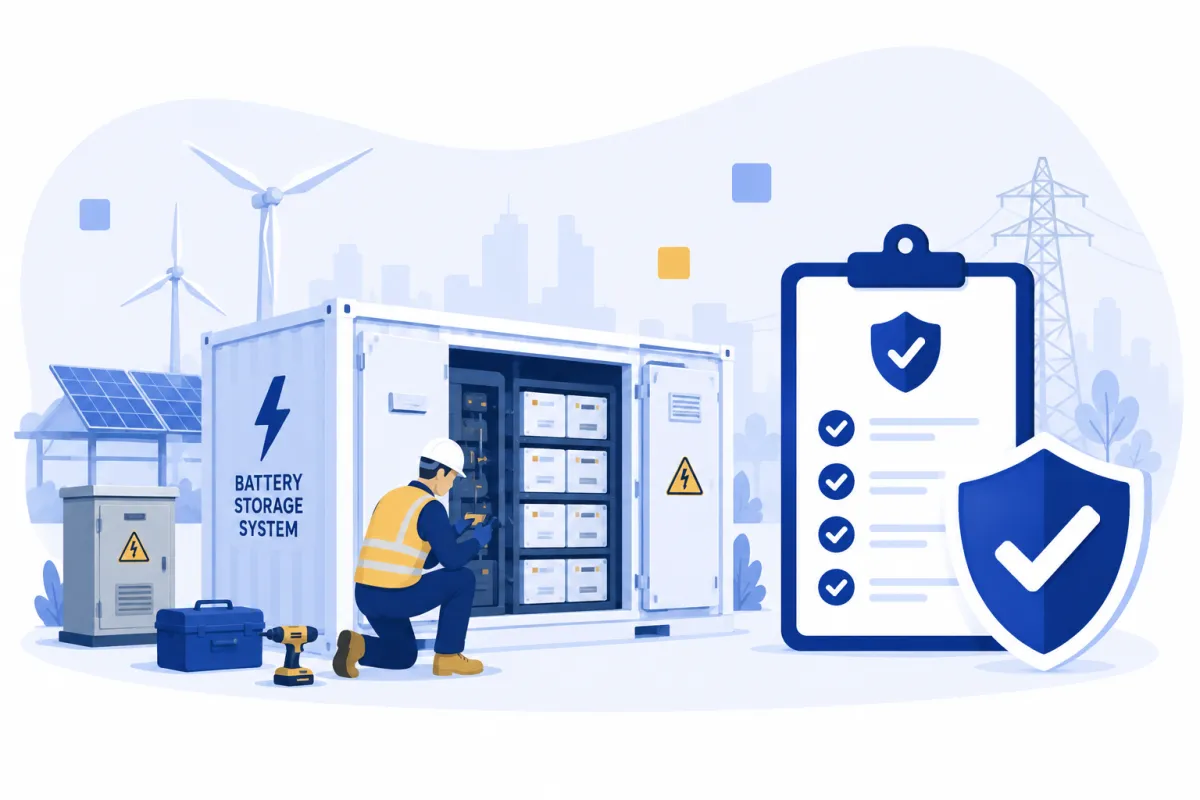
Battery Storage Installer & EPC Contractor Insurance | UK
If your business designs, installs, commissions or maintains battery energy storage systems, your insurance is not just a cost of doing business — it is a condition of winning the work. Principals, developers and funders now routinely require specific covers to be in place and evidenced before a contract is awarded, and the wrong gap in your programme can cost you a tender rather than just a claim. At the same time, the same lithium-ion capacity squeeze that troubles site operators makes contractor cover harder to arrange than it was even two years ago. This guide sets out every cover a battery storage contractor should consider, why principals demand it, where the hidden gaps usually sit, and how to present your business so insurers say yes.
Why Battery Storage Contractors Are a Special Case
A general electrical or M&E contractor's insurance programme was not designed around lithium-ion risk, and the gaps only become visible when something goes wrong or when a principal's pre-contract checklist lands on your desk. Three features make battery storage work different from ordinary contracting.
The commissioning window is the danger zone. Battery systems are at their most vulnerable while being energised and commissioned — the phase when the most serious losses in this sector have occurred. Your liability and contract works arrangements have to respond cleanly during exactly the period when standard wordings are often least clear about who carries the risk.
Design and specification carry real liability. Whether you are selecting the system, sizing it, specifying its protection, or integrating it with solar PV and the grid connection, you are taking on design responsibility that can be the subject of a claim years later — long after the job is finished and paid for. The owners of finished sites need different cover again, explained on our solar farm insurance page.
The consequences of failure are severe and visible. A defect in an ordinary installation might mean a callback. A defect in a battery installation can mean a fire, third-party property damage, environmental clean-up and a high-profile loss. Insurers price the contractor's exposure with that tail in mind, which is why presentation matters as much for you as it does for the site operator.
The Core Covers Every BESS Contractor Should Hold
Public & Products Liability
The foundation. Public liability covers injury to third parties and damage to their property arising from your work; products liability responds after you have handed over, if the system or components you supplied and installed cause injury or damage. For battery work, the products element is especially important and especially scrutinised — a fire alleged to originate in a system you installed is a products liability claim with a potentially large quantum. Limits of indemnity demanded by principals on BESS projects are frequently higher than for general contracting; £5 million is common and £10 million is increasingly requested on larger schemes.
Employers' Liability
A legal requirement if you employ anyone, including most subcontractors and labour-only staff. Battery and electrical work carries genuine injury exposure — arc flash, electrical burns, manual handling of heavy modules — so this is not a box-tick; it is cover you will be grateful for.
Professional Indemnity / Design Liability
The cover most often missing and most often demanded. If you design, specify, size or give advice on a system — not merely install to someone else's drawings — you carry professional liability for that judgement. A claim that a system was incorrectly specified, underperforms against a contracted output, or was unsuitable for its purpose is a PI claim, not a public liability one, and a public liability policy will not answer it. Funders and principals on serious projects almost always require PI, frequently at £1 million to £5 million, and frequently on terms that must remain in force for years after completion. We expand on the design exposure below because it is where contractors are most exposed and least aware.
Contract Works / Contractors' All Risks
Covers the works themselves — materials, plant and the installation in progress — against damage, fire and theft until practical completion or handover. For battery projects this cover is doing its hardest work during commissioning, so the wording needs to respond during energisation and testing, not exclude it. Check carefully whether the policy treats commissioning as a covered phase or steps away from it.
Plant, Tools & Equipment
Own and hired-in plant, test equipment and tools. Routine, but worth aligning hired-in plant cover with the indemnity your hire agreements actually require.
Efficacy & Performance Exposure
A specialist concern that catches contractors out: liability arising where a system you installed fails to perform its intended function — for instance, a protection or safety system that does not operate as designed. Efficacy exposures are excluded or restricted under many standard liability wordings, and bridging that gap requires specialist cover or careful wording. On battery projects, where the safety case depends on protective systems working, this is not academic.
The combination is what matters. No single policy covers a battery storage contractor. The protection comes from public and products liability, employers' liability, professional indemnity, contract works and efficacy cover working together with consistent definitions and no gaps between them. The most expensive claims are the ones that fall into the space between two policies that were each bought separately and never read against each other.
Design Liability: The Exposure Contractors Underestimate
Many contractors believe they are "just installing" and therefore carry no design risk. In battery storage that belief is usually wrong, and the gap between belief and reality is where uninsured claims live.
You are taking on design responsibility if you select the battery system or its protection, size it to a client's requirement, decide separation and siting, specify the monitoring and suppression approach, or integrate the storage with existing solar PV and the grid connection. Each of those is a judgement that can be challenged later — and the challenge typically arrives not as a dramatic failure but as an allegation: the system does not deliver the capacity promised, the protection was inadequate, the integration caused a problem elsewhere, the specification did not suit the site.
Two features make design claims dangerous. First, they have a long tail: a claim can surface years after completion, which is why PI is written on a claims-made basis and must be kept in force after the work ends, not cancelled the moment the invoice is paid. Second, they are precisely the claims a public liability policy excludes — PL covers injury and damage, not pure financial loss from a design or performance shortfall. A contractor relying on PL alone for design exposure is uninsured for the very claims most likely to arrive in this sector.
If you genuinely only ever install to a fully specified third-party design and give no advice, your PI need may be lighter — but that boundary is easy to cross without noticing, the first time you tell a client "you'd be better off with the larger unit" or adjust a layout on site. Where you sit on that line is worth establishing deliberately rather than discovering at claim time.
Why Principals and Funders Demand This Cover
Insurance requirements on battery projects are not box-ticking — they are risk transfer. A developer or funder putting capital into a storage asset wants certainty that if your work causes a loss, there is a policy behind you to meet the claim rather than a contractor who folds and leaves them exposed. That is why pre-contract checklists specify cover types, minimum limits, and sometimes named insurers or rating requirements, and why they increasingly ask for PI to be maintained for a defined period after completion.
The practical consequence: your insurance programme is a commercial qualification. A contractor who can evidence the full suite — adequate limits, design cover, contract works that respond during commissioning — can bid for work that a competitor without it simply cannot. Conversely, discovering at tender stage that your PI limit is too low or your products cover too narrow can lose you a contract you were otherwise winning. Getting the programme right is business development, not just protection.
How to Present Your Contracting Business to Insurers
The same submission-quality principle that governs site risks governs contractor risks: insurers in this class are selective and they triage on information. Be ready to evidence:
- Scope of work — exactly what you do: design, supply, install, commission, maintain, or some combination. Be precise, because it defines which covers respond.
- Experience and qualifications — relevant electrical and renewable accreditations, manufacturer training and approvals, and track record on battery and solar-plus-storage projects.
- Typical project profile — size of systems, chemistries worked with, value of contracts, and the mix of domestic-scale, commercial and grid-connected work.
- Subcontracting — what you subcontract and how you verify your subcontractors' own insurance and competence.
- Quality and handover — commissioning records, the documentation pack you hand over, and your approach to standards and manufacturer specifications. A professional handover pack is an insurance asset, because it is also what the site operator needs to insure the asset well.
- Claims history — disclosed fully and in context, including any previous declinatures, which carry a duty of fair presentation under the Insurance Act 2015.
The underwriting concerns behind these questions — chemistry, protection, commissioning risk — are the same ones we set out in detail in our in-depth battery storage facility insurance guide. A contractor who understands what the site operator's insurer is worried about presents their own risk far more convincingly.
If You Have Already Been Declined
Contractor cover for battery work is squeezed by the same market forces as operator cover, and a refusal — particularly for PI or efficacy exposure — is increasingly common. As with site risks, a contractor declinature is frequently about the market and the submission rather than your business, and the route back in is the same: diagnose the refusal, rebuild the presentation, and approach specialist contractor markets rather than the generalists who issued the no. We cover the hard market and the route back in within our main battery storage facility insurance guide.
The Subcontractor Trap
One exposure deserves singling out because it quietly undoes otherwise sound programmes. If you subcontract any part of your battery work — groundworks, electrical connection, civils, specialist commissioning — their failures can become your liability, and their insurance gaps can become your uninsured loss. A principal holds you responsible for the whole works; an injured third party sues up the chain; and if your subcontractor is uninsured, underinsured, or carries cover that excludes battery work, the claim lands on your policy or, worse, in the gap beyond it.
The defences are unglamorous but decisive: verify every subcontractor's cover before they start, not after a loss; check that their policy actually extends to battery and energy storage work rather than excluding it; confirm their limits are adequate for the project; and make sure your own public liability properly treats your subcontractors' work. Insurers will ask how you manage this, and a contractor with a documented subcontractor-verification process presents as a materially better risk than one who waves the question away. It is also simply good business: the subcontractor check that protects your insurance position is the same check that protects your reputation on site.
Why Battery Storage Contractors Work With Us
We are an independent commercial broker specialising in energy infrastructure and hard-to-place risks. Miller & Partner Limited is an Appointed Representative of Gauntlet Risk Management Ltd, which is authorised and regulated by the Financial Conduct Authority. We arrange cover for battery storage operators and installers, heat network contractors and renewable energy businesses, so we understand both sides of a BESS project — the contractor's exposure and the operator's — and we know the markets that write contractor liability, design PI and efficacy cover for this work rather than excluding it. Because we are independent, we build the programme around what your contracts actually require and where your real exposures sit, then present it to insurers in a way that wins terms. You can see the full operator-side programme on our main battery storage insurance page.
Related Battery Storage Insurance Guides
- Battery Storage Insurance — our main cover page for operators, installers and EPC contractors.
- Battery Storage Facility Insurance (UK 2026) — the definitive risk-and-cover deep-dive: thermal runaway, balance of plant, environmental, BI, cyber, NFCC.
- Renewable Energy Installer Insurance — MCS-compliant cover across solar, heat pump, EV and battery storage trades.
Bidding for Battery Work? Get Your Cover Right First
Tell us what you do and what your contracts demand. We will map the covers you need, flag the gaps in what you hold now, and arrange a programme that lets you bid with confidence — usually with terms within a few working days.
Request Your Quote







Instagram
LinkedIn