


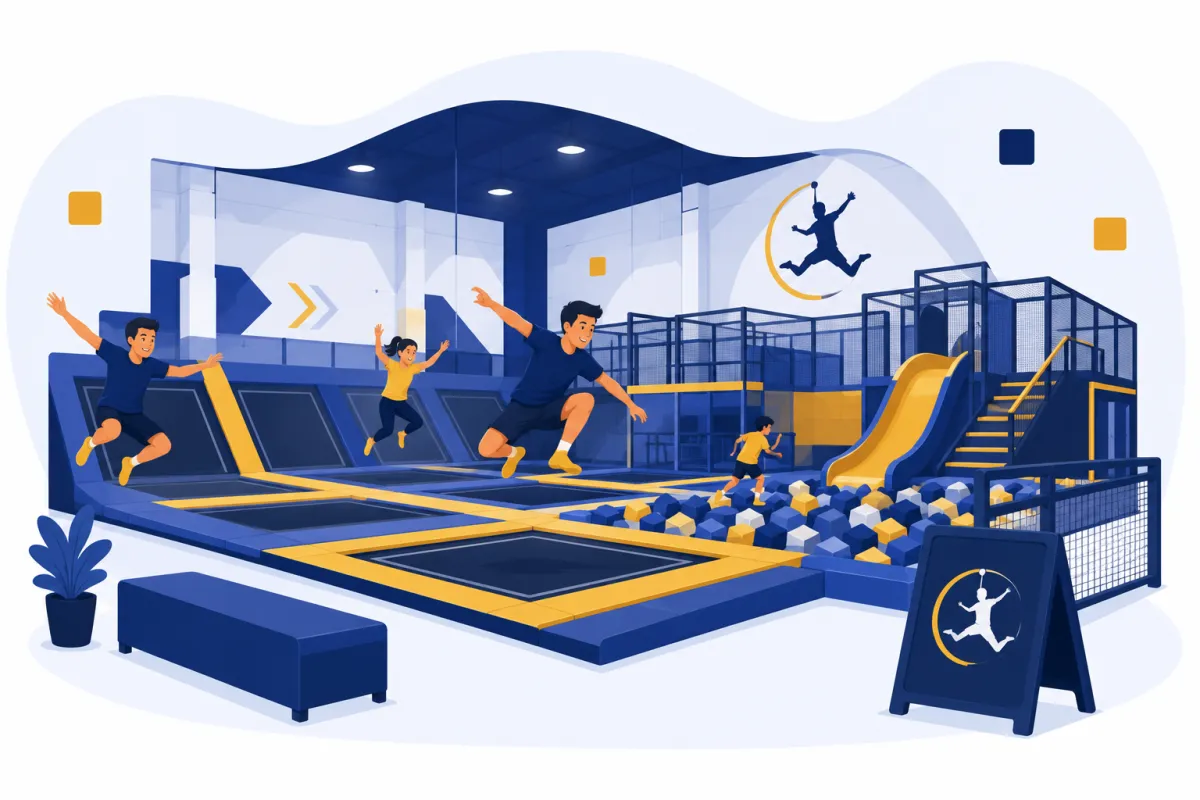
Trampoline Park Insurance UK | Specialist Leisure Broker
Why is trampoline park insurance so hard to place in 2026?
Trampoline parks are one of the toughest activity-leisure risks to insure in the UK. The sector exploded — trampoline park openings rose by around 3,000% from 2014 — but the injury frequency, claims severity and litigation attached to high-impact bouncing have made mainstream insurers deeply cautious. Some leisure insurers decline trampoline, inflatable and adventure-park risks outright as "too dangerous"; those that remain apply strict conditions, high excesses on injury claims, and premiums far above a comparable indoor leisure unit. If you operate a trampoline park, you have probably found that the comparison sites won't quote you, and that generalist brokers quietly run out of markets.
This is the territory Miller & Partner works in. As a specialist broker for adverse and hard-to-place risks, we place cover for high-risk leisure operators the standard market avoids — including parks that have been refused cover elsewhere or non-renewed after an injury claim. This guide explains why the market hardened, what PAS 5000 compliance means for your premium, what a properly built trampoline park policy must contain, and how to present your risk so specialist underwriters actually want to write it.
How does The Insurability Framework™ apply to trampoline parks?
Underwriter Intelligence
We know which specialist leisure and Lloyd's markets still write trampoline parks in 2026, and what triggers their concern — foam-pit design, jump-tower heights, session capacity, staff-to-jumper ratios. We present your PAS 5000 inaugural inspection and risk assessments before the underwriter has to ask.
Difficult Risk Expertise
Activity leisure is a decline-heavy sector. Our specialist MGA and Lloyd's access reaches the underwriters who still have appetite for trampoline, inflatable and adventure parks — including risks with a prior injury claim or a lapse in cover.
Risk Assessment
We audit your park the way an insurer's surveyor will: PAS 5000 compliance, court monitor coverage, foam-pit and airbag maintenance, session briefings, waiver systems and accident records — the exposures hidden in your day-to-day operation.
Claims Advocacy
A serious foam-pit or fall injury produces a contested, high-value claim with a personal-injury solicitor on the other side. When it happens, you deal with a named broker who fights your corner, not a call centre.
Key facts at a glance
- Trampoline park openings rose by roughly 3,000% from 2014, but safety standards lagged the boom — the first UK standard, PAS 5000, wasn't published until 2017.
- PAS 5000 compliance is voluntary, not law — there is no trampoline-park-specific safety regulation — yet most underwriters now require a PAS 5000 inaugural inspection before they will quote.
- Injuries cluster around foam pits and jump towers: back, neck and spinal injuries feature heavily, and Judicial College Guidelines value a spinal-cord back injury at roughly £111,000 to £196,000 in general damages alone.
- At one park, 270 accidents were recorded in seven weeks — its directors were prosecuted in 2024 for a "cavalier" approach to safety.
- A signed waiver does not remove liability: the Unfair Contract Terms Act 1977 prevents a business excluding liability for death or personal injury caused by its negligence.
- Roughly half of UK trampoline parks are IATP members — the differentiator underwriters use to separate well-run parks from the rest.
- The average trampoline-park public liability claim can exceed £50,000, and a single life-changing spinal claim can run into seven figures once care and loss of earnings are included.
What must a trampoline park policy include that a standard one won't?
The most dangerous assumption an operator can make is that an off-the-shelf commercial combined policy — the sort sold online to shops and offices — will respond to a trampoline park injury. It usually won't. Activity-leisure operations breach the assumptions, warranties and exclusions of standard wordings in several places at once. The comparison below shows where a generic policy fails and what a specialist trampoline park wording does differently.
| Exposure | Standard commercial policy | Specialist trampoline park wording |
|---|---|---|
| Participant injury (public liability) | Trampolining often excluded as a hazardous activity, or PL limits far too low | Written with full disclosure of activities; £5m–£10m limits sized for catastrophic spinal claims |
| Foam pits, jump towers, airbags | Not contemplated; the highest-severity feature is uninsured | Rated on PAS 5000 design compliance, pit maintenance and capacity control |
| Injury to staff (employers' liability) | Priced as low-risk retail; court monitors and coaches jump too | EL rated for an active workforce, with training and supervision evidence reflected |
| Business interruption after an incident | 12-month indemnity, no allowance for HSE investigation or forced closure | 18–24 month indemnity, including closure for investigation and reinstatement |
| Added activities (ninja, clip-'n-climb, soft play) | Undisclosed activities can void the claim | Each activity individually disclosed and rated, so nothing falls outside cover |
| Abuse & safeguarding (child-heavy footfall) | Rarely addressed; a growing exposure at children's venues | Abuse cover and safeguarding conditions built into the programme |
| Product liability (café, vending, retail) | Food and merchandise exposures missed | Products and food-safety liability included where the park has a café or shop |
Why have insurers pulled back from the trampoline park sector?
The market's caution wasn't a single event — it was a compounding cycle. The explosive growth of parks from 2014 outran any safety framework: for the first few years there was no UK standard at all, foam-pit and jump-tower designs varied wildly, and a run of serious injuries — including spinal and neck injuries from foam-pit landings — generated headlines, ambulance-callout data and, inevitably, litigation. Personal-injury solicitors built dedicated trampoline-claim practices. Loss ratios on activity-leisure books deteriorated, and insurers responded the way they always do: some exited the sector, and those that stayed repriced and attached conditions.
What has kept the market hard rather than letting it soften is that the underlying exposure is structural. High-impact bouncing by a mostly young, mostly untrained public will always generate injuries; waivers don't stop claims; and a single foam-pit landing can produce a life-changing spinal injury worth seven figures. The result is a two-tier market. Parks that can evidence disciplined safety management — PAS 5000 compliance, IATP membership, strong court monitoring, clean accident records — can still access competitive specialist terms. Parks that can't are quoted defensively, restricted, or declined. If you've already been declined, our guide to insurance when you've been refused elsewhere explains how specialist placement works from that position.
From recent placement conversations
The conversations I have most often start the same way: an operator has been non-renewed, or their premium has jumped by half, after a single injury claim — and they've been told, in so many words, that trampoline parks are just uninsurable now. They're not. But the market has almost no patience for a thin presentation.
The parks we place at the best terms are the ones that hand us their PAS 5000 inaugural inspection certificate, their IATP membership, their court-monitor rota and their accident book as a single pack — before anyone asks. One operator we placed last year had been declined by two brokers; nothing about the risk had changed, but presenting the compliance evidence properly turned a decline into three competing quotes. In this sector, presentation is not decoration — it is the placement.
What is PAS 5000 and why do underwriters insist on it?
PAS 5000 is the publicly available specification, published in 2017 by the British Standards Institution with the International Association of Trampoline Parks (IATP), RoSPA, British Gymnastics, the HSE and Environmental Health Officers, that sets out how a fixed indoor trampoline park should be designed, built, operated and maintained. It covers court layout, jump-tower heights, foam-pit and airbag construction, a mandatory design risk assessment before opening, staffing, and emergency procedures. IATP UK membership requires demonstrating PAS 5000 compliance through an inaugural inspection by an approved inspector.
The critical point for insurance is this: PAS 5000 compliance is voluntary — there is no trampoline-park-specific law — but it has become the insurance industry's baseline. Most underwriters now require evidence of a PAS 5000 inaugural inspection before they will offer terms, and use the same document to rate the risk. A park that can show current compliance is in an entirely different negotiating position from one that can't. The HSE also expects operators to manage the risk under the general duties of the Health and Safety at Work etc. Act 1974, and enforcement follows where they don't.
What insurance covers does a trampoline park need?
A trampoline park programme is genuinely combined — it has to knit together liability, property, engineering and interruption covers so that a single incident (which will usually touch several at once) doesn't fall between sections. The core structure looks like this:
Public liability
The single most important cover, and the reason parks get declined. Third-party injury to jumpers — with limits sized for catastrophic spinal claims, usually £5m minimum and often £10m where landlords or lenders require it. See our guide to high-risk public liability insurance.
Employers' liability
Legally required under the Employers' Liability (Compulsory Insurance) Act 1969. Court monitors, coaches and party hosts are an active workforce who jump, demonstrate and lift — a very different EL risk from retail staff.
Property, contents and equipment
Trampolines, foam, safety padding, airbags, structural towers and fit-out are a major capital investment under constant stress. Insure at correct reinstatement values to avoid underinsurance and the condition of average.
Business interruption
A serious injury can force closure for HSE investigation or reinstatement; the indemnity period must reflect that. Covered in detail below and in our guide to business interruption insurance.
Abuse, safeguarding and management liability
Child-heavy footfall makes abuse cover and safeguarding a genuine exposure, and directors can be named personally after a serious incident — see our directors' & officers' guide.
Products, food and cyber
Cafés, vending and merchandise bring product and food-safety liability; booking, payment and waiver systems bring a data exposure that suits cyber insurance.
Cover checker: what does your activity venue need?
Select the profile closest to your operation. Tags show what's legally required, essential, or worth considering. Every activity-leisure programme should be built individually — this checker maps the starting point. Our main high-risk public liability guide covers the liability core.
- CRITICALPublic liability £5m–£10m — the cover that decides insurability; foam-pit and jump-tower claims drive severity. Specialist placement needed if you've had a previous injury claim.
- LEGALEmployers' liability (£10m) — compulsory; court monitors and coaches are an active workforce.
- ESSENTIALPAS 5000 compliance evidence — an inaugural inspection is a precondition of most quotes, not just a discount.
- ESSENTIALProperty & equipment at reinstatement value — trampolines, foam and towers under constant stress.
- ESSENTIALBusiness interruption, 18–24 month indemnity — allow for HSE investigation and forced closure.
- RECOMMENDEDAbuse / safeguarding cover — child-heavy footfall makes this a real exposure.
- CRITICALEach activity individually disclosed — ninja courses, warp walls and clip-'n-climb each carry distinct fall exposures; undisclosed activities void claims.
- CRITICALPublic liability £10m — height and fall risk push severity up; landlords often mandate this limit.
- LEGALEmployers' liability (£10m) — belay and course-monitor staff.
- ESSENTIALHeight-safety system maintenance records — auto-belay and harness inspection logs are underwriting evidence.
- RECOMMENDEDBusiness interruption with added-activity revenue included.
- CRITICALInflatable-specific PL — inflatable parks are their own hardening sub-sector after high-profile injury claims; specialist placement essential.
- LEGALEmployers' liability (£10m) — inflatable marshals and setup crew.
- ESSENTIALAnchorage & wind-management procedures — for any outdoor or semi-outdoor inflatables.
- ESSENTIALCapacity & age-zoning controls — collisions are the dominant inflatable claim.
- RECOMMENDEDProperty cover for the inflatables themselves at replacement cost.
- CRITICALUnder-5 zoning — mixing soft play toddlers with trampoline zones is a severity and safeguarding red flag; keep zones and cover distinct.
- CRITICALPublic liability £5m–£10m across both activity types.
- LEGALEmployers' liability (£10m).
- ESSENTIALSoft-play equipment inspection regime alongside PAS 5000 for the trampoline zone.
- RECOMMENDEDProducts & food-safety liability for the café.
- CRITICALSpecialist placement only — multi-activity adventure parks (high ropes, karting, axe throwing, climbing) sit outside packaged leisure products entirely.
- CRITICALActivity schedule — every activity listed, rated and reflected in the wording.
- LEGALEmployers' liability (£10m) — instructor-led, high-supervision workforce.
- ESSENTIALPublic liability £10m with contractual liability reviewed against landlord and event terms.
- RECOMMENDEDManagement liability given the enforcement exposure; see our D&O guide.
- CRITICALMobile / pop-up cover — travelling inflatable and trampoline operations need transit, setup and per-site liability; standard leisure policies exclude off-site.
- LEGALEmployers' liability the moment you employ setup crew or marshals.
- ESSENTIALPublic liability with worldwide/UK-wide site cover and event-terms review.
- ESSENTIALGoods in transit & equipment cover for the kit between sites.
- CONSIDEREvent cancellation — see our event public liability guide for the crossover.
Why is public liability the make-or-break cover for a trampoline park?
Public liability is where trampoline parks live or die in the eyes of an underwriter. The exposure is uniquely severe: a mostly young public performing high-impact, self-directed movements, where a single bad landing into a foam pit or an awkward fall from a jump tower can produce a spinal or brain injury. Judicial College Guidelines value a severe back injury with spinal-cord and nerve-root damage at roughly £111,000 to £196,000 in general damages, and a very severe brain injury far higher — before special damages for care, adaptations and lifetime loss of earnings, which is where seven-figure settlements come from.
That severity is why specialist wordings carry £5m–£10m limits and why underwriters interrogate the controls that reduce frequency and severity: session capacity, staff-to-jumper ratios, court-monitor coverage, foam-pit and airbag maintenance, age zoning, and the quality of the pre-jump safety briefing. Because these are also occupiers' liability exposures under the Occupiers' Liability Act 1957, the duty of care to visitors is non-negotiable — and the evidence you keep that you met it is what defends the claim.
How dangerous is the work for staff — and what does that mean for EL?
Employers' liability at a trampoline park is priced against a genuinely active workforce. Court monitors move constantly across live trampoline beds; coaches demonstrate; party hosts lift and supervise; and everyone works long shifts in a high-energy environment. Staff injuries do happen — and they produce claims. In one documented case, a trampoline park worker injured jumping into a foam pit on a training day suffered a bulging disc and nerve damage and, after a multi-year legal battle, won her claim when the court found the foam pit defective despite the park having complied with the construction guidelines in force at the time.
That case is a compressed lesson for operators: compliance with a standard is a defence, not a guarantee, and the evidence trail — training records, supervision logs, maintenance schedules — is what determines the outcome when a staff claim lands. Underwriters know this, which is why EL rating for an activity venue leans heavily on your documented training and supervision regime, not just headcount and wage roll.
Do liability waivers actually protect a trampoline park?
This is the single most misunderstood point in the sector. Almost every park asks jumpers to accept a risk acknowledgement or waiver — and many operators believe that document is their protection. It is not. Under the Unfair Contract Terms Act 1977, a business cannot exclude or restrict its liability for death or personal injury resulting from its own negligence. A waiver may record that the participant understood the activity carried inherent risk, but it does not stop a negligence claim where the park failed in its duty of care — defective equipment, inadequate supervision, overcrowding, or a skipped safety briefing.
The practical consequence: your waiver is useful evidence, but it is your insurance and your safety systems, not the waiver, that actually protect the business. Underwriters are entirely unmoved by "but they signed a waiver" — and so are the courts. This is exactly why public liability with an adequate limit is non-negotiable, and why parks that lean on waivers instead of cover are the ones that fail after a serious claim.
Red-flag checklist: would an underwriter worry about your park?
Tap each statement that is currently true of your park. These are the things that make a leisure underwriter nervous — the more that light up, the harder (and pricier) your placement becomes.
Why is business interruption so easily underinsured at an activity venue?
Business interruption is the cover trampoline park operators most often get wrong, because activity venues have high fixed costs and a revenue profile that a generic policy doesn't anticipate. A serious injury can force a temporary closure for HSE investigation, equipment repair or regulatory compliance — and the park still owes rent, equipment finance and core staffing throughout. On top of that, revenue is seasonal, weather-influenced and discretionary, so a closure at the wrong time of year is disproportionately damaging.
Two structural points matter. First, the indemnity period should be 18–24 months, not the standard 12 — an HSE investigation plus reinstatement plus rebuilding lost bookings routinely exceeds a year. Second, declare gross profit correctly and review it annually, because average applies to BI just as it does to property. Our guides to business interruption and day one reinstatement cover the mechanics.
What about foam pits, ninja courses, clip-'n-climb and party rooms?
Modern parks are rarely "just trampolines" — and every added attraction changes the risk. Foam pits and airbags are the highest-severity feature and the focus of PAS 5000's most detailed guidance on pit depth, foam density and the gap between the trampoline bed and the floor. Ninja courses, warp walls and clip-'n-climb add fall-from-height exposures with their own auto-belay and harness maintenance duties. Party rooms and cafés bring food-safety and products liability. Karting, axe throwing or high ropes push the risk into full multi-activity adventure-park territory.
The underwriting rule is simple and unforgiving: every activity must be individually disclosed and rated. An attraction added after inception but never notified to insurers is the classic route to a declined claim. When you expand, tell your broker before you open the new feature — not at renewal, and never after an incident.
Risk assessor: how will an underwriter score your park?
What regulations and duties apply to trampoline parks?
Trampoline parks operate in an unusual regulatory space: there is no trampoline-park-specific licensing regime, yet several overlapping legal duties apply with full force — and each one feeds into how your insurance is underwritten and how a claim is defended.
Health and safety law
The Health and Safety at Work etc. Act 1974 imposes duties to protect both employees and members of the public, supported by the Management of Health and Safety at Work Regulations 1999 (risk assessment) and the Provision and Use of Work Equipment Regulations 1998 (PUWER) for the equipment itself. The HSE is the enforcing authority, and a serious incident triggers investigation and — where duties were breached — prosecution, with fines linked to turnover under the Sentencing Council's definitive guideline.
Occupiers' liability
The Occupiers' Liability Act 1957 imposes a duty of care to all visitors, and children are owed a higher standard because they are less careful than adults. This is the legal backbone of most participant claims.
PAS 5000 and equipment standards
PAS 5000:2017 governs park design and operation; EN 71-14 covers trampolines for domestic-style use. Neither is statute, but both are the benchmarks a court and an insurer will measure you against — and IATP membership is conditional on PAS 5000 compliance.
Consumer protection and unfair terms
The Unfair Contract Terms Act 1977 and the Consumer Rights Act 2015 limit what your waiver can achieve — you cannot contract out of liability for negligently caused personal injury. The Consumer Protection Act 1987 can also bring equipment suppliers into a claim where a defect caused injury.
What drives the cost of trampoline park insurance?
There is no meaningful "average premium" for a trampoline park — the spread between a single-court, PAS-5000-compliant, IATP-member park with a clean record and a multi-activity site with a claims history is enormous. What every operator can do is understand the rating factors and work the ones within their control:
| Rating factor | Why it moves your premium | Mitigation |
|---|---|---|
| PAS 5000 compliance | A precondition of most quotes; non-compliance = decline or heavy loading | Current inaugural inspection; re-inspect after any layout change |
| IATP membership | The fastest signal of a well-run park | Join and maintain; display the certification |
| Activity mix | Foam pits, towers, ninja and climb each add severity | Disclose every activity; zone and rate separately |
| Public liability limit | Catastrophic spinal claims need £5m–£10m | Buy the limit the risk (and your landlord) demands |
| Court-monitor ratios | Supervision density drives injury frequency | Define, staff and record ratios per session |
| Session capacity control | Overcrowding is a leading cause of collision claims | Booked sessions, capped numbers, documented |
| Age zoning | Mixing under-5s with general jumpers raises severity | Separate toddler zones and sessions |
| Foam-pit / airbag maintenance | Depth and density failures are the classic defect claim | Documented depth checks and replacement schedule |
| Claims history | A prior injury claim reprices everything for 3–5 years | Evidence what changed since; see our claims history guide |
| Safety-briefing enforcement | A skipped briefing is a negligence gift to a claimant | Mandatory briefing/video every session, logged |
| Staff training records | EL rating leans on documented competence | Induction, refresher training, signed records |
| Declared values & indemnity period | Underinsurance triggers average; 12-month BI is too short | Reinstatement valuations; 18–24 month indemnity |
| Continuity of cover | Lapses and mid-term cancellations are decline red flags | Start renewal early; never let cover gap |
What do real trampoline park claims look like?
These three fictionalised but market-realistic case studies show how activity-leisure losses actually unfold — and where the decisions made at placement decided the outcome.
Case study 1: The foam-pit spinal injury — £1.6m public liability claim
A teenager attempted a somersault from a jump tower into a foam pit during a busy weekend session and landed head-first near the edge, sustaining a spinal injury. Investigation found the pit foam had compacted below the maintenance threshold and the session was over its stated capacity, with one court monitor covering an area meant for two.
The numbers: £900,000 general and special damages for the spinal injury including future care and loss of earnings, £480,000 in ongoing care provision, £220,000 legal and defence costs. Total: £1.6m — comfortably inside the park's £5m PL limit, but only because that limit had been bought.
The lesson: the claim was met because the park carried an adequate PL limit on a specialist wording. Two failures — foam compaction and understaffing — turned an inherent risk into a negligence finding. Renewal premium rose 55%, with capacity and monitor-ratio warranties attached; the park regained competitive terms over three years by evidencing the new controls.
Case study 2: The undisclosed ninja course — a £340,000 claim declined
A park added a ninja-warrior course six months into its policy year to boost midweek revenue. It was popular — and one adult user fell awkwardly from a warp wall, fracturing a wrist and elbow and claiming for lost self-employed income. The activity had never been notified to insurers.
The numbers: the claim was valued at around £340,000 including special damages. The insurer declined it, citing a material change in risk that was never disclosed, and reserved its position on the whole policy.
The lesson: the loss fell on the business directly, and the near-voiding of the entire policy was worse than the single claim. Adding an activity is a material fact — it must be disclosed before the feature opens, not at renewal. A five-minute call to the broker would have rated the ninja course in and kept the claim covered.
Case study 3: The staff foam-pit injury — £185,000 EL settlement despite guideline compliance
A court monitor demonstrating a foam-pit entry during a training session suffered a disc injury and nerve damage, leaving her unable to work for months. The park had built the pit to the construction guidance current at the time — but a court still found the pit defective because the foam was too hard and the gap to the floor insufficient to absorb impact.
The numbers: £185,000 employers' liability settlement including loss of earnings and future care contribution, plus £40,000 defence costs.
The lesson: compliance with a standard is a strong defence but not an absolute one — an operator can still be liable if the real-world installation is unsafe. The EL policy responded in full; the operator's takeaway was to move from "we met the guideline" to independent, documented pit testing. EL premium carried a three-year loading.
What if your park has been refused cover or non-renewed?
Refusal, non-renewal and mid-term cancellation are common enough in activity leisure that they carry less stigma with specialist underwriters than operators fear — but they must be handled correctly. Every future proposal will ask whether you have been refused cover, and the duty of fair presentation makes the answer permanent. The workable path is the one we set out in our guides to insurance for businesses refused cover and high-risk public liability insurance: disclose everything, evidence what has changed since any prior claim, and approach the specialist market through a broker who can frame the risk — never through serial applications that build a paper trail of declines. Parks carrying a prior claim alongside the trade's inherent severity need both issues presented together, once, properly.
How do you manage a serious injury claim at a trampoline park?
Trampoline park claims are won and lost in the first fortnight. This is the sequence we run with clients:
- Get medical help and make the area safe. Life safety first; then isolate the equipment or zone involved so the scene is preserved for investigation.
- Record the incident fully, at once. Accident book entry, CCTV export, session booking and capacity data, staff-on-shift records, and the monitor rota — while everything is fresh and retrievable.
- Notify your broker the same day. Late notification breaches policy conditions. Your broker triggers insurer notification across PL, EL and any other affected section.
- Report to the HSE where required. RIDDOR-reportable injuries must be reported; take advice before giving any account that could be used in enforcement.
- Preserve the equipment evidence. Foam-pit depth readings, airbag pressure logs, maintenance records and inspection certificates — the documents that prove (or disprove) a defect.
- Control communications. One spokesperson; no admissions of liability to the injured party, their family, or on social media — statements made now surface in the claim later.
- Cooperate with the loss adjuster, on the right footing. The insurer's adjuster is professional but not your representative; on a serious claim, take your broker's advice on whether your own support is justified.
- Fix the root cause and evidence it. Whatever the investigation finds — capacity, monitoring, maintenance — correct it and document the change. It protects the next renewal as much as the next jumper.

About the author — John Miller
John Miller is Director & Principal Broker at Miller & Partner Limited (FCA Firm Ref 1029698), with over 13 years' specialist commercial insurance experience and direct access to the Lloyd's Market and specialist MGA schemes. John specialises in adverse and hard-to-place risks — including trampoline parks, inflatable parks and other high-risk activity-leisure venues the standard market avoids — placing cover for operators others have declined. He was previously the #1 Account Executive at Brown & Brown and #1 Salesperson at AXA.
Read more about John · Office: Vivian House, Roman Bridge Close, Mumbles, Swansea SA3 5BG · 01792 001350
Glossary of trampoline park insurance terms
- PAS 5000
- The 2017 publicly available specification for the construction and operation of a fixed indoor trampoline park — the insurance industry's baseline standard, though not itself law.
- IATP
- The International Association of Trampoline Parks, whose UK membership requires demonstrated PAS 5000 compliance via an inaugural inspection.
- Inaugural inspection
- The approved-inspector assessment confirming a park meets PAS 5000 — frequently a precondition of insurance and IATP membership.
- Foam pit
- A pit filled with foam blocks used to cushion landings; its depth, foam density and floor gap are the most heavily scrutinised safety features.
- Jump tower
- An elevated platform from which users drop into a foam pit or airbag — a high-severity feature governed by PAS 5000 height guidance.
- Court monitor
- A member of staff supervising live trampoline areas; monitor-to-jumper ratios are a key underwriting factor.
- Public liability
- Cover for third-party (participant and visitor) injury and property damage — the make-or-break cover for a trampoline park.
- Employers' liability
- Legally compulsory cover for injury to staff, priced against an active, high-energy workforce.
- Occupiers' liability
- The duty under the Occupiers' Liability Act 1957 to keep visitors reasonably safe — a higher standard applies to children.
- Waiver / risk acknowledgement
- A document recording a participant's acceptance of inherent risk; it cannot exclude liability for negligently caused injury under UCTA 1977.
- UCTA 1977
- The Unfair Contract Terms Act 1977, which prevents a business excluding liability for death or personal injury caused by its negligence.
- Business interruption
- Cover for lost revenue and continuing costs after an insured event forces closure — needs an 18–24 month indemnity period for activity venues.
- Indemnity period
- The maximum time business interruption cover pays after a loss; too short an indemnity period is the most common BI failure at a park.
- Condition of average
- The mechanism that proportionately reduces claims where declared values are below true values — a live risk on high-value trampoline fit-outs.
- Material change in risk
- A change such as adding an activity that must be disclosed to insurers; failure to do so can void a claim.
- RIDDOR
- The Reporting of Injuries, Diseases and Dangerous Occurrences Regulations 2013, requiring certain injuries to be reported to the HSE.
- Fair presentation
- The duty under the Insurance Act 2015 to disclose every material circumstance about the risk — including activities, losses and refused cover.






Instagram
LinkedIn