


Product Recall Insurance UK: Cover, Costs & GPSR Guide
Why does product recall need its own specialist cover?
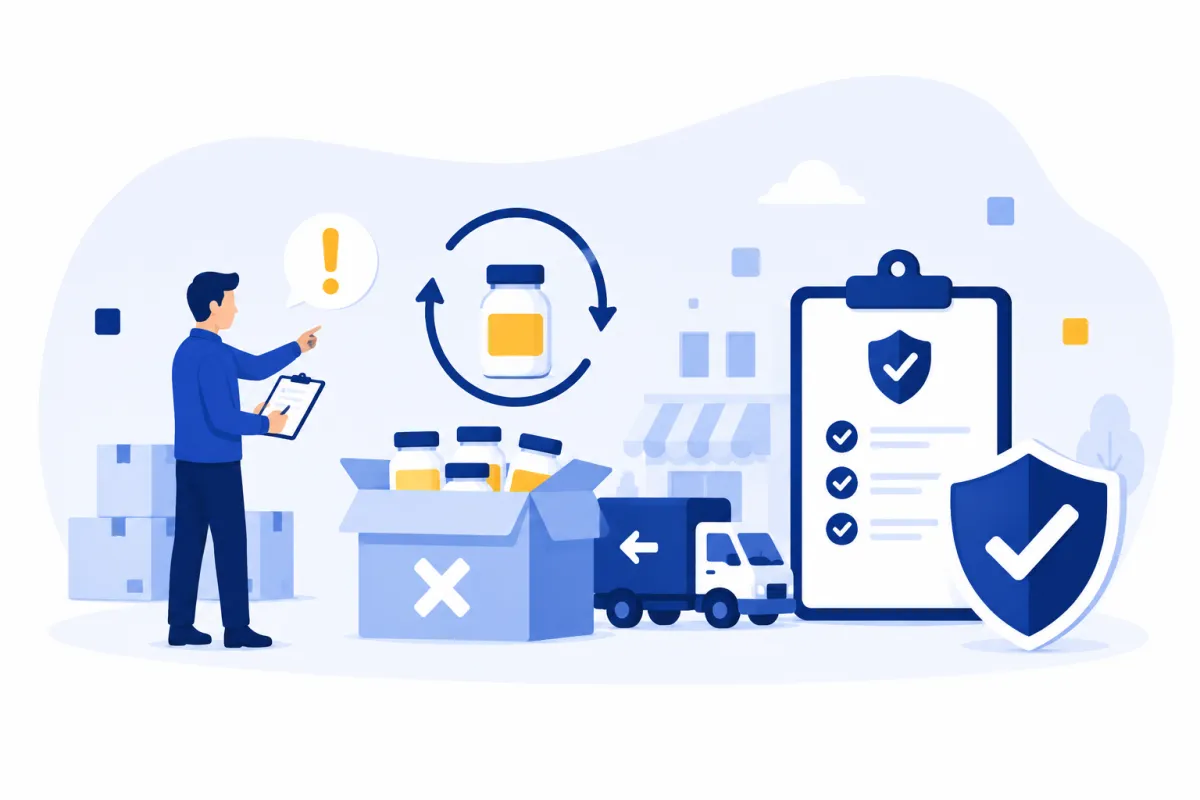
Product recall insurance pays your own costs of getting an unsafe or defective product back from the market: notification, transport, destruction, replacement, lost income and rebuilding the brand. To arrange cover, see our product recall insurance page.
Most businesses that make, brand or supply a physical product assume that if something goes wrong, their product liability cover will deal with it. It usually won't — at least not with the part that hurts most. Product liability pays third parties injured by your product; it generally does not pay the cost of getting the product back. Pulling stock off shelves, notifying customers, transporting and destroying goods, replacing them and rebuilding the brand is a separate, first-party cost — and recall is routinely excluded from liability cover.
That gap is where product recall insurance sits, and it is one of the most under-bought covers in UK manufacturing. Our manufacturing insurance page shows where it sits in a full manufacturer's programme. A recall can run into the millions, can be triggered by something as small as a mislabelled allergen, and can be forced on you by a regulator rather than chosen. For a business with one or two product lines, a single recall can rewrite the balance sheet.
At Miller & Partner we place recall and contamination cover through The Insurability Framework™ — underwriter intelligence, difficult-risk expertise, risk assessment and claims advocacy — because the recall markets are specialist, the wordings vary enormously, and the difference between a policy that responds and one that doesn't is in the detail.
Product recall: key facts at a glance
- Product recall and product liability are different covers — recall costs are usually excluded from product liability.
- Product recall is first-party: it pays the cost of recalling — transport, storage, destruction, notification, advertising, lost income and brand rehabilitation.
- In Great Britain, general consumer-product safety is governed by the GPSR 2005, overseen by the OPSS; unsafe food is reported to the FSA.
- A consumer recall is treated as a last resort — withdrawal, warnings and repair come first, decided by risk assessment (PAS 7100).
- The EU GPSR (from 13 December 2024) now binds UK exporters selling into the EU and Northern Ireland.
- Triggers include accidental contamination, manufacturing defect, allergen mislabelling and malicious tampering.
- A single recall can run into the millions — and reputational loss can continue for months or years after.
Product recall vs liability vs guarantee — what's the difference?
Three covers are constantly confused, and the confusion leaves real gaps. Each responds to a different cost from the same faulty product:
| Cover | What it pays for | What it does NOT cover |
|---|---|---|
| Product liability | Third-party injury or property damage caused by your defective product, plus legal defence. | The cost of recalling the product — usually excluded. |
| Product recall | The first-party cost of recalling: notification, transport, storage, destruction, replacement, lost income and brand rehabilitation. | Third-party injury claims — that's product liability's job. |
| Product guarantee | The cost of repairing or replacing a product that fails to do its job (financial loss / fitness for purpose). | Injury claims and most recall logistics. |
| Product contamination | Recall and clean-up after accidental contamination, malicious tampering or extortion (often food & beverage). | Defects with no contamination or safety trigger. |
The single most important takeaway: buying product liability does not give you recall cover. If your income depends on a small number of product lines, the recall and contamination sections are where the catastrophic exposure actually lives — and they need to be arranged deliberately, usually through a specialist commercial broker with access to the recall markets.
What does product recall insurance actually cover?
A well-structured recall and contamination policy is really a crisis-response package. Typical cover includes:
- Recall expenses (first-party) — customer and consumer notification, advertising, transport, storage, warehousing and the destruction or disposal of affected stock.
- Replacement and redistribution — the cost of replacing recalled product and getting safe product back into the market.
- Third-party recall costs — where a customer (for example, a retailer or another manufacturer) incurs recall costs because of your product.
- Business interruption — lost gross profit and increased cost of working while production is suspended or sales are hit; see our business interruption guide.
- Brand rehabilitation — extra marketing and PR to re-establish sales and rebuild reputation after the event.
- Crisis management & consultancy — 24/7 access to recall consultants, PR and legal specialists who manage the event itself.
What can trigger a product recall claim?
Recalls rarely come from dramatic causes. The everyday triggers are:
- Accidental contamination — microbiological (listeria, salmonella, E. coli), chemical or foreign-body contamination, especially in food and beverage.
- Allergen mislabelling — an undeclared allergen is one of the most common UK food recall causes and a strict-liability risk.
- Manufacturing or design defect — a fault that makes the product unsafe or non-compliant with safety standards.
- Malicious tampering or product extortion — deliberate interference, threatened or actual.
- Component failure — a defective part that triggers a recall of the finished product (relevant for component and precision manufacturers).
- Regulatory / government-mandated recall — where the OPSS, FSA or an EU authority requires action.
What does UK product safety law require (GPSR, OPSS, FSA)?
In Great Britain, the framework rests on a few key pillars:
- General Product Safety Regulations 2005 — the GPSR 2005 require that producers place only safe consumer products on the market, with appropriate warnings and instructions, and monitor safety after sale.
- Office for Product Safety and Standards (OPSS) — the national regulator that coordinates large-scale recalls of non-food consumer products and supports local Trading Standards. See OPSS on GOV.UK.
- Consumer Protection Act 1987 — the CPA 1987 imposes strict liability for defective products that cause injury or damage, the backbone of product liability.
- Food law & the FSA — unsafe food and drink must be withdrawn or recalled and notified to the Food Standards Agency and the local authority, under assimilated General Food Law and the Food Safety and Hygiene Regulations.
- PAS 7100 — the BSI Code of Practice for product safety recalls, developed with the OPSS, sets out how to plan and run a recall.
Importantly, a full consumer recall is generally a last resort. The corrective-action hierarchy runs from withdrawal from the supply chain, through warnings and in-market repair, to a consumer-facing recall — and which action applies is driven by a risk assessment, not by choice.
How does the EU GPSR affect UK exporters?
This is the development catching UK businesses out in 2026. The EU General Product Safety Regulation (EU 2023/988) applied from 13 December 2024, replacing the old EU directive. Great Britain's own regime did not change, so there is now a real divergence between GB rules and the EU/Northern Ireland rules — and UK exporters are caught by the EU side whenever they sell consumer goods into the EU or NI.
The practical obligations that matter most to UK manufacturers and online sellers:
- An EU "Responsible Person" — an economic operator established in the EU must be designated for products placed on the EU market.
- A mandatory recall-notice format — recalls must use a standardised notice, and certain reassuring words (for example "voluntary" or "precautionary") are restricted.
- Consumer remedies — consumers affected by a recall must be offered at least two of repair, replacement or refund.
- Incident reporting — accidents and risks reported through the EU Safety Gate portal, with specific duties on online marketplaces.
The insurance point is simple: if you export, your recall exposure now spans two regimes, and your cover and recall plan should reflect both.
Why are first-party recall costs the overlooked exposure?
When businesses picture a product problem, they picture an injured customer suing — a third-party event their liability policy is built for. What they rarely picture is the first-party cost: their own money spent pulling product back, notifying the market, destroying stock, halting and restarting production, and rebuilding a damaged brand. That cost often dwarfs the injury claim, and it is precisely the part liability cover excludes.
From recent placement conversations
"The sentence I hear most is 'we've got product liability, so we're covered.' I have to be the one to explain that the recall itself — the logistics, the destruction, the lost contracts — is usually carved out. It's an uncomfortable conversation to have before a claim, and a far worse one to have after."
"The other blind spot is the supermarket contract. A lot of food and consumer-goods suppliers don't realise their customer can pass the entire cost of a recall back to them, contractually. Third-party recall cover is what stands between that clause and your balance sheet."
Which businesses need product recall cover?
Select your sector to see the typical recall exposure and the cover that fits. A starting point — your own product, supply chain and contracts set the definitive need.
Food / beverage producer
Cosmetics / personal care
Electronics / appliances
Toys / children's products
Automotive components
Supplements / nutraceuticals
Is your recall readiness in order?
Tick each statement that's true of your business. The unticked items are where a recall turns from manageable to catastrophic.
How exposed is your business to a recall right now?
A quick two-factor gauge of recall exposure. Indicative only.
Who must act in a recall, and what are the penalties?
The duty to act when a product is unsafe falls primarily on the producer — the manufacturer, the own-brand seller, or an importer bringing goods into the country — with distributors required to cooperate. Under the GPSR 2005, producers must place only safe products on the market, monitor safety after sale, and take corrective action when a problem emerges. You cannot wait for a regulator to force your hand; the legal duty to act is yours.
Corrective action follows a hierarchy, and a full consumer recall is generally the last resort. Depending on the risk assessment, the right response may be:
- Withdrawal — removing the product from the supply chain before it reaches consumers.
- Warnings — alerting consumers to a risk and how to use the product safely.
- In-market repair or modification — fixing products already with consumers.
- Consumer recall — asking consumers to return or stop using the product, the most disruptive and costly step.
Enforcement sits with the OPSS and local-authority Trading Standards for non-food products, and the FSA and local authorities for food. Their powers run from compliance notices and forced withdrawals to recalls and, for persistent or deliberate non-compliance, prosecution. On top of any regulatory penalty, an unsafe product that injures someone exposes the business to a strict-liability claim under the Consumer Protection Act 1987 and, where personal failures are alleged, can put the spotlight on individual directors — the territory directors' & officers cover is built for.
What drives the cost of product recall insurance?
Recall premiums reflect what you make, how much of it, where it goes and how well you could control an event. The factors below move the price — and most can be improved before renewal.
| Rating factor | Why it affects premium | How to improve it |
|---|---|---|
| Sector / product type | Ingestible and children's products carry the highest recall frequency and severity. | Evidence rigorous safety, testing and quality controls for your category. |
| Turnover and volume | More product in the market means a larger potential recall. | Declare accurately; show how volume is managed and tracked. |
| Export footprint | EU and global sales add regulatory regimes and recall complexity. | Maintain an EU Responsible Person and compliant labelling for export lines. |
| Product-line concentration | Reliance on one or two lines makes a single recall existential. | Document diversification and the ability to keep trading through an event. |
| Traceability & batch control | Good traceability lets you target a recall rather than pull everything. | Robust batch coding, lot records and supply-chain mapping. |
| Recall plan & preparedness | A tested plan shortens and contains an event. | Maintain a written, rehearsed recall plan aligned to PAS 7100. |
| Quality management | Recognised systems reduce the chance of a defect reaching the market. | HACCP, BRCGS, ISO 22000 or ISO 9001 certification as relevant. |
| Recall / claims history | Prior recalls signal recurring exposure. | Show root-cause fixes and process improvements since any past event. |
| Customer contracts | Clauses passing recall costs back to you increase exposure. | Review supply contracts and arrange third-party recall cover to match. |
| Limit & sub-limits | Higher limits and brand-rehabilitation extensions add premium but close gaps. | Set limits against a realistic worst-case, not a token figure — see underinsurance. |
| Quality of presentation | A clear submission with controls and a recall plan earns better terms. | Use a specialist broker to present the risk to the recall markets. |
What do real product recall claims look like?
Three illustrative examples, based on the kinds of recall we see, show how recall costs land — and why product liability alone rarely answers them. They are composites, not accounts of identifiable clients, and the figures are indicative.
How do you handle a product recall?
When a product problem emerges, a fast, structured response limits both the harm and the cost:
- Stop distribution and quarantine stock. Halt further sale of the suspect product and isolate affected stock to stop it reaching more customers.
- Notify your broker and insurer. Report immediately so recall and crisis-management cover is triggered and consultants are engaged early.
- Convene your recall team and assess the risk. Activate your plan and carry out a risk assessment to decide the right corrective action under PAS 7100.
- Notify the regulator. Inform the FSA and local authority for food, or the OPSS and Trading Standards for non-food consumer products.
- Identify and trace the affected batches. Use batch codes and supply-chain records to pinpoint the affected product, so the recall is targeted rather than total.
- Communicate the recall. Issue clear notices to customers and consumers through the right channels, using any mandatory format where it applies.
- Recover, replace or remedy the product. Collect, repair, replace or refund affected products and arrange safe destruction or disposal where required.
- Investigate root cause and rehabilitate the brand. Establish why it happened, fix the process, and invest in the communication needed to rebuild sales and reputation.

John has 13+ years' specialist commercial insurance experience, including placing product recall, contamination and product liability cover for food producers, consumer-goods brands and component manufacturers — including exporters caught by the EU GPSR. A former #1 Account Executive at Brown & Brown and #1 Salesperson at AXA, he has direct access to the Lloyd's recall markets and structures cover so first-party and third-party recall costs are both met. More about John.
Product recall glossary
- Product recall
- The action of retrieving an unsafe or defective product from the market or from consumers, and the insurance that funds it.
- Product liability
- Cover for third-party injury or property damage caused by a defective product; recall costs are usually excluded.
- Product guarantee
- Cover for the cost of repairing or replacing a product that fails to perform its intended function.
- Product contamination
- Cover for recall and clean-up after accidental contamination, malicious tampering or extortion — common for food and beverage.
- First-party costs
- Your own costs of running a recall — notification, transport, storage, destruction, replacement and lost income.
- Third-party recall costs
- A customer's recall costs (e.g. a retailer or OEM) that you become liable for because of your defective product.
- Withdrawal
- Removing a product from the supply chain before it reaches consumers — a step short of a full consumer recall.
- Accidental contamination
- Unintended microbiological, chemical or physical contamination of a product during production or handling.
- Malicious tampering
- Deliberate interference with a product, whether by an insider or a third party, that may force a recall.
- Brand rehabilitation
- Extra marketing and PR spend, covered by some recall policies, to rebuild sales and reputation after an event.
- OPSS
- The Office for Product Safety and Standards — the UK regulator coordinating large-scale non-food product recalls.
- FSA
- The Food Standards Agency — to which unsafe food must be notified, and which issues food recalls and allergy alerts.
- GPSR 2005
- The General Product Safety Regulations 2005 — Great Britain's framework requiring producers to place only safe products on the market.
- EU GPSR
- The EU General Product Safety Regulation (2023/988), in force from 13 December 2024, binding UK exporters selling into the EU and Northern Ireland.
- PAS 7100
- The BSI Code of Practice for product safety recalls, developed with the OPSS, setting out how to plan and run a recall.
- Responsible Person
- An economic operator established in the EU that must be designated for products placed on the EU market under the EU GPSR.
Product recall insurance: frequently asked questions
Is product recall insurance the same as product liability?
No. Product liability covers third parties injured or whose property is damaged by your defective product. Product recall covers your own first-party cost of getting the product back — notification, transport, destruction, replacement, lost income and brand rehabilitation. Recall is usually excluded from product liability, so they are separate covers that work together.
Is product recall insurance a legal requirement in the UK?
No. Unlike employers' liability, recall insurance is not compulsory. But the duty to recall an unsafe product is a legal one under product safety and food law, and the cost of meeting it falls on you whether or not you are insured — which is why many manufacturers treat the cover as essential rather than optional.
What does product recall insurance typically cover?
A typical policy covers recall expenses (notification, transport, storage, destruction), replacement and redistribution, third-party recall costs passed down by customers, business interruption while production or sales are hit, brand rehabilitation, and access to crisis-management consultants who run the event.
What's the most common cause of a UK product recall?
In food, undeclared allergens and microbiological contamination are leading causes; in non-food consumer goods, electrical, fire and choking hazards feature heavily. Most recalls come from everyday errors — a mislabelled batch, a contaminated ingredient, a faulty component — rather than dramatic events.
Does my product liability policy cover the cost of a recall?
Generally not. Product liability responds to third-party injury or damage, and recall costs are usually carved out by an exclusion. If a recall happened tomorrow, the logistics, destruction, replacement and lost income would typically fall outside a standard liability policy — which is the gap recall cover fills.
Who regulates product recalls in the UK?
For non-food consumer products, the Office for Product Safety and Standards (OPSS) coordinates large-scale recalls and supports local Trading Standards. For food and drink, the Food Standards Agency (FSA) and local authorities oversee withdrawals and recalls. Producers must notify the relevant authority of an unsafe product.
Do I need to comply with the EU GPSR if I export?
If you sell consumer goods into the EU or Northern Ireland, yes. The EU General Product Safety Regulation has applied since 13 December 2024 and requires an EU-based Responsible Person, a standardised recall-notice format and defined consumer remedies. Great Britain's own rules did not change, so exporters now face two regimes.
What is the difference between a withdrawal and a recall?
A withdrawal removes a product from the supply chain before it reaches consumers; a recall asks consumers who already have the product to return it or stop using it. A consumer recall is the most disruptive and costly step, and is generally treated as a last resort once the risk assessment rules out lesser action.
Can a customer make me pay for their recall costs?
Often, yes. Supermarket and OEM supply contracts frequently include clauses passing the cost of a recall back to the supplier whose product caused it. Third-party recall cover is the section that responds to those passed-down costs — without it, a customer's recall can land entirely on your balance sheet.
What does product recall insurance cost?
It depends on your sector, turnover, export footprint, traceability, recall plan and claims history. There's no flat figure — but set against a recall that can run into hundreds of thousands or millions, the premium is usually modest. The right question is whether the limit and extensions match a realistic worst case, not whether it's the cheapest.
Does recall cover include business interruption?
It can, and for many businesses it's the most valuable part. A recall often suspends production or loses a key retail listing, and the resulting loss of gross profit can rival the recall logistics. A business-interruption extension within the recall policy responds to that income loss.
Why use a specialist broker for product recall cover?
Because the recall markets are specialist, the wordings vary widely, and the difference between a policy that responds and one that doesn't is in the detail — first-party versus third-party cost, contamination triggers, BI and brand rehabilitation. Miller & Partner approaches every placement through The Insurability Framework — underwriter intelligence, difficult-risk expertise, risk assessment and claims advocacy. See our commercial insurance page.







Instagram
LinkedIn