


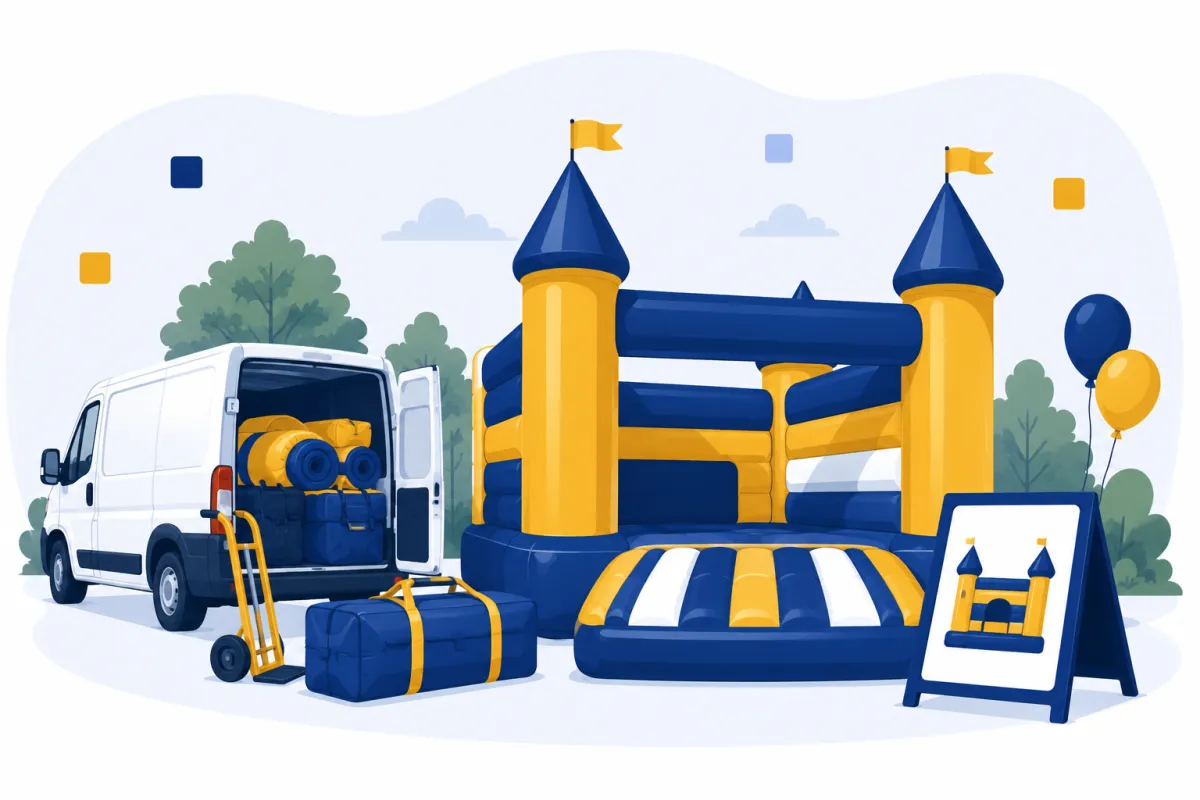
Bouncy Castle & Inflatable Hire Insurance UK | Specialist
Why is bouncy castle and inflatable hire insurance so hard to place in 2026?
Bouncy castle and inflatable hire is one of the most misunderstood insurance risks in the UK. To the public it looks like a cheerful, low-stakes trade — but to an underwriter it is a mobile operation putting members of the public, mostly young children, onto wind-sensitive equipment on ground the operator doesn't control, often with a single person supervising. A gust of wind, a missed anchor point, or a moment's inattention can turn a children's party into a fatality. That reality — and the litigation and prosecutions that follow serious incidents — has made many insurers cautious about the trade, and left legitimate operators paying more, accepting tighter conditions, or being declined at renewal.
This is the territory Miller & Partner works in. As a specialist broker for adverse and hard-to-place risks, we place cover for high-risk activity and hire operators the standard market avoids — including businesses that have been refused cover elsewhere or non-renewed after a claim. This guide explains why the market is cautious, what PIPA and BS EN 14960 compliance mean for your premium, what a properly built inflatable hire policy must contain, and how to present your risk so specialist underwriters actually want to write it.
How does The Insurability Framework™ apply to inflatable hire?
Underwriter Intelligence
We know which specialist leisure and Lloyd's markets still write inflatable hire in 2026, and what triggers their concern — PIPA test status, anchorage discipline, wind procedures and supervision ratios. We present your test tags and risk assessments before the underwriter has to ask.
Difficult Risk Expertise
Inflatable hire is a decline-prone trade. Our specialist MGA and Lloyd's access reaches the underwriters who still have appetite for bouncy castle, inflatable and soft-play hire — including operators with a prior claim or a lapse in cover.
Risk Assessment
We audit your operation the way a claimant's solicitor will after an incident: PIPA tags, anchorage records, anemometer use, hire agreements, safety briefings and handover documentation — the evidence that decides a claim.
Claims Advocacy
A serious inflatable incident produces a high-value, emotionally charged claim — and, in the worst cases, a criminal investigation. When it happens, you deal with a named broker who fights your corner, not a call centre.
Key facts at a glance
- No inflatable may be used in winds above 24mph (Force 5 on the Beaufort Scale) — the single most important operating rule in the trade, and the factor behind its worst tragedies.
- Commercial inflatables must be built and tested to BS EN 14960; the standard itself isn't law, but an annual test by a competent person is a legal requirement under PUWER.
- Every outdoor inflatable needs a minimum of 6 anchor points, using metal stakes at least 380mm long and 16mm wide — or ballast of at least 163kg per anchor point on hard standing.
- In 2016 a seven-year-old girl died when a bouncy castle blew away at a fair; the operators were convicted of gross-negligence manslaughter and jailed for three years.
- "Toy" or domestic inflatables cannot be hired out commercially — they aren't built to BS EN 14960 and cannot be covered for public liability.
- Most insurers require a valid PIPA tag or ADiPS declaration of compliance before they will offer public liability cover.
- Public liability is the trade's core cover, and serious injury claims involving children can run well into six or seven figures once care and future loss are included.
What must an inflatable hire policy include that a standard one won't?
The most dangerous assumption a hire operator can make is that a cheap "public liability for entertainers" policy bought online will respond to a serious inflatable incident. Often it won't. Inflatable hire breaches the assumptions and exclusions of generic wordings in several places at once — and the gaps only surface after a claim. The comparison below shows where a generic policy fails and what a specialist inflatable hire wording does differently.
| Exposure | Generic / cheap online policy | Specialist inflatable hire wording |
|---|---|---|
| Participant injury (public liability) | Low limits; inflatables sometimes excluded or heavily conditioned | £5m–£10m limits sized for serious child-injury claims, with inflatables fully disclosed |
| Wind / anchorage failure | May be excluded as an operating breach if procedures not evidenced | Covered where you operate to BS EN 14960 — wind logs and anchorage records support the claim |
| PIPA / annual test condition | Often a hidden warranty; an out-of-test unit voids the claim | Test discipline built into the risk presentation, not a trap |
| The inflatables themselves (property) | Rarely covered; theft or damage falls on you | Equipment cover at replacement value, including in transit and storage |
| The van and towed trailer | Falls between motor and business policies | Commercial motor and goods-in-transit aligned with the liability cover |
| Supervised vs unsupervised (drop-and-go) hire | Not distinguished; unsupervised hire may be uninsured | Rated explicitly, with handover and hirer-agreement conditions reflected |
| Added kit (soft play, generators, slides) | Undisclosed items fall outside cover | Each item type disclosed and rated so nothing falls through the gap |
Why have insurers pulled back from the inflatable hire sector?
Insurer caution in this trade is driven less by claim frequency than by claim severity and reputation. Most inflatable hires pass without incident — but when something goes wrong, it can go catastrophically wrong, and it involves children. A run of high-profile tragedies, coupled with gross-negligence manslaughter prosecutions of operators, put the sector under a spotlight and made insurers acutely aware of the tail risk in a book of "cheap" public liability policies. When the worst-case claim is the death of a child and a criminal conviction, underwriters price and select very carefully.
Two structural factors keep the market cautious. First, the operating environment is uncontrolled: the operator sets up on someone else's grass or car park, exposed to weather they can't change, often for a modest hire fee that doesn't reflect the exposure. Second, the trade has a long tail of under-insured or non-compliant operators using toy equipment, skipping annual tests, or ignoring wind limits — which drags on the whole sector's loss experience. The result is a two-tier market. Operators who can evidence PIPA compliance, disciplined anchorage and wind procedures, proper hire agreements and supervision can still access competitive terms. Those who can't are quoted defensively or declined. If you've already been declined, our guide to insurance when you've been refused elsewhere explains how specialist placement works from that position.
From recent placement conversations
The operators who call us are almost always the good ones — the ones who PIPA-test every unit, log the wind, and turn down a booking when it's too windy. And they're often the ones being punished for the sins of the cowboys, facing a premium hike or a decline because the trade as a whole scares insurers.
What turns that around is evidence. The operators we place at the best terms hand us their PIPA tags, their wind-log procedure, their hire agreement and their public liability history as a single pack — before anyone asks. It signals a professional operator in a trade with too few of them, and underwriters reward it. One operator we placed had been quoted a near-doubling at renewal; presenting the compliance evidence properly brought competing terms within a week. In this trade, presentation is not decoration — it is the placement.
What are BS EN 14960, PIPA and RPII — and why do underwriters insist on them?
BS EN 14960 is the European standard governing the design, manufacture, testing and safe operation of inflatable play equipment. It defines anchorage requirements, containment walls, the blower specification, and the operating rules — including the wind limit. Commercial inflatables must be built to it.
The standard itself is not law — but an annual test by a competent person is a legal requirement, because inflatable play equipment is "work equipment" under the Provision and Use of Work Equipment Regulations 1998 (PUWER). The industry meets this through two recognised schemes: PIPA (the inflatable play inspection scheme, which issues a numbered tag and certificate) and ADiPS (which issues a declaration of compliance). Both use RPII-registered inspectors, whose competence the HSE accepts. A valid PIPA tag or ADiPS DoC is the document that proves you've discharged the annual-test duty.
The insurance point is decisive: most underwriters require a valid PIPA tag (or ADiPS DoC) on every unit before they will offer public liability cover, and treat a lapsed test as a coverage defence. Keeping every unit in test — and being able to prove it — is the single cheapest premium-control measure in the trade.
What insurance covers does an inflatable hire business need?
An inflatable hire programme is genuinely combined — liability, property, transit and motor covers have to knit together so that a single incident (which will usually touch several at once) doesn't fall between sections. The core structure looks like this:
Public liability
The single most important cover, and the reason operators get declined. Third-party injury to users and bystanders — with limits sized for serious child-injury claims, usually £5m minimum and often £10m where event organisers or councils require it. See our guide to high-risk public liability insurance.
Employers' liability
Legally required under the Employers' Liability (Compulsory Insurance) Act 1969 the moment you employ setup crew, drivers or supervisors — even part-time or seasonal helpers.
Equipment / property cover
The inflatables, blowers, generators and soft play are your income-earning assets, exposed to theft, fire, storm and transit damage. Insure at replacement value to avoid underinsurance and the condition of average.
Commercial motor and goods in transit
The van and towed trailer carrying your kit between sites need commercial motor cover, with the equipment covered in transit and while loading/unloading.
Business interruption
Loss of hire income if theft, fire or damage takes your fleet of inflatables out of action in peak season — see our guide to business interruption insurance.
Products and management liability
If you sell food or run added attractions, products and food-safety liability applies; and after a serious incident directors can be named personally — see our directors' & officers' guide.
Cover checker: what does your hire operation need?
Select the profile closest to your operation. Tags show what's legally required, essential, or worth considering. Every hire programme should be built individually — this checker maps the starting point. Our main high-risk public liability guide covers the liability core.
- CRITICALPublic liability £5m–£10m — the cover that decides insurability; serious child-injury claims drive severity. Specialist placement needed if you've had a previous claim.
- ESSENTIALValid PIPA tag / ADiPS DoC on every unit — a precondition of most quotes, not just a discount.
- LEGALEmployers' liability (£10m) — the moment you employ setup or supervision staff.
- ESSENTIALEquipment cover at replacement value — theft and storm damage to your fleet.
- RECOMMENDEDGoods in transit — for the kit between sites.
- CRITICALDrop-and-go explicitly disclosed — unsupervised domestic hire is a distinct risk; undisclosed, it may be uninsured. The hirer agreement and handover documentation are your defence.
- CRITICALPublic liability £5m minimum — you retain liability for equipment condition even when you're not on site.
- ESSENTIALWritten hire agreement + safety briefing — evidence the hirer was instructed on wind, capacity and supervision.
- ESSENTIALPIPA tags current on every unit hired out.
- RECOMMENDEDEquipment cover against damage returned by hirers.
- CRITICALPublic liability £10m — corporate clients, councils and event organisers routinely mandate this limit.
- LEGALEmployers' liability (£10m) — event crew.
- ESSENTIALContractual liability review — event and venue contracts push risk onto you; the wording must reflect it.
- ESSENTIALWind & anchorage procedures documented — large open-site events are the highest wind-exposure hires.
- CONSIDEREvent public liability crossover — see our event public liability guide.
- CRITICALFixed-site inflatable park cover — a permanent venue is a different risk from mobile hire; property, BI and higher-footfall PL all apply. See our trampoline & activity park guide.
- CRITICALPublic liability £10m across all activities.
- LEGALEmployers' liability (£10m).
- ESSENTIALBusiness interruption — a fixed venue has rent and staffing to cover after a closure.
- RECOMMENDEDAbuse / safeguarding cover — child-heavy footfall.
- CRITICALEach equipment type disclosed — soft play, ball pits and inflatables carry distinct exposures; list them all.
- CRITICALPublic liability £5m–£10m across the mix.
- LEGALEmployers' liability (£10m).
- ESSENTIALUnder-5 zoning and capacity control — toddler soft play alongside inflatables raises severity.
- RECOMMENDEDEquipment cover for the full inventory.
- CRITICALEnclosed-unit evacuation risk — disco domes and enclosed inflatables carry additional entrapment and evacuation-time exposures that underwriters probe.
- CRITICALPublic liability £5m–£10m.
- ESSENTIALPIPA tags current — enclosed units are inspected under the same scheme.
- ESSENTIALElectrical / PAT testing of blowers and lighting.
- CONSIDEREmployers' liability if you staff domes at events.
Why is public liability the make-or-break cover for inflatable hire?
Public liability is where inflatable hire operators live or die in the eyes of an underwriter — and in the eyes of the law. The exposure is uniquely severe: mostly young children, on equipment sensitive to wind and anchorage, in an environment the operator only partly controls. A single serious incident — a wind-related overturning, a fall, an entrapment — can produce a life-changing or fatal injury to a child, and claims involving children carry long limitation periods and high awards once future care and loss of earnings are included.
That severity is why specialist wordings carry £5m–£10m limits and why event organisers, councils and venues routinely demand £10m before they'll let you on site. It's also why underwriters interrogate the controls that reduce frequency and severity: PIPA test status, anchorage discipline, wind monitoring, supervision, capacity control and the quality of your hire agreement and safety briefing. Because these are also duties under the Health and Safety at Work etc. Act 1974, the evidence you keep that you met them is exactly what defends the claim.
Why is wind the single biggest killer in this trade?
If there is one number every inflatable operator must know, it is 24mph — Force 5 on the Beaufort Scale, the maximum wind speed at which any inflatable may be used. Above it, an inadequately anchored inflatable can lift, and the consequences have been fatal. The trade's most infamous tragedy involved a bouncy castle that blew away from its moorings in 2016, carrying a seven-year-old girl some 300 metres; the operators had failed to anchor it securely and had not monitored the weather. They were convicted of gross-negligence manslaughter and jailed for three years, and the judge called publicly for wind-measuring equipment to be made compulsory at fairgrounds.
The lesson for both safety and insurance is that wind is a controllable risk — and underwriters expect it to be controlled. That means using an anemometer to measure wind speed at intervals, not guessing; anchoring to the full BS EN 14960 specification (minimum six points, correct stakes or 163kg ballast per point on hard standing); and — the discipline that actually saves lives and claims — being willing to switch off and turn away a booking when the wind is too high. Operators who can evidence a documented wind procedure are a fundamentally different risk from those who can't.
Why can't you insure a "domestic" or toy inflatable for hire?
This is the trap that catches new entrants. Cheap "toy" or domestic inflatables — the kind sold for back-garden family use — are not built to BS EN 14960, are not strong enough for repeated commercial hire, and cannot be covered for public liability. Hiring one out isn't just uninsurable; it breaches PUWER and the Health and Safety at Work etc. Act, and it puts users at real risk because the anchorage, seams and containment simply aren't engineered for it.
The practical rule is absolute: only ever hire out commercial inflatables built and tested to BS EN 14960, with a current PIPA tag or ADiPS DoC. If an underwriter discovers a toy unit in your fleet after a claim, expect the claim to fail and the policy to be challenged. When you buy equipment, buy commercial — it's the foundation the entire insurance programme sits on.
Red-flag checklist: would an underwriter worry about your hire business?
Tap each statement that is currently true of your operation. These are the things that make a leisure underwriter nervous — the more that light up, the harder (and pricier) your placement becomes.
What about the van, the kit and cover between sites?
Because inflatable hire is a mobile trade, a surprising amount of the risk sits away from the party itself — in the van, the trailer, and the storage unit. The inflatables, blowers, generators and soft play are your income-earning assets, and they're most vulnerable in transit and storage: theft from a van overnight, storm damage to a trailer, or a fire in a lock-up can wipe out a season's earning capacity in one event. Yet these exposures routinely fall into the gap between a personal motor policy and a public liability policy that never contemplated the equipment.
A properly built programme aligns commercial motor cover for the van and trailer, goods-in-transit for the kit on the move, and equipment/property cover at replacement value for storage — with a business interruption element so that losing your fleet in June doesn't mean losing the summer. Declare replacement values honestly and review them as you add units, because average applies here just as it does to any property cover.
Risk assessor: how will an underwriter score your operation?
What regulations and duties apply to inflatable hire?
Like trampoline parks, inflatable hire operates without a bespoke licensing regime — but several overlapping legal duties apply with full force, and each one feeds into how your insurance is underwritten and how a claim is defended.
Health and safety law
The Health and Safety at Work etc. Act 1974 imposes duties to protect both employees and the public. The Provision and Use of Work Equipment Regulations 1998 (PUWER) classes inflatables as work equipment and is the source of the legal duty to have them tested annually by a competent person. The HSE is the enforcing authority and has secured prosecutions citing BS EN 14960 as the benchmark of safe operation.
BS EN 14960 and the inspection schemes
BS EN 14960 governs design, manufacture and safe operation; PIPA and ADiPS are the two HSE-recognised inspection schemes that evidence the annual test, using RPII-registered inspectors. The standard is not statute, but it is the document a court and an insurer measure you against.
Occupiers' and consumer duties
The Occupiers' Liability Act 1957 and the duty of care to visitors underpin most participant claims, with a higher standard owed to children. For drop-and-go hire, the Consumer Rights Act 2015 and your hire agreement govern the operator-hirer relationship — but you cannot contract out of liability for negligently caused injury.
Manslaughter exposure
The most serious risk in this trade is criminal, not civil. Where a death results from a gross breach of the duty of care, operators face gross-negligence manslaughter — as the 2016 Harlow case showed, with custodial sentences for the operators. No insurance covers a criminal fine or sentence; only your safety systems prevent this outcome.
What drives the cost of inflatable hire insurance?
There is no meaningful "average premium" for inflatable hire — the spread between a supervised, fully PIPA-compliant events operator and a high-volume drop-and-go business with out-of-test units is enormous. What every operator can do is understand the rating factors and work the ones within their control:
| Rating factor | Why it moves your premium | Mitigation |
|---|---|---|
| PIPA / annual test status | A precondition of most quotes; lapsed tests = decline or coverage defence | Every unit in test; keep tags and certificates to hand |
| Supervised vs drop-and-go | Unsupervised hire is a materially higher risk | Disclose the split; strong hire agreements for drop-and-go |
| Wind procedure | Wind is the trade's fatal risk; underwriters expect it controlled | Anemometer + documented wind log; willingness to stand down |
| Anchorage discipline | Under-anchoring is the leading cause of catastrophic incidents | Full BS EN 14960 spec: 6+ points, 163kg ballast on hard standing |
| Public liability limit | Serious child-injury claims need £5m–£10m | Buy the limit the risk (and event organisers) demand |
| Equipment type & fleet size | Commercial-only fleets rate very differently from mixed | Commercial BS EN 14960 units only — never toy inflatables |
| Claims history | A prior injury claim reprices everything for 3–5 years | Evidence what changed since; see our claims history guide |
| Hire agreements & handover | Poor documentation weakens every claim defence | Written agreement + safety briefing every hire, recorded |
| Electrical / PAT testing | Blower and generator faults are a real ignition and injury source | Regular PAT testing, logged |
| Capacity & age control | Overloading and age-mismatch drive injury frequency | Enforce manufacturer capacity and height limits |
| Declared equipment values | Underinsurance triggers average on your fleet | Replacement-value declarations, reviewed as you add units |
| Continuity of cover | Lapses and mid-term cancellations are decline red flags | Start renewal early; never let cover gap |
What do real inflatable hire claims look like?
These three fictionalised but market-realistic case studies show how inflatable hire losses actually unfold — and where the decisions made at placement decided the outcome.
Case study 1: The wind incident — £1.2m public liability claim
A hire operator set up a bouncy castle at a summer fete on a breezy day. The forecast was borderline; no anemometer reading was taken. A gust lifted a corner of the inadequately anchored inflatable, and two children were thrown, one suffering a serious head injury with lasting effects.
The numbers: £780,000 general and special damages for the injured child including future care and loss of earnings, £260,000 for the second child's injuries, £160,000 defence and investigation costs. Total: £1.2m — met because the operator carried a £5m PL limit on a specialist wording.
The lesson: the claim was covered, but the absence of a wind reading and full anchorage turned an insurable accident into a near-certain liability finding. Renewal premium rose 60%, with an anemometer-use warranty attached. The operator's takeaway — documented every wind reading thereafter — is exactly what regained competitive terms over three years.
Case study 2: The out-of-test unit — a £220,000 claim declined
A drop-and-go operator hired out a bouncy castle whose PIPA test had lapsed four months earlier. A seam failed during use and a child fell awkwardly, fracturing an arm and wrist. When the insurer reviewed the file, the lapsed test surfaced.
The numbers: the claim was valued at around £220,000 including special damages. The insurer declined it, citing breach of the policy's annual-test warranty, and the loss fell on the operator personally.
The lesson: a lapsed PIPA test is not an administrative slip — it's a live coverage defence. The £60 test the operator skipped cost them a £220,000 claim and, effectively, the business. Keeping every unit in test, and being able to prove it, is the cheapest insurance discipline in the trade.
Case study 3: The stolen fleet — £48,000 equipment and business interruption loss
Thieves broke into an operator's storage unit in late May and took six inflatables, three blowers and a generator — the core of the summer fleet — just as the peak booking season began. The operator had public liability but had never insured the equipment itself.
The numbers: £34,000 to replace the stolen equipment and £14,000 in lost bookings over the six weeks it took to re-equip. Total uninsured loss: £48,000, because the property and business interruption elements had been left out to save premium.
The lesson: public liability protects the public — it does nothing for your own assets. In a mobile trade where the kit is the business, equipment cover at replacement value plus a business interruption element is not optional. The few hundred pounds of extra premium would have turned a season-ending loss into a claim.
What if your hire business has been refused cover?
Refusal, non-renewal and mid-term cancellation are common enough in inflatable hire that they carry less stigma with specialist underwriters than operators fear — but they must be handled correctly. Every future proposal will ask whether you have been refused cover, and the duty of fair presentation makes the answer permanent. The workable path is the one we set out in our guides to insurance for businesses refused cover and high-risk public liability insurance: disclose everything, evidence your PIPA compliance and what has changed since any prior claim, and approach the specialist market through a broker who can frame the risk — never through serial online applications that build a paper trail of declines. Operators carrying a prior claim alongside the trade's inherent severity need both issues presented together, once, properly.
How do you manage a serious inflatable incident?
Inflatable incidents are managed — and claims are won or lost — in the first hours and days. This is the sequence we run with clients:
- Get medical help and make the scene safe. Life safety first; then shut down and isolate the inflatable and blower, and stop all use, so the scene is preserved.
- Preserve the equipment and conditions evidence. Do not dismantle or move the unit if avoidable; record the anchorage, the wind reading, and the set-up exactly as it was — photographs and the anemometer log are decisive.
- Record the incident fully, at once. Incident log, witness details, the hire agreement, the PIPA tag and test certificate, and the safety briefing given — while everything is fresh.
- Notify your broker the same day. Late notification breaches policy conditions. Your broker triggers insurer notification across PL, EL and any equipment sections.
- Report to the HSE where required. RIDDOR-reportable injuries must be reported; take advice before giving any account that could be used in enforcement or a criminal investigation.
- Control communications. One spokesperson; no admissions of liability to the family, the public or on social media — statements made now surface in the claim, and potentially a prosecution, later.
- Cooperate with the loss adjuster, on the right footing. The insurer's adjuster is professional but not your representative; on a serious claim, take your broker's advice on whether your own support is justified.
- Fix the root cause and evidence it. Whatever the investigation finds — anchorage, wind procedure, test status — correct it and document the change. It protects the next hire as much as the next renewal.

About the author — John Miller
John Miller is Director & Principal Broker at Miller & Partner Limited (FCA Firm Ref 1029698), with over 13 years' specialist commercial insurance experience and direct access to the Lloyd's Market and specialist MGA schemes. John specialises in adverse and hard-to-place risks — including bouncy castle and inflatable hire, soft play and other high-risk activity trades the standard market avoids — placing cover for operators others have declined. He was previously the #1 Account Executive at Brown & Brown and #1 Salesperson at AXA.
Read more about John · Office: Vivian House, Roman Bridge Close, Mumbles, Swansea SA3 5BG · 01792 001350
Glossary of inflatable hire insurance terms
- BS EN 14960
- The European standard for the design, manufacture, testing and safe operation of inflatable play equipment — the benchmark insurers and courts measure operators against.
- PIPA
- The inflatable play inspection scheme that issues a numbered tag and certificate confirming a unit has passed its annual test to BS EN 14960.
- ADiPS
- The Amusement Device Inspection Procedures Scheme, an alternative HSE-recognised scheme issuing a declaration of compliance for inflatables and wider amusement devices.
- RPII
- The Register of Play Inspectors International — the body whose registered inspectors carry out the annual test that PIPA and ADiPS certify.
- Annual test
- The legally required inspection of inflatable "work equipment" by a competent person under PUWER — usually evidenced by a PIPA tag or ADiPS DoC.
- PUWER
- The Provision and Use of Work Equipment Regulations 1998, which class inflatables as work equipment and require them to be maintained and tested.
- Anchorage
- The system of stakes or ballast securing an inflatable; BS EN 14960 requires a minimum of six points, with defined stake sizes or 163kg ballast per point on hard standing.
- Anemometer
- A wind-speed measuring instrument; using one at intervals is the expected way to enforce the 24mph operating limit.
- Beaufort Force 5
- The 24mph wind threshold above which no inflatable may be used — the trade's cardinal operating rule.
- Toy / domestic inflatable
- A non-commercial inflatable not built to BS EN 14960; illegal to hire out and uninsurable for public liability.
- Drop-and-go hire
- Unsupervised hire where the operator delivers and leaves the inflatable with the hirer — a materially higher risk that must be disclosed and documented.
- Public liability
- Cover for third-party (user and bystander) injury and property damage — the make-or-break cover for an inflatable hire business.
- Employers' liability
- Legally compulsory cover for injury to staff, required as soon as you employ setup crew, drivers or supervisors.
- Goods in transit
- Cover for the inflatables, blowers and kit while being transported between sites.
- Condition of average
- The mechanism that proportionately reduces claims where declared equipment values are below true replacement values.
- Gross-negligence manslaughter
- The criminal offence operators can face where a death results from a gross breach of the duty of care — uninsurable, and prevented only by safe operation.
- Fair presentation
- The duty under the Insurance Act 2015 to disclose every material circumstance about the risk — including hire model, equipment, losses and refused cover.





Instagram
LinkedIn