


Contingent Business Interruption Insurance UK Guide
Why doesn't standard business interruption cover your supply chain?
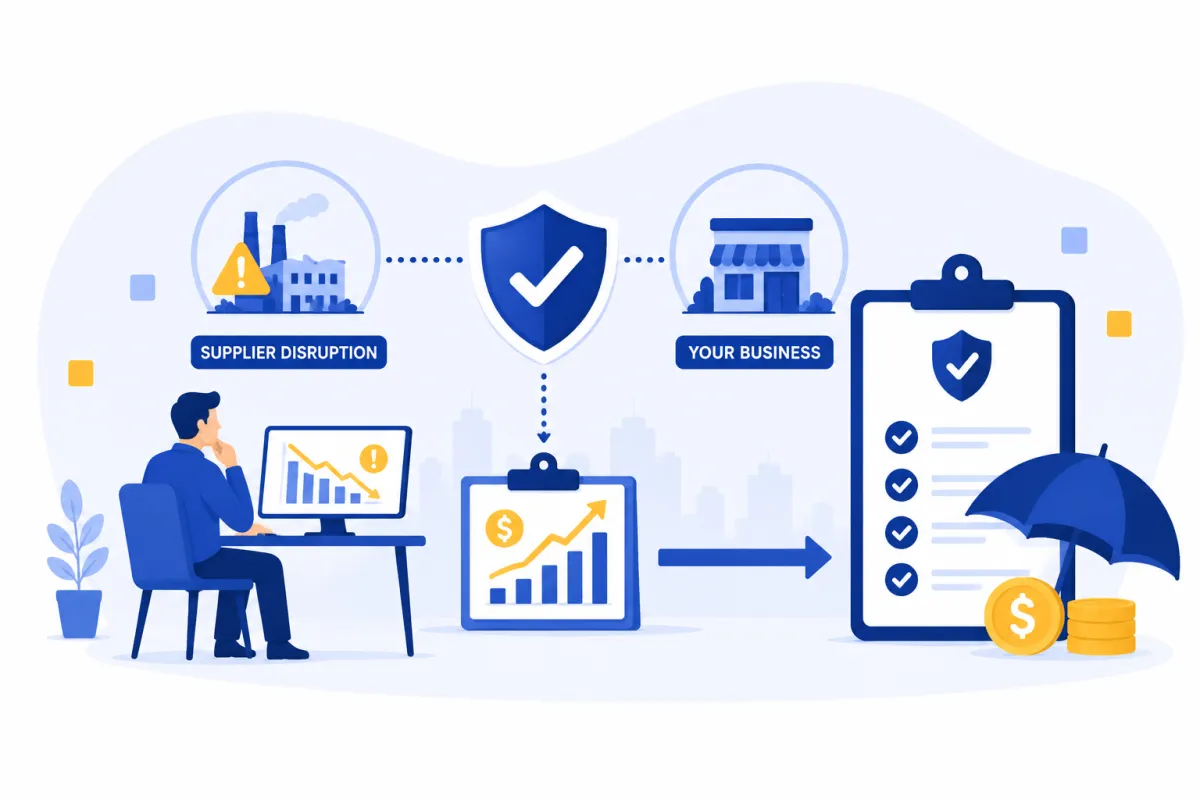
Standard business interruption insurance has a boundary most owners never notice until they claim: it responds to physical damage at your own premises. If a fire, flood or storm hits your building, it pays the income you lose. But if the disruption starts somewhere else in your supply chain — a key supplier's factory burns down, a major customer is shut, a port is blocked — your own premises are untouched, and a standard policy has nothing to respond to.
That is the gap contingent business interruption insurance (CBI) is built to close. In a world where most businesses depend on a handful of suppliers and customers, often overseas, the interruption that takes you down is increasingly one that happens to someone else. CBI — also called dependent business interruption — extends your cover beyond your fence line to the third parties your income relies on.
But CBI has a catch of its own, and a newer, larger gap sits behind it: the non-damage disruptions — a cyber attack on a supplier, a supplier insolvency, a trade or shipping disruption — that no physical-damage policy was designed to cover. At Miller & Partner we map these exposures through The Insurability Framework™ — underwriter intelligence, difficult-risk expertise, risk assessment and claims advocacy — because supply-chain cover is specialist, the wordings differ sharply, and the difference between a policy that responds and one that doesn't is in the trigger.
Contingent BI & supply chain: key facts at a glance
- Standard BI only covers loss from physical damage at your own premises — a supplier or customer being hit leaves you uncovered.
- Contingent BI (CBI), also called dependent BI, extends cover to income lost when a supplier or customer suffers damage.
- The catch: standard CBI usually still needs physical damage at the third party — non-damage events are typically excluded.
- Non-damage supply-chain disruption — cyber at a supplier, insolvency, pandemic, port or trade disruption — is the big modern gap.
- Second-tier cover (your suppliers' suppliers) usually requires the supplier to be specifically named.
- The 2025 cyber attacks on major UK manufacturers and retailers showed how losses cascade through supply chains to dependent businesses.
- CBI cover is specialist and limited — few insurers model supply-chain loss, so a mapped supply chain and strong presentation matter.
What is contingent business interruption insurance?
Contingent business interruption insurance covers the income you lose when a business you depend on — rather than your own premises — is disrupted. It sits as an extension to your property and BI programme, and responds when a named or described supplier, customer or other dependent party can no longer supply you or buy from you because of an insured event at their location.
A typical CBI extension can respond to:
- Supplier disruption — a key supplier can't deliver materials or components because their premises are damaged.
- Customer disruption — a major customer can't receive your goods because their premises are damaged, hitting your sales.
- Utilities and infrastructure — failure of electricity, gas, water or telecoms supply from damage upstream.
- Denial of access — physical damage nearby that prevents access to your own premises.
The cover pays your lost gross profit and increased costs of working during the interruption, up to the limits and indemnity period you set — the same machinery as standard BI, pointed outward at your dependencies.
Standard BI vs contingent BI vs supply-chain cover — what's the difference?
Four related covers respond to very different links in the chain. Knowing which one you actually hold is the difference between a paid claim and a nasty surprise:
| Cover | Responds to | Key limitation |
|---|---|---|
| Standard business interruption | Income lost from physical damage at your own premises. | Nothing happening to a supplier or customer is covered. |
| Contingent BI (suppliers/customers) | Income lost when a supplier or customer suffers physical damage. | Usually still needs physical damage at the third party. |
| Non-damage / supply-chain cover | Disruption with no physical damage — cyber, insolvency, trade or shipping events. | Specialist, limited capacity; often named-peril and tightly underwritten. |
| Trade credit insurance | A customer's failure to pay, including through insolvency. | Covers the unpaid debt, not the lost production or income. |
Supplier insolvency is a good example of how easily the gaps line up: it is not physical damage (so CBI won't respond), and it isn't always a non-payment by your customer (so trade credit may not fit either). Matching the cover to the actual failure mode is exactly the job of a specialist commercial broker.
What triggers a contingent BI claim — and what's the catch?
The trigger is the single most important — and most misunderstood — feature of CBI. In most standard wordings, the cover responds only when the third party suffers physical damage from a peril that would have been covered at your own premises (fire, flood, storm and similar). If your supplier's factory burns down, you can claim; if your supplier simply stops supplying for any other reason, you usually can't.
That distinction quietly excludes most of the supply-chain events that actually happen:
- A supplier suffers a cyber attack and can't process orders — no physical damage, often no cover.
- A supplier goes insolvent — no physical damage, no cover under CBI.
- A port closes or shipping is disrupted — no physical damage to your supplier, no cover.
- A pandemic or government restriction halts a supplier — generally excluded post-2020.
Why is non-damage supply-chain disruption the big gap?
The exposures that have grown fastest are precisely the ones the physical-damage trigger misses. The 2025 cyber attacks on major UK manufacturers and retailers were a wake-up call: the damage rippled outward to suppliers and dependent businesses who had no physical loss of their own, and many found their BI cover simply didn't engage. Tariff-driven supply-chain restructuring has added another layer — businesses consolidating to a single source to manage costs, only to create a concentration risk that no policy was written around.
Non-damage business interruption (NDBI) / supply-chain insurance is the specialist answer, but it is a genuinely hard market. Few insurers offer broad cover, because modelling a loss that can originate anywhere in a chain they have little visibility of is extremely difficult. Where cover is available, it is typically selective, named-peril and closely underwritten — and securing it depends heavily on how well you can describe and evidence your supply chain.
From recent placement conversations
"The conversation that's changed most in the last year is about cyber in the supply chain. After the big 2025 attacks, clients started asking 'what if it's not us, but our supplier?' — and the honest answer for most of them was that their BI wouldn't pay, because nothing was physically damaged."
"The other one is single-sourcing. A lot of businesses quietly became dependent on one supplier to save money, and never told their insurer. The first an underwriter hears of it is at the claim — which is the worst possible moment, both for the cover and for the duty of fair presentation."
Which businesses need contingent BI cover?
Select your business type to see the typical supply-chain exposure and the cover that fits. A starting point — your own dependencies set the definitive need.
Manufacturer
Food / perishables
Retailer / wholesaler
Importer / exporter
Just-in-time / automotive
Tech / SaaS
Is your supply-chain cover in order?
Tick each statement that's true of your business. The unticked items are where a third-party disruption goes uncovered.
How exposed is your supply chain right now?
A quick two-factor gauge of supply-chain interruption exposure. Indicative only.
How do you present your supply chain to insurers?
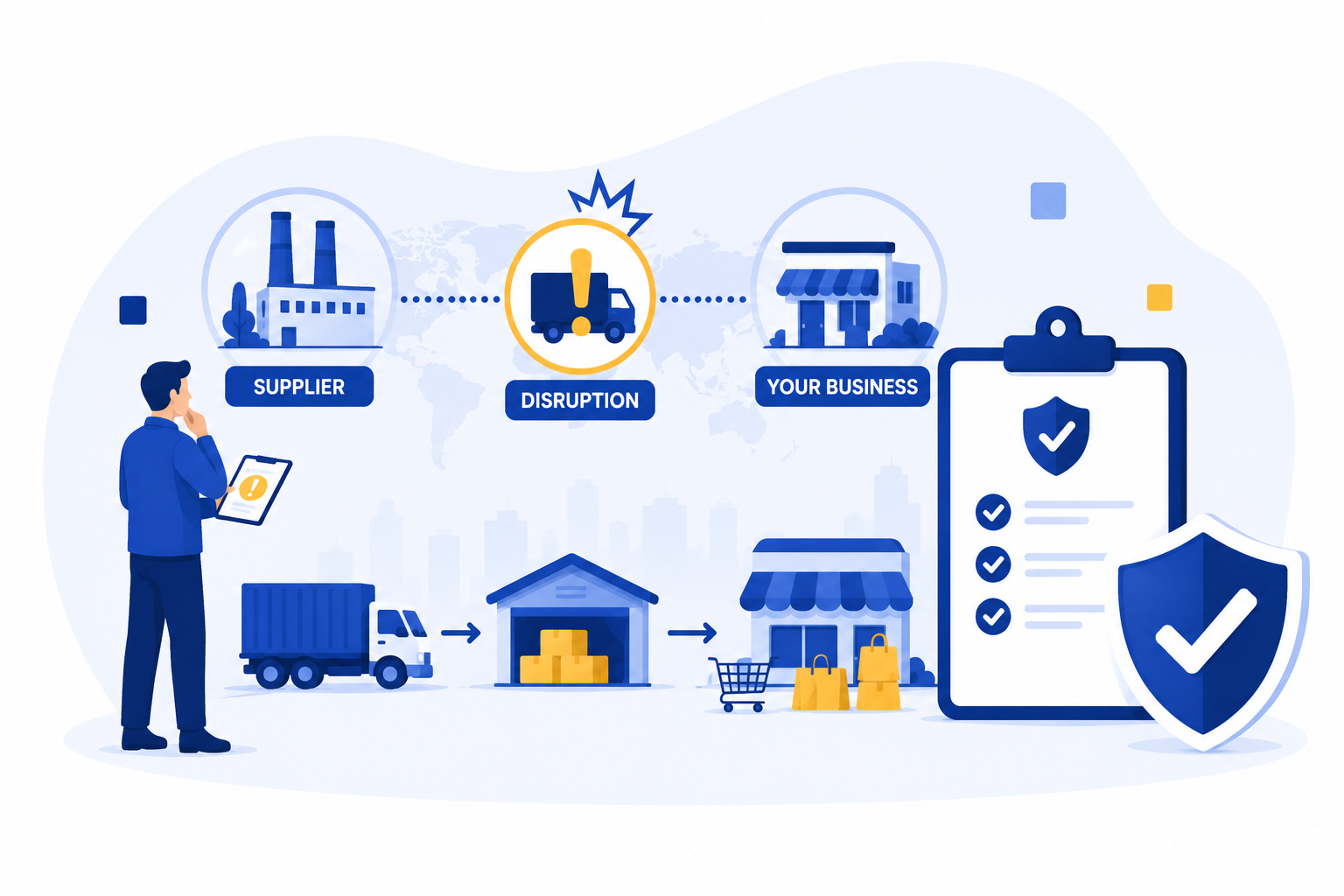
Contingent and non-damage cover lives or dies on presentation. Insurers are being asked to take on a loss that can originate anywhere in a chain they cannot see, so the quality of the information you give them directly shapes whether cover is offered, how broad it is, and what it costs. This is not just good practice — under the Insurance Act 2015, you have a legal duty of fair presentation: you must disclose every material circumstance you know or ought to know, clearly and accessibly.
For supply-chain cover, the most material circumstances are your dependencies — and a single-source supplier or a dominant customer is exactly the kind of fact an underwriter would want to know. Fail to disclose it, and a later claim can be reduced or declined under the Act's proportionate remedies. The practical answer is a supply-chain map:
- Identify your critical suppliers and customers — typically the top five of each, plus anyone you cannot quickly replace.
- Flag single-source dependencies — where there is no ready alternative for a critical input or a dominant customer.
- Trace the important second-tier links — the suppliers' suppliers that a critical relationship itself depends on.
- Document continuity arrangements — backup suppliers, buffer stock and recovery plans that shorten a loss.
A clear map does double duty: it satisfies the duty of fair presentation, and it gives the underwriter the confidence to offer broader terms. It is the same principle that runs through every business interruption placement — present the risk fully and the policy does what it should.
What drives the cost of contingent BI cover?
Contingent and supply-chain premiums reflect how dependent you are, on whom, and how exposed those dependencies are to disruption. The factors below move the price — and most can be improved with better information and planning.
| Rating factor | Why it affects premium | How to improve it |
|---|---|---|
| Supply-chain concentration | Single-source dependency makes one failure existential. | Diversify where you can; document alternatives and buffer stock. |
| Sector | Just-in-time, food and high-tech supply chains carry higher disruption exposure. | Evidence resilience measures specific to your sector. |
| Geographic spread | Overseas and long supply lines add trade, shipping and geopolitical risk. | Map sources; show dual-sourcing or nearshoring where it exists. |
| Named vs described suppliers | Cover for specific critical suppliers needs them identified. | Name your critical first- and second-tier suppliers. |
| Trigger breadth | Adding non-damage perils (cyber, insolvency) widens cover and premium. | Buy non-damage cover only where the dependency justifies it. |
| Indemnity period | Longer periods mean the insurer is on risk for more loss. | Match to realistic re-sourcing time — neither inflate nor cut. |
| Sums insured adequacy | Under-set BI values are cut at claim — see underinsurance. | Set values on the correct gross-profit basis, reviewed annually. |
| Business continuity | Backup suppliers and tested plans shorten a loss. | Maintain and rehearse a supply-chain continuity plan. |
| Customer concentration | Reliance on one or two customers raises customer-side exposure. | Document the customer base and any contractual protections. |
| Claims history | Prior supply-chain or BI losses signal recurring exposure. | Show what changed since any past disruption. |
| Quality of presentation | A clear supply-chain map earns broader terms under the Insurance Act 2015. | Use a specialist broker to present the chain fully and accurately. |
What do real supply-chain BI claims look like?
Three anonymised but representative cases show how the trigger decides everything.
How do you handle a supply-chain interruption claim?
When a third-party disruption hits, a structured response protects both your trading and your claim:
- Notify your broker and insurer. Report as soon as the disruption affects your supply or sales, so the claim opens and the trigger is assessed early.
- Establish the trigger. Work out whether it's damage-based (a fire or flood at the third party) or non-damage (cyber, insolvency, trade disruption) — this decides which cover responds.
- Mitigate the interruption. Activate backup suppliers, alternative sourcing or temporary arrangements; you have a duty to mitigate, and it limits the loss.
- Document the dependency and the disruption. Evidence how the third party affects your income and what stopped — orders, contracts, correspondence and the event itself.
- Engage your accountant to quantify the loss. Calculate lost gross profit against what you would have earned but for the disruption.
- Track increased costs of working. Keep evidence of expedited shipping, alternative sourcing and overtime — these are usually recoverable.
- Monitor the indemnity period. Track recovery against the period and flag early if re-sourcing runs long, because payments stop when it ends.
- Review cover and your supply-chain map at renewal. Update the map and reassess limits, indemnity period and whether non-damage cover should be added.

John has 13+ years' specialist commercial insurance experience, including structuring contingent and non-damage business interruption cover for manufacturers, importers, food producers and retailers reliant on key suppliers and customers. A former #1 Account Executive at Brown & Brown and #1 Salesperson at AXA, he has direct access to the Lloyd's market and specialist supply-chain schemes, and maps client dependencies so cover responds to the disruption that actually happens. More about John.
Contingent BI & supply chain glossary
- Contingent business interruption (CBI)
- Cover for income lost when a third party you depend on — a supplier or customer — is disrupted, rather than your own premises.
- Dependent business interruption
- Another name for contingent BI, emphasising the dependency on a third party's continued operation.
- Standard business interruption
- Cover for income lost from physical damage at your own premises; it does not respond to events at a supplier or customer.
- Non-damage business interruption (NDBI)
- Specialist cover for income loss caused by a disruption with no physical damage — cyber, insolvency, trade or shipping events.
- Supply-chain insurance
- A broad term for cover protecting against income loss from disruption anywhere in a business's supply chain.
- Suppliers extension
- A BI extension responding when damage at a supplier's premises interrupts your supply and income.
- Customers extension
- A BI extension responding when damage at a customer's premises stops them buying from you.
- Denial of access
- An extension covering loss when physical damage nearby prevents access to your own premises.
- Named supplier
- A supplier specifically identified in the policy, usually required for cover of critical or second-tier suppliers.
- Unnamed (unspecified) supplier
- Cover for suppliers generally, without naming them; typically narrower and subject to a lower sub-limit.
- Tier-1 / tier-2 supplier
- A direct (first-tier) supplier versus a supplier's supplier (second-tier); second-tier cover usually requires naming.
- Single-source dependency
- Reliance on one supplier for a critical input, with no ready alternative — a material fact for insurers.
- Trade disruption
- Interruption from port closures, shipping route problems, customs delays or trade restrictions — usually a non-damage event.
- Duty of fair presentation
- The Insurance Act 2015 duty to disclose material circumstances clearly; breach can lead to proportionate remedies.
- Increased cost of working
- Extra costs incurred to keep trading after a disruption — expedited shipping, alternative sourcing — usually recoverable.
Contingent business interruption insurance: frequently asked questions
What is contingent business interruption insurance?
It's cover for the income you lose when a business you depend on — a key supplier or customer — is disrupted, rather than your own premises. Also called dependent BI, it extends your business interruption cover beyond your own four walls to the third parties your income relies on.
Does my business interruption policy cover my supply chain?
Not by default. Standard BI responds only to physical damage at your own premises. To be covered when a supplier or customer is disrupted, you need contingent (suppliers and customers) extensions added — and even then, most respond only to physical damage at the third party.
What's the difference between contingent BI and standard BI?
Standard BI covers income lost from damage at your own premises. Contingent BI covers income lost when a supplier or customer is damaged. Same machinery — lost gross profit and increased costs of working — but pointed at your dependencies rather than your own building.
Does contingent BI cover a supplier going insolvent?
Usually not. Standard contingent BI requires physical damage at the supplier, and insolvency involves no damage. Supplier insolvency falls into the non-damage gap, which needs a specialist non-damage section — and a customer's non-payment is a different cover again (trade credit).
Does it cover a cyber attack on a supplier?
Standard contingent BI generally won't, because a cyber outage at a supplier involves no physical damage. This is one of the fastest-growing exposures and one of the most commonly uncovered. Cover exists through specialist non-damage or cyber supply-chain extensions, but it must be arranged deliberately.
What is non-damage business interruption insurance?
It's cover for income loss caused by a disruption with no physical damage — a supplier cyber attack, insolvency, port closure or trade restriction. It's a specialist, limited market, because insurers find supply-chain losses hard to model, so cover is typically named-peril and closely underwritten.
Are my suppliers' suppliers covered?
Only if arranged. Contingent BI often covers direct (first-tier) suppliers, but cover for second-tier suppliers — your suppliers' suppliers — usually requires them to be specifically identified and named on the policy. Mapping the chain is what reveals which second-tier links matter.
Do I need to name my suppliers on the policy?
For critical and second-tier suppliers, usually yes. Unnamed supplier cover is often available but narrower and subject to lower sub-limits. Naming your key suppliers gives the underwriter the information to offer proper cover, and is part of presenting the risk fairly.
Does contingent BI cover a pandemic or shipping disruption?
Generally not. Pandemics and communicable disease are widely excluded post-2020, and shipping or port disruption involves no physical damage to your supplier, so standard contingent BI won't respond. These exposures need specialist non-damage or trade disruption cover where it's available.
What does contingent BI insurance cost?
It depends on your supply-chain concentration, sector, geographic spread, the breadth of trigger you need and your sums insured. There's no flat figure — but set against the income a prolonged disruption can cost, the premium is usually modest. The right question is whether the trigger and limit match your real dependencies.
How do I work out the limit and indemnity period?
Base the limit on the gross profit at risk if a key dependency fails, and the indemnity period on how long it would realistically take to re-source or recover — often many months for a specialist supplier. Global disruptions run long, so a short period or token limit is the common mistake.
Why use a specialist broker for supply-chain cover?
Because the cover is specialist and the triggers are where claims are won or lost. A specialist maps your dependencies, matches the trigger to your real failure modes, names the suppliers that matter and presents the chain to satisfy the Insurance Act 2015. Miller & Partner approaches every placement through The Insurability Framework — underwriter intelligence, difficult-risk expertise, risk assessment and claims advocacy. See our commercial insurance page.






Instagram
LinkedIn