


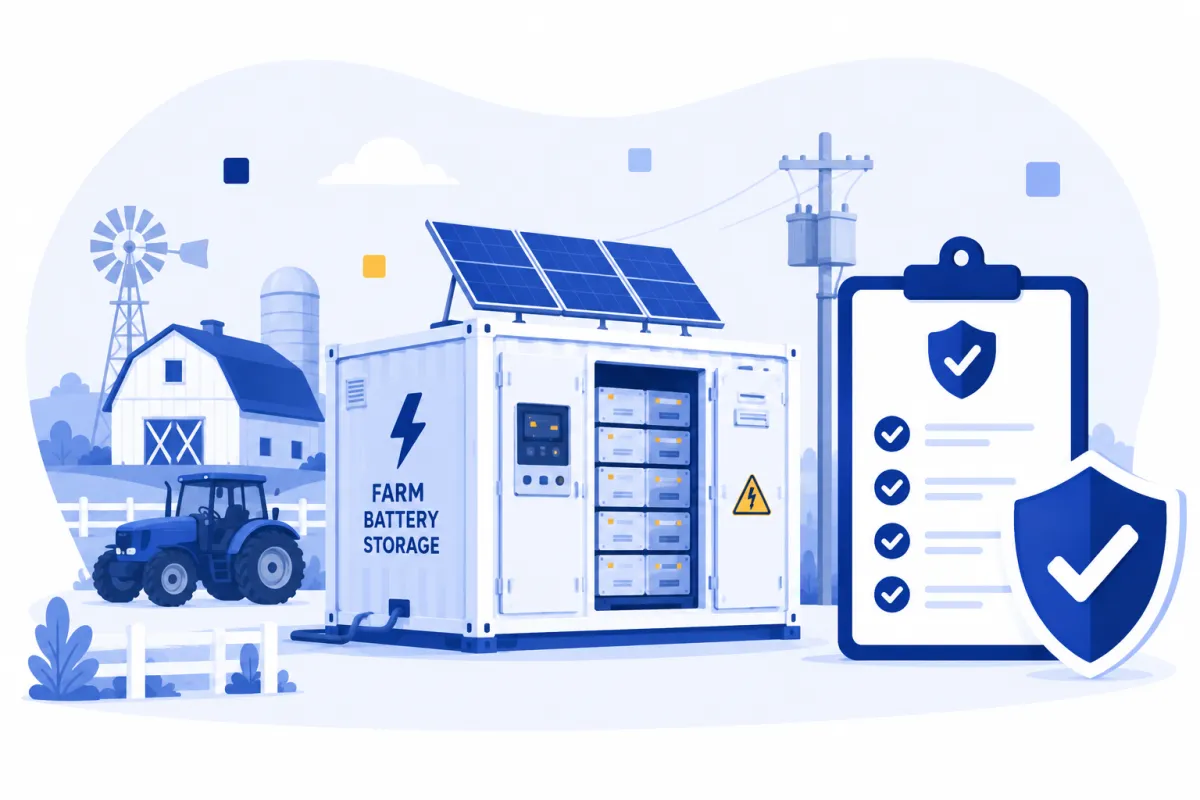
Farm & Agricultural Battery Storage Insurance: What Cover You Need
Battery storage has become one of the most common additions to a modern farm — pairing with solar PV to cut energy bills, store cheap or self-generated power, and open up income from grid services and flexible export. It is good business. But it also quietly changes your insurance position, and the change is one many farmers only discover at claim time. A battery system bolted onto a farm without telling your insurer can leave the storage uninsured, the wider farm policy compromised, and a diversification income stream unprotected. This guide explains how battery storage interacts with farm insurance, where the hidden gaps sit, and how to cover a rural storage system properly — whether it powers your own operation or earns its keep on the grid.
Why Farm Battery Storage Is an Insurance Blind Spot
Most farm and agricultural insurance is arranged as a combined policy covering the farmhouse, buildings, stock, machinery, liability and often diversification activities. These policies were built around the traditional shape of a farm business — and a lithium-ion battery installation does not fit that shape neatly. Three problems follow.
The battery may simply not be covered. A standard farm combined policy is unlikely to contemplate a significant lithium-ion energy storage system as an insured item without it being specifically declared and rated. If it is not listed, a fire or fault that destroys the unit may not be covered at all — you have an expensive asset sitting outside your policy.
The wider policy may be compromised. This is the serious one. Adding a material new risk to your premises without disclosing it can amount to a breach of your duty of fair presentation, giving the insurer grounds to reduce or decline claims — including claims that have nothing to do with the battery. An undisclosed battery system does not just leave itself uninsured; it can undermine the cover on your barns, machinery and home.
Insurers are increasingly excluding rather than rating. Aware of lithium-ion fire risk, some farm insurers now add a battery storage exclusion at renewal rather than underwriting the system. If that has happened to your policy, the storage is explicitly outside cover and needs arranging separately. We deal with that scenario, and the wider hard market for BESS cover, in our main guide to battery storage facility insurance.
Have you added battery storage and not yet told your insurer? Treat this as a priority, not a renewal-day job. Disclose it now, in writing, and get confirmation of how your policy responds. Disclosure protects both the battery and the rest of your cover — silence risks both. If you would rather we handled the disclosure and arranged the right cover, call us on 01792 001350.
The Two Kinds of Farm Battery Setup — and Why It Matters
How your system is insured depends heavily on what it is for, because the two common configurations carry different risks and different cover needs.
Behind-the-meter: storage for your own use
The system stores solar generation or off-peak grid power to run the farm — dairy parlours, grain drying, refrigeration, EV charging, general load. The insurance job here is to protect the asset and to make sure its presence does not prejudice the wider farm policy. Cover needs to address fire and damage to the unit, the consequences of a battery fire spreading to buildings or stock, and the liability exposure if a fire reaches a neighbour or a third party on the holding. Where the battery is charged by a turbine on the holding, our guide to small wind turbine insurance covers the turbine itself.
Front-of-meter and revenue-generating: storage as a business
Larger systems — often standalone, sometimes leased land let to an energy developer, sometimes farmer-owned — that earn through exporting to the grid, trading, or providing balancing and flexibility services. This is a diversification enterprise in its own right, and it needs cover that reflects that: not just property and liability, but business interruption protecting the revenue the system generates. A system that pays for itself through grid income is also a system whose lost income hurts when it goes offline after a fault.
Many farms now sit somewhere between the two — a system sized mainly for self-supply that also exports surplus. The cover should follow the reality of how the system is used and how it earns, which is exactly the kind of detail a specialist submission captures and a tick-box farm renewal does not.
What Farm Battery Storage Insurance Should Cover
The Battery System Itself
Fire, thermal runaway, storm, flood, theft and accidental damage to the battery units, inverters and associated equipment. Sums insured should reflect full replacement cost including installation — not just the hardware invoice — because reinstating a damaged system means design, supply and commissioning all over again.
Damage to Surrounding Property
The reason siting matters. A battery fire that spreads to a barn, a grain store, livestock housing or the farmhouse turns a contained equipment loss into a catastrophic one. Cover and, just as importantly, sensible separation between the battery and other buildings work together here — insurers will look closely at how far the system sits from anything that can burn.
Business Interruption & Lost Income
For revenue-generating systems, loss of grid and trading income after an insured event, structured around a realistic indemnity period given battery replacement lead times. For behind-the-meter systems, the equivalent is the additional cost of buying grid power you would otherwise have generated or stored while the system is down.
Public Liability
Injury or third-party property damage arising from the system — including the wider public-access dimension that farms often carry through footpaths, visitors, contractors and neighbouring land.
Environmental Exposure
Pollution and clean-up arising from a battery incident — firewater run-off into watercourses, ditches and groundwater is a particular concern in a rural setting, where drainage runs to land and a contaminated supply can affect livestock and crops as well as the environment.
Integration With the Farm Combined Policy
The cover above can sometimes be arranged as an extension to a farm policy and sometimes as a standalone storage policy sitting alongside it — what matters is that there is no gap or overlap between the two, and that both insurers know the full picture. Getting this boundary right is the broking job.
What Rural Sites Should Know About Fire Risk and Response
Battery fire risk is the same chemistry wherever the system sits, but a rural location changes the response. Fire and rescue attendance times are typically longer in the countryside, mains water for firefighting may be limited, and a lithium-ion fire can burn and reignite over an extended period — so the gap between ignition and effective intervention can be wider on a farm than on an urban site. That raises the premium on prevention and containment: tier-one equipment and a manufacturer-integrated battery management system, sensible separation from buildings and boundaries, monitoring with a response procedure, and a simple emergency plan and information pack for the fire service. We set out what insurers look for in full in our main guide to battery storage facility insurance — the same standards apply on a farm, and meeting them is what turns a difficult rural risk into an insurable one.
Siting is your cheapest insurance. Of everything an underwriter weighs on a farm battery risk, the distance between the system and your buildings is the factor most within your control and the one that most reduces both your premium and your real-world exposure. A system sited sensibly away from the barn, the grain store and the house is a fundamentally better risk than an identical system tucked against them — decide this at installation, not at renewal.
If You Lease Land to a Battery Developer
A growing number of farmers earn from battery storage without owning the system — letting a parcel of land to an energy developer who installs and operates a grid-scale BESS. This is a different insurance question, and a comfortable one if handled properly. Your concern is not insuring the battery (that is the developer's obligation) but protecting yourself: confirming through the lease that the operator carries adequate property, liability and environmental cover; that you are noted or indemnified where appropriate; and that your own farm policy is not exposed by the presence of the installation on your land. Reviewing the insurance and indemnity provisions of a battery lease before you sign is time well spent — the income is attractive, but the liability tail of a neighbouring battery fire is not something you want to inherit by omission.
Getting Disclosure Right: A Worked Example
Disclosure sounds like paperwork, but it is the single act that determines whether your cover holds. Consider a mixed arable and livestock farm that installs a container battery alongside an existing rooftop solar array, sized mainly to run grain drying and refrigeration with surplus exported. The system cost a meaningful five-figure sum installed and sits twelve metres from the main machinery shed.
Done badly, the farmer treats it as an electrical upgrade, mentions nothing to the insurer, and carries on. The battery is uninsured; the proximity to the shed is unassessed; and if a fire originates in the unit and spreads, the insurer may decline not only the battery but the shed and machinery too, on the grounds that a material change was never disclosed.
Done well, the farmer notifies the insurer in writing as soon as the system is commissioned, providing the specification, chemistry, value, siting and the monitoring in place. The insurer either rates the system into the farm policy or confirms it should be insured separately — and either way, the farmer has written confirmation of where they stand. The same fire is now a covered loss. The only difference between the two outcomes is a disclosure that cost nothing but a letter. That is why we treat disclosure as the first job on any farm battery enquiry, not an afterthought.
Battery Storage as Farm Diversification
For many holdings, battery storage is part of a broader diversification picture alongside solar, wind, anaerobic digestion, holiday lets or commercial lettings of redundant buildings. Each of these strands carries its own insurance implications, and they interact: a farm that has steadily diversified often finds its original farm combined policy straining to hold everything, with gaps opening up between the agricultural cover and the various enterprises bolted onto it. Battery storage is frequently the addition that finally exposes the strain. The constructive way to read that is as a prompt for a proper review — not just of the battery, but of whether the whole programme still fits a business that has grown beyond its original shape. A diversified farm is increasingly a commercial enterprise with an agricultural core, and its insurance should reflect that rather than pretend the farm of fifteen years ago is the farm of today.
Why Farmers and Landowners Work With Us
We are an independent commercial broker with deep experience in both renewable energy and the kind of hard-to-place risks that standard insurers shy away from. Miller & Partner Limited is an Appointed Representative of Gauntlet Risk Management Ltd, which is authorised and regulated by the Financial Conduct Authority. Farm battery storage sits exactly where those two specialisms meet: it needs someone who understands agricultural insurance, energy storage risk, and how to make the two work together without leaving a gap. Because we are independent, we will tell you honestly whether your system is best covered by extending your farm policy or by a separate arrangement, and we will make sure disclosure is handled so the battery is protected and the rest of your cover stays intact. You can see the full picture of what we arrange in our main guide to battery storage facility insurance.
Related Battery Storage Insurance Guides
- Battery Storage Facility Insurance (UK 2026) — our definitive guide to BESS risk and cover: thermal runaway, balance of plant, environmental, business interruption, cyber and NFCC alignment.
- Renewable Energy Installer Insurance — MCS-compliant cover for solar, heat pump, EV and battery storage contractors.
- Commercial Insurance — our main hub for hard-to-place commercial and agricultural risks.
Added Battery Storage to Your Farm? Let's Get It Covered Properly
Tell us about your system — what it is, where it sits, and whether it powers the farm or earns on the grid. We will make sure it is properly insured and that your wider farm cover stays watertight, usually with an answer within one working day.
Request Your Quote







Instagram
LinkedIn