


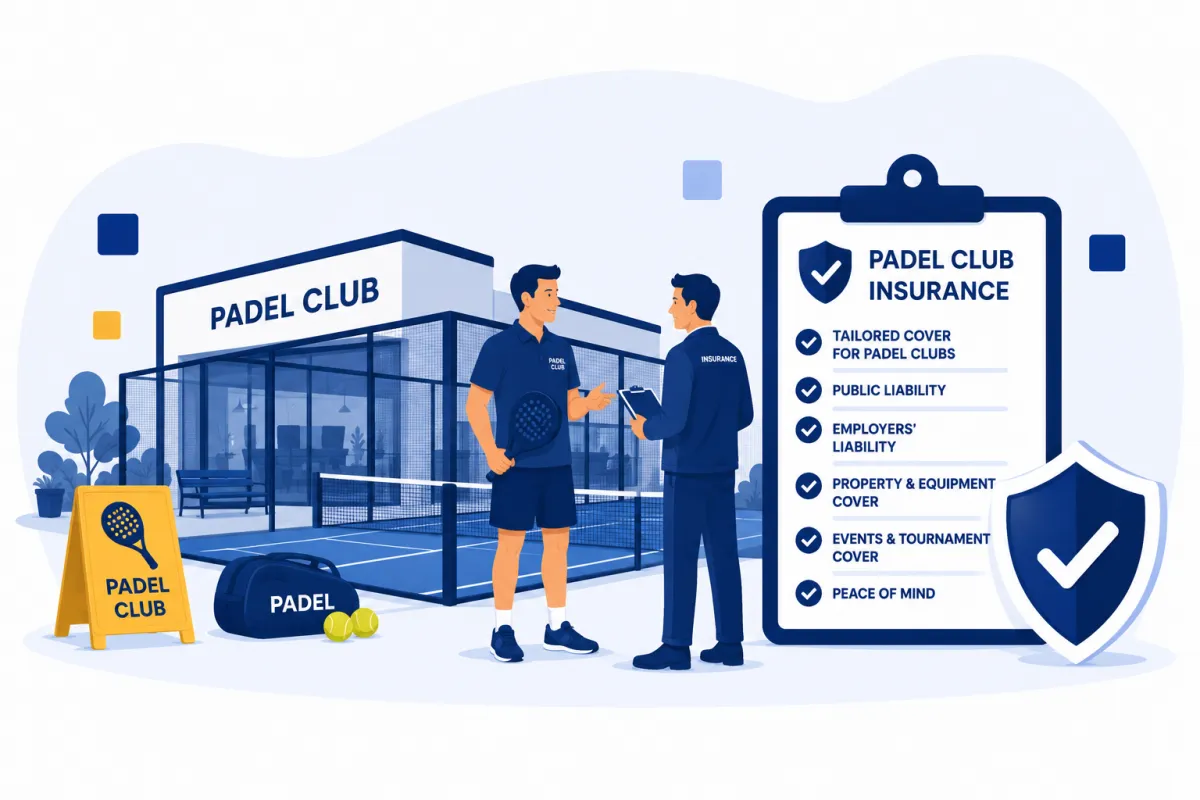
Padel Club Insurance UK | Cover for Courts, Coaching & Clubs
Why does a padel club need specialist insurance?
Padel is the fastest-growing sport in Britain, and the numbers are genuinely staggering: from 69 courts in 2020, when the LTA took over as national governing body, to more than 1,550 courts across 559 venues by the end of 2025, with participation now past a million players. New clubs are opening every week — indoor centres, covered-outdoor courts, tennis clubs adding padel, and social venues built around the game. But the very things that make padel special also give it a risk profile that a standard, off-the-shelf sports policy was never designed for.
Think about what a padel court actually is: an enclosed arena with glass back and side walls, where two pairs play a fast, reactive game, chasing balls that ricochet off the glass, colliding with each other and occasionally with the walls themselves. Add floodlights, artificial turf, covered structures exposed to the weather, and — at more and more venues — a licensed café or bar. That is a public-liability, property and business-interruption picture with several moving parts, and getting it wrong leaves a booming business dangerously exposed.
At Miller & Partner we arrange tailored cover for padel clubs and racket-sport venues across the UK, matching the policy to how you actually operate rather than forcing you into a generic sports template. We approach every placement through The Insurability Framework™ — a structured method covering underwriter intelligence, difficult-risk expertise, risk assessment and claims advocacy — which matters even in a fast-growing, insurable sector like padel, where the glass-court and hybrid-venue realities are easy for a generalist to miss. You can read more about how we work on our commercial insurance pages.
Key facts on padel club cover, at a glance
- Padel is the UK's fastest-growing sport — from 69 courts in 2020 to over 1,550 across 559 venues by the end of 2025, with participation past a million players.
- The LTA has governed padel in Great Britain since 2020; LTA accreditation matters for coaching and grant funding.
- Padel's enclosed glass-walled courts, fast doubles play and player collisions create a distinctive public-liability and property risk.
- Employers' liability is compulsory by law for any club with staff or coaches; public liability is the core cover, usually £5m or more.
- Because courts sell out days ahead, business interruption from court downtime after glass, storm or fire damage is a real and costly exposure.
- Many venues are hybrids — courts, coaching and a licensed café or bar — needing multi-strand cover, not a single template policy.
- Clubs on leased or council land usually face contractual insurance limits and indemnities they must meet.
What insurance does a padel club need?
A padel venue is rarely a single-cover business. Even a modest two-court site combines a place the public visits, staff or coaches, valuable court equipment, and income that depends entirely on courts being playable. Here is the core programme most clubs need, and why each part earns its place.
| Cover | What it protects | Priority |
|---|---|---|
| Public liability | Injury to players, spectators and visitors; the core exposure | Essential |
| Employers' liability | Staff and coaches — required by law | Compulsory |
| Property & contents | Courts, glass, netting, floodlights, clubhouse, structures | Essential |
| Business interruption | Lost court income while damage is repaired | Essential |
| Coaching / instructor liability | Injury arising from coaching and lessons | Recommended |
| Licensed / café cover | The bar, food and social areas at hybrid venues | Recommended |
| Personal accident | Members' and players' injury benefit | Consider |
| Cyber | Booking systems, payments and member data | Consider |
| Management liability / D&O | Club committees, directors and officers | Consider |
The right combination depends on how you operate — which is exactly why a tailored placement beats a template. A busy indoor centre with coaching and a bar needs a very different programme to two covered courts on leased council land.
Why are glass courts a distinctive liability risk?
The enclosed glass court is what makes padel padel — and it is also the feature that shapes the risk. Players move fast in a confined space, react to balls rebounding off the walls, and regularly collide with a doubles partner or the glass surround. Slips on the artificial surface, trips at the low net, balls striking players or spectators, and impacts with the structure are all everyday possibilities. In a growing and increasingly competitive sport, an injured player who feels the venue fell short on safety is exactly the kind of claim public liability exists to meet.
None of this makes padel uninsurable — it is a fundamentally sound, insurable business. It simply means the public-liability limit and terms should reflect the reality of a contact-adjacent sport in an enclosed arena, and that good risk management — clear court rules, appropriate signage, well-maintained surfaces and glass, trained staff — both reduces claims and helps secure sensible terms. Most established venues carry a public-liability limit of £5 million or more, and contractual arrangements or event hosting can push that higher.
What strikes me talking to padel operators is how fast they've had to scale — a site goes from planning to packed courts in a season, and the insurance is sometimes an afterthought bolted on at the last minute. The glass, the collisions, the sold-out bookings and the clubhouse bar are all sitting on a policy meant for a simple sports pitch. When we review a padel programme, we're usually not finding a business that's uninsurable — we're finding one that's grown past the cover it started with, and needs a policy built for what it has actually become.
Is employers' liability compulsory for a padel club?
If your club employs anyone — coaches, reception staff, maintenance, bar staff — then yes, employers' liability insurance is required by law, with a minimum limit of £5 million (most policies provide £10 million as standard). It is one of the few genuinely non-negotiable covers, and trading without it where it is required can carry significant penalties. The main grey area for padel venues is coaches: whether a coach is an employee or genuinely self-employed affects who insures them, so it is worth confirming rather than assuming — a self-employed coach should carry their own liability cover, and the club should verify it.
Cover checker: what fits your venue?
Select the venue type that fits. Each shows the cover priorities — and a specialist broker tailors the detail to your site.
- LEGAL Employers' liability for all staff and coaches.
- ESSENTIAL Public liability at a limit reflecting player and spectator numbers.
- ESSENTIAL Property cover for courts, glass, lighting and the building.
- ESSENTIAL Business interruption — indoor courts run year-round and downtime is costly.
- CONSIDER Cyber for booking and payment systems.
- CRITICAL Weather and storm cover for canopies, floodlights and exposed structures.
- ESSENTIAL Public liability and property as core, plus adequate structure sums insured.
- ESSENTIAL Business interruption for seasonal downtime after damage.
- LEGAL Employers' liability for staff.
- CONSIDER Wind-uplift and escape-of-water exposures on new builds.
- ESSENTIAL A combined policy spanning padel, tennis and any other activities on site.
- LEGAL Employers' liability across all staff and coaches.
- ESSENTIAL Public liability sized for the busiest use, not the quietest.
- RECOMMENDED Confirm the policy covers every sport you actually offer.
- CONSIDER Management liability if run by a committee or club board.
- CRITICAL Licensed-premises and food-safety cover for the bar and café — a separate risk layer.
- ESSENTIAL Public liability extending to the social areas, not just the courts.
- LEGAL Employers' liability including bar and hospitality staff.
- RECOMMENDED Stock and contents cover for the bar and kitchen.
- CONSIDER A combined policy so courts and hospitality sit together.
- CRITICAL Meet the exact public-liability limit and indemnity the lease or council contract requires.
- ESSENTIAL Confirm who insures the structure vs the contents under the lease.
- LEGAL Employers' liability for your staff on site.
- RECOMMENDED Provide certificates of cover promptly to the landlord/council.
- CONSIDER Contractual liability under shared-risk agreements.
- ESSENTIAL Coaching / professional liability for instruction and lessons.
- RECOMMENDED Confirm LTA accreditation and any governing-body cover you already hold.
- ESSENTIAL Public liability for sessions, including at third-party venues.
- CONSIDER Personal accident for yourself as a self-employed coach.
- LEGAL Employers' liability if you take on assistant coaches.
Why does court downtime need business interruption cover?
This is the exposure padel operators most often underestimate. Padel's defining commercial feature is that demand outstrips supply — courts at established venues sell out days or weeks ahead, and every booked hour is income. So when a court is knocked out of action — a shattered glass panel, storm damage to a canopy, a floodlight failure, a fire in the clubhouse — you are not just paying to repair it, you are losing the bookings it would have taken while it is down. Business interruption cover replaces that lost income, and for a high-utilisation padel site it can matter as much as the property cover itself.
The key is setting the sum insured and the indemnity period correctly. Glass court panels and specialist court components can take time to source and replace, so an indemnity period that is too short — or an income figure that understates a busy site's takings — leaves a gap exactly when you are trying to recover. Getting these numbers right is a core part of a properly built padel programme, and a common place we find existing policies fall short.
Red-flag check: is your padel club under-covered?
Tick each item that is true. Each is a sign your cover may not match how your venue actually operates.
Cover-fit assessor: how well matched is your club?
Choose two factors for an indicative read on how well your cover fits your venue. Guidance, not advice.
How do you insure a padel venue with a bar or café?
The modern padel club is often as much a social venue as a sports facility — and that hybrid model is a big part of the sport's appeal. But a licensed bar, a café or a food offering sits on a completely different risk footing to the courts. You are now serving alcohol and food to the public, which brings licensed-premises liability, food-safety obligations, stock and kitchen exposures, and a different set of claims — slips in the social area, food-related illness, alcohol-related incidents — none of which a pure sports policy contemplates.
The clean solution is a combined programme that puts the courts, the coaching and the hospitality under one roof, with the public liability extending across the whole site rather than stopping at the court fence. This is where padel overlaps with the hospitality world, and the same principles that apply to a pub or a café come into play alongside the sports cover. Treating the bar as an afterthought on a sports policy is one of the most common — and most exposing — gaps we see at hybrid venues.
What cover do you need on leased or council land?
A large share of new padel courts sit on leased or council-owned land, frequently under shared-risk or profit-share models where a local authority provides the site and an operator builds and runs the courts. These arrangements almost always come with contractual insurance requirements: a specified minimum public-liability limit (often £5 million or £10 million), an indemnity to the landowner, and an obligation to evidence cover with certificates. Fail to meet them and you can be in breach of the agreement that lets you operate at all.
The practical points are to read the insurance clauses of any lease or licence carefully, confirm exactly who is responsible for insuring the structure as opposed to your contents and business, and make sure your policy limits meet or exceed what the contract demands. A specialist broker checks the new policy against the contractual conditions as a matter of routine, so there is no gap between what you have agreed to and what you are actually covered for. Underinsurance here is doubly damaging — it exposes you to loss and to breach, so getting the sums insured right matters.
What drives a padel club's insurance premium?
Padel is an insurable, sought-after risk, and premiums are driven by a straightforward set of factors — most of which you can influence with good risk management and an accurate presentation of your venue.
| Factor | Why it matters | How to manage it |
|---|---|---|
| Number of courts | More courts, more exposure and value | Keep sums insured current as you expand |
| Indoor vs outdoor | Outdoor/covered adds weather risk | Robust structures; storm mitigation |
| Player throughput | More players, more liability exposure | Court rules, signage, supervision |
| Public liability limit | Higher limits cost more but may be required | Match to contracts and event needs |
| Bar / café presence | Adds licensed and food-safety risk | Combined cover; food-safety controls |
| Coaching activity | Instruction adds professional exposure | Accredited coaches; clear supervision |
| Property values | Courts, glass, lighting, buildings | Accurate, up-to-date sums insured |
| Business interruption limit | Reflects income at risk from downtime | Correct income figure and indemnity period |
| Claims history | Past claims affect pricing | Good record-keeping and risk management |
| Events / tournaments | Spectators and temporary structures | Notify and extend cover for events |
| Security & maintenance | Reduces theft and injury claims | Maintenance logs; secure premises |
| Quality of presentation | A clear risk picture earns better terms | Full submission via a specialist broker |
Three real-world padel club claim case studies
These composites reflect the situations we see across sports and leisure venues. Figures are illustrative, but the dynamics — and the difference the right cover makes — are real.
Baseline Padel — a court collision claim
At a busy indoor centre, a player lunging for a ball collided heavily with a glass side wall and a doubling partner, suffering a fractured wrist and concussion. A public-liability claim followed, alleging inadequate court rules and worn surface matting, and settled with damages and defence costs of around £38,000. The venue's public-liability cover responded in full. The lesson: the enclosed, fast-moving nature of padel makes player-injury claims a real possibility — a properly sized public-liability limit and documented court rules and maintenance are essential. The club tightened its signage and matting schedule at renewal.
Riverside Racket Club — storm downtime
A covered-outdoor venue lost two of its four courts when a winter storm tore part of the canopy and knocked out the floodlighting. Repairs and replacement glass took six weeks to source and install, during which the sold-out courts stood idle. The property claim covered the physical damage of around £55,000, and — crucially — a business interruption claim recovered roughly £34,000 of lost court income over the closure. The lesson: for a high-utilisation padel site, business interruption with a realistic income figure and indemnity period is as important as the property cover. Uncovered, the income loss alone could have threatened the season.
CourtSide Social — the hybrid gap
A padel venue with a popular licensed bar had insured its courts well but treated the bar as a minor add-on. When a customer slipped on a wet floor in the social area and a separate food-hygiene issue arose the same year, the claims fell awkwardly across a policy never designed for hospitality, and part of the exposure sat outside cover — leaving the venue around £22,000 out of pocket across the two matters. The lesson: a hybrid padel-and-bar venue needs genuine licensed and food-safety cover built in, not bolted on. We re-placed the site on a combined programme covering courts, coaching and hospitality together.
How to insure a padel club properly
Whether you are opening your first courts or reviewing cover on an expanding venue, these eight steps will help you build a programme that matches how you actually operate.
- Map how your venue operates. List courts, indoor or outdoor, coaching, events, and any bar or café — the whole picture, not just the courts.
- Set the right public-liability limit. Reflect player and spectator numbers, and meet any contractual minimum — often £5 million or £10 million.
- Arrange compulsory employers' liability. Cover all staff and coaches, and confirm the employment status of each coach.
- Value property accurately. Insure courts, glass, floodlights, structures and the clubhouse on up-to-date, correct sums insured.
- Add business interruption. Set a realistic income figure and indemnity period so lost court bookings are covered if you close.
- Cover the hospitality layer. Build in licensed-premises and food-safety cover for any bar or café, ideally on a combined policy.
- Check contractual requirements. Match your cover to any lease or council conditions and evidence it with certificates.
- Review as you grow. Update cover whenever you add courts, activities or events — expansion is when gaps appear.

Padel insurance glossary
- Padel
- A racket sport played in doubles on an enclosed court with glass walls, governed in Great Britain by the LTA.
- Public liability
- Cover for injury to, or property damage suffered by, players, spectators and visitors — the core cover for a padel venue.
- Employers' liability
- Legally required cover for injury or illness to staff and employed coaches, minimum £5 million.
- Business interruption
- Cover for lost income while courts are out of action after insured damage — vital for a high-utilisation site.
- Indemnity period
- The maximum length of time a business interruption policy will pay out — must allow for sourcing specialist court parts.
- Glass court panel
- The toughened glass wall of a padel court — a distinctive property item that can be costly to replace.
- Covered court / canopy
- A roofed outdoor court structure enabling year-round play — exposed to wind, storm and uplift risk.
- Artificial turf surface
- The synthetic playing surface of a padel court, relevant to slip and injury risk and maintenance.
- LTA accreditation
- Recognition by the Lawn Tennis Association, the governing body — relevant to coaching standards and grant funding.
- Combined liability
- A policy bringing public, employers' and product liability together under one contract.
- Licensed-premises cover
- Cover for the risks of serving alcohol and food at a venue's bar or café — a separate risk layer.
- Personal accident
- Optional cover paying benefits to members or players injured while playing, regardless of fault.
- Sums insured
- The amounts you insure property and income for — must keep pace with expansion to avoid underinsurance.
- Contractual liability
- Liability assumed under a lease or council agreement — common in shared-risk padel developments.
- Excess
- The amount you pay towards each claim before the insurer contributes.
Frequently asked questions
What insurance does a padel club need?
How much public liability cover does a padel venue need?
Do I need business interruption cover for a padel club?
Are padel coaches covered by the club's insurance?
How much does padel club insurance cost?
Does my padel venue's bar need separate cover?
What cover do I need for courts on council or leased land?
Is padel more of a claims risk than other racket sports?
Do I need extra cover to host tournaments or events?
I've added courts since I took out cover — does it matter?
Can you cover a brand-new padel venue that's just opening?
How do I find a specialist padel club broker?
Related specialist guides
- Personal Trainer & Fitness Coach Insurance
- Reformer Pilates Studio Insurance
- Bootcamp Business Insurance
- Esports Team Insurance
- Pub Insurance
- Café Insurance
- Business Interruption Insurance
- High-Risk Public Liability Insurance
- Underinsurance & the Condition of Average
- Directors & Officers Insurance
- Business Insurance After a Flood Claim
- Business Insurance After a Fire Claim
- Lifestyle & Leisure Insights Hub
- Commercial Insurance
- Sports Club & Gym Quote Form
This guide is general information, not advice for your specific circumstances, and does not constitute legal or financial advice. Cover needs vary by venue, activities and contracts. Always confirm your requirements with a qualified broker and check any lease or governing-body conditions. Miller & Partner Limited is authorised and regulated by the Financial Conduct Authority, Firm Reference 1029698.






Instagram
LinkedIn