



Painters and Decorators Insurance Specialists UK
Why do painters and decorators need specialist insurance treatment?
Painting and decorating is one of the trades the insurance market often misprices in both directions. At the cheap end, comparison-site quotes treat decorators as low-risk "interior tradesman" and price accordingly — until a claim involves a £6,000 oak floor, a heritage staircase, or a ladder fall, and the operator discovers their policy excludes work above three storeys, excludes heat work, or carves out listed buildings entirely. At the other end, generic contractor packages over-engineer cover the decorator will never use and load premium for trades work the decorator doesn't do.
The reality is more nuanced. A full-time UK painter and decorator in 2026 typically faces a tight set of recurring exposures: third-party property damage from paint, dropped materials, and access equipment; staff injury from falls from height and manual handling; theft and damage of tools and stored materials; and — increasingly for commercial and heritage work — disputes about specification, durability, and finish quality. Around all of that sits a clear regulatory perimeter: the Work at Height Regulations 2005, the Control of Lead at Work Regulations 2002, the Control of Substances Hazardous to Health Regulations 2002, and the Construction (Design and Management) Regulations 2015.
The 2024/25 HSE data shows why this matters. Construction recorded 35 worker fatalities in the year — about five times the all-industry average rate — and falls from height accounted for over half of construction deaths across the five-year average. Painters and decorators feature heavily in those figures. Insurance that doesn't engage with the specific exposures of the trade is insurance that may not respond when it's needed.
This guide is the definitive 2026 painters and decorators insurance article — built around the actual cover lines the trade uses, the risks that drive claims, the regulatory framework that shapes premium, and the documentation that defends a renewal. It complements our deeper cost-focused sister piece on tradesman liability insurance guide, the cheap tradesman insurance review, and trade-specific guides such as carpenter tools insurance and floor fitter liability insurance.
Key facts at a glance
- Public liability is the dominant cover line for painters and decorators — paint damage, dropped materials, ladder slips, and access equipment claims drive routine notifications. Most full-time decorators need £2m–£5m depending on client mix; £5m is the working standard for housing associations and local authorities.
- Employers' liability is legally required from the moment you have anyone working for you under the Employers' Liability (Compulsory Insurance) Act 1969 — fines of £2,500 per day for non-compliance. This includes labour-only subcontractors, casual help, apprentices, and family members.
- Falls from height killed 35 UK workers in 2024/25 and account for over half of all construction fatalities on the five-year average — and painters and decorators are squarely in the high-exposure group given the time spent on ladders, towers, and scaffolds.
- Lead paint risk is not a historic curiosity — any pre-1980 property is likely to contain lead-based paint somewhere, and stripping, sanding, or burning off triggers duties under CLAW 2002 including risk assessment, exposure control, and in some cases medical surveillance.
- The average UK decorator PL claim sits between £1,800 and £4,500 per published insurer data — well below typical cover limits, but more than enough to wipe out an uninsured sole trader and trigger a renewal premium increase.
- HSE prosecutions involving painter and decorator access work continue at pace — the AIM Access Solutions £30,800 fine in February 2025 for unsafe tower scaffold access (no internal ladder) is a recent example with direct read-across for any decorator using subcontracted access equipment.
- Painters and decorators insurance premiums typically run £180–£500 for sole traders, £900–£2,800 for small firms with employees, and £3,500–£12,000+ for established decorating companies running spray, commercial, or heritage work — pricing depends on work mix, height exposure, and claims history.
1. Cover programme summary: which policies do painters and decorators actually need?
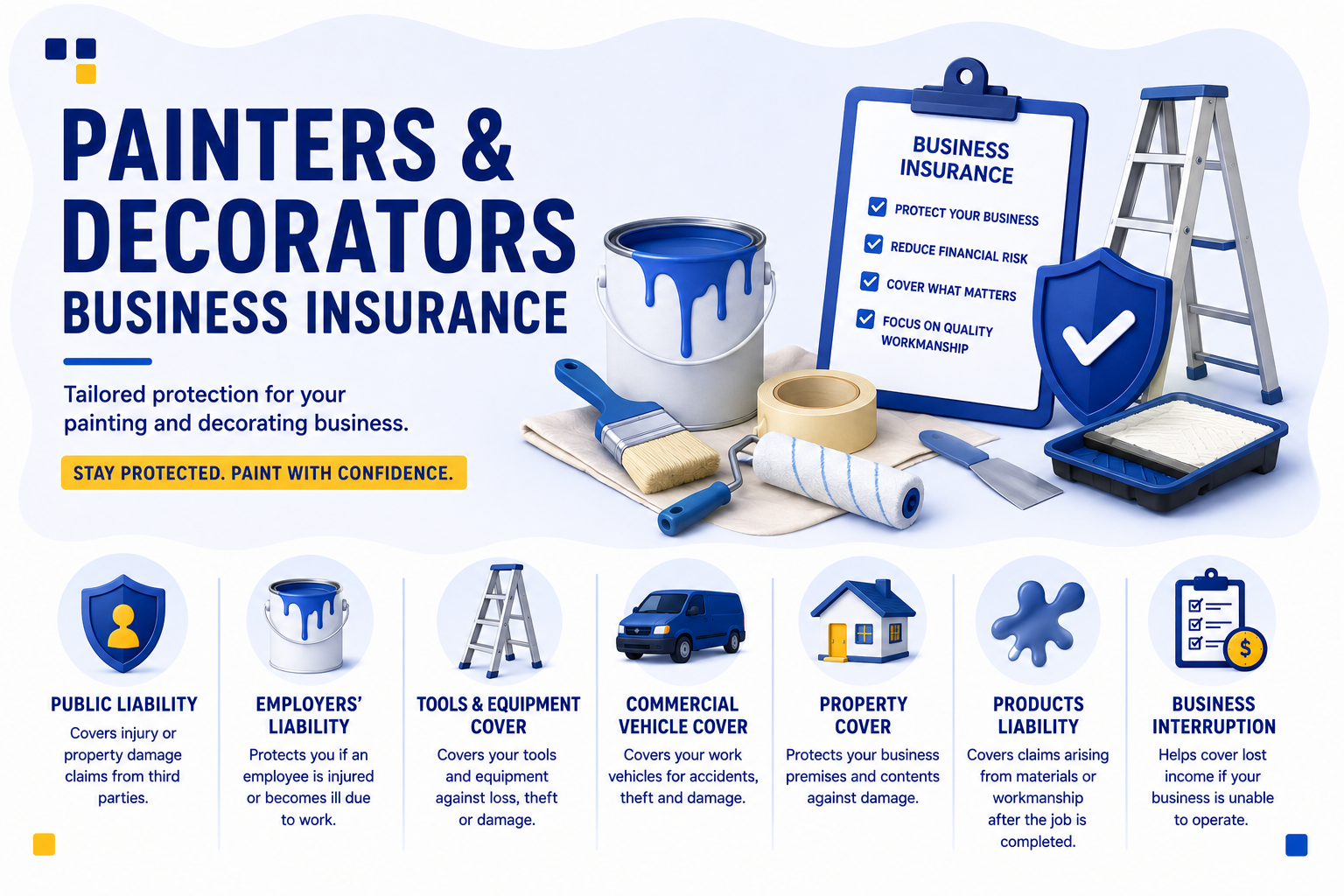
The painters and decorators insurance programme in 2026 is built from a relatively small number of cover lines stacked in the right priority order. The table below shows what the working programme looks like for most operators, why each line exists, and how it engages with the trade's real risk profile.
| Cover Line | Required? | What It Does for a Decorator | Typical Limit |
|---|---|---|---|
| Public Liability (PL) | Practically essential | Third-party injury and property damage — paint on a sofa, water from a wash-out tray through a ceiling, dropped scraper through a window, client trips over your dust sheet | £2m–£10m |
| Employers' Liability (EL) | Legally required if you have staff or labour-only subbies | Staff injury claims — falls from height, manual handling, solvent exposure, contact dermatitis, long-tail respiratory disease | £10m (statutory minimum: £5m) |
| Tools and Equipment | Commercially essential | Theft, loss, and damage to brushes, rollers, sprayers, sanders, ladders, towers, dust extractors — typically van or site-based | £2,000–£15,000 |
| Contract Works / Own Work | Important for larger jobs | Damage to part-completed decorating work before handover — fire, water, vandalism, weather on exterior work | £25,000–£250,000 |
| Hired-in Plant | Yes if you hire towers, MEWPs, or scaffolds | Damage to and continuing hire charges on hired access equipment | £10,000–£50,000 |
| Commercial Vehicle | Yes for any van used for business | Van, contents in transit, business use class — domestic policies do not cover work use | Market value |
| Personal Accident | Important for sole traders | Income replacement after injury — the sole trader's substitute for sick pay | £250–£1,000 per week typical |
| Professional Indemnity (PI) | Where you advise, specify, or design | Colour advice, specification, heritage matching, durability warranties, design consultancy | £100k–£2m |
| Legal Expenses | Strongly recommended | Contract disputes, debt recovery, HSE investigation, tax enquiries, employment disputes | £100,000 |
| Cyber | Worth considering | Client data and quoting/scheduling systems if digital — invoice fraud is the major SME claim driver | £50,000–£250,000 |
The hierarchy that matters in practice: PL is the most-used cover (claim frequency is high); EL is the highest-severity line (single claims can reach six figures); tools is the most-noticed cover (sole traders feel a van break-in immediately); contract works is the most-overlooked cover (until a fire on a £40,000 commercial fit-out before handover); PI is the most-debated cover (essential for specification-led commercial work, optional for pure execution-only domestic decorating).
2. Why is public liability the biggest single line for any decorator?
Public liability is the cover that defines a painters and decorators policy. It responds to claims from third parties — clients, members of the public, other contractors on site — for injury or property damage caused by your work or your presence on site. For a trade that spends its working life inside or around other people's homes, businesses, and commercial premises, with paint, water, ladders, and dust, PL is the cover line that earns its premium most quickly.
What public liability typically covers for decorators
Routine PL claims for painters and decorators fall into a small number of categories: paint and material damage to client surfaces, contents, or vehicles (gloss on flooring, emulsion overspray on a leather sofa, paint splash on a parked car bonnet, masking tape pulling away client wallpaper); water damage from paint tray wash-out, sink overflow, or burst plumbing during access work; dropped materials and equipment damaging client property (ladder dent in a car, dropped scraper through a window, paint can knocked off a working platform onto landscaping); access equipment damage to client property (scaffold marks on lawns or driveways, tower damage to door frames during erection); slip and trip injuries to clients or visitors from drop cloths, trailing leads, or wet paint.
What public liability typically excludes
The exclusions matter as much as the inclusions. Common decorator PL exclusions worth checking before binding: work above defined heights (some basic policies exclude above 10m or three storeys); heat work and hot work permits (heat guns, paint stripping); spray application (some policies cover brush and roller only); listed buildings or Grade I/II* heritage work; work on commercial premises above defined contract value; faulty workmanship itself (PL responds to consequential damage from poor work, not the cost of redoing the work — that's a workmanship claim); deliberate acts; and damage to property the decorator is working on, which is typically a contract works cover rather than PL.
How much public liability do painters and decorators need?
The right limit depends on client mix. £1m is technically possible but increasingly out of step with contract requirements. £2m is the working baseline for domestic and small commercial decorators. £5m is the standard requirement for housing associations, local authority contracts, schools, and most letting agents. £10m is needed for many main contractor sub-contractor relationships and larger commercial fit-out work. The premium differential between £2m and £5m is typically small (£20–£60 per year for a sole trader); the differential between £5m and £10m is similar. Underbuying the limit to save £40 a year is a false economy when one £6,000 oak floor claim and one £15,000 heritage staircase claim could exhaust a £20,000 limit between them.
3. When is employers' liability legally required and what does it cover?
Employers' liability insurance is one of the few covers in UK commercial insurance that is genuinely a legal requirement — and the legal definition of "employer" is wider than most decorators realise. Under the Employers' Liability (Compulsory Insurance) Act 1969, you need EL cover from the moment you have anyone working for you. That includes: full-time and part-time employees; apprentices; labour-only subcontractors who use your tools and work to your direction; casual or temporary help; family members who help with the work; and in some cases trainees on placement. The statutory minimum is £5m; the working market standard is £10m, and £10m is what virtually every contract specifies.
What employers' liability covers for decorating staff
EL responds to staff injury or occupational disease arising from work. The major claim drivers for painters and decorators are: falls from height (ladders, towers, scaffolds, MEWPs); manual handling injuries (carrying paint, lifting ladders, repetitive overhead work shoulder/neck injuries); contact dermatitis from solvents, paints, and water-based products; long-tail respiratory disease from solvent vapours, isocyanates in two-pack sprays, dust from sanding, and historic lead exposure; eye injuries from splash, dust, or chemical contact; and slip/trip injuries on site.
The long-tail problem
EL is unusual because some of the most expensive claims are notified years after the employment relationship has ended. A decorator who sanded down lead-painted Victorian woodwork in the 1990s without proper RPE and develops respiratory or neurological conditions in 2026 can bring a claim under "long-tail" disease cover. The policy that responds is the one that was in force at the time of exposure. This is why EL renewals require continuous cover even during periods when no current staff exist — gaps in the cover history create gaps in defence.
Penalties for trading without EL
HSE can fine an employer up to £2,500 for every day they are without compulsory EL cover, plus £1,000 for failing to display the EL certificate. The financial penalty is large, but the bigger issue is that an uninsured employer becomes personally liable for any staff injury claim — and a single fall-from-height claim can settle at six figures.
4. How does tools and contract works cover protect the business cash flow?
Tools insurance and contract works cover are the "make-good" lines of a decorator's programme. PL and EL protect against claims from others; tools and contract works protect the decorator's own assets and work-in-progress. For sole traders and small firms, these are the covers that prevent a single bad night or a single site incident turning into a cash-flow crisis.
Tools and equipment cover
Modern tools insurance for decorators covers theft, loss, accidental damage, and sometimes breakdown for the tools and equipment the business owns. The cover scope matters: most policies cover tools in your van overnight only if the van is locked and parked at a defined location (home address, secure compound, locked garage); fewer cover tools left on site overnight; almost none cover tools in an unattended van during a coffee break. Van break-ins are the dominant claim. The HMRC-recognised CIS list of replaceable tools for a working decorator typically includes airless sprayers (£600–£2,500), HVLP sprayers, dust extractors, ladders and towers, sanders, fillers, and the brush/roller/tape inventory — total replacement values of £3,000–£15,000 are normal.
Contract works (own work) cover
Contract works covers damage to your work-in-progress before practical completion. The classic claim: you've spent two weeks on a commercial fit-out, applied three coats, and the night before handover a sprinkler activation, fire, or vandalism destroys the work. Without contract works cover, you've either lost the value of the materials and labour or are renegotiating with a client who paid for finished work. With contract works cover, the policy reinstates the work to the point of completion. The relevant cover lines and how they engage with each other are explained more fully in our contractors all-risks insurance guide — the principles apply directly to commercial-scale decorating work.
Hired-in plant
If you hire tower scaffolds, MEWPs, podiums, dust extractors, or any other access or specialist equipment, your hire agreement makes you responsible for damage to that equipment and for continuing hire charges if it's damaged or stolen. Hired-in plant cover responds to both. The cover is usually inexpensive (£40–£120 a year for a £10,000 limit) and is one of the cheapest meaningful protections in the programme.
5. Do you actually need professional indemnity as a painter or decorator?
Professional indemnity (PI) is the most debated cover line in a decorator's programme. The traditional position was that PI was for designers, architects, and consultants — not for execution-led trades. That position has shifted as commercial decorating contracts increasingly require minimum PI limits, as heritage and specification-led work has grown, and as clients increasingly bring "negligent advice" claims separately from straightforward workmanship complaints.
When PI is genuinely needed
PI is essential where the decorator's work involves any of: written specifications or product recommendations (you specify a particular paint system for a particular substrate); colour or finish advice given in writing or through a quote (the gloss didn't match the agreed reference sample); durability guarantees or warranty periods (you warranted the exterior coating for 5 years and it failed at 2); heritage or listed-building work where matching historic finishes is part of the scope; main contractor sub-contracting relationships where the head contract requires PI cover (typically £1m–£2m); local authority, housing association, or insurance panel contracts that specify minimum PI levels.
When PI is genuinely optional
For pure execution-only domestic decorating — the client specifies the colour, the substrate, the brand, and the finish, and your role is to apply paint competently — PI is genuinely optional. The risks that can go wrong are mostly workmanship issues (the wall isn't smooth, the finish is patchy) which sit under PL consequential damage and disputed-workmanship cover rather than PI proper. A sole trader doing exclusively domestic execution work can reasonably defer PI until they take on commercial, specification-led, or heritage work.
Our detailed sister piece — painters and decorators professional indemnity UK costs — covers the pricing structure, claim examples, and limit selection in much greater depth, and pairs with our general professional indemnity insurance product page. For most working decorators, the conversation about PI is the conversation about whether you're moving up the value chain into commercial specification-led work — and that's a conversation worth having with a specialist broker before the contract requirement appears.
6. Painters and decorators insurance cover checker
Select your business profile below to see the cover programme matched to your specific risk profile. For broader tradesman cover principles see our tradesman liability insurance guide.
Painters and Decorators Insurance Cover Checker
Select your business profile to see the recommended insurance programme matched to your real exposures
Sole Trader Domestic Decorator
- ESSENTIAL Public Liability £2m — minimum acceptable for domestic and small commercial work
- ESSENTIAL Tools and equipment cover at full van inventory replacement value
- ESSENTIAL Commercial vehicle policy — business use class, not domestic + commuting
- ESSENTIAL Personal accident — income replacement after injury, the sole trader's sick pay substitute
- RECOMMENDED Legal Expenses with contract dispute and HSE investigation scope
- RECOMMENDED Hired-in plant if you hire towers or MEWPs
- CONSIDER Professional Indemnity £100k–£250k if you give written colour/specification advice
- CHECK Height restriction in PL — minimum 10m or "all heights" for any exterior or commercial work
Small Decorating Firm (2-5 staff)
- LEGAL Employers' Liability £10m — required from first employee, casual help, or labour-only subbie
- ESSENTIAL Public Liability £5m — typically required by commercial and letting agent contracts
- ESSENTIAL Tools and equipment cover with van overnight and site cover declared
- ESSENTIAL Contract works £50,000 — protects work-in-progress before handover
- ESSENTIAL Hired-in plant cover
- ESSENTIAL Commercial vehicle / multi-driver fleet
- ESSENTIAL Legal Expenses with comprehensive scope
- RECOMMENDED Professional Indemnity £250k–£500k if any specification or written advice work
- CHECK Heat work scope, height scope, and spray scope all positively declared
Spray and Commercial Specialist
- CRITICAL Spray application must be specifically declared — non-declaration is the #1 claim dispute for spray operators
- LEGAL Employers' Liability £10m with occupational respiratory disease scope (isocyanate two-pack work)
- ESSENTIAL Public Liability £5m–£10m with explicit spray and overspray scope
- ESSENTIAL Tools cover including sprayer equipment at full replacement (sprayers £1,500–£4,000 each)
- ESSENTIAL Contract works £100,000+ for commercial fit-out exposure
- ESSENTIAL COSHH-aligned RPE programme documented — fit-test records, health surveillance
- ESSENTIAL Professional Indemnity £500k–£1m — commercial spec work creates real PI exposure
- ESSENTIAL Legal Expenses with HSE investigation scope
- RECOMMENDED Cyber insurance — commercial client data and quoting systems
Heritage and Listed Building Work
- CRITICAL Listed building scope must be specifically declared — many cheap policies exclude heritage entirely
- LEGAL Employers' Liability £10m with lead exposure scope (CLAW 2002)
- ESSENTIAL Public Liability £5m–£10m with explicit heritage/listed building scope
- ESSENTIAL Professional Indemnity £500k–£2m — heritage matching and historic specification create high PI exposure
- ESSENTIAL Contract works at full reinstatement value of work-in-progress
- ESSENTIAL CLAW-aligned lead exposure programme — blood lead monitoring, medical surveillance
- ESSENTIAL Run-off PI cover — heritage claims can surface 3–5 years after completion
- ESSENTIAL Legal Expenses comprehensive
Sub-contracting on Main Contractor Sites
- CRITICAL Main contractor will specify minimum cover terms — review pre-contract checklist carefully
- LEGAL Employers' Liability £10m comprehensive
- ESSENTIAL Public Liability £5m–£10m as specified
- ESSENTIAL Professional Indemnity £1m typically required by main contractor head contracts
- ESSENTIAL Contract works at site contract value
- ESSENTIAL Tools and hired-in plant cover
- ESSENTIAL CSCS card scheme staff competency
- ESSENTIAL Legal Expenses including contract dispute scope
- ESSENTIAL CDM 2015 documentation — RAMS per site
Established Decorating Firm (6-15 staff)
- LEGAL Employers' Liability £10m comprehensive — falls from height, respiratory, manual handling scope
- ESSENTIAL Public Liability £10m with full heat, spray, and height scope
- ESSENTIAL Professional Indemnity £1m–£2m
- ESSENTIAL Contract works at maximum single-contract value
- ESSENTIAL Fleet insurance covering multi-vehicle multi-driver
- ESSENTIAL Tools at full firm-wide inventory replacement
- ESSENTIAL Property and contents at premises / yard / depot
- ESSENTIAL Business interruption — operational continuity at this scale
- ESSENTIAL Cyber insurance comprehensive scope
- ESSENTIAL Legal Expenses with comprehensive scope
- RECOMMENDED Directors and Officers (D&O) liability for HSE prosecution defence
7. Risk 1: Work at height — falls, ladders, and tower scaffolds
Work at Height — The Dominant Fatal Risk
Painters and decorators spend more time at height than almost any other interior trade. Ladders, stepladders, podium steps, tower scaffolds, mobile elevated work platforms (MEWPs), and fixed scaffolds all feature in the working day. UK fatal injury data for 2024/25 shows 35 falls-from-height deaths across all sectors, with falls accounting for over half of all construction fatalities on the five-year average. The Work at Height Regulations 2005 impose a hierarchy of control — avoid, prevent, minimise — and apply to any work where a person could fall a distance liable to cause injury, with no minimum height threshold.
Recent HSE prosecution patterns reinforce the exposure. In February 2025 AIM Access Solutions Ltd was fined £30,800 plus £5,040 costs at Wirral Magistrates' Court after HSE found the firm had failed to construct a tower scaffold correctly — workers were climbing the scaffold rungs to access the working platform instead of using a proper internal ladder. The prosecution was brought under Section 2(1) of the Health and Safety at Work Act 1974. The case illustrates that even where the incident isn't proven causative of an injury, regulatory failures around access equipment alone attract material fines.
Documented site-specific risk assessment per job above defined height threshold; competent ladder, tower, and MEWP use training (PASMA for towers, IPAF for MEWPs) with refresher records; pre-use ladder inspections logged; tower erection and dismantling per manufacturer instructions; podium steps preferred over leaning ladders for short-duration interior work; harness and fall-arrest where collective protection isn't feasible (with rescue plan); subcontractor scaffold inspections documented; refusing to work from unsafe scaffolds even where a main contractor pressures the site.
Employers' Liability is the primary response for staff fall injuries — claim values £25k–£300k+ depending on injury severity, with severe spinal and head injuries reaching seven figures. Public Liability responds for third-party injury (a passer-by struck by a falling ladder or paint can). Legal Expenses with HSE investigation scope covers defence cost on regulatory prosecution. The defence depends on documented training, inspection, and risk assessment records — without these, both insurance defence and regulatory defence become very difficult.
8. Risk 2: Overspray, paint damage, and the classic PL claim
Overspray and Paint Damage — The Routine Claim
The bread-and-butter painters and decorators claim isn't dramatic — it's paint on a sofa, gloss on an oak floor, water leaking from a wash-out tray onto the floor below, or overspray drift from exterior work landing on parked cars next door. Insurer data published by Markel, Hiscox, and Simply Business consistently puts the average UK decorator PL claim between £1,800 and £4,500. That's not catastrophic — but it's enough to exceed several years of premium and trigger renewal loading. Spray application materially increases the exposure: overspray drift in light wind can travel further than operators expect, and a single careless exterior spray session can damage half a dozen neighbouring vehicles or window frames.
Pre-work property condition photographs (timestamped); surface protection protocols (drop cloths, masking, plastic sheeting for spray); wash-out station discipline (no painting equipment cleaned in client sinks or baths); exterior spray only in still conditions with documented wind assessment; warning of adjacent property owners before exterior spray; clear contract terms on what constitutes acceptable disturbance vs damage; documented post-work walk-through with client sign-off.
Public Liability standard response. Where spray is part of the operation, spray must be specifically declared at proposal — non-declaration is a common claim dispute. Pre-work photographs are the primary claim defence; without them, claims defence on minor pre-existing damage becomes very difficult. Most claims settle at sub-£10,000 with documented evidence; without documentation, clients can credibly claim higher. The renewal impact of multiple small claims is often worse than one large claim — frequency is rated separately from severity.
9. Risk 3: Lead paint, CLAW 2002, and pre-1980s properties
Lead Paint Exposure — The Long-Tail EL Risk
Lead-based paint was restricted in the UK from the 1960s but continued to be used in domestic primers until the late 1980s, and is still permitted for Grade I and Grade II* listed buildings subject to approval. The practical implication: any pre-1980 property is likely to contain lead-based paint somewhere — typically on Victorian and Edwardian timber windows, doors, staircases, and external woodwork. Stripping, sanding, or burning off old paint releases lead dust and fume, with both acute and chronic health effects. The Control of Lead at Work Regulations 2002 (CLAW) impose duties for risk assessment, exposure control, air monitoring, and in some cases medical surveillance with blood lead level monitoring. The HSE's CIS79 guidance on old lead paint for busy builders sets out the practical compliance steps.
Pre-work lead paint risk assessment on any pre-1980 property; preference for in-situ overcoating with non-lead paint where the substrate is sound (the lowest-risk option); wet preparation methods only when stripping is unavoidable (no dry sanding, no burning off, no power sanding without HEPA capture); RPE specified for the substance (typically FFP3 minimum, half-mask with P3 filters for higher-exposure work); Tyvek-style disposable coveralls; site-specific PPE issue records; HEPA vacuum cleaning of all debris; sealed waste disposal as hazardous; blood lead monitoring under CLAW medical surveillance where exposure thresholds are reached.
Employers' Liability with long-tail occupational disease scope responds to lead exposure claims — including chronic conditions that surface years after the exposure period. The policy that responds is the one in force at the time of exposure, which is why continuous EL cover history matters. PL responds to third-party exposure claims (typically tenants or family members in occupied properties). Lead exposure prosecutions under CLAW are rare per business but consequential when they occur — fines of £30,000–£150,000 for SMEs are typical under the UK Sentencing Guidelines.
10. Painters and decorators red-flag checker
Tick each red flag your current insurance arrangement matches. The more ticked, the higher your retrospective exposure and the more urgently a specialist review is needed.
Painters and Decorators Insurance Red-Flag Checker
Click each red flag that matches your current insurance arrangement. The more ticked, the more material your cover gap is likely to be.
-
Bought policy purely on price via comparison site without reading the schedule — typical exclusions (height, heat, spray, listed buildings) not actively checked
-
Height restriction unknown or below your actual work — policy excludes above 10m or three storeys, you regularly work on four-storey exteriors
-
Spray application not specifically declared at proposal — you use HVLP or airless sprayers on a meaningful proportion of jobs
-
Heat work not declared — you use heat guns for stripping but the policy excludes hot work or requires a hot work permit you don't operate
-
Listed building / heritage scope absent — you've taken on Grade II work in the last 12 months but the policy carves out listed buildings
-
Labour-only subbie used without EL cover — anyone who works to your direction and uses your tools is your employee for EL purposes, regardless of how you pay them
-
Van used for business on a domestic policy — domestic + commuting class does not cover business use; cover is voidable from inception
-
No tools cover or undeclared site overnight tools — most policies cover tools in a locked van at home address only; site overnight cover is a specific extension
-
No contract works cover on commercial jobs — work-in-progress on a £40k commercial fit-out is uninsured against fire, water, or vandalism before handover
-
No FFP3 fit-test records for sanders or sprayers — staff using RPE without documented fit-testing creates EL defence gap and COSHH compliance gap simultaneously
-
No documented site-specific risk assessments — site RAMS not produced per job above defined complexity threshold
-
PI absent despite main contractor sub-contracting — head contract requires £1m PI, you've signed without checking your policy
11. Risk 4: Solvents, isocyanate sprays, and COSHH duties
Solvent and Isocyanate Exposure — COSHH Scope
HSE-commissioned research identifies painters and decorators as a significant at-risk group within the construction industry for occupational cancer, with historic exposures linked to deaths from cancers including lung and bladder cancer. Modern paint technology has materially reduced (though not eliminated) the worst exposures — lead pigments have largely gone, solvent levels in most decorative paints are significantly lower than 30 years ago — but specific exposures remain serious. Two-pack isocyanate sprays (used for some specialist coatings and industrial finishes) cause occupational asthma; cellulose thinners and white spirit cause chronic skin and respiratory effects; epoxy resins cause sensitisation dermatitis; and fine dust from sanding (especially older paint layers) carries multiple hazards.
The Control of Substances Hazardous to Health Regulations 2002 (COSHH) require employers (and self-employed people) to assess exposure to hazardous substances, control that exposure, provide and maintain control measures including RPE, provide information and training, monitor exposure, and provide health surveillance where appropriate. HSE's EH40 Workplace Exposure Limits document sets out the specific occupational exposure limits for individual substances.
Site-specific COSHH risk assessment per job involving solvent or two-pack work; Safety Data Sheets (SDS) accessible per product; substance-specific RPE (FFP3 minimum for sanding; half-mask with appropriate filter cartridges for solvent and two-pack work; air-fed hoods for isocyanate spray); RPE fit-testing per operative per mask model with annual re-test; ventilation management during application; documented training in chemical handling, including mixing prohibitions; health surveillance via occupational health for staff on regular spray or two-pack work; respiratory health baseline at recruitment.
Employers' Liability for staff occupational disease — including occupational asthma, dermatitis, and chronic respiratory conditions. Claim values for established occupational asthma £40k–£150k+. Public Liability for third-party exposure injury (rare for decorators but possible where ventilation fails during application in occupied premises). The defence depends on documented RPE issue, fit-testing, health surveillance, and COSHH risk assessments — without these, both insurance defence and HSE compliance are simultaneously weak.
12. Painters and decorators operation risk assessor
Two factors drive painters and decorators operational risk above all others: the complexity of work mix and the maturity of risk documentation. Use the tool below for your specific risk profile.
Painters and Decorators Operation Risk Assessor
Select your work mix and your documentation maturity to see your specific risk profile and indicative insurance package
13. Risk 5: Hot work, heat guns, and fire damage
Hot Work and Fire Damage — The Underestimated Catastrophic Risk
Heat guns are routine equipment for many decorators — paint stripping, softening putty, removing old varnish. They are also one of the highest-severity claim drivers in the trade. A heat gun left running on a windowsill ignites curtain fabric; smouldering paint dust ignites overnight in a void; a heat gun used near unseen polystyrene insulation in a Victorian dado triggers smoke damage through a whole property. Fire damage claims from hot work routinely reach £50,000–£500,000 for domestic properties and seven figures for commercial properties. Many basic painter and decorator PL policies exclude heat work entirely or require a documented hot work permit system the operator doesn't actually run.
Heat work declared specifically at proposal — never assumed within "decorating" generally; written hot work permit per session (start time, finish time, area of work, fire watch arrangements); 1-hour fire watch after completion of any heat work session — no leaving site immediately after heat use; fire extinguisher (typically CO2 or water-mist) accessible at all heat work; surface temperature awareness — heat guns can ignite materials behind the surface being stripped (polystyrene insulation, old timber, accumulated dust); smoke detector activation testing before leaving site; preference for chemical stripping or mechanical scraping where heat is not strictly necessary.
Public Liability with explicit hot work scope as primary response. Check the policy schedule — many cheap online policies exclude hot work entirely, and some require hot work permits as a policy condition. Single-claim severity is high; an exhausted PL limit on a single fire claim is a real scenario. Property damage exposure on commercial premises can exceed £1m. Specialist tradesman placement with confirmed hot work scope is materially safer than generic budget cover.
14. Risk 6: Specification disputes, finish quality, and heritage claims
Specification and Finish Quality Disputes — The Growing PI Risk
As decorators move up the value chain into commercial fit-out, heritage restoration, and high-net-worth domestic work, the nature of claims shifts. Routine PL claims (paint damage, ladder incidents) give way to disputes about specification, durability, finish quality, and historic matching. These are PI claims, not PL claims — they relate to the professional service of advice and specification, not to physical damage caused during execution. The typical pattern: contractor specifies a paint system warranted for 5 years; the coating fails at 2 years; the client claims professional negligence in specification. Or: heritage decorator matches a Victorian distemper finish; the client's heritage architect identifies the match as inappropriate for the period; the contractor faces a claim for inappropriate specification on protected fabric.
The 25–50% premium uplift for heritage-heavy portfolios is well-documented across the specialist insurer market. Our deeper analysis of pricing dynamics is in the sister piece painters and decorators professional indemnity UK costs.
Written quotes and specifications with clear scope limitations; product recommendations made in writing with manufacturer datasheet references; warranty terms with documented exclusions (substrate moisture, ongoing leaks, ventilation defects); pre-work substrate assessment recorded; reference samples agreed and signed off before bulk application; heritage work referred to conservation architects where appropriate; written confirmation of any client instructions that depart from the contractor's recommended approach; ongoing maintenance recommendations to client.
Professional Indemnity with explicit specification and design responsibility scope. Limits typically £250k–£500k for small operators; £1m–£2m for established commercial or heritage decorators; main contractor sub-contracts typically specify £1m. Run-off cover important — specification claims can surface 2–5 years after completion. Generic tradesman PI may exclude heritage and design responsibility; specialist placement scopes these in explicitly.
15. What does painters and decorators insurance cost in 2026?
Painters and decorators insurance pricing in 2026 reflects the genuine claim exposure differential between domestic interior-only work and the more complex commercial, spray, and heritage profiles. Indicative annual premium ranges from current market quotes:
| Business Profile | Indicative Annual Premium 2026 |
|---|---|
| Sole trader, domestic interior only — £25k–£50k turnover, no employees, no spray, no heat | £180–£400 |
| Sole trader, mixed domestic interior + exterior — £40k–£80k turnover | £300–£650 |
| Small firm (2–5 staff) — domestic and small commercial, £150k–£300k turnover | £1,800–£4,500 |
| Spray and commercial specialist — £200k–£500k turnover | £3,200–£7,500 |
| Heritage / listed building specialist — £150k–£400k turnover | £2,800–£6,800 |
| Sub-contractor on main contractor sites — £300k–£800k turnover with PI £1m | £4,500–£9,500 |
| Established decorating firm (6–15 staff) — £500k–£1.5m turnover, full multi-discipline | £7,500–£15,000+ |
The rating factors below drive both insurance premium and overall risk management investment. The differential within each profile band is typically larger than the differential between profile bands — meaning a sole trader with poor documentation can pay more than a small firm with excellent documentation.
| Rating Factor | Impact on Premium | What You Can Do |
|---|---|---|
| Work mix and complexity | Domestic interior lowest; commercial spray and heritage highest | Declare every work type specifically; misdeclaration is the #1 claim dispute |
| Annual turnover and staff numbers | Primary scaling factors for PL, EL, PI | Declare accurately including planned growth |
| Height exposure | Up to 3-storey lowest; 4+ storey or full external scaffold work substantially higher | Match policy height scope to actual work — never operate above the policy limit |
| Spray application | Spray-led work attracts 25–40% rating uplift vs brush/roller only | Declare specifically; document RPE programme; ventilation discipline at application |
| Heat work / hot work | Specific declaration required; some insurers decline; some require permit system | Declare specifically; operate documented hot work permit system; 1-hour fire watch |
| Heritage / listed building portfolio | 25–50% premium uplift where heritage is >30% of portfolio | Specialist placement essential; document heritage methodology |
| Documentation maturity (RAMS, RPE, training) | Mature documentation reduces premium 10–20% across programme | Site-specific RAMS, RPE fit-testing records, training matrix |
| CSCS / PASMA / IPAF certification | Recognised certification reduces premium 5–10% | Maintain at staff level; evidence at every renewal |
| Limits selected | £2m/£5m/£10m PL rate differently; £100k/£500k/£1m PI material | Match to contract requirements; never underbuy to save £40 a year |
| Claims history | 5-year impact; multiple small PL claims can affect renewal more than one large claim | Document pre-work property condition; settle quickly with good evidence |
| Geographic operating area | Postcode-based loadings for vehicle theft and operational risk | Declare typical operating area accurately |
| Continuity with insurer | 3+ years with same insurer typically reduces renewal 5–10% | Strategic continuity decision; don't chase £40 savings |
16. Real claims and how to manage them
Claim — Heat Gun Fire, £128,000 PL Settlement
A two-operative decorating firm was stripping paint from external timber sash windows on a Victorian terraced property using heat guns. One operative left a heat gun resting on a windowsill while reaching for a scraper. The gun, still hot, contacted dry timber paint flakes accumulated in the sill rebate. Smoke was noticed within 5 minutes; the operatives extinguished the visible fire with a bucket of water and continued working. Overnight, smouldering paint dust in the void beneath the sill reignited. The fire spread into the cavity and into the bedroom above, causing structural damage to the joists, smoke and water damage throughout the house, and the displacement of the family for 4 months while repairs were carried out.
The homeowner's insurer paid out and pursued recovery against the decorating firm. Investigation identified: no hot work permit in operation; no fire watch maintained after heat work session; no extinguisher on site (the bucket of water was the entire fire response); heat work not specifically declared on the decorating firm's PL policy. The policy did respond — heat work wasn't explicitly excluded — but the absence of a documented hot work permit system gave the insurer grounds to dispute coverage scope, and settlement was after extended negotiation.
Settlement: £128,000 (structural reinstatement, contents, alternative accommodation for 4 months, family belongings). Defence costs: £14,500. Total claim: £142,500.
Post-claim renewal: PL premium increased 65%. Insurer required: documented hot work permit system; 1-hour fire watch as policy condition; fire extinguisher on site at every heat work session; specific heat work declaration. The firm implemented these and at the following renewal premium returned to a 24% loading over baseline.
The lesson: hot work is the highest-severity routine claim category for decorators. A £600 day's work became a £142,500 claim because the heat gun was left unattended for 90 seconds and there was no fire watch protocol. The investment in a hot work permit system and a £30 CO2 extinguisher pays back across the insurance programme far faster than it costs to maintain.
Claim — Fall from Tower Scaffold, £185,000 EL Settlement
A three-staff decorating firm was repainting the external woodwork of a four-storey Edwardian block of flats. A tower scaffold had been hired in and erected by the firm's senior decorator. An apprentice (18 months into a 3-year apprenticeship) climbed the scaffold rungs externally rather than using the proper internal ladder — which had been omitted from the tower assembly. At the third lift the apprentice's foot slipped on a rung wet from morning dew; he fell approximately 7 metres onto concrete, sustaining a fractured pelvis, fractured wrist, and concussion.
The apprentice brought an EL claim. The firm's documentation review identified: tower erection was performed by the senior decorator without PASMA certification (the firm's records showed PASMA had been completed but the certificate had expired 18 months earlier); the tower had been erected without an internal ladder, in contravention of the manufacturer's assembly instructions; no pre-use inspection record existed for the day in question; site-specific risk assessment for the work mentioned the tower but did not address access; the apprentice had received no formal tower access training and had relied on watching the senior decorator.
The firm's £10m EL responded. Settlement: £185,000 (medical costs, surgery, rehabilitation, lost earnings during recovery, future earnings impact from reduced manual capacity, general damages). Defence costs: £28,500. Total claim: £213,500. HSE separately investigated and issued an improvement notice but did not bring prosecution given the firm's cooperative response and remediation.
Post-claim renewal: EL premium increased 55%. Insurer required: PASMA training renewals on diary; tower erection by certified operatives only; daily pre-use inspection records; site-specific RAMS addressing tower access specifically; formal apprentice training programme with tower access as a defined module. The firm implemented these and at the following renewal saw premium return to a 22% loading over baseline.
The lesson: fall-from-height EL is the highest-severity exposure for any decorating firm with staff. The documentation that defends these claims — PASMA records, pre-use inspections, site-specific RAMS, training matrix — is the same documentation that prevents them. The AIM Access Solutions £30,800 HSE fine in February 2025 for similar access failures (no internal ladder on a tower scaffold) shows that even where no injury claim follows, regulatory exposure alone is material.
Claim — Heritage Specification PI, £52,000 Settlement
An established decorating firm specialising in period property work was engaged to redecorate the principal rooms of a Grade II listed Georgian townhouse. The contractor specified a modern acrylic eggshell finish on the historic timber panelling and skirting — arguing it provided better durability, washability, and a closer visual match to the agreed reference. The homeowner approved the specification in writing. Eighteen months later, the homeowner's heritage architect (engaged for separate restoration work) identified that the modern acrylic system was inappropriate for the listed fabric — the film impermeability was trapping moisture in the historic timber, causing localised swelling and cracking, and the unauthorised material change was a potential breach of listed building consent.
The homeowner brought a contractual claim against the decorating firm for negligent specification on protected fabric. The firm's documentation review identified: the original specification was provided in writing with manufacturer datasheet references; the homeowner's written approval was on file; however, no consultation with heritage authorities had been undertaken before specification, and the firm's quote did not include a scope limitation noting that heritage compliance was the client's responsibility.
The firm's £500k PI responded. Settlement: £52,000 (stripping back the inappropriate finish, applying a heritage-appropriate breathable mineral system, listed building consent variation costs, surveyor fees). Defence costs: £11,200. Total claim: £63,200.
Post-claim renewal: PI premium increased 38%. Insurer required: heritage scope of work to include written confirmation of any heritage compliance requirements; client to confirm in writing whether listed building consent considerations had been addressed; specification recommendations to include scope limitation statements where heritage compliance is the client's responsibility.
The lesson: as decorators move into commercial, heritage, and specification-led work, PI becomes the dominant claim line rather than PL. The cover that responds is the cover that explicitly contemplates specification and design responsibility — generic tradesman PI often doesn't. Specialist placement makes a material difference; the premium uplift is dramatically cheaper than the claim exposure.
Claims Management Steps
How to respond to a painter and decorator incident, claim, or regulatory engagement — the steps below apply across the multi-policy programme typical of 2026 decorating work:
- Make the site safe and protect persons first. Standard response. If fire, fall injury, or chemical exposure has occurred, medical response (A&E for acute, occupational health within 24–48 hours) takes priority over administrative steps. For fire incidents, evacuate and call emergency services before any other action.
- Notify your insurer immediately for any potential claim. Decorator incidents often engage multiple policies (EL, PL, PI, contract works, legal expenses). Single notification triggers coordinated response. The threshold is "may give rise to a claim" — much lower than "formal claim received". Late notification is a frequent claim dispute.
- Preserve all documentation rigorously. Pre-work property photographs; site-specific risk assessment; methodology and product datasheets; chemicals used and SDS; tower / ladder inspection records; RPE issue and fit-test records; client communications; written specifications and approvals; warranty documentation. The documentation pack is the defence across all coverage layers.
- Do not admit liability or fault. Provide factual information about what happened, what work was done, methodology followed. Do not accept fault, apologise in writing, or commit to remedial work that could be interpreted as admission. Genuine, kindly responses to clients are fine; written admissions are not.
- Manage HSE engagement carefully. If HSE attend or notify, engage your Legal Expenses insurer immediately. Cooperate factually with inspectors but do not provide written statements without legal representation. Regulatory investigation can become criminal prosecution; the HSE inspector you cooperate with today writes the prosecution brief tomorrow.
- Engage with main contractor procedurally. If working as a sub-contractor and an incident affects the main contract, follow the main contract notification clause precisely. The head contract's notification timeline is often shorter than the policy timeline; missing it can crystallise contractual liability without insurance defence.
- Conduct root cause analysis and document remedial action. Identify the underlying cause and implement remedial action. Insurers reviewing renewal will ask what's changed since the claim; regulators will require evidence of remedial action.
- Update operational documentation to address gap. Where the claim identified a documentation gap (no hot work permit, no tower inspection, no fit-test record, no written specification), update the standard operating procedure to close the gap. This is both insurance and regulatory defence.

Glossary of painters and decorators insurance terms
- CLAW 2002 (Control of Lead at Work Regulations 2002)
- UK regulations governing occupational exposure to lead, including lead-based paint. Imposes duties for risk assessment, exposure control, air monitoring, RPE provision, and in some cases medical surveillance with blood lead level monitoring.
- COSHH (Control of Substances Hazardous to Health Regulations 2002)
- UK regulation governing exposure to hazardous substances including paint solvents, isocyanates, dust, and biological agents. Imposes duties for risk assessment, exposure control, health surveillance, and information/training.
- CDM 2015 (Construction (Design and Management) Regulations 2015)
- UK regulations governing health and safety on construction projects, including decorating work that forms part of construction. Applies to all construction projects regardless of size with duties scaled by project complexity.
- Work at Height Regulations 2005
- UK regulations governing all work where a person could fall a distance liable to cause injury. Imposes a hierarchy of control (avoid, prevent, minimise) and applies to ladder, tower, and scaffold work with no minimum height threshold.
- RAMS (Risk Assessment and Method Statement)
- The combined document set required for site-specific health and safety planning. Increasingly required by commercial clients, main contractors, and housing associations before site access is granted.
- RPE (Respiratory Protective Equipment)
- Face masks, half-masks, and air-fed hoods used to protect against airborne hazards. For decorators: FFP3 minimum for sanding and dust work; half-mask with appropriate filter for solvent work; air-fed hood for isocyanate spray.
- FFP3 Respirator
- Filtering Face Piece class 3 respirator — the UK standard for higher-protection particulate respiratory protection. Requires fit-testing per operative per mask model. Fit-test records are essential EL claim defence.
- PASMA (Prefabricated Access Suppliers' and Manufacturers' Association)
- UK trade body running the recognised certification scheme for mobile tower scaffold assembly. PASMA certification is widely required for tower erection competence and reduces insurance premium loadings.
- IPAF (International Powered Access Federation)
- International trade body running the recognised certification scheme for MEWP (mobile elevated work platform) operation. IPAF PAL card is widely required for cherry picker and scissor lift operation.
- MEWP (Mobile Elevated Work Platform)
- Self-propelled access equipment such as cherry pickers and scissor lifts. Substantially safer than ladders for sustained work at height where ground access permits, but operator must hold IPAF certification.
- Hot Work Permit
- A written authorisation system for any work involving sources of ignition (heat guns, blowtorches, hot air strippers, soldering). Specifies start/finish times, fire watch arrangements, and post-work surveillance period (typically 1 hour minimum).
- Contract Works / Own Work Cover
- Insurance covering damage to the decorator's own work-in-progress before practical completion. Responds to fire, water, vandalism, weather, and accidental damage affecting partly-completed decorating before handover.
- Hired-in Plant Cover
- Insurance covering damage to access equipment and other plant hired in by the decorator under a hire agreement. Responds to physical damage to the equipment and continuing hire charges payable during reinstatement.
- Run-off Cover
- Professional Indemnity cover that continues to respond to claims notified after the policy has ended (provided the work was performed during the original policy period). Essential for heritage and specification work where claims can surface 2–5 years after completion.
- CSCS (Construction Skills Certification Scheme)
- UK card-based competency scheme for construction site workers. Increasingly required by main contractors for site access. Painter and decorator card available at multiple levels (labourer, skilled worker, supervisor).
- EH40 Workplace Exposure Limits
- HSE document setting out occupational exposure limits for specific hazardous substances. Forms the technical basis of COSHH compliance for solvents, isocyanates, and other paint-related substances.
- Long-tail Disease Claim
- An EL claim made years (sometimes decades) after the exposure period that caused the injury. Common for respiratory disease and lead exposure. The policy that responds is the one in force at the time of exposure — making continuous EL cover history important.
Frequently asked questions
Painters and decorators insurance is a tailored commercial insurance programme for the trade. The core covers are: Public Liability for third-party injury and property damage (paint on a sofa, ladder dent in a car, water leak through a ceiling); Employers' Liability for staff injury claims; Tools and equipment cover for theft and damage; Contract works for damage to work-in-progress; Commercial vehicle; Personal Accident for sole traders; and optionally Professional Indemnity where specification or advice is part of the service. The exact mix depends on whether you work domestic, commercial, spray, or heritage.
Employers' Liability is legally required from the moment you have anyone working for you under the Employers' Liability (Compulsory Insurance) Act 1969 — including labour-only subcontractors, casual help, apprentices, and family members. Statutory minimum £5m; working market standard £10m. Penalties for non-compliance are £2,500 per day. Public Liability is not legally required but is contractually required by virtually all commercial clients, letting agents, housing associations, and main contractors. Commercial vehicle insurance is legally required for any van used for business.
Indicative 2026 annual premiums: sole trader domestic only £180–£400; sole trader mixed domestic £300–£650; small firm (2–5 staff) £1,800–£4,500; spray and commercial specialist £3,200–£7,500; heritage specialist £2,800–£6,800; main contractor sub-contractor £4,500–£9,500; established firm (6–15 staff) £7,500–£15,000+. Pricing depends on work mix, height exposure, spray/heat scope, documentation maturity, claims history, limits selected, and broker placement. For more on PI cost dynamics specifically see our painters and decorators PI costs guide.
Only where the work involves specification, design responsibility, or written advice. For pure execution-only domestic decorating (client specifies colour, brand, finish; you apply paint) PI is genuinely optional. For commercial fit-out where you specify the paint system, heritage work where you match historic finishes, sub-contracting on main contractor sites where the head contract requires PI, or any work where you give written colour or specification advice, PI is essential. Limits typically £100k–£500k for small operators; £1m–£2m for established commercial or heritage decorators. See our deeper guide on painters and decorators PI costs.
The cover doesn't change — PL responds to third-party injury or damage from your work at height; EL responds to your staff injuries from falls. What changes is the policy scope and the operational documentation required. Check that your policy doesn't restrict working height (some cheap policies exclude above 10m or three storeys); declare the actual height of work you undertake; document tower/ladder/MEWP training (PASMA, IPAF); maintain pre-use inspection records; and document site-specific risk assessments. The Work at Height Regulations 2005 apply to all work where a person could fall a distance liable to cause injury — with no minimum height threshold.
Generally yes within standard EL and PL scope, but the cover defence depends on demonstrating CLAW 2002 compliance — risk assessment, exposure control, RPE issue and fit-testing, and medical surveillance where required. The HSE's CIS79 guidance sets out practical compliance steps. Long-tail respiratory and neurological disease claims from historic lead exposure are real EL exposures; documented compliance with CLAW is the primary defence. Any pre-1980 property is likely to contain lead paint somewhere — assume exposure unless tested.
Buying on price alone via comparison sites without reading the schedule. Common hidden exclusions on cheap policies include: height restrictions (no cover above 10m or three storeys); heat work exclusions (no cover for heat gun stripping); spray exclusions (brush and roller only); listed building exclusions; and undeclared occupation type. The exclusions aren't hidden — they're in the schedule — but most decorators never read it. At claim stage the insurer points to the policy schedule and the claim is uninsured. The fix at proposal stage is small premium difference; the retrospective cost can be every claim across multiple policy years.
Only if specifically declared. Many basic painter and decorator PL policies cover brush and roller application only — spray application is a specific declaration that attracts a 25–40% rating uplift. Non-declared spray work is a major claim dispute area: overspray damage to neighbouring property is the classic claim and the one most likely to be disputed at notification. If you use HVLP or airless sprayers on any meaningful proportion of work, declare it specifically at proposal and check the schedule confirms spray cover. EL for spray operators should also include occupational respiratory disease scope given isocyanate and solvent exposure.
No. Domestic plus commuting policies exclude business use; using a vehicle for decorating work (carrying tools, travelling between jobs, transporting materials) requires either Class 1 business use or commercial vehicle insurance proper. Operating on a domestic policy means the cover is voidable from inception — at claim stage the insurer can refuse to pay any claim and recover any payments already made. For ongoing van use a commercial vehicle policy is the right route; for occasional car use Class 1 business is the minimum. For broader cost context see our commercial vehicle insurance cost guide.
The biggest premium reduction lever is documented operational discipline: site-specific RAMS per job, RPE fit-testing records, PASMA/IPAF/CSCS certification, training matrix with renewal dates, pre-work property condition photographs, hot work permit system. Mature documentation typically reduces premium 10–20% across the programme. Other levers: accurate work mix declaration (declaring everything you actually do prevents claim disputes and often costs less than the dispute settlement); limits matched to contract requirements; 3+ years continuity with same insurer; annual payment vs monthly direct debit. Avoid the trap of buying the cheapest comparison-site policy — the saving is dwarfed by uninsured exposure on the most common decorator claims.
Main contractors typically specify minimum cover terms in their head contract: PL £5m–£10m; EL £10m; PI £1m; contract works at site value; documented RAMS; CSCS-carded staff; CDM 2015 compliance. The head contract notification clause typically requires you to notify the main contractor within tight timeframes for any incident — missing this can crystallise contractual liability without insurance defence. Specialist tradesman placement with explicit sub-contractor scope is materially better than generic cover. See our contractors combined insurance guide for the broader principles and our contractors combined product page.
Look for brokers with specific experience in tradesman, painter and decorator, and contractor risk evidenced by: specialist articles or guides covering the trade specifically; willingness to discuss exposures (height, spray, heat, heritage, lead, specification) in detail at proposal; access to Lloyd's market and specialist MGAs rather than just mainstream commercial markets; FCA authorisation and documented track record. Avoid brokers offering "tradesman package" without discussing the trade specifics; brokers who can only quote one or two markets; brokers who don't ask about height, heat, and spray scope at proposal. Miller & Partner specialise in this sector — start at our tradesman insights hub and broader commercial insurance hub.







Instagram
LinkedIn