


Spray Foam Removal Insurance UK | Specialist Broker
Why does spray foam removal need specialist insurance treatment?
Spray foam removal is one of the fastest-growing trades in Britain — and one of the hardest to insure properly. It exists because of a lending crisis: with an estimated 250,000+ homes now effectively unmortgageable due to spray foam insulation applied to their roofs, and 70–80% of lenders refusing to lend until the foam is removed and the roof certified sound, a whole industry of removal specialists has sprung up almost overnight. But the insurance market hasn't caught up, and most removal firms are sold the wrong cover. The reason is subtle but crucial: a spray foam removal business isn't just a labouring trade — it is a business whose certificate a homeowner, surveyor and mortgage lender rely on to release hundreds of thousands of pounds. That makes it, in insurance terms, part contractor and part professional adviser — a hybrid the standard market handles badly.
This is the territory Miller & Partner works in. As a specialist broker for adverse and hard-to-place risks, we place cover for niche and high-risk trades the standard market avoids — the same approach behind our asbestos removal insurance and demolition insurance pages, where strip-out work meets the same claims-made and existing-structures questions — including removal firms that have been refused cover elsewhere or sold policies that would never respond to their biggest exposure. This guide explains why professional indemnity — not just public liability — is the cover that defines this trade, why property-damage and isocyanate exposures are so acute, and how to present a removal business so specialist underwriters actually want to write it.
How does The Insurability Framework™ apply to spray foam removal?
Underwriter Intelligence
We know which markets understand that a removal firm's certificate carries a professional-indemnity exposure, not just a tradesman's public-liability one — and what they need to see: survey methodology, moisture testing, certification wording and PI limits that match the transactions relying on them.
Difficult Risk Expertise
Spray foam removal is a new, reputation-mixed class that many insurers decline. Our specialist MGA and Lloyd's access reaches underwriters who will write it properly — including firms with a prior complaint, a claim, or a lapse in cover.
Risk Assessment
We audit the business the way a claimant's solicitor will: the certificate you issue, the survey behind it, isocyanate and dust controls, working-at-height method statements and property-protection procedures — the exposures that decide both premium and claim outcome.
Claims Advocacy
A removal claim can arrive as a property-damage dispute, a professional-negligence allegation over a certificate, or a staff health claim — often years later. When it does, you deal with a named broker who fights your corner, not a call centre.
Key facts at a glance
- An estimated 250,000+ UK homes are effectively unmortgageable because of spray foam insulation in the roof, driving demand for professional removal.
- Around 70–80% of UK mortgage lenders refuse to lend on a spray-foamed property until the foam is removed and the roof certified sound.
- The removal firm's post-removal certificate is relied upon by surveyors and lenders — which gives the business a genuine professional indemnity exposure, not just public liability.
- Removal is destructive work: the foam bonds to timbers, tiles and membranes, so careless removal can damage the roof it was meant to reveal — a direct property-damage claim.
- Spray foam contains isocyanates, a leading cause of occupational asthma; disturbing cured foam creates dust and fumes, making employers' liability a real exposure.
- Loft and roof work brings it squarely under the Work at Height Regulations 2005 and COSHH.
- The sector's mixed, mis-selling reputation makes many insurers wary — so well-run firms need specialist presentation to secure fair terms.
What must a removal policy include that a general builder's won't?
Most spray foam removal firms are sold a standard tradesman or general builder's policy — public liability, employers' liability, maybe tools. For the physical side of the work that isn't wrong, but it misses the exposure that defines the trade: the professional indemnity that attaches to the certificate and advice the business provides. A general builder doesn't issue a document a mortgage lender relies on to release funds; a removal firm does. The comparison below shows where a general policy falls short and what a properly structured removal programme does differently. Our high-risk trades insurance guide covers the broader hard-to-place trades landscape.
| Exposure | Standard tradesman / builder's policy | Specialist removal programme |
|---|---|---|
| Certification & advice (PI) | Not covered — no professional indemnity at all | PI sized to the property transactions relying on your certificate |
| Property damage to the roof | Basic PL; destructive-removal damage often disputed | PL rated for the reality of destructive removal work |
| Isocyanate / dust health (EL) | Standard EL; occupational disease latency not contemplated | EL rated with COSHH/RPE controls evidenced |
| Work at height | Often excluded or height-limited | Height working confirmed for loft/roof work |
| Efficacy / "foam not fully removed" | Not addressed; falls between PL and PI | Handled through the PI/workmanship structure |
| Run-off after you stop trading | None — PI claims can arrive years later | Run-off cover for the long certificate tail |
| Contract works / clients' property | Limited | Cover for damage to the property you're working on |
Why is professional indemnity the cover that defines this trade?
This is the single most important thing to understand about insuring a spray foam removal business: you are not just removing material, you are producing a document that a property transaction depends on. After removal, the firm typically issues a certificate confirming the foam has been fully removed and the roof structure is sound — and a surveyor, a mortgage lender, and a buyer all rely on that certificate to proceed with a sale or remortgage worth hundreds of thousands of pounds. The moment your work is relied upon by others in that way, you have a professional-services exposure, and the cover that responds to it is professional indemnity insurance — not public liability.
The exposure is real and specific. If foam is left in place and the property is later flagged again; if timber rot or condensation damage is missed or understated; if the certificate implies a mortgageability it can't guarantee — the buyer, lender or surveyor who relied on it can bring a professional-negligence claim for their loss, which can be far larger than the removal fee. Two features make this worse than in most trades. First, the claim tail is long: a defect may not surface for years, so run-off cover matters if you ever stop trading or change entity. Second, because the market is new, many firms don't carry PI at all — and discover the gap only when a claim arrives. A removal business that already holds proper PI, and can evidence a robust survey and certification process behind it, is a fundamentally more insurable — and more credible — operation.
From recent placement conversations
The call I have most often with removal firms goes the same way: they've been trading a year or two on a cheap builder's policy, business is booming because of the mortgage crisis, and nobody has ever told them their certificate is a professional-indemnity exposure. When I explain that the document they hand every customer is exactly what a lender relies on to release the mortgage — and that a PL policy won't respond if that document is challenged — you can hear the penny drop.
The firms we place best are the ones that treat the certificate as a professional deliverable: a documented survey method, moisture readings, photographs before and after, clear wording about what the certificate does and doesn't warrant, and PI sized to the value of the transactions relying on it. Present that to a specialist underwriter and the whole risk reads differently — not a cowboy with a scraper, but a professional business managing a real exposure. In this trade, your certificate is your biggest liability and your best credential at the same time.
Why has the spray foam lending crisis created this niche?
Understanding the trade means understanding the crisis that created it. Spray polyurethane foam was widely marketed — and at one point government-supported — as an energy-saving upgrade, and hundreds of thousands of UK homeowners had it applied to their roof timbers. The problem is that the foam bonds to and conceals the timber, so a surveyor can no longer inspect the roof structure for rot, damp or movement. Under RICS guidance, a surveyor who cannot inspect the timber must flag the property, and lenders — wary of taking security they can't properly value — increasingly refuse to lend. The result is an estimated 250,000+ homes rendered effectively unmortgageable, with RICS-linked valuation reductions of 15–20% where foam is present.
For most affected owners, the only route back to a mortgageable property is full professional removal followed by certification — which is why the removal sector has grown so fast, and why its work is so consequential. The firm isn't just clearing insulation; it's unlocking a frozen asset, on a deadline (often a collapsing sale), with a lender waiting on the paperwork. That combination — high stakes, time pressure, reliance on a certificate, and a destructive physical process on someone's roof — is precisely what makes the insurance non-standard. It sits at the intersection of the construction and adverse-risk worlds we cover across our construction insights hub.
Why is property-damage public liability so acute in removal work?
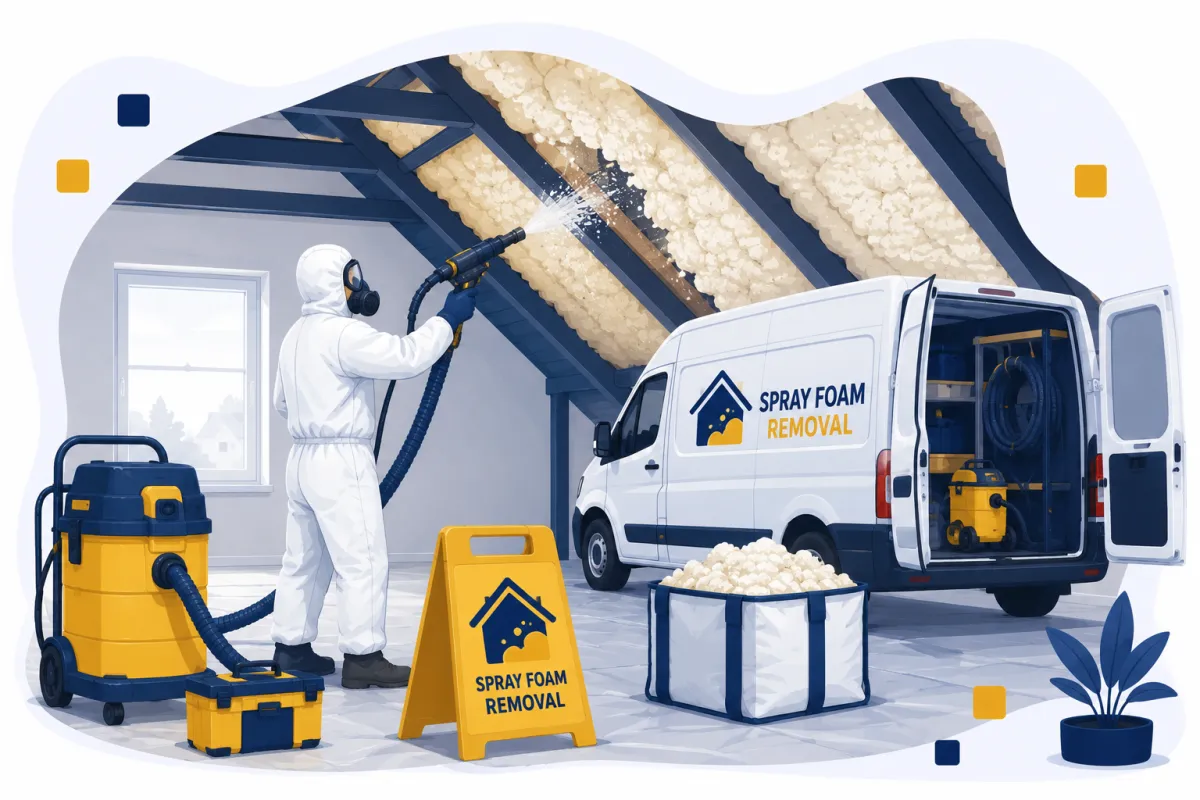
Alongside the professional-indemnity exposure sits an unusually acute public-liability one, and it comes from the nature of removal itself. Spray foam — especially closed-cell foam — bonds hard to roof timbers, tiles, battens and any breathable membrane. Getting it off is inherently destructive: scraping, cutting and abrading material that is stuck fast to the very structure you're trying to preserve. Done carelessly, removal can crack or displace tiles, tear the membrane, gouge rafters, or leave residue that causes further problems — turning a job meant to reveal a sound roof into the cause of a damaged one. Because you are working on the customer's most valuable asset, any such damage is a direct third-party property-damage claim under your public liability.
This is why underwriters look closely at your method: how you protect the property, how you remove without over-cutting the timber, how you handle waste, and how you document the roof's condition before and after. A firm that can evidence a controlled, protective removal method — and photographic before/after records — is both less likely to cause damage and far better placed to defend a spurious claim. The severity of these exposures is the same reason we treat this trade alongside our guidance on high-risk public liability insurance.
What insurance covers does a spray foam removal business need?
A spray foam removal programme is genuinely combined, and the covers have to be structured together so an incident (which will often touch several at once) doesn't fall between them. The core structure looks like this:
Professional indemnity
The defining cover. Responds to claims that your certificate, survey or advice was negligent and caused a third party (buyer, lender, surveyor) a loss. Size it to the value of the transactions relying on your certification. See professional indemnity insurance.
Public liability (with property damage)
Third-party injury and — critically here — damage to the customer's roof and property during destructive removal. Usually £5m minimum, rated on your removal method. See high-risk public liability.
Employers' liability
Legally required under the Employers' Liability (Compulsory Insurance) Act 1969 — and, given isocyanate and dust exposure plus work at height, a genuinely front-line risk for your operatives.
Tools, plant and contract works
Removal equipment, extraction gear, access equipment and any works in progress. Insure at proper value to avoid underinsurance and the condition of average.
Business interruption and management liability
Income protection if you can't trade after an insured event; and directors can be named personally after a serious health or property incident (see our D&O guide). Booking and customer-data systems create a cyber exposure too.
Cover checker: what does your removal business need?
Select the profile closest to your operation. Tags show what's legally required, essential, or worth considering. Every removal business should be built individually — this checker maps the starting point. Our main professional indemnity guide covers the certification core.
- CRITICALProfessional indemnity — your certificate is relied on by lenders; PL alone won't respond to a negligence claim. Specialist placement needed if you've had a prior PI claim.
- CRITICALPublic liability £5m with property-damage cover for destructive removal.
- LEGALEmployers' liability (£10m) — isocyanate, dust and height risk.
- ESSENTIALTools & equipment and contract works.
- RECOMMENDEDPI run-off for the long certificate tail if you ever stop trading.
- CRITICALProfessional indemnity is the primary cover — a survey/assessment business is pure professional advice relied on by lenders and owners.
- ESSENTIALPublic liability for site visits.
- LEGALEmployers' liability (£10m) if you employ surveyors.
- RECOMMENDEDClear report wording defining scope and limitations — reduces PI exposure.
- CRITICALPI + PL together — re-insulation adds Building Regs (Approved Document L) advice exposure on top of removal.
- LEGALEmployers' liability (£10m).
- ESSENTIALProduct liability for the replacement insulation supplied.
- ESSENTIALContract works & materials cover.
- CONSIDERWider contractor cover — see contractors combined.
- CRITICALPL property-damage cover — roof repair after removal raises the damage exposure further.
- CRITICALProfessional indemnity for the certification and any structural advice.
- LEGALEmployers' liability (£10m).
- ESSENTIALContract works including JCT/works exposure — see contractors combined.
- ESSENTIALWork at height confirmed on the policy.
- CRITICALProfessional indemnity — even a one-van operator who certifies roofs carries the full PI exposure.
- CRITICALPublic liability £5m with property damage.
- LEGALEmployers' liability if you use any labour, even casual.
- ESSENTIALTools & van cover.
- CONSIDERIndividual-trade structure — see specialist tradesman liability.
- CRITICALHigher PI & PL limits — volume of certified jobs multiplies the aggregate PI exposure.
- LEGALEmployers' liability (£10m) across all crews.
- ESSENTIALHealth surveillance for isocyanate exposure across the workforce.
- ESSENTIALFleet, plant & contract works at scale.
- RECOMMENDEDManagement liability & D&O — see our D&O guide.
Why do isocyanates make employers' liability a real exposure?
Spray polyurethane foam is made using isocyanates — principally MDI (methylene diphenyl diisocyanate) — and isocyanates are among the leading causes of occupational asthma, to the point that work-related asthma has overtaken asbestosis as the leading cause of new occupational lung disease. Isocyanates are respiratory sensitisers: once a worker becomes sensitised, even very low future exposures can trigger a severe, potentially disabling asthma attack, and there is no recognised safe level for a sensitised person. Removal work disturbs cured foam — cutting, scraping and abrading it releases dust and particulates, and any residual reactive material adds fume exposure — so operatives doing this day in, day out are genuinely at risk.
For the business, this is an employers' liability exposure with an awkward feature: occupational disease has a long latency, so a claim may surface years after the exposure. The HSE expects control under COSHH — suitable respiratory protective equipment (RPE) with the right filters, face-fit testing, dust extraction, safe systems of work and, where appropriate, health surveillance. Underwriters rating a removal firm's EL will want to see those controls evidenced. A firm that can show a proper isocyanate and dust regime is protecting both its workers and its insurability; one that treats RPE as optional is carrying a claim waiting to happen.
What are the working-at-height and health-and-safety duties?
Removal happens in lofts and on roofs, which brings the work squarely under the Work at Height Regulations 2005 and the general duties of the Health and Safety at Work etc. Act 1974. Falls from height remain the single biggest cause of workplace fatalities in construction, and confined, awkward loft spaces add manual-handling and access difficulties. Duties include proper access equipment, fall prevention, safe systems of work, and risk assessments and method statements for each job.
The Control of Substances Hazardous to Health Regulations 2002 (COSHH) then layers the isocyanate and dust controls on top. For insurance, this all feeds the employers' and public liability rating: an underwriter reading a removal firm's risk wants to see documented method statements, height-working controls, RPE and COSHH assessments. These aren't just compliance box-ticking — they are the evidence that defends a claim and the difference between a firm the market wants to write and one it declines. This is the high-hazard contractor territory covered across our high-risk trades guide.
Red-flag checklist: would an underwriter worry about your business?
Tap each statement that is currently true of your business. These are the things that make a specialist trades underwriter nervous — the more that light up, the harder (and pricier) your placement becomes. The first flag is, on its own, close to decisive.
Why does the sector's reputation make cover harder to place?
There is an uncomfortable truth every honest removal firm has to work around: the sector has a mixed reputation. The same lending crisis that created legitimate demand also drew in opportunists — firms that overstate the problem, pressure-sell unnecessary removal, do destructive work badly, or issue certificates that don't withstand scrutiny. Consumer bodies and the press have flagged mis-selling on both the installation and removal sides, and that reputation reaches the insurance market. Underwriters, wary of a young, fast-growing, complaint-prone class, price it defensively or decline it — which unfairly penalises the professional operators.
The way through is differentiation. A firm that presents as a professional business — documented methods, honest certification, proper PI, evidenced health-and-safety, and a clean or well-explained claims record — separates itself from the cowboys in the underwriter's eyes. This is exactly the adverse-risk presentation challenge we handle for trades the standard market misjudges, and it's why the specialist route matters: cover for firms refused elsewhere, or carrying a claims history, is placed on the strength of how the risk is presented, not just what class it sits in.
Risk assessor: how will an underwriter score your business?
What regulations and duties apply to spray foam removal?
A spray foam removal business sits across construction, health-and-safety and professional-services duties, and each feeds directly into how the risk is underwritten and how a claim is defended.
Health and safety at work
The Health and Safety at Work etc. Act 1974 sets the overarching duty to protect employees and others affected by the work — enforced by the HSE with unlimited fines and, in serious cases, imprisonment.
Hazardous substances (isocyanates)
The Control of Substances Hazardous to Health Regulations 2002 (COSHH) require assessment and control of isocyanate and dust exposure — RPE, extraction, safe systems of work and, where appropriate, health surveillance.
Working at height
The Work at Height Regulations 2005 govern loft and roof access — falls from height remain construction's biggest cause of fatalities.
Building standards and professional duty
Any re-insulation must meet Building Regulations — principally Approved Document L (conservation of fuel and power) and Approved Document A (structure). And because your certificate is relied upon in a property transaction, the common-law duty of care in negligence applies to the advice you give — the exposure your professional indemnity answers. RICS and PCA guidance frames what surveyors and lenders expect of a compliant removal.
What drives the cost of spray foam removal insurance?
There is no meaningful "average premium" for a spray foam removal business — the spread between a documented, PI-backed professional operation and a PL-only newcomer is enormous. What every operator can do is understand the rating factors and work the ones within their control:
| Rating factor | Why it moves your premium | Mitigation |
|---|---|---|
| Professional indemnity limit | Your certificate underpins large property transactions | Size PI to the value of transactions relying on your certification |
| Certification discipline | Vague certificates invite negligence claims | Define scope and limitations; document survey and moisture testing |
| Removal method | Destructive removal risks property-damage claims | Protective, controlled method; before/after photographic records |
| COSHH / isocyanate controls | Occupational asthma is a long-tail EL exposure | RPE + face-fit, extraction, safe systems, health surveillance |
| Work-at-height controls | Falls are construction's biggest fatality cause | Method statements, access equipment, fall prevention |
| Claims & complaint history | Prior PI/PL claims reprice or restrict cover | Evidence remediation; see our claims history guide |
| Trading history / newness | New firms in a young class are rated cautiously | Present experience, training and accreditations |
| Public liability limit | Roof damage claims need real capacity | £5m minimum with clear property-damage cover |
| Run-off provision | PI claims can arrive years after a certificate | Arrange run-off cover when trading changes |
| Turnover & job volume | More certified jobs = higher aggregate PI exposure | Accurate declaration; limits sized to volume |
| Re-insulation / repair add-ons | Extra services add Building Regs and works exposure | Disclose all activities; add product/contract-works cover |
| Accreditations | Recognised training/membership signals professionalism | Hold and evidence relevant industry accreditation |
What do real spray foam removal claims look like?
These three fictionalised but market-realistic case studies show how removal-business losses actually unfold — and where the decisions made at placement decided the outcome.
Case study 1: The certificate relied upon — £160,000 professional indemnity claim
A removal firm certified a roof as fully cleared and structurally sound, and the buyer's lender released the mortgage on the strength of it. Within eighteen months, hidden timber rot — concealed behind foam the firm had not fully removed in one section — caused a partial roof failure. The buyer sued the removal firm, alleging the certificate was negligent and that they had relied on it in completing the purchase.
The numbers: the claim settled at £160,000 including the remedial roofing works and the claimant's costs. Because the firm held professional indemnity sized to the transactions it certified, the policy responded.
The lesson: this was not a public-liability claim — it was professional negligence over a document a lender relied on. A PL-only policy, which is what most removal firms carry, would have paid nothing and the owner would have borne £160,000 personally. PI is the cover that defines this trade.
Case study 2: The damaged roof — £48,000 public liability property-damage claim
During an aggressive closed-cell removal, operatives cracked a run of roof tiles and tore the breathable membrane. The damage wasn't noticed until the next heavy rain, when water ingress reached the ceilings below. The homeowner claimed for a partial re-roof and internal redecoration.
The numbers: £34,000 roofing and membrane repair, £14,000 internal damage and alternative accommodation — £48,000 total, met under public liability with property-damage cover.
The lesson: removal is destructive by nature, and damage to the customer's roof is a live public-liability exposure — not a remote one. The firm's before/after photographs helped scope the claim fairly, and its move to a more protective removal method afterwards eased the following renewal. A policy without clear property-damage cover would have left this contested.
Case study 3: The occupational asthma claim — £95,000 employers' liability claim
An operative who had spent three years removing spray foam, often with inadequate respiratory protection, developed isocyanate-induced occupational asthma and could no longer work in the trade. He brought an employers' liability claim, and the HSE examined the firm's COSHH controls.
The numbers: the EL claim settled at £95,000 for the career-ending sensitisation. The firm also faced HSE enforcement over its RPE and health-surveillance failings — the fine for which was uninsurable.
The lesson: isocyanate sensitisation is a long-tail, career-ending injury, and employers' liability is not a formality in this trade. The EL policy met the civil claim, but no policy pays a criminal fine — only proper RPE, face-fit testing and health surveillance could have prevented both. The claim surfaced years after the exposure began, underlining why continuity of EL cover matters.
What if your business has been refused cover or non-renewed?
Refusal and non-renewal are common in this young sector — insurers decline the class wholesale, or withdraw after a complaint or claim — but it carries less stigma with specialist underwriters than operators fear, provided it's handled correctly. Every future proposal will ask whether you've been refused cover, and the duty of fair presentation makes the answer permanent, so serial applications that rack up declines are the worst possible approach. The workable path is the one we set out in our guides to insurance for businesses refused cover and business insurance refused elsewhere: disclose everything, evidence your certification discipline, method and health-and-safety controls, and approach the specialist market through a broker who can frame the risk. If a prior PI claim is the issue, our guide to professional indemnity after a claim explains how cover is rebuilt — present the claim and what changed, once, properly.
How do you manage a claim or complaint after a removal?
Removal disputes — a damaged roof, a challenged certificate, a health complaint — are managed, and claims are won or lost, by what you do in the first days. This is the sequence we run with clients:
- Do not admit liability or agree remedial works. A sympathetic "we'll sort it" can be treated as an admission and prejudice your cover. Acknowledge the concern, but commit to nothing on liability.
- Notify your broker immediately. Professional indemnity is typically written on a claims-made basis, so late notification can defeat the claim entirely. Tell your broker the moment a complaint could become a claim — not when it's formalised.
- Preserve every record for that job. The survey, moisture readings, before/after photographs, the certificate and its wording, method statements and correspondence. In a certification dispute, this file is your defence.
- Identify which policy responds. Property damage points to public liability; a challenged certificate points to professional indemnity; a staff health issue to employers' liability. Your broker maps the claim to the right section — some incidents touch more than one.
- Report to the authorities where required. A serious injury or dangerous occurrence may be RIDDOR-reportable to the HSE. Take advice before giving accounts that could feed enforcement.
- Control communications. One point of contact; nothing on liability to the customer, their solicitor, the lender or on social media. Let insurers and, where needed, solicitors handle the response.
- Cooperate with insurer-appointed experts. A surveyor or engineer may need to inspect. Give them full access and your complete records — a well-documented file resolves claims faster and more cheaply.
- Fix the root cause and evidence it. Whatever the dispute reveals — certificate wording, removal method, RPE — correct it and document the change. It protects the next customer and your next renewal.

About the author — John Miller
John Miller is Director & Principal Broker at Miller & Partner Limited (FCA Firm Ref 1029698), with over 13 years' specialist commercial insurance experience and direct access to the Lloyd's Market and specialist MGA schemes. John specialises in adverse and hard-to-place risks — including spray foam removal firms and other niche contractors whose professional-indemnity and property-damage exposures the standard market misjudges — placing cover for businesses others have declined. He was previously the #1 Account Executive at Brown & Brown and #1 Salesperson at AXA.
Read more about John · Office: Vivian House, Roman Bridge Close, Mumbles, Swansea SA3 5BG · 01792 001350
Glossary of spray foam removal insurance terms
- Spray polyurethane foam (SPF)
- The insulation product — open-cell or closed-cell — sprayed onto roof timbers; the material whose removal this trade specialises in.
- Closed-cell foam
- A dense, rigid foam that bonds especially hard to timber and is the most difficult and destructive to remove.
- Professional indemnity (PI)
- Cover for claims that your certificate, survey or advice was negligent and caused a third party a financial loss — the defining cover for this trade.
- Post-removal certificate
- The document confirming the foam has been removed and the roof inspected, relied upon by surveyors and lenders to proceed with a mortgage.
- Claims-made basis
- The basis on which PI is usually written: the policy in force when a claim is made responds, which is why continuity and run-off matter.
- Run-off cover
- PI cover maintained after you stop trading or change entity, to answer claims arising from past certificates.
- Public liability (PL)
- Cover for third-party injury and property damage — here, principally damage to the customer's roof during removal.
- Employers' liability (EL)
- Legally compulsory cover for staff injury or illness — including isocyanate-induced occupational asthma.
- Isocyanates / MDI
- The reactive chemicals in spray foam; MDI (methylene diphenyl diisocyanate) is a leading cause of occupational asthma.
- Sensitisation
- The process by which repeated isocyanate exposure makes a worker allergic, so even low future exposure triggers severe asthma.
- COSHH
- The Control of Substances Hazardous to Health Regulations 2002 — the duty to assess and control isocyanate and dust exposure.
- RPE / face-fit testing
- Respiratory protective equipment and the testing that confirms it seals to the wearer — a core isocyanate control.
- Work at Height Regulations 2005
- The regulations governing loft and roof access; falls from height are construction's biggest fatality cause.
- Interstitial condensation
- Moisture trapped within the roof structure behind the foam — a primary driver of the timber decay lenders fear.
- Contract works
- Cover for the works in progress and materials on site, including any re-insulation or repair the firm undertakes.
- Fair presentation
- The duty under the Insurance Act 2015 to disclose every material circumstance — activities, certification, losses and refused cover.






Instagram
LinkedIn