


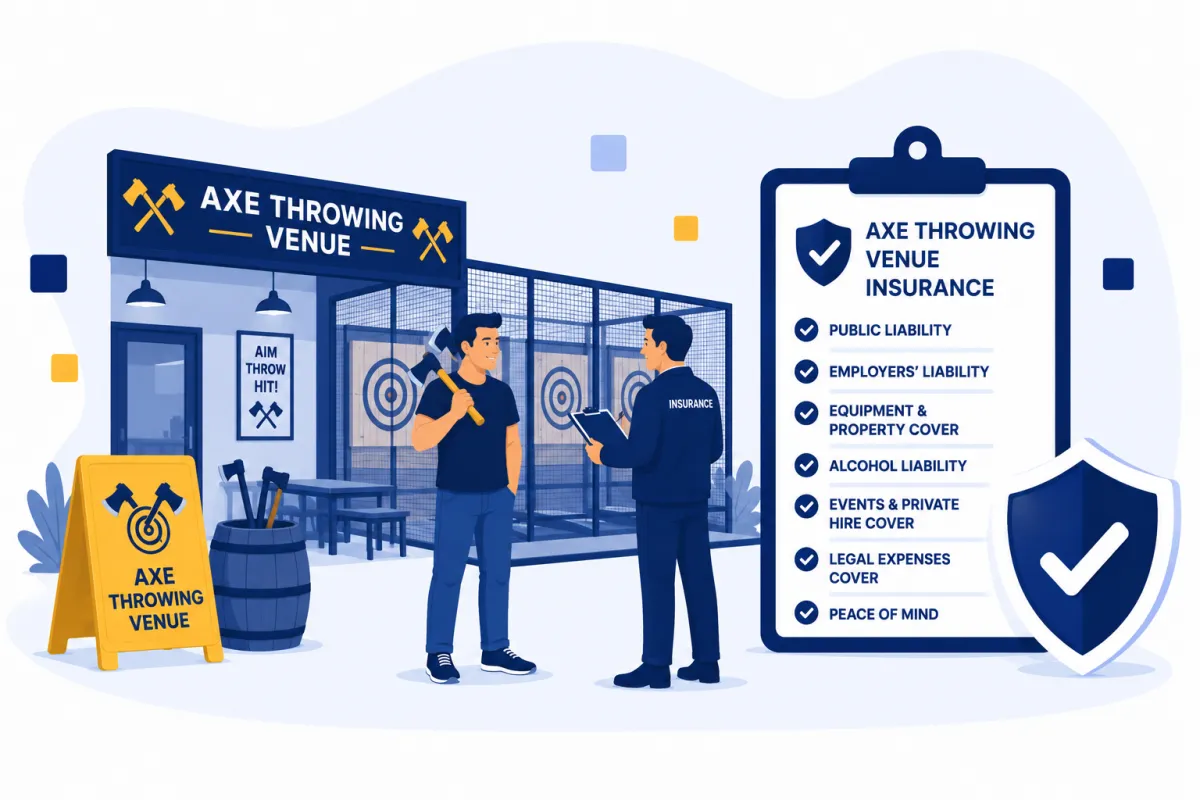
Axe Throwing Venue Insurance UK | Specialist Activity Cover
Why is axe throwing so hard to insure?
Axe throwing has gone from novelty to mainstream night-out in a few short years, riding the wave of "competitive socialising" alongside shuffleboard, darts bars and mini-golf. It is a brilliant business — but from an insurer's chair it is an unusual one, because the core proposition is handing members of the public a bladed tool and inviting them to throw it, frequently in a venue that also serves alcohol. That combination puts axe throwing squarely in the territory that ordinary commercial insurers decline on sight.
None of that means axe throwing is uninsurable — far from it. It means the risk has to be placed with a specialist who understands it, and built around the real exposures rather than shoe-horned into a generic sports or hospitality policy. The activity has to be named explicitly on the cover; the alcohol-plus-axes question has to be answered properly; and the venue's safety system — lane design, supervision, waivers, retrieval rules — has to be evidenced. Get those right and it is a perfectly insurable, thriving business. Get them wrong and you are either uninsured or carrying a policy that will not pay when it matters.
This is exactly the hard-to-place work we specialise in. At Miller & Partner we place cover for axe-throwing venues, competitive-socialising sites and mobile operators that standard markets won't quote, matching the policy to the real risk and the safety controls you run.
Axe throwing is precisely the kind of risk a generalist declines and a specialist can place with the right controls in place. Here is how each pillar applies.
Key facts on axe-throwing cover, at a glance
- Standard insurers routinely decline axe throwing — thrown blades near people, often with a licensed bar, sit outside ordinary appetite, so it needs a specialist activity policy.
- The activity must be named explicitly on the policy; calling yourself a "sports venue" without disclosing axe throwing can void a claim for non-disclosure.
- Public liability is the core cover — usually £5m, often £10m for corporate events or where a landlord requires it — and must respond to a rebounding or mis-thrown axe.
- The alcohol-plus-axes combination is the central underwriting concern; incidents involving intoxication may be excluded, so alcohol controls matter.
- Insurers expect recognised safety controls: one thrower and one axe per lane, walled and separated lanes, marked throwing lines, trained marshals and retrieval rules.
- Employers' liability is compulsory for staff and marshals, and signed participant waivers are essential.
- Mobile and pop-up operators need cover that follows them to festivals, corporate events and third-party sites.
Why do standard insurers decline it?
Ordinary commercial policies are built around ordinary risks. Handing an intoxicated stranger a hatchet to hurl at a wooden target is not one of them. When a standard insurer sees "axe throwing" — especially with a bar attached — it usually declines, not because the business is bad, but because the risk falls outside the appetite of a mainstream book. The signature exposure is obvious: a heavy blade travelling at speed, which can rebound off a target, slip from a grip, or strike a participant or spectator who has strayed into a lane. That is a serious-injury claim by its nature, and it needs an insurer that prices for it deliberately rather than one that stumbled into it.
The result is that generic quotes either come back as a flat decline, or — more dangerously — as a policy that appears to cover you but quietly excludes the activity or the alcohol angle. A specialist placement solves this by going to markets that actively want the risk, naming the activity, and building the terms around your controls. It is the same difference we see across every hard-to-place sector: a decline from a generalist is not a verdict on your business, it is a signal you are in the specialist market's territory.
Standard cover vs a specialist policy
The gap between a generic policy and a specialist one is not cosmetic — it is the difference between a claim paid and a claim declined. Here is where they diverge.
| Requirement | Generic policy | Specialist policy |
|---|---|---|
| Axe throwing named | Often not — or excluded | Explicitly covered |
| Rebounding-axe injury | May fall outside cover | Core insured event |
| Alcohol-plus-activity | Frequently excluded | Priced with controls |
| Lane fit-out / partitions | Often overlooked | Tenant's improvements covered |
| Mobile / pop-up work | Tied to one address | Follows you off-site |
| Corporate events | Limit may be too low | £10m where required |
The takeaway is simple: a policy that doesn't name axe throwing isn't cheaper cover for the same thing — it's different, thinner cover that may not respond to your biggest risk at all.
Why is alcohol the central underwriting concern?
If there is one question that decides your terms, it is how you manage alcohol. Competitive socialising thrives on the bar, but combining drinking with throwing blades is exactly what makes underwriters cautious — and it is why many will exclude incidents involving intoxication unless they can see you control it. The public-safety expectations that sit behind a premises licence point the same way: the throwing range and axe storage should be clearly defined, and you should be able to show how you keep impaired customers away from the axes.
In practice, insurable venues run a documented alcohol policy: limits on drinks before or during throwing, staff empowered to refuse participation to anyone visibly impaired, clear separation between the bar and the lanes, and marshals with the authority to stop a session. Some venues keep axe throwing entirely alcohol-free to simplify the risk. Whatever you choose, being able to evidence the controls is what turns the alcohol question from a decline into a manageable, priced exposure.
The single biggest thing operators underestimate is how much the alcohol policy drives the whole placement. They think the axe is the risk — and it is — but underwriters have seen enough thrown-blade venues to know that a sober, marshalled lane is a very different animal to a stag party three rounds in. The controls around the bar matter as much to the price as the blades on the wall. When we present a venue with a genuine, documented alcohol policy and trained marshals, doors open that a bare "we do axe throwing" submission slams shut.
What insurance does an axe-throwing venue need?
Even a single-lane operation combines a public activity, staff, a fitted-out premises, and — usually — a bar. Here is the core programme most venues need.
| Cover | What it protects | Priority |
|---|---|---|
| Public liability (activity named) | Injury to participants and spectators — the core exposure | Essential |
| Employers' liability | Staff and marshals — required by law | Compulsory |
| Buildings / contents & fit-out | Lanes, partitions, safety glass, flooring, equipment | Essential |
| Business interruption | Lost income if you have to close | Recommended |
| Licensed / bar cover | The bar, food and alcohol service | Recommended |
| Products liability | Merchandise, food and drink supplied | Recommended |
| Mobile / pop-up extension | Events at festivals and third-party sites | Consider |
| Cyber | Booking systems and customer data | Consider |
| Management liability / D&O | Directors of a limited company | Consider |
Cover checker: what fits your venue?
Select the setup that fits. Each shows the priorities — and a specialist broker tailors the detail.
- CRITICAL Public liability with axe throwing explicitly named, at a limit reflecting footfall.
- LEGAL Employers' liability for all staff and marshals.
- ESSENTIAL Fit-out and contents cover for lanes, partitions and equipment.
- ESSENTIAL Business interruption if you have to close.
- RECOMMENDED Documented safety and retrieval procedures for underwriters.
- CRITICAL Tell your insurer you've added axe throwing — a bar policy won't cover it silently. Specialist placement needed.
- CRITICAL Evidence a documented alcohol-and-axes policy and lane separation from the bar.
- LEGAL Check your premises licence reflects the activity and public-safety measures.
- ESSENTIAL Extend public liability to name the activity.
- CONSIDER Whether throwing sessions are kept alcohol-limited.
- ESSENTIAL A combined policy naming every activity — axe throwing, mini-golf, darts, shuffleboard.
- CRITICAL Don't let the higher-risk activities go undisclosed under a broad description.
- LEGAL Employers' liability across all staff.
- ESSENTIAL Public liability sized for the busiest, riskiest activity.
- CONSIDER Management liability if run by a company.
- CRITICAL Cover that follows you to festivals, offices and third-party sites — not tied to one address. Specialist placement needed.
- ESSENTIAL Public liability naming mobile axe throwing.
- ESSENTIAL Equipment and transit cover for your kit and targets.
- LEGAL Employers' liability for staff and marshals on the road.
- CONSIDER Event-specific requirements from venues you visit.
- CRITICAL A £10m public liability limit is often required for corporate bookings.
- ESSENTIAL Confirm cover extends to team-building and private events.
- RECOMMENDED Provide certificates promptly to corporate clients.
- ESSENTIAL Waivers for every participant, including corporate groups.
- CONSIDER Higher limits where a client contract demands them.
- LEGAL Sort your premises licence, reflecting axe throwing and public-safety measures.
- CRITICAL Arrange specialist cover before you open — generic quotes may exclude the activity.
- ESSENTIAL Build safety in from day one: lane design, marshals, waivers, retrieval rules.
- RECOMMENDED Document your alcohol policy for underwriters.
- CONSIDER A broker who knows the competitive-socialising market.
What is the "sports venue" non-disclosure trap?
This is the mistake that turns a policy you paid for into a claim that doesn't pay. When arranging cover, some operators describe their business in broad, comfortable terms — a "sports venue," a "leisure centre," a "bar with games" — without spelling out that the main activity is throwing axes. It feels harmless, but it is a non-disclosure: if your proposal doesn't accurately describe what you do, the insurer can decline a claim on the grounds that the risk they priced isn't the risk that actually existed.
Red-flag check: is your venue exposed?
Tick each item that is true. Each is a sign your cover may not match how your venue actually operates.
Placeability assessor: how straightforward is your cover?
Choose two factors for an indicative read on how your placement is likely to go. Guidance, not advice.
What safety standards do insurers expect?
Insurers price an axe-throwing venue on its controls as much as its activity, so the safer and better-documented your operation, the more markets will look at it and the better the terms. Most underwriters expect the kind of standards set by bodies like the World Axe Throwing League, which have become the industry reference point: walled and separated lanes that keep axes within their target area, a marked throwing line with clear rules on crossing it, one thrower and one axe per lane, no outside axes brought in, and defined retrieval procedures so no one collects an axe while another is throwing.
Around the equipment sit the human controls: trained marshals supervising every session, signed participant waivers, age rules for younger throwers, and a documented approach to anyone who appears impaired. All of this also feeds your health-and-safety duties under the general requirement to assess and manage risk. From an insurance point of view, the message is consistent: strong, evidenced controls are not just good practice, they are what make the risk placeable and affordable in the first place.
How are mobile and pop-up operators covered?
A large slice of the axe-throwing market is mobile — operators who take lanes and targets to festivals, corporate away-days, weddings and private parties. The exposure is the same thrown-blade risk, but in unfamiliar settings you don't control, which makes two things essential. First, your public and employers' liability must follow you to third-party sites rather than being tied to a fixed address. Second, your equipment needs transit and away-from-premises cover, because kit is loaded, transported and set up in the open, where damage and theft are more likely.
Mobile operators also inherit each host site's conditions: an event organiser or corporate client will often demand a specific public-liability limit and a certificate before you can set up. A specialist policy built for a mobile axe-throwing business handles all of this — naming the activity, travelling with you, covering your kit, and meeting the limits your clients require — so a lucrative corporate booking doesn't fall through on a paperwork gap or leave you working uninsured on someone else's land.
What drives an axe-throwing venue's premium?
Axe throwing is a specialist but genuinely insurable risk, and the premium is driven by a clear set of factors — most of which good controls and an honest, detailed presentation can improve.
| Factor | Why it matters | How to manage it |
|---|---|---|
| Alcohol policy | The central underwriting concern | Document limits, separation and refusal rules |
| Supervision model | Marshalled sessions are far lower risk | Trained marshals present at all times |
| Lane design | Separation contains the blade | Walled lanes, barriers, marked lines |
| Number of lanes / footfall | More throwing, more exposure | Match the public liability limit to scale |
| Public liability limit | Corporate work needs higher limits | £5m base, £10m for events/contracts |
| Waivers & records | Defend and deter claims | Signed waivers for every participant |
| Fit-out value | Lanes and partitions are costly | Insure tenant's improvements accurately |
| Mobile / off-site work | Adds transit and third-party exposure | Away-from-premises and transit cover |
| Other activities | Archery, knife throwing raise risk | Name every activity you offer |
| Claims history | Past claims affect pricing | Strong controls and record-keeping |
| Business interruption limit | Income at risk if you close | Realistic income and indemnity period |
| Quality of presentation | Detail earns better terms | Full submission via a specialist broker |
Three real-world axe-throwing claim case studies
These composites reflect the situations we and other specialist brokers see across activity and competitive-socialising venues. Figures are illustrative, but the dynamics — and the gaps — are real.
Timber Lanes — the rebounding axe
At a busy dedicated venue, a spectator stepped forward to photograph a friend mid-throw and moved into the edge of an adjacent lane just as an axe rebounded off the target. The resulting injury led to a public-liability claim of around £48,000 in damages and defence costs. Because the venue's policy named axe throwing and the activity was properly disclosed, the cover responded in full, and the venue tightened its spectator-line marking and marshal briefings. The lesson: the rebounding or mis-thrown axe striking a bystander is the signature claim — a properly named public-liability policy at an adequate limit is non-negotiable.
The Foundry Bar — alcohol and axes
A city-centre bar added two axe lanes to draw evening trade but arranged nothing beyond its existing licensed-premises policy. When a customer, several drinks in, was injured during a session, the insurer scrutinised the alcohol controls and the fact that the activity had never been declared. A large part of the claim — around £35,000 — was jeopardised because axe throwing wasn't on the policy and no documented alcohol-and-axes policy existed. The lesson: adding axes to a bar changes the risk entirely; the activity must be named and the alcohol controls documented, or the claim is exposed.
Nomad Axes — the off-site gap
A mobile operator ran a corporate team-building event at a client's premises. A participant was injured, and the client also required a £10m certificate the operator couldn't provide. Worse, the operator's policy was written for its home base only, so the off-site claim — around £22,000 — fell outside cover, and the corporate contract was lost. The lesson: mobile and pop-up work needs cover that travels, names the activity, and meets the limits corporate clients demand. We re-placed the business on a mobile-ready policy with a £10m limit.
How to insure an axe-throwing venue properly
Whether you're opening your first lanes, adding axes to a bar, or running mobile events, these eight steps will help you build cover that actually responds.
- Name the activity. Make sure axe throwing — and any archery or knife throwing — is explicitly stated on the policy, never hidden under "sports venue."
- Get public liability right. Set a limit that reflects footfall and corporate work — £5m as a base, £10m where events or contracts require it.
- Document your alcohol policy. Evidence limits, bar-to-lane separation and refusal rules — the single biggest driver of your terms.
- Arrange compulsory employers' liability. Cover all staff and marshals.
- Insure the fit-out. Include lanes, partitions, safety glass and flooring as tenant's improvements, plus contents and equipment.
- Add business interruption. Protect your income if you have to close after an incident or damage.
- Cover mobile work if you do it. Ensure liability and equipment cover follow you to third-party sites and meet client limits.
- Use a specialist broker. Thrown-blade risks are written by only a handful of insurers; a specialist places it correctly and evidences your controls.

Axe-throwing insurance glossary
- Competitive socialising
- The leisure trend of activity-led venues — axe throwing, mini-golf, darts, shuffleboard — usually combined with food and a bar.
- Public liability
- Cover for injury to participants, spectators and visitors, or damage to their property — the core cover for an axe venue.
- Named activity
- An activity explicitly stated on the policy; if axe throwing isn't named, a related claim can be declined.
- Non-disclosure
- Failing to tell the insurer material facts — such as the real activity — giving grounds to reduce or refuse a claim.
- Employers' liability
- Legally required cover for injury or illness to staff and marshals, minimum £5 million.
- Tenant's improvements
- Fit-out you've paid for in a leased premises — lanes, partitions, safety glass, flooring — insurable as your property.
- Business interruption
- Cover for lost income while you're closed after insured damage or an incident.
- WATL
- The World Axe Throwing League, whose equipment and facility standards are the widely-adopted industry reference.
- Throwing lane
- The walled and separated area from which axes are thrown, designed to keep the blade within its target zone.
- Marshal / coach
- A trained member of staff supervising a throwing session, enforcing rules and managing retrieval.
- Participant waiver
- A signed acknowledgement of the risks and rules — a core defence against claims and often a cover condition.
- Rebound
- When a thrown axe bounces back off the target instead of sticking — a key injury scenario for spectators.
- Premises licence
- The licence to sell alcohol and provide regulated activity, under which public safety must be promoted.
- Mobile / pop-up operator
- An operator taking axe throwing to festivals, corporate events and third-party sites — needing cover that travels.
- Limit of indemnity
- The maximum an insurer will pay on a claim — commonly £5m, or £10m for corporate and contractual requirements.
Frequently asked questions
Can you get insurance for an axe-throwing venue?
Why did standard insurers decline my axe-throwing business?
How much public liability cover do I need?
Does my policy need to name axe throwing specifically?
Can I serve alcohol at an axe-throwing venue?
What safety measures do insurers expect?
I run a bar and want to add axe lanes — what changes?
Do mobile axe-throwing operators need different cover?
Are participant waivers enough to protect me?
How much does axe-throwing insurance cost?
Can I insure a multi-activity competitive-socialising venue?
Do you arrange insurance for axe-throwing venues?
Related specialist guides
- Padel Club Insurance
- Pub & Bar Insurance
- High-Risk Public Liability Insurance
- Insurance for Businesses Refused Cover
- Business Insurance Refused Elsewhere
- Specialist Broker for Adverse-Risk Insurance
- Business Interruption Insurance
- Underinsurance & the Condition of Average
- Directors & Officers Insurance
- Esports Team Insurance
- Café Insurance
- Business Insurance After a Fire Claim
- Commercial Insurance
- Lifestyle & Leisure Insights Hub
- Sports, Gym & Social Club Quote Form
This guide is general information, not advice for your specific circumstances, and does not constitute legal or financial advice. Cover, safety and licensing requirements vary by venue and activity. Always confirm your requirements with your local authority, follow recognised safety standards, and take advice from a qualified broker. Miller & Partner Limited is authorised and regulated by the Financial Conduct Authority, Firm Reference 1029698.






Instagram
LinkedIn