


Business Insurance After a Food Hygiene Closure UK 2026
Can you still get business insurance after a food hygiene closure or prosecution?
Every food business in the UK is inspected by its local authority's environmental health officers, scored, and published. The Food Hygiene Rating Scheme puts the result — 0 to 5 — in the window, on the FSA's public website, and into the data feeds that delivery platforms, landlords and insurers read. Behind the rating sits a set of enforcement powers that escalate quickly: a hygiene improvement notice with a minimum 14-day compliance period, a voluntary closure agreed on the spot, an emergency prohibition notice that shuts the premises the same afternoon and goes before magistrates within three days, and prosecution — of the company, and personally of the owner or manager, who can be banned from managing any food business at all.
This guide is for the operator who has just been closed, marked down, served with a notice or summonsed — the publican, restaurateur, takeaway owner, caterer, guest house keeper or food manufacturer who now needs to know what it does to the insurance the business depends on. It explains the enforcement ladder in insurance terms, which closure costs can and cannot be insured, exactly what must be disclosed and when, what a renewal looks like afterwards, and how a food business with an enforcement history is placed with markets that will write it. It sits in our adverse-risk cluster alongside insurance after an HSE prosecution, insurance after trading standards enforcement and insurance for businesses refused cover.
Key facts at a glance
- Fines cannot be insured. It is against public policy for insurance to indemnify a criminal penalty. Legal Expenses can fund the defence of a food hygiene prosecution — it will never pay the fine, the costs order or the victim surcharge.
- Your rating is public — and permanent until re-scored. The Food Hygiene Rating Scheme publishes every score at ratings.food.gov.uk. Display of the sticker is mandatory in Wales and Northern Ireland; in England the score is online whether you display it or not.
- Enforcement is a material fact. Under the Insurance Act 2015 you must disclose notices, closures, low ratings where asked, investigations and prosecutions at inception and renewal — and mid-term where the policy requires it.
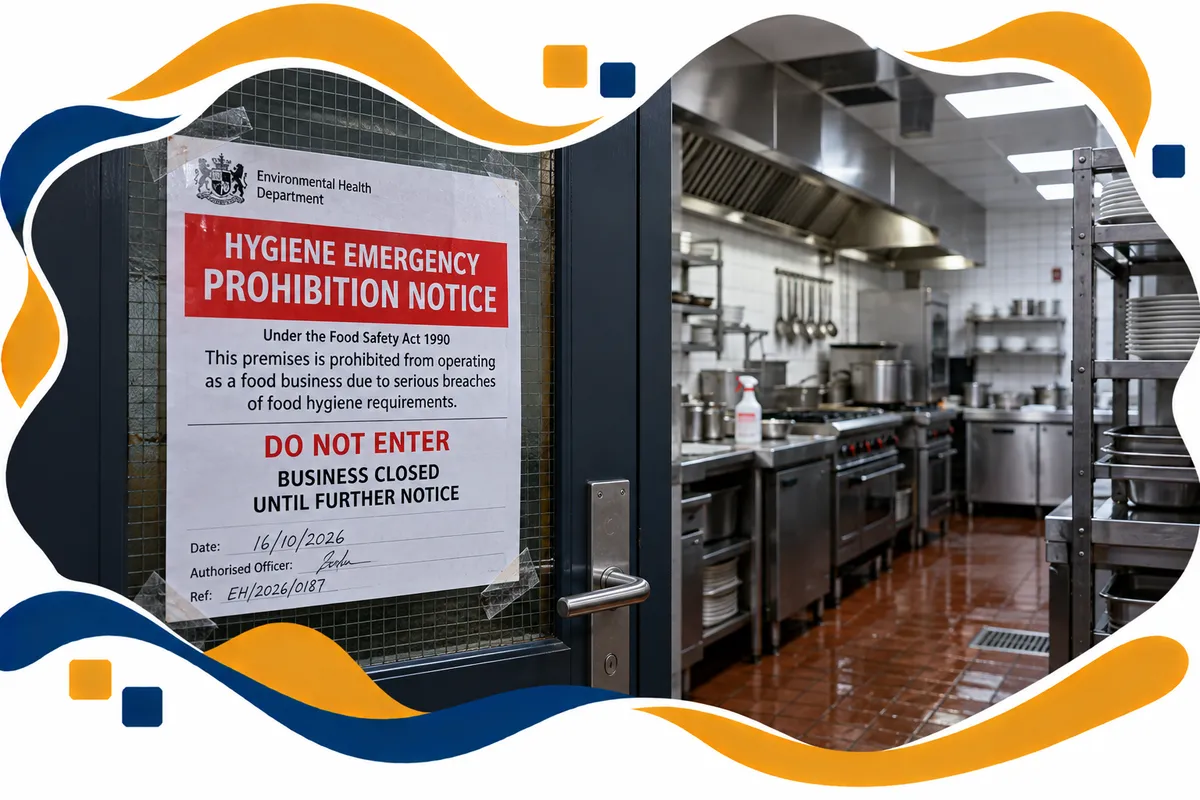
- An emergency closure moves fast. A Hygiene Emergency Prohibition Notice shuts the premises immediately where there is an imminent risk to health, and the council must apply to magistrates within three days for an order confirming it. If the court refuses, compensation is payable.
- A hygiene improvement notice gives you at least 14 days to put a contravention right. Failure to comply is itself a criminal offence.
- Fines are unlimited and turnover-based. Since 2015 magistrates' fines are uncapped, and courts sentence food safety and hygiene offences under the Sentencing Council's guideline — culpability, harm and turnover — the same method that has driven six-figure fines for hospitality businesses.
- Owners and managers are prosecuted personally. A hygiene prohibition order can ban an individual from participating in the management of any food business — a sanction that follows the person, not the company, onto every future proposal form.
How does The Insurability Framework™ apply after hygiene enforcement?
Placing a kitchen after an emergency closure, a pest infestation or a prosecution is exactly what the Insurability Framework was built for. Each pillar has a specific job in a post-enforcement placement.
The Insurability Framework — applied after food hygiene enforcement
Four pillars, one method: separate the inspection from the business, and price the business.
Underwriter Intelligence
An underwriter reading an emergency closure asks three questions: was this a lapse or a culture, what has been done, and will it hold? We answer all three in the submission — the notice, the re-opening confirmation, the new pest control contract, the re-score — so the file is read as a remediated risk, not a red flag.
Difficult Risk Expertise
Hospitality package insurers decline enforcement history by rule. Lloyd's syndicates and specialist MGAs write it by judgement. We place pubs, restaurants, takeaways and food manufacturers with closures, low ratings and prosecutions in markets that have seen them before and price them on evidence.
Risk Assessment
We identify what the enforcement exposed beyond the inspection itself: the food poisoning claim that may follow, the delivery platform delisting, the franchise or lease clause now breached, the personal position of the owner, and the mid-term notification condition already triggered in the current policy.
Claims Advocacy
The same incident can produce a prosecution and a customer illness claim at once. We coordinate the Legal Expenses solicitor and the liability insurer's handler so that nothing said in one forum damages the other — and so the business has a human broker, not a helpline, through the months it takes to rebuild.
What is the food hygiene enforcement ladder — and what does each step mean to an insurer?
| Enforcement action | What it is | Public? | Typical insurance consequence |
|---|---|---|---|
| Verbal or written advice | EHO identifies minor issues; follow-up letter, no formal action | No | Not usually a material fact unless a proposal question asks about "any inspection"; disclose if in doubt |
| Low hygiene rating (0, 1 or 2) | Published score reflecting hygiene, structure and management of food safety | Yes — ratings.food.gov.uk until re-scored | Many hospitality schemes ask the rating on the proposal form and decline 0–1 by rule; a 2 commonly triggers referral or a loading |
| Hygiene improvement notice | Formal notice requiring a contravention to be remedied within a stated period of at least 14 days | Not centrally, but disclosable and on local authority records | Material fact. Loading of 10–30% typical; compliance confirmed in writing usually restores standard terms after a clean year or two |
| Voluntary closure | Operator agrees to close while a problem (often pests) is resolved — avoids the court process | Not formally, but often reported locally | Material fact. Treated by underwriters much like an emergency closure, softened by the cooperation it shows |
| Hygiene Emergency Prohibition Notice | Immediate closure where there is an imminent risk of injury to health; magistrates asked to confirm within 3 days | Court hearing is public; closures widely reported | Material fact. Many package markets decline or impose pest-control and food-safety warranties; specialist markets require the re-opening evidence |
| Hygiene Emergency Prohibition Order | The magistrates' order confirming the closure until the risk is removed and the EHO certifies re-opening | Yes | As above, with the court record attached. The certificate of satisfaction lifting the closure is the key renewal document |
| Remedial action notice | Immediate notice in approved premises (e.g. meat, dairy, fish establishments) stopping a process or use of equipment | Not centrally | Material fact for manufacturers; read alongside BRCGS/SALSA status and customer audit results |
| Simple caution | Formal admission of an offence without prosecution | Not published, but disclosable | Treated by many insurers as a conviction for disclosure purposes |
| Prosecution and conviction | Magistrates' or Crown Court; unlimited fines under the Sentencing Council guideline | Yes — court registers and press | Material fact. Decline from most package and scheme markets; specialist placement on evidence. Fines and costs uninsurable |
| Hygiene prohibition order (personal) | Court order banning a convicted proprietor or manager from managing any food business | Yes | Follows the individual onto every proposal form, for this business and any future one |
Which closure costs can insurance never pay — and which can it?
The business interruption point is the one that surprises operators most. A standard BI section responds to loss of income caused by insured physical damage — fire, flood, escape of water. An environmental health closure involves no damage, so the section never triggers, however long the premises stay shut. The relevant cover is the closure by public authority extension (often called "notifiable disease, vermin and defective sanitation" cover), which many hospitality wordings offer as standard or as an optional add-on. It typically pays loss of income when the premises are closed by order of a competent authority because of vermin or pests at the premises, defective drains or sanitation, a murder or suicide, or an outbreak of a notifiable disease at or near the premises — subject to inner limits (commonly £25,000–£250,000) and time franchises.
Two caveats decide whether it pays after a hygiene closure. First, the closure must be by (or at the direction of) the authority — a voluntary closure agreed before a notice is served can fall outside a narrow wording, which is worth knowing before you volunteer. Second, most wordings exclude closures arising from the insured's failure to comply with food hygiene law where that failure was known and ignored; a pest infestation discovered and acted on is insurable in a way that a long-ignored one is not. Reading this extension — its triggers, inner limit and exclusions — is the single most valuable thing a food operator can do with its policy before an inspection, not after. Where product contamination rather than premises hygiene is the issue, product recall insurance is the section that responds, and for licensed premises a loss of licence section protects the value of the justices' licence if it is forfeited or suspended.
What must you disclose to your insurer after a hygiene inspection, closure or prosecution?
The Insurance Act 2015 duty of fair presentation requires you to disclose every material circumstance you know or ought to know, or enough to put the insurer on notice to ask. Hospitality proposal forms ask directly: "Has the business or any partner or director ever been prosecuted, served with a notice or had premises closed under food safety or hygiene legislation?" — frequently with a five-year window, sometimes with no time limit at all. Many also ask the current Food Hygiene Rating as a rating factor. Answering around these questions is not a grey area, and the remedies are the standard ones: proportionate reduction of a claim, imposition of the terms that would have applied, or avoidance of the policy where the insurer would have declined.
The mid-term trap
Most operators understand renewal disclosure. Fewer notice that the current policy usually contains a condition requiring notification of "any material change in the risk" during the year. An emergency closure is unarguably one; so is a pest infestation serious enough to close voluntarily. Failing to notify mid-term rarely voids the policy on its own, but it prejudices any related claim — a kitchen that burns down a month after an undisclosed closure for a gas safety and cleaning failure is a claim with a problem. The rule is the same one we give every client: the day you sign for a notice, your broker hears about it.
Owners, managers and previous businesses
Proposal forms ask about the people, not just the company. A proprietor who was prosecuted personally, or banned under a hygiene prohibition order, carries that history into every new venture — and insurers ask about previous businesses precisely because hospitality operators move premises and reincorporate often. This is where hygiene enforcement meets our work on insurance after insolvency: a closed restaurant company that is liquidated does not take the owner's disclosure obligations with it to the new site.
What actually happens at your next renewal?
Hospitality is a scheme-driven market. Pub, restaurant and takeaway packages are written to underwriting rules, and many carry a hard rule on enforcement: any closure or prosecution in the last three or five years is outside appetite, and a current 0 or 1 rating often is too. If your business is on one of those schemes, the renewal decision was made by the rules engine before anyone read your file — the invitation simply does not arrive. That silence, six weeks from expiry, is where most of our post-closure enquiries start. Our guide to insurance for businesses refused cover covers the mechanics of that window.
Specialist markets read files. What they want is what the readiness self-check below assembles: the notice and the certificate lifting it, the re-score, the pest control contract and reports, the documented food safety management system, training records, invoices for the works, and a short statement from the owner on what changed. Presented that way, an emergency closure on an otherwise sound business typically lands at a 25–60% loading in year one with a pest-control warranty, unwinding over two or three clean renewals. A prosecution is heavier and slower — but it is placed.
Which cover do you need after each type of hygiene enforcement?
Post-Enforcement Cover Checker
Select the enforcement action your food business has received to see the programme and the disclosure position that go with it
Low hygiene rating (0, 1 or 2)
- LEGAL Employers' Liability £10m — maintain without a gap
- ESSENTIAL Check whether your proposal form asked the rating — if it did, tell your broker it has changed
- ESSENTIAL Fix, evidence, and request the re-inspection — the published score is the commercial wound, and only a re-score heals it
- RECOMMENDED Legal Expenses with prosecution defence scope added now, while nothing formal is on foot
- RECOMMENDED Review the closure-by-authority extension on your BI section — this is the moment to know its triggers and inner limit
- CONSIDER Use the right to reply so your side of the score is published alongside it
Hygiene improvement notice
- LEGAL Employers' Liability £10m — no gap
- ESSENTIAL Mid-term notification to your current insurer if the policy carries a change-in-risk condition
- ESSENTIAL Comply within the period — non-compliance is a separate offence — and keep written confirmation the notice is satisfied
- ESSENTIAL Legal Expenses with food safety prosecution scope
- RECOMMENDED Documented food safety management review (your SFBB pack or HACCP plan, brought up to date and signed off)
- CONSIDER Appeal within the notice period if the notice is wrong — a withdrawn notice is a very different disclosure
Voluntary closure
- CRITICAL Check your closure-by-authority BI extension before agreeing the closure — a narrow wording may pay only when the authority orders it
- LEGAL Employers' Liability £10m — no gap
- ESSENTIAL Immediate mid-term notification; the infestation or failure behind the closure is a material change in risk
- ESSENTIAL Pest control contract with documented treatment and proofing works — the document underwriters ask for first
- ESSENTIAL Deterioration of stock cover for what was condemned or spoiled
- RECOMMENDED EHO re-visit in writing confirming satisfactory re-opening
Emergency prohibition notice / order
- CRITICAL Expect hospitality package markets to decline or impose warranties — start the specialist placement conversation now, not at renewal
- LEGAL Employers' Liability £10m — no gap
- ESSENTIAL Immediate notification to Legal Expenses and the current insurer — the court hearing is within three days
- ESSENTIAL Solicitor at the magistrates' hearing; if the order is refused, compensation is payable and the record matters
- ESSENTIAL The EHO's certificate of satisfaction on re-opening — the single most important renewal document
- ESSENTIAL Deterioration of stock claim for condemned food; BI claim if your closure extension responds
- RECOMMENDED Root-cause report and independent food safety audit before any market approach
Prosecuted and fined
- CRITICAL The conviction is public and a decline trigger for most hospitality schemes for three to five years
- LEGAL Employers' Liability £10m — no gap
- ESSENTIAL Specialist re-placement with a full remediation pack: sentencing remarks, audit, re-score, training records, owner statement
- ESSENTIAL Cash-flow planning for the fine and costs — uninsurable, set by reference to turnover, and payable alongside a loaded premium
- ESSENTIAL Legal Expenses retained — a follow-up inspection after conviction is routine
- RECOMMENDED Check whether any director or manager faces a personal charge or a hygiene prohibition order — their position needs separate advice
Customer illness / allergen incident
- CRITICAL Notify Public/Products Liability immediately — late notification is the most common reason cover is prejudiced
- LEGAL Employers' Liability £10m — no gap
- ESSENTIAL Preserve the evidence: the dish, batch records, allergen matrix, temperature logs, the till order — do not amend anything retrospectively
- ESSENTIAL Legal Expenses notified in parallel — a serious illness or allergen incident can produce an EHO investigation alongside the claim
- ESSENTIAL Say nothing to the claimant beyond sympathy — admissions prejudice the insurer's position and your policy conditions
- RECOMMENDED Review Products Liability limit (£2m is light for a serious allergen injury) and your PPDS labelling compliance
Are you ready to approach insurers? The post-enforcement readiness self-check
Post-Enforcement Readiness Self-Check
Tap each item you can produce as a document today. Your score appears underneath.
- Every notice and letter — the improvement notice, HEPN/HEPO paperwork, EHO correspondence, in one file in date order
- Re-opening confirmation — the EHO's certificate of satisfaction or written confirmation the closure/notice is lifted
- Re-inspection requested or completed — the new FHRS score, or written proof you have applied for the re-visit
- Documented food safety management — your HACCP plan or Safer Food, Better Business pack, current and signed off
- Pest control contract — a current contract with visit reports and proofing works recorded
- Structural and cleaning works evidenced — invoices and photos for repairs, proofing and the deep clean
- Training records — Level 2 food hygiene (and allergen training) certificates for current kitchen staff
- Allergen matrix — a current allergen record for the menu, with a process for changes and substitutions
- Root-cause account — a short written explanation of what failed and why it cannot recur
- Temperature and cleaning logs — daily records running continuously since the incident
- Current insurance position — schedule, claims experience, and confirmation your insurer was notified of the enforcement
- Owner's statement — a one-page signed statement from the proprietor on the changes made and the standards now in place
How difficult will your placement be? Quick risk assessor
Placement Difficulty Assessor
This is a guide to the conversation ahead, not a quote. Every placement turns on its own facts.
What if you were prosecuted personally — or banned from managing a food business?
Environmental health prosecutions routinely name the sole trader, partner or director personally alongside — or instead of — the company, particularly where the failure was a management one. A personal conviction changes the insurance picture in three ways. First, it is disclosable wherever a proposal form asks about prosecutions of "any partner or director", which is almost all of them, across every class from shop packages to commercial combined programmes. Second, it survives corporate surgery: liquidating the convicted company and opening next door as a new limited company moves nothing, because the forms ask about the people and their previous businesses. Third, where a hygiene prohibition order is made against an individual, the ban itself is a material fact — an underwriter asked to insure a food business will want to know that someone connected to it is prohibited from managing one.
The prohibition is not necessarily permanent — the banned person can apply to the court to lift it, generally after six months — and the lifting order is itself a document worth having in the placement file. If you are facing personal charges, two covers matter immediately: Legal Expenses (or the defence section of a Management Liability policy) for representation, and, for companies with external directors or investors, D&O — noting that no policy pays the fine itself.
What happens when customers were actually made ill?
The civil claims are what liability insurance is for: Public and Products Liability responds to third-party illness caused by your food, pays the damages and the defence costs, and this is not in itself an "adverse" event — it is the cover doing its job. The complications are procedural. Notify immediately: liability policies carry notification conditions, and an operator who waits until a solicitor's letter arrives months later has given the insurer a reason to look hard at the claim. Preserve everything — batch records, suppliers' delivery notes, temperature logs, the menu and till data for the sitting — and amend nothing retrospectively; an altered log destroys a defensible case. And say nothing beyond sympathy: admissions of fault prejudice the insurer's position and breach most policy conditions.
Where the outbreak also produces a prosecution, the sequencing matters, because a guilty plea or conviction will surface in the civil claims as evidence. This is Pillar 04 territory: the Legal Expenses solicitor running the regulatory defence and the liability insurer's panel solicitors defending the claims need to know of each other, and your broker is the one who makes that happen. One more quiet consequence: a paid outbreak claim sits on your claims experience at every future renewal, alongside the enforcement disclosure — our guide to business insurance with a claims history covers how that is presented.
How do allergen incidents and Natasha's Law change the picture?
An allergen incident engages everything in this guide at once: a possible EHO investigation and prosecution, a Products Liability claim from the person harmed, and a disclosure that reshapes the next renewal. Underwriters' questions after one are specific: who holds allergen training certificates, how the allergen matrix is maintained when the menu or a supplier changes, how substitutions are controlled in the kitchen, and how front-of-house communicates with the kitchen when a customer declares an allergy. A business that can answer those in writing is placeable; one that cannot will struggle even in the specialist market.
Who else reads your hygiene rating — platforms, landlords and lenders?
The major delivery platforms draw their data from the published FHRS feed and operate minimum-rating policies — typically removing or refusing outlets rated below a threshold until re-inspection. For a takeaway doing most of its covers through apps, a 1 rating can mean the trade simply stops while the premises stay open. Lease and franchise agreements increasingly carry compliance clauses too, so an emergency closure can put you in technical breach of the lease on the same day — worth knowing before speaking to the landlord, and a further reason the remediation file should be assembled quickly and shared selectively.
Display rules differ across the UK: displaying the rating sticker is mandatory in Wales and Northern Ireland, and voluntary (though near-universal in practice) in England — but the score is published on ratings.food.gov.uk either way, which is exactly where platforms, journalists and the occasional diligent underwriter look. The practical sequence after a mark-down: fix, evidence, request the re-inspection, use the right to reply in the meantime, and tell your broker — in that order, and quickly.
What does insurance cost after a hygiene closure or prosecution?
| Driver | Pushes premium up | Brings it back down |
|---|---|---|
| Position on the ladder | Emergency closure, prosecution, personal charges | Action resolved at notice level; notice withdrawn on appeal |
| Current rating | Still trading on a 0–2 | Re-scored to 4 or 5, evidenced |
| Remediation file | Verbal assurances, nothing documented | The 12-item file above, complete |
| Time elapsed | Enforcement within the last 12 months | Two or more clean years and clean inspections since |
| Root cause | Culture: repeated failures, ignored warnings, poor training | Lapse: single identified failure, fixed and proofed |
| Claims alongside | Illness claims arising from the same incident | No linked claims, or claims closed and explained |
| Continuity of cover | A lapse or cancellation on the record | Cover maintained without a gap throughout |
Two structural points soften the bill. Loadings land on the premises and liability premium, not on every policy you hold — and a specialist placement is not forever: the goal of the first post-enforcement year is to build the clean record that lets us negotiate the loading down, and in time move the risk back toward conventional markets. Budget for the fine separately; it is uninsurable and, under the sentencing guideline, set by reference to turnover and culpability.
What do real post-closure placements look like?
Case study 1 — Takeaway, emergency closure for mice (illustrative composite)
An urban takeaway was closed under a Hygiene Emergency Prohibition Notice after an EHO found an active mouse infestation. The magistrates confirmed the order; the premises re-opened eleven days later with the EHO's certificate. The package insurer declined to renew. By renewal we held the full file: the order and the certificate, a pest control contract with proofing works invoiced, a re-score to 4, and the owner's statement. Placed with a specialist market at roughly 40% above the old premium, carrying a pest control contract warranty. At the second renewal, with a clean inspection in between, the loading was cut by half.
Case study 2 — Restaurant, allergen prosecution with a liability claim alongside (illustrative composite)
A restaurant was prosecuted after a customer with a declared nut allergy suffered a serious reaction to a mislabelled dish; the customer also claimed. Two defences ran at once: the Legal Expenses solicitor on the prosecution, the Products Liability insurer's panel on the claim — coordinated so the regulatory outcome did not ambush the civil defence. The company was convicted and fined (uninsured, as fines always are); the liability claim was handled and paid by insurers. At renewal the conviction took the risk out of the scheme market entirely. Re-placed with a Lloyd's-backed specialist at a little under double the expiring premium, with allergen training and matrix conditions — and the claim's handling record, well documented, did more good than harm in the submission.
Case study 3 — Café, the undisclosed notice (illustrative composite)
A café received a hygiene improvement notice, complied, was re-scored — and never told anyone. Two renewals later, a kitchen fire claim brought loss adjusters, whose enquiries with the local authority surfaced the notice. The insurer invoked the Insurance Act remedies for non-disclosure and settled the claim proportionately, on the terms it would have written had it known. The shortfall ran to five figures — several times what the loading for an honest disclosure would ever have cost. The placement that followed had to carry both the notice and the non-disclosure finding; it was done, but it is the hardest kind of file to present. The lesson is the whole of this guide: the disclosure was never the danger.
The post-enforcement playbook: eight steps
If your food business has just been closed, marked down or summonsed, this is the order of operations we walk clients through:
- Notify within 24 hours. Your broker, your Legal Expenses insurer and — if there is any linked illness or damage — your liability insurer. Early notification protects every later position.
- Get a solicitor before any interview. Anything said in a PACE interview or to the EHO under caution shapes the prosecution and the civil claims alike.
- Comply fast and get it certified. Do the works, then obtain the EHO's written confirmation — the re-opening certificate or notice-satisfied letter is the anchor document of the placement file.
- Commission the root cause and the re-score. A short root-cause account, an independent audit where the incident was serious, and the re-inspection request as soon as the standards justify it.
- Coordinate the two tracks. If illness claims accompany the enforcement, make sure the regulatory and civil defences know of each other and sequence accordingly.
- Disclose with evidence, early. Start the renewal conversation around eight weeks out, leading with the remediation file rather than the incident.
- Plan cash for the uninsurable. The fine, the costs order and the lost trade the BI extension doesn't cover are yours; budget them alongside the loaded premium.
- Keep cover continuous. Whatever happens, do not let the policy lapse — a gap in cover is a second adverse disclosure you gave yourself.

Glossary: the terms on your notices and your policy
Food hygiene & insurance glossary
- FHRS (Food Hygiene Rating Scheme)
- The scheme run by the Food Standards Agency with local authorities, scoring food businesses 0–5 on hygiene, structure and management of food safety. Scores are published at ratings.food.gov.uk; display of the sticker is mandatory in Wales and Northern Ireland and voluntary in England.
- EHO (Environmental Health Officer)
- The local authority officer who inspects food premises, scores them, serves notices and brings prosecutions. The EHO's written confirmations — of compliance, of re-opening — are the anchor documents of a post-enforcement insurance file.
- Hygiene improvement notice
- A formal notice requiring a food hygiene contravention to be remedied within a stated period of at least 14 days. Non-compliance is itself an offence. A material fact for insurers.
- Hygiene Emergency Prohibition Notice (HEPN)
- An immediate closure notice served where there is an imminent risk of injury to health. The authority must apply to the magistrates within three days for an order confirming it; if the court refuses, compensation is payable to the business.
- Hygiene Emergency Prohibition Order (HEPO)
- The magistrates' order confirming an emergency closure. The premises stay shut until the EHO certifies the health risk has been removed.
- Remedial action notice
- An immediate notice used in approved premises (such as meat, fish and dairy establishments) prohibiting a process, the use of equipment, or part of the premises.
- Voluntary closure
- An agreement to close while a problem — often pests — is resolved, avoiding the formal notice and court process. Still a material fact for insurers, and worth checking your BI closure extension before agreeing to.
- Hygiene prohibition order
- A court order on conviction banning a proprietor or manager from participating in the management of any food business. Personal, public, and disclosable on future proposal forms until lifted by the court.
- HACCP
- Hazard Analysis and Critical Control Points — the structured food safety management system food law requires businesses to operate in a form appropriate to their size. The documented plan is a core underwriting document after enforcement.
- SFBB (Safer Food, Better Business)
- The Food Standards Agency's simplified food safety management pack for small catering businesses — the small-business route to meeting the HACCP-based requirement.
- PPDS / Natasha's Law
- Since October 2021, food prepacked for direct sale (PPDS) must carry a full ingredient list with the 14 allergens emphasised. Named for Natasha Ednan-Laperouse, whose death led to the change.
- Due diligence defence
- The statutory defence to food safety charges: that the business took all reasonable precautions and exercised all due diligence. It lives or dies on documentation — the same documentation underwriters ask for.
- Primary authority
- A scheme letting a business partner with one local authority for assured, consistent regulatory advice that other authorities must respect — valuable for multi-site food operators.
- Fair presentation
- The Insurance Act 2015 duty to disclose every material circumstance you know or ought to know — including enforcement history — in a clear, accessible way, at inception and renewal.
- Proportionate remedy
- The Insurance Act's menu of consequences for non-disclosure that is not deliberate: the insurer can reduce a claim, apply the terms it would have imposed, or charge the premium it would have charged.
- Avoidance
- The severest remedy: the policy is treated as never having existed. Available where non-disclosure was deliberate or reckless, or where the insurer would have declined the risk altogether.
- Closure by public authority extension
- The business interruption extension — often labelled notifiable disease, vermin and defective sanitation cover — that can pay loss of income when premises are closed by order of a competent authority, subject to inner limits and exclusions.
- Deterioration of stock cover
- Cover for food stock that spoils or is condemned — the section that responds to the contents of the walk-in after a closure or equipment failure.
Frequently asked questions
Yes. A closure puts you outside most hospitality package schemes, which decline enforcement history by rule, but specialist insurers and Lloyd's markets write post-enforcement food businesses on evidence. Expect a loading in the first year and often a pest control or food safety warranty; expect both to improve over two or three clean renewals. What decides the outcome is the remediation file you present, not the closure itself.
No. Criminal fines, prosecution costs orders and the victim surcharge are uninsurable as a matter of public policy — no policy sold in the UK can lawfully pay them. What insurance can pay is the defence: Legal Expenses or Management Liability cover can fund solicitors and representation, which in a food safety case can run to tens of thousands of pounds. Budget for the fine itself as a cash cost.
If the proposal form asked your rating — and many hospitality forms now do — then yes: a change to the answer is disclosable at renewal, and mid-term if your policy has a change-in-risk condition. A low rating that came with a formal notice or closure is disclosable in any event, because the enforcement is a material fact. When in doubt, tell your broker; a disclosure costs a conversation, a non-disclosure can cost the claim.
Standard business interruption cover needs insured physical damage to trigger, so an environmental health closure doesn't engage it. What may respond is the closure by public authority extension — often called notifiable disease, vermin and defective sanitation cover — if your policy includes it. It typically pays when the authority closes you for vermin, defective drains or a notifiable disease, subject to an inner limit and exclusions, and may not respond where the closure arose from a known, ignored hygiene failure. Read the extension now, not after the inspection.
Proposal forms typically ask about prosecutions, closures and notices over the last five years, and some ask without any time limit. The premium effect fades faster than the disclosure duty: with a complete remediation file and clean inspections, loadings usually reduce materially at the second renewal and can be negotiated back towards standard terms after two or three clean years. The disclosure itself must continue for as long as the question asks.
Tell them straight away. Most hospitality policies carry a condition requiring notification of material changes in the risk during the policy year, and a closure, a serious infestation or a summons is unarguably one. Notifying mid-term protects any claim that follows; staying silent until renewal risks a reduced or disputed claim in the meantime. The working rule: the day you sign for a notice, your broker hears about it.
It is a court order, made on conviction, banning a person from participating in the management of any food business. It is personal and public, and it follows the individual onto every future proposal form — for this business and any new venture — until the court lifts it, which the banned person can generally apply for after six months. An underwriter asked to insure a food business connected to a prohibited person will treat that as a central material fact.
Notify your Public/Products Liability insurer immediately — the civil claim is what that cover exists for — and preserve the evidence: the dish, batch records, the allergen matrix, the order trail. If the incident draws an EHO investigation, notify Legal Expenses too and make sure the two defences are coordinated, because a conviction can be used as evidence in the civil claim. At renewal, expect detailed questions about allergen training, matrix maintenance and kitchen substitution controls.
They can, and routinely do. The major platforms draw scores from the published FHRS feed and operate minimum-rating policies, removing or refusing outlets below their threshold until re-inspection. For delivery-led businesses this is often the largest cost of a mark-down — bigger than any premium loading — which is why fixing, evidencing and requesting the re-score is usually the most urgent commercial task after enforcement.
There are three routes. You can appeal the score within the deadline if you think it is wrong; you can publish a right-to-reply alongside the rating explaining what has changed; and once the issues are fixed you can request a re-inspection — free in Wales and Northern Ireland, and for a modest fee in most English authorities. The re-score is the only thing that changes the published number, so request it as soon as your standards genuinely justify it.
No. Proposal forms ask about the people as well as the company — prosecutions of "any partner or director", including in previous businesses — so the owners carry the history into any new venture. A liquidation adds its own disclosure on top. Reincorporating to escape enforcement history doesn't work with insurers, and an undisclosed previous business is a classic route to a voided policy.
Look for a broker who places adverse and declined risks every week, with access to Lloyd's and specialist markets — and who asks you for documents, not just dates. A specialist will build your remediation file into an underwriting submission and present it to insurers who read files rather than run rules. Miller & Partner does exactly this for food and hospitality businesses after closures, low ratings and prosecutions; the proposal form takes a few minutes and costs nothing.







Instagram
LinkedIn